
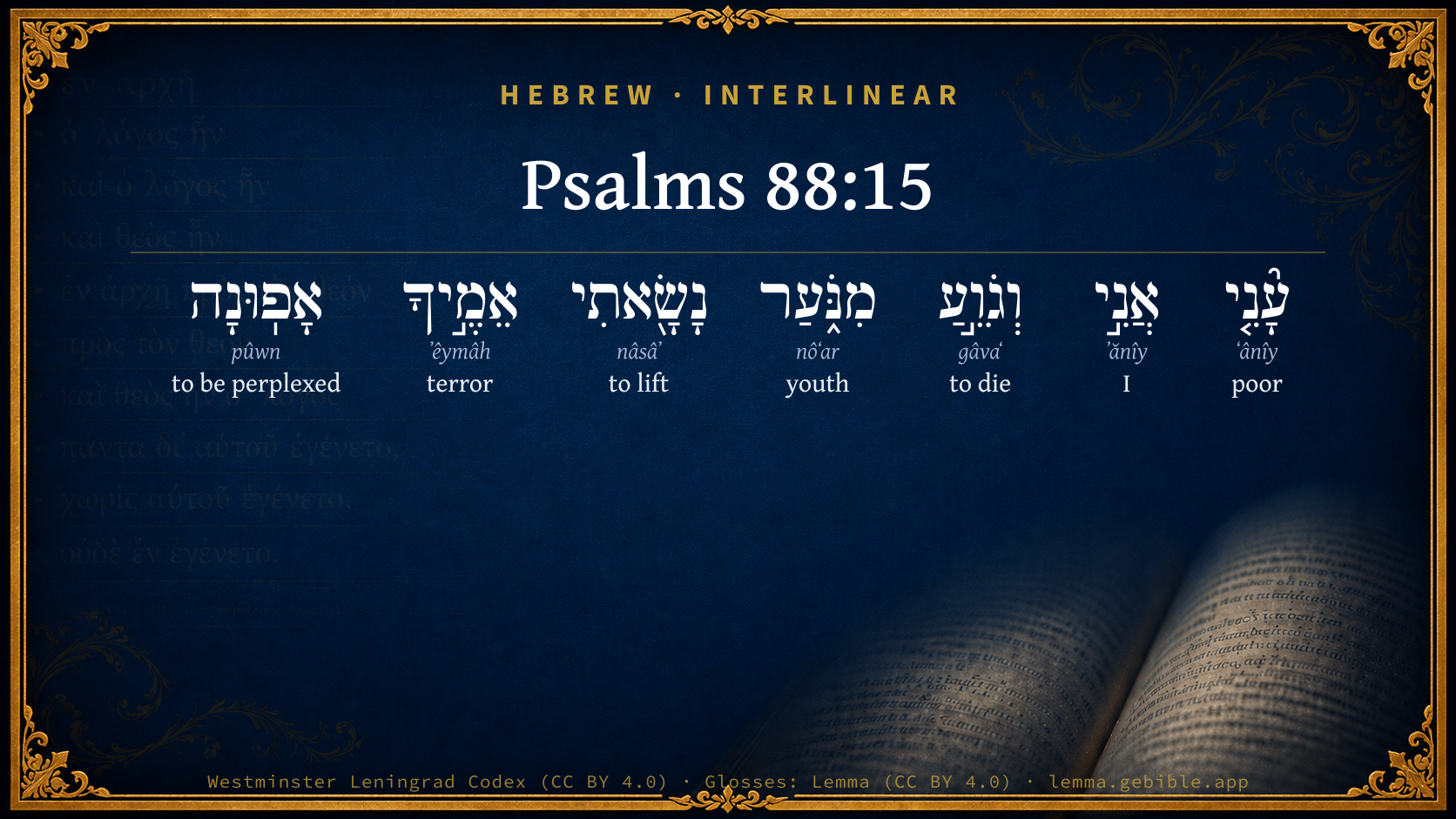
Psalms 88:15

Hebrew (Westminster Leningrad Codex) Psalms 88:15 appears in the Hebrew Old Testament. The text above is from the Westminster Leningrad Codex. Each word links to its Strong’s number, a concise gloss, and parsing drawn from the Open Scriptures Hebrew Bible morphology. Click any word for its full Brown-Driver-Briggs (BDB) entry.
Download image
Cite this verse

Psalms 88:15 (World English Bible). Public Domain. Lemma interlinear Bible study tool, https://lemma.gebible.app/v/psalms/88/15.

Show BibTeX & RIS
BibTeX
RIS
English Translation
I am afflicted and ready to die from my youth up. While I suffer your terrors, I am distracted.
World English Bible · Public Domain
Highlights
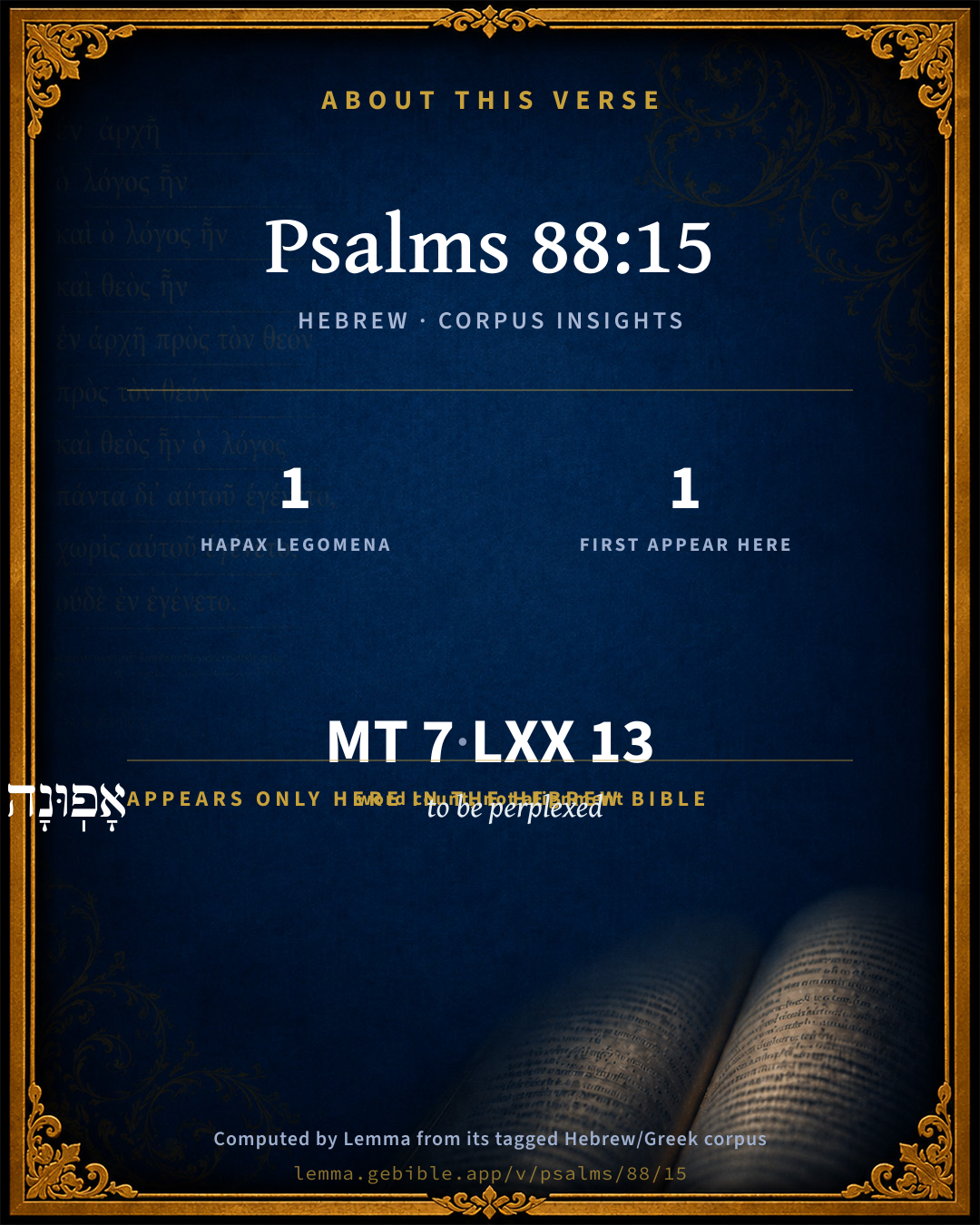
  • 1 hapax legomenon — only here in the Hebrew Bible
  • 1 first appearance in the Hebrew Bible
Full analysis ↓
Download a study sheet

One document with this verse’s original text, its word-by-word gloss line, the meaning frame, cross-references with their text, attributed commentary, and full source and license credits — printable, and it pastes into notes with its structure intact.

This verse Autodidact and up

Study sheet (.html) Plain text (.txt)

A passage Seminary Student

Up to 50 verses in one chapter. A passage sheet keeps up to 6 commentary sources and 12 cross-references per verse, in the order this page ranks them, and says so on the sheet whenever that leaves anything out. Ask for a single verse and you get the Autodidact verse sheet above.

Everything on this page stays free to read, with no account — the sheet is a download of what is already on screen, not access to it.

Want to remove ads? Support Godless Engineer
Compare translations 3

The same verse in 3 English versions, stacked beneath the original-language interlinear above. Click any original word for its lexicon entry.

Each is an independent rendering of the whole verse — the interlinear is not word-aligned to these translations.

Highlighted words mark where these versions differ — a whole-verse word diff, not a word-by-word alignment.

  • World English Bible Public Domain
    I am afflicted and ready to die from my youth up. While I suffer your terrors, I am distracted.
  • King James Version Public Domain
    I am afflicted and ready to die from my youth up: while I suffer thy terrors I am distracted.
  • unfoldingWord Literal Text CC BY-SA 4.0
    I weak and expiring since youth; I have borne your terrors; I must despair.

unfoldingWord Literal Text — © unfoldingWord, licensed CC BY-SA 4.0. Word-aligned USFM3 via Door43 (git.door43.org/unfoldingWord/en_ult).

Versions to compare (up to 4)

3 of 4 selected

Show all 18 translations

Every available English version of this verse, each an independent rendering of the whole verse.

  • World English Bible Public Domain
    I am afflicted and ready to die from my youth up. While I suffer your terrors, I am distracted.
  • Berean Standard Bible Public Domain
    From my youth I was afflicted and near death. I have borne Your terrors; I am in despair.
  • Majority Standard Bible Public Domain
    From my youth I was afflicted and near death. I have borne Your terrors; I am in despair.
  • King James Version Public Domain
    I am afflicted and ready to die from my youth up: while I suffer thy terrors I am distracted.
  • American Standard Version (1901) Public Domain
    I am afflicted and ready to die from my youth up: While I suffer thy terrors I am distracted.
  • Revised Version (1885) Public Domain
    I am afflicted and ready to die from my youth up: while I suffer thy terrors I am distracted.
  • Geneva Bible (1599) Public Domain
    I am afflicted and at the point of death: from my youth I suffer thy terrours, doubting of my life.
  • Douay-Rheims (1899) Public Domain
    Lord, why castest thou off my prayer: why turnest thou away thy face from me?
  • Young's Literal Translation Public Domain
    I `am' afflicted, and expiring from youth, I have borne Thy terrors -- I pine away.
  • Literal Standard Version CC BY-SA 4.0
    I [am] afflicted, and expiring from youth, || I have borne Your terrors—I pine away.
  • Unlocked Literal Bible CC BY-SA 4.0
    I have always been afflicted and on the verge of death since my youth. I have suffered from your terrors; I am in despair.
  • unfoldingWord Literal Text CC BY-SA 4.0
    I weak and expiring since youth; I have borne your terrors; I must despair.
  • Darby Bible Public Domain
    I am afflicted and expiring from my youth up; I suffer thy terrors, [and] I am distracted.
  • World Messianic Bible Public Domain
    I am afflicted and ready to die from my youth up. While I suffer your terrors, I am distracted.
  • Webster's Bible Public Domain
    \\88:14\\LORD, why castest thou off my soul? why hidest thou thy face from me?
  • Free Bible Version CC BY-SA 4.0
    I have been sick since I was young, often at death's door. I have had to bear the terrible things you've done to me. I'm in despair!
  • Bible in Basic English Public Domain
    I have been troubled and in fear of death from the time when I was young; your wrath is hard on me, and I have no strength.
  • JPS Tanakh (1917) Public Domain
    (88-16) I am afflicted and at the point of death from my youth up; I have borne Thy terrors, I am distracted.

Literal Standard Version (2020), Covenant Press — licensed CC BY-SA 4.0. Text via the HelloAO Bible API (eBible.org). Unlocked Literal Bible (unfoldingWord) — licensed CC BY-SA 4.0. Text via the HelloAO Bible API (eBible.org). unfoldingWord Literal Text — © unfoldingWord, licensed CC BY-SA 4.0. Word-aligned USFM3 via Door43 (git.door43.org/unfoldingWord/en_ult). Free Bible Version, Dr. Jonathan Gallagher — licensed CC BY-SA 4.0. Text via the HelloAO Bible API (eBible.org).

Word by word

More ways to search: Search by grammar → Find every occurrence → Compare this word →

Practice this passage: Drill this verse → Learn its vocabulary →

About this verse

These counts appear in no published source. They are computed here, from the morphology-tagged text and Lemma’s own curated glosses. What Lemma adds →

7
words
7
distinct lemmas
Wisdom
section

Notable vocabulary

1 hapax legomenon — a word that appears only here in the entire Hebrew Bible:

  • אָפֽוּנָה to be perplexed H6323

First appearance in Scripture

This word makes its first canonical appearance in the Hebrew Bible here:

  • אָפֽוּנָה to be perplexed H6323

Shared distinctive vocabulary

מִנֹּ֑עַר youth H5290 occurs in 4 verses of the Hebrew Bible. Also found in:

Grammatical profile

  • 3 verbs
  • 2 nouns
  • 1 adjective
  • 1 pronoun

Verb forms

  • וְגֹוֵ֣עַ Qal · Participle Active
  • נָשָׂ֖אתִי Qal · Perfect
  • אָפֽוּנָה Qal · Cohortative

Hebrew & Septuagint length

In English translation the verse runs 19 words from the Hebrew and 20 from the Septuagint (LXX English) — closely comparable.

A rough comparison of the two English renderings, which tokenize alike — not a word-level alignment.

Word counts can differ between the Hebrew and the Greek without any difference in meaning — e.g. the Hebrew direct-object marker אֵת has no separate Greek word, and Greek often adds the article ὁ.

In the original languages it is 7 Hebrew tokens and 13 Greek tokens — but the two are counted differently (Hebrew bundles its prefixes and suffixes into one token; the Greek is in lemma form), so that isn’t a like-for-like length.

Cross-references

10

Topical passages linked to Psalms 88:15 in the Treasury of Scripture Knowledge — connected by theme and wording, ordered by reader-vote popularity; previews shown in the World English Bible.

  • Job 6:4 For the arrows of the Almighty are within me, My spirit drinks up their poison. The terrors of God set themselves in array against me.
  • Luke 22:44 Being in agony he prayed more earnestly. His sweat became like great drops of blood falling down on the ground.
  • Job 7:11–16 "Therefore I will not keep silent. I will speak in the anguish of my spirit. I will complain in the bitterness of my soul.
  • Psalms 73:14 For all day long have I been plagued, And punished every morning.
  • Isaiah 53:10 Yet it pleased Yahweh to bruise him; he has put him to grief: when you shall make his soul an offering for sin, he shall see [his] seed, he shall prolong his days, and the pleasure of Yahweh shall prosper in his hand.
  • Zechariah 13:7 "Awake, sword, against my shepherd, And against the man who is close to me," says Yahweh of Hosts. Strike the shepherd, and the sheep will be scattered; And I will turn my hand against the little ones.
  • Job 17:1 "My spirit is consumed, my days are extinct, And the grave is ready for me.
  • Job 17:11–16 My days are past, my plans are broken off, As are the thoughts of my heart.
  • Psalms 22:14–15 I am poured out like water. All my bones are out of joint. My heart is like wax; It is melted within me.
  • Isaiah 53:3 He was despised, and rejected by men; a man of suffering, and acquainted with disease: and as one from whom men hide their face he was despised; and we didn't respect him.

Cross-references courtesy of OpenBible.info (CC BY 4.0).

Hebrew and Greek witnesses Masoretic Hebrew ↔ Greek Septuagint

The same verse in the two great witnesses to the Old Testament, shown verse-for-verse.

You’re reading Greek Psalm 87 (Hebrew Psalm 88). The Septuagint counts the superscription, so verse numbers can differ from the Hebrew — chapter-level alignment, not verse-by-verse. Numbering follows Rahlfs.

These are two independent witnesses, not word-aligned to each other, and the Septuagint is shown in lemma (dictionary) form.

Hebrew Psalms 88:15 Masoretic · Westminster Leningrad Codex

עָ֘נִ֤י אֲנִ֣י וְגֹוֵ֣עַ מִנֹּ֑עַר נָשָׂ֖אתִי אֵמֶ֣יךָ אָפֽוּנָה

I am afflicted and ready to die from my youth up. While I suffer your terrors, I am distracted.

World English Bible · Public Domain

Greek LXX Greek Psalm 87:15 Septuagint · lemma form

ἵνα τίς κύριος ἀποὠθέω ὁ ψυχή ἐγώ ἀποστρέφω ὁ πρόσωπον σύ ἀπό ἐγώ

I am poor and in troubles from my youth; and having been exalted, I was brought low and into despair.

LXX2012 (modern English Septuagint) · Public Domain

Hebrew: Westminster Leningrad Codex (CC BY 4.0). Greek: Septuagint (public domain); English from LXX2012 (modern English Septuagint) (Public Domain). How the Septuagint differs from the Hebrew →

Commentary

Notes on Psalms 88:15 from classic Christian and Jewish commentators (each source and its license shown beneath its notes). The classic Christian expositions comment on the surrounding passage and are grouped to its opening verse, so a note may address several verses; the Jewish commentaries on the Tanakh (Rashi and others) are per-verse, so they appear only where the commentator wrote on this verse.

Lemma curates 59 commentaries, every one of them public domain or Creative Commons licensed, each selected and text-cleaned for this edition rather than reprinted as found. About our sources →

Trapp's Complete Commentary

John Trapp

Psa 88:15 I [am] afflicted and ready to die from [my] youth up: [while] I suffer thy terrors I am distracted.

Ver. 15. I am afflicted, &c.] He was brought up in the school of temptations, and kept in this form from his youth. He was put soon to it, and so deep lessons had he set him, that he had like to have lost his wits. I am distracted, saith he, I am held upon the wheel.

John Trapp, A Commentary or Exposition upon All the Books of the Old and New Testament (1647–1656) — public domain. Text from a community e-Sword module.

The Biblical Illustrator

Joseph S. Exell

Psa_88:15

I am afflicted and ready to die from my youth up: while I suffer Thy terrors, I am distracted.

Religious terrors

As the comforts which true religion affords are the only sure support against the evils and calamities to which every condition of life is more or less exposed, so the terrors of religion, being very grievous in themselves, exclusive of these comforts, add weight to all our miseries, and are a burden too heavy for the spirit of a man to sustain. These terrors arise from--

I. Uncertainty in religion. The religious man fears God because he knows Him; and therefore he fears Him, as a wise, just, good, and merciful Father and Judge ought to be feared: his fear is full of love and reverence, and has nothing dreadful in it, unless guilt and a wounded conscience arm it with unnatural terrors; but the superstitious man fears God, just as children and weak men fear spirits and apparitions; he trembles at the thought of Him, he flies from he knows not what, seeks refuge he knows not where; and this hurry and confusion of mind he calls religion; but the psalmist has given it a better name, it is distraction.

II. False notions of God, and of the honour and worship due to Him. We ought never to expect more from God than He has expressly promised, or than He may grant consistently with the measures by which His providence rules and governs the world. If we exceed these bounds, religion, instead of being our comfort, will soon become our torment; but we, and not religion, will be to blame. If we consider that this world is a state of trial, and that afflictions are trials, we can never lay it down to ourselves, that God will relieve us at our request from all afflictions; for this would be owning ourselves in a state of trial, and, at the same time, expecting that no trial should come near us: It is supposing that God has shown us a way to defeat the great end of His providence in sending us into this world; He sent us here to be proved, and yet we think to prevail on Him not to prove us.

III. A conscience wounded under the sense of guilt. Natural religion has no cure for this; because the title by obedience being forfeited, there are no certain principles of reason from which we can conclude how far, and to what instances, the mercy of God will extend; because we can have no assurance of ourselves that our sorrow is such, and our resolutions of amendment such as may deserve mercy; and lastly, because this whole matter is founded upon reasons and speculations too exact, and too refined, to be of common use to mankind. This last reason alone will sufficiently justify the wisdom and goodness of God, in proposing to the world a safe and general method for the salvation of sinners; for what if you have penetration enough to see a way for sinners to escape under natural religion; must your great parts be a measure for Gods dealing with the world? Shall thousands and thousands live and die without comfort because they cannot reason as you do? This consideration should make those who have the highest opinion of themselves, and therefore of natural religion, adore the goodness of God in condescending to the infirmities of men, and showing them the way to mercy, which they were unable to find out. This He has done by the revelation of the Gospel of Christ, which is the sinners great charter of pardon, a certain remedy against all the terrors and fears of guilt.

IV. Accidental disorders of mind or body. Whatever the union of soul and body is, so united they are, that the disorders of one often derive themselves to the other. A melancholy mind will waste the strength and bring paleness and leanness upon the body; disorders in the body do often affect the mind; a stroke of the palsy will rob a man of the use of his understanding, and leave him disabled in mind as well as body. For this reason it is that I ascribe some religious fears to the disorders of the body, though they properly belong to the mind. These terrors cannot be imputed as a blemish to religion; not by him, at least, who acknowledges the providence of God, and whose principle of religion is reason; for all madness is destructive of reason, as much as these terrors are of religion: they are both destructive: they are evils to which we must submit; and if we cannot account for the reason of them, it becomes us to be dumb, and not open our mouths in His presence whose ways are past finding out. (Bp. Sherlock.)

The Biblical Illustrator, edited by Joseph S. Exell (c. 1880s–1900s) — public domain. Text from a community e-Sword module.

J. A. Alexander on Psalms

Joseph Addison Alexander

16. (Psa 88:15) Wretched (am) I and expiring from childhood; I have borne thy terrors; I despair. Expiring, ready to perish, at the point of death, a strong description of extreme distress. The childhood may be that of the individual sufferer, or of Israel as a nation (Hos 11:1). Both applications may have been intended.

Joseph Addison Alexander, The Psalms Translated and Explained (1850) — public domain. Text from a community e-Sword module.

Geneva Bible (1599)

Geneva Bible translators

I am ever in great dangers and sorrows, as though my life should utterly be cut off every moment.

Geneva Bible (1599) marginal notes — public domain. Text via Bolls.life.

Adam Clarke's Commentary

Verse 15. From my youth up.] I have always been a child of sorrow, afflicted in my body, and distressed in my mind. There are still found in the Church of God persons in similar circumstances; persons who are continually mourning for themselves and for the desolations of Zion. A disposition of this kind is sure to produce an unhealthy body; and indeed a weak constitution may often produce an enfeebled mind; but where the terrors of the Lord prevail, there is neither health of body nor peace of mind.

Adam Clarke's Commentary on the Bible (1810–1826) — public domain. Text from a community e-Sword/MySword module.

John Calvin's Commentaries

The reason why he says that he was ready to die from his youth, (verse 15,) is uncertain, unless it may be considered a probable conjecture that he was severely tried in a variety of ways, so that his life, as it were, hung by a thread amidst various tremblings and fears. Whence also we gather that God’s wraths and terrors, of which he speaks in the 16th verse, were not of short continuance. He expresses them in the 17th verse as having encompassed him daily. Since nothing is more dreadful than to conceive of God as angry with us, he not improperly compares his distress to a flood. Hence also proceeded his doubting. for a sense of the divine anger must necessarily have agitated his mind with sore disquietude. But it may be asked, How can this wavering agree with faith? It is true, that when the heart is in perplexity and doubt, or rather is tossed hither and thither, faith seems to be swallowed up. But experience teaches us, that faith, while it fluctuates amidst these agitations, continues to rise again from time to time, so as not to be overwhelmed; and if at any time it is at the point of being stifled, it is nevertheless sheltered and cherished, for though the tempests may become never so violent, it shields itself from them by reflecting that God continues faithful, and never disappoints or forsakes his own children.

John Calvin's Commentaries (1540-1563) — public domain. Text from the Calvin Translation Society English edition (1840s-50s) via the Christian Classics Ethereal Library (ccel.org). Calvin's coverage is partial (roughly two-thirds of the Bible); uncommented books and verses are honest gaps, never fabricated. The 19th-century editor's footnotes and remarks are omitted so the notes are faithfully Calvin's own voice.

Ellicott's Commentary for English Readers

(15) Terrors.—Another of the many expressions which connect this psalm with the book of Job. (See Job_6:4; Job_9:34, &c.)

Distracted.—The Hebrew word is peculiar to the place. The ancient versions all agree in taking it as a verb, and rendering it by some general term denoting “trouble.” But the context evidently requires a stronger word, and possibly connecting with a cognate word meaning “wheel,” we may get, “I turn giddy.” A change of a stroke in one letter would give “I grow frigid.” (Comp. Psa_38:8.)

A Bible Commentary for English Readers, edited by Charles John Ellicott (1878–1897) — public domain. Text from a community e-Sword module.

The Cambridge Bible for Schools and Colleges

gen. ed. J. J. S. Perowne

15. Will God have no pity upon one whose whole life has been spent at the point of death? Could this be said of Israel as a nation? ‘From youth’ is of course frequently used of the nation (Psa_129:1-2; Jer_32:30; &c.), but Israel’s existence had not been continuously wretched and precarious.

while I suffer &c.] I have borne thy terrors (till) I am distracted. Terrors is a favourite word with Job. The word rendered distracted occurs here only and is of doubtful meaning. Possibly it is a false reading for another word meaning faint or stupefied (Psa_38:8).

The Cambridge Bible for Schools and Colleges (gen. ed. J. J. S. Perowne; Cambridge University Press, 1878–1918) — public domain. Text from a community e-Sword module.

John Gill's Exposition

I am afflicted,.... In body and mind, from within and from without, by Satan, by the men of the world, and by the Lord himself; which is the common lot of God's people, Psa 34:19 and was the case of the Messiah, who was afflicted both with the tongues and hands of men, by words, by blows, and by the temptations of Satan; and was smitten and afflicted of God, by divine justice, as the sinner's surety: see Psa 22:24 or

I am poor (a); which as it is a character, which, for the most part, agrees with the saints, who are the poor of this world God has chosen, to whom the Gospel is sent, and by whom it is received, and who are effectually called by it, so likewise belongs to Christ, Zac 9:9,

and ready to die, from my youth up; a sickly unhealthful person from his infancy, and often in danger of death; which last was certainly the case of Christ in his infancy, through the malice of Herod; and many times afterwards, when grown up, through the attempts of the Jews to take away his life: some render it, "I am ready to die through concussion", or "shaking" (b); meaning some very rough and severe dispensation of Providence, such an one as Job expresses by shaking him to pieces, Job 16:12 and was literally true of Christ, when his body was so shaken by the jog of the cross, that all his bones were put out of joint, Psa 22:14.

while I suffer thy terrors; or "bear" (c) them, or "carry", even terrible afflictions, in which he had terrible apprehensions of the wrath of God in them, of death they would issue in, and of an awful judgment that should follow that; all which are called the terrors of the Lord, Job 6:4, and which the saints, when left to God, have some dreadful apprehensions of: such were the terrors of the Lord the Messiah endured, when in a view of the sins of his people being laid upon him, and of the wrath of God coming on him for them, his sweat was, as it were, great drops of blood falling to the ground, Luk 22:44. Compare with this Psa 18:4.

I am distracted: not out of his mind, deprived of his senses, and without the use of reason; but his thoughts were distracted and confused, and his mind discomposed with the terrors of God upon him: the Hebrew word "aphunah" is only used in this place, and is difficult of interpretation, and is variously derived and rendered: some take it to be of the same root with "pen", which signifies "lest, perhaps" (d); seeing persons in a panic are apt to use such expressions; perhaps, or it may be, such and such things will befall me; forming and framing in their minds ten thousand dreadful things, which they fear are coming upon them; so Aben Ezra and Kimchi; and is applied by Cocceius (e) to the solicitous care and fear of Christ concerning his body, the church, Heb 5:7 others derive it from "ophen", which signifies a wheel, and so may be rendered, "I am wheeled about" (f); always in motion, and have no rest day nor night; as Christ was after his apprehension, being carried from place to place, and from bar to bar: others derive it from the Arabic word "aphan" (g), which signifies to be in want of counsel and advice: Christ though, as God, needed no counsel, nor did he take counsel with any; and, as Mediator, is the wonderful Counsellor; yet, as man, he needed it, and had it from his Father, for which he blesses him, Psa 16:7, others from the Hebrew root "phanah", which signifies to look unto, as persons in a panic look here and there; and as Christ did when suffering, who looked, and there was none to help, Isa 63:5. The Syriac and Arabic versions render it "amazed", or "astonished", which is said of Christ, Mar 14:33, the Vulgate Latin version is "troubled", which also agrees with Christ, Joh 12:27 as he must needs be, when his enemies surrounded him, the sins of his people were upon him, the sword of justice awaked against him, and the wrath of God on him, as follows.

(a) "pauper", V. L. Pagninus, Junius & Tremellius; "inops", Cocceius, Michaelis. (b) "a concussione", Luther, Schmidt, Junius & Tremellius; "propter concussionem", Piscator; "prae concussione", Gejerus. (c) "portavi", Pagninus, Montanus; "fero", Tigurine version, Piscator; "tuli", Musculus, Cocceius; "pertuli portavi", Michaelis. (d) a "ne forte", Amama, Gejerus; "anxius timeo vel metno, ne hoc vel illud fiat", Michaelis. (e) Lex. Heb. p. 663. (f) Heb. "rotor, seu instar rotae circumagor", Piscator. (g) "consilii inops fuit", Castel. Lex. col. 199.

John Gill's Exposition of the Whole Bible (1746–1763) — public domain (CC PDM 1.0). Text via the HelloAO Bible API.

Albert Barnes' Notes on the Bible

I am afflicted and ready to die - I am so afflicted - so crushed with sorrow and trouble - that my strength is nearly gone, and I can endure it but a little longer.

From my youth up - That is, for a long time; so long, that the remembrance of it seems to go back to my very childhood. My whole life has been a life of trouble and sorrow, and I have not strength to bear it longer. It may have been literally true that the author of the psalm had been a man always afflicted; or, this may be the language of strong emotion, meaning that his sufferings had been of so long continuance that they seemed to him to have begun in his very boyhood.

While I suffer thy terrors - I bear those things which produce terror; or, which fill my mind with alarm; to wit, the fear of death, and the dread of the future world.

I am distracted - I cannot compose and control my mind; I cannot pursue any settled course of thought; I cannot confine my attention to anyone subject; I cannot reason calmly on the subject of affliction, on the divine government, on the ways of God. I am distracted with contending feelings, with my pain, and my doubts, and my fears - and I cannot think clearly of anything. Such is often the case in sickness; and consequently what we need, to prepare us for sickness, is a strong faith, built on a solid foundation while we are in health; such an intelligent and firm faith that when the hour of sickness shall come we shall have nothing else to do but to believe, and to take the comfort of believing. The bed of sickness is not the proper place to examine the evidences of religion; it is not the place to make preparation for death; not the proper place to become religious. Religion demands the best vigor of the intellect and the calmest state of the heart; and this great subject should be settled in our minds before we are sick - before we are laid on the bed of death.

Albert Barnes' Notes on the Bible (1834–1885) — public domain. Text from a community e-Sword/MySword module.

Matthew Poole's English Annotations

From my youth up; my whole life hath been filled with a succession of deadly calamities. O Lord, take some pity upon me, and let me have a little breathing space before I die.

I suffer thy terrors upon my mind and conscience, which do accompany and aggravate my outward miseries.

Matthew Poole's English Annotations on the Holy Bible (1683–1685) — public domain. Text from a community e-Sword/MySword module.

The Treasury of David

Charles H. Spurgeon

Ver. 15. I am afflicted and ready to die from my youth up. His affliction had now lasted so long that he could hardly remember when it commenced; it seemed to him as if he had been at death's door ever since he was a child. This was no doubt an exaggeration of a depressed spirit, and yet perhaps Heman may have been born under the cypress, and have been all his days afflicted with some chronic disease or bodily infirmity; there are holy men and women whose lives are a long apprenticeship to patience, and these deserve both our sympathy and our reverence, our reverence we have ventured to say, for since the Saviour became the acquaintance of grief, sorrow has become honourable in believers' eyes. A life long sickness may by divine grace prove to be a life long blessing. Better suffer from childhood to old age than to be let alone to find pleasure in sin.

While I suffer thy terrors I am distracted. Long use had not blunted the edge of sorrow, God's terrors had not lost their terror; rather had they become more overwhelming and had driven the man to despair. He was unable to collect his thoughts, he was so tossed about that he could not judge and weigh his own condition in a calm and rational manner. Sickness alone will thus distract the mind; and when a sense of divine anger is added thereto, it is not to be wondered at if reason finds it hard to hold the reins. How near akin to madness soul depression sometimes may be, it is not our province to decide; but we speak what we do know when we say that a feather weight might be sufficient to turn the scale at times. Thank God O ye tempted ones who yet retain your reason! Thank him that the devil himself cannot add that feather while the Lord stands by to adjust all things. Even though we have grazed upon the rock of utter distraction, we bless the infinitely gracious Steersman that the vessel is seaworthy yet, and answers to her helm: tempest tossed from the hour of her launch even to this hour, yet she mounts the waves and defies the hurricane.

Ver. 15. I am afflicted. (Vulg. Pauper sum ego.) God more readily hears the poor, and gives himself wholly to them. First, his eyes, to behold them, Ps 11:5, "His eyes behold the poor." Secondly, his ears, to hear them, Ps 10:17, "Thou wilt prepare their hearts, thou wilt cause thine ears to hear." Thirdly, his hand, to help, Ps 107:41, "Yet setteth he the poor on high from his affliction." Fourthly, his breast and his arms, to receive the fugitives and those in peril, Ps 60:9, "The Lord also will be a refuge for the oppressed." Fifthly, memory to recollect for them, Ps 9:18, "The needy shall not alway be forgotten." Sixthly, intellect, to care for them, and watch over their comfort, Ps 40:17, "But I am poor and needy; yet the Lord thinketh upon me." Seventhly, goodwill, to love their prayers, Ps 22:24, "For he hath not despised nor abhorred the affliction of the afflicted, neither hath he hid his face from him." Eighthly and lastly, he gives himself wholly to them, to preserve them, Ps 72:13, "He shall save the souls of the needy." Le Blanc.

Ver. 15. I am afflicted and ready to die from my youth up. How much some suffer! I have seen a child, who at the age of twenty months had probably suffered more bodily pain than the whole congregation of a thousand souls, where its parents worshipped. Asaph seems to have been of a sad heart. Jeremiah lived and died lamenting. Heman seems to have been of the same lot and of the same turn of mind. William S. Plumer.

Ver. 15. (First clause). We found the heat more oppressive this day than we had yet experienced it. The hillocks of sand between which we were slowly moving at the usual camel's pace, reflected the sun's rays upon us, till our faces were glowing as if we had been by the side of a furnace... Perhaps it was through this part of the desert of Shur that Hagar wandered, intending to go back to her native country; and it may have been by this way that Joseph carried the young child Jesus when they fled into the land of Egypt. Even in tender infancy the sufferings of the Redeemer began, and he complains, "I am afflicted and ready to die from my youth up." Perhaps these scorching beams beat upon his infant brow, and this sand laden breeze dried up his infant lips, while the heat of the curse of God began to melt his heart within. Even in the desert we see the suretyship of Jesus. R.M. Macheyne's "Narrative of a Mission of Inquiry to the Jews."

Ver. 15. From my youth up. That is, for a long time; so long, that the remembrance of it seems to go back to my very childhood. My whole life has been a life of trouble and sorrow, and I have not strength to bear it longer. It may have been literally true that the author of the Psalm had been a man always afflicted; or, this may be the language of strong emotion, meaning that his sufferings had been of so long continuance that they seemed to him to have begun in his very boyhood. Albert Barnes.

Ver. 15. While I suffer thy terrors I am distracted. The word doth not signify properly the distraction of a man that is mad, but the distraction of a man that is in doubt. It is the distraction of a man who knows not what to do, not of a man who knows not what he doth, and yet that distraction doth often lead to a degree of this; for a man who is much troubled to know what to do, and cannot know it, grows at last to do he knows not what. Joseph Caryl.

Ver. 15. While I suffer thy terrors I am distracted. The Psalm hath this striking peculiarity in it, namely, that it not only hath reference to the Lord Jesus Christ, and him alone; but that he himself is the sole speaker from the beginning to the end. And although the whole of the Psalms are of him, and concerning him, more or less, and he is the great object and subject of all; yet, secondarily and subordinately we meet with many parts in the Psalms where his church is also noticed, and becomes concerned, from union with him, in what is said. But in this Psalm there is allusion to no other. (We differ from Dr. Hawker in his exclusion of the saints from this Psalm. Where the Head is the members are never far away. ED.) All is of him and his incommunicable work. All is of the Son of God in our nature. It contains an account of the cries of the Lord Jesus "when in the days of his flesh he offered up prayers and supplications, with strong crying and tears."

The soul agonies of Christ even from the moment of his incarnation to his death, may be contemplated, or read, from the sacred records of Scripture, but cannot come within the province of any created power to conceive, much less unfold. It is remarkable that whatever the Lord meant to convey by the phrase, "I am distracted", this is the only place in the whole Bible where the word "distracted" is used. Indeed the inspired writers have varied their terms of expression; when speaking of Christ's sufferings, as if unable to convey any full idea. Matthew renders it that the Lord Jesus said: "My soul is exceeding sorrowful, even unto death!" (Mt 26:38.) Mark describes him as "being sore amazed, and very heavy!" (Mr 14:33.) And Luke: his "being in an agony!" (Lu 22:44.) But here we must rest, in point of apprehension, for we can proceed no further. Robert Hawker.

Ver. 15. O Lord, the monotony of my changeless days oppresses me, the constant weariness of my body weighs me down. I am weary of gazing on the same dull objects: I am tired of going through the same dull round day after day; the very inanimate things about my room, and the patterns on the walls, seem quickened with the waste of my life, and, through the power of association, my own thoughts and my own pain come back upon me from them with a dull reverberation. My heart is too tired to hope; I dare not look forward to the future; I expect nothing from the days to come, and yet my heart sinks at the thought of the grey waste of years before me; and I wonder how I shall endure, whether I shall faint by the way, before I reach my far off home. From "Christ the Consoler."

Ver. 15.

1. The afflictions of the righteous may be long continued though severe. "I am afflicted, etc., from my youth up."

2. Severe though long continued.

(a) Painful, "afflicted."

(b) Threatening, "ready to die."

(c) Terrific, "suffer thy terrors."

(d) Distracting, "I am", etc. G.R.

Ver. 15. The personal sufferings of Christ for the salvation of his people. Sermon by Robert Hawker. Works, Vol. 4. pg 91.

Psalms 88:16*

Charles H. Spurgeon's The Treasury of David (1869–1885) — public domain. Psalms only. Text from a community e-Sword/MySword module.

Whedon's Commentary on the Bible

Daniel D. Whedon

15. Ready to die from my youth up—Literally, Dying from my youth. So repeated and terrible were the chastisements of God for disobedience, from the days of Moses till now, that, comparatively, the nation had lived a dying life. What an experience for a professed worshipper of God, whether Jew or Christian!

Daniel D. Whedon (gen. ed.), Commentary on the Old and New Testaments (1874–1909) — public domain. Text from a community e-Sword module.

The Pulpit Commentary

I am afflicted and ready to die from my youth up. This is a new point. The psalmist"s afflictions have not come upon him recently. He does not merely mean, as some have supposed, that, like other men, as soon as he was born he began to die, but speaks of something, if not absolutely peculiar to himself, yet at any rate rare and abnormal a long continuance in a dying state, such as could only have been brought about by some terribly severe malady. While I suffer thy terrors I am distracted; literally, I have endured thy terrors; I am exhausted. (On the endurance of God"s "terrors," see Job_6:4 Job_9:34 Job_13:21) The natural result would be a state, not of distraction, but of exhaustion. (So Kay, and substantially Professor Cheyne)

The Pulpit Commentary (1880–1919), ed. H.D.M. Spence-Jones & Joseph S. Exell — public domain. Text from a community e-Sword module.

unfoldingWord translationNotes

Door43 World Missions Community

Your angry actions have passed over me

This speaks of God punishing the writer as if God's actions are a large wave rising out of the sea that fall on and crush the writer. AT: "It is as if your angry actions crush me" (See: Metaphor)

your terrifying deeds have annihilated me

This exaggeration speaks about God punishing the writer as if God has completely destroyed the writer. AT: "the terrifying things you do have destroyed me" or "the terrifying things you do have almost destroyed me" (See: Hyperbole and Generalization)

translationWords

afflicted

die

suffer

terror

anger

works

unfoldingWord translationNotes — © Distant Shores Media and the Door43 World Missions Community, licensed CC BY-SA 4.0. Source: git.door43.org/Door43/en_tn.

Lesson kit

Teaching starters — assembled from the data on this page, not authored interpretation. Every prompt links to the verse data it draws on. Edit before teaching.

Psalms, in the Wisdom, opens this verse with 7 words (7 distinct Hebrew lemmas). Its most distinctive word is pûwn (“to be perplexed”). A historical commentator’s framing appears above. Read the whole chapter for the surrounding context.

Discussion questions

  1. The word pûwn carries the sense “to be perplexed.” How does it shape the verse?
  2. This verse holds 1 word here found nowhere else in the Hebrew Bible. What might the rare word draw attention to?
  3. The word “to be perplexed” first appears here in Scripture. What is being introduced at this debut?
  4. Job 33:25 shares the word «youth» with this verse. How do the two illuminate each other?
  5. These translations render this verse differently. What is at stake in choosing one wording over another?
  6. The verb «וְגֹוֵ֣עַ» is Qal Participle Active. How does its form color the action?
  7. Reading how Trapp's Complete Commentary and The Biblical Illustrator read this verse, where do the two commentators agree and where do they part?

Things to notice

Reading settings

Reading text

Shown beneath each verse's original-language words.

Old Testament
Old Testament edition

Read the OT as the Masoretic Hebrew (MT) or the Greek Septuagint (LXX).

English shown for the Greek Septuagint (in the Hebrew ↔ Greek comparison).

Comparing translations? Open the Compare panel on any verse page to stack up to four side by side.