
2 Kings 18:14

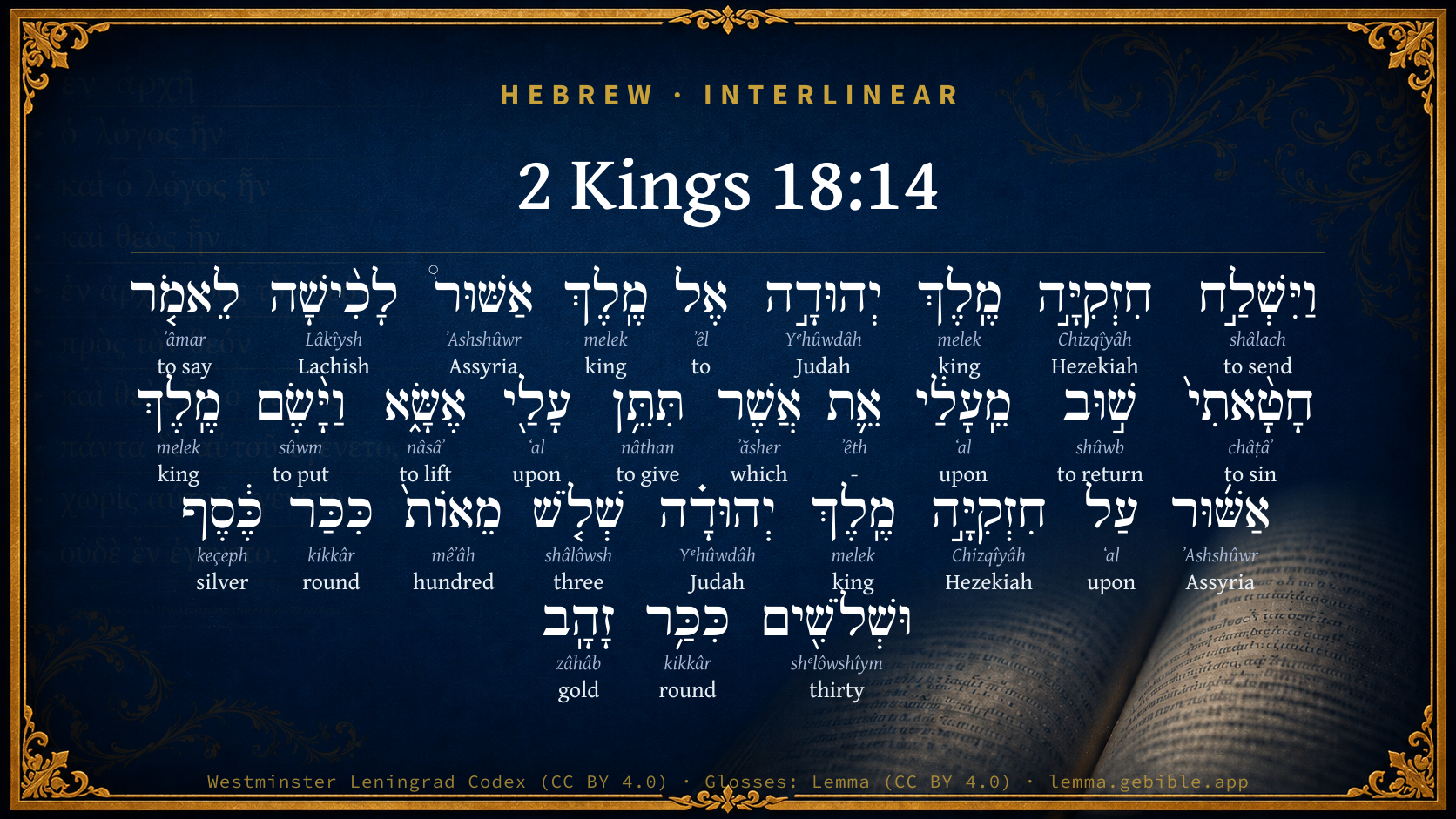
Hebrew (Westminster Leningrad Codex) 2 Kings 18:14 appears in the Hebrew Old Testament. The text above is from the Westminster Leningrad Codex. Each word links to its Strong’s number, a concise gloss, and parsing drawn from the Open Scriptures Hebrew Bible morphology. Click any word for its full Brown-Driver-Briggs (BDB) entry.
Download image
Cite this verse

2 Kings 18:14 (World English Bible). Public Domain. Lemma interlinear Bible study tool, https://lemma.gebible.app/v/2-kings/18/14.

Show BibTeX & RIS
BibTeX
RIS
English Translation
Hezekiah king of Judah sent to the king of Assyria to Lachish, saying, I have offended; return from me: that which you put on me will I bear. The king of Assyria appointed to Hezekiah king of Judah three hundred talents of silver and thirty talents of gold.
World English Bible · Public Domain
Download a study sheet

One document with this verse’s original text, its word-by-word gloss line, the meaning frame, cross-references with their text, attributed commentary, and full source and license credits — printable, and it pastes into notes with its structure intact.

This verse Autodidact and up

Study sheet (.html) Plain text (.txt)

A passage Seminary Student

Up to 50 verses in one chapter. A passage sheet keeps up to 6 commentary sources and 12 cross-references per verse, in the order this page ranks them, and says so on the sheet whenever that leaves anything out. Ask for a single verse and you get the Autodidact verse sheet above.

Everything on this page stays free to read, with no account — the sheet is a download of what is already on screen, not access to it.

Want to remove ads? Support Godless Engineer
Compare translations 3

The same verse in 3 English versions, stacked beneath the original-language interlinear above. Click any original word for its lexicon entry.

Each is an independent rendering of the whole verse — the interlinear is not word-aligned to these translations.

Highlighted words mark where these versions differ — a whole-verse word diff, not a word-by-word alignment.

  • World English Bible Public Domain
    Hezekiah king of Judah sent to the king of Assyria to Lachish, saying, I have offended; return from me: that which you put on me will I bear. The king of Assyria appointed to Hezekiah king of Judah three hundred talents of silver and thirty talents of gold.
  • King James Version Public Domain
    And Hezekiah king of Judah sent to the king of Assyria to Lachish, saying, I have offended; return from me: that which thou puttest on me will I bear. And the king of Assyria appointed unto Hezekiah king of Judah three hundred talents of silver and thirty talents of gold.
  • unfoldingWord Literal Text CC BY-SA 4.0
    And Hezekiah, the king of Judah, sent to the king of Assyria, to Lachish, saying, “I have sinned. Turn back from against me. Whatever you put on me, I will bear.” And the king of Assyria set for Hezekiah, the king of Judah, 300 kikkars of silver and 30 kikkars of gold.

unfoldingWord Literal Text — © unfoldingWord, licensed CC BY-SA 4.0. Word-aligned USFM3 via Door43 (git.door43.org/unfoldingWord/en_ult).

Versions to compare (up to 4)

3 of 4 selected

Show all 18 translations

Every available English version of this verse, each an independent rendering of the whole verse.

  • World English Bible Public Domain
    Hezekiah king of Judah sent to the king of Assyria to Lachish, saying, I have offended; return from me: that which you put on me will I bear. The king of Assyria appointed to Hezekiah king of Judah three hundred talents of silver and thirty talents of gold.
  • Berean Standard Bible Public Domain
    So Hezekiah king of Judah sent word to the king of Assyria at Lachish, saying, “I have done wrong; withdraw from me, and I will pay whatever you demand from me.” And the king of Assyria exacted from Hezekiah king of Judah three hundred talents of silver and thirty talents of gold.
  • Majority Standard Bible Public Domain
    So Hezekiah king of Judah sent word to the king of Assyria at Lachish, saying, “I have done wrong; withdraw from me, and I will pay whatever you demand from me.” And the king of Assyria exacted from Hezekiah king of Judah three hundred talents of silver and thirty talents of gold.
  • King James Version Public Domain
    And Hezekiah king of Judah sent to the king of Assyria to Lachish, saying, I have offended; return from me: that which thou puttest on me will I bear. And the king of Assyria appointed unto Hezekiah king of Judah three hundred talents of silver and thirty talents of gold.
  • American Standard Version (1901) Public Domain
    And Hezekiah king of Judah sent to the king of Assyria to Lachish, saying, I have offended; return from me: that which thou puttest on me will I bear. And the king of Assyria appointed unto Hezekiah king of Judah three hundred talents of silver and thirty talents of gold.
  • Revised Version (1885) Public Domain
    And Hezekiah king of Judah sent to the king of Assyria to Lachish, saying, I have offended; return from me: that which thou puttest on me will I bear. And the king of Assyria appointed unto Hezekiah king of Judah three hundred talents of silver and thirty talents of gold.
  • Geneva Bible (1599) Public Domain
    Then Hezekiah King of Iudah sent vnto the King of Asshur to Lachish, saying, I haue offended: depart from me, and what thou layest vpon me, I wil beare it. And the King of Asshur appoynted vnto Hezekiah King of Iudah three hudreth talents of siluer, and thirty talets of golde.
  • Douay-Rheims (1899) Public Domain
    Then Ezechias king of Juda sent messengers to the king of the Assyrians to Lachis, saying: I have offended, depart from me: and all that thou shalt put upon me, I will bear. And the king of the Assyrians put a tax upon Ezechias king of Juda, of three hundred talents of silver, and thirty talents of gold.
  • Young's Literal Translation Public Domain
    and Hezekiah king of Judah sendeth unto the king of Asshur to Lachish, saying, `I have sinned, turn back from off me; that which thou puttest on me I bear;' and the king of Asshur layeth on Hezekiah king of Judah three hundred talents of silver, and thirty talents of gold,
  • Literal Standard Version CC BY-SA 4.0
    and Hezekiah king of Judah sends to the king of Asshur at Lachish, saying, “I have sinned, turn back from off me; that which you put on me I bear”; and the king of Asshur lays on Hezekiah king of Judah three hundred talents of silver and thirty talents of gold,
  • Unlocked Literal Bible CC BY-SA 4.0
    So Hezekiah king of Judah sent word to the king of Assyria, who was at Lachish, saying, “I have offended you. Withdraw from me. Whatever you put on me I will bear.” The king of Assyria required Hezekiah king of Judah to pay three hundred talents of silver and thirty talents of gold.
  • unfoldingWord Literal Text CC BY-SA 4.0
    And Hezekiah, the king of Judah, sent to the king of Assyria, to Lachish, saying, “I have sinned. Turn back from against me. Whatever you put on me, I will bear.” And the king of Assyria set for Hezekiah, the king of Judah, 300 kikkars of silver and 30 kikkars of gold.
  • Darby Bible Public Domain
    And Hezekiah king of Judah sent to the king of Assyria to Lachish, saying, I have sinned; retire from me: I will bear what thou layest upon me. And the king of Assyria laid upon Hezekiah king of Judah three hundred talents of silver and thirty talents of gold.
  • World Messianic Bible Public Domain
    Hezekiah king of Judah sent to the king of Assyria at Lachish, saying, “I have offended you. Withdraw from me. That which you put on me, I will bear.” The king of Assyria appointed to Hezekiah king of Judah three hundred talents of silver and thirty talents of gold.
  • Webster's Bible Public Domain
    And Hezekiah king of Judah sent to the king of Assyria to Lachish, saying, I have offended; return from me: that which thou puttest on me I will bear. And the king of Assyria appointed to Hezekiah king of Judah three hundred talents of silver and thirty talents of gold.
  • Free Bible Version CC BY-SA 4.0
    So Hezekiah, king of Judah, sent a message to the king of Assyria who was at Lachish, saying, “I've made a terrible mistake! Please retreat and leave me alone, and I'll pay you whatever you want!” The king of Assyria demanded Hezekiah, king of Judah, pay three hundred talents of silver and thirty talents of gold.
  • Bible in Basic English Public Domain
    And Hezekiah, king of Judah, sent to Lachish, to the king of Assyria, saying, I have done wrong; give up attacking me, and whatever you put on me I will undergo. And the payment he was to make was fixed by the king of Assyria at three hundred talents of silver and thirty talents of gold.
  • JPS Tanakh (1917) Public Domain
    And Hezekiah king of Judah sent to the king of Assyria to Lachish, saying: 'I have offended; return from me; that which thou puttest on me will I bear.' And the king of Assyria appointed unto Hezekiah king of Judah three hundred talents of silver and thirty talents of gold.

Literal Standard Version (2020), Covenant Press — licensed CC BY-SA 4.0. Text via the HelloAO Bible API (eBible.org). Unlocked Literal Bible (unfoldingWord) — licensed CC BY-SA 4.0. Text via the HelloAO Bible API (eBible.org). unfoldingWord Literal Text — © unfoldingWord, licensed CC BY-SA 4.0. Word-aligned USFM3 via Door43 (git.door43.org/unfoldingWord/en_ult). Free Bible Version, Dr. Jonathan Gallagher — licensed CC BY-SA 4.0. Text via the HelloAO Bible API (eBible.org).

Word by word

More ways to search: Search by grammar → Find every occurrence → Compare this word →

Practice this passage: Drill this verse → Learn its vocabulary →

לָכִ֨ישָׁה
Lâkîysh
H3923
“Lachish · toward”
Noun, Proper + Suffix, Demonstrative
Part of Speech
Noun
Type
Proper
Full BDB Definition

Origin: from an unused root of uncertain meaning

TWOT: None

Lachish = "invincible" - a city lying south of Jerusalem on the borders of Simeon and which belonged to the Amorites until conquered by Joshua and allotted to Judah
  1. וַיִּשְׁלַ֣ח shâlach H7971 “and · to send” Conjunction + Verb, Qal, Sequential Imperfect, 3rd Person, Masculine, Singular
  2. חִזְקִיָּ֣ה Chizqîyâh H2396 “Hezekiah” Noun, Proper
  3. מֶֽלֶךְ melek H4428 “king of” Noun, Common, Masculine, Singular, Construct
  4. יְהוּדָ֣ה Yᵉhûwdâh H3063 “Judah” Noun, Proper
  5. אֶל ʼêl H413 “to” Preposition
  6. מֶֽלֶךְ melek H4428 “king of” Noun, Common, Masculine, Singular, Construct
  7. אַשּׁוּר֩ ʼAshshûwr H804 “Assyria” Noun, Proper
  8. לֵאמֹ֤ר ʼâmar H559 “to say” Preposition + Verb, Qal, Infinitive Construct
  9. חָטָ֨אתִי֙ châṭâʼ H2398 “to sin” Verb, Qal, Perfect, 1st Person, Common, Singular
  10. שׁ֣וּב shûwb H7725 “return” Verb, Qal, Imperative, 2nd Person, Masculine, Singular
  11. מֵֽעָלַ֔י ʻal H5921 “from · upon · me” Preposition + Preposition + Suffix, Personal, 1st Person, Common, Singular
  12. אֵ֛ת ʼêth H853 “-” Particle, Direct Object
  13. אֲשֶׁר ʼăsher H834 “which” Particle, Relative
  14. תִּתֵּ֥ן nâthan H5414 “to give” Verb, Qal, Imperfect, 2nd Person, Masculine, Singular
  15. עָלַ֖י ʻal H5921 “upon · me” Preposition + Suffix, Personal, 1st Person, Common, Singular
  16. אֶשָּׂ֑א nâsâʼ H5375 “to lift” Verb, Qal, Imperfect, 1st Person, Common, Singular
  17. וַיָּ֨שֶׂם sûwm H7760 “and · to put” Conjunction + Verb, Qal, Sequential Imperfect, 3rd Person, Masculine, Singular
  18. מֶֽלֶךְ melek H4428 “king of” Noun, Common, Masculine, Singular, Construct
  19. אַשּׁ֜וּר ʼAshshûwr H804 “Assyria” Noun, Proper
  20. עַל ʻal H5921 “upon” Preposition
  21. חִזְקִיָּ֣ה Chizqîyâh H2396 “Hezekiah” Noun, Proper
  22. מֶֽלֶךְ melek H4428 “king of” Noun, Common, Masculine, Singular, Construct
  23. יְהוּדָ֗ה Yᵉhûwdâh H3063 “Judah” Noun, Proper
  24. שְׁלֹ֤שׁ shâlôwsh H7969 “three” Adjective, Cardinal number, Feminine, Singular, Absolute
  25. מֵאוֹת֙ mêʼâh H3967 “hundred” Adjective, Cardinal number, Both, Plural, Absolute
  26. כִּכַּר kikkâr H3603 “round of” Noun, Common, Both, Singular, Construct
  27. כֶּ֔סֶף keçeph H3701 “silver” Noun, Common, Masculine, Singular, Absolute
  28. וּשְׁלֹשִׁ֖ים shᵉlôwshîym H7970 “and · thirty” Conjunction + Adjective, Cardinal number, Both, Plural, Absolute
  29. כִּכַּ֥ר kikkâr H3603 “round of” Noun, Common, Both, Singular, Construct
  30. זָהָֽב zâhâb H2091 “gold” Noun, Common, Masculine, Singular, Absolute

About this verse

These counts appear in no published source. They are computed here, from the morphology-tagged text and Lemma’s own curated glosses. What Lemma adds →

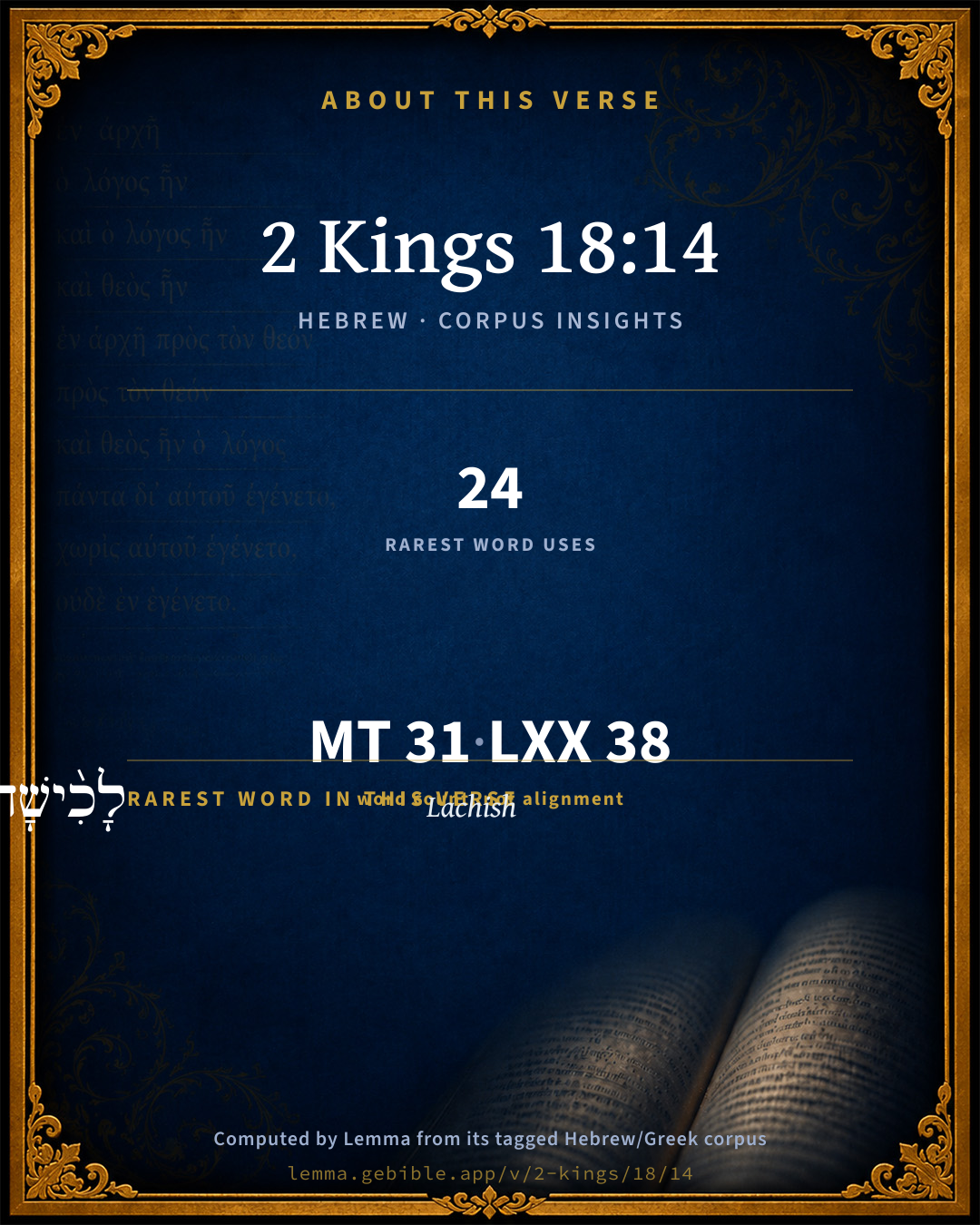
31
words
22
distinct lemmas
Historical
section

Notable vocabulary

The rarest word here is לָכִ֨ישָׁה Lachish H3923 — appearing just 24 times in the whole Hebrew Bible.

Shared distinctive vocabulary

לָכִ֨ישָׁה Lachish H3923 occurs in 22 verses of the Hebrew Bible. Also found in:

Grammatical profile

  • 7 verbs
  • 15 nouns
  • 3 adjectives
  • 4 prepositions
  • 2 particles

Verb forms

  • וַיִּשְׁלַ֣ח Qal · Sequential Imperfect
  • לֵאמֹ֤ר Qal · Infinitive Construct
  • חָטָ֨אתִי֙ Qal · Perfect
  • שׁ֣וּב Qal · Imperative
  • תִּתֵּ֥ן Qal · Imperfect
  • אֶשָּׂ֑א Qal · Imperfect
  • וַיָּ֨שֶׂם Qal · Sequential Imperfect

Repetition

Words recur within this verse — often emphatic in Hebrew:

  • מֶֽלֶךְ king H4428 ×4
  • מֵֽעָלַ֔י upon H5921 ×3
  • חִזְקִיָּ֣ה Hezekiah H2396 ×2
  • יְהוּדָ֣ה Judah H3063 ×2
  • אַשּׁוּר֩ Assyria H804 ×2
  • כִּכַּר round H3603 ×2

Hebrew & Septuagint length

In English translation the verse runs 48 words from the Hebrew and 55 from the Septuagint (LXX English) — closely comparable.

A rough comparison of the two English renderings, which tokenize alike — not a word-level alignment.

Word counts can differ between the Hebrew and the Greek without any difference in meaning — e.g. the Hebrew direct-object marker אֵת has no separate Greek word, and Greek often adds the article ὁ.

In the original languages it is 31 Hebrew tokens and 38 Greek tokens — but the two are counted differently (Hebrew bundles its prefixes and suffixes into one token; the Greek is in lemma form), so that isn’t a like-for-like length.

Cross-references

4

Topical passages linked to 2 Kings 18:14 in the Treasury of Scripture Knowledge — connected by theme and wording, ordered by reader-vote popularity; previews shown in the World English Bible.

  • 2 Kings 18:7 Yahweh was with him; wherever he went forth he prospered: and he rebelled against the king of Assyria, and didn't serve him.
  • 1 Kings 20:4 The king of Israel answered, It is according to your saying, my lord, O king; I am yours, and all that I have.
  • Proverbs 29:25 The fear of man proves to be a snare, But whoever puts his trust in Yahweh is kept safe.
  • Luke 14:32 Or else, while the other is yet a great way off, he sends an envoy, and asks for conditions of peace.

Cross-references courtesy of OpenBible.info (CC BY 4.0).

Hebrew and Greek witnesses Masoretic Hebrew ↔ Greek Septuagint

The same verse in the two great witnesses to the Old Testament, shown verse-for-verse.

These are two independent witnesses, not word-aligned to each other, and the Septuagint is shown in lemma (dictionary) form.

Hebrew 2 Kings 18:14 Masoretic · Westminster Leningrad Codex

וַיִּשְׁלַ֣ח חִזְקִיָּ֣ה מֶֽלֶךְ יְהוּדָ֣ה אֶל מֶֽלֶךְ אַשּׁוּר֩ לָכִ֨ישָׁה לֵאמֹ֤ר חָטָ֨אתִי֙ שׁ֣וּב מֵֽעָלַ֔י אֵ֛ת אֲשֶׁר תִּתֵּ֥ן עָלַ֖י אֶשָּׂ֑א וַיָּ֨שֶׂם מֶֽלֶךְ אַשּׁ֜וּר עַל חִזְקִיָּ֣ה מֶֽלֶךְ יְהוּדָ֗ה שְׁלֹ֤שׁ מֵאוֹת֙ כִּכַּר כֶּ֔סֶף וּשְׁלֹשִׁ֖ים כִּכַּ֥ר זָהָֽב

Hezekiah king of Judah sent to the king of Assyria to Lachish, saying, I have offended; return from me: that which you put on me will I bear. The king of Assyria appointed to Hezekiah king of Judah three hundred talents of silver and thirty talents of gold.

World English Bible · Public Domain

Greek LXX 2 Kings 18:14 Septuagint · lemma form

καί ἀποστέλλω εζεκιας βασιλεύς ιουδα ἄγγελος πρός βασιλεύς ἀσσύριος εἰς λαχις λέγω ἁμαρτάνω ἀποστρέφω ἀπό ἐγώ ὅς ἐάν ἐπιτίθημι ἐπί ἐγώ βαστάζω καί ἐπιτίθημι ὁ βασιλεύς ἀσσύριος ἐπί εζεκιας βασιλεύς ιουδα τριακόσιοι τάλαντον ἀργύριον καί τριάκοντα τάλαντον χρυσίον

And Ezekias king of Juda sent messengers to the king of the Assyrians to Lachis, saying, I have offended; depart from me: whatever you shall lay upon me, I will bear. And the king of Assyria laid upon Ezekias king of Juda a tribute of three hundred talents of silver, and thirty talents of gold.

LXX2012 (modern English Septuagint) · Public Domain

Hebrew: Westminster Leningrad Codex (CC BY 4.0). Greek: Septuagint (public domain); English from LXX2012 (modern English Septuagint) (Public Domain). How the Septuagint differs from the Hebrew →

Targum (Aramaic paraphrase)

1

The Targum is the ancient Jewish Aramaic paraphrase of the Hebrew Scriptures — an interpretive translation, not the Hebrew text itself. Onkelos (literal) and Pseudo-Jonathan (expansive) render the Torah, and Jonathan the Prophets. Coverage is partial: where no permissively-licensed English translation exists for a verse, only the Aramaic is shown. This is verse-level text, not a word-by-word alignment to the Hebrew.

  1. Targum Jonathan Prophets (Joshua–Malachi)
    וּשְׁלַח חִזְקִיָה מֶלֶךְ שִׁבְטָא דְבֵית יְהוּדָה לְוַת מַלְכָּא דְאַתּוּר לְלָכִישׁ לְמֵימָר חָבֵית אִסְתַּלַק מִנִי יַת דְתִרְמֵי עֲלַי אֲקַבֵּל וּרְמָא מַלְכָּא דְאַתּוּר עַל חִזְקִיָה מֶלֶךְ שִׁבְטָא דְבֵית יְהוּדָה תְּלַת מְאָה כִּכְּרִין דִכְסַף וּתְלָתִין כִּכְּרִין דְדַהֲבָא:

    (no public-domain English translation for this verse)

    Targum Jonathan — Aramaic: “Mikraot Gedolot” (public domain). English: “Sefaria Community Translation” (CC0 1.0 (public-domain dedication)); “London "Chaldee Paraphrase," 1871” (public domain). Text via Sefaria.

Commentary

Notes on 2 Kings 18:14 from classic Christian and Jewish commentators (each source and its license shown beneath its notes). The classic Christian expositions comment on the surrounding passage and are grouped to its opening verse, so a note may address several verses; the Jewish commentaries on the Tanakh (Rashi and others) are per-verse, so they appear only where the commentator wrote on this verse.

Lemma curates 59 commentaries, every one of them public domain or Creative Commons licensed, each selected and text-cleaned for this edition rather than reprinted as found. About our sources →

Trapp's Complete Commentary

John Trapp

2Ki 18:14 And Hezekiah king of Judah sent to the king of Assyria to Lachish, saying, I have offended; return from me: that which thou puttest on me will I bear. And the king of Assyria appointed unto Hezekiah king of Judah three hundred talents of silver and thirty talents of gold.

Ver. 14. And Hezekiah king of Judah sent.] This showed his weakness and pusillanimity. Had he still kept up his trust in God, this had never been done; but the best have their frailties, and the strongest faith may sometimes seem to fail; adeo nihil est in nobis magnum, quod non potest minui.

Return from me: that which thou puttest on me will I bear.] Hezekiah held it good policy to make his enemy a golden bridge to go over: so to be rid of him.

John Trapp, A Commentary or Exposition upon All the Books of the Old and New Testament (1647–1656) — public domain. Text from a community e-Sword module.

Joseph Benson's Commentary

2Ki 18:14. Hezekiah sent to the king of Assyria, saying, I have offended — Namely, against thee, in revolting, and denying the usual tribute. I have given thee occasion to make war against me, of which I now repent, and am ready to make the satisfaction that shall be demanded. “Where,” says Henry: “was Hezekiah’s courage? Where his confidence in God? Why did he not advise with Isaiah, before he sent this sneaking message?” Three hundred talents of silver, and thirty talents of gold — About two hundred and fifty thousand pounds sterling, a vast sum, not however to be paid annually, but as a present ransom. To raise this sum he was forced, not only to empty the public treasures, (2Ki 18:15,) but to take the gold plates off from the doors of the temple, and from the pillars, being driven, as he judged, by hard necessity to make this use of these sacred things, to prevent the enemy from burning the city and temple. No doubt Hezekiah designed to restore this treasure in full, as soon as he should be able.

Joseph Benson's Commentary on the Old and New Testaments (1811–1818) — public domain. Text from a community e-Sword module.

Tyndale Open Study Notes

Tyndale Open Resources

18:14 Lachish lay southwest of Jerusalem, not far from the Philistine border. • I have done wrong (literally I have sinned). Hezekiah’s message to Sennacherib was in well-chosen diplomatic language. • Sennacherib claimed that in addition to the eleven tons of silver and one ton of gold, he received from Hezekiah many jewels and rich treasures as well as Hezekiah’s own daughter, the women of his harem, and his male and female singers.

Tyndale Open Study Notes — © Tyndale Open Resources, licensed CC BY-SA 4.0. Text via the HelloAO Bible API.

Geneva Bible (1599)

Geneva Bible translators

As his zeal was before praised, so his weakness is here set forth, that none should glory in himself.

Geneva Bible (1599) marginal notes — public domain. Text via Bolls.life.

Jamieson, Fausset & Brown

Robert Jamieson, A. R. Fausset & David Brown

Hezekiah . . . sent to Lachish, saying, . . . that which thou puttest on me will I bear--Disappointed in his expectations of aid from Egypt, and feeling himself unable to resist so mighty a conqueror who was menacing Jerusalem itself, Hezekiah made his submission. The payment of 300 talents of silver, and 30 talents of gold--£351,000--brought a temporary respite; but, in raising the imposed tribute, he was obliged not only to drain all the treasures of the palace and the temple, but even to strip the doors and pillars of the sacred edifice of the gold that adorned them.

Jamieson, Fausset & Brown — Commentary Critical and Explanatory on the Whole Bible (1871) — public domain (CC PDM 1.0). Text via the HelloAO Bible API.

Ellicott's Commentary for English Readers

(14) Lachish.—Um-Lâkis, in the south-west corner of Judah, close to the Philistine border, and near the high road from Judæa and Philistia to Egypt. The fortress was important to Sennacherib, as it commanded this route. In fact, Sennacherib’s chief aim was Egypt, as appears from 2Ki_19:24, and Herodotus (ii. 141), and it was necessary for him to secure his rear by first making himself master of the fortresses of Judah, which was in league with Egypt. (See Note on 2Ch_32:9.)

I have offended.—Literally, I have sinned. The term “sin” is constantly used of “revolts” in the Assyrian inscriptions.

That which thou puttest on me.—In the way of tribute. A similar phrase occurs on the monuments.

Three hundred talents of silver, and thirty-talents of gold.—Sennacherib says: “Eight hundred talents of silver, and thirty of gold,” estimating the silver by the light Babylonian talent, which was to the heavy Palestinian talent in the ratio of eight to three. The sum mentioned is about a seventh less than that exacted by Pul from Menahem (2Ki_15:19).

A Bible Commentary for English Readers, edited by Charles John Ellicott (1878–1897) — public domain. Text from a community e-Sword module.

The Cambridge Bible for Schools and Colleges

gen. ed. J. J. S. Perowne

14. to Lachish] On the situation and previous history of Lachish, see on 2Ki_14:19. It was very close to Askelon, which is mentioned in the inscriptions as one of the places against which Sennacherib’s expedition was specially directed. It is stated (2Ch_32:9) that at this time Sennacherib besieged Lachish with all his power. So that it must have been a stronghold of some importance and perhaps a place likely to be of advantage in checking the approach of forces from Egypt, which were sure to be invited by those whom the Assyrians were attacking.

I have offended] It seems most natural to gather from this that Hezekiah had begun his movement for rebellion without any provocation from Assyria. The compact between Ahaz and Tiglath-pileser he would no doubt find galling, but his confession of a fault shews that he had attempted to withdraw his homage merely because he thought himself strong enough to do so. ‘What, do we mince that fact which holy Hezekiah himself censures?… The comfort of liberty may not be had with an unwarranted violence. Holiness cannot free us from infirmity. It was a weakness to do that act which must be soon undone, with much repentance and more loss’ (Bp Hall).

three hundred talents of silver] On the value of the talent of silver and of gold, see on 2Ki_5:5. The amount exacted on this occasion is not so great as that taken by Pul from Menahem, which was a thousand talents of silver. But in the previous reign Ahaz (2Ki_16:8) had paid large sums to Assyria, so that Judah must at this time have been drained of resources, and even the king of Assyria could not have what was not there.

The Cambridge Bible for Schools and Colleges (gen. ed. J. J. S. Perowne; Cambridge University Press, 1878–1918) — public domain. Text from a community e-Sword module.

John Gill's Exposition

And the king of Assyria sent Tartan and Rabsaris, and Rabshakeh from Lachish to King Hezekiah with a great host against Jerusalem,.... Notwithstanding he took the above large sum of money of him, so false and deceitful was he: these were three generals of his army, whom he sent to besiege Jerusalem, while he continued the siege of Lachish; only Rabshakeh is mentioned in Isa 36:2 he being perhaps chief general, and the principal speaker; whose speech, to the end of this chapter, intended to intimidate Hezekiah, and dishearten his people, with some circumstances which attended it, are recorded word for word in Isa 36:1 throughout; See Gill on Isa 36:1 and notes on that chapter.

Next: 2 Kings Chapter 19

John Gill's Exposition of the Whole Bible (1746–1763) — public domain (CC PDM 1.0). Text via the HelloAO Bible API.

Albert Barnes' Notes on the Bible

Return from me - Or “retire from me,” i. e., “withdraw thy troops.”

Three hundred talents ... - According to Sennacherib’s own account, the terms of peace were as follows:

(1) A money payment to the amount of 800 talents of silver and 30 talents of gold.

(2) the surrender of the Ekronite king.

(3) a cession of territory toward the west and the southwest, which was apportioned between the kings of Ekron, Ashdod, and Gaza.

Albert Barnes' Notes on the Bible (1834–1885) — public domain. Text from a community e-Sword/MySword module.

Matthew Poole's English Annotations

I have offended, to wit, against thee, i.e. I have given thee occasion of warring against me, whereof I now repent. Or his ill success might make him think that he had sinned against God in this action, and might make him willing to submit to him, though God graciously prevented it. Of a talent of gold see on Exo 25:39.

Matthew Poole's English Annotations on the Holy Bible (1683–1685) — public domain. Text from a community e-Sword/MySword module.

Whedon's Commentary on the Bible

Daniel D. Whedon

14. Sent to… Lachish — Which city Sennacherib was at the time besieging. On its location see at Jos_10:3. It is said in 2Ch_32:9 that he “laid siege against Lachish, and all his power with him.” Layard found what he regarded as a representation of this siege on the slabs which he exhumed at Nineveh, and which bear the following inscription: “Sennacherib, the mighty king, king of the country of Assyria, sitting on the throne of judgment before the city of Lachish — I give permission for its slaughter.” The cut on the opposite page is supposed to represent Lachish, defended by double walls, with bulwarks and towers, and resisting the attack of the Assyrians. Comp. note on 2Ki_19:8.

I have offended — This humiliation and submission of Hezekiah doubtless grew out of a feeling of his inability to cope with so formidable a power as Assyria. According to 2Ch_32:2-6 he prepared himself for a siege by strengthening the fortifications of Jerusalem, and manufacturing arms in abundance, and stopping the fountains and streams outside of the city to prevent their being used by the besieging army. But for all this he trembled when he saw the principal cities of his kingdom fallen into the hands of that power that had so recently carried Israel into captivity.

Three hundred talents of silver — About five hundred thousand dollars.

Thirty talents of gold — The gold talent of the Hebrews is supposed to have been worth fifty-six thousand nine hundred dollars, and thirty such talents would equal one million seven hundred and seven thousand dollars. Accordingly the whole amount demanded of Hezekiah was over two millions of dollars.

Daniel D. Whedon (gen. ed.), Commentary on the Old and New Testaments (1874–1909) — public domain. Text from a community e-Sword module.

The Pulpit Commentary

And Hezekiah King of Judah sent to the King of Assyria to Lachish, saying. (On the position of Lachish, see the comment upon 2Ki_14:19) A bas-relief in the British Museum is thought to represent Sennacherib at the siege of Lachish. He is seated on a highly ornamented throne, and is engaged in receiving prisoners. The city is represented as strongly fortified, and as attacked with sealing-ladders and battering-rams. The surrender is taking place, and the captives of importance are being conducted from one of the tower-gates to the presence of the conqueror. An accompanying inscription is to the following effect: "Sennacherib, the great king, the King of Assyria, sitting on the throne of judgment before the city of Lakhisha (Lachish). I give permission for its destruction." It would seem that while Sennacherib was personally engaged in this siege, a portion of his army had invested Jerusalem, and were pressing the siege. (see Isa_22:1-7) I have offended; return from me. The tone of the submission is abject. In vain had Isaiah counseled resistance, and promised deliverance if trust were placed in God. (Isa_8:9-15 Isa_10:24-26 Isa_14:24, Isa_14:25) When the siege commenced, all was dismay within the walls it was "a day of trouble, and of treading down, and of perplexity. (Isa_22:5) Some of the rulers fled; (Isa_22:3) others gave themselves up for lost, and resolved on "ashort life and a merry one". (Isa_22:13) Hezekiah found no encouragement to resist in any of his counselors except Isaiah, and was therefore driven to despair acknowledged himself in the wrong for rebelling, and besought Sennacherib to "return from himi.e. in retire and withdraw his troops. That which thou puttest on me will I bear. Whatever burden Sennacherib chooses to put upon him, Hezekiah says he will bear, be it tribute, be it cession of territory, be it indignity of any sort or kind. He makes no reservation; but of course he assumes that the terms about to be offered him will be such as, according in the usages of war at the time, would be regarded as reasonable. And the King of Assyria appointed unto Hezekiah King of Judah three hundred talents of silver and thirty talents of gold. Sennacherib says that the payment made him by Hezekiah was thirty talents of gold and eight hundred talents of silver ("Records of the Past," vol. 1. p. 39, line 34). He has, perhaps, exaggerated, or he may have counted in all the silver that he carried off from the whole of Judaea; or, possibly, the payment to purchase peace was eight hundred talents, the fixed tribute three hundred. We learn from Sennacherib"s inscription that, besides making this money payment, Hezekiah had to consent to

(1) a cession of territory towards the south-west, which was apportioned between Gaza, Ekron, and Ash-deal;

(2) the surrender of an Assyrian vassal king, detained in Jerusalem; and

(3) the contribution to the harem at Nineveh of two if not more of his daughters.

The Pulpit Commentary (1880–1919), ed. H.D.M. Spence-Jones & Joseph S. Exell — public domain. Text from a community e-Sword module.

John Wesley's Explanatory Notes

Three hundred talents, &c. - Above two hundred thousand pounds.

John Wesley, Explanatory Notes Upon the Whole Bible (1754–1765) — public domain. Text via the GEBible commentary corpus.

Lesson kit

Teaching starters — assembled from the data on this page, not authored interpretation. Every prompt links to the verse data it draws on. Edit before teaching.

2 Kings, in the Historical, opens this verse with 31 words (22 distinct Hebrew lemmas). Its most distinctive word is Lâkîysh (“Lachish”). A historical commentator’s framing appears above. Read the whole chapter for the surrounding context.

Discussion questions

  1. How does “Lachish” (Lâkîysh) shape what this verse is saying?
  2. Joshua 10:3 shares the word «Lachish» with this verse. How do the two illuminate each other?
  3. “king” occurs 4× in this one verse. What is the effect of the repetition?
  4. The translations on this page render this verse differently — a whole-verse word diff, not a word-by-word alignment. What might account for the different wordings?
  5. The verb «וַיִּשְׁלַ֣ח» is Qal Sequential Imperfect. How does its form color the action?
  6. Reading how Trapp's Complete Commentary and Joseph Benson's Commentary read this verse, where do the two commentators agree and where do they part?

Things to notice

Reading settings

Reading text

Shown beneath each verse's original-language words.

Old Testament
Old Testament edition

Read the OT as the Masoretic Hebrew (MT) or the Greek Septuagint (LXX).

English shown for the Greek Septuagint (in the Hebrew ↔ Greek comparison).

Comparing translations? Open the Compare panel on any verse page to stack up to four side by side.