
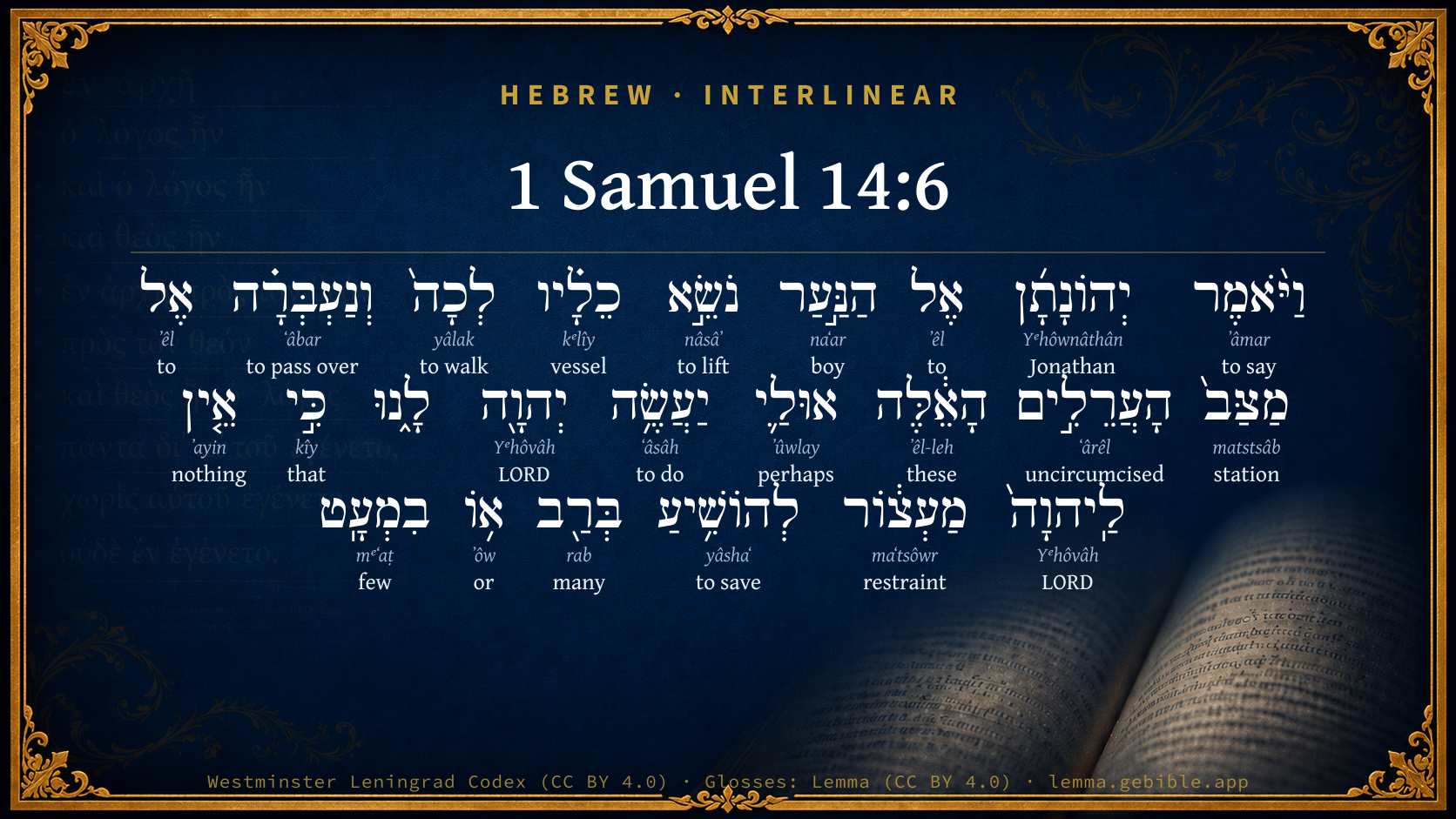
1 Samuel 14:6

Hebrew (Westminster Leningrad Codex) 1 Samuel 14:6 appears in the Hebrew Old Testament. The text above is from the Westminster Leningrad Codex. Each word links to its Strong’s number, a concise gloss, and parsing drawn from the Open Scriptures Hebrew Bible morphology. Click any word for its full Brown-Driver-Briggs (BDB) entry.
Download image
Cite this verse

1 Samuel 14:6 (World English Bible). Public Domain. Lemma interlinear Bible study tool, https://lemma.gebible.app/v/1-samuel/14/6.

Show BibTeX & RIS
BibTeX
RIS
English Translation
Jonathan said to the young man who bore his armor, Come, and let us go over to the garrison of these uncircumcised: it may be that Yahweh will work for us; for there is no restraint to Yahweh to save by many or by few.
World English Bible · Public Domain
Highlights
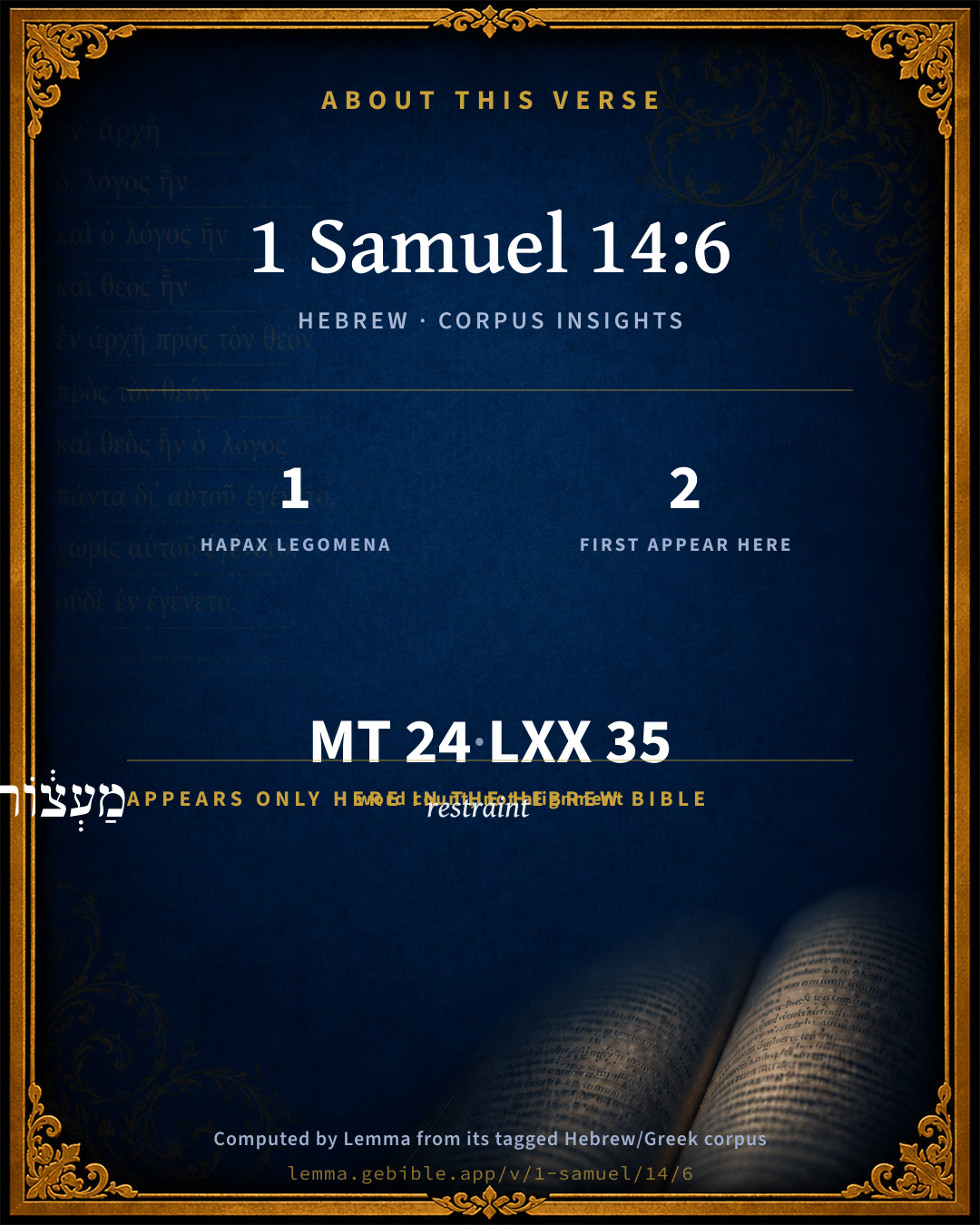
  • 1 hapax legomenon — only here in the Hebrew Bible
  • 2 first appearances in the Hebrew Bible
Full analysis ↓
Download a study sheet

One document with this verse’s original text, its word-by-word gloss line, the meaning frame, cross-references with their text, attributed commentary, and full source and license credits — printable, and it pastes into notes with its structure intact.

This verse Autodidact and up

Study sheet (.html) Plain text (.txt)

A passage Seminary Student

Up to 50 verses in one chapter. A passage sheet keeps up to 6 commentary sources and 12 cross-references per verse, in the order this page ranks them, and says so on the sheet whenever that leaves anything out. Ask for a single verse and you get the Autodidact verse sheet above.

Everything on this page stays free to read, with no account — the sheet is a download of what is already on screen, not access to it.

Want to remove ads? Support Godless Engineer
Compare translations 3

The same verse in 3 English versions, stacked beneath the original-language interlinear above. Click any original word for its lexicon entry.

Each is an independent rendering of the whole verse — the interlinear is not word-aligned to these translations.

Highlighted words mark where these versions differ — a whole-verse word diff, not a word-by-word alignment.

  • World English Bible Public Domain
    Jonathan said to the young man who bore his armor, Come, and let us go over to the garrison of these uncircumcised: it may be that Yahweh will work for us; for there is no restraint to Yahweh to save by many or by few.
  • King James Version Public Domain
    And Jonathan said to the young man that bare his armor, Come, and let us go over unto the garrison of these uncircumcised: it may be that the LORD will work for us: for there is no restraint to the LORD to save by many or by few.
  • unfoldingWord Literal Text CC BY-SA 4.0
    And Jonathan said to the young man, the carrier of his equipment, “Come, and let us cross over to the garrison of these uncircumcised! Perhaps Yahweh will act for us, for no hindrance to Yahweh to save by many or by few.”

unfoldingWord Literal Text — © unfoldingWord, licensed CC BY-SA 4.0. Word-aligned USFM3 via Door43 (git.door43.org/unfoldingWord/en_ult).

Versions to compare (up to 4)

3 of 4 selected

Show all 18 translations

Every available English version of this verse, each an independent rendering of the whole verse.

  • World English Bible Public Domain
    Jonathan said to the young man who bore his armor, Come, and let us go over to the garrison of these uncircumcised: it may be that Yahweh will work for us; for there is no restraint to Yahweh to save by many or by few.
  • Berean Standard Bible Public Domain
    Jonathan said to the young man bearing his armor, “Come, let us cross over to the outpost of these uncircumcised men. Perhaps the LORD will work on our behalf. Nothing can hinder the LORD from saving, whether by many or by few.”
  • Majority Standard Bible Public Domain
    Jonathan said to the young man bearing his armor, “Come, let us cross over to the outpost of these uncircumcised men. Perhaps the LORD will work on our behalf. Nothing can hinder the LORD from saving, whether by many or by few.”
  • King James Version Public Domain
    And Jonathan said to the young man that bare his armor, Come, and let us go over unto the garrison of these uncircumcised: it may be that the LORD will work for us: for there is no restraint to the LORD to save by many or by few.
  • American Standard Version (1901) Public Domain
    And Jonathan said to the young man that bare his armor, Come, and let us go over unto the garrison of these uncircumcised: it may be that Jehovah will work for us; for there is no restraint to Jehovah to save by many or by few.
  • Revised Version (1885) Public Domain
    And Jonathan said to the young man that bare his armour, Come and let us go over unto the garrison of these uncircumcised: it may be that the LORD will work for us: for there is no restraint to the LORD to save by many or by few.
  • Geneva Bible (1599) Public Domain
    And Ionathan saide to the yong man that bare his armour, Come, and let vs goe ouer vnto the garison of these vncircumcised: it may be that the Lord will worke with vs: for it is not hard to the Lord to saue with many, or with fewe.
  • Douay-Rheims (1899) Public Domain
    And Jonathan said to the young man that bore his armour: Come, let us go over to the garrison of these uncircumcised, it may be the Lord will do for us, because it is easy for the Lord to save either by many, or by few.
  • Young's Literal Translation Public Domain
    And Jonathan saith unto the young man bearing his weapons, `Come, and we pass over unto the station of these uncircumcised; it may be Jehovah doth work for us, for there is no restraint to Jehovah to save by many or by few.'
  • Literal Standard Version CC BY-SA 4.0
    And Jonathan says to the young man carrying his weapons, “Come, and we pass over to the station of these uncircumcised; it may be YHWH works for us, for there is no restraint to YHWH to save by many or by few.”
  • Unlocked Literal Bible CC BY-SA 4.0
    Jonathan said to his young armor bearer, “Come, let us cross over to the garrison of these uncircumcised fellows. It may be that Yahweh will work on our behalf, for nothing can stop Yahweh from saving by many or by few people.”
  • unfoldingWord Literal Text CC BY-SA 4.0
    And Jonathan said to the young man, the carrier of his equipment, “Come, and let us cross over to the garrison of these uncircumcised! Perhaps Yahweh will act for us, for no hindrance to Yahweh to save by many or by few.”
  • Darby Bible Public Domain
    And Jonathan said to the young man that bore his armour, Come, and let us go over to the garrison of these uncircumcised: perhaps Jehovah will work for us; for there is no restraint to Jehovah to save by many or by few.
  • World Messianic Bible Public Domain
    Jonathan said to the young man who bore his armor, “Come! Let’s go over to the garrison of these uncircumcised. It may be that the LORD will work for us, for there is no restraint on the LORD to save by many or by few.”
  • Webster's Bible Public Domain
    And Jonathan said to the young man that bore his armor, Come, and let us go over to the garrison of these uncircumcised: it may be that the LORD will work for us: for there is no restraint to the LORD to save by many or by few.
  • Free Bible Version CC BY-SA 4.0
    Jonathan said to the young armor-bearer, “Come on, let's cross over to the garrison of these heathen men. Maybe the Lord will help us out. It's not a problem for the Lord to win, whether by many or by few.”
  • Bible in Basic English Public Domain
    And Jonathan said to his young servant who had his arms, Come, let us go over to the armies of these men who have no circumcision: it may be that the Lord will give us help, for there is no limit to his power; the Lord is able to give salvation by a great army or by a small band.
  • JPS Tanakh (1917) Public Domain
    And Jonathan said to the young man that bore his armour: 'Come and let us go over unto the garrison of these uncircumcised; it may be that the LORD will work for us; for there is no restraint to the LORD to save by many or by few.'

Literal Standard Version (2020), Covenant Press — licensed CC BY-SA 4.0. Text via the HelloAO Bible API (eBible.org). Unlocked Literal Bible (unfoldingWord) — licensed CC BY-SA 4.0. Text via the HelloAO Bible API (eBible.org). unfoldingWord Literal Text — © unfoldingWord, licensed CC BY-SA 4.0. Word-aligned USFM3 via Door43 (git.door43.org/unfoldingWord/en_ult). Free Bible Version, Dr. Jonathan Gallagher — licensed CC BY-SA 4.0. Text via the HelloAO Bible API (eBible.org).

Word by word

More ways to search: Search by grammar → Find every occurrence → Compare this word →

Practice this passage: Drill this verse → Learn its vocabulary →

מַעְצ֔וֹר
maʻtsôwr
H4622
“restraint”
Noun, Common, Masculine, Singular, Absolute
Part of Speech
Noun
Type
Common
Gender
Masculine
Number
Singular
State
Absolute
Full BDB Definition

Origin: from H6113

TWOT: 1675d

restraint, hindrance
  1. וַיֹּ֨אמֶר ʼâmar H559 “and · to say” Conjunction + Verb, Qal, Sequential Imperfect, 3rd Person, Masculine, Singular
  2. יְהוֹנָתָ֜ן Yᵉhôwnâthân H3083 “Jonathan” Noun, Proper
  3. אֶל ʼêl H413 “to” Preposition
  4. הַנַּ֣עַר naʻar H5288 “the · boy” Particle, Definite Article + Noun, Common, Masculine, Singular, Absolute
  5. נֹשֵׂ֣א nâsâʼ H5375 “lifting” Verb, Qal, Participle Active, Masculine, Singular, Construct
  6. כֵלָ֗יו kᵉlîy H3627 “vessels · his” Noun, Common, Masculine, Plural, Construct + Suffix, Personal, 3rd Person, Masculine, Singular
  7. לְכָה֙ yâlak H3212 “walk” Verb, Qal, Imperative, 2nd Person, Masculine, Singular + Suffix, h
  8. וְנַעְבְּרָ֗ה ʻâbar H5674 “and · to pass over” Conjunction + Verb, Qal, Cohortative, 1st Person, Common, Plural
  9. אֶל ʼêl H413 “to” Preposition
  10. מַצַּב֙ matstsâb H4673 “station of” Noun, Common, Masculine, Singular, Construct
  11. הָעֲרֵלִ֣ים ʻârêl H6189 “the · uncircumcised” Particle, Definite Article + Adjective, Adjective, Masculine, Plural, Absolute
  12. הָאֵ֔לֶּה ʼêl-leh H428 “the · these” Particle, Definite Article + Pronoun, Demonstrative, Common, Plural
  13. אוּלַ֛י ʼûwlay H194 “perhaps” Adverb
  14. יַעֲשֶׂ֥ה ʻâsâh H6213 “to do” Verb, Qal, Imperfect, 3rd Person, Masculine, Singular
  15. יְהוָ֖ה Yᵉhôvâh H3068 “LORD” Noun, Proper
  16. כִּ֣י kîy H3588 “that” Conjunction
  17. אֵ֤ין ʼayin H369 “nothing” Particle, Negative
  18. לַֽיהוָה֙ Yᵉhôvâh H3068 “to/for · LORD” Preposition + Noun, Proper
  19. לְהוֹשִׁ֥יעַ yâshaʻ H3467 “to save” Preposition + Verb, Hiphil, Infinitive Construct
  20. בְּרַ֖ב rab H7227 “in/at · many” Preposition + Adjective, Adjective, Masculine, Singular, Absolute
  21. א֥וֹ ʼôw H176 “or” Conjunction
  22. בִמְעָֽט mᵉʻaṭ H4592 “in/at · few” Preposition + Adjective, Adjective, Masculine, Singular, Absolute

About this verse

These counts appear in no published source. They are computed here, from the morphology-tagged text and Lemma’s own curated glosses. What Lemma adds →

24
words
21
distinct lemmas
Historical
section

Notable vocabulary

1 hapax legomenon — a word that appears only here in the entire Hebrew Bible:

  • מַעְצ֔וֹר restraint H4622

First appearance in Scripture

These words make their first canonical appearance in the Hebrew Bible here:

  • יְהוֹנָתָ֜ן Jonathan H3083
  • מַעְצ֔וֹר restraint H4622

Shared distinctive vocabulary

מַצַּב֙ station H4673 occurs in 10 verses of the Hebrew Bible. Also found in:

Grammatical profile

  • 6 verbs
  • 7 nouns
  • 3 adjectives
  • 1 pronoun
  • 3 prepositions
  • 2 conjunctions
  • 1 adverb
  • 1 particle

Verb forms

  • וַיֹּ֨אמֶר Qal · Sequential Imperfect
  • נֹשֵׂ֣א Qal · Participle Active
  • לְכָה֙ Qal · Imperative
  • וְנַעְבְּרָ֗ה Qal · Cohortative
  • יַעֲשֶׂ֥ה Qal · Imperfect
  • לְהוֹשִׁ֥יעַ Hiphil · Infinitive Construct

Repetition

Words recur within this verse — often emphatic in Hebrew:

  • יְהוָ֖ה LORD H3068 ×2
  • אֶל to H413 ×2

Hebrew & Septuagint length

In English translation the verse runs 45 words from the Hebrew and 43 from the Septuagint (LXX English) — closely comparable.

A rough comparison of the two English renderings, which tokenize alike — not a word-level alignment.

Word counts can differ between the Hebrew and the Greek without any difference in meaning — e.g. the Hebrew direct-object marker אֵת has no separate Greek word, and Greek often adds the article ὁ.

In the original languages it is 24 Hebrew tokens and 35 Greek tokens — but the two are counted differently (Hebrew bundles its prefixes and suffixes into one token; the Greek is in lemma form), so that isn’t a like-for-like length.

Cross-references

20

Topical passages linked to 1 Samuel 14:6 in the Treasury of Scripture Knowledge — connected by theme and wording, ordered by reader-vote popularity; previews shown in the World English Bible.

  • Matthew 19:26 Looking at them, Jesus said, "With men this is impossible, but with God all things are possible."
  • Romans 8:31 What then shall we say about these things? If God is for us, who can be against us?
  • Zechariah 4:6 Then he answered and spoke to me, saying, "This is the word of Yahweh to Zerubbabel, saying, 'Not by might, nor by power, but by my Spirit,' says Yahweh of Hosts.
  • Deuteronomy 32:30 How should one chase a thousand, Two put ten thousand to flight, Except their Rock had sold them, Yahweh had delivered them up?
  • 2 Chronicles 14:11 Asa cried to Yahweh his God, and said, Yahweh, there is none besides you to help, between the mighty and him who has no strength: help us, Yahweh our God; for we rely on you, and in your name are we come against this multitude. Yahweh, you are our God; don't let man prevail against you.
  • Psalms 115:1–3 Not to us, Yahweh, not to us, But to your name give glory, For your loving kindness, and for your truth's sake.
  • Judges 7:4–7 Yahweh said to Gideon, The people are yet too many; bring them down to the water, and I will try them for you there: and it shall be, that of whom I tell you, This shall go with you, the same shall go with you; and of whoever I tell you, This shall not go with you, the same shall not go.
  • 2 Samuel 16:12 It may be that Yahweh will look on the wrong done to me, and that Yahweh will requite me good for [his] cursing of me this day.
  • 2 Kings 19:4 It may be Yahweh your God will hear all the words of Rabshakeh, whom the king of Assyria his master has sent to defy the living God, and will rebuke the words which Yahweh your God has heard. Therefore lift up your prayer for the remnant that is left.
  • Jeremiah 9:26 Egypt, and Judah, and Edom, and the children of Ammon, and Moab, and all that have the corners [of their hair] cut off, who dwell in the wilderness; for all the nations are uncircumcised, and all the house of Israel are uncircumcised in heart.
  • Genesis 17:7–11 I will establish my covenant between me and you and your seed after you throughout their generations for an everlasting covenant, to be a God to you and to your seed after you.
  • Judges 15:18 He was very thirsty, and called on Yahweh, and said, You have given this great deliverance by the hand of your servant; and now shall I die for thirst, and fall into the hand of the uncircumcised.
  • 1 Samuel 17:26 David spoke to the men who stood by him, saying, What shall be done to the man who kills this Philistine, and takes away the reproach from Israel? for who is this uncircumcised Philistine, that he should defy the armies of the living God?
  • 1 Samuel 17:36 Your servant struck both the lion and the bear: and this uncircumcised Philistine shall be as one of them, seeing he has defied the armies of the living God.
  • Jeremiah 9:23 Thus says Yahweh, Don't let the wise man glory in his wisdom, neither let the mighty man glory in his might, don't let the rich man glory in his riches;
  • Amos 5:15 Hate evil, love good, And establish justice in the courts. It may be that Yahweh, the God of hosts, will be gracious to the remnant of Joseph."
  • Ephesians 2:11–12 Therefore remember that once you, the Gentiles in the flesh, who are called "uncircumcision" by that which is called "circumcision," (in the flesh, made by hands);
  • 2 Samuel 1:20 Don't tell it in Gath, Don't publish it in the streets of Ashkelon; Lest the daughters of the Philistines rejoice, Lest the daughters of the uncircumcised triumph.
  • Zephaniah 2:3 Seek Yahweh, all you humble of the land, who have kept his ordinances. Seek righteousness. Seek humility. It may be that you will be hidden in the day of Yahweh's anger.
  • Philippians 3:3 For we are the circumcision, who worship God in the Spirit, and rejoice in Christ Jesus, and have no confidence in the flesh;

Cross-references courtesy of OpenBible.info (CC BY 4.0).

Hebrew and Greek witnesses Masoretic Hebrew ↔ Greek Septuagint

The same verse in the two great witnesses to the Old Testament, shown verse-for-verse.

These are two independent witnesses, not word-aligned to each other, and the Septuagint is shown in lemma (dictionary) form.

Hebrew 1 Samuel 14:6 Masoretic · Westminster Leningrad Codex

וַיֹּ֨אמֶר יְהוֹנָתָ֜ן אֶל הַנַּ֣עַר נֹשֵׂ֣א כֵלָ֗יו לְכָה֙ וְנַעְבְּרָ֗ה אֶל מַצַּב֙ הָעֲרֵלִ֣ים הָאֵ֔לֶּה אוּלַ֛י יַעֲשֶׂ֥ה יְהוָ֖ה לָ֑נוּ כִּ֣י אֵ֤ין לַֽיהוָה֙ מַעְצ֔וֹר לְהוֹשִׁ֥יעַ בְּרַ֖ב א֥וֹ בִמְעָֽט

Jonathan said to the young man who bore his armor, Come, and let us go over to the garrison of these uncircumcised: it may be that Yahweh will work for us; for there is no restraint to Yahweh to save by many or by few.

World English Bible · Public Domain

Greek LXX 1 Samuel 14:6 Septuagint · lemma form

καί εἶπον ιωναθαν πρός ὁ παιδάριον ὁ αἴρω ὁ σκεῦος αὐτός δεῦρο διαβαίνω εἰς μεσσαβ ὁ ἀπερίτμητος οὗτος εἰ τις ποιέω ἐγώ κύριος ὅτι οὐ εἰμί ὁ κύριος συνἔχω σώζω ἐν πολύς ἤ ἐν ὀλίγος

And Jonathan said to the young man that bore his armor, Come, let us go over to Messab of these uncircumcised, if perhaps the Lord may do something for us; for the Lord is not straitened to save by many or by few.

LXX2012 (modern English Septuagint) · Public Domain

Hebrew: Westminster Leningrad Codex (CC BY 4.0). Greek: Septuagint (public domain); English from LXX2012 (modern English Septuagint) (Public Domain). How the Septuagint differs from the Hebrew →

Targum (Aramaic paraphrase)

1

The Targum is the ancient Jewish Aramaic paraphrase of the Hebrew Scriptures — an interpretive translation, not the Hebrew text itself. Onkelos (literal) and Pseudo-Jonathan (expansive) render the Torah, and Jonathan the Prophets. Coverage is partial: where no permissively-licensed English translation exists for a verse, only the Aramaic is shown. This is verse-level text, not a word-by-word alignment to the Hebrew.

  1. Targum Jonathan Prophets (Joshua–Malachi)
    וַאֲמַר יְהוֹנָתָן לְעוּלֵימָא נָטֵל זְיָנֵיהּ אִיתָא וְנֶעְבַּר לְאִסְטַרְטִיג עֲרֵלַיָא הָאִלֵין מָאִים יַעְבֵּיד יְיָ לָנָא נִסָא אֲרֵי לֵית קֳדָם יְיָ מַעְצוֹר לְמִפְרַק בְּסַגִיאֵי אוֹ בִזְעֵירֵי:

    (no public-domain English translation for this verse)

    Targum Jonathan — Aramaic: “Mikraot Gedolot” (public domain). English: “Sefaria Community Translation” (CC0 1.0 (public-domain dedication)); “London "Chaldee Paraphrase," 1871” (public domain). Text via Sefaria.

Commentary

Notes on 1 Samuel 14:6 from classic Christian and Jewish commentators (each source and its license shown beneath its notes). The classic Christian expositions comment on the surrounding passage and are grouped to its opening verse, so a note may address several verses; the Jewish commentaries on the Tanakh (Rashi and others) are per-verse, so they appear only where the commentator wrote on this verse.

Lemma curates 59 commentaries, every one of them public domain or Creative Commons licensed, each selected and text-cleaned for this edition rather than reprinted as found. About our sources →

Trapp's Complete Commentary

John Trapp

1Sa 14:6 And Jonathan said to the young man that bare his armour, Come, and let us go over unto the garrison of these uncircumcised: it may be that the LORD will work for us: for [there is] no restraint to the LORD to save by many or by few.

Ver. 6. Unto the garrison of these uncircumcised.] Strangers to the covenant, and therefore we shall the sooner prevail against them. By the consideration of the sacraments we should strengthen our faith against all adverse power; this being one special use of them.

It may be that the Lord will work for us.] A promise God had made, that Saul should save them out of the hand of the Philistines; {1Sa 9:16} but whether at this time, and by this means, he submitteth to God’s holy will, saying, "It may be that the Lord," &c., which is not spoken by way of doubting, saith Pellican, but of praying and exciting himself and his armour bearer to trust in God all-sufficient. {a}

for there is no restraint to the Lord.] He is magnus in magnis, nec parvus in minimis, {b} and hath promised to help his people "with a little help," {Dan 11:34} that through weaker means they may see his greater strength.

{a} Magis orantis quam trepidantis affectu.

{b} August.

John Trapp, A Commentary or Exposition upon All the Books of the Old and New Testament (1647–1656) — public domain. Text from a community e-Sword module.

The Biblical Illustrator

Joseph S. Exell

1Sa_14:6

There is no restraint to the Lord, to save by many or by few.

Jonathans faith

1. This faith of Jonathan was reasonable. Some think faith mere assumption, or the result of ignorance. It is not so. Faith rests on reason. We know we can do nothing of ourselves in an emergency like that which had overtaken the children of Israel. We know God has infinite power, and He has said that He will help those who trust Him. He has the power and He is willing, then is it not in reason to trust Him?

2. Jonathan believed that it was the height of wisdom to give God the opportunity to reveal His mighty arm. God needs our faith. God is necessary to us, and we, in a sense, are necessary to God. We need God that we may have ground for our faith, and He needs our faith to call out His help. We trust too much in ourselves. Said one to me, the churches are growing so weak. I would to God that they were weak enough to lean on God. I do not doubt that there are church members who can get up at five oclock, swing in and out with the multitude at Moody and Sankeys meetings, but how few are willing to go up alone against the Philistines. There is an inspiration in a multitude, but it is not always the inspiration that comes through faith in God. The Philistines commenced slaying each other. So it often is when God comes down to help the Church, sinners assist the work in their confusion. Then the Israelites who had hid in caves, when they saw that the army of the Philistines had met disaster, helped on the victory. When God manifests His power, backsliders return. Every man can do something in the Churchs work.

3. Remember, lastly, that if such faith and such labour glorified God, then they can do it again. Is the Church in straitened circumstances? Are the enemies clamorous? There is need of the faith of Jonathan and of his armour bearer. Give God an opportunity, by trusting in Him, to reveal His strength. Defeat comes through a lack of faith. Let no ones heart be faint. (Metropolitan Pulpit.)

God and we

Richter says that we should all make as much of ourselves as can be made out of the stuff. The stuff we are made of may be particularly poor, for we know that we have been able to make little or nothing out of it. Suppose we take it to its Maker and ask Him to do something with it? On the keystone of a bridge over a stream in a beautiful Scotch parish are the words, God and We, teaching all who read them that nothing can be built without the help of the great Architect. It is so with the edification or building up of ourselves. It is not God alone, which would mean human idleness; or We alone, which would mean human presumption; or We and God, which would be almost blasphemy; but God and We.

Divine and human cooperation

We may often be cheered by this recollection of a beautiful reciprocity in things human and Divine. If God promises His unfailing help to us. He has also conditioned much of the success of His cause on our help rendered to it. Sun, moon, and stars are mutual helpers in sustaining the equilibrium of Natures forces. When the earth, sun, and moon join their attractions in a right line the tides rise to the full; but when these worlds exert their forces at right angles then the tides sink to their lowest. So when we place ourselves in the right attitude of harmony with the Divine powers, then we exert the most beneficent influence. The Divine Spirit is the great and all-sufficient source of help for human souls. Science gives us a beautiful illustration. A strong man cannot very long hold up a heavy weight. His arm grows weary and he feels weak. But if a current from a magnetic battery or an electric machine be applied to the tired arm the muscles instantly regain strength, and the weight is held up with ease. So it is with the invisible current of the Divine power of the Spirit applied to our weary souls. (Christian Commonwealth.)

Strength in quiet assurance

Pelopidas, when informed that the number of the enemy was double that of his own army, replied: So much the better. We shall conquer so many the more. His intelligent self-possession was more than a thousand spears. The battle of Gilboa was lost before Saul began it. In quietness and confidence shall be your strength. (E. P. Thwing.)

The Biblical Illustrator, edited by Joseph S. Exell (c. 1880s–1900s) — public domain. Text from a community e-Sword module.

Joseph Benson's Commentary

1Sa 14:6. The garrison of these uncircumcised — So he calls them, to strengthen his faith by this consideration, that his enemies were enemies to God; whereas he was circumcised, and therefore in covenant with God, who was both able and engaged to assist his people. It may be — He speaks doubtfully; for though he felt himself stirred up by God to this exploit, and was assured that God would deliver his people, yet he was not certain that he would do it at this time, and in this way. That the Lord will work — Great and wonderful things. There is no restraint to the Lord to save by many or few — From this it appears that Jonathan had a true faith in the power of God, being fully persuaded that he could do every thing, and needed not the help or co-operation of natural causes.

Joseph Benson's Commentary on the Old and New Testaments (1811–1818) — public domain. Text from a community e-Sword module.

Tyndale Open Study Notes

Tyndale Open Resources

14:6 pagans (literally uncircumcised): A disdainful term for enemies of Israel (see also 17:36; 31:4). • Perhaps: Jonathan had no guarantee of survival, but he was certain that God could grant them victory despite the odds. Victory was in God’s hands; Jonathan offered himself as an instrument God could use. • many warriors or only a few: Jonathan knew what Gideon had learned many years earlier (see Judg 7:2-8).

Tyndale Open Study Notes — © Tyndale Open Resources, licensed CC BY-SA 4.0. Text via the HelloAO Bible API.

Geneva Bible (1599)

Geneva Bible translators

To wit, the Philistines.

Or, none can let the Lord.

Geneva Bible (1599) marginal notes — public domain. Text via Bolls.life.

Jamieson, Fausset & Brown

Robert Jamieson, A. R. Fausset & David Brown

it may be that the Lord will work for us--This expression did not imply a doubt; it signified simply that the object he aimed at was not in his own power--but it depended upon God--and that he expected success neither from his own strength nor his own merit.

Jamieson, Fausset & Brown — Commentary Critical and Explanatory on the Whole Bible (1871) — public domain (CC PDM 1.0). Text via the HelloAO Bible API.

Adam Clarke's Commentary

Verse 6. Let us go over] Moved, doubtless, by a Divine impulse.

There is no restraint to the Lord] This is a fine sentiment; and where there is a promise of defense and support, the weakest, in the face of the strongest enemy, may rely on it with the utmost confidence.

Adam Clarke's Commentary on the Bible (1810–1826) — public domain. Text from a community e-Sword/MySword module.

Ellicott's Commentary for English Readers

(6) And Jonathan said.—This companion in arms answered to the esquire of the knight of the middle ages. Gideon, Joab, David, and others of the famous Israelite warriors, were constantly accompanied in a similar manner by an armour-bearer.

Come, and let us go over.—Although in this history of the great deed of Jonathan there is no mention of the “Spirit of the Lord” having come upon him, as in the case of Gideon (Jdg_6:34), Othniel (Jdg_3:10), Samson, and others—who, in order to enable them to accomplish a particular act, were temporarily endowed with superhuman strength and courage and wisdom—there is no shadow of doubt but that in this case the “Spirit of the Lord” descended on the heroic son of Saul. All the circumstances connected with this event, which had so marked an influence on the fortunes of Israel, are evidently supernatural. The brave though desperate thought which suggested the attack, the courage and strength needful to carry it out, the strange panic which seized the Philistine garrison, the utter dismay which spread over the whole of the Philistine forces, and which caused them to fly in utter confusion before the small bands of Israelites, all belong to the same class of incidents so common in the earlier Hebrew story, when it is clear that the Glorious Arm of the Eternal helped them in a way it helped no other peoples.

The term “uncircumcised” is commonly applied to the Philistines, and to other of the enemies of Israel. It is used as a special term of reproach. The enmity between Philistia and Israel lasted over a long period, and was very bitter.

It may be that the Lord will work for us.—These words explain the apparent recklessness of Jonathan’s attempt. It was Another who would fight the armed garrison on those tall peaks opposite, and bring him safely back to his people again.

For there is no restraint to the Lord to save by many or by few.—“O Divine power of faith, which makes a man more than men. The question is not what Jonathan can do, but what God can do, whose power is not in the means, but in Himself. There is no restraint in the Lord to save by many or by few. O admirable faith in Jonathan, whom neither the steepness of the rocks nor multitude of enemies can dissuade from such an assault.”—Bishop Hall.

A Bible Commentary for English Readers, edited by Charles John Ellicott (1878–1897) — public domain. Text from a community e-Sword module.

The Cambridge Bible for Schools and Colleges

gen. ed. J. J. S. Perowne

6. these uncircumcised] A frequent epithet of abhorrence for the Philistines. Here it has a special significance, for it indicates that Jonathan’s hope of success was based on the reflection that the Philistines stood in no covenant-relation to Jehovah, as Israel did.

there is no restraint to the Lord to save by many or by few] See ch. 1Sa_17:46-47; Jdg_7:4; Jdg_7:7; 2Ch_14:11, and the noble words of Judas Maccabaeus before the battle of Beth-horon (1Ma_3:16-21): “With the God of heaven it is all one to deliver with a great multitude or with a small company; for the victory of battle standeth not in the multitude of an host; but strength cometh from heaven.” These were among the heroes who “through faith waxed valiant in fight, turned to flight the armies of the aliens” (Heb_11:34).

The Cambridge Bible for Schools and Colleges (gen. ed. J. J. S. Perowne; Cambridge University Press, 1878–1918) — public domain. Text from a community e-Sword module.

John Gill's Exposition

And Jonathan said to the young man that bare his armour,.... A second time, as Abarbinel thinks; the young man giving no answer to him the first time, perhaps through fear, he repeats it, and enlarges upon it for his encouragement:

come, and let us go over unto the garrison of these uncircumcised; as these Philistines were, whereas several of the other nations, though Heathen, were circumcised; as the Edomites, Arabians, and others; and this Jonathan observes to the young man, in hope that they being such the Lord would deliver them into their hand:

it may be that the Lord will work for us; a sign, as the Targum, a miracle, as indeed he did; and of which Jonathan was persuaded in his own mind, though he did not choose to express himself in a confident way; not knowing in what manner, and whether at this time the Lord would appear, and work salvation and deliverance; and yet had a strong impulse upon his mind it would be wrought, and therefore was encouraged to try this expedient:

for there is no restraint to the Lord to save by many or by few; he is not limited to numbers, and can easily work salvation by a few as by many. It is no difficult thing to him to save by few, nor can anything hinder him, let the difficulties be what they will, when he has determined to deliver his people.

John Gill's Exposition of the Whole Bible (1746–1763) — public domain (CC PDM 1.0). Text via the HelloAO Bible API.

Albert Barnes' Notes on the Bible

It is remarkable that the epithet “uncircumcised,” used as a term of reproach, is confined almost exclusively to the Philistines. (Compare 1Sa 17:26, 1Sa 17:36; Jdg 14:3; Jdg 15:18, etc.) This is probably an indication of the long oppression of the Israelites by the Philistines and of their frequent wars.

Albert Barnes' Notes on the Bible (1834–1885) — public domain. Text from a community e-Sword/MySword module.

Haydock's Catholic Bible Commentary

Uncircumcised. The Hebrews looked upon the Gentiles as unclean and they, in their turn, spoke of the Jews in the most contemptuous manner. (Calmet) --- It may. Literally, "if perchance." (Haydock) --- This does not express any doubt. The hero found himself impelled to undertake this work, but he knew not by what means God would crown it with success. He therefore prays to him in this manner, as Abraham’s servant had done, Genesis xxiv. 12. He does not tempt God no more than Gedeon and Moses, who begged that the Lord would manifest his will by miracles. (Calmet) --- Few. These words are often repeated, (2 Paralipomenon xiv. 11., and 1 Machabees iii. 18,) and were verified, chap. xvii. 47., and Judges vii. 4. (Menochius)

George Leo Haydock (1774–1849), Haydock's Catholic Family Bible and Commentary, 1859 edition — public domain. Excludes Psalms (Douay-Rheims chapter numbering differs from Protestant) and Deuterocanonical books (Catholic canon only).

Matthew Poole's English Annotations

These uncircumcised; so he calls them, partly in contempt, and principally to strengthen his faith by this consideration, that his enemies were enemies to God, and without any hope in God, or help from him; whereas he was circumcised, and therefore in covenant with God, who was both able and engaged to assist his people.

It may be; he speaks doubtfully; for though he found and felt himself stirred up by God to this exploit, and was assured that God would deliver his people, yet he was not certain that he would do it at this time, and in this way.

The Lord will work, to wit, great and wonderful things.

There is no restraint to the Lord; there is no person nor thing which can hinder God from thus doing.

Matthew Poole's English Annotations on the Holy Bible (1683–1685) — public domain. Text from a community e-Sword/MySword module.

Whedon's Commentary on the Bible

Daniel D. Whedon

6. No restraint to the Lord to save by many or by few — Jonathan was confident in the arm of Jehovah. He seems to have made this adventure a subject of prayer, as Abraham’s servant did the matter about which his master had sent him. Gen_24:12.

Daniel D. Whedon (gen. ed.), Commentary on the Old and New Testaments (1874–1909) — public domain. Text from a community e-Sword module.

The Pulpit Commentary

Uncircumcised. An epithet of dislike almost confined to the Philistines. But underneath the whole speech of Jonathan lies the conviction of the covenant relation of Israel to Jehovah, of which circumcision was the outward sign. Notice also Jonathan"s humble reliance upon God. It may be that Jehovah will work for us, etc.

The Pulpit Commentary (1880–1919), ed. H.D.M. Spence-Jones & Joseph S. Exell — public domain. Text from a community e-Sword module.

John Wesley's Explanatory Notes

Uncircumcised - So he calls them, to strengthen his faith by this consideration, that his enemies were enemies to God; whereas he was circumcised, and therefore in covenant with God, who was both able, and engaged to assist his people. It way be - He speaks doubtfully: for tho' he felt himself stirred up by God to this exploit, and was assured that God would deliver his people; yet he was not certain that he would do it at this time, and in this way. Work - Great and wonderful things.

John Wesley, Explanatory Notes Upon the Whole Bible (1754–1765) — public domain. Text via the GEBible commentary corpus.

unfoldingWord translationNotes

Door43 World Missions Community

his young armor bearer

This was a teenage boy who was responsible for caring for his master's weapons of war. See how you translated this in 1 Samuel 14:1.

uncircumcised fellows

a derogatory term used for non-Jewish men

work on our behalf

"work for our support" or "help us"

nothing can stop Yahweh from saving

This double negative can be stated in positive form. AT: "Yahweh can save" (See: Double Negatives)

by many or by few people

These extremes also include everything in between. AT: "by any number of people" (See: Merism)

everything that is in your heart

Here "heart" refers to Jonathan's desires. AT: "everything that you desire to do" (See: Metonymy)

translationWords

circumcise

Yahweh

save

heart

obey

command

unfoldingWord translationNotes — © Distant Shores Media and the Door43 World Missions Community, licensed CC BY-SA 4.0. Source: git.door43.org/Door43/en_tn.

Lesson kit

Teaching starters — assembled from the data on this page, not authored interpretation. Every prompt links to the verse data it draws on. Edit before teaching.

1 Samuel, in the Historical, opens this verse with 24 words (21 distinct Hebrew lemmas). Its most distinctive word is maʻtsôwr (“restraint”). A historical commentator’s framing appears above. Read the whole chapter for the surrounding context.

Discussion questions

  1. What does “restraint” (maʻtsôwr) contribute to the verse as a whole?
  2. 1 word here appears nowhere else in the Hebrew Bible. Why might the author reach for such rare wording?
  3. 2 words make their first appearance in Scripture here. What does this debut establish?
  4. How does Joshua 4:3, which shares the word «station», read alongside this verse?
  5. What does the repetition of “LORD” (2× in this one verse) do in this verse?
  6. The translations on this page render this verse differently — a whole-verse word diff, not a word-by-word alignment. What might account for the different wordings?
  7. «וַיֹּ֨אמֶר» is a Qal Sequential Imperfect verb. How does that grammatical form shape the action described?
  8. Compare how Trapp's Complete Commentary and The Biblical Illustrator read this verse. Where do they agree or differ?

Things to notice

  • 1 word in this verse appears nowhere else in the Hebrew Bible.
  • 2 words make their first canonical appearance in Scripture here.
  • This verse counts 24 Hebrew ↔ 35 Greek words.
  • These translations choose different wording for 17 words in this verse.
  • “LORD” occurs 2× in this single verse.

Reading settings

Reading text

Shown beneath each verse's original-language words.

Old Testament
Old Testament edition

Read the OT as the Masoretic Hebrew (MT) or the Greek Septuagint (LXX).

English shown for the Greek Septuagint (in the Hebrew ↔ Greek comparison).

Comparing translations? Open the Compare panel on any verse page to stack up to four side by side.