
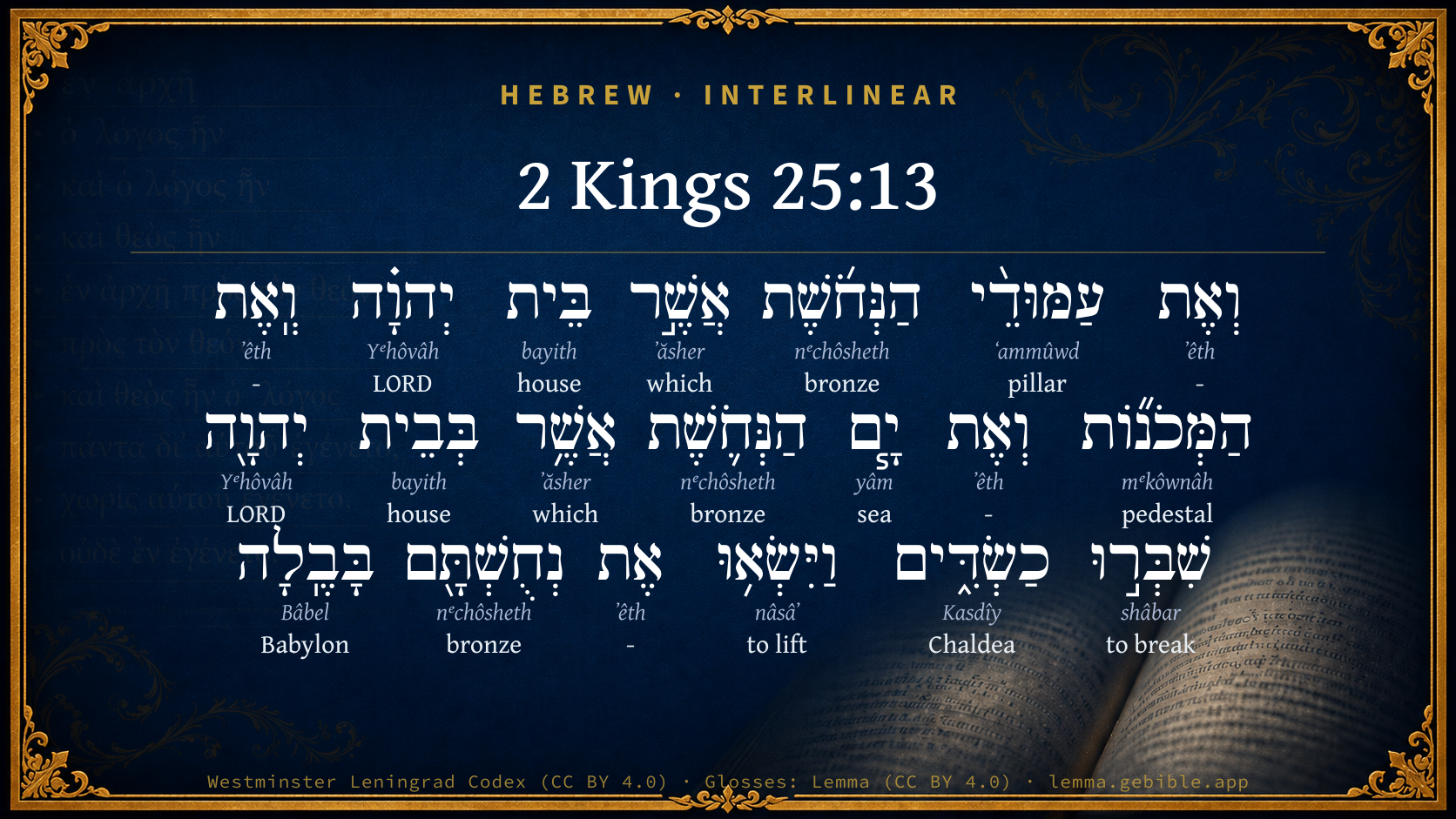
2 Kings 25:13

Hebrew (Westminster Leningrad Codex) 2 Kings 25:13 appears in the Hebrew Old Testament. The text above is from the Westminster Leningrad Codex. Each word links to its Strong’s number, a concise gloss, and parsing drawn from the Open Scriptures Hebrew Bible morphology. Click any word for its full Brown-Driver-Briggs (BDB) entry.
Download image
Cite this verse

2 Kings 25:13 (World English Bible). Public Domain. Lemma interlinear Bible study tool, https://lemma.gebible.app/v/2-kings/25/13.

Show BibTeX & RIS
BibTeX
RIS
English Translation
The pillars of brass that were in the house of Yahweh, and the bases and the brazen sea that were in the house of Yahweh, did the Chaldeans break in pieces, and carried the brass of them to Babylon.
World English Bible · Public Domain
Download a study sheet

One document with this verse’s original text, its word-by-word gloss line, the meaning frame, cross-references with their text, attributed commentary, and full source and license credits — printable, and it pastes into notes with its structure intact.

This verse Autodidact and up

Study sheet (.html) Plain text (.txt)

A passage Seminary Student

Up to 50 verses in one chapter. A passage sheet keeps up to 6 commentary sources and 12 cross-references per verse, in the order this page ranks them, and says so on the sheet whenever that leaves anything out. Ask for a single verse and you get the Autodidact verse sheet above.

Everything on this page stays free to read, with no account — the sheet is a download of what is already on screen, not access to it.

Want to remove ads? Support Godless Engineer
Compare translations 3

The same verse in 3 English versions, stacked beneath the original-language interlinear above. Click any original word for its lexicon entry.

Each is an independent rendering of the whole verse — the interlinear is not word-aligned to these translations.

Highlighted words mark where these versions differ — a whole-verse word diff, not a word-by-word alignment.

  • World English Bible Public Domain
    The pillars of brass that were in the house of Yahweh, and the bases and the brazen sea that were in the house of Yahweh, did the Chaldeans break in pieces, and carried the brass of them to Babylon.
  • King James Version Public Domain
    And the pillars of brass that were in the house of the LORD, and the bases, and the brazen sea that was in the house of the LORD, did the Chaldees break in pieces, and carried the brass of them to Babylon.
  • unfoldingWord Literal Text CC BY-SA 4.0
    And the Chaldeans broke up the pillars of bronze that the house of Yahweh and the stands and the sea of bronze that in the house of Yahweh, and they carried their bronze to Babylon.

unfoldingWord Literal Text — © unfoldingWord, licensed CC BY-SA 4.0. Word-aligned USFM3 via Door43 (git.door43.org/unfoldingWord/en_ult).

Versions to compare (up to 4)

3 of 4 selected

Show all 18 translations

Every available English version of this verse, each an independent rendering of the whole verse.

  • World English Bible Public Domain
    The pillars of brass that were in the house of Yahweh, and the bases and the brazen sea that were in the house of Yahweh, did the Chaldeans break in pieces, and carried the brass of them to Babylon.
  • Berean Standard Bible Public Domain
    Moreover, the Chaldeans broke up the bronze pillars and stands and the bronze Sea in the house of the LORD, and they carried the bronze to Babylon.
  • Majority Standard Bible Public Domain
    Moreover, the Chaldeans broke up the bronze pillars and stands and the bronze Sea in the house of the LORD, and they carried the bronze to Babylon.
  • King James Version Public Domain
    And the pillars of brass that were in the house of the LORD, and the bases, and the brazen sea that was in the house of the LORD, did the Chaldees break in pieces, and carried the brass of them to Babylon.
  • American Standard Version (1901) Public Domain
    And the pillars of brass that were in the house of Jehovah, and the bases and the brazen sea that were in the house of Jehovah, did the Chaldeans break in pieces, and carried the brass of them to Babylon.
  • Revised Version (1885) Public Domain
    And the pillars of brass that were in the house of the LORD, and the bases and the brasen sea that were in the house of the LORD, did the Chaldeans break in pieces, and carried the brass of them to Babylon.
  • Geneva Bible (1599) Public Domain
    Also the pillars of brasse that were in the house of the Lord, and the bases, and the brasen Sea that was in the house of the Lord, did the Caldees breake, and caried the brasse of them to Babel.
  • Douay-Rheims (1899) Public Domain
    And the pillars of brass that were in the temple of the Lord, and the bases, and the sea of brass which was in the house of the Lord, the Chaldees broke in pieces, and carried all the brass of them to Babylon.
  • Young's Literal Translation Public Domain
    And the pillars of brass that `are' in the house of Jehovah, and the bases, and the sea of brass, that `is' in the house of Jehovah, have the Chaldeans broken in pieces, and bear away their brass to Babylon.
  • Literal Standard Version CC BY-SA 4.0
    And the pillars of bronze that [are] in the house of YHWH, and the bases, and the sea of bronze, that [is] in the house of YHWH, the Chaldeans have broken in pieces, and carry away their bronze to Babylon.
  • Unlocked Literal Bible CC BY-SA 4.0
    As for the bronze pillars that were in the house of Yahweh, and the stands and the bronze sea that were in the house of Yahweh, the Chaldeans broke them into pieces and carried the bronze back to Babylon.
  • unfoldingWord Literal Text CC BY-SA 4.0
    And the Chaldeans broke up the pillars of bronze that the house of Yahweh and the stands and the sea of bronze that in the house of Yahweh, and they carried their bronze to Babylon.
  • Darby Bible Public Domain
    And the brazen pillars that were in the house of Jehovah, and the bases, and the brazen sea that was in the house of Jehovah, the Chaldeans broke in pieces, and carried the brass thereof to Babylon.
  • World Messianic Bible Public Domain
    The Kasdim broke up the pillars of bronze that were in the LORD’s house and the bases and the bronze sea that were in the LORD’s house, and carried the bronze pieces to Babylon.
  • Webster's Bible Public Domain
    And the pillars of brass that were in the house of the LORD, and the bases, and the brazen sea that was in the house of the LORD, did the Chaldees break in pieces, and carried the brass of them to Babylon.
  • Free Bible Version CC BY-SA 4.0
    The Babylonians broke into pieces the bronze pillars, the movable carts, and the bronze Sea that belonged to the Lord's Temple, and they took all the bronze to Babylon.
  • Bible in Basic English Public Domain
    And the brass pillars in the house of the Lord, and the wheeled bases, and the great brass water-vessel in the house of the Lord, were broken up by the Chaldaeans, who took the brass to Babylon.
  • JPS Tanakh (1917) Public Domain
    And the pillars of brass that were in the house of the LORD, and the bases and the brazen sea that were in the house of the LORD, did the Chaldeans break in pieces, and carried the brass of them to Babylon.

Literal Standard Version (2020), Covenant Press — licensed CC BY-SA 4.0. Text via the HelloAO Bible API (eBible.org). Unlocked Literal Bible (unfoldingWord) — licensed CC BY-SA 4.0. Text via the HelloAO Bible API (eBible.org). unfoldingWord Literal Text — © unfoldingWord, licensed CC BY-SA 4.0. Word-aligned USFM3 via Door43 (git.door43.org/unfoldingWord/en_ult). Free Bible Version, Dr. Jonathan Gallagher — licensed CC BY-SA 4.0. Text via the HelloAO Bible API (eBible.org).

Word by word

More ways to search: Search by grammar → Find every occurrence → Compare this word →

Practice this passage: Drill this verse → Learn its vocabulary →

הַמְּכֹנ֞וֹת
mᵉkôwnâh
H4350
“the · pedestals”
Particle, Definite Article + Noun, Common, Feminine, Plural, Absolute
Part of Speech
Particle + Noun
Type
Common
Gender
Feminine
Number
Plural
State
Absolute
Full BDB Definition

Origin: from H4349

TWOT: 964d

fixed resting place, base, pedestal
  1. וְאֶת ʼêth H853 “and · -” Conjunction + Particle, Direct Object
  2. עַמּוּדֵ֨י ʻammûwd H5982 “pillars of” Noun, Common, Masculine, Plural, Construct
  3. הַנְּחֹ֜שֶׁת nᵉchôsheth H5178 “the · bronze” Particle, Definite Article + Noun, Common, Feminine, Singular, Absolute
  4. אֲשֶׁ֣ר ʼăsher H834 “which” Particle, Relative
  5. בֵּית bayith H1004 “house of” Noun, Common, Masculine, Singular, Construct
  6. יְהוָ֗ה Yᵉhôvâh H3068 “LORD” Noun, Proper
  7. וְֽאֶת ʼêth H853 “and · -” Conjunction + Particle, Direct Object
  8. וְאֶת ʼêth H853 “and · -” Conjunction + Particle, Direct Object
  9. יָ֧ם yâm H3220 “sea of” Noun, Common, Masculine, Singular, Construct
  10. הַנְּחֹ֛שֶׁת nᵉchôsheth H5178 “the · bronze” Particle, Definite Article + Noun, Common, Feminine, Singular, Absolute
  11. אֲשֶׁ֥ר ʼăsher H834 “which” Particle, Relative
  12. בְּבֵית bayith H1004 “in/at · house of” Preposition + Noun, Common, Masculine, Singular, Construct
  13. יְהוָ֖ה Yᵉhôvâh H3068 “LORD” Noun, Proper
  14. שִׁבְּר֣וּ shâbar H7665 “to break” Verb, Piel, Perfect, 3rd Person, Common, Plural
  15. כַשְׂדִּ֑ים Kasdîy H3778 “Chaldea” Noun, Proper
  16. וַיִּשְׂא֥וּ nâsâʼ H5375 “and · to lift” Conjunction + Verb, Qal, Sequential Imperfect, 3rd Person, Masculine, Plural
  17. אֶת ʼêth H853 “-” Particle, Direct Object
  18. נְחֻשְׁתָּ֖ם nᵉchôsheth H5178 “bronze · their” Noun, Common, Feminine, Singular, Construct + Suffix, Personal, 3rd Person, Masculine, Plural
  19. בָּבֶֽלָה Bâbel H894 “Babylon · toward” Noun, Proper + Suffix, Demonstrative

About this verse

These counts appear in no published source. They are computed here, from the morphology-tagged text and Lemma’s own curated glosses. What Lemma adds →

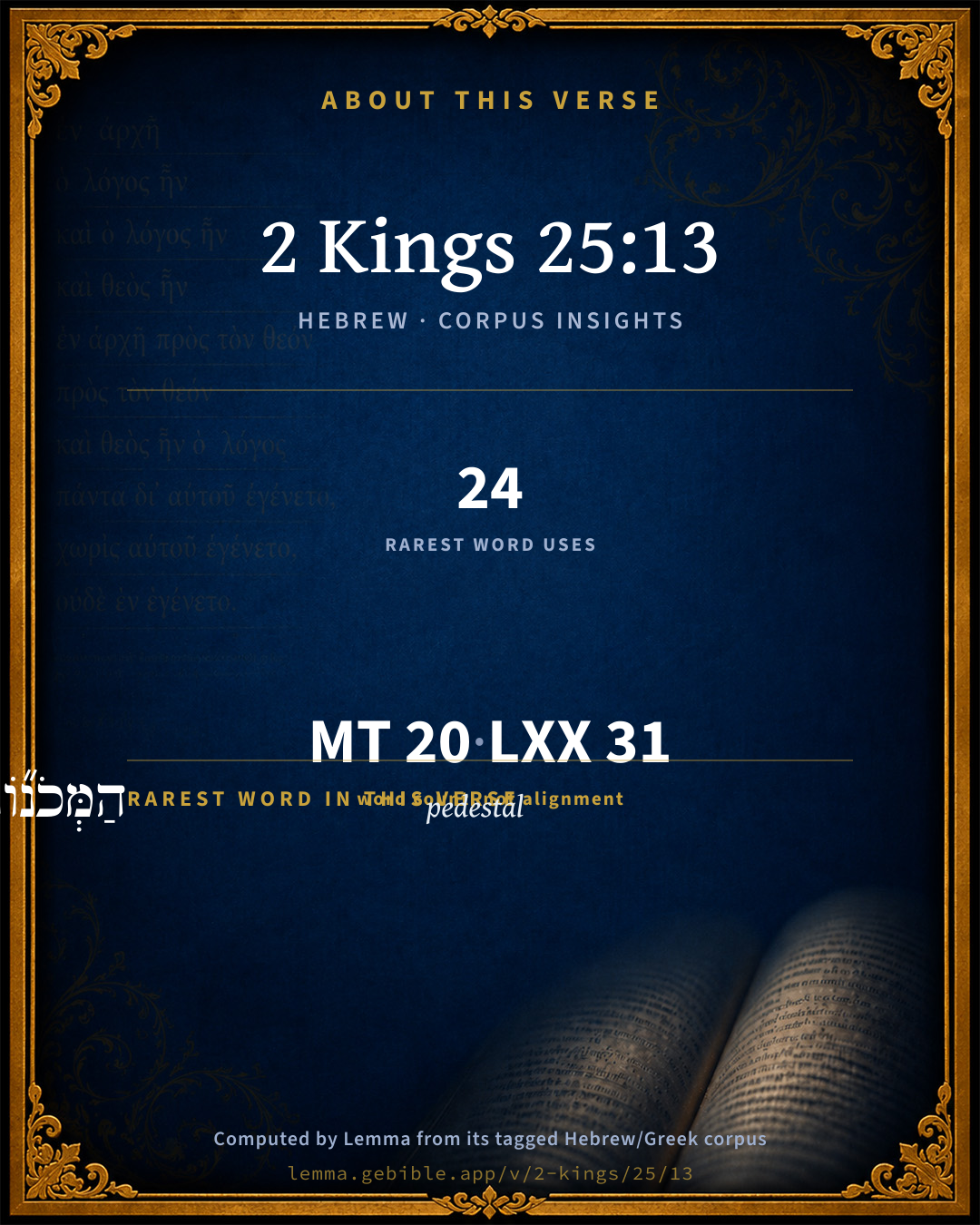
20
words
12
distinct lemmas
Historical
section

Notable vocabulary

The rarest word here is הַמְּכֹנ֞וֹת pedestal H4350 — appearing just 24 times in the whole Hebrew Bible.

Shared distinctive vocabulary

הַמְּכֹנ֞וֹת pedestal H4350 occurs in 18 verses of the Hebrew Bible. Also found in:

Grammatical profile

  • 2 verbs
  • 12 nouns
  • 6 particles

Verb forms

  • שִׁבְּר֣וּ Piel · Perfect
  • וַיִּשְׂא֥וּ Qal · Sequential Imperfect

Repetition

Words recur within this verse — often emphatic in Hebrew:

  • הַנְּחֹ֜שֶׁת bronze H5178 ×3
  • בֵּית house H1004 ×2
  • יְהוָ֗ה LORD H3068 ×2
  • אֲשֶׁ֣ר which H834 ×2

Hebrew & Septuagint length

In English translation the verse runs 39 words from the Hebrew and 38 from the Septuagint (LXX English) — closely comparable.

A rough comparison of the two English renderings, which tokenize alike — not a word-level alignment.

Word counts can differ between the Hebrew and the Greek without any difference in meaning — e.g. the Hebrew direct-object marker אֵת has no separate Greek word, and Greek often adds the article ὁ.

In the original languages it is 20 Hebrew tokens and 31 Greek tokens — but the two are counted differently (Hebrew bundles its prefixes and suffixes into one token; the Greek is in lemma form), so that isn’t a like-for-like length.

Cross-references

10

Topical passages linked to 2 Kings 25:13 in the Treasury of Scripture Knowledge — connected by theme and wording, ordered by reader-vote popularity; previews shown in the World English Bible.

  • 2 Chronicles 36:18 All the vessels of the house of God, great and small, and the treasures of the house of Yahweh, and the treasures of the king, and of his princes, all these he brought to Babylon.
  • 1 Kings 7:15 For he fashioned the two pillars of brass, eighteen cubits high apiece: and a line of twelve cubits compassed either of them about.
  • 2 Kings 20:17 Behold, the days come, that all that is in your house, and that which your fathers have laid up in store to this day, shall be carried to Babylon: nothing shall be left, says Yahweh.
  • Jeremiah 52:17–20 The pillars of brass that were in the house of Yahweh, and the bases and the brazen sea that were in the house of Yahweh, did the Chaldeans break in pieces, and carried all the brass of them to Babylon.
  • Lamentations 1:10 The adversary has spread out his hand on all her pleasant things: For she has seen that the nations are entered into her sanctuary, Concerning whom you did command that they should not enter into your assembly.
  • Exodus 27:3 You shall make its pots to take away its ashes, its shovels, its basins, its flesh hooks, and its fire pans: all its vessels you shall make of brass.
  • 1 Kings 7:23–45 He made the molten sea of ten cubits from brim to brim, round in compass, and the height of it was five cubits; and a line of thirty cubits compassed it round about.
  • 2 Chronicles 4:2–6 Also he made the molten sea of ten cubits from brim to brim, round in compass; and the height of it was five cubits; and a line of thirty cubits compassed it round about.
  • 2 Chronicles 4:12–16 the two pillars, and the bowls, and the two capitals which were on the top of the pillars, and the two networks to cover the two bowls of the capitals that were on the top of the pillars,
  • Jeremiah 27:19–22 For thus says Yahweh of Hosts concerning the pillars, and concerning the sea, and concerning the bases, and concerning the residue of the vessels that are left in this city,

Cross-references courtesy of OpenBible.info (CC BY 4.0).

Hebrew and Greek witnesses Masoretic Hebrew ↔ Greek Septuagint

The same verse in the two great witnesses to the Old Testament, shown verse-for-verse.

These are two independent witnesses, not word-aligned to each other, and the Septuagint is shown in lemma (dictionary) form.

Hebrew 2 Kings 25:13 Masoretic · Westminster Leningrad Codex

וְאֶת עַמּוּדֵ֨י הַנְּחֹ֜שֶׁת אֲשֶׁ֣ר בֵּית יְהוָ֗ה וְֽאֶת הַמְּכֹנ֞וֹת וְאֶת יָ֧ם הַנְּחֹ֛שֶׁת אֲשֶׁ֥ר בְּבֵית יְהוָ֖ה שִׁבְּר֣וּ כַשְׂדִּ֑ים וַיִּשְׂא֥וּ אֶת נְחֻשְׁתָּ֖ם בָּבֶֽלָה

The pillars of brass that were in the house of Yahweh, and the bases and the brazen sea that were in the house of Yahweh, did the Chaldeans break in pieces, and carried the brass of them to Babylon.

World English Bible · Public Domain

Greek LXX 2 Kings 25:13 Septuagint · lemma form

καί ὁ στῦλος ὁ χαλκός ὁ ἐν οἶκος κύριος καί ὁ μεχωνωθ καί ὁ θάλασσα ὁ χαλκοῦς ὁ ἐν οἶκος κύριος συντρίβω ὁ χαλδαῖος καί αἴρω ὁ χαλκός αὐτός εἰς βαβυλών

And the Chaldeans broke to pieces the brazen pillars that were in the house of the Lord, and the bases, and the brazen sea that was in the house of the Lord, and carried their brass to Babylon.

LXX2012 (modern English Septuagint) · Public Domain

Hebrew: Westminster Leningrad Codex (CC BY 4.0). Greek: Septuagint (public domain); English from LXX2012 (modern English Septuagint) (Public Domain). How the Septuagint differs from the Hebrew →

Targum (Aramaic paraphrase)

1

The Targum is the ancient Jewish Aramaic paraphrase of the Hebrew Scriptures — an interpretive translation, not the Hebrew text itself. Onkelos (literal) and Pseudo-Jonathan (expansive) render the Torah, and Jonathan the Prophets. Coverage is partial: where no permissively-licensed English translation exists for a verse, only the Aramaic is shown. This is verse-level text, not a word-by-word alignment to the Hebrew.

  1. Targum Jonathan Prophets (Joshua–Malachi)
    וְיַת עֲמוּדֵי נְחָשָׁא דִבְבֵית מַקְדְשָׁא דַייָ וְיַת בְּסִיסַיָא וְיַת יַמָא דִנְחָשָׁא דִי בְּבֵית מַקְדְשָׁא דַייָ תְּבַרוּ כַסְדָאֵי וְאוֹבִילוּ יַת נְחָשֵׁיהוֹן לְבָבֶל:

    (no public-domain English translation for this verse)

    Targum Jonathan — Aramaic: “Mikraot Gedolot” (public domain). English: “Sefaria Community Translation” (CC0 1.0 (public-domain dedication)); “London "Chaldee Paraphrase," 1871” (public domain). Text via Sefaria.

Commentary

Notes on 2 Kings 25:13 from classic Christian and Jewish commentators (each source and its license shown beneath its notes). The classic Christian expositions comment on the surrounding passage and are grouped to its opening verse, so a note may address several verses; the Jewish commentaries on the Tanakh (Rashi and others) are per-verse, so they appear only where the commentator wrote on this verse.

Lemma curates 59 commentaries, every one of them public domain or Creative Commons licensed, each selected and text-cleaned for this edition rather than reprinted as found. About our sources →

Trapp's Complete Commentary

John Trapp

2Ki 25:13 And the pillars of brass that [were] in the house of the LORD, and the bases, and the brasen sea that [was] in the house of the LORD, did the Chaldees break in pieces, and carried the brass of them to Babylon.

Ver. 13. And the pillars of brass.] The ornaments of the temple and instruments of God’s service were all carried away, as had been foretold. {Jer 27:21-22} But it befell Jeremiah, as the poets feign of Cassandra, that he spake truth, but could not be believed.

And carried the brass.] It being very fine brass. {1Ki 7:15}

John Trapp, A Commentary or Exposition upon All the Books of the Old and New Testament (1647–1656) — public domain. Text from a community e-Sword module.

Joseph Benson's Commentary

2Ki 25:13. The pillars of brass, &c., did the Chaldees break in pieces — Because they were too cumbersome to be carried away whole. And carried the brass of them to Babylon — As was foretold Jer 27:21-22.

Joseph Benson's Commentary on the Old and New Testaments (1811–1818) — public domain. Text from a community e-Sword module.

Tyndale Open Study Notes

Tyndale Open Resources

25:13-16 The Babylonians broke up the Temple furnishings that had been crafted by Huram of Tyre and all the other bronze articles (see 1 Kgs 7:13-50) for their own use. The transport of these valuable furnishings to Babylon was a major undertaking; everything of value was carried away (see also Jer 52:17-23).

Tyndale Open Study Notes — © Tyndale Open Resources, licensed CC BY-SA 4.0. Text via the HelloAO Bible API.

Ellicott's Commentary for English Readers

(13) And the pillars of brass.—From this point Jeremiah 39 ceases to be parallel with the present narrative. (See the Notes on 1Ki_7:15 seq., for the objects enumerated in this and the following verses.) Instead of “brass” we should probably understand copper throughout.

A Bible Commentary for English Readers, edited by Charles John Ellicott (1878–1897) — public domain. Text from a community e-Sword module.

The Cambridge Bible for Schools and Colleges

gen. ed. J. J. S. Perowne

13. and the pillars of brass] These were the pillars, Jachin and Boaz, the two masterpieces of Hiram mentioned in 1Ki_7:15. Their position was not within the house, but in the porch (see 1Ki_7:21 and all the notes there).

and the bases] See 1Ki_7:27. These were richly wrought stands to support the lavers used in the sacrificial services.

and the brasen sea that was [R.V. were] in the house of the Lord] On the brasen sea, see 1Ki_7:23. Both the bases and the sea were within the inner court.

The Cambridge Bible for Schools and Colleges (gen. ed. J. J. S. Perowne; Cambridge University Press, 1878–1918) — public domain. Text from a community e-Sword module.

John Gill's Exposition

And the captain of the guard took Seraiah the chief priest, and Zephaniah the second priest,.... The sagan, or deputy priest, who officiated for the high priest, when by any means he was rendered unfit and incapable; so Joseph, the son of Ellem, as Josephus (x) relates, officiated for Matthias, when defiled with a nocturnal pollution; and seven days before the day of atonement they always substituted one under the high priest, lest anything of this kind should happen to him (y). From hence, to the end of Kg2 25:21 the account is the same as in Jer 52:25, only here in Kg2 25:19 it is said, that five men that were in the king's presence were taken, there seven men; to account for which; see Gill on Jer 52:25.

(x) Antiqu. l. 17. c. 6. sect. 4. (y) Misn. Yoma, c. 1. sect. 1.

John Gill's Exposition of the Whole Bible (1746–1763) — public domain (CC PDM 1.0). Text via the HelloAO Bible API.

Albert Barnes' Notes on the Bible

The pillars of brass ... - All the more precious treasures had been already removed from the temple 2Ki 24:13. But there still remained many things, the list of which is given in Jer 52:17-23 much more fully than in this place. Objects in brass, or rather bronze, were frequently carried off by the Assyrians from the conquered nations. Bronze was highly valued, being the chief material both for arms and implements. The breaking up of the pillars, bases, etc., shows that it was for the material, and not for the workmanship, that they were valued. On the various articles consult the marginal references.

Albert Barnes' Notes on the Bible (1834–1885) — public domain. Text from a community e-Sword/MySword module.

Matthew Poole's English Annotations

The pillars of brass; the carriage whereof to Babylon was foretold, Jer 27:19,22.

Matthew Poole's English Annotations on the Holy Bible (1683–1685) — public domain. Text from a community e-Sword/MySword module.

Whedon's Commentary on the Bible

Daniel D. Whedon

13. Pillars… bases… sea — See on 1Ki_7:15; 1Ki_7:23; 1Ki_7:27.

Daniel D. Whedon (gen. ed.), Commentary on the Old and New Testaments (1874–1909) — public domain. Text from a community e-Sword module.

The Pulpit Commentary

And the pillars of brass that were in the house of the Lord. The two columns, Jachin and Boaz, cast by Hiram under the directions of Solomon, (1Ki_7:15-22) are intended. They were works of art of an elaborate character, but being too bulky to be carried off entire, they were "broken in pieces." And the bases. "The bases" were the stands for the layers, also made by Hiram for Solomon, (1Ki_7:27-37) and very elaborate, having "borders" ornamented with lions, oxen, and cherubim. And the brazen sea that was in the house of the Lord. This was the great laver, fifteen feet in diameter, emplaced originally on the backs of twelve oxen, three facing each way, (1Ki_7:23-26) which King Ahaz had taken down from off the oxen (2Ki_16:17) and "put upon a pavement of stones," but which Hezekiah had probably restored. The oxen are mentioned by Jer_52:20 among the objects which Nebuzar-adan carried off. Did the Chaldees break in pieces thus destroying the workmanship, in which their value mainly consistedand carried the brass of them to Babylon. Brass, or rather bronze, was used by the Babylonians for vessels, arms, armor, and implements generally.

The Pulpit Commentary (1880–1919), ed. H.D.M. Spence-Jones & Joseph S. Exell — public domain. Text from a community e-Sword module.

unfoldingWord translationNotes

Door43 World Missions Community

As for the bronze pillars ... Yahweh, the Chaldeans

"This is what happened to the bronze pillars ... Yahweh: the Chaldeans"

the stands

This refers to the large, moveable bronze stands with bronze wheels and axles. "the moveable bronze stands" or "the bronze stands with wheels"

the bronze sea

"the large bronze basin"

broke them into pieces

"cut them into pieces" or "chopped them up into small pieces"

shovels

A shovel was a tool that was used to clean the altar, typically used to move big piles of dirt, sand, or ashes.

with which the priests had served in the temple

"which the priests had used in the temple service"

The pots for removing ashes

You may need to make explicit which ashes are spoken of. AT: "The pots that were used for removing ashes from the altar" (See: Assumed Knowledge and Implicit Information)

translationWords

bronze

column

house of God

Chaldea

Babylon

lamp

priest

servant

temple

gold

silver

unfoldingWord translationNotes — © Distant Shores Media and the Door43 World Missions Community, licensed CC BY-SA 4.0. Source: git.door43.org/Door43/en_tn.

Lesson kit

Teaching starters — assembled from the data on this page, not authored interpretation. Every prompt links to the verse data it draws on. Edit before teaching.

2 Kings, in the Historical, opens this verse with 20 words (12 distinct Hebrew lemmas). Its most distinctive word is mᵉkôwnâh (“pedestal”). A historical commentator’s framing appears above. Read the whole chapter for the surrounding context.

Discussion questions

  1. What does “pedestal” (mᵉkôwnâh) contribute to the verse as a whole?
  2. How does 1 Kings 7:27, which shares the word «pedestal», read alongside this verse?
  3. What does the repetition of “bronze” (3× in this one verse) do in this verse?
  4. The translations on this page render this verse differently — a whole-verse word diff, not a word-by-word alignment. What might account for the different wordings?
  5. «שִׁבְּר֣וּ» is a Piel Perfect verb. How does that grammatical form shape the action described?
  6. Compare how Trapp's Complete Commentary and Joseph Benson's Commentary read this verse. Where do they agree or differ?

Things to notice

Reading settings

Reading text

Shown beneath each verse's original-language words.

Old Testament
Old Testament edition

Read the OT as the Masoretic Hebrew (MT) or the Greek Septuagint (LXX).

English shown for the Greek Septuagint (in the Hebrew ↔ Greek comparison).

Comparing translations? Open the Compare panel on any verse page to stack up to four side by side.