
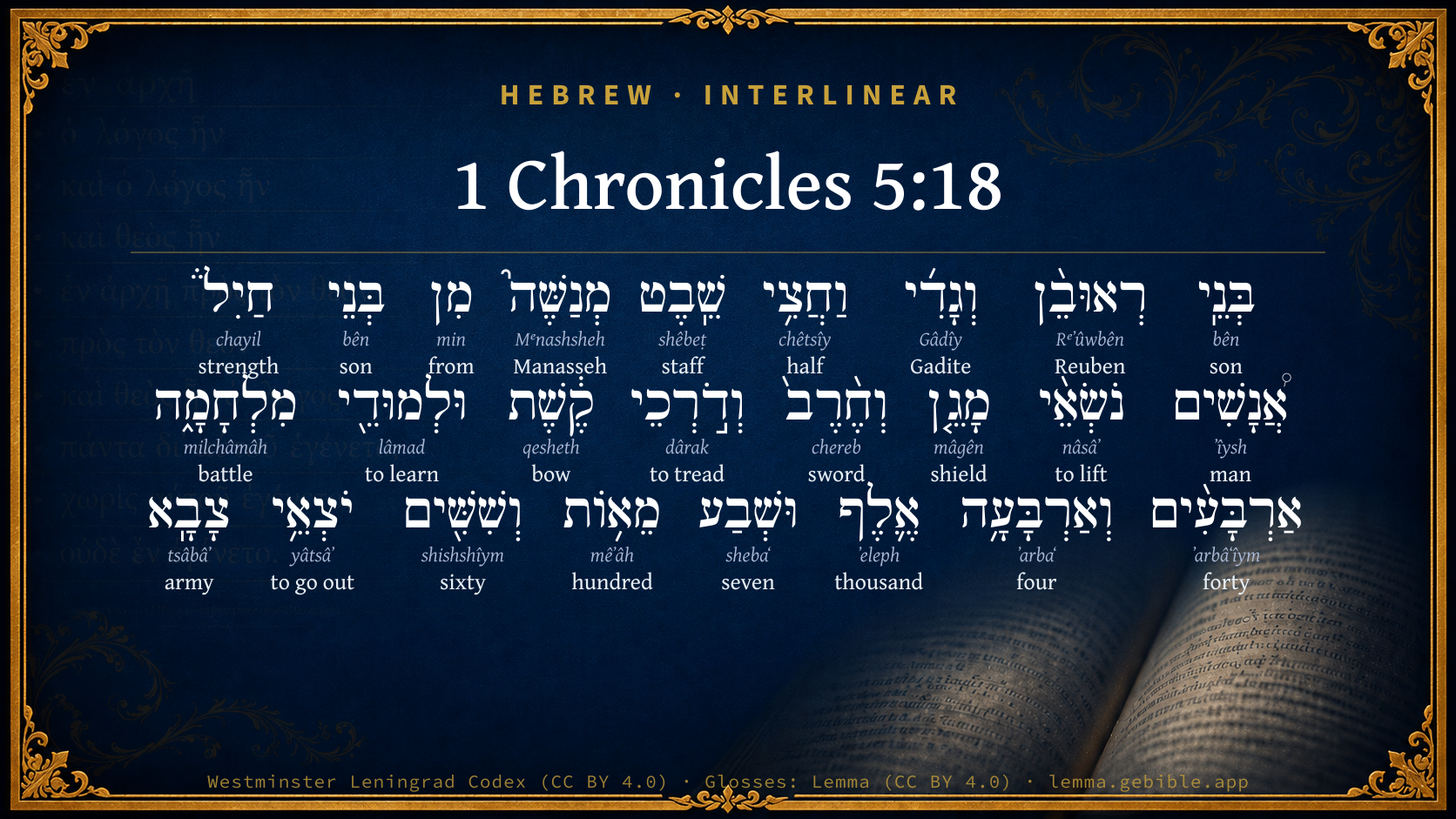
1 Chronicles 5:18

Hebrew (Westminster Leningrad Codex) 1 Chronicles 5:18 appears in the Hebrew Old Testament. The text above is from the Westminster Leningrad Codex. Each word links to its Strong’s number, a concise gloss, and parsing drawn from the Open Scriptures Hebrew Bible morphology. Click any word for its full Brown-Driver-Briggs (BDB) entry.
Download image
Cite this verse

1 Chronicles 5:18 (World English Bible). Public Domain. Lemma interlinear Bible study tool, https://lemma.gebible.app/v/1-chronicles/5/18.

Show BibTeX & RIS
BibTeX
RIS
English Translation
The sons of Reuben, and the Gadites, and the half-tribe of Manasseh, of valiant men, men able to bear buckler and sword, and to shoot with bow, and skillful in war, were forty-four thousand seven hundred and sixty, that were able to go forth to war.
World English Bible · Public Domain
Download a study sheet

One document with this verse’s original text, its word-by-word gloss line, the meaning frame, cross-references with their text, attributed commentary, and full source and license credits — printable, and it pastes into notes with its structure intact.

This verse Autodidact and up

Study sheet (.html) Plain text (.txt)

A passage Seminary Student

Up to 50 verses in one chapter. A passage sheet keeps up to 6 commentary sources and 12 cross-references per verse, in the order this page ranks them, and says so on the sheet whenever that leaves anything out. Ask for a single verse and you get the Autodidact verse sheet above.

Everything on this page stays free to read, with no account — the sheet is a download of what is already on screen, not access to it.

Want to remove ads? Support Godless Engineer
Compare translations 3

The same verse in 3 English versions, stacked beneath the original-language interlinear above. Click any original word for its lexicon entry.

Each is an independent rendering of the whole verse — the interlinear is not word-aligned to these translations.

Highlighted words mark where these versions differ — a whole-verse word diff, not a word-by-word alignment.

  • World English Bible Public Domain
    The sons of Reuben, and the Gadites, and the half-tribe of Manasseh, of valiant men, men able to bear buckler and sword, and to shoot with bow, and skillful in war, were forty-four thousand seven hundred and sixty, that were able to go forth to war.
  • King James Version Public Domain
    The sons of Reuben, and the Gadites, and half the tribe of Manasseh, of valiant men, men able to bear buckler and sword, and to shoot with bow, and skillful in war, were four and forty thousand seven hundred and threescore, that went out to the war.
  • unfoldingWord Literal Text CC BY-SA 4.0
    The sons of Reuben and the Gadite and half of the tribe of Manasseh, from sons of valor, men, carriers of the shield and sword and treaders of the bow and taught of battle, 44,760 going out an army.

unfoldingWord Literal Text — © unfoldingWord, licensed CC BY-SA 4.0. Word-aligned USFM3 via Door43 (git.door43.org/unfoldingWord/en_ult).

Versions to compare (up to 4)

3 of 4 selected

Show all 18 translations

Every available English version of this verse, each an independent rendering of the whole verse.

  • World English Bible Public Domain
    The sons of Reuben, and the Gadites, and the half-tribe of Manasseh, of valiant men, men able to bear buckler and sword, and to shoot with bow, and skillful in war, were forty-four thousand seven hundred and sixty, that were able to go forth to war.
  • Berean Standard Bible Public Domain
    The Reubenites, the Gadites, and the half-tribe of Manasseh had 44,760 warriors—valiant men who carried the shield and sword, drew the bow, and were trained for battle.
  • Majority Standard Bible Public Domain
    The Reubenites, the Gadites, and the half-tribe of Manasseh had 44,760 warriors—valiant men who carried the shield and sword, drew the bow, and were trained for battle.
  • King James Version Public Domain
    The sons of Reuben, and the Gadites, and half the tribe of Manasseh, of valiant men, men able to bear buckler and sword, and to shoot with bow, and skillful in war, were four and forty thousand seven hundred and threescore, that went out to the war.
  • American Standard Version (1901) Public Domain
    The sons of Reuben, and the Gadites, and the half-tribe of Manasseh, of valiant men, men able to bear buckler and sword, and to shoot with bow, and skilful in war, were forty and four thousand seven hundred and threescore, that were able to go forth to war.
  • Revised Version (1885) Public Domain
    The sons of Reuben, and the Gadites, and the half tribe of Manasseh, of valiant men, men able to bear buckler and sword, and to shoot with bow, and skilful in war, were forty and four thousand seven hundred and threescore, that were able to go forth to war.
  • Geneva Bible (1599) Public Domain
    The sonnes of Reuben and of Gad, and of halfe the tribe of Manasseh of those that were viliant men, able to beare shield, and sworde, and to draw a bowe, exercised in warre, were foure and fourtie thousand, seuen hundreth and three score, that went out to the warre.
  • Douay-Rheims (1899) Public Domain
    The sons of Ruben, and of Gad, and of the half tribe of Manasses, fighting men, bearing shields, and swords, and bending the bow, and trained up to battles, four and forty thousand seven hundred and threescore that went out to war.
  • Young's Literal Translation Public Domain
    Sons of Reuben, and the Gadite, and the half of the tribe of Manasseh, of sons of valour, men bearing shield and sword, and treading bow, and taught in battle, `are' forty and four thousand and seven hundred and sixty, going out to the host.
  • Literal Standard Version CC BY-SA 4.0
    Sons of Reuben, and the Gadite, and the half of the tribe of Manasseh, of sons of valor, men carrying shield and sword, and treading bow, and taught in battle, [are] forty-four thousand and seven hundred and sixty, going out to the host.
  • Unlocked Literal Bible CC BY-SA 4.0
    The Reubenites, the Gadites, and the half tribe of Manasseh had 44,760 soldiers trained for war, who carried shield and sword, and who drew the bow.
  • unfoldingWord Literal Text CC BY-SA 4.0
    The sons of Reuben and the Gadite and half of the tribe of Manasseh, from sons of valor, men, carriers of the shield and sword and treaders of the bow and taught of battle, 44,760 going out an army.
  • Darby Bible Public Domain
    The children of Reuben and the Gadites and half the tribe of Manasseh, of valiant men, men who carried shield and sword, drawing the bow and skilful in war, were forty-four thousand seven hundred and sixty, able to go forth to war.
  • World Messianic Bible Public Domain
    The sons of Reuben, the Gadites, and the half-tribe of Manasseh, of valiant men, men able to bear buckler and sword, able to shoot with bow, and skillful in war, were forty-four thousand seven hundred sixty that were able to go out to war.
  • Webster's Bible Public Domain
    The sons of Reuben, and the Gadites, and half the tribe of Manasseh, of valiant men, men able to bear buckler and sword, and to shoot with bow, and skillful in war, were four and forty thousand seven hundred and sixty, that went out to the war.
  • Free Bible Version CC BY-SA 4.0
    The tribe of Reuben, the tribe of Gadites, and the half-tribe of Manasseh had 44,760 battle-ready strong warriors capable of using shields and swords and bows.
  • Bible in Basic English Public Domain
    There were forty-four thousand, seven hundred and sixty of the sons of Reuben and of the Gadites and of the half-tribe of Manasseh, all strong men, expert in the use of the body-cover, the sword, and the bow, and in the art of war, all able to take up arms.
  • JPS Tanakh (1917) Public Domain
    The sons of Reuben, and the Gadites, and the half-tribe of Manasseh, as many as were valiant men, men able to bear buckler and sword, and to shoot with bow, and skilful in war, were forty and four thousand seven hundred and threescore, that were able to go forth to war.

Literal Standard Version (2020), Covenant Press — licensed CC BY-SA 4.0. Text via the HelloAO Bible API (eBible.org). Unlocked Literal Bible (unfoldingWord) — licensed CC BY-SA 4.0. Text via the HelloAO Bible API (eBible.org). unfoldingWord Literal Text — © unfoldingWord, licensed CC BY-SA 4.0. Word-aligned USFM3 via Door43 (git.door43.org/unfoldingWord/en_ult). Free Bible Version, Dr. Jonathan Gallagher — licensed CC BY-SA 4.0. Text via the HelloAO Bible API (eBible.org).

Word by word

More ways to search: Search by grammar → Find every occurrence → Compare this word →

Practice this passage: Drill this verse → Learn its vocabulary →

וְגָדִ֜י
Gâdîy
H1425
“and · Gadite”
Conjunction + Noun, Gentilic, Masculine, Singular, Absolute
Part of Speech
Conjunction + Noun
Type
Gentilic
Gender
Masculine
Number
Singular
State
Absolute
Full BDB Definition

Origin: patronymically from H1410

TWOT: None

Gadite = "an invader: a troop: fortune" - one of the tribe descended from Gad
  1. בְּנֵֽי bên H1121 “sons of” Noun, Common, Masculine, Plural, Construct
  2. רְאוּבֵ֨ן Rᵉʼûwbên H7205 “Reuben” Noun, Proper
  3. וַחֲצִ֥י chêtsîy H2677 “and · half of” Conjunction + Noun, Common, Masculine, Singular, Construct
  4. שֵֽׁבֶט shêbeṭ H7626 “staff of” Noun, Common, Masculine, Singular, Construct
  5. מְנַשֶּׁה֮ Mᵉnashsheh H4519 “Manasseh” Noun, Proper
  6. מִן min H4480 “from” Preposition
  7. בְּנֵי bên H1121 “sons of” Noun, Common, Masculine, Plural, Construct
  8. חַיִל֒ chayil H2428 “strength” Noun, Common, Masculine, Singular, Absolute
  9. אֲ֠נָשִׁים ʼîysh H376 “men” Noun, Common, Masculine, Plural, Absolute
  10. נֹשְׂאֵ֨י nâsâʼ H5375 “lifting” Verb, Qal, Participle Active, Masculine, Plural, Construct
  11. מָגֵ֤ן mâgên H4043 “shield” Noun, Common, Both, Singular, Absolute
  12. וְחֶ֨רֶב֙ chereb H2719 “and · sword” Conjunction + Noun, Common, Feminine, Singular, Absolute
  13. וְדֹ֣רְכֵי dârak H1869 “and · treading” Conjunction + Verb, Qal, Participle Active, Masculine, Plural, Construct
  14. קֶ֔שֶׁת qesheth H7198 “bow” Noun, Common, Feminine, Singular, Absolute
  15. וּלְמוּדֵ֖י lâmad H3925 “and · learned” Conjunction + Verb, Qal, Participle Passive, Masculine, Plural, Construct
  16. מִלְחָמָ֑ה milchâmâh H4421 “battle” Noun, Common, Feminine, Singular, Absolute
  17. אַרְבָּעִ֨ים ʼarbâʻîym H705 “forty” Adjective, Cardinal number, Both, Plural, Absolute
  18. וְאַרְבָּעָ֥ה ʼarbaʻ H702 “and · four” Conjunction + Adjective, Cardinal number, Masculine, Singular, Absolute
  19. אֶ֛לֶף ʼeleph H505 “thousand” Adjective, Cardinal number, Both, Singular, Absolute
  20. וּשְׁבַע shebaʻ H7651 “and · seven” Conjunction + Adjective, Cardinal number, Feminine, Singular, Absolute
  21. מֵא֥וֹת mêʼâh H3967 “hundred” Adjective, Cardinal number, Both, Plural, Absolute
  22. וְשִׁשִּׁ֖ים shishshîym H8346 “and · sixty” Conjunction + Adjective, Cardinal number, Both, Plural, Absolute
  23. יֹצְאֵ֥י yâtsâʼ H3318 “going out” Verb, Qal, Participle Active, Masculine, Plural, Construct
  24. צָבָֽא tsâbâʼ H6635 “army” Noun, Common, Both, Singular, Absolute

About this verse

These counts appear in no published source. They are computed here, from the morphology-tagged text and Lemma’s own curated glosses. What Lemma adds →

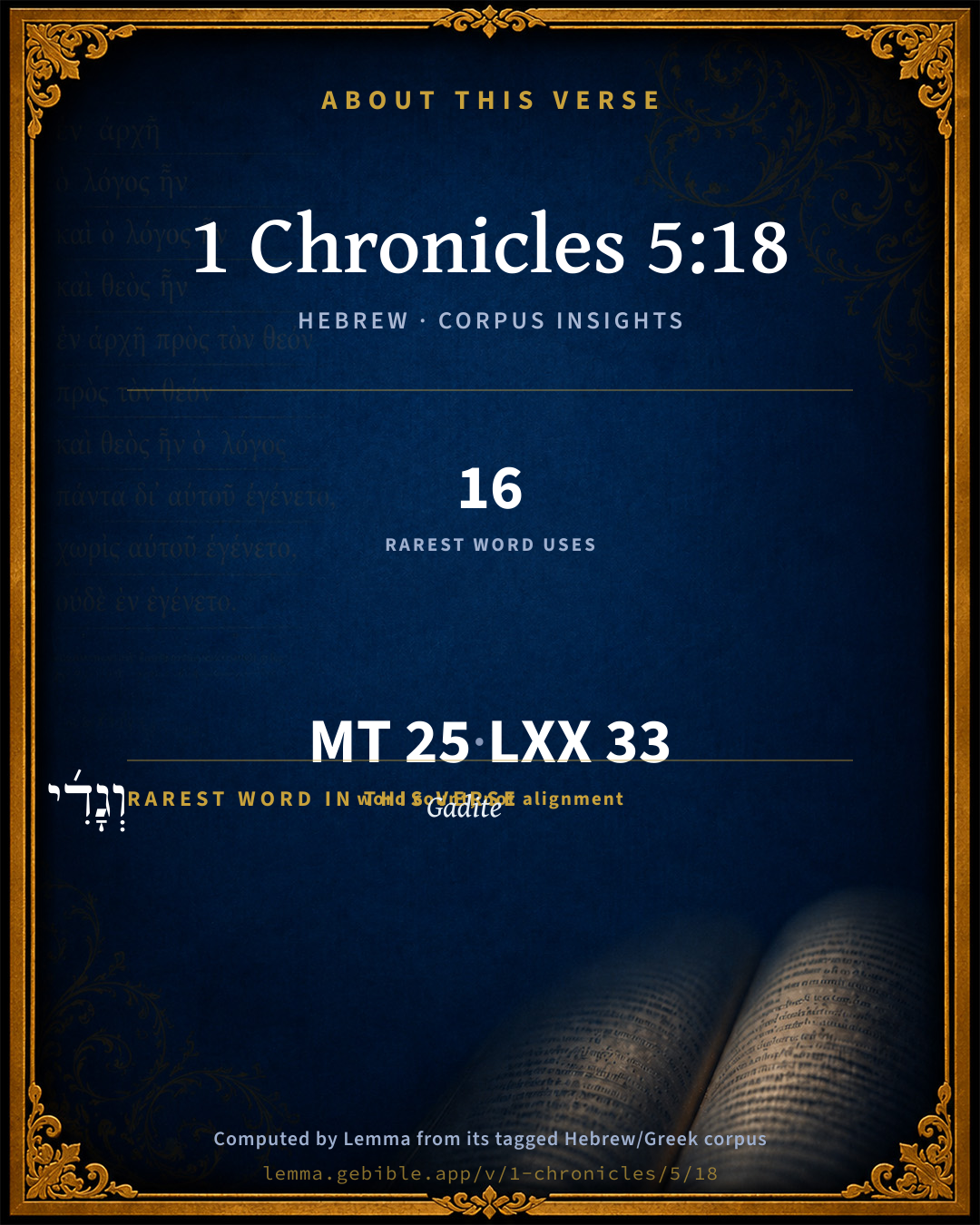
25
words
24
distinct lemmas
Historical
section

Notable vocabulary

The rarest word here is וְגָדִ֜י Gadite H1425 — appearing just 16 times in the whole Hebrew Bible.

Shared distinctive vocabulary

וְגָדִ֜י Gadite H1425 occurs in 16 verses of the Hebrew Bible. Also found in:

Grammatical profile

  • 4 verbs
  • 14 nouns
  • 6 adjectives
  • 1 preposition

Verb forms

  • נֹשְׂאֵ֨י Qal · Participle Active
  • וְדֹ֣רְכֵי Qal · Participle Active
  • וּלְמוּדֵ֖י Qal · Participle Passive
  • יֹצְאֵ֥י Qal · Participle Active

Repetition

A word recurs within this verse — often emphatic in Hebrew:

  • בְּנֵֽי son H1121 ×2

Hebrew & Septuagint length

In English translation the verse runs 46 words from the Hebrew and 40 from the Septuagint (LXX English) — closely comparable.

A rough comparison of the two English renderings, which tokenize alike — not a word-level alignment.

Word counts can differ between the Hebrew and the Greek without any difference in meaning — e.g. the Hebrew direct-object marker אֵת has no separate Greek word, and Greek often adds the article ὁ.

In the original languages it is 25 Hebrew tokens and 33 Greek tokens — but the two are counted differently (Hebrew bundles its prefixes and suffixes into one token; the Greek is in lemma form), so that isn’t a like-for-like length.

Cross-references

2

Topical passages linked to 1 Chronicles 5:18 in the Treasury of Scripture Knowledge — connected by theme and wording, ordered by reader-vote popularity; previews shown in the World English Bible.

  • Numbers 1:3 from twenty years old and upward, all who are able to go out to war in Israel. You and Aaron shall number them by their divisions.
  • Joshua 4:12–13 The children of Reuben, and the children of Gad, and the half-tribe of Manasseh, passed over armed before the children of Israel, as Moses spoke to them:

Cross-references courtesy of OpenBible.info (CC BY 4.0).

Hebrew and Greek witnesses Masoretic Hebrew ↔ Greek Septuagint

The same verse in the two great witnesses to the Old Testament, shown verse-for-verse.

These are two independent witnesses, not word-aligned to each other, and the Septuagint is shown in lemma (dictionary) form.

Hebrew 1 Chronicles 5:18 Masoretic · Westminster Leningrad Codex

בְּנֵֽי רְאוּבֵ֨ן וְגָדִ֜י וַחֲצִ֥י שֵֽׁבֶט מְנַשֶּׁה֮ מִן בְּנֵי חַיִל֒ אֲ֠נָשִׁים נֹשְׂאֵ֨י מָגֵ֤ן וְחֶ֨רֶב֙ וְדֹ֣רְכֵי קֶ֔שֶׁת וּלְמוּדֵ֖י מִלְחָמָ֑ה אַרְבָּעִ֨ים וְאַרְבָּעָ֥ה אֶ֛לֶף וּשְׁבַע מֵא֥וֹת וְשִׁשִּׁ֖ים יֹצְאֵ֥י צָבָֽא

The sons of Reuben, and the Gadites, and the half-tribe of Manasseh, of valiant men, men able to bear buckler and sword, and to shoot with bow, and skillful in war, were forty-four thousand seven hundred and sixty, that were able to go forth to war.

World English Bible · Public Domain

Greek LXX 1 Chronicles 5:18 Septuagint · lemma form

υἱός ρουβην καί γαδ καί ἥμισυς φυλή μανασσή ἐκ υἱός δύναμις ἀνήρ αἴρω ἀσπίς καί μάχαιρα καί τείνω τόξον καί διδάσκω πόλεμος τεσσαράκοντα καί τέσσαρες χιλιάς καί ἑπτακόσιοι καί ἑξήκοντα ἐκπορεύομαι εἰς παράταξις

The sons of Ruben and Gad, and the half-tribe of Manasse, of mighty men, bearing shields and sword, and bending the bow, and skilled in war, were forty and four thousand and seven hundred and sixty, going forth to battle.

LXX2012 (modern English Septuagint) · Public Domain

Hebrew: Westminster Leningrad Codex (CC BY 4.0). Greek: Septuagint (public domain); English from LXX2012 (modern English Septuagint) (Public Domain). How the Septuagint differs from the Hebrew →

Commentary

Notes on 1 Chronicles 5:18 from classic Christian and Jewish commentators (each source and its license shown beneath its notes). The classic Christian expositions comment on the surrounding passage and are grouped to its opening verse, so a note may address several verses; the Jewish commentaries on the Tanakh (Rashi and others) are per-verse, so they appear only where the commentator wrote on this verse.

Lemma curates 59 commentaries, every one of them public domain or Creative Commons licensed, each selected and text-cleaned for this edition rather than reprinted as found. About our sources →

Matthew Henry's Commentary

The heads of the half-tribe of Manasseh, that were seated on the other side Jordan, are named here, Ch1 5:23, Ch1 5:24. Their lot, at first, was Bashan only; but afterwards they increased so much in wealth and power that they spread far north, even unto Hermon. Two things only are here recorded concerning these tribes on the other side Jordan, in which they were all concerned. They all shared,

I. In a glorious victory over the Hagarites, so the Ishmaelites were now called, to remind them that they were the sons of the bond-woman, that was cast out. We are not told when this victory was obtained: whether it be the same with that of the Reubenites (which is said Ch1 5:10 to be in the days of Saul), or whether that success of one of these tribes animated and excited the other two to join with them in another expedition, is not certain. It seems, though in Saul's time the common interests of the kingdom were weak and low, some of the tribes that acted separately did well for themselves. We are here told,

1. What a brave army these frontier-tribes brought into the field against the Hagarites, 44,000 men and upwards, all strong, and brave, and skilful in war, so many effective men, that knew how to manage their weapons, Ch1 5:18. How much more considerable might Israel have been than they were in the time of the judges if all the tribes had acted in conjunction!

2. What course they took to engage God for them: They cried to God, and put their trust in him, Ch1 5:20. Now they acted as Israelites indeed. (1.) As the seed of believing Abraham, they put their trust in God. Though they had a powerful army, they relied not on that, but on the divine power. They depended on the commission they had from God to wage war with their neighbours for the enlarging of their coasts, if there was occasion, even with those that were very far off, besides the devoted nations. See Deu 20:15. They depended on God's providence to give them success. (2.) As the seed of praying Jacob, they cried unto God, especially in the battle, when perhaps, at first, they were in danger of being overpowered. See the like done, Ch2 13:14. In distress, God expects we should cry to him; he distrains upon us for this tribute, this rent. In our spiritual conflicts, we must look up to heaven for strength; and it is the believing prayer that will be the prevailing prayer.

3. We are told what success they had: God was entreated of them, though need drove them to him; so ready is he to hear and answer prayer. They were helped against their enemies; for God never yet failed any that trusted in him. And then they routed the enemy's army, though far superior in number to theirs, slew many (Ch1 5:22), took 100,000 prisoners, enriched themselves greatly with the spoil, and settled themselves in their country (Ch1 5:21, Ch1 5:22), and all this because the war was of God, undertaken in his fear and carried on in a dependence upon him. If the battle be the Lord's, there is reason to hope it will be successful. Then we may expect to prosper in any enterprise, and then only, when we take God along with us.

II. They shared, at length, in an inglorious captivity. Had they kept close to God and their duty, they would have continued to enjoy both their ancient lot and their new conquests; but they transgressed against the God of their fathers, Ch1 5:25. They lay upon the borders, and conversed most with the neighbouring nations, by which means they learned their idolatrous usages and transmitted the infection to the other tribes; for this God had a controversy with them. He was a husband to them, and no marvel that his jealousy burnt like fire when they went a whoring after other gods. Justly is a bill of divorce given to the adulteress. God stirred up the spirit of the kings of Assyria, first one and then another, against them, served his own purposes by the designs of those ambitious monarchs, employed them to chastise these revolters first, and, when that humbled them not, then wholly to root them out, Ch1 5:26. These tribes were first placed, and they were first displaced. They would have the best land, not considering that it lay most exposed. But those who are governed more by sense than by reason or faith in their choices may expect to fare accordingly.

Matthew Henry's Commentary on the Whole Bible (1708–1710) — public domain (CC PDM 1.0). Text via the HelloAO Bible API.

Trapp's Complete Commentary

John Trapp

1Ch 5:18 The sons of Reuben, and the Gadites, and half the tribe of Manasseh, of valiant men, men able to bear buckler and sword, and to shoot with bow, and skilful in war, [were] four and forty thousand seven hundred and threescore, that went out to the war.

Ver. 18. Men able to bear buckler and sword, and to shoot with bow.] These weapons were much in use till guns were invented; to the destruction, not of the inventor only - who was therefore hanged they say - but of many other brave marshals.

John Trapp, A Commentary or Exposition upon All the Books of the Old and New Testament (1647–1656) — public domain. Text from a community e-Sword module.

Joseph Benson's Commentary

1Ch 5:18-20. The sons of Reuben, &c. — These three tribes, or at least so many of them as made a great army, joined their forces together, consisting of their best soldiers, to invade the country of the Hagarites. They were helped against them — Against the Hagarites, who, it seems, fought stoutly; but God assisted the Israelites, enduing them with extraordinary courage and success, in consequence of their crying to him, and putting their trust in him, in his power, mercy, and faithfulness to his promise.

Joseph Benson's Commentary on the Old and New Testaments (1811–1818) — public domain. Text from a community e-Sword module.

Tyndale Open Study Notes

Tyndale Open Resources

5:18-22 The account of the war against the Hagrites develops the elements introduced in 5:10. It was a struggle among shepherds over grazing territory. All three tribes were participants; the Chronicler details their prowess, military qualifications, and numbers. With God . . . fighting against the enemy, the victory resulted in enormous spoils and total possession of the territory.

Tyndale Open Study Notes — © Tyndale Open Resources, licensed CC BY-SA 4.0. Text via the HelloAO Bible API.

Jamieson, Fausset & Brown

Robert Jamieson, A. R. Fausset & David Brown

Hagarites--or, "Hagarenes," originally synonymous with "Ishmaelites," but afterwards applied to a particular tribe of the Arabs (compare Psa 83:6).

Jetur--His descendants were called Itureans, and the country Auranitis, from Hauran, its chief city. These, who were skilled in archery, were invaded in the time of Joshua by a confederate army of the tribes of Reuben, Gad, and half Manasseh, who, probably incensed by the frequent raids of those marauding neighbors, took reprisals in men and cattle, dispossessed almost all of the original inhabitants, and colonized the district themselves. Divine Providence favoured, in a remarkable manner, the Hebrew army in this just war.

Jamieson, Fausset & Brown — Commentary Critical and Explanatory on the Whole Bible (1871) — public domain (CC PDM 1.0). Text via the HelloAO Bible API.

Ellicott's Commentary for English Readers

(18-22) A war of conquest between the three tribes east of Jordan, and their Arab neighbours. The date is not given.

(18) Of valiant men.—“All that were valiant men, bearing shield and sword, and drawing bow, and-trained in warfare, were 44,760, going out in the host” Comp. what is said in 1Ch_12:8; 1Ch_12:21, of the Gadites and Manassites, who joined fortunes with David. The number of the warriors of the three tribes nearly corresponds to the number (40,000) assigned in Jos_4:13. It evidently rests upon some official census, of which the chronicler had the record or among his authorities. The data of the Pentateuch (Numbers 1, 26) are quite different,

(19) Hagarites.—See 1Ch_5:10.

Jetur, and Nephish, and Nodab.—In 1Ch_1:31, Jetur, Naphish, and Kedemah are the last three of the twelve tribes of Ishmael. As Nodab is mentioned nowhere else, the word may be a corruption of Kedemah, or rather Kedem. The first two letters might have been mistaken for h, the d is common to both words, and b and m are often confused in Hebrew writing. Jetur is the original of the classical name Ituraea, the modern El-Jedur.

(20) And they were helped against them.—The same word recurs in 1Ch_15:26 : “And when God helped the Levites that bare the Ark.” In both places strictly natural events are regarded as providential. Here the Divine hand is recognised as controlling the issues of an invasion; there as permitting the Ark to be successfully removed from its temporary resting place.

For they cried to God in the battle.—No doubt the Arab warriors also cried to their gods in the fierce struggle for life; and their faith, such as it was, gave them strength for the battle. (Comp. Psa_18:3-6 and Psa_18:41.) The whole sentence to the end of the verse looks like a reason added to the narrative by the chronicler himself.

(21) And they took away their cattle.—The numbers are large, but not at all incredible. Flocks and herds naturally constituted the chief wealth of these nomade tribes. Comp. the annual tribute in kind paid by Mesha, king of Moab, to Ahab of Israel (2Ki_3:4): “a hundred thousand lambs, and a hundred thousand rams in fleeces.”

Sheep.—The Heb. word denotes both sheep and goats; pecora.

Of men an hundred thousand.—And persons (soul of man, a collective expression) a hundred thousand. In Num_31:32-35 the booty taken from Midian is far greater, but only 32,000 virgins were saved from the general slaughter of the vanquished. The number here may be corrupt, but we do not know enough about the numerical strength of the Arabian peoples to be able to decide. The captives would be valuable as slaves. Sennacherib boasts that he took 200,150 persons “small and great, male and female,” from the cities of Judah.

(22) There fell down many slain.—Hence the richness of the plunder. The warriors of the Arabian allies were probably exterminated.

The war was of God.—Comp. 2Ch_25:20. This accounts for the completeness of the Arabian overthrow. It is a human instinct to see tokens of Divine activity in great national catastrophes, as well as in the more awful phenomena of nature. In prophetic language, a “day of the Lord” had overtaken the sons of Hagar and their kindred.

And they dwelt in their steads until the captivity.—When they were carried away to Assyria by Tiglath-Pileser, 1Ch_5:6; 1Ch_5:26.

A Bible Commentary for English Readers, edited by Charles John Ellicott (1878–1897) — public domain. Text from a community e-Sword module.

The Cambridge Bible for Schools and Colleges

gen. ed. J. J. S. Perowne

18–22. The War of the Trans-Jordanic Tribes against the Hagrites

18. forty and four thousand] According to Jos_4:13 “about forty thousand” from these tribes crossed the Jordan with Joshua to aid in the Conquest.

that went out to the war] R.V. that were able to go forth to war.

The Cambridge Bible for Schools and Colleges (gen. ed. J. J. S. Perowne; Cambridge University Press, 1878–1918) — public domain. Text from a community e-Sword module.

John Gill's Exposition

And they were helped against them,.... The Israelites were helped against the Ishmaelites, to fight with them, and overcome them; either by their brethren of the house of Israel, as the Targum, those on this side Jordan; or rather by the Lord, to whom they cried, and who was entreated by them as follows:

and the Hagarites were delivered into their hand, and all that were with them; they and their confederates and auxiliaries, the Ituraeans, &c.

for they cried to God in the battle; which at first seems to have gone against them; and they prayed to God, as the Targum, while they were fighting, that he would appear for them, and give them victory:

and he was entreated of them; he received their prayer, as the same paraphrase; he heard them, and answered them:

because they put their trust in him; in his power and providence, and not in their own strength, courage, and military skill; the Targum is,"because they trusted in his word.''

John Gill's Exposition of the Whole Bible (1746–1763) — public domain (CC PDM 1.0). Text via the HelloAO Bible API.

The Pulpit Commentary

Vers. 18-22. These verses appear to be the fuller development of the war in Saul"s time, mentioned in ver. 10 the account apparently there delayed till the genealogy of the tribe of Gad had been given, and which still seems premature till the contents of vers. 23 and 24 should have been given.

Vers. 18-22.

Victors and vanquished.

The two tribes and a half who occupied the province east of the Jordan were naturally regarded with hostility or jealousy by their Arab neighbours. Conflicts arose, having reference especially to the possession of the rich pasture-lands. In the time of Saul, and apparently under a later king, there was war between the trans-Jordanic tribes and the Hagarites, an Ishmaelitish race. These verses record the war and its result, namely, the defeat of the Hagarites and the possession of the land by the Israelites until the time of the Captivity. Observe

I THE INSTRUMENTALITY OF THE VICTORY. The warriors engaged on behalf of Israel were numerous, amounting to forty-four thousand men. They were not only numerous, but valiant, well armed, and trained to fight.

II THE EXPLANATION OF VICTORY. The chronicler gives this account of the matter: "The war was of God;" "They cried to God in the battle, and he was entreated of them." All strength and valour are from God, and in this respect we are justified in ascribing victory unto him. It is not, however, every just cause that triumphs, and defeat is sometimes the lot of the innocent and those who contend for their rights and liberty. It is a consolation to know that, in any case, what happens is permitted by Providence and is overruled by Providence for good. The King of Sweden, before the great battle of Lutzen, prayed, "Jesus, vouchsafe this day to be my strong Helper, and give me courage to fight for the honour of thy Name!

III THE FRUITS OF VICTORY. There were immediate fruits in the vast spoil and booty taken by the conquerors (ver. 21), and abiding fruits in the lands which the tribes won and possessed and inhabited for generations.

PRACTICAL LESSONS.

1. Trace the hand of God even in human wars.

2. Concerning wars in which both parties profess to fight for justice, letnations accustom themselves deliberately to ask, "Is the war of God?" If men would be guided by the answer to this question, many wars would be checked and prevented, and the blessings of peace would oftener be secured. T.

Vers. 18-26.

Devotion, declension, and doom.

In this brief story we have a painfully characteristic piece of human history first, spiritual soundness; then consequent prosperity; then laxity andsin; then punishment and disaster. We trace the steps.

I A COMMENCEMENT IN MORAL AND SPIRITUAL SOUNDNESS. These two tribes and a half were brave and godly men: "valiant men" (ver. 18); godly men also, for they "cried to God in the battle, and they put their trust in him" (ver. 20); and it is clear that they were acting so much under the direction and in the service of Jehovah that it could be said of their struggle "the war was of God" (ver. 22). It is possible that a war of the same kind, a struggle between contending armies, may now be "of God," and that godly soldiers may cry, with genuine and acceptable devotion, for Divine succour. But such engagements are rare. The illustration of this truth is found now in other fields:

(1) in the battle of life;

(2) in the struggle against particular evils, such as drunkenness, impurity, etc.;

(3) in the great missionary campaign. Here are three principal virtues in all moral and spiritual warfare valour (ver. 18), prayer (ver. 20), and trust in his Word (ver. 20).

II CONSEQUENT SUCCESS AT THE HAND OF GOD. "They were helped against them, and the Hagarites were delivered into their hand," etc. (ver. 20). Beside the security and joy of victory came possessions (ver. 21) and a home (vers. 22, 23). Those who, in the battles they fight under God, strive in accordance with his will, manfully, prayerfully, and expectantly, will certainly be rewarded with

(1) the joy of victory,

(2) increase of power and spiritual wealth, and

(3) the approval and reward of the Divine Captain.

Too often alas for human infirmity! comes

III SPIRITUAL DECLENSION. "They transgressed against the God of their fathers," etc. (ver. 25). Their comfortable prosperity led to free intercourse with ungodly neighbours, and this to laxity of thought and word, and this, ultimately, to defection and rank disobedience. So is it only too often in the history of men, of Churches, of nations. Their early piety leads to an enjoyable prosperity; this leads to intimate association and intercourse with those less devout and pure; and this to contamination and corruption. It is the course which humanity has taken in every dispensation, in every land, in every Church; not necessarily, but with a lamentable frequency. So common is the case that all prosperous piety may well hear a loud voice bidding it Beware! Spiritual declension is unperceived in its beginning; spreads through the soul through the ranks with perilous subtlety; grows with gathering rapidity; is increasingly hard to overcome; is fatal in its final issues. It leads to

IV A MISERABLE DOOM. It ended, in the case of these Israelites, in defeat and exile in national destruction (ver. 26). It ends, with us:

1. In utter defeat and failure; so that the purpose of our life, whetherindividual or collective, is wholly thwarted.

2. In spiritual exile; in disastrous separation from God. He is no longer with us as he once was; he is no longer in us. We live apart from him in a far country.

3. In saddest disappointment. The Master is grieved that his Church (hisdisciple) has fallen from its (his) high estate; the good and wise grieve over one more deplorable defection. C.

Vers. 18-24.

Reuben, Gad, and Manasseh: their valour.

We have first a description of the men brought before us. They were "valiant men, men able to bear buckler and sword, and to shoot with bow, and skilful in war." Such are God"s children to be at all times. They are not to rest in their Christianity, not to sit down and fold their hands because they are saved. No; they are to "fight the good fight of faith," to "war a good warfare," to "put on the whole armour of God," to be good soldiers of Jesus Christ." In order to be "good soldiers" they must be "valiant" for the truth; they must be "able" men, endued with the power of the Holy Spirit. They must be men able to bear "buckler and sword, and to shoot with bow, and skilful in war." They must be men trained of God"s Holy Spirit, men "able" to use all the spiritual weapons of truth in the armoury of God. They must be "able to shoot with bow to send home some pointed arrow of truth to some heart and conscience by word and by deed. They must be "able to bear the sword to use the Word of God, the "sword of the Spirit," with power. So that the "sword" and the" bow "may be said to take in the near and the distant the sword" the hand-to-hand conflict; the bow the distant weapon, the arrow well aimed. The different aspects of truth, the different ways of using it, the different attitudes which the Christian is to take with regard to the enemy, these are the points of instruction shadowed forth by this variety of weapon. He is to be taught of God"s Spirit, disciplined by prayer, by meditation, by the reading of the Word, by dependence on God, yea, and by his own defeats and failures, his sorrows and sins, so as to be "skilful in war." And observe that this spiritual warfare is to be no mere head-knowledge, no mere talk, no hollow profession. It is a real thing. Mark it here went out to the war;" they made war;" "they were helped against" the enemy in the war; they conquered in the war (vers. 18-20). Here are the four stages of Christian warfare in all its reality they "went out;" they "made;" they were "helped;" they conquered. And why did they conquer? What was the secret of their victory? Was it their "valour," their "sword," their "bow," their "buckler," their skill"? Ah, no! All would have been in vain if it had depended on these. "The Hagarites were delivered into their hand, for they cried to God in the battle. " "Except the Lord keep the city, the watchman waketh but in vain." "if it had not been the Lord who was on our side, now may Israel say; if it had not been the Lord who was on our side, when men rose up against us: then they had swallowed us up quick, when their wrath was kindled against us: then the waters had overwhelmed us, the stream had gone over our soul: then the proud waters bad gone over our soul. Blessed be the Lord, who hath not given us as a prey to their teeth". (Psa_124:1-6) Nor were the Reubenites conquerors only. "They took away their cattle; of their camels fifty thousand, and of sheep two hundred and fifty thousand, and of asses two thousand, of men a hundred thousand. " What a victory, and what abundance of spoil! Yes; the Lord"s battles are always sure things sure victory and sure spoil. He giveth great victory; he enables us to carry away rich blessings from the spiritual conflict. It is no mere winning with the Christian. It is a glorious warfare and an equally glorious victory. "In all these things," says the apostle, "we are more than conquerors through him that loved us." We do indeed "war a good warfare." There are "Hagarites" all round you and within you. Be "skilful in war:" gird the buckler," the "bow," and the "sword" of truth close to your souls. Go out to the war;" "make war." "Cry to God" in the battle. "Put your trust in him." Your labour in the Lord is not in vain." So shall you be a conqueror; so shall you carry away great spoil; so shall "many fall down slain" by you. Be a valiant" man; so shall you be "more than conqueror" in everything that is against you. And remember, it is not your battle, but God"s. Mark what is said: "There fell down many slain, because the war was of God. " Yes; the war is of God. He cannot look upon sin. He has no part in this world. It is all in spirit contrary to him. He would have you not "conformed" to it but "transformed." "This is not your rest. Arise ye, and depart." He has better things in store for you. Everything here is too poor for the King"s sons. You are waiting for the gold and the jewels and the crowns of the celestial city. "Arise ye, and depart." This war, this discipline, this struggle with sin, those defeats, those humiliations, those hot scalding tears, those bleeding hearts, those mysteries and baffling enigmas making you cry out, "What does it all mean? it is all of God. This warfare is fitting you for the glory. It is making you to know yourself and to know Jesus. It is brightening your crown; it is tuning your golden harp; it is weaving your starlit diadem. Yes; "the war is of God." Oh, if you could only see it! If you could only look at it, just for a moment, from yonder height of glory, how it would all seem right then! If you could only look at it through the tearless eye, up on the height, out of the smoke and din and roar of the battle in the plain, how it would all be right! Yes; "the war is of God." Then war a good warfare. The Captain of your salvation will soon be here to reward you with the crown. "Be thou faithful unto death, and I will give thee a crown of life." Mark the elements of this great victory: "They cried to God in the battle, and be was entreated of them; because they put their trust in him." "When Moses held up his hand, Israel prevailed." So here. Not prayer without trust that is unbelief. Not trust without prayer that is presumption. Prayer and trust that is victory. W.

Vers. 18-22.

Man"s power and God"s power in war.

It was a characteristic feature of Jewish thought, and it was a fitting expression of the theocratic principle, that God was recognized as directly concerned in and related to every event, and in such a way as made him, in a very real and deep sense, the cause of the event. The observation of this peculiarity is necessary to the understanding of the Old Testament Scriptures, and it alone explains some of the Scripture difficulties, especially those which seem to assert that God is the author of evil, that he hardened Pharaoh"s heart, sent an evil spirit to Saul, and a lying spirit into the prophets, etc. Still, admitting this general feature, there appears to be an unusual positiveness and strength about the assertions in this passage, that "the war was of God;" that "they cried to God in the battle, and he was entreated of them; because they put their trust in him." Probably the historical reference is to the "great war in the time of Saul between the trans-Jordanic Israelites and the Hagarenes, who then occupied the rich tract north and north-east of Gilead, known as the Hauran at the present day." A study of the map will impress the importance of the subjection of this district to the security of the trans-Jordanic tribes. The Hagarenes were "noted for their thievish habits, and were regarded as savage and warlike." We note, from these verses, that the difficulty of putting rightly together mans working and Gods strengthening finds constant and ever-varied illustration in Holy Scripture, coming up to view in very unlikely places. Here the instance is a striking one, because, in the common and less thoughtful estimate of men, war is precisely the thing in which God is not wanted; in which the whole foreground is occupied with man"s armies, man"s weapons, man"s skill, and man"s energies, and there is plainly no room for God. The instance is an impressive one, because in such unusual circumstances we are called to learn the lesson of trust, and to see that man only achieves a true success when he is strong in God. Even in his wars man should find the principle working that is so skilfully expressed by the apostle in relation to the personal life: "Work out your own salvation with fear and trembling; for it is God who worketh in you both to will and to do of his good pleasure". (Php_2:12, 13; see the form in the Revised Version) The possibility of uniting energy and trust in wartimes may be illustrated in the soldiers of Gustavus Adolphus and of Cromwell.

I MAN"S OWN WORK IN WAR. It is usually entered upon for reasons of state. The times bring round to some men the spirit of conquest. Nations undertake wars to secure their boundaries, to repress the encroachments of neighbours, etc.; and even in sacred wars, such as the Crusades, the real object is the securing of some human sovereignty, such as was claimed by the pope. War is the great sphere for the exercise of man"s trained physical powers. And it is usual for success in war to follow the greatest army and the highest efficiency. So it is of all human things the most intensely human.

II MAN"S TRUST IN GOD IN WAR. If the object of the war be right, man need never separate God from it. And, to impress this, Scripture shows us God fighting with and by means of armies; even saying distinctly, "the war was of God." We have not to decide the right in historical cases, which demand a fuller basis of judgment and more complete knowledge than we possess; but we must decide the right of any wars which we sanction, and only when assured of the right can we trust God for success.

III GOD"S WORK THROUGH MAN IN WAR. None can read the story of the race without seeing that God has used war as one of the severer agents in his providential workings for the sum total of good. And no, man. can read aright" the "signs of his times" without finding God in battlefields, making the wrath of man praise him." Impress for all right spheres of human life the practical compatibility of trust and toil. R.T.

The Pulpit Commentary (1880–1919), ed. H.D.M. Spence-Jones & Joseph S. Exell — public domain. Text from a community e-Sword module.

Keil & Delitzsch

C. F. Keil & F. Delitzsch

And they were helped against them,.... The Israelites were helped against the Ishmaelites, to fight with them, and overcome them; either by their brethren of the house of Israel, as the Targum, those on this side Jordan; or rather by the Lord, to whom they cried, and who was entreated by them as follows:

and the Hagarites were delivered into their hand, and all that were with them; they and their confederates and auxiliaries, the Ituraeans, &c.

for they cried to God in the battle; which at first seems to have gone against them; and they prayed to God, as the Targum, while they were fighting, that he would appear for them, and give them victory:

and he was entreated of them; he received their prayer, as the same paraphrase; he heard them, and answered them:

because they put their trust in him; in his power and providence, and not in their own strength, courage, and military skill; the Targum is,"because they trusted in his word.''

Keil & Delitzsch — Biblical Commentary on the Old Testament (1861–1891) — public domain (CC PDM 1.0). Text via the HelloAO Bible API. (Old Testament only.)

unfoldingWord translationNotes

Door43 World Missions Community

Reubenites

This refers to the people from the tribe of Rueben. (See: How to Translate Names)

Gadites

This refers to the people from the tribe of Gad.

44,760 soldiers

"forty-four thousand seven hundred and sixty soldiers" (See: Numbers)

who carried shield and sword, and who drew the bow

The soldiers are described as skilled in warfare by the weapons they carried. AT: "who were all trained to fight well in battles" (See: Metonymy Ellipsis)

Hagrites ... Jetur ... Naphish ... Nodab

These are the names of people groups.

translationWords

Reuben

Gad

Manasseh

shield

sword

bow and arrow

unfoldingWord translationNotes — © Distant Shores Media and the Door43 World Missions Community, licensed CC BY-SA 4.0. Source: git.door43.org/Door43/en_tn.

Rashi

Rabbi Shlomo Yitzchaki (Rashi)

The sons of Reuben, and the Gadites, and half the tribe of Manasseh, of men of valor, etc. That is to say: they all gathered and made war with the Hagarites.

Rashi on the Tanakh — English translations: “The Judaica Press complete Tanach with Rashi, translated by A. J. Rosenberg” (CC BY 4.0); “Pentateuch with Rashi's commentary by M. Rosenbaum and A.M. Silbermann, 1929-1934” (public domain); “The Metsudah Tanach series, Lakewood, N.J” (CC BY 4.0); and “The Book of Joshua, Metsudah Publications, 1997” (CC BY 4.0). Text via Sefaria.

Lesson kit

Teaching starters — assembled from the data on this page, not authored interpretation. Every prompt links to the verse data it draws on. Edit before teaching.

1 Chronicles, in the Historical, opens this verse with 25 words (24 distinct Hebrew lemmas). Its most distinctive word is Gâdîy (“Gadite”). A historical commentator’s framing appears above. Read the whole chapter for the surrounding context.

Discussion questions

  1. What does “Gadite” (Gâdîy) contribute to the verse as a whole?
  2. How does Numbers 34:14, which shares the word «Gadite», read alongside this verse?
  3. What does the repetition of “son” (2× in this one verse) do in this verse?
  4. These translations render this verse differently; the difference is in the English rendering, not the original. What questions does that raise?
  5. «נֹשְׂאֵ֨י» is a Qal Participle Active verb. How does that grammatical form shape the action described?
  6. Compare how Matthew Henry's Commentary and Trapp's Complete Commentary read this verse. Where do they agree or differ?

Things to notice

Reading settings

Reading text

Shown beneath each verse's original-language words.

Old Testament
Old Testament edition

Read the OT as the Masoretic Hebrew (MT) or the Greek Septuagint (LXX).

English shown for the Greek Septuagint (in the Hebrew ↔ Greek comparison).

Comparing translations? Open the Compare panel on any verse page to stack up to four side by side.