
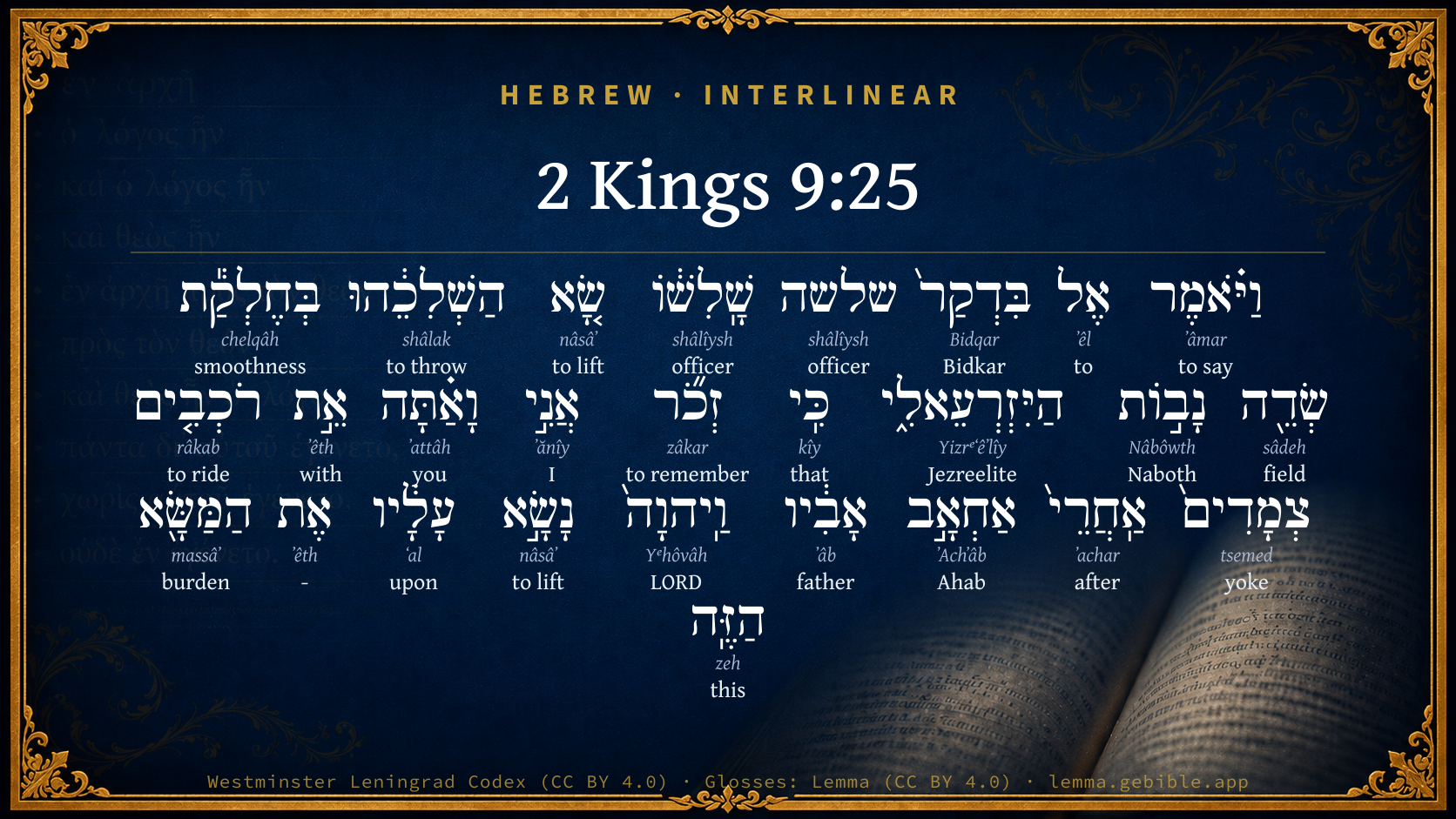
2 Kings 9:25

Hebrew (Westminster Leningrad Codex) 2 Kings 9:25 appears in the Hebrew Old Testament. The text above is from the Westminster Leningrad Codex. Each word links to its Strong’s number, a concise gloss, and parsing drawn from the Open Scriptures Hebrew Bible morphology. Click any word for its full Brown-Driver-Briggs (BDB) entry.
Download image
Cite this verse

2 Kings 9:25 (World English Bible). Public Domain. Lemma interlinear Bible study tool, https://lemma.gebible.app/v/2-kings/9/25.

Show BibTeX & RIS
BibTeX
RIS
English Translation
Then said [Jehu] to Bidkar his captain, Take up, and cast him in the portion of the field of Naboth the Jezreelite; for remember how that, when I and you rode together after Ahab his father, Yahweh laid this burden on him:
World English Bible · Public Domain
Highlights
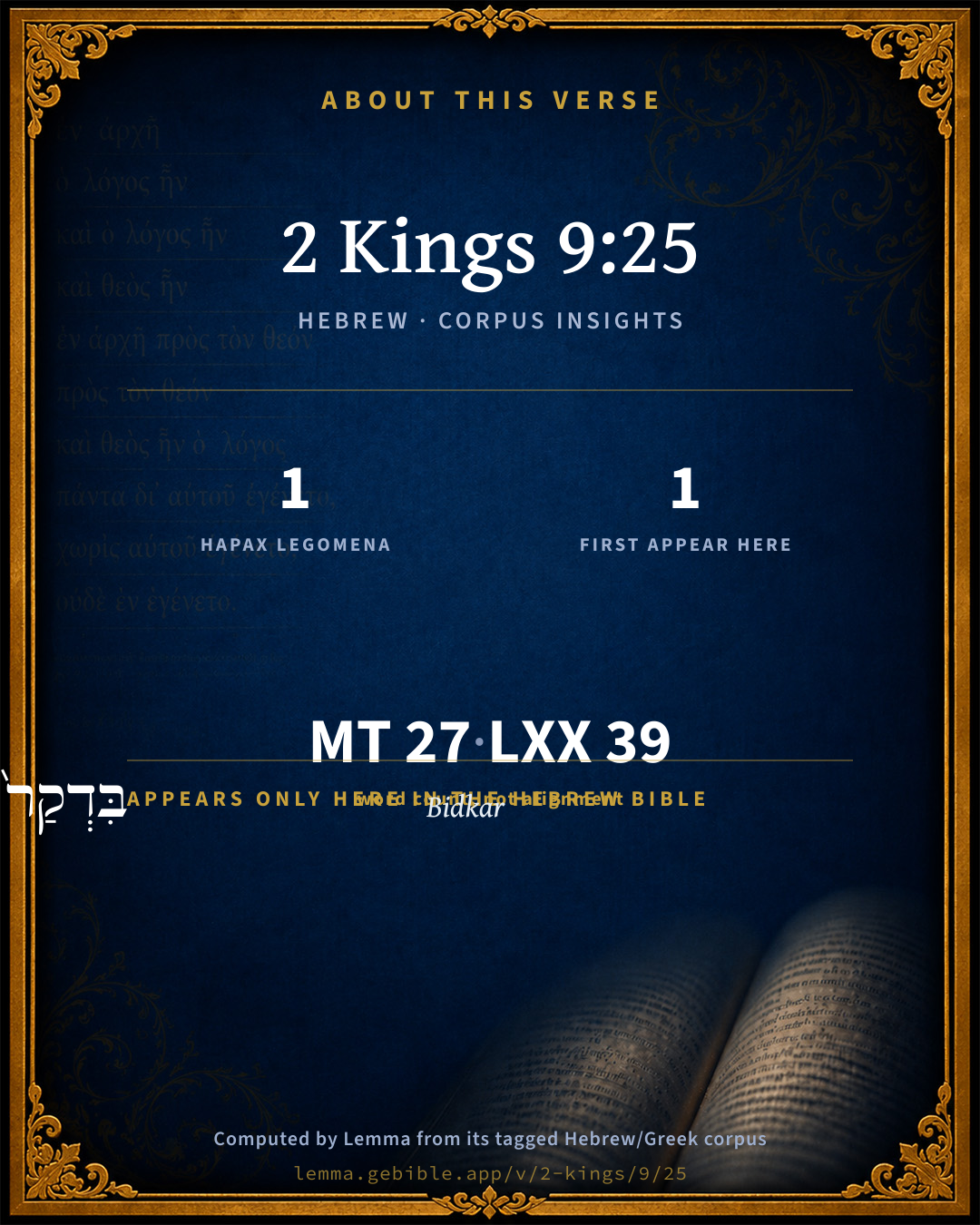
  • 1 hapax legomenon — only here in the Hebrew Bible
  • 1 first appearance in the Hebrew Bible
Full analysis ↓
Download a study sheet

One document with this verse’s original text, its word-by-word gloss line, the meaning frame, cross-references with their text, attributed commentary, and full source and license credits — printable, and it pastes into notes with its structure intact.

This verse Autodidact and up

Study sheet (.html) Plain text (.txt)

A passage Seminary Student

Up to 50 verses in one chapter. A passage sheet keeps up to 6 commentary sources and 12 cross-references per verse, in the order this page ranks them, and says so on the sheet whenever that leaves anything out. Ask for a single verse and you get the Autodidact verse sheet above.

Everything on this page stays free to read, with no account — the sheet is a download of what is already on screen, not access to it.

Want to remove ads? Support Godless Engineer
Compare translations 3

The same verse in 3 English versions, stacked beneath the original-language interlinear above. Click any original word for its lexicon entry.

Each is an independent rendering of the whole verse — the interlinear is not word-aligned to these translations.

Highlighted words mark where these versions differ — a whole-verse word diff, not a word-by-word alignment.

  • World English Bible Public Domain
    Then said [Jehu] to Bidkar his captain, Take up, and cast him in the portion of the field of Naboth the Jezreelite; for remember how that, when I and you rode together after Ahab his father, Yahweh laid this burden on him:
  • King James Version Public Domain
    Then said Jehu to Bidkar his captain, Take up, and cast him in the portion of the field of Naboth the Jezreelite: for remember how that, when I and thou rode together after Ahab his father, the LORD laid this burden upon him;
  • unfoldingWord Literal Text CC BY-SA 4.0
    And he said to Bidkar his captain, “Pick up and throw him onto the portion of the field of Naboth the Jezreelite. For remember, me and you riding pairs after Ahab his father, and Yahweh lifted this burden against him,

unfoldingWord Literal Text — © unfoldingWord, licensed CC BY-SA 4.0. Word-aligned USFM3 via Door43 (git.door43.org/unfoldingWord/en_ult).

Versions to compare (up to 4)

3 of 4 selected

Show all 18 translations

Every available English version of this verse, each an independent rendering of the whole verse.

  • World English Bible Public Domain
    Then said [Jehu] to Bidkar his captain, Take up, and cast him in the portion of the field of Naboth the Jezreelite; for remember how that, when I and you rode together after Ahab his father, Yahweh laid this burden on him:
  • Berean Standard Bible Public Domain
    And Jehu said to Bidkar his officer, “Pick him up and throw him into the field of Naboth the Jezreelite. For remember that when you and I were riding together behind his father Ahab, the LORD lifted up this burden against him:
  • Majority Standard Bible Public Domain
    And Jehu said to Bidkar his officer, “Pick him up and throw him into the field of Naboth the Jezreelite. For remember that when you and I were riding together behind his father Ahab, the LORD lifted up this burden against him:
  • King James Version Public Domain
    Then said Jehu to Bidkar his captain, Take up, and cast him in the portion of the field of Naboth the Jezreelite: for remember how that, when I and thou rode together after Ahab his father, the LORD laid this burden upon him;
  • American Standard Version (1901) Public Domain
    Then said `Jehu' to Bidkar his captain, Take up, and cast him in the portion of the field of Naboth the Jezreelite; for remember how that, when I and thou rode together after Ahab his father, Jehovah laid this burden upon him:
  • Revised Version (1885) Public Domain
    Then said Jehu to Bidkar his captain, Take up, and cast him in the portion of the field of Naboth the Jezreelite: for remember how that, when I and thou rode together after Ahab his father, the LORD laid this burden upon him;
  • Geneva Bible (1599) Public Domain
    Then said Iehu to Bidkar a captaine, Take, and cast him in some place of the fielde of Naboth the Izreelite: for I remember that when I and thou rode together after Ahab his father, the Lord layed this burden vpon him.
  • Douay-Rheims (1899) Public Domain
    And Jehu said to Badacer his captain: Take him, and cast him into the field of Naboth the Jezrahelite: for I remember when I and thou sitting in a chariot followed Achab this man's father, that the Lord laid this burden upon him, saying:
  • Young's Literal Translation Public Domain
    And `Jehu' saith unto Bidkar his captain, `Lift up, cast him into the portion of the field of Naboth the Jezreelite -- for, remember, I and thou were riding together after Ahab his father, and Jehovah lifted upon him this burden:
  • Literal Standard Version CC BY-SA 4.0
    And [Jehu] says to his captain Bidkar, “Lift up, cast him into the portion of the field of Naboth the Jezreelite—for remember, you and I were riding together after his father Ahab, and YHWH lifted this burden on him:
  • Unlocked Literal Bible CC BY-SA 4.0
    Then Jehu said to Bidkar his captain, “Pick him up and throw him in the field of Naboth the Jezreelite. Think about how when you and I rode together after Ahab his father, Yahweh placed this prophecy against him:
  • unfoldingWord Literal Text CC BY-SA 4.0
    And he said to Bidkar his captain, “Pick up and throw him onto the portion of the field of Naboth the Jezreelite. For remember, me and you riding pairs after Ahab his father, and Yahweh lifted this burden against him,
  • Darby Bible Public Domain
    And he said to Bidkar his captain, Take him up [and] cast him in the plot of the field of Naboth the Jizreelite. For remember how, when I and thou rode together after Ahab his father, that Jehovah laid this burden upon him:
  • World Messianic Bible Public Domain
    Then Jehu said to Bidkar his captain, “Pick him up, and throw him in the plot of the field of Naboth the Jezreelite; for remember how, when you and I rode together after Ahab his father, the LORD laid this burden on him:
  • Webster's Bible Public Domain
    Then said Jehu to Bidkar his captain, Take up, and cast him into the portion of the field of Naboth the Jezreelite; for remember how that, when I and thou rode together after Ahab his father, the LORD laid this burden upon him;
  • Free Bible Version CC BY-SA 4.0
    Jehu said to Bidkar his officer, “Pick him up and throw him into the field of Naboth from Jezreel. Remember when you and I were riding together behind his father Ahab how the Lord made this prophecy against him:
  • Bible in Basic English Public Domain
    Then Jehu said to Bidkar, his captain, Take him up, and put him in the field of Naboth the Jezreelite: for is not that day in your memory when you and I together on our horses were going after Ahab, his father, and the Lord put this fate on him, saying:
  • JPS Tanakh (1917) Public Domain
    Then said Jehu to Bidkar his captain: 'Take up, and cast him in the portion of the field of Naboth the Jezreelite; for remember how that, when I and thou rode together after Ahab his father, the LORD pronounced this burden against him:

Literal Standard Version (2020), Covenant Press — licensed CC BY-SA 4.0. Text via the HelloAO Bible API (eBible.org). Unlocked Literal Bible (unfoldingWord) — licensed CC BY-SA 4.0. Text via the HelloAO Bible API (eBible.org). unfoldingWord Literal Text — © unfoldingWord, licensed CC BY-SA 4.0. Word-aligned USFM3 via Door43 (git.door43.org/unfoldingWord/en_ult). Free Bible Version, Dr. Jonathan Gallagher — licensed CC BY-SA 4.0. Text via the HelloAO Bible API (eBible.org).

Word by word

More ways to search: Search by grammar → Find every occurrence → Compare this word →

Practice this passage: Drill this verse → Learn its vocabulary →

בִּדְקַר֙
Bidqar
H920
“Bidkar”
Noun, Proper
Part of Speech
Noun
Type
Proper
Full BDB Definition

Origin: probably from H1856 with a prepositional prefix

TWOT: None

Bidkar = "with a stab" - a captain of Jehu
  1. וַיֹּ֗אמֶר ʼâmar H559 “and · to say” Conjunction + Verb, Qal, Sequential Imperfect, 3rd Person, Masculine, Singular
  2. אֶל ʼêl H413 “to” Preposition
  3. שלשה shâlîysh H7991 “officer” Adjective, Cardinal number, Masculine, Singular, Absolute
  4. שָֽׁלִשׁ֔וֹ shâlîysh H7991 “officer · his” Noun, Common, Masculine, Singular, Construct + Suffix, Personal, 3rd Person, Masculine, Singular
  5. שָׂ֚א nâsâʼ H5375 “lift” Verb, Qal, Imperative, 2nd Person, Masculine, Singular
  6. הַשְׁלִכֵ֔הוּ shâlak H7993 “throw · him” Verb, Hiphil, Imperative, 2nd Person, Masculine, Singular + Suffix, Personal, 3rd Person, Masculine, Singular
  7. בְּחֶלְקַ֕ת chelqâh H2513 “in/at · smoothness of” Preposition + Noun, Common, Feminine, Singular, Construct
  8. שְׂדֵ֖ה sâdeh H7704 “field of” Noun, Common, Masculine, Singular, Construct
  9. נָב֣וֹת Nâbôwth H5022 “Naboth” Noun, Proper
  10. הַיִּזְרְעֵאלִ֑י Yizrᵉʻêʼlîy H3158 “the · Jezreelite” Particle, Definite Article + Noun, Gentilic, Masculine, Singular, Absolute
  11. כִּֽי kîy H3588 “that” Conjunction
  12. זְכֹ֞ר zâkar H2142 “remember” Verb, Qal, Imperative, 2nd Person, Masculine, Singular
  13. אֲנִ֣י ʼănîy H589 “I” Pronoun, Personal, 1st Person, Common, Singular
  14. וָאַ֗תָּה ʼattâh H859 “and · you” Conjunction + Pronoun, Personal, 2nd Person, Masculine, Singular
  15. אֵ֣ת ʼêth H854 “with” Preposition
  16. רֹכְבִ֤ים râkab H7392 “riding” Verb, Qal, Participle Active, Masculine, Plural, Absolute
  17. צְמָדִים֙ tsemed H6776 “yokes” Noun, Common, Masculine, Plural, Absolute
  18. אַֽחֲרֵי֙ ʼachar H310 “after” Preposition
  19. אַחְאָ֣ב ʼAchʼâb H256 “Ahab” Noun, Proper
  20. אָבִ֔יו ʼâb H1 “father · his” Noun, Common, Masculine, Singular, Construct + Suffix, Personal, 3rd Person, Masculine, Singular
  21. וַֽיהוָה֙ Yᵉhôvâh H3068 “and · LORD” Conjunction + Noun, Proper
  22. נָשָׂ֣א nâsâʼ H5375 “to lift” Verb, Qal, Perfect, 3rd Person, Masculine, Singular
  23. עָלָ֔יו ʻal H5921 “upon · him” Preposition + Suffix, Personal, 3rd Person, Masculine, Singular
  24. אֶת ʼêth H853 “-” Particle, Direct Object
  25. הַמַּשָּׂ֖א massâʼ H4853 “the · burden” Particle, Definite Article + Noun, Common, Masculine, Singular, Absolute
  26. הַזֶּֽה zeh H2088 “the · this” Particle, Definite Article + Pronoun, Demonstrative, Masculine, Singular

About this verse

These counts appear in no published source. They are computed here, from the morphology-tagged text and Lemma’s own curated glosses. What Lemma adds →

27
words
25
distinct lemmas
Historical
section

Notable vocabulary

1 hapax legomenon — a word that appears only here in the entire Hebrew Bible:

  • בִּדְקַר֙ Bidkar H920

First appearance in Scripture

This word makes its first canonical appearance in the Hebrew Bible here:

  • בִּדְקַר֙ Bidkar H920

Shared distinctive vocabulary

הַיִּזְרְעֵאלִ֑י Jezreelite H3158 occurs in 8 verses of the Hebrew Bible. Also found in:

Grammatical profile

  • 6 verbs
  • 11 nouns
  • 1 adjective
  • 3 pronouns
  • 4 prepositions
  • 1 conjunction
  • 1 particle

Verb forms

  • וַיֹּ֗אמֶר Qal · Sequential Imperfect
  • שָׂ֚א Qal · Imperative
  • הַשְׁלִכֵ֔הוּ Hiphil · Imperative
  • זְכֹ֞ר Qal · Imperative
  • רֹכְבִ֤ים Qal · Participle Active
  • נָשָׂ֣א Qal · Perfect

Repetition

Words recur within this verse — often emphatic in Hebrew:

  • שלשה officer H7991 ×2
  • שָׂ֚א to lift H5375 ×2

Hebrew & Septuagint length

In English translation the verse runs 42 words from the Hebrew and 44 from the Septuagint (LXX English) — closely comparable.

A rough comparison of the two English renderings, which tokenize alike — not a word-level alignment.

Word counts can differ between the Hebrew and the Greek without any difference in meaning — e.g. the Hebrew direct-object marker אֵת has no separate Greek word, and Greek often adds the article ὁ.

In the original languages it is 27 Hebrew tokens and 39 Greek tokens — but the two are counted differently (Hebrew bundles its prefixes and suffixes into one token; the Greek is in lemma form), so that isn’t a like-for-like length.

Cross-references

7

Topical passages linked to 2 Kings 9:25 in the Treasury of Scripture Knowledge — connected by theme and wording, ordered by reader-vote popularity; previews shown in the World English Bible.

  • 1 Kings 21:19 You shall speak to him, saying, Thus says Yahweh, Have you killed and also taken possession? You shall speak to him, saying, Thus says Yahweh, In the place where dogs licked the blood of Naboth shall dogs lick your blood, even yours.
  • 1 Kings 21:24–29 Him who dies of Ahab in the city the dogs shall eat; and him who dies in the field shall the birds of the sky eat.
  • Isaiah 13:1 The burden of Babylon, which Isaiah the son of Amoz did see.
  • Jeremiah 23:33–38 When this people, or the prophet, or a priest, shall ask you, saying, What is the burden of Yahweh? then shall you tell them, What burden! I will cast you off, says Yahweh.
  • Nahum 1:1 An oracle about Nineveh. The book of the vision of Nahum the Elkoshite.
  • Malachi 1:1 An oracle: the word of Yahweh to Israel by Malachi.
  • Matthew 11:30 For my yoke is easy, and my burden is light."

Cross-references courtesy of OpenBible.info (CC BY 4.0).

Hebrew and Greek witnesses Masoretic Hebrew ↔ Greek Septuagint

The same verse in the two great witnesses to the Old Testament, shown verse-for-verse.

These are two independent witnesses, not word-aligned to each other, and the Septuagint is shown in lemma (dictionary) form.

Hebrew 2 Kings 9:25 Masoretic · Westminster Leningrad Codex

וַיֹּ֗אמֶר אֶל בִּדְקַר֙ שלשה שָֽׁלִשׁ֔וֹ שָׂ֚א הַשְׁלִכֵ֔הוּ בְּחֶלְקַ֕ת שְׂדֵ֖ה נָב֣וֹת הַיִּזְרְעֵאלִ֑י כִּֽי זְכֹ֞ר אֲנִ֣י וָאַ֗תָּה אֵ֣ת רֹכְבִ֤ים צְמָדִים֙ אַֽחֲרֵי֙ אַחְאָ֣ב אָבִ֔יו וַֽיהוָה֙ נָשָׂ֣א עָלָ֔יו אֶת הַמַּשָּׂ֖א הַזֶּֽה

Then said [Jehu] to Bidkar his captain, Take up, and cast him in the portion of the field of Naboth the Jezreelite; for remember how that, when I and you rode together after Ahab his father, Yahweh laid this burden on him:

World English Bible · Public Domain

Greek LXX 2 Kings 9:25 Septuagint · lemma form

καί εἶπον ιου πρός βαδεκαρ ὁ τριστάτης αὐτός ῥίπτω αὐτός ἐν ὁ μερίς ἀγρός ναβουθαι ὁ ιεζραηλῖτις ὅτι μνημονεύω ἐγώ καί σύ ἐπιβαίνω ἐπί ζεῦγος ὀπίσω αχααβ ὁ πατήρ αὐτός καί κύριος λαμβάνω ἐπί αὐτός ὁ λῆμμα οὗτος λέγω

And Ju said to Badecar his chief officer, Cast him into the portion of ground of Nabuthai the Jezraelite, for I and you remember, riding as we were on chariots after Achaab his father, that the Lord took up this burden against him, saying,

LXX2012 (modern English Septuagint) · Public Domain

On this verse, The Pulpit Commentary discusses the Septuagint’s reading. Read the note in Commentary ↓

Hebrew: Westminster Leningrad Codex (CC BY 4.0). Greek: Septuagint (public domain); English from LXX2012 (modern English Septuagint) (Public Domain). How the Septuagint differs from the Hebrew →

Targum (Aramaic paraphrase)

1

The Targum is the ancient Jewish Aramaic paraphrase of the Hebrew Scriptures — an interpretive translation, not the Hebrew text itself. Onkelos (literal) and Pseudo-Jonathan (expansive) render the Torah, and Jonathan the Prophets. Coverage is partial: where no permissively-licensed English translation exists for a verse, only the Aramaic is shown. This is verse-level text, not a word-by-word alignment to the Hebrew.

  1. Targum Jonathan Prophets (Joshua–Malachi)
    וַאֲמַר לְבִדְקַר גִבָּרֵיהּ סַב רְמִיהִי בְּאַחֲסָנַת חֲקַל נָבוֹת יִזְרְעֶאלָה אֲרֵי דְכִיר אֲנָא וְאַתְּ כַּד הֲוֵינָא רְכִיבִין זוּגָא חַד אָזְלִין בָּתַר אַחְאָב אֲבוּהִי וּמִן קֳדָם יְיָ אִתְנַטֵל עֲלוֹהִי יַת מֵטַל נְבוּאֲתָא הָדֵין:

    (no public-domain English translation for this verse)

    Targum Jonathan — Aramaic: “Mikraot Gedolot” (public domain). English: “Sefaria Community Translation” (CC0 1.0 (public-domain dedication)); “London "Chaldee Paraphrase," 1871” (public domain). Text via Sefaria.

Commentary

Notes on 2 Kings 9:25 from classic Christian and Jewish commentators (each source and its license shown beneath its notes). The classic Christian expositions comment on the surrounding passage and are grouped to its opening verse, so a note may address several verses; the Jewish commentaries on the Tanakh (Rashi and others) are per-verse, so they appear only where the commentator wrote on this verse.

Lemma curates 59 commentaries, every one of them public domain or Creative Commons licensed, each selected and text-cleaned for this edition rather than reprinted as found. About our sources →

Trapp's Complete Commentary

John Trapp

2Ki 9:25 Then said [Jehu] to Bidkar his captain, Take up, [and] cast him in the portion of the field of Naboth the Jezreelite: for remember how that, when I and thou rode together after Ahab his father, the LORD laid this burden upon him;

Ver. 25. Then said Jehu to Bidkar his captain.] Heb., Triarium suum, his third captain, or captain of a third part of his forces.

The Lord laid this burden.] {See Trapp on "Mal 1:1"}

John Trapp, A Commentary or Exposition upon All the Books of the Old and New Testament (1647–1656) — public domain. Text from a community e-Sword module.

Geneva Bible (1599)

Geneva Bible translators

Or, spake this prophecy against him.

Geneva Bible (1599) marginal notes — public domain. Text via Bolls.life.

Jamieson, Fausset & Brown

Robert Jamieson, A. R. Fausset & David Brown

cast him in the portion of the field of Naboth the Jezreelite, &c.--according to the doom pronounced by divine authority on Ahab (Kg1 21:19), but which on his repentance was deferred to be executed on his son.

Jamieson, Fausset & Brown — Commentary Critical and Explanatory on the Whole Bible (1871) — public domain (CC PDM 1.0). Text via the HelloAO Bible API.

Adam Clarke's Commentary

Verse 25. Cast him in the portion of the field] This was predicted, 1 Kings 21; and what now happened to the son of Ahab is foretold in 1Kg 21:29 of that chapter.

Adam Clarke's Commentary on the Bible (1810–1826) — public domain. Text from a community e-Sword/MySword module.

Ellicott's Commentary for English Readers

(25) Then said Jehu.—Literally, And he said.

Bidkar.—The Syriac gives Bar-dĕkar, “son of stabbing,” i.e., “stabber,” “slayer” a very suitable name for Jehu’s squire. The Hebrew name is, therefore, a contraction of Ben-dekar. (Comp. Bedan, “son of Dan,” i.e., Danite, 1Sa_12:11; and Bedad, “son of Hadad,” in 1Ch_1:46.)

Captain.—Adjutant, aide-de-camp, chief (2Ki_7:2).

Remember how that, when I and thou rode together.—This gives the sense of the Hebrew correctly. Literally, remember thou me and thee riding together. The word rendered “together” probably means riding side by side on horseback in attendance on the king. The Targum, vulg., and Kimchi interpret, riding together in the same chariot; Josephus, riding together in Ahab’s chariot behind him.

The Lord laid this burden upon him.—Rather, Jehovah uttered this (prophetic) utterance upon (i.e., about) him. (Comp. the oracle uttered by Elijah against Ahab when taking possession of Naboth’s vineyard, 1Ki_21:17, seq., 1Ki_21:29.)

A Bible Commentary for English Readers, edited by Charles John Ellicott (1878–1897) — public domain. Text from a community e-Sword module.

The Cambridge Bible for Schools and Colleges

gen. ed. J. J. S. Perowne

25. rode together after Ahab his father] Jehu had long experience of the doings of Ahab’s family, and had not forgotten the prophetic words of Elijah. ‘Little did he think when he heard that message that his hands would act it’ (Bp Hall). By ‘riding together after Ahab’ we are not to understand that they were both together in the same chariot or both in Ahab’s chariot, but that they were together among the king’s retinue, when he went down to take possession of Naboth’s vineyard.

laid this burden upon him] Or (as R.V. margin) ‘uttered this oracle against him’. The noun is that which is so often used by the prophets, especially Isaiah, for the oracle spoken against any city or nation. Cf. Isa_13:1; Isa_15:1; Isa_17:1; Isa_19:1, &c. Also 2Ch_24:27. The verb also is cognate with the noun, and signifies here ‘to lift up’, i.e. the voice, in the utterance of a prophecy.

The Cambridge Bible for Schools and Colleges (gen. ed. J. J. S. Perowne; Cambridge University Press, 1878–1918) — public domain. Text from a community e-Sword module.

John Gill's Exposition

And his servants carried him in a chariot to Jerusalem,.... With the leave of Jehu, because he was the grandson of Jehoshaphat, a sincere worshipper of God, Ch2 22:9,

and buried him in his sepulchre with his fathers in the city of David; see Kg1 22:50.

John Gill's Exposition of the Whole Bible (1746–1763) — public domain (CC PDM 1.0). Text via the HelloAO Bible API.

Albert Barnes' Notes on the Bible

Rode together after Ahab - The Assyrian sculptures make it probable that Josephus was right in interpreting this “rode side by side behind Ahab in his chariot.” The Assyrian monarchs, when they go out to war, are frequently attended hy two guards, who stand behind them in the same chariot.

Burden - Compare the use of the same word in Isaiah (Isa 13:1; Isa 15:1, etc.), and in Lamentations Lam 2:14, for a denunciation of woe.

Albert Barnes' Notes on the Bible (1834–1885) — public domain. Text from a community e-Sword/MySword module.

Haydock's Catholic Bible Commentary

Sitting. Hebrew, "rode together after," as if they were two abreast. (Calmet) --- Burden, or dreadful misfortune. (Menochius)

George Leo Haydock (1774–1849), Haydock's Catholic Family Bible and Commentary, 1859 edition — public domain. Excludes Psalms (Douay-Rheims chapter numbering differs from Protestant) and Deuterocanonical books (Catholic canon only).

Matthew Poole's English Annotations

When I and thou rode together after Ahab his father; which might be when Ahab went in his chariot, attended with his nobles or chief officers, (of which these were two,) to take a formal and solemn possession of Naboth’s land; for then the prophet Elijah met him, and denounced this judgment against him, 1Ki 21:17, &c.

This burden, i.e. this grievous prophecy; for such are oft and truly called burdens, as Isa 13:1; 15:1; Jer 23:33,34; Na 1:1.

Matthew Poole's English Annotations on the Holy Bible (1683–1685) — public domain. Text from a community e-Sword/MySword module.

Whedon's Commentary on the Bible

Daniel D. Whedon

25. For remember — Jehu remembers, and in substance repeats, the word of the Lord by Elijah, (1Ki_21:19; 1Ki_21:29,) and, conscious that he himself is the minister of judgment, he fulfils the word of the Lord. “This,” says Kitto, “completes the first act of this awful tragedy, which reads like the old Greek dramas — but far less old than this — of accomplished fate. The appointed executer of the doom was himself the witness of its being imposed. All is complete.”

Laid this burden upon him — This burden of judgment; that is, pronounced upon him this doom.

Daniel D. Whedon (gen. ed.), Commentary on the Old and New Testaments (1874–1909) — public domain. Text from a community e-Sword module.

The Pulpit Commentary

Then said Jehu to Bidkar his captain; literally, his thirdsman; Keil renders "his aide-de-camp," probably one of those who was in his chariot with himTake up, and cast him in the portion of the field of Naboth the Jezreelite. "Take up the body," i.e. "and cast it into the plot of ground which once belonged to Naboth the Jezreelite, and was forfeited to the crown at his death, (1Ki_21:15) and taken possession of by Ahab". (1Ki_21:16) The reason for the order follows. For remember how that, when I and thou rode together after Ahab his father, the Lord laid this burden upon him. The LXX have mnhmoneuw, "I remember;" but the Hebrew text is rkz, not rkza "Remember" (imperative mood) is the correct translation. Jehu recalls his captain"s recollection to an occurrence which was deeply impressed upon his own. "When thou and I rode together after Ahab" probably means "when we two stood behind Ahab in his chariot." The Assyrian sculptures usually represent the monarch as attended by two body-guards, who ride in the same chariot with him, standing up behind him, and often interposing their shields to protect his person. In this near proximity Jehu and Bidkar would hear any speech which was addressed to Ahab. By a "burden" is meant a sentence of punishment. (comp. Isa_13:1 Isa_15:1 Isa_17:1; etc.; Nah_1:1, etc.) Surely I have seen yesterday the blood of Naboth. (comp. 1Ki_21:19, where the same idea of retribution is expressed, though in different words) Jehu, after the lapse of fourteen or fifteen years, naturally had forgotten the exact words used. And the blood of his sons. The execution of Naboth"s sons had not been mentioned previously; but, under the rude jurisprudence of the age, (2Ki_14:6) sons were usually slain with their fathers. And, unless they had been removed, Ahab could not have inherited the vineyard. Saith the Lord; and I will requite thee in this plat, saith the Lord. This was the gist of the prophecy, which ran as follows: "In the place where dogs licked the blood of Naboth shall dogs lick thy blood, even thine." Now therefore take and cast him into the plat of ground, according to the word of the Lord. The evil prophesied against Ahab had been formally and expressly deferred to his son"s days on Ahab"s repentance (cf. 1Ki_21:29)

Vers. 25-37. Retribution may be long in coming, but it comes at last.

Even a heathen could say, "Raro antecedentem scelestum deseruit pede poena claudo" (Horace, "Od.," 3:2, lines 31, 32). Yet throughout all history evil-disposed men have persisted in wicked and cruel conduct, just as if it was not only possible, but probable, that retribution would be escaped. The lesson thus needs continually to be impressed on men, that, sooner or later, retribution must come that there is no escape from it, Retribution must come

I BECAUSE GOD RULES THE UNIVERSE, AND GOD IS JUST. Disbelief in retribution is essentially atheistic. It implies either that there is no God, or that God is without one or more of those attributes which make him God. A just God must have the will to punish; an omnipotent God must have the power to punish. If a so-called God did not punish sin, he must be either not just, or not omnipotent, or not either; but then he would not be God. As Bahr says, "A God without vengeance, i.e. who cannot and will not punish, is no God, but a divinity fashioned from one"s thoughts.

II BECAUSE GOD HAS DECLARED THAT IT SHALL COME, AND GOD IS TRUE. God has said to each man, through his conscience, that he will punish sin. Remorse and reset, the dissatisfaction of a guilty conscience, are such punishment begun. In his Word God has expressly declared that he "will reward every man according to his works" (Psa_62:12; Pro_24:12; Mat_16:7; Rom_2:6; 2Ti_4:14) that he "will by no means clear the guilty"; (Exo_34:7) that "indignation and wrath, tribulation and anguish, shall be on every soul of man that doeth evil". (Rom_2:8, Rom_2:9) Nothing is more plainly taught in the whole of Scripture, from the beginning to the end, than requital, retribution, condign punishment. Ahab"s case is singular, not in the general principle, but only in the exact correspondence between the sin and its punishment. Such correspondence is rare and abnormal; but it does occur from time to time, and, when it occurs, there is something about it that is most impressive and striking. When the author of proscription, Marius, is himself proscribed; when the dethroner of kings, Napoleon L, is himself dethroned; when the inventor of conspiracies, Titus Oates, falls a victim to an invented conspiracy; when Robespierre and Danton, who have ruled by the guillotine, perish by the guillotine; justice" as it has been called, is satisfied, and the world at large is forced to recognize and acknowledge that requital has taken place in a signal way.

III BECAUSE ANY NEGATIVE INSTANCE THAT CAN BE PRODUCED WILL ONLY SHOW A DELAY, NOT AN ABROGATION OF THE SENTENCE. Infinite time is at the disposal of the Almighty. Men are impatient, and, if retribution does not overtake the sinner speedily, are apt to conclude that it will never overtake him. But with the Almighty "one day is as a thousand years, and a thousand years as one day." The important thing to be borne in mind is the end; and the end will not be reached till "the judgment is set, and the books are opened", (Dan_7:10) and men are "judged out of those things which are written in the books, according to their works". (Rev_20:12) Punishment may be long in coming the ungodly may continue during their whole lifetime in prosperity. But there remains a future. Where the heathen felt and said, "Raro," the Christian will say, Nuquam antecedentem scelestum deseruit pede poena claudo."

The Pulpit Commentary (1880–1919), ed. H.D.M. Spence-Jones & Joseph S. Exell — public domain. Text from a community e-Sword module.

unfoldingWord translationNotes

Door43 World Missions Community

Bidkar

This is the name of a man. (See: How to Translate Names)

Pick him up and throw him

"Pick up his dead body and throw it" or "Take his corpse and throw it"

Think about how

"Remember"

after Ahab his father

This means that they rode in the chariot behind Ahab's chariot. AT: "behind his father Ahab's chariot" (See: Assumed Knowledge and Implicit Information)

Yahweh placed this prophecy against him

"Yahweh spoke this prophecy against Ahab"

the blood of Naboth and the blood of his sons

Here the word "blood" refers to "murder" AT: "the murder of Naboth and the murder of his sons" (See: Metonymy)

I will surely make you pay for it

This means that he will punish Ahab as he deserves for the evil he has done. AT: "I will give you what you deserve for the evil you have done" (See: Assumed Knowledge and Implicit Information)

pick him up and throw him on this field

"take Joram's dead body and throw it into the field of Naboth"

according to the word of Yahweh

"to fulfill the prophecy spoken to us"

translationWords

ancestor

prophet

blood

son

word of God

unfoldingWord translationNotes — © Distant Shores Media and the Door43 World Missions Community, licensed CC BY-SA 4.0. Source: git.door43.org/Door43/en_tn.

Rashi

Rabbi Shlomo Yitzchaki (Rashi)

Were riding together. How you and I were riding together (other texts: as a pair) after Achov on the day that he killed Navos.

When Adonoy put upon him. This prophecy through Eliyahu the prophet, and we heard.

Rashi on the Tanakh — English translations: “The Judaica Press complete Tanach with Rashi, translated by A. J. Rosenberg” (CC BY 4.0); “Pentateuch with Rashi's commentary by M. Rosenbaum and A.M. Silbermann, 1929-1934” (public domain); “The Metsudah Tanach series, Lakewood, N.J” (CC BY 4.0); and “The Book of Joshua, Metsudah Publications, 1997” (CC BY 4.0). Text via Sefaria.

Lesson kit

Teaching starters — assembled from the data on this page, not authored interpretation. Every prompt links to the verse data it draws on. Edit before teaching.

2 Kings, in the Historical, opens this verse with 27 words (25 distinct Hebrew lemmas). Its most distinctive word is Bidqar (“Bidkar”). A historical commentator’s framing appears above. Read the whole chapter for the surrounding context.

Discussion questions

  1. The word Bidqar carries the sense “Bidkar.” How does it shape the verse?
  2. This verse holds 1 word here found nowhere else in the Hebrew Bible. What might the rare word draw attention to?
  3. The word “Bidkar” first appears here in Scripture. What is being introduced at this debut?
  4. 1 Kings 21:1 shares the word «Jezreelite» with this verse. How do the two illuminate each other?
  5. “officer” occurs 2× in this one verse. What is the effect of the repetition?
  6. These translations render this verse differently; the difference is in the English rendering, not the original. What questions does that raise?
  7. The verb «וַיֹּ֗אמֶר» is Qal Sequential Imperfect. How does its form color the action?
  8. Reading how Trapp's Complete Commentary and Geneva Bible (1599) read this verse, where do the two commentators agree and where do they part?

Things to notice

  • 1 word in this verse appears nowhere else in the Hebrew Bible.
  • 1 word makes its first canonical appearance in Scripture here.
  • This verse counts 27 Hebrew ↔ 39 Greek words.
  • These translations choose different wording for 21 words in this verse.
  • “officer” occurs 2× in this single verse.

Reading settings

Reading text

Shown beneath each verse's original-language words.

Old Testament
Old Testament edition

Read the OT as the Masoretic Hebrew (MT) or the Greek Septuagint (LXX).

English shown for the Greek Septuagint (in the Hebrew ↔ Greek comparison).

Comparing translations? Open the Compare panel on any verse page to stack up to four side by side.