2 Kings 4:37

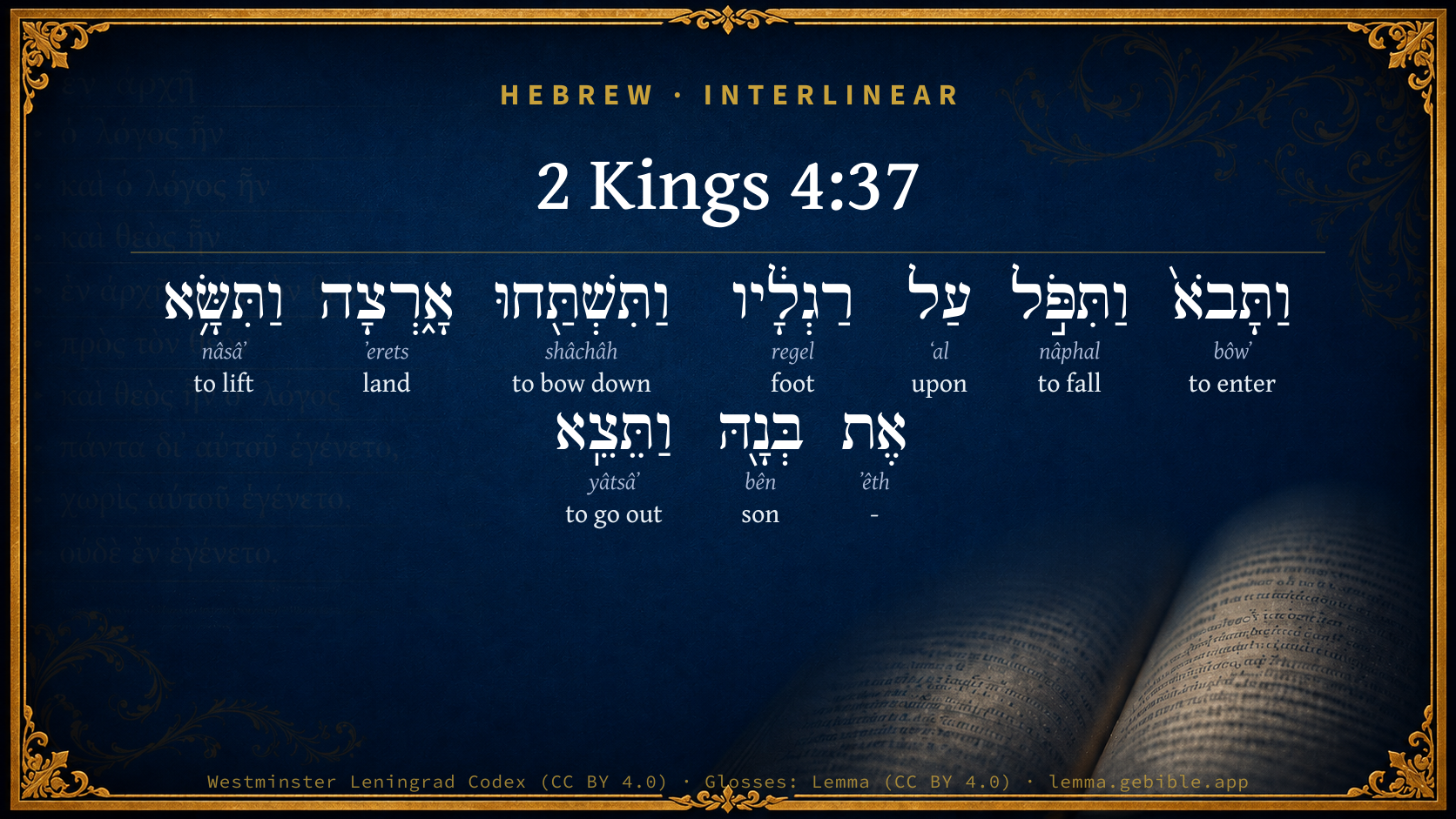
Hebrew (Westminster Leningrad Codex) 2 Kings 4:37 appears in the Hebrew Old Testament. The text above is from the Westminster Leningrad Codex. Each word links to its Strong’s number, a concise gloss, and parsing drawn from the Open Scriptures Hebrew Bible morphology. Click any word for its full Brown-Driver-Briggs (BDB) entry.
Download image
Cite this verse

2 Kings 4:37 (World English Bible). Public Domain. Lemma interlinear Bible study tool, https://lemma.gebible.app/v/2-kings/4/37.

Show BibTeX & RIS
BibTeX
RIS
English Translation
Then she went in, and fell at his feet, and bowed herself to the ground; and she took up her son, and went out.
World English Bible · Public Domain
Download a study sheet

One document with this verse’s original text, its word-by-word gloss line, the meaning frame, cross-references with their text, attributed commentary, and full source and license credits — printable, and it pastes into notes with its structure intact.

This verse Autodidact and up

Study sheet (.html) Plain text (.txt)

A passage Seminary Student

Up to 50 verses in one chapter. A passage sheet keeps up to 6 commentary sources and 12 cross-references per verse, in the order this page ranks them, and says so on the sheet whenever that leaves anything out. Ask for a single verse and you get the Autodidact verse sheet above.

Everything on this page stays free to read, with no account — the sheet is a download of what is already on screen, not access to it.

Want to remove ads? Support Godless Engineer
Compare translations 3

The same verse in 3 English versions, stacked beneath the original-language interlinear above. Click any original word for its lexicon entry.

Each is an independent rendering of the whole verse — the interlinear is not word-aligned to these translations.

Highlighted words mark where these versions differ — a whole-verse word diff, not a word-by-word alignment.

  • World English Bible Public Domain
    Then she went in, and fell at his feet, and bowed herself to the ground; and she took up her son, and went out.
  • King James Version Public Domain
    Then she went in, and fell at his feet, and bowed herself to the ground, and took up her son, and went out.
  • unfoldingWord Literal Text CC BY-SA 4.0
    And she came in, and she fell at his feet, and she prostrated herself to the ground. Then she picked up her son and went out.

unfoldingWord Literal Text — © unfoldingWord, licensed CC BY-SA 4.0. Word-aligned USFM3 via Door43 (git.door43.org/unfoldingWord/en_ult).

Versions to compare (up to 4)

3 of 4 selected

Show all 18 translations

Every available English version of this verse, each an independent rendering of the whole verse.

  • World English Bible Public Domain
    Then she went in, and fell at his feet, and bowed herself to the ground; and she took up her son, and went out.
  • Berean Standard Bible Public Domain
    She came in, fell at his feet, and bowed to the ground. Then she picked up her son and went out.
  • Majority Standard Bible Public Domain
    She came in, fell at his feet, and bowed to the ground. Then she picked up her son and went out.
  • King James Version Public Domain
    Then she went in, and fell at his feet, and bowed herself to the ground, and took up her son, and went out.
  • American Standard Version (1901) Public Domain
    Then she went in, and fell at his feet, and bowed herself to the ground; and she took up her son, and went out.
  • Revised Version (1885) Public Domain
    Then she went in, and fell at his feet, and bowed herself to the ground; and she took up her son, and went out.
  • Geneva Bible (1599) Public Domain
    And she came, and fell at his feete, and bowed her selfe to the ground, and tooke vp her sonne, and went out.
  • Douay-Rheims (1899) Public Domain
    She came and fell at his feet, and worshipped upon the ground: and took up her son, and went out.
  • Young's Literal Translation Public Domain
    And she goeth in, and falleth at his feet, and boweth herself to the earth, and lifteth up her son, and goeth out.
  • Literal Standard Version CC BY-SA 4.0
    And she goes in, and falls at his feet, and bows herself to the earth, and lifts up her son, and goes out.
  • Unlocked Literal Bible CC BY-SA 4.0
    Then she lay facedown on the ground at his feet and bowed to the ground, and then picked up her son and went out.
  • unfoldingWord Literal Text CC BY-SA 4.0
    And she came in, and she fell at his feet, and she prostrated herself to the ground. Then she picked up her son and went out.
  • Darby Bible Public Domain
    And she came and fell at his feet, and bowed herself to the ground; and she took up her son, and went out.
  • World Messianic Bible Public Domain
    Then she went in, fell at his feet, and bowed herself to the ground; then she picked up her son, and went out.
  • Webster's Bible Public Domain
    Then she went in, and fell at his feet, and bowed herself to the ground, and took up her son, and went out.
  • Free Bible Version CC BY-SA 4.0
    She came in, fell at his feet, and bowed to the ground. Then she picked up her son and left.
  • Bible in Basic English Public Domain
    And she came in, and went down on her face to the earth at his feet; then she took her son in her arms and went out.
  • JPS Tanakh (1917) Public Domain
    Then she went in, and fell at his feet, and bowed down to the ground; and she took up her son, and went out.

Literal Standard Version (2020), Covenant Press — licensed CC BY-SA 4.0. Text via the HelloAO Bible API (eBible.org). Unlocked Literal Bible (unfoldingWord) — licensed CC BY-SA 4.0. Text via the HelloAO Bible API (eBible.org). unfoldingWord Literal Text — © unfoldingWord, licensed CC BY-SA 4.0. Word-aligned USFM3 via Door43 (git.door43.org/unfoldingWord/en_ult). Free Bible Version, Dr. Jonathan Gallagher — licensed CC BY-SA 4.0. Text via the HelloAO Bible API (eBible.org).

Word by word

More ways to search: Search by grammar → Find every occurrence → Compare this word →

Practice this passage: Drill this verse → Learn its vocabulary →

וַתִּשְׁתַּ֖חוּ
shâchâh
H7812
“and · to bow down”
Conjunction + Verb, Hishtaphel, Sequential Imperfect, 3rd Person, Feminine, Singular
Part of Speech
Conjunction + Verb
Stem
Hishtaphel
Form
Sequential Imperfect
Person
3rd Person
Gender
Feminine
Number
Singular
Full BDB Definition

Origin: a primitive root

TWOT: 2360

to bow down - (Qal) to bow down - (Hiphil) to depress (figuratively) - (Hithpael) - to bow down, prostrate oneself - before superior in homage - before God in worship - before false gods - before angel
  1. וַתָּבֹא֙ bôwʼ H935 “and · to enter” Conjunction + Verb, Qal, Sequential Imperfect, 3rd Person, Feminine, Singular
  2. וַתִּפֹּ֣ל nâphal H5307 “and · to fall” Conjunction + Verb, Qal, Sequential Imperfect, 3rd Person, Feminine, Singular
  3. עַל ʻal H5921 “upon” Preposition
  4. רַגְלָ֔יו regel H7272 “feet · his” Noun, Common, Feminine, Dual, Construct + Suffix, Personal, 3rd Person, Masculine, Singular
  5. אָ֑רְצָה ʼerets H776 “land · toward” Noun, Common, Both, Singular, Absolute + Suffix, Demonstrative
  6. וַתִּשָּׂ֥א nâsâʼ H5375 “and · to lift” Conjunction + Verb, Qal, Sequential Imperfect, 3rd Person, Feminine, Singular
  7. אֶת ʼêth H853 “-” Particle, Direct Object
  8. בְּנָ֖הּ bên H1121 “son · her” Noun, Common, Masculine, Singular, Construct + Suffix, Personal, 3rd Person, Feminine, Singular
  9. וַתֵּצֵֽא yâtsâʼ H3318 “and · to go out” Conjunction + Verb, Qal, Sequential Imperfect, 3rd Person, Feminine, Singular

About this verse

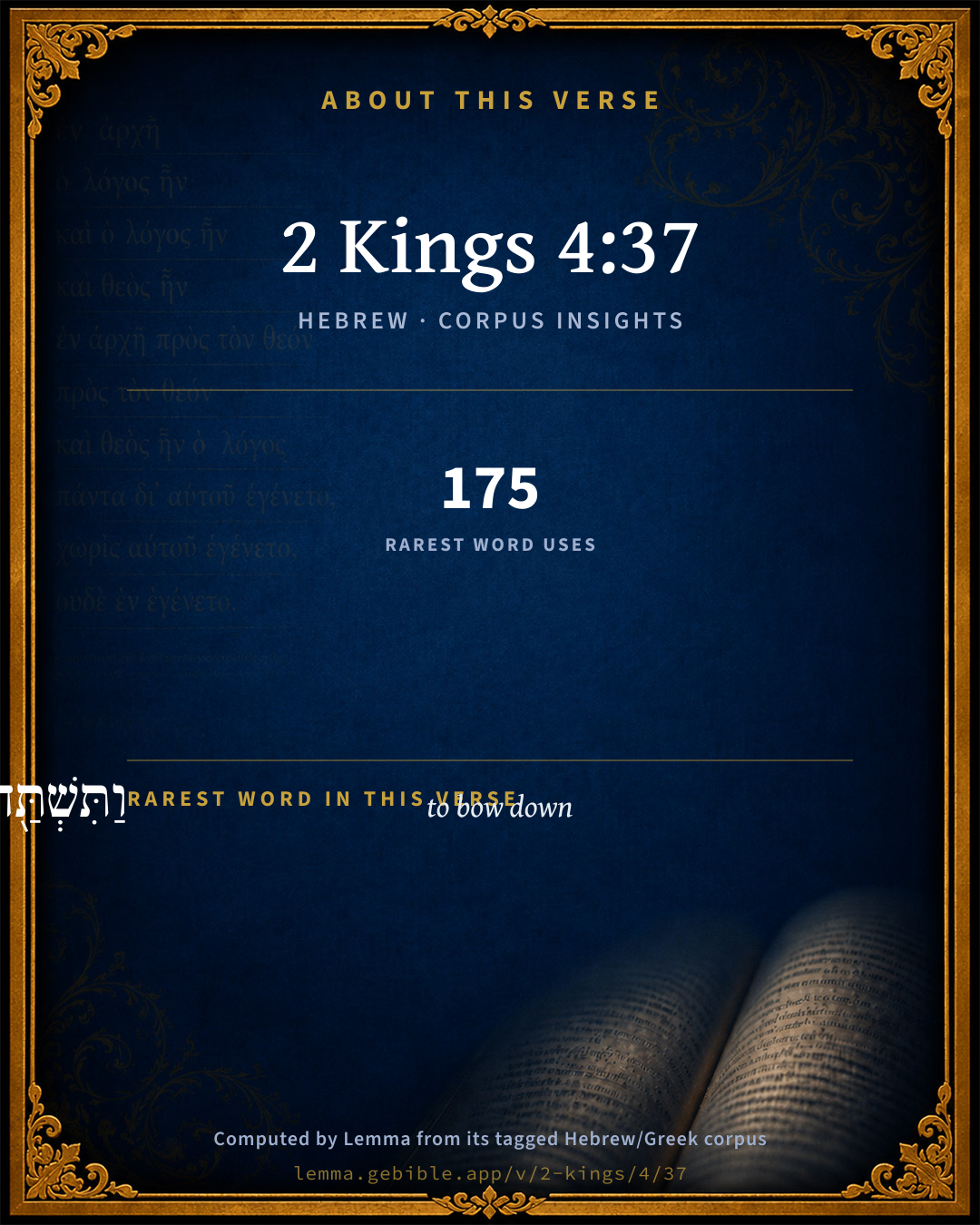
These counts appear in no published source. They are computed here, from the morphology-tagged text and Lemma’s own curated glosses. What Lemma adds →

10
words
10
distinct lemmas
Historical
section

Grammatical profile

  • 5 verbs
  • 3 nouns
  • 1 preposition
  • 1 particle

Verb forms

  • וַתָּבֹא֙ Qal · Sequential Imperfect
  • וַתִּפֹּ֣ל Qal · Sequential Imperfect
  • וַתִּשְׁתַּ֖חוּ Hishtaphel · Sequential Imperfect
  • וַתִּשָּׂ֥א Qal · Sequential Imperfect
  • וַתֵּצֵֽא Qal · Sequential Imperfect

Hebrew & Septuagint length

In English translation the verse runs 24 words from the Hebrew and 25 from the Septuagint (LXX English) — closely comparable.

A rough comparison of the two English renderings, which tokenize alike — not a word-level alignment.

Word counts can differ between the Hebrew and the Greek without any difference in meaning — e.g. the Hebrew direct-object marker אֵת has no separate Greek word, and Greek often adds the article ὁ.

Cross-references

4

Topical passages linked to 2 Kings 4:37 in the Treasury of Scripture Knowledge — connected by theme and wording, ordered by reader-vote popularity; previews shown in the World English Bible.

  • Hebrews 11:35 Women received their dead by resurrection. Others were tortured, not accepting their deliverance, that they might obtain a better resurrection.
  • 1 Kings 17:24 The woman said to Elijah, Now I know that you are a man of God, and that the word of Yahweh in your mouth is truth.
  • 2 Kings 2:15 When the sons of the prophets who were at Jericho over against him saw him, they said, The spirit of Elijah does rest on Elisha. They came to meet him, and bowed themselves to the ground before him.
  • 2 Kings 4:27 When she came to the man of God to the hill, she caught hold of his feet. Gehazi came near to thrust her away; but the man of God said, Let her alone: for her soul is vexed within her; and Yahweh has hid it from me, and has not told me.

Cross-references courtesy of OpenBible.info (CC BY 4.0).

Hebrew and Greek witnesses Masoretic Hebrew ↔ Greek Septuagint

The same verse in the two great witnesses to the Old Testament, shown verse-for-verse.

These are two independent witnesses, not word-aligned to each other, and the Septuagint is shown in lemma (dictionary) form.

Hebrew 2 Kings 4:37 Masoretic · Westminster Leningrad Codex

וַתָּבֹא֙ וַתִּפֹּ֣ל עַל רַגְלָ֔יו וַתִּשְׁתַּ֖חוּ אָ֑רְצָה וַתִּשָּׂ֥א אֶת בְּנָ֖הּ וַתֵּצֵֽא

Then she went in, and fell at his feet, and bowed herself to the ground; and she took up her son, and went out.

World English Bible · Public Domain

Greek LXX 2 Kings 4:37 Septuagint · lemma form

καί εἰςἔρχομαι ὁ γυνή καί πίπτω ἐπί ὁ πούς αὐτός καί προςκυνέω ἐπί ὁ γῆ καί λαμβάνω ὁ υἱός αὐτός καί ἐκἔρχομαι

And the woman went in, and fell at his feet, and did obeisance bowing to the ground; and she took her son, and went out.

LXX2012 (modern English Septuagint) · Public Domain

Hebrew: Westminster Leningrad Codex (CC BY 4.0). Greek: Septuagint (public domain); English from LXX2012 (modern English Septuagint) (Public Domain). How the Septuagint differs from the Hebrew →

Targum (Aramaic paraphrase)

1

The Targum is the ancient Jewish Aramaic paraphrase of the Hebrew Scriptures — an interpretive translation, not the Hebrew text itself. Onkelos (literal) and Pseudo-Jonathan (expansive) render the Torah, and Jonathan the Prophets. Coverage is partial: where no permissively-licensed English translation exists for a verse, only the Aramaic is shown. This is verse-level text, not a word-by-word alignment to the Hebrew.

  1. Targum Jonathan Prophets (Joshua–Malachi)
    וַאֲתַת וּנְפָלַת קֳדָם רַגְלוֹהִי וּסְגִידַת עַל אַרְעָא וּנְסֵיבַת יַת בְּרָהּ וּנְפָקַת:

    (no public-domain English translation for this verse)

    Targum Jonathan — Aramaic: “Mikraot Gedolot” (public domain). English: “Sefaria Community Translation” (CC0 1.0 (public-domain dedication)); “London "Chaldee Paraphrase," 1871” (public domain). Text via Sefaria.

Commentary

Notes on 2 Kings 4:37 from classic Christian and Jewish commentators (each source and its license shown beneath its notes). The classic Christian expositions comment on the surrounding passage and are grouped to its opening verse, so a note may address several verses; the Jewish commentaries on the Tanakh (Rashi and others) are per-verse, so they appear only where the commentator wrote on this verse.

Lemma curates 59 commentaries, every one of them public domain or Creative Commons licensed, each selected and text-cleaned for this edition rather than reprinted as found. About our sources →

Trapp's Complete Commentary

John Trapp

2Ki 4:37 Then she went in, and fell at his feet, and bowed herself to the ground, and took up her son, and went out.

Ver. 37. And took up her son, and went out.] Singing as she went, "This my son was dead, and is alive again; and was lost, and is found." {Luk 15:24}

John Trapp, A Commentary or Exposition upon All the Books of the Old and New Testament (1647–1656) — public domain. Text from a community e-Sword module.

Adam Clarke's Commentary

Verse 37. She went in and fell at his feet] Few can enter into the feelings of this noble woman. What suspense must she have felt during the time that the prophet was employed in the slow process referred to above! for slow in its own nature it must have been, and exceedingly exhausting to the prophet himself.

Adam Clarke's Commentary on the Bible (1810–1826) — public domain. Text from a community e-Sword/MySword module.

Ellicott's Commentary for English Readers

(37) Then she went in.—And she came.

Bowed herself to the ground.—In deep veneration for the prophet of Jehovah.

A Bible Commentary for English Readers, edited by Charles John Ellicott (1878–1897) — public domain. Text from a community e-Sword module.

The Cambridge Bible for Schools and Colleges

gen. ed. J. J. S. Perowne

37. fell at his feet] In token of her deep gratitude. This she shews before she will give way to the natural feeling of joy over her restored child. She bowed herself to the ground before Elisha, reverencing in him the God, who had so mightily answered his prayers.

The Cambridge Bible for Schools and Colleges (gen. ed. J. J. S. Perowne; Cambridge University Press, 1878–1918) — public domain. Text from a community e-Sword module.

John Gill's Exposition

Then she went in, and fell at his feet, and bowed herself to the ground,.... In reverence of him, and with the most profound gratitude and thankfulness for the mercy received:

and took up her son, and went out; of the chamber into her house, with great joy and gladness.

John Gill's Exposition of the Whole Bible (1746–1763) — public domain (CC PDM 1.0). Text via the HelloAO Bible API.

Haydock's Catholic Bible Commentary

Ground. To honour the saint, who had done her such a kindness. (Menochius)

George Leo Haydock (1774–1849), Haydock's Catholic Family Bible and Commentary, 1859 edition — public domain. Excludes Psalms (Douay-Rheims chapter numbering differs from Protestant) and Deuterocanonical books (Catholic canon only).

Matthew Poole's English Annotations

She went in; into his chamber, and, after she had done him honour, to the bed where the child lay, whence she took him, and went her way.

Matthew Poole's English Annotations on the Holy Bible (1683–1685) — public domain. Text from a community e-Sword/MySword module.

The Pulpit Commentary

Then she went in, and fell at his feet, and bowed herself to the ground; in acknowledgment of the boon conferred on her. In the East such prostrations are common, and denote at once gratitude and humility. And took up her son, and went out. (On some later circumstances in the life of the woman, see (2Ki_8:1-6)

The Pulpit Commentary (1880–1919), ed. H.D.M. Spence-Jones & Joseph S. Exell — public domain. Text from a community e-Sword module.

Lesson kit

Teaching starters — assembled from the data on this page, not authored interpretation. Every prompt links to the verse data it draws on. Edit before teaching.

2 Kings, in the Historical, opens this verse with 10 words (10 distinct Hebrew lemmas). Its most distinctive word is shâchâh (“to bow down”). A historical commentator’s framing appears above. Read the whole chapter for the surrounding context.

Discussion questions

  1. How does “to bow down” (shâchâh) shape what this verse is saying?
  2. Hebrews 11:35 shares this passage’s theme. How do the two illuminate each other?
  3. The translations on this page render this verse differently — a whole-verse word diff, not a word-by-word alignment. What might account for the different wordings?
  4. The verb «וַתָּבֹא֙» is Qal Sequential Imperfect. How does its form color the action?
  5. Reading how Trapp's Complete Commentary and Adam Clarke's Commentary read this verse, where do the two commentators agree and where do they part?

Things to notice

Reading settings

Reading text

Shown beneath each verse's original-language words.

Old Testament
Old Testament edition

Read the OT as the Masoretic Hebrew (MT) or the Greek Septuagint (LXX).

English shown for the Greek Septuagint (in the Hebrew ↔ Greek comparison).

Comparing translations? Open the Compare panel on any verse page to stack up to four side by side.