
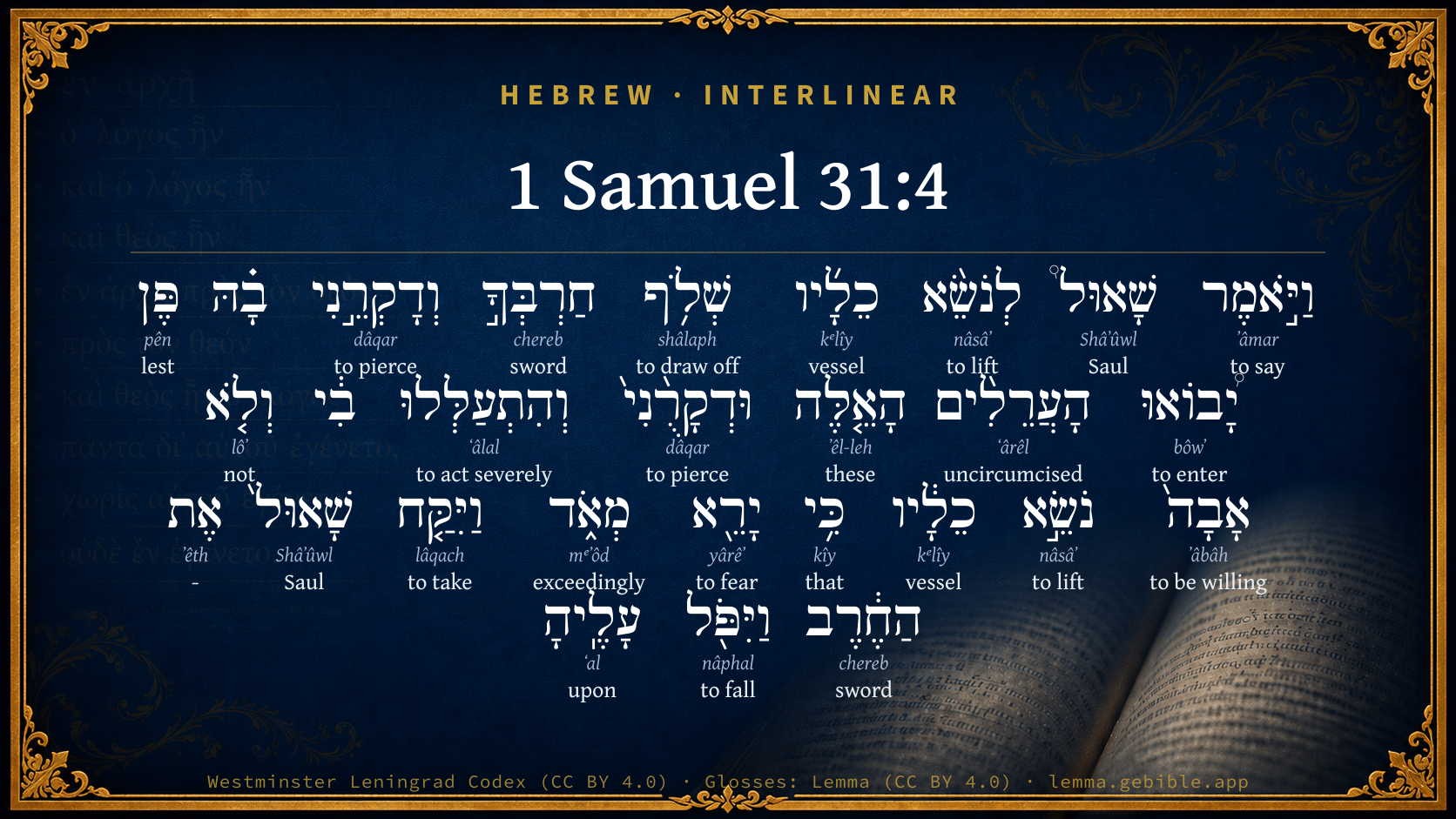
1 Samuel 31:4

Hebrew (Westminster Leningrad Codex) 1 Samuel 31:4 appears in the Hebrew Old Testament. The text above is from the Westminster Leningrad Codex. Each word links to its Strong’s number, a concise gloss, and parsing drawn from the Open Scriptures Hebrew Bible morphology. Click any word for its full Brown-Driver-Briggs (BDB) entry.
Download image
Cite this verse

1 Samuel 31:4 (World English Bible). Public Domain. Lemma interlinear Bible study tool, https://lemma.gebible.app/v/1-samuel/31/4.

Show BibTeX & RIS
BibTeX
RIS
English Translation
Then said Saul to his armor bearer, Draw your sword, and thrust me through therewith, lest these uncircumcised come and thrust me through, and abuse me. But his armor bearer would not; for he was sore afraid. Therefore Saul took his sword, and fell on it.
World English Bible · Public Domain
Download a study sheet

One document with this verse’s original text, its word-by-word gloss line, the meaning frame, cross-references with their text, attributed commentary, and full source and license credits — printable, and it pastes into notes with its structure intact.

This verse Autodidact and up

Study sheet (.html) Plain text (.txt)

A passage Seminary Student

Up to 50 verses in one chapter. A passage sheet keeps up to 6 commentary sources and 12 cross-references per verse, in the order this page ranks them, and says so on the sheet whenever that leaves anything out. Ask for a single verse and you get the Autodidact verse sheet above.

Everything on this page stays free to read, with no account — the sheet is a download of what is already on screen, not access to it.

Want to remove ads? Support Godless Engineer
Compare translations 3

The same verse in 3 English versions, stacked beneath the original-language interlinear above. Click any original word for its lexicon entry.

Each is an independent rendering of the whole verse — the interlinear is not word-aligned to these translations.

Highlighted words mark where these versions differ — a whole-verse word diff, not a word-by-word alignment.

  • World English Bible Public Domain
    Then said Saul to his armor bearer, Draw your sword, and thrust me through therewith, lest these uncircumcised come and thrust me through, and abuse me. But his armor bearer would not; for he was sore afraid. Therefore Saul took his sword, and fell on it.
  • King James Version Public Domain
    Then said Saul unto his armourbearer, Draw thy sword, and thrust me through therewith; lest these uncircumcised come and thrust me through, and abuse me. But his armourbearer would not; for he was sore afraid. Therefore Saul took a sword, and fell upon it.
  • unfoldingWord Literal Text CC BY-SA 4.0
    And Saul said to the carrier of his equipment, “Draw your sword and stab me with it, lest these uncircumcised come and stab me and abuse me.” But the carrier of his equipment was not willing, for he feared greatly. So Saul took the sword and fell on it.

unfoldingWord Literal Text — © unfoldingWord, licensed CC BY-SA 4.0. Word-aligned USFM3 via Door43 (git.door43.org/unfoldingWord/en_ult).

Versions to compare (up to 4)

3 of 4 selected

Show all 18 translations

Every available English version of this verse, each an independent rendering of the whole verse.

  • World English Bible Public Domain
    Then said Saul to his armor bearer, Draw your sword, and thrust me through therewith, lest these uncircumcised come and thrust me through, and abuse me. But his armor bearer would not; for he was sore afraid. Therefore Saul took his sword, and fell on it.
  • Berean Standard Bible Public Domain
    Then Saul said to his armor-bearer, “Draw your sword and run it through me, or these uncircumcised men will come and run me through and torture me!” But his armor-bearer was terrified and refused to do it. So Saul took his own sword and fell on it.
  • Majority Standard Bible Public Domain
    Then Saul said to his armor-bearer, “Draw your sword and run me through with it, or these uncircumcised men will come and run me through and torture me!” But his armor-bearer was terrified and refused to do it. So Saul took his own sword and fell on it.
  • King James Version Public Domain
    Then said Saul unto his armourbearer, Draw thy sword, and thrust me through therewith; lest these uncircumcised come and thrust me through, and abuse me. But his armourbearer would not; for he was sore afraid. Therefore Saul took a sword, and fell upon it.
  • American Standard Version (1901) Public Domain
    Then said Saul to his armorbearer, Draw thy sword, and thrust me through therewith, lest these uncircumcised come and thrust me through, and abuse me. But his armorbearer would not; for he was sore afraid. Therefore Saul took his sword, and fell upon it.
  • Revised Version (1885) Public Domain
    Then said Saul to his armourbearer, Draw thy sword, and thrust me through therewith; lest these uncircumcised come and thrust me through, and abuse me. But his armourbearer would not; for he was sore afraid. Therefore Saul took his sword, and fell upon it.
  • Geneva Bible (1599) Public Domain
    Then saide Saul vnto his armour bearer, Drawe out thy sworde, and thrust mee through therewith, lest the vncircumcised come and thrust me through and mocke me: but his armour bearer would not, for hee was sore afraid. Therefore Saul tooke a sworde and fell vpon it.
  • Douay-Rheims (1899) Public Domain
    Then Saul said to his armourbearer: Draw thy sword, and kill me: lest these uncircumcised come, and slay me, and mock at me. And his armourbearer would not: for he was struck with exceeding great fear. Then Saul took his sword, and fell upon it.
  • Young's Literal Translation Public Domain
    and Saul saith to the bearer of his weapons, `Draw thy sword, and pierce me with it, lest they come -- these uncircumcised -- and have pierced me, and rolled themselves on me;' and the bearer of his weapons hath not been willing, for he is greatly afraid, and Saul taketh the sword, and falleth upon it.
  • Literal Standard Version CC BY-SA 4.0
    and Saul says to the bearer of his weapons, “Draw your sword, and pierce me with it, lest they come—these uncircumcised—and have pierced me, and rolled themselves on me”; and the bearer of his weapons has not been willing, for he is greatly afraid, and Saul takes the sword, and falls on it.
  • Unlocked Literal Bible CC BY-SA 4.0
    Then Saul said to his armor bearer, “Draw your sword and thrust me through with it. Otherwise, these uncircumcised will come and abuse me.” But his armor bearer would not, for he was very afraid. So Saul took his own sword and fell on it.
  • unfoldingWord Literal Text CC BY-SA 4.0
    And Saul said to the carrier of his equipment, “Draw your sword and stab me with it, lest these uncircumcised come and stab me and abuse me.” But the carrier of his equipment was not willing, for he feared greatly. So Saul took the sword and fell on it.
  • Darby Bible Public Domain
    Then said Saul to his armour-bearer, Draw thy sword, and thrust me through with it; lest these uncircumcised come and thrust me through, and abuse me. But his armour-bearer would not; for he was much afraid. So Saul took the sword and fell on it.
  • World Messianic Bible Public Domain
    Then Saul said to his armor bearer, “Draw your sword, and thrust me through with it, lest these uncircumcised come and thrust me through and abuse me!” But his armor bearer would not, for he was terrified. Therefore Saul took his sword and fell on it.
  • Webster's Bible Public Domain
    Then said Saul to his armor-bearer, Draw thy sword, and thrust me through with it; lest these uncircumcised should come and thrust me through, and abuse me. But his armor-bearer would not; for he was exceedingly afraid. Therefore Saul took a sword, and fell upon it.
  • Free Bible Version CC BY-SA 4.0
    Saul said to his armor-bearer, “Take your sword and kill me, or these heathen men will come and kill and torture me!” But the armor-bearer didn't want to do it because he was too afraid. So Saul took his own sword and fell on it.
  • Bible in Basic English Public Domain
    Then Saul said to the servant who had the care of his arms, Take out your sword and put it through me, before these men without circumcision come and make sport of me. But his servant, full of fear, would not do so. Then Saul took out his sword, and falling on it, put an end to himself.
  • JPS Tanakh (1917) Public Domain
    Then said Saul to his armour-bearer: 'Draw thy sword, and thrust me through therewith; lest these uncircumcised come and thrust me through, and make a mock of me.' But his armour-bearer would not; for he was sore afraid. Therefore Saul took his sword, and fell upon it.

Literal Standard Version (2020), Covenant Press — licensed CC BY-SA 4.0. Text via the HelloAO Bible API (eBible.org). Unlocked Literal Bible (unfoldingWord) — licensed CC BY-SA 4.0. Text via the HelloAO Bible API (eBible.org). unfoldingWord Literal Text — © unfoldingWord, licensed CC BY-SA 4.0. Word-aligned USFM3 via Door43 (git.door43.org/unfoldingWord/en_ult). Free Bible Version, Dr. Jonathan Gallagher — licensed CC BY-SA 4.0. Text via the HelloAO Bible API (eBible.org).

Word by word

More ways to search: Search by grammar → Find every occurrence → Compare this word →

Practice this passage: Drill this verse → Learn its vocabulary →

וְדָקְרֵ֣נִי
dâqar
H1856
“and · pierce · me”
Conjunction + Verb, Qal, Imperative, 2nd Person, Masculine, Singular + Suffix, Personal, 1st Person, Common, Singular
Part of Speech
Conjunction + Verb
Stem
Qal
Form
Imperative
Person
2nd Person
Gender
Masculine
Number
Singular
Full BDB Definition

Origin: a primitive root

TWOT: 449

to pierce, thrust through, pierce through - (Qal) to pierce, run through - (Niphal) to be pierced through - (Pual) pierced, riddled (participle)
  1. וַיֹּ֣אמֶר ʼâmar H559 “and · to say” Conjunction + Verb, Qal, Sequential Imperfect, 3rd Person, Masculine, Singular
  2. שָׁאוּל֩ Shâʼûwl H7586 “Saul” Noun, Proper
  3. לְנֹשֵׂ֨א nâsâʼ H5375 “to/for · lifting” Preposition + Verb, Qal, Participle Active, Masculine, Singular, Construct
  4. כֵלָ֜יו kᵉlîy H3627 “vessels · his” Noun, Common, Masculine, Plural, Construct + Suffix, Personal, 3rd Person, Masculine, Singular
  5. שְׁלֹ֥ף shâlaph H8025 “draw off” Verb, Qal, Imperative, 2nd Person, Masculine, Singular
  6. חַרְבְּךָ֣ chereb H2719 “sword · your” Noun, Common, Feminine, Singular, Construct + Suffix, Personal, 2nd Person, Masculine, Singular
  7. פֶּן pên H6435 “lest” Conjunction
  8. יָ֠בוֹאוּ bôwʼ H935 “to enter” Verb, Qal, Imperfect, 3rd Person, Masculine, Plural
  9. הָעֲרֵלִ֨ים ʻârêl H6189 “the · uncircumcised” Particle, Definite Article + Adjective, Adjective, Masculine, Plural, Absolute
  10. הָאֵ֤לֶּה ʼêl-leh H428 “the · these” Particle, Definite Article + Pronoun, Demonstrative, Common, Plural
  11. וּדְקָרֻ֨נִי֙ dâqar H1856 “and · to pierce · me” Conjunction + Verb, Qal, Perfect, 3rd Person, Common, Plural + Suffix, Personal, 1st Person, Common, Singular
  12. וְהִתְעַלְּלוּ ʻâlal H5953 “and · to act severely” Conjunction + Verb, Hithpael, Perfect, 3rd Person, Common, Plural
  13. וְלֹ֤א lôʼ H3808 “and · not” Conjunction + Particle, Negative
  14. אָבָה֙ ʼâbâh H14 “to be willing” Verb, Qal, Perfect, 3rd Person, Masculine, Singular
  15. נֹשֵׂ֣א nâsâʼ H5375 “lifting” Verb, Qal, Participle Active, Masculine, Singular, Construct
  16. כֵלָ֔יו kᵉlîy H3627 “vessels · his” Noun, Common, Masculine, Plural, Construct + Suffix, Personal, 3rd Person, Masculine, Singular
  17. כִּ֥י kîy H3588 “that” Conjunction
  18. יָרֵ֖א yârêʼ H3372 “to fear” Verb, Qal, Perfect, 3rd Person, Masculine, Singular
  19. מְאֹ֑ד mᵉʼôd H3966 “exceedingly” Adverb
  20. וַיִּקַּ֤ח lâqach H3947 “and · to take” Conjunction + Verb, Qal, Sequential Imperfect, 3rd Person, Masculine, Singular
  21. שָׁאוּל֙ Shâʼûwl H7586 “Saul” Noun, Proper
  22. אֶת ʼêth H853 “-” Particle, Direct Object
  23. הַחֶ֔רֶב chereb H2719 “the · sword” Particle, Definite Article + Noun, Common, Feminine, Singular, Absolute
  24. וַיִּפֹּ֖ל nâphal H5307 “and · to fall” Conjunction + Verb, Qal, Sequential Imperfect, 3rd Person, Masculine, Singular
  25. עָלֶֽיהָ ʻal H5921 “upon · her” Preposition + Suffix, Personal, 3rd Person, Feminine, Singular

About this verse

These counts appear in no published source. They are computed here, from the morphology-tagged text and Lemma’s own curated glosses. What Lemma adds →

28
words
21
distinct lemmas
Historical
section

Notable vocabulary

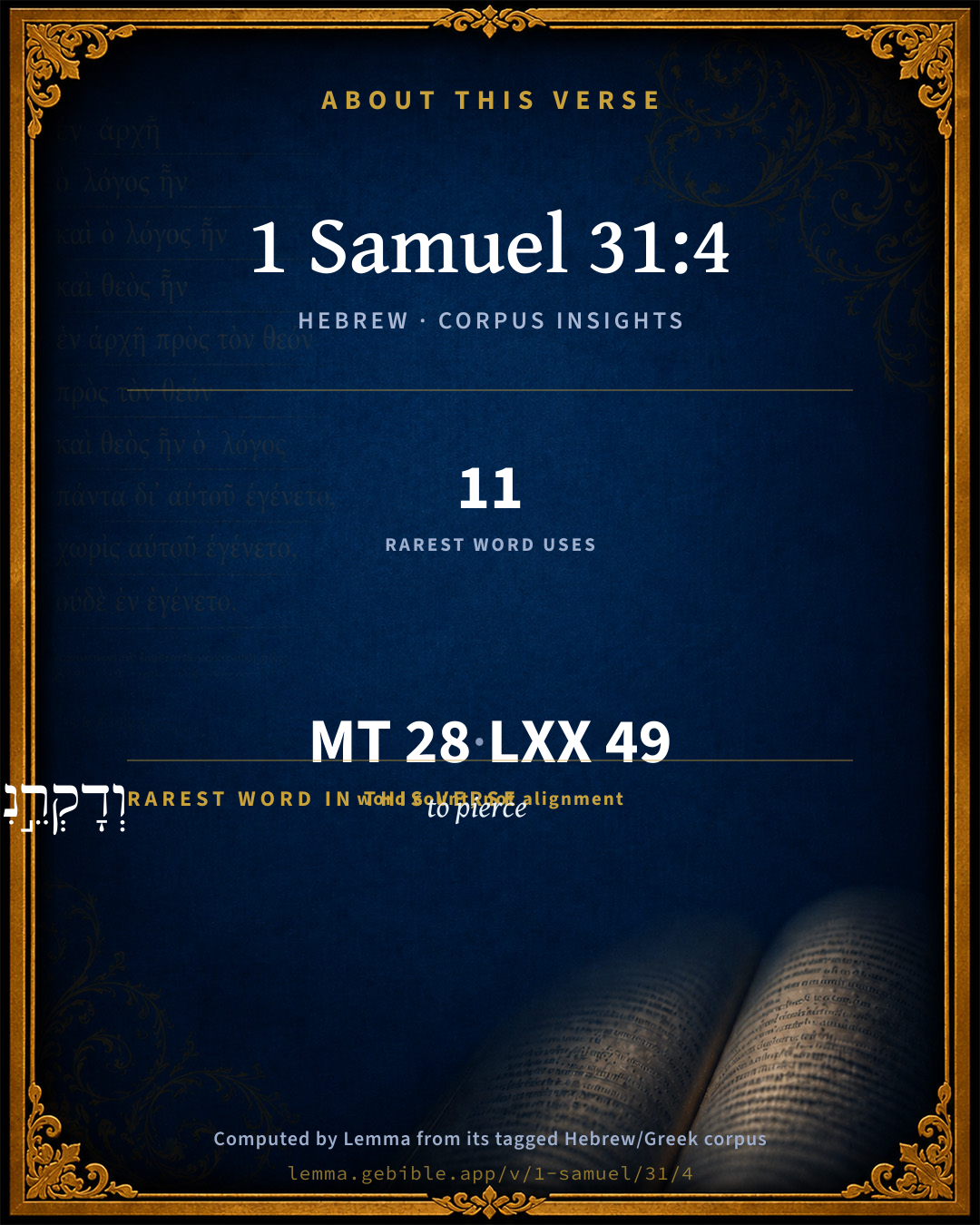
The rarest word here is וְדָקְרֵ֣נִי to pierce H1856 — appearing just 11 times in the whole Hebrew Bible.

Shared distinctive vocabulary

וְדָקְרֵ֣נִי to pierce H1856 occurs in 10 verses of the Hebrew Bible. Also found in:

Grammatical profile

  • 12 verbs
  • 6 nouns
  • 1 adjective
  • 1 pronoun
  • 3 prepositions
  • 2 conjunctions
  • 1 adverb
  • 2 particles

Verb forms

  • וַיֹּ֣אמֶר Qal · Sequential Imperfect
  • לְנֹשֵׂ֨א Qal · Participle Active
  • שְׁלֹ֥ף Qal · Imperative
  • וְדָקְרֵ֣נִי Qal · Imperative
  • יָ֠בוֹאוּ Qal · Imperfect
  • וּדְקָרֻ֨נִי֙ Qal · Perfect
  • וְהִתְעַלְּלוּ Hithpael · Perfect
  • אָבָה֙ Qal · Perfect
  • נֹשֵׂ֣א Qal · Participle Active
  • יָרֵ֖א Qal · Perfect
  • וַיִּקַּ֤ח Qal · Sequential Imperfect
  • וַיִּפֹּ֖ל Qal · Sequential Imperfect

Repetition

Words recur within this verse — often emphatic in Hebrew:

  • שָׁאוּל֩ Saul H7586 ×2
  • לְנֹשֵׂ֨א to lift H5375 ×2
  • כֵלָ֜יו vessel H3627 ×2
  • חַרְבְּךָ֣ sword H2719 ×2
  • וְדָקְרֵ֣נִי to pierce H1856 ×2

Hebrew & Septuagint length

In English translation the verse runs 46 words from the Hebrew and 44 from the Septuagint (LXX English) — closely comparable.

A rough comparison of the two English renderings, which tokenize alike — not a word-level alignment.

Word counts can differ between the Hebrew and the Greek without any difference in meaning — e.g. the Hebrew direct-object marker אֵת has no separate Greek word, and Greek often adds the article ὁ.

In the original languages it is 28 Hebrew tokens and 49 Greek tokens — but the two are counted differently (Hebrew bundles its prefixes and suffixes into one token; the Greek is in lemma form), so that isn’t a like-for-like length.

Cross-references

14

Topical passages linked to 1 Samuel 31:4 in the Treasury of Scripture Knowledge — connected by theme and wording, ordered by reader-vote popularity; previews shown in the World English Bible.

  • Judges 9:54 Then he called hastily to the young man his armor bearer, and said to him, Draw your sword, and kill me, that men not say of me, A woman killed him. His young man thrust him through, and he died.
  • 2 Samuel 1:6 The young man who told him said, As I happened by chance on Mount Gilboa, behold, Saul was leaning on his spear; and, behold, the chariots and the horsemen followed hard after him.
  • 2 Samuel 1:9–10 He said to me, Stand, I pray you, beside me, and kill me; for anguish has taken hold of me, because my life is yet whole in me.
  • 2 Samuel 1:20 Don't tell it in Gath, Don't publish it in the streets of Ashkelon; Lest the daughters of the Philistines rejoice, Lest the daughters of the uncircumcised triumph.
  • 2 Samuel 17:23 When Ahithophel saw that his counsel was not followed, he saddled his donkey, and arose, and got him home, to his city, and set his house in order, and hanged himself; and he died, and was buried in the tomb of his father.
  • Judges 14:3 Then his father and his mother said to him, Is there never a woman among the daughters of your brothers, or among all my people, that you go to take a wife of the uncircumcised Philistines? Samson said to his father, Get her for me; for she pleases me well.
  • 1 Samuel 14:6 Jonathan said to the young man who bore his armor, Come, and let us go over to the garrison of these uncircumcised: it may be that Yahweh will work for us; for there is no restraint to Yahweh to save by many or by few.
  • 1 Samuel 17:26 David spoke to the men who stood by him, saying, What shall be done to the man who kills this Philistine, and takes away the reproach from Israel? for who is this uncircumcised Philistine, that he should defy the armies of the living God?
  • 1 Samuel 17:36 Your servant struck both the lion and the bear: and this uncircumcised Philistine shall be as one of them, seeing he has defied the armies of the living God.
  • 2 Samuel 1:14 David said to him, How were you not afraid to put forth your hand to destroy Yahweh's anointed?
  • 1 Kings 16:27 Now the rest of the acts of Omri which he did, and his might that he shown, aren't they written in the book of the chronicles of the kings of Israel?
  • 1 Chronicles 10:4 Then said Saul to his armor-bearer, Draw your sword, and thrust me through therewith, lest these uncircumcised come and abuse me. But his armor-bearer would not; for he was sore afraid. Therefore Saul took his sword, and fell on it.
  • Jeremiah 9:25–26 Behold, the days come, says Yahweh, that I will punish all those who are circumcised in [their] uncircumcision:
  • Ezekiel 44:7–9 in that you have brought in foreigners, uncircumcised in heart and uncircumcised in flesh, to be in my sanctuary, to profane it, even my house, when you offer my bread, the fat and the blood, and they have broken my covenant, [to add] to all your abominations.

Cross-references courtesy of OpenBible.info (CC BY 4.0).

Hebrew and Greek witnesses Masoretic Hebrew ↔ Greek Septuagint

The same verse in the two great witnesses to the Old Testament, shown verse-for-verse.

These are two independent witnesses, not word-aligned to each other, and the Septuagint is shown in lemma (dictionary) form.

Hebrew 1 Samuel 31:4 Masoretic · Westminster Leningrad Codex

וַיֹּ֣אמֶר שָׁאוּל֩ לְנֹשֵׂ֨א כֵלָ֜יו שְׁלֹ֥ף חַרְבְּךָ֣ וְדָקְרֵ֣נִי בָ֗הּ פֶּן יָ֠בוֹאוּ הָעֲרֵלִ֨ים הָאֵ֤לֶּה וּדְקָרֻ֨נִי֙ וְהִתְעַלְּלוּ בִ֔י וְלֹ֤א אָבָה֙ נֹשֵׂ֣א כֵלָ֔יו כִּ֥י יָרֵ֖א מְאֹ֑ד וַיִּקַּ֤ח שָׁאוּל֙ אֶת הַחֶ֔רֶב וַיִּפֹּ֖ל עָלֶֽיהָ

Then said Saul to his armor bearer, Draw your sword, and thrust me through therewith, lest these uncircumcised come and thrust me through, and abuse me. But his armor bearer would not; for he was sore afraid. Therefore Saul took his sword, and fell on it.

World English Bible · Public Domain

Greek LXX 1 Samuel 31:4 Septuagint · lemma form

καί εἶπον σαούλ πρός ὁ αἴρω ὁ σκεῦος αὐτός σπάω ὁ ῥομφαία σύ καί ἀποκεντέω ἐγώ ἐν αὐτός μή ἔρχομαι ὁ ἀπερίτμητος οὗτος καί ἀποκεντέω ἐγώ καί ἐνπαίζω ἐγώ καί οὐ βούλομαι ὁ αἴρω ὁ σκεῦος αὐτός ὅτι φοβέω σφόδρα καί λαμβάνω σαούλ ὁ ῥομφαία καί ἐπιπίπτω ἐπί αὐτός

And Saul said to his armor-bearer, Draw your sword and pierce me through with it; lest these uncircumcised come and pierce me through, and mock me. But his armor-bearer would not, for he feared greatly: so Saul took his sword and fell upon it.

LXX2012 (modern English Septuagint) · Public Domain

Hebrew: Westminster Leningrad Codex (CC BY 4.0). Greek: Septuagint (public domain); English from LXX2012 (modern English Septuagint) (Public Domain). How the Septuagint differs from the Hebrew →

Targum (Aramaic paraphrase)

1

The Targum is the ancient Jewish Aramaic paraphrase of the Hebrew Scriptures — an interpretive translation, not the Hebrew text itself. Onkelos (literal) and Pseudo-Jonathan (expansive) render the Torah, and Jonathan the Prophets. Coverage is partial: where no permissively-licensed English translation exists for a verse, only the Aramaic is shown. This is verse-level text, not a word-by-word alignment to the Hebrew.

  1. Targum Jonathan Prophets (Joshua–Malachi)
    וַאֲמַר שָׁאוּל לְנָטֵל זְיָנֵיהּ שְׁלוֹף חַרְבָּךְ וְקַטְלַנִי בָהּ דִלְמָא יֵיתוּן עֲרֵלַיָא הָאִלֵין וְיִקְטְלוּנַנִי וְיִתְלַעֲבוּן בִּי וְלָא אָבָא נָטֵל זְיָנֵיהּ אֲרֵי דָחִיל לַחֲדָא וּנְסִיב שָׁאוּל יַת חַרְבָּא וּנְפַל עֲלָהּ:

    (no public-domain English translation for this verse)

    Targum Jonathan — Aramaic: “Mikraot Gedolot” (public domain). English: “Sefaria Community Translation” (CC0 1.0 (public-domain dedication)); “London "Chaldee Paraphrase," 1871” (public domain). Text via Sefaria.

Commentary

Notes on 1 Samuel 31:4 from classic Christian and Jewish commentators (each source and its license shown beneath its notes). The classic Christian expositions comment on the surrounding passage and are grouped to its opening verse, so a note may address several verses; the Jewish commentaries on the Tanakh (Rashi and others) are per-verse, so they appear only where the commentator wrote on this verse.

Lemma curates 59 commentaries, every one of them public domain or Creative Commons licensed, each selected and text-cleaned for this edition rather than reprinted as found. About our sources →

Ellicott's Commentary for English Readers

(4) His armourbearer.—Jewish tradition tells us that this faithful armourbearer was Doeg, the Edomite, and that the sword which Saul took apparently from the hand of the armourbearer was the sword with which Doeg had massacred the priests at Gibeon and at Nob.

Lest these uncircumcised come and thrust me.—“Even in Saul’s dying speech there is something of that religious formalism which marked his character after his fall from God, and which is a striking sign of spiritual blindness. He censures the Philistines as ‘uncircumcised.’”—Wordsworth.

Saul had a strong consciousness of the sacredness of his person as the Lord’s anointed; as it has been well said of him, no descendant of a long line of so-styled Christian or Catholic sovereigns has held a loftier claim of personal inviolability.

And abuse me.—He remembered how these same Philistines in former years had treated the hero Samson when he fell into their hands.

His armourbearer would not.—Love and devotion to his master we can well imagine stayed his hand from carrying out his fallen master’s last terrible command. If the armourbearer—as the Jewish tradition above referred to asserts—was indeed Doeg the Edomite, the two, the king and his confidential officer, had been fast friends for years. Some dread of the after consequences, too, may have weighed with the royal armour-bearer, as he was to a certain extent responsible for the king’s life. What possibly he dreaded actually came to pass in the case of the Amalekite who told David that he was the one who inflicted the fatal stroke when the king was dying; as a guerdon for his act, David had him at once put to death for having put forth his hand to destroy the Lord’s anointed.

A sword.—It was a heavy weapon, a war sword, answering to the great epée d’armes of the Middle Ages. This he took from the reluctant hands of his faithful follower, and placing the hilt firmly on the ground, he threw the weight of his body on the point.

In 2Sa_1:6-10 we have another account of the death. There an Amalekite bearing the royal insignia of the late king, the crown royal and the well-known bracelet of Saul, comes to David at Ziklag after the fatal fight, and recounts how, finding the king leaning on his spear—possibly, as Bunsen supposes, “lying on the ground propping his weary head with the nervously-clutched spear,” exhausted and seized with “cramp” (this is the Rabbinical translation of the word rendered “anguish”), at his urgent request, slew him. Most commentators—for instance, Kiel, Lange, Bishop Hervey, &c.—regard the Amalekite’s story as an invention framed to extract a rich gift from David, who, the savage Arab thought, would be rejoiced to hear of his great enemy’s fall. If this be so, then we must suppose that the Amalekite wandering over the field of battle strewn with the slain on the night which succeeded the battle, came upon the body of Saul, and, attracted by the glitter of the golden ornaments, stripped off the precious insignia, and hastened with his lying story to David. Ewald, however, sees no reason to doubt the trustworthiness of the Amalekite’s story; in fact, the two accounts may well be harmonised. Stanley graphically paints the scene after he had fallen on his sword, and his faithful armourbearer had in despairing sorrow killed himself also. “His armourbearer lies dead beside him; on his head the royal crown, on his arm the royal bracelet; . . . the huge spear is still in his hand; he is leaning peacefully on it. He has received his death-blow either from the enemy (1Sa_31:3), or from his own sword (1Sa_31:4). The dizziness and darkness of death is upon him. At that moment a wild Amalekite, lured probably to the field by the hope of spoil, came up and finished the work which the arrows of the Philistines and the sword of Saul himself had all but accomplished.”—Jewish Church, Lect. 21. The words of the next verse (5) do not contradict this possible explanation. The armourbearer, seeing the king pierced with the arrows and then falling on his own sword, may well have imagined his master dead, and so put an end to his own life. But Saul, though mortally wounded, may have rallied again for a brief space; in that brief space the Amalekite may have come up and finished the bloody work; then, after the king was dead, he probably stripped the royal insignia from the lifeless corpse.

So Saul died.—This is one of the very rare instances of self-destruction among the chosen people. It seems to have been almost unknown among the Israelites. Prior to Saul the only recorded example is that of Samson, and his was a noble act of self-devotion—the hero sacrificed his life in order to compass the destruction of a great crowd of men, powerful and influential foes of his dear country. His death in the great Dagon Temple at Gaza ranks, as it has been well said, with the heroism of one dying in battle rather than with cases of despairing suicide. There is another instance after the days of Saul—that of the wise privy councillor of King David, Ahithophel, who, in a paroxysm of bitter mortification, we read, went and hanged himself. There is another in the Gospel story familiar to us all. Theologians are divided in their judgment on King Saul. S. Bernard, for instance, thinks that Saul was lost for ever. Corn, à Lapide, followed by Bishop Wordsworth, has no kindly thought for the great first king. The Jewish historian Josephus, on the contrary, writes in warm and glowing terms of the patriotic devotion with which Saul went to meet his end. Many of the Rabbis sympathise with Josephus in his estimate of the unhappy monarch. Without in any way justifying the fatal act which closed the dark tragedy of his reign, we may well plead in extenuation the awful position in which the king found himself that evening after Gilboa had been fought and lost, and we may well remember the similar conduct of Brutus, Cassius, and the younger Cato, and call to our minds what posterity has said of these noble heathens, and how far they have judged them guilty of causeless self-murder.

Well would it be for men when they sit in judgment on Saul, and on other great ones who have failed, as they think, in the discharge of their duties to God as well as to man—well would it be for once to imitate what has been rightly called “the fearless human sympathy of the Biblical writers,” and to remember how the “man after God’s own heart,” in strains never to be forgotten, wrote his touching lament over King Saul, dwelling only on the Saul, the mighty conqueror, the delight of his people, the father of his beloved and faithful friend, like him in life, united with him in death; and how with these words—gentle as they are lovely, inspired by the Holy Spirit—the Bible closes the record of the life, and leaves the first great king, the first anointed of the Lord, in the hands of his God.

A Bible Commentary for English Readers, edited by Charles John Ellicott (1878–1897) — public domain. Text from a community e-Sword module.

Trapp's Complete Commentary

John Trapp

1Sa 31:4 Then said Saul unto his armourbearer, Draw thy sword, and thrust me through therewith; lest these uncircumcised come and thrust me through, and abuse me. But his armourbearer would not; for he was sore afraid. Therefore Saul took a sword, and fell upon it.

Ver. 4. Then said Saul unto his armourbearer.] Whom the Rabbis constantly affirm to have been Doeg, the Edomite, whom Saul had once commanded to slay the Lord’s priests, and now to do the like to himself.

“ Discite iustitiam moniti. ”

Lest these uncircumcised come.] To his last he reproaches the Philistines with their uncircumcision: as if his condition had been better than theirs, because he was circumcised. Whereas external privileges profit nothing those that are profane; but they are therefore the worse, because they ought to be better. {Gal 5:6; Gal 6:15}

And abuse me,] i.e., My body, whereof he took more care than for his precious soul; a common fault. His body was abused, nevertheless.

But his armourbearer would not.] No more would Mark Antony’s armourbearer Eras: but, that he might not meddle with his master, fell first upon his own sword.

Therefore Saul took a sword, and fell upon it.] After that he had first seen so many fall by the sword before him; and that with delight, if he had fallen before into the unpardonable sin, as some think he had. We read {a} of one that had committed that sin, that he wished that his wife and children, and all the world, might be damned together with him. But that he thus desperately slew himself, lest he should be slain by the enemy, "Hic rogo non furor est, ne moriare mori?" So some Jews at the sack of Jerusalem killed themselves, lest they should be taken by the Romans. Cato, lest he should fall into the hands of Caesar; for which suicide Seneca {b} highly extolleth him, but Augustine, {c} upon better grounds, dispraiseth and condemneth that fact of his as absurd and cowardly; especially since at his death he bade his son to do otherwise; yea, to promise himself all good of Caesar’s clemency. Cleombrotus and the Circumcelliones are not worth mentioning; Brutus and Cassius were to be pitied: but God receiveth not such souls, saith Jerome, {d} as against his will go out of their bodies. Osiander thinketh that Saul’s desperate death was a forerunner of his everlasting destruction: the Lord taketh it upon himself, and saith that he slew him. {1Ch 10:14}

{a} Burr., Moses’s Choice, p. 34.

{b} Lib. de Provid. Divin.

{c} De Civ. Dei, lib. i. cap. xxiii.

{d} Ad Marcel.

John Trapp, A Commentary or Exposition upon All the Books of the Old and New Testament (1647–1656) — public domain. Text from a community e-Sword module.

The Biblical Illustrator

Joseph S. Exell

1Sa_31:4

Saul took a sword and fell upon it.

The death of Saul

Sauls life is a tragedy, and his death is the closing scene. Circumstances close round him, and press him to his doom. These circumstances know no remorse. They never pause for pity. The last foe that Saul meets is himself. His death was neither more nor less than suicide; the death of all deaths the most loathsome and despised of men; of all deaths the only one that men call cowardly. Yet to this Saul came, as if he had not been the anointed of the Lord, as if he never had been the glory of Gods people Israel. The whole of the preceding history had a sound in it portentous of change and death. And Saul himself, better than any other man, was aware that his end was near; and he went on to that end in a most pitiable plight; a hero without a heros hope. There is a singular fitness in the chapter which closes this life of Saul. There is no sentimental dallying with the tragic facts. The battle was set, and from the first, the Philistines did the fighting. We need not dwell on the features of this tragedy. It was a great historical event, meaning much to the nation which saw its first king thus sadly fall. It was the end of Sauls kingdom: his sons and all his family, and, with them, all his hopes, died with him that night on Mount Gilboa. And it is still a conspicuous moral, as well as historical, event, on which we may well pause to look across the ages. Saul brought down thousands with him when he fell, but he had been lowering the tone of the spiritual nation almost from the time when he began his reign. The people had, indeed, got in him what they asked for--a king like unto their neighbours. And as he had been in his life in the land, so was he when he died at Gilboa. For there was the shield of the mighty vilely cast away--the shield of Saul--as of one not anointed of the Lord. When we look at this life in its most general, human aspects, it is hard to escape the question: Why did God bring Saul into all these circumstances of trial where he so ignobly failed and fell? Would it not have been better for Saul never to have been called from his fathers plough? There is something more serious by far than to be a king; it, is more serious to be a man. If mere safety and immunity from trial and danger are all that are to be desired by us, we must needs rank ourselves with the irrational creation. But when we are made men we are called with a high calling. We have set before us an immortal destiny, either to work that out or wreck it away. We are all on our trial. The highest issues of human life are brought out by the greatness and the strength of our trials. So was it with Saul. His trial began with his great opportunity. The highness of his calling measures the deepness of his falling. There are three points which indicate the departure of Saul from the path of peace and duty.

1. He had not long reigned until he began to separate himself from good men in the land. He was soon separated from Samuel, the best, the noblest, the representative good man of the time he was soon separate from David, the man of the future, the man after Gods own heart, and who desired to do only Gods will. He was soon cruel and fierce in his wrath, slaying one by one the priests of the Lord.

2. Then we find that he was separate from God. He prayed to God, and God gave him no answer. He asked in vain for Gods guidance, and then called in vain for the dead Samuel.

3. Last of all, Saul got separated from himself; from his own best nature. There was a great chasm in his nature, between his evil and his controlling, better self; and thus he was left to the wreck and ruin which his own worst nature prompted. Such is the spiritual history of him whose tragic life we have now read to its close. (Armstrong Black.)

Suicide

Our Creator, it is said, has given us a general desire to obtain good, and avoid evil; why may we not obey this impulse? We leave a kingdom, or a society, of which we do not approve; we avoid bodily pain by all the means which we can invent; why may we not cease to live, when life becomes a greater evil, than a good? Because, in avoiding pain, or in procuring pleasure, we are always to consider the good of others, as well as our own. Poverty is an evil, but we may not rob to avoid it; power is a good, but it is not justifiable to obtain it by violence or deceit; we have only a right to consult our own good within certain boundaries, and after such a manner that we do not diminish the good of others: Every evil incapable of such limited remedy, it is our duty to bear; and if the general idea that we have a right to procure voluntary death to ourselves, be pregnant with infinite mischief to the interests of religion, and morality, it is our duty to live, as much as it is our duty to do anything else for the same reason; a single instance of suicide may be of little consequence; nor is a single instance of robbery of much; but we judge of single actions, by the probability there is of their becoming frequent, and by the effects they produce, when they are frequent.

1. Suicide, is as unfavourable to human talents, and resources, as it is to human virtues; we should never have dreamt of the latent power, and energy of our nature, but for the struggle of great minds with great afflictions, nor known the limits of ourselves, nor mans dominion over fortune: What would the world now have been, if it had always been said, because the archers smite me sore, and the battle goeth against me, I will die? Alas! man has gained all his joy by his pains; misery, hunger, and nakedness, have been his teachers, and goaded him on to the glories of civilised life; take from him his unyielding spirit, and if he had lived at all, he would have lived the most suffering creature of the forest.

2. Suicide has been called magnanimity; but what is magnanimity? A patient endurance of evil, to effect a proposed good; and when considering the strange mutability of human affairs, are we to consider this endurance as useless, or when should hope terminate but with life? To linger out year after year, unbroken in spirit, unchanged in purpose, is doubtless, a less imposing destiny than public, and pompous suicide; but if to be, is more commendable, than to seem to be; if we love the virtue, better than the name, then is it true magnanimity to extract wisdom from misery, and doctrine from shame; to call day, and night upon God; to keep the minds eye sternly riveted on its object through failure, and through suffering; through evil report, and through good report; and to make the bed of death the only grave of human hope; but at the moment when Christianity warns you that your present adversity may be a trial from God; when experience teaches that great qualities come in arduous situations; when piety stimulates you to show the hidden vigour, the inexhaustible resources, the beautiful capacities of that soul, which God has exempted from the destruction which surrounds it; at that moment, the law of self-murder gives you, for your resource, ignominious death, frightful disobedience, and never-ending torments.

3. It may be imagined that suicide is a crime of rare occurrence, but we must not so much overrate our love of life, when there is hardly a passion so weak, which cannot at times, overcome it; many fling away life from ambition, many from vanity, many from restlessness, many from fear, many from almost every motive; nature has made death terrible, but nature has made those evils terrible, from the dread of which we seek death; nature has made resentment terrible, infamy terrible, want terrible, hunger terrible; every first principle of our nature alternately conquers and is conquered; the passion that is a despot in one mind, is a slave in the other; we know nothing of their relative force.

4. It is hardly possible be conceive this crime, committed by anyone who has not confounded his common notions of right and wrong by some previous sophistry, and cheated himself into a temporary scepticism; but who would trust to the reasoning of such a moment in such a state of the passions, when the probability of error is so great, and the punishment so immeasurable? Men should determine, even upon important human actions, with coolness, and unimpeded thought; much less, then, is a rash and disturbed hour enough for eternity.

5. It has often been asked, if self-murder is forbidden by the Christian religion; but those who ask this question forget, that Christianity is not a code of laws, but a set of principles from which particular laws must frequently be inferred; it is not sufficient to say, there is no precise, and positive law, naming, and forbidding self-murder; there is no law of the gospel, which forbids the subject to destroy his ruler; but there is a law, which says, fear, and obey him; there is no law which prevents me from slaying my parent; but there is a law which says, love, and honour them; be meek, says our Saviour; be long suffering; abide patiently to the last; submit to the chastening hand of God, and let us never forget, that the fifth, and greatest gospel is the life of Christ; that he acted for us, as well as taught, that in the deserts of Judea, in the hall of Pilate, on the supreme cross, his patience shows us, that evil is to be endured, and his prayers point out to us, how alone it can be mitigated. (Sidney Smith, M. A.)

Lessons from a suicide

There is always something solemn in doing things which, when done, cannot be undone--in taking steps which, when taken once, can never be recalled. We sign our contracts with a trembling hand; and enter into those bonds which least of all we desire to break, with a solemnity which arises from the thought that, once entered upon, we cannot recede. The act of suicide affords the most decisive evidence of the extensive delusion which men can practise on themselves, and of the blinding power which they permit the tempter to exercise over them, when, under the idea of relief and escape, they involve themselves in a deeper calamity, and in order to effect an oblivion of present suffering, they grasp the cup of eternal woe, and put it to their lips. From what shall I escape? is but one-half of the question--Into what shall I bring myself? is the still more momentous portion of the inquiry.

1. Looking at the circumstances of Sauls death in their connection with the history of the people over whom he reigned, it is impossible not to perceive that they were fraught with instruction to the nation, with lessons valuable though humiliating. They reiterate with deeper emphasis the truth--that when men are determined to have their own way--when they will not listen to heavenly suggestions, to Divine remonstrances--and when they think that they can manage better for themselves than God can manage for them, there is but one way of convincing them of their error. They must be allowed to take the problem of their peace and happiness into their own hands, to attempt to work it out in their own fashion, and then to reap the bitter results of failure, which in such a case are inevitable. Israel worked out their own problem, and they brought it to this issue--And the men of Israel flee from before the Philistines, and fell down slain in Mount Gilboa, etc. And thus will it ever be, where men expect to reap more from their own theories than from Gods fixed laws and plans.

2. We may take, as a second suggestion from the spectacle before us, the thought--How dreadful it is for a man to be in trouble without God to sustain and support him. The waves and billows were indeed going over Saul. We see here the acting out of one of those principles which regulate the Divine dealings with men If they seek Him, He will be found of them; if they forsake Him, He will cast them off foreverse Fearful as is the lesson taught us by the self-murder of Saul, it is consolatory to know that no one need be in trouble without God. Precious promises point out the way in which we may be delivered from any such fear.

3. We see, in Sauls case, that there is no surer sign that a man is on the high road to ruin than that his heart is hardened against Divine warnings. Quickly, one after another, came solemn calls to the king of Israel to humble himself at last before God. We wait; and the thought rushes into our heart, He will break down at last; he will stand out no longer. But it did not. And then it was seen that the heart which can stand out against solemn calls, ruin will be the result. He that being often reproved, etc. It is a grievous miscalculation, moreover, which men make, when, conscious that life is passing on in the neglect of God and of duty, they reckon within themselves upon a certain power which they imagine the approach of death will have to awaken their attention to religious duties, and to bring with it the disposition to return to God in repentance and prayer.

4. As we compare the conclusion of this history with its commencement, we cannot but discover an impressive lesson as to the influence of external circumstances upon personal character. As Saul rose in his social position, he sunk in his moral condition. It is dangerous to keep an idol for ourselves; it is not less perilous to become the idol of others. Never was there a man more frequently instructed in the lesson of entire dependence upon God. (J. A. Miller.)

The Biblical Illustrator, edited by Joseph S. Exell (c. 1880s–1900s) — public domain. Text from a community e-Sword module.

Joseph Benson's Commentary

1Sa 31:4. Lest these uncircumcised come and thrust me through, and abuse me — He was afraid they might put him to some ignominious death, or make sport with him, as they did with Samson. But his armour-bearer would not, for he was sore afraid — He dreaded to think of killing his king. Saul took a sword, and fell upon it — “A truly brave man,” says Delaney, “would have died fighting, as Jonathan did, or would, at worst, have gloried at being abused, and even tortured, for having done his duty! Saul then died, not as a hero, but a deserter. Self-murder is demonstrably the effect of cowardice: and it is as irrational and iniquitous as it is base. God, whose creatures we are, is the sole arbiter, as he is the sole author of our life: our lives are his property; and he hath given our country, our family, and our friends, a share in them. And, therefore, as Plato finely observes in his Phædo, God is as much injured by self-murder, as I should be by having one of my slaves killed without my consent. Not to insist on the injury done to others, in a variety of relations, by the same act.”

Joseph Benson's Commentary on the Old and New Testaments (1811–1818) — public domain. Text from a community e-Sword module.

Tyndale Open Study Notes

Tyndale Open Resources

31:4 David had once held the position of armor bearer (16:21). • kill me: This is one of many parallels between the death of Abimelech in the time of the judges (Judg 9) and Saul, Israel’s first national king (cp. Judg 9:54).

Tyndale Open Study Notes — © Tyndale Open Resources, licensed CC BY-SA 4.0. Text via the HelloAO Bible API.

Geneva Bible (1599)

Geneva Bible translators

So we see that his cruel life hath a desperate end: as is commonly seen in them that persecute the children of God.

Geneva Bible (1599) marginal notes — public domain. Text via Bolls.life.

Adam Clarke's Commentary

Verse 4. Draw thy sword, and thrust me through] Dr. Delaney has some good observations on this part of the subject: "Saul and his armour-bearer died by the same sword. That his armour-bearer died by his own sword is out of all doubt; the text expressly tells us so; and that Saul perished by the same sword is sufficiently evident. Draw THY sword, says he to him, and thrust me through; which, when he refused, Saul, says the text, took THE sword, (את החרב eth hachereb, the very sword,) and fell upon it. What sword? Not his own, for then the text would have said so; but, in the plain natural grammatical construction, the sword before mentioned must be the sword now referred to, that is, his armour-bearer's, 1Ch 10:4-5. Now it is the established tradition of all the Jewish nation that this armour-bearer was Doeg, and I see no reason why it should be discredited; and if so, then Saul and his executioner both fell by that weapon with which they had before massacred the priests of God. So Brutus and Cassius killed themselves with the same swords with which they stabbed Caesar; and Calippus was stabbed with the same sword with which he stabbed Dio."

Adam Clarke's Commentary on the Bible (1810–1826) — public domain. Text from a community e-Sword/MySword module.

The Cambridge Bible for Schools and Colleges

gen. ed. J. J. S. Perowne

4. Then said Saul, &c.] Cp. Jdg_9:54.

these uncircumcised] No indignity could be more intolerable than for the sacred person of Jehovah’s Anointed to be the butt of the heathen who had no part in His covenant. Cp. 1Sa_14:6.

abuse me] Maltreat me for their own amusement.

a sword] His sword.

fell upon it] This account of Saul’s death is obviously inconsistent with that given by the Amalekite (2Sa_1:9 ff.). His story was a fabrication. He found the king’s corpse on the field, stripped it, and brought the spoil to David in the hope of a reward.

The Cambridge Bible for Schools and Colleges (gen. ed. J. J. S. Perowne; Cambridge University Press, 1878–1918) — public domain. Text from a community e-Sword module.

John Gill's Exposition

Then said Saul unto his armourbearer,.... Who, the Jews (b) say, was Doeg the Edomite, promoted to this office for slaying the priests:

draw thy sword, and thrust me through therewith; for if he was wounded, yet not mortally, and it is certain he did not so apprehend it. It is much the sword of the armourbearer should be sheathed in a battle; but perhaps he was preparing for flight, and so had put it up in its scabbard:

lest these uncircumcised come and thrust me through, and abuse me; lest they should not dispatch him at once, but put him to a lingering and torturing death, and insult him, and mock at him, as they did Samson:

but his armourbearer would not, for he was sore afraid; to lay his hand on the king the Lord's anointed, to take away his life, being more scrupulous of doing that, if this was Doeg, than of slaying the priests of the Lord; or he might be afraid of doing this, since should he survive this action, he would be called to an account by the Israelites, and be put to death for killing the king:

therefore Saul took a sword, and fell upon it; or rather "the sword", the sword of his armourbearer, and so was a suicide: the Jews endeavour to excuse this fact of Saul, because he knew he should die in battle from the words of Samuel; and being pressed sore by the archers, he saw it was impossible to escape out of their hands and therefore judged it better to kill himself than to fall by the hands of the uncircumcised; but these excuses will not do. Josephus (c) denies he killed himself; that though he attempted it, his sword would not pierce through him, and that he was killed by the Amalekite, and that that was a true account he gave to David in the following chapter; though it seems rather to be a lie, to curry favour with David, and that Saul did destroy himself.

(b) Hieron. Trad. Heb. in lib. Reg. fol. 77. B. (c) Antiqu. l. 6. c. 14. sect. 7.

John Gill's Exposition of the Whole Bible (1746–1763) — public domain (CC PDM 1.0). Text via the HelloAO Bible API.

Haydock's Catholic Bible Commentary

Bearer. The Rabbins say he was Doeg. They were not yet come to a close engagement. --- Mock at me, as was then customary. See Josue viii. 29., and Judges i. 7. He might recollect the treatment of Samson. (Calmet) --- Fear. "To spill the royal blood’s a direful thing." (Homer)

George Leo Haydock (1774–1849), Haydock's Catholic Family Bible and Commentary, 1859 edition — public domain. Excludes Psalms (Douay-Rheims chapter numbering differs from Protestant) and Deuterocanonical books (Catholic canon only).

Matthew Poole's English Annotations

Thrust me through, and abuse me; lest they take me, and put me to some shameful and cruel death.

Saul took a sword, and fell upon it, and died of the wound, as it follows.

Matthew Poole's English Annotations on the Holy Bible (1683–1685) — public domain. Text from a community e-Sword/MySword module.

Whedon's Commentary on the Bible

Daniel D. Whedon

4. His armourbearer would not — He dared not stretch forth his hand against the Lord’s anointed; the very thought of such an act filled him with fear.

Saul took a sword — Rather, took the sword, that is, the sword of the armourbearer just referred to.

Fell upon it — Thrust it through himself by falling over upon it.

This account of Saul’s death is every way consistent with itself and with Saul’s character, and is to be regarded as the true and authentic record of the sacred historian himself. The story of the Amalekite, who stole the king’s crown and bracelet, and brought them to David, (2Sa_1:4-10,) is to be treated as a fabrication, feigned with the hope of finding favour with the successor of Saul.

Daniel D. Whedon (gen. ed.), Commentary on the Old and New Testaments (1874–1909) — public domain. Text from a community e-Sword module.

unfoldingWord translationNotes

Door43 World Missions Community

armor bearer

The armor bearer carried the large shield of his commanding officer and other weapons. He protected the commanding officer during a battle.

these uncircumcised

The nominal adjective "uncircumcised" can be translated as an adjective. Not being circumcised is a metonym for being foreigners. AT: "these men who have not been circumcised" or "these non-Israelite men" (See: Nominal Adjectives and Metonymy)

would not

The ellipsis can be filled in. AT: "would not do what Saul had told him to do" (See: Ellipsis)

took his own sword and fell on it

"killed himself with his own sword"

that same day

"on that one day"

translationWords

Saul (OT)

armor

sword

circumcise

fear

unfoldingWord translationNotes — © Distant Shores Media and the Door43 World Missions Community, licensed CC BY-SA 4.0. Source: git.door43.org/Door43/en_tn.

Lesson kit

Teaching starters — assembled from the data on this page, not authored interpretation. Every prompt links to the verse data it draws on. Edit before teaching.

1 Samuel, in the Historical, opens this verse with 28 words (21 distinct Hebrew lemmas). Its most distinctive word is dâqar (“to pierce”). A historical commentator’s framing appears above. Read the whole chapter for the surrounding context.

Discussion questions

  1. What does “to pierce” (dâqar) contribute to the verse as a whole?
  2. Numbers 25:8 shares the word «to pierce» with this verse. How do the two illuminate each other?
  3. “Saul” occurs 2× in this one verse. What is the effect of the repetition?
  4. These translations render this verse differently. What is at stake in choosing one wording over another?
  5. The verb «וַיֹּ֣אמֶר» is Qal Sequential Imperfect. How does its form color the action?
  6. Reading how Ellicott's Commentary for English Readers and Trapp's Complete Commentary read this verse, where do the two commentators agree and where do they part?

Things to notice

Reading settings

Reading text

Shown beneath each verse's original-language words.

Old Testament
Old Testament edition

Read the OT as the Masoretic Hebrew (MT) or the Greek Septuagint (LXX).

English shown for the Greek Septuagint (in the Hebrew ↔ Greek comparison).

Comparing translations? Open the Compare panel on any verse page to stack up to four side by side.