
1 Chronicles 21:16

Hebrew (Westminster Leningrad Codex) 1 Chronicles 21:16 appears in the Hebrew Old Testament. The text above is from the Westminster Leningrad Codex. Each word links to its Strong’s number, a concise gloss, and parsing drawn from the Open Scriptures Hebrew Bible morphology. Click any word for its full Brown-Driver-Briggs (BDB) entry.
Download image
Cite this verse

1 Chronicles 21:16 (World English Bible). Public Domain. Lemma interlinear Bible study tool, https://lemma.gebible.app/v/1-chronicles/21/16.

Show BibTeX & RIS
BibTeX
RIS
English Translation
David lifted up his eyes, and saw the angel of Yahweh standing between earth and the sky, having a drawn sword in his hand stretched out over Jerusalem. Then David and the elders, clothed in sackcloth, fell on their faces.
World English Bible · Public Domain
Download a study sheet

One document with this verse’s original text, its word-by-word gloss line, the meaning frame, cross-references with their text, attributed commentary, and full source and license credits — printable, and it pastes into notes with its structure intact.

This verse Autodidact and up

Study sheet (.html) Plain text (.txt)

A passage Seminary Student

Up to 50 verses in one chapter. A passage sheet keeps up to 6 commentary sources and 12 cross-references per verse, in the order this page ranks them, and says so on the sheet whenever that leaves anything out. Ask for a single verse and you get the Autodidact verse sheet above.

Everything on this page stays free to read, with no account — the sheet is a download of what is already on screen, not access to it.

Want to remove ads? Support Godless Engineer
Compare translations 3

The same verse in 3 English versions, stacked beneath the original-language interlinear above. Click any original word for its lexicon entry.

Each is an independent rendering of the whole verse — the interlinear is not word-aligned to these translations.

Highlighted words mark where these versions differ — a whole-verse word diff, not a word-by-word alignment.

  • World English Bible Public Domain
    David lifted up his eyes, and saw the angel of Yahweh standing between earth and the sky, having a drawn sword in his hand stretched out over Jerusalem. Then David and the elders, clothed in sackcloth, fell on their faces.
  • King James Version Public Domain
    And David lifted up his eyes, and saw the angel of the LORD stand between the earth and the heaven, having a drawn sword in his hand stretched out over Jerusalem. Then David and the elders of Israel, who were clothed in sackcloth, fell upon their faces.
  • unfoldingWord Literal Text CC BY-SA 4.0
    And David lifted his eyes and saw the angel of Yahweh standing between the earth and between the heavens, and his drawn sword in his hand stretched out over Jerusalem. And David fell, and the elders, covered in sackcloth, on their faces.

unfoldingWord Literal Text — © unfoldingWord, licensed CC BY-SA 4.0. Word-aligned USFM3 via Door43 (git.door43.org/unfoldingWord/en_ult).

Versions to compare (up to 4)

3 of 4 selected

Show all 18 translations

Every available English version of this verse, each an independent rendering of the whole verse.

  • World English Bible Public Domain
    David lifted up his eyes, and saw the angel of Yahweh standing between earth and the sky, having a drawn sword in his hand stretched out over Jerusalem. Then David and the elders, clothed in sackcloth, fell on their faces.
  • Berean Standard Bible Public Domain
    When David lifted up his eyes and saw the angel of the LORD standing between heaven and earth, with a drawn sword in his hand stretched out over Jerusalem, David and the elders, clothed in sackcloth, fell facedown.
  • Majority Standard Bible Public Domain
    When David lifted up his eyes and saw the angel of the LORD standing between heaven and earth, with a drawn sword in his hand stretched out over Jerusalem, David and the elders, clothed in sackcloth, fell facedown.
  • King James Version Public Domain
    And David lifted up his eyes, and saw the angel of the LORD stand between the earth and the heaven, having a drawn sword in his hand stretched out over Jerusalem. Then David and the elders of Israel, who were clothed in sackcloth, fell upon their faces.
  • American Standard Version (1901) Public Domain
    And David lifted up his eyes, and saw the angel of Jehovah standing between earth and heaven, having a drawn sword in his hand stretched out over Jerusalem. Then David and the elders, clothed in sackcloth, fell upon their faces.
  • Revised Version (1885) Public Domain
    And David lifted up his eyes, and saw the angel of the LORD stand between the earth and the heaven, having a drawn sword in his hand stretched out ever Jerusalem. Then David and the elders, clothed in sackcloth, fell upon their faces.
  • Geneva Bible (1599) Public Domain
    And Dauid lift vp his eyes, and sawe the Angel of the Lord stande betweene the earth and the heauen with his sworde drawen in his hand, and stretched out towarde Ierusalem. Then Dauid and the Elders of Israel, which were clothed in sacke, fell vpon their faces.
  • Douay-Rheims (1899) Public Domain
    And he sent an angel to Jerusalem, to strike it: and as he was striking it, the Lord beheld, and took pity for the greatness of the evil: and said to the angel that destroyed: It is enough, now stop thy hand. And the angel of the Lord stood by the thrashing
  • Young's Literal Translation Public Domain
    and David lifteth up his eyes, and seeth the messenger of Jehovah standing between the earth and the heavens, and his sword drawn in his hand, stretched out over Jerusalem, and David falleth, and the elders, covered with sackcloth, on their faces.
  • Literal Standard Version CC BY-SA 4.0
    and David lifts up his eyes, and sees the messenger of YHWH standing between the earth and the heavens, and his sword [is] drawn in his hand, stretched out over Jerusalem, and David falls, and the elderly, covered with sackcloth, on their faces.
  • Unlocked Literal Bible CC BY-SA 4.0
    David looked up and saw the angel of Yahweh standing between earth and heaven, having a drawn sword in his hand raised over Jerusalem. Then David and the elders, clothed in sackcloth, lay facedown on the ground.
  • unfoldingWord Literal Text CC BY-SA 4.0
    And David lifted his eyes and saw the angel of Yahweh standing between the earth and between the heavens, and his drawn sword in his hand stretched out over Jerusalem. And David fell, and the elders, covered in sackcloth, on their faces.
  • Darby Bible Public Domain
    And David lifted up his eyes, and saw the angel of Jehovah stand between the earth and the heavens, and his sword drawn in his hand, stretched out over Jerusalem. And David and the elders, clothed in sackcloth, fell on their faces.
  • World Messianic Bible Public Domain
    David lifted up his eyes, and saw the LORD’s angel standing between earth and the sky, having a drawn sword in his hand stretched out over Jerusalem. Then David and the elders, clothed in sackcloth, fell on their faces.
  • Webster's Bible Public Domain
    And David lifted up his eyes, and saw the angel of the LORD stand between the earth and the heaven, having a drawn sword in his hand stretched out over Jerusalem. Then David and the elders of Israel, who were clothed in sackcloth, fell upon their faces.
  • Free Bible Version CC BY-SA 4.0
    When David looked up and saw the angel of the Lord standing between earth and heaven, holding his drawn sword extended over Jerusalem, David and the elders, wearing sackcloth, fell on their faces.
  • Bible in Basic English Public Domain
    And David, lifting up his eyes, saw the angel of the Lord there between earth and heaven, with an uncovered sword in his hand stretched out over Jerusalem. Then David and the responsible men, clothed in haircloth, went down on their faces.
  • JPS Tanakh (1917) Public Domain
    And David lifted up his eyes, and saw the angel of the LORD standing between the earth and the heaven, having a drawn sword in his hand stretched out over Jerusalem. Then David and the elders, clothed in sackcloth, fell upon their faces.

Literal Standard Version (2020), Covenant Press — licensed CC BY-SA 4.0. Text via the HelloAO Bible API (eBible.org). Unlocked Literal Bible (unfoldingWord) — licensed CC BY-SA 4.0. Text via the HelloAO Bible API (eBible.org). unfoldingWord Literal Text — © unfoldingWord, licensed CC BY-SA 4.0. Word-aligned USFM3 via Door43 (git.door43.org/unfoldingWord/en_ult). Free Bible Version, Dr. Jonathan Gallagher — licensed CC BY-SA 4.0. Text via the HelloAO Bible API (eBible.org).

Word by word

More ways to search: Search by grammar → Find every occurrence → Compare this word →

Practice this passage: Drill this verse → Learn its vocabulary →

שְׁלוּפָה֙
shâlaph
H8025
“drawn off”
Verb, Qal, Participle Passive, Feminine, Singular, Absolute
Part of Speech
Verb
Stem
Qal
Form
Participle Passive
Gender
Feminine
Number
Singular
State
Absolute
Full BDB Definition

Origin: a primitive root

TWOT: 2402

to draw out or off, take off - (Qal) - to draw out - to draw off - to shoot up, draw out (of blade of grass on roof)
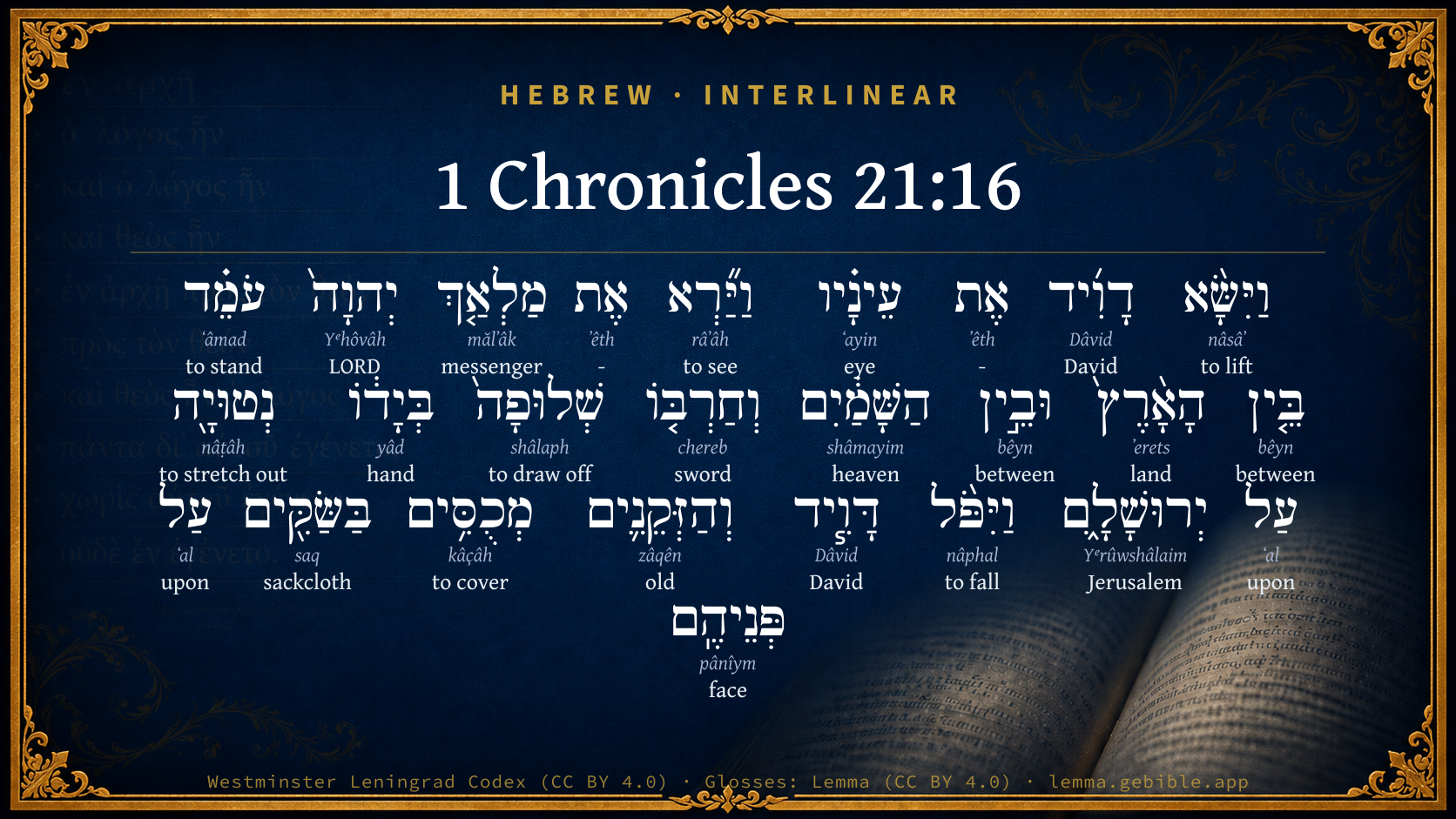
  1. וַיִּשָּׂ֨א nâsâʼ H5375 “and · to lift” Conjunction + Verb, Qal, Sequential Imperfect, 3rd Person, Masculine, Singular
  2. דָוִ֜יד Dâvid H1732 “David” Noun, Proper
  3. אֶת ʼêth H853 “-” Particle, Direct Object
  4. עֵינָ֗יו ʻayin H5869 “eyes · his” Noun, Common, Both, Dual, Construct + Suffix, Personal, 3rd Person, Masculine, Singular
  5. וַיַּ֞רְא râʼâh H7200 “and · to see” Conjunction + Verb, Qal, Sequential Imperfect, 3rd Person, Masculine, Singular
  6. אֶת ʼêth H853 “-” Particle, Direct Object
  7. מַלְאַ֤ךְ mălʼâk H4397 “messenger of” Noun, Common, Masculine, Singular, Construct
  8. יְהוָה֙ Yᵉhôvâh H3068 “LORD” Noun, Proper
  9. עֹמֵ֗ד ʻâmad H5975 “standing” Verb, Qal, Participle Active, Masculine, Singular, Absolute
  10. בֵּ֤ין bêyn H996 “between” Preposition
  11. הָאָ֨רֶץ֙ ʼerets H776 “the · land” Particle, Definite Article + Noun, Common, Both, Singular, Absolute
  12. וּבֵ֣ין bêyn H996 “and · between” Conjunction + Preposition
  13. הַשָּׁמַ֔יִם shâmayim H8064 “the · heaven(s)” Particle, Definite Article + Noun, Common, Masculine, Plural, Absolute
  14. וְחַרְבּ֤וֹ chereb H2719 “and · sword · his” Conjunction + Noun, Common, Feminine, Singular, Construct + Suffix, Personal, 3rd Person, Masculine, Singular
  15. בְּיָד֔וֹ yâd H3027 “in/at · hand · his” Preposition + Noun, Common, Both, Singular, Construct + Suffix, Personal, 3rd Person, Masculine, Singular
  16. נְטוּיָ֖ה nâṭâh H5186 “stretched out” Verb, Qal, Participle Passive, Feminine, Singular, Absolute
  17. עַל ʻal H5921 “upon” Preposition
  18. יְרוּשָׁלִָ֑ם Yᵉrûwshâlaim H3389 “Jerusalem” Noun, Proper
  19. וַיִּפֹּ֨ל nâphal H5307 “and · to fall” Conjunction + Verb, Qal, Sequential Imperfect, 3rd Person, Masculine, Singular
  20. דָּוִ֧יד Dâvid H1732 “David” Noun, Proper
  21. וְהַזְּקֵנִ֛ים zâqên H2205 “and · the · old” Conjunction + Particle, Definite Article + Adjective, Adjective, Masculine, Plural, Absolute
  22. מְכֻסִּ֥ים kâçâh H3680 “covered” Verb, Pual, Participle Passive, Masculine, Plural, Absolute
  23. בַּשַּׂקִּ֖ים saq H8242 “in/at the · sacks” Preposition, Determined + Noun, Common, Masculine, Plural, Absolute
  24. עַל ʻal H5921 “upon” Preposition
  25. פְּנֵיהֶֽם pânîym H6440 “face(s) · their” Noun, Common, Both, Plural, Construct + Suffix, Personal, 3rd Person, Masculine, Plural

About this verse

These counts appear in no published source. They are computed here, from the morphology-tagged text and Lemma’s own curated glosses. What Lemma adds →

26
words
22
distinct lemmas
Historical
section

Notable vocabulary

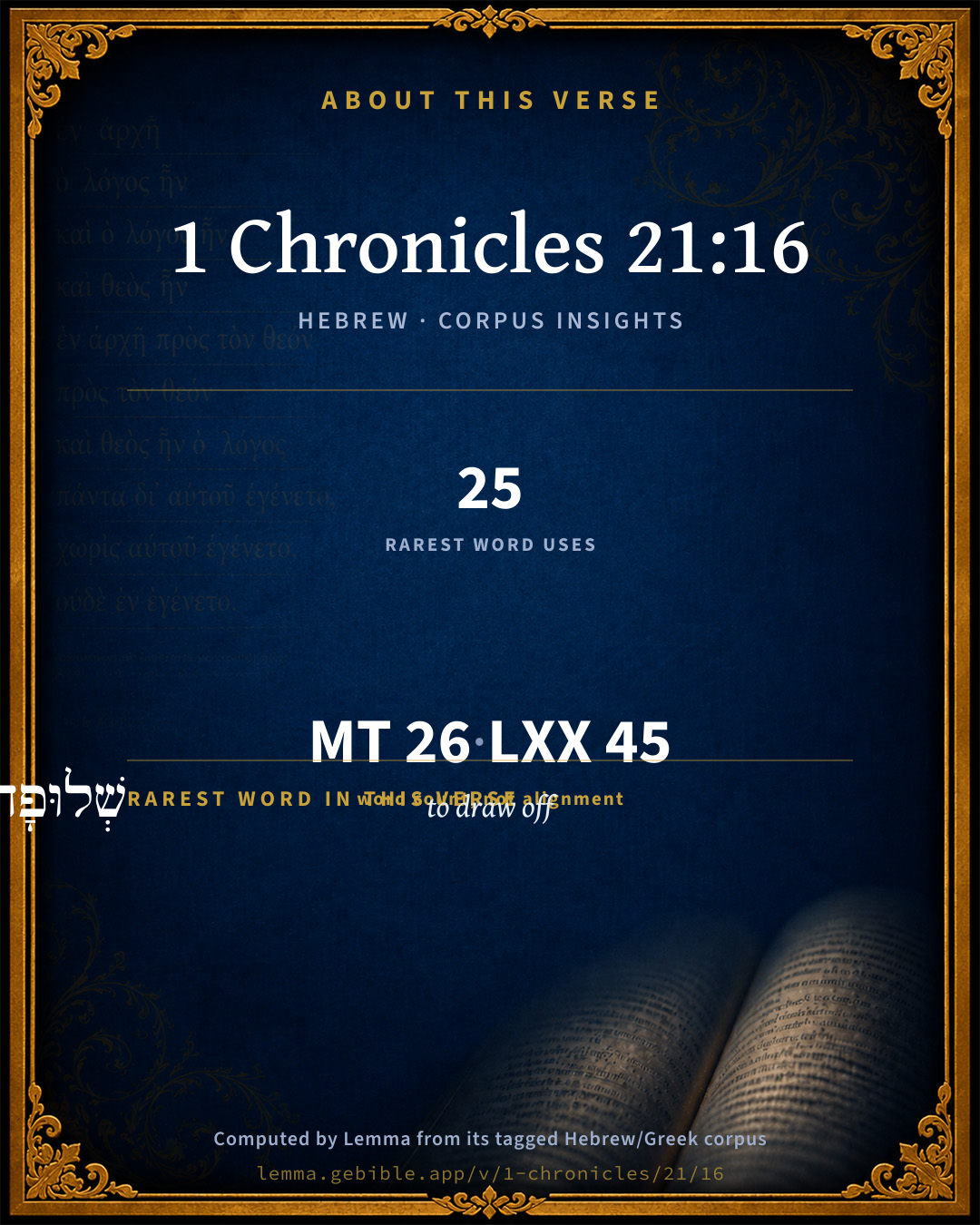
The rarest word here is שְׁלוּפָה֙ to draw off H8025 — appearing just 25 times in the whole Hebrew Bible.

Shared distinctive vocabulary

שְׁלוּפָה֙ to draw off H8025 occurs in 24 verses of the Hebrew Bible. Also found in:

Grammatical profile

  • 7 verbs
  • 12 nouns
  • 1 adjective
  • 4 prepositions
  • 2 particles

Verb forms

  • וַיִּשָּׂ֨א Qal · Sequential Imperfect
  • וַיַּ֞רְא Qal · Sequential Imperfect
  • עֹמֵ֗ד Qal · Participle Active
  • שְׁלוּפָה֙ Qal · Participle Passive
  • נְטוּיָ֖ה Qal · Participle Passive
  • וַיִּפֹּ֨ל Qal · Sequential Imperfect
  • מְכֻסִּ֥ים Pual · Participle Passive

Repetition

Words recur within this verse — often emphatic in Hebrew:

  • דָוִ֜יד David H1732 ×2
  • בֵּ֤ין between H996 ×2
  • עַל upon H5921 ×2

Hebrew & Septuagint length

In English translation the verse runs 40 words from the Hebrew and 43 from the Septuagint (LXX English) — closely comparable.

A rough comparison of the two English renderings, which tokenize alike — not a word-level alignment.

Word counts can differ between the Hebrew and the Greek without any difference in meaning — e.g. the Hebrew direct-object marker אֵת has no separate Greek word, and Greek often adds the article ὁ.

In the original languages it is 26 Hebrew tokens and 45 Greek tokens — but the two are counted differently (Hebrew bundles its prefixes and suffixes into one token; the Greek is in lemma form), so that isn’t a like-for-like length.

Cross-references

11

Topical passages linked to 1 Chronicles 21:16 in the Treasury of Scripture Knowledge — connected by theme and wording, ordered by reader-vote popularity; previews shown in the World English Bible.

  • Numbers 14:5 Then Moses and Aaron fell on their faces before all the assembly of the congregation of the children of Israel.
  • 1 Kings 21:27 It happened, when Ahab heard those words, that he tore his clothes, and put sackcloth on his flesh, and fasted, and lay in sackcloth, and went softly.
  • Genesis 3:24 So he drove out the man; and he placed Cherubs at the east of the garden of Eden, and the flame of a sword which turned every way, to guard the way to the tree of life.
  • Exodus 14:19–20 The angel of God, who went before the camp of Israel, moved and went behind them; and the pillar of cloud moved from before them, and stood behind them.
  • Numbers 16:22 They fell on their faces, and said, God, the God of the spirits of all flesh, shall one man sin, and will you be angry with all the congregation?
  • Numbers 22:31 Then Yahweh opened the eyes of Balaam, and he saw the angel of Yahweh standing in the way, with his sword drawn in his hand; and he bowed his head, and fell on his face.
  • Joshua 5:13–14 It happened, when Joshua was by Jericho, that he lifted up his eyes and looked, and, behold, there stood a man over against him with his sword drawn in his hand: and Joshua went to him, and said to him, Are you for us, or for our adversaries?
  • 2 Kings 6:17 Elisha prayed, and said, Yahweh, Please open his eyes, that he may see. Yahweh opened the eyes of the young man; and he saw: and, behold, the mountain was full of horses and chariots of fire round about Elisha.
  • 2 Kings 19:1 It happened, when king Hezekiah heard it, that he tore his clothes, and covered himself with sackcloth, and went into the house of Yahweh.
  • Psalms 35:13–14 But as for me, when they were sick, my clothing was sackcloth. I afflicted my soul with fasting. My prayer returned into my own bosom.
  • Jonah 3:6–8 The news reached the king of Nineveh, and he arose from his throne, and took off his royal robe, covered himself with sackcloth, and sat in ashes.

Cross-references courtesy of OpenBible.info (CC BY 4.0).

Hebrew and Greek witnesses Masoretic Hebrew ↔ Greek Septuagint

The same verse in the two great witnesses to the Old Testament, shown verse-for-verse.

These are two independent witnesses, not word-aligned to each other, and the Septuagint is shown in lemma (dictionary) form.

Hebrew 1 Chronicles 21:16 Masoretic · Westminster Leningrad Codex

וַיִּשָּׂ֨א דָוִ֜יד אֶת עֵינָ֗יו וַיַּ֞רְא אֶת מַלְאַ֤ךְ יְהוָה֙ עֹמֵ֗ד בֵּ֤ין הָאָ֨רֶץ֙ וּבֵ֣ין הַשָּׁמַ֔יִם וְחַרְבּ֤וֹ שְׁלוּפָה֙ בְּיָד֔וֹ נְטוּיָ֖ה עַל יְרוּשָׁלִָ֑ם וַיִּפֹּ֨ל דָּוִ֧יד וְהַזְּקֵנִ֛ים מְכֻסִּ֥ים בַּשַּׂקִּ֖ים עַל פְּנֵיהֶֽם

David lifted up his eyes, and saw the angel of Yahweh standing between earth and the sky, having a drawn sword in his hand stretched out over Jerusalem. Then David and the elders, clothed in sackcloth, fell on their faces.

World English Bible · Public Domain

Greek LXX 1 Chronicles 21:16 Septuagint · lemma form

καί ἐπιαἴρω δαυίδ ὁ ὀφθαλμός αὐτός καί ὁράω ὁ ἄγγελος κύριος ἵστημι ἀνά μέσος ὁ γῆ καί ἀνά μέσος ὁ οὐρανός καί ὁ ῥομφαία αὐτός σπάω ἐν ὁ χείρ αὐτός ἐκτείνω ἐπί ἰερουσαλήμ καί πίπτω δαυίδ καί ὁ πρεσβύτερος περιβάλλω ἐν σάκκος ἐπί πρόσωπον αὐτός

And David lifted up his eyes, and saw the angel of the Lord, standing between the earth and the heaven, and his sword drawn in his hand, stretched out over Jerusalem: and David and the elders clothed in sackcloth, fell upon their faces.

LXX2012 (modern English Septuagint) · Public Domain

Hebrew: Westminster Leningrad Codex (CC BY 4.0). Greek: Septuagint (public domain); English from LXX2012 (modern English Septuagint) (Public Domain). How the Septuagint differs from the Hebrew →

Commentary

Notes on 1 Chronicles 21:16 from classic Christian and Jewish commentators (each source and its license shown beneath its notes). The classic Christian expositions comment on the surrounding passage and are grouped to its opening verse, so a note may address several verses; the Jewish commentaries on the Tanakh (Rashi and others) are per-verse, so they appear only where the commentator wrote on this verse.

Lemma curates 59 commentaries, every one of them public domain or Creative Commons licensed, each selected and text-cleaned for this edition rather than reprinted as found. About our sources →

Trapp's Complete Commentary

John Trapp

1Ch 21:16 And David lifted up his eyes, and saw the angel of the LORD stand between the earth and the heaven, having a drawn sword in his hand stretched out over Jerusalem. Then David and the elders [of Israel, who were] clothed in sackcloth, fell upon their faces.

Ver. 16. Having a drawn sword in his hand.] This must needs be terrible to the beholders. Commodus, the emperor, set his own statue before the senate house, in form of an archer ready to shoot, that he might strike a terror into the people. {a}

{a} Herodian.

John Trapp, A Commentary or Exposition upon All the Books of the Old and New Testament (1647–1656) — public domain. Text from a community e-Sword module.

Tyndale Open Study Notes

Tyndale Open Resources

21:16-17 These verses provide a more detailed description of the angel and of David’s response than the parallel text (2 Sam 24:17). The sight of the angel carrying out his mission inspired David to plead on behalf of the people.

Tyndale Open Study Notes — © Tyndale Open Resources, licensed CC BY-SA 4.0. Text via the HelloAO Bible API.

Jamieson, Fausset & Brown

Robert Jamieson, A. R. Fausset & David Brown

David and the elders . . . clothed in sackcloth, fell upon their faces--They appeared in the garb and assumed the attitude of humble penitents, confessing their sins, and deprecating the wrath of God.

Jamieson, Fausset & Brown — Commentary Critical and Explanatory on the Whole Bible (1871) — public domain (CC PDM 1.0). Text via the HelloAO Bible API.

Ellicott's Commentary for English Readers

(16) This verse is not read in Samuel, which, however, mentions the essential fact that David “saw the angel that smote the people” (2Sa_24:17). There is nothing in the style to suggest suspicion of a later hand; and it is as likely that the compiler of Samuel has abridged the original account as that the chronicler has embellished it.

Having a drawn sword in his hand.—Comp. Num_22:23, where the same phrase occurs. Literally, and his sword drawn in his hand.

Stretched out.—See Isa_5:25; Isa_9:12, &c., for this term so used of the menace of Divine wrath.

Then David and the elders.—Literally, and David fell, and the elders, covered with the sackcloth. on their faces. The elders have not been mentioned before, but wherever the king went he would naturally be accompanied by a retinue of nobles, and their presence on this occasion agrees with the statement of 2Sa_24:20, that Araunah saw the king and his servants coming towards him. (See 1Ch_21:21, below.)

Fell upon their faces.—See Num_22:31; Jos_5:14; Jdg_13:20.

Clothed in sackcloth.—The garb of mourners and penitents.

A Bible Commentary for English Readers, edited by Charles John Ellicott (1878–1897) — public domain. Text from a community e-Sword module.

The Cambridge Bible for Schools and Colleges

gen. ed. J. J. S. Perowne

16. lift up] The old form of the past changed in modern editions to lifted up; cp. Gen_22:4, etc.

saw the angel] The full description of the vision is peculiar to Chron.; cp. 2Sa_24:17.

and the elders of Israel, who were clothed in sackcloth] The words supplied in A.V. are unnecessary, and are omitted in R.V. The wearing of sackcloth was doubtless accompanied with fasting; cp. Jon_3:5.

The Cambridge Bible for Schools and Colleges (gen. ed. J. J. S. Perowne; Cambridge University Press, 1878–1918) — public domain. Text from a community e-Sword module.

Albert Barnes' Notes on the Bible

Here a picture of awful grandeur takes the place of the bare statement of the earlier historian 2Sa 24:17. And here, as elsewhere, the author probably extracts from the ancient documents such circumstances as harmonize with his general plan. As the sanctity of the temple was among the points whereon he was most anxious to lay stress, he gives in full all the miraculous circumstances attending this first designation of what became the temple site (marginal reference “k”) as a place “holy to the Lord.”

David and the elders ... clothed in sackcloth, fell upon their faces - Facts additional to the narrative of Samuel; But facts natural in themselves, and in harmony with that narrative. Similarly, the narrative in 1Ch 21:20 is additional to the account in Samuel; but its parts hang together; and there is no sufficient ground for suspecting it.

Albert Barnes' Notes on the Bible (1834–1885) — public domain. Text from a community e-Sword/MySword module.

Matthew Poole's English Annotations

In sackcloth, i.e. in mourning garments, humbling themselves before God for their sins, and deprecating his wrath against the people.

Matthew Poole's English Annotations on the Holy Bible (1683–1685) — public domain. Text from a community e-Sword/MySword module.

The Pulpit Commentary

Vers. 16, 17. These verses offer instances, especially the former, of the shorter narratives not being with Chronicles, but with Samuel And the longer narrative being with Chronicles is found uniformly in the cases in which reference is had, whether more or less directly, to the ecclesiastical or permanent institution of the Israelites.

The Pulpit Commentary (1880–1919), ed. H.D.M. Spence-Jones & Joseph S. Exell — public domain. Text from a community e-Sword module.

John Wesley's Explanatory Notes

Sackcloth - In mourning garments, humbling themselves before God for their sins, and deprecating his wrath against the people.

John Wesley, Explanatory Notes Upon the Whole Bible (1754–1765) — public domain. Text via the GEBible commentary corpus.

Scofield Reference Notes

C. I. Scofield

angel

(See Scofield Heb 1:4).

The Scofield Reference Bible (1917 edition), notes by C. I. Scofield — public domain. Text from a community e-Sword module.

unfoldingWord translationNotes

Door43 World Missions Community

standing between earth and heaven

This is symbolic language to indicate that the angel was sent from Yahweh in heaven to judge the people on the earth. (See: Symbolic Language)

having a drawn sword in his hand raised over Jerusalem

The angel holding a sword in his hand is a symbolic action that shows he is ready to attack Jerusalem. This is symbolic, because the judgment was sickness. AT: "holding a sword in his hand as if ready to attack Jerusalem" (See: Symbolic Action)

clothed in sackcloth, lay facedown on the ground

These were symbols of repentance. (See: Symbolic Action)

Is it not I that commanded that the army be numbered?

David uses this question to emphasize that his is the one who sinned by counting the people. AT: "I am the one who commanded that the army be numbered." (See: Rhetorical Question)

But these sheep

David speaks of the people of Israel as if they were sheep, who are known for trusting and following their leader. (See: Metaphor)

what have they done?

David uses this question to asks God not to punish the people. This rhetorical question can be translated as a statement. AT: "they certainly have done nothing that deserves punishment." (See: Rhetorical Question)

Let your hand strike me and my family

Here "hand" represents Yahweh's power to punish. AT: "Punish me and my family" (See: Metonymy)

translationWords

earth

heaven

Jerusalem

elder

sackcloth

God

command

evil

ewe

hand

family

plague

unfoldingWord translationNotes — © Distant Shores Media and the Door43 World Missions Community, licensed CC BY-SA 4.0. Source: git.door43.org/Door43/en_tn.

Rashi

Rabbi Shlomo Yitzchaki (Rashi)

extended over Jerusalem In Joshua (5:13), it says: “... and behold, a man was standing opposite him with his sword drawn in his hand, etc. ’Are you for us or for our adversaries?” Joshua was standing with his back opposite his adversaries, and the angel came opposite him; therefore, he wondered and asked him, “Are you for us or for our enemies?” [Have you come] to help us since you are standing opposite me, or to help our enemies, because you are standing also opposite them? But here, since he saw the sword of the angel, which was extended over Jerusalem, he knew by himself that he had come to strike Israel.

Rashi on the Tanakh — English translations: “The Judaica Press complete Tanach with Rashi, translated by A. J. Rosenberg” (CC BY 4.0); “Pentateuch with Rashi's commentary by M. Rosenbaum and A.M. Silbermann, 1929-1934” (public domain); “The Metsudah Tanach series, Lakewood, N.J” (CC BY 4.0); and “The Book of Joshua, Metsudah Publications, 1997” (CC BY 4.0). Text via Sefaria.

Lesson kit

Teaching starters — assembled from the data on this page, not authored interpretation. Every prompt links to the verse data it draws on. Edit before teaching.

1 Chronicles, in the Historical, opens this verse with 26 words (22 distinct Hebrew lemmas). Its most distinctive word is shâlaph (“to draw off”). A historical commentator’s framing appears above. Read the whole chapter for the surrounding context.

Discussion questions

  1. What does “to draw off” (shâlaph) contribute to the verse as a whole?
  2. How does Numbers 22:23, which shares the word «to draw off», read alongside this verse?
  3. What does the repetition of “David” (2× in this one verse) do in this verse?
  4. These translations render this verse differently. What is at stake in choosing one wording over another?
  5. «וַיִּשָּׂ֨א» is a Qal Sequential Imperfect verb. How does that grammatical form shape the action described?
  6. Compare how Trapp's Complete Commentary and Tyndale Open Study Notes read this verse. Where do they agree or differ?

Things to notice

Reading settings

Reading text

Shown beneath each verse's original-language words.

Old Testament
Old Testament edition

Read the OT as the Masoretic Hebrew (MT) or the Greek Septuagint (LXX).

English shown for the Greek Septuagint (in the Hebrew ↔ Greek comparison).

Comparing translations? Open the Compare panel on any verse page to stack up to four side by side.