
Genesis 43:34

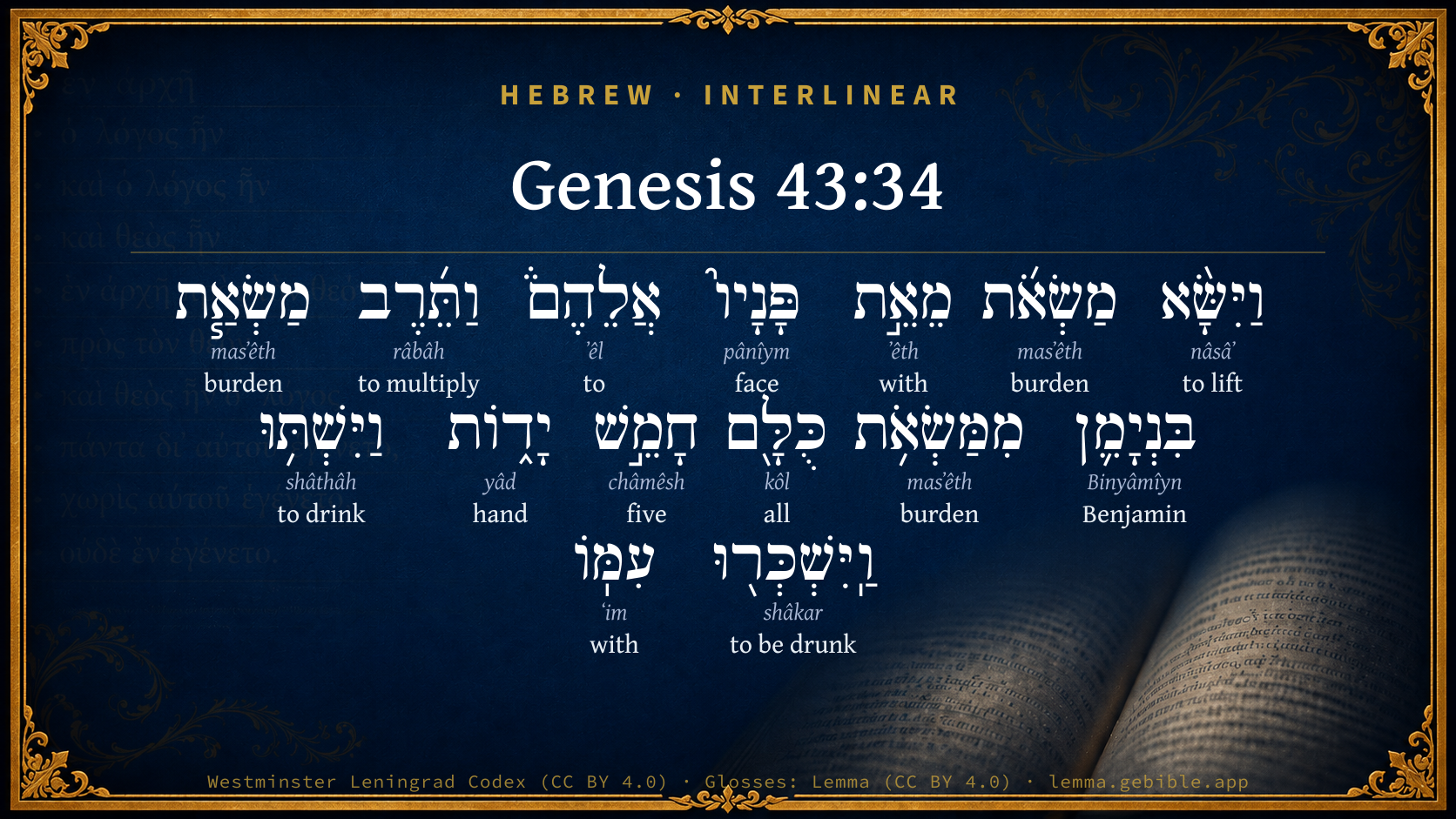
Hebrew (Westminster Leningrad Codex) Genesis 43:34 appears in the Hebrew Old Testament. The text above is from the Westminster Leningrad Codex. Each word links to its Strong’s number, a concise gloss, and parsing drawn from the Open Scriptures Hebrew Bible morphology. Click any word for its full Brown-Driver-Briggs (BDB) entry.
Download image
Cite this verse

Genesis 43:34 (World English Bible). Public Domain. Lemma interlinear Bible study tool, https://lemma.gebible.app/v/genesis/43/34.

Show BibTeX & RIS
BibTeX
RIS
English Translation
He sent portions to them from before him, but Benjamin's portion was five times as much as any of theirs. They drank, and were merry with him.
World English Bible · Public Domain
Highlights
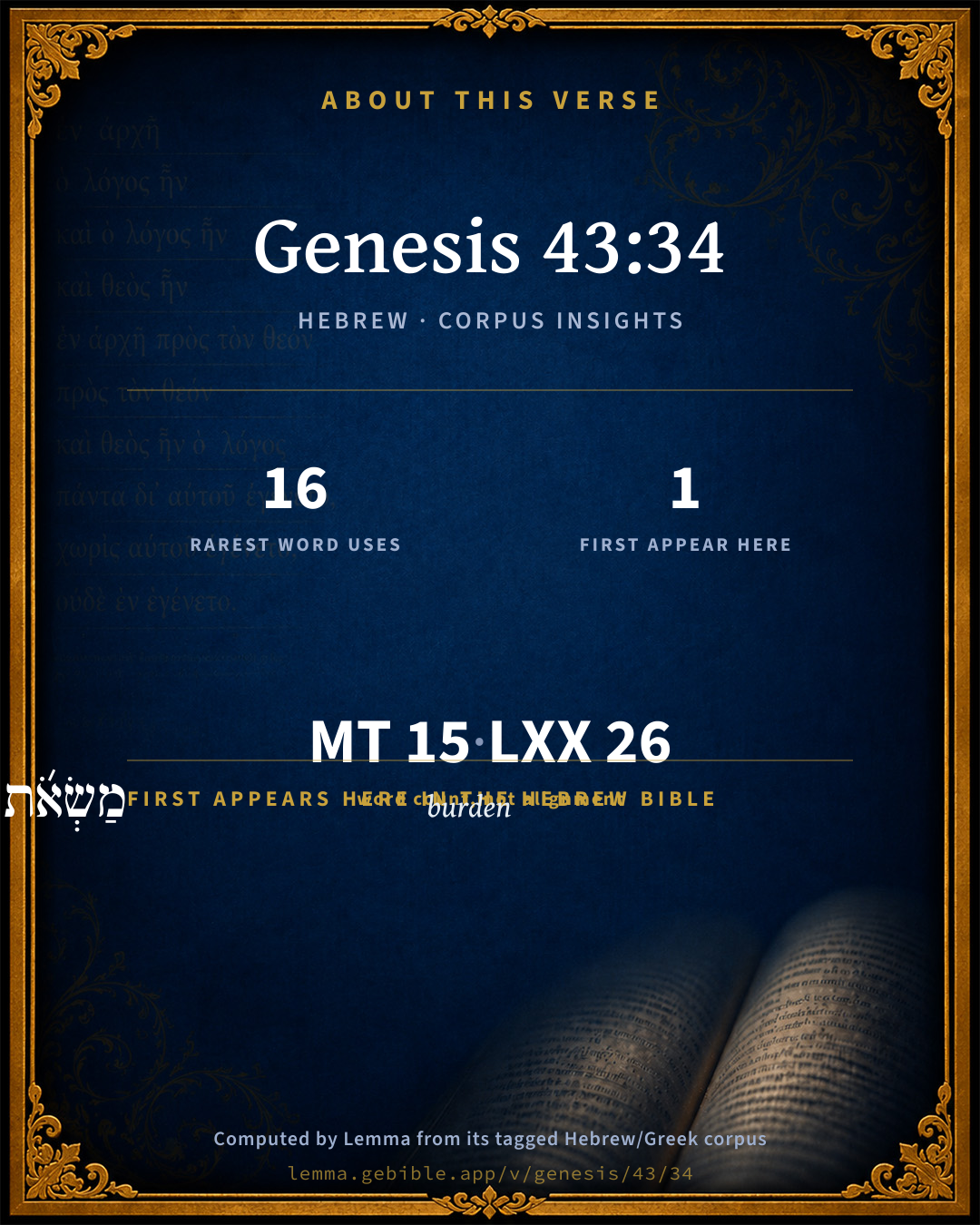
  • 1 first appearance in the Hebrew Bible
Full analysis ↓
Download a study sheet

One document with this verse’s original text, its word-by-word gloss line, the meaning frame, cross-references with their text, attributed commentary, and full source and license credits — printable, and it pastes into notes with its structure intact.

This verse Autodidact and up

Study sheet (.html) Plain text (.txt)

A passage Seminary Student

Up to 50 verses in one chapter. A passage sheet keeps up to 6 commentary sources and 12 cross-references per verse, in the order this page ranks them, and says so on the sheet whenever that leaves anything out. Ask for a single verse and you get the Autodidact verse sheet above.

Everything on this page stays free to read, with no account — the sheet is a download of what is already on screen, not access to it.

Want to remove ads? Support Godless Engineer
Compare translations 3

The same verse in 3 English versions, stacked beneath the original-language interlinear above. Click any original word for its lexicon entry.

Each is an independent rendering of the whole verse — the interlinear is not word-aligned to these translations.

Highlighted words mark where these versions differ — a whole-verse word diff, not a word-by-word alignment.

  • World English Bible Public Domain
    He sent portions to them from before him, but Benjamin's portion was five times as much as any of theirs. They drank, and were merry with him.
  • King James Version Public Domain
    And he took and sent messes unto them from before him: but Benjamin's mess was five times so much as any of theirs. And they drank, and were merry with him.
  • unfoldingWord Literal Text CC BY-SA 4.0
    Then he served to them servings from before him, but Benjamin’s serving was five times larger than any of their servings. And they drank and became drunk with him.

unfoldingWord Literal Text — © unfoldingWord, licensed CC BY-SA 4.0. Word-aligned USFM3 via Door43 (git.door43.org/unfoldingWord/en_ult).

Versions to compare (up to 4)

3 of 4 selected

Show all 16 translations

Every available English version of this verse, each an independent rendering of the whole verse.

  • World English Bible Public Domain
    He sent portions to them from before him, but Benjamin's portion was five times as much as any of theirs. They drank, and were merry with him.
  • Berean Standard Bible Public Domain
    When the portions were served to them from Joseph’s table, Benjamin’s portion was five times larger than any of the others. So they feasted and drank freely with Joseph.
  • Majority Standard Bible Public Domain
    When the portions were served to them from Joseph’s table, Benjamin’s portion was five times larger than any of the others. So they feasted and drank freely with Joseph.
  • King James Version Public Domain
    And he took and sent messes unto them from before him: but Benjamin's mess was five times so much as any of theirs. And they drank, and were merry with him.
  • American Standard Version (1901) Public Domain
    And he took `and sent' messes unto them from before him: but Benjamin's mess was five times so much as any of theirs. And they drank, and were merry with him.
  • Revised Version (1885) Public Domain
    And he took and sent messes unto them from before him: but Benjamin’s mess was five times so much as any of theirs. And they drank, and were merry with him.
  • Geneva Bible (1599) Public Domain
    And they tooke meases from before him, and sent to them: but Beniamins mease was fiue times so much as any of theirs: and they drunke, and had of the best drinke with him.
  • Douay-Rheims (1899) Public Domain
    Taking the messes which they received of him: and the greater mess came to Benjamin, so that it exceeded by five parts. And they drank, and were merry with him.
  • Young's Literal Translation Public Domain
    and he lifteth up gifts from before him unto them, and the gift of Benjamin is five hands more than the gifts of all of them; and they drink, yea, they drink abundantly with him.
  • Literal Standard Version CC BY-SA 4.0
    and he lifts up gifts from before him to them, and the gift of Benjamin is five hands more than the gifts of all of them; and they drink, indeed, they drink abundantly with him.
  • Unlocked Literal Bible CC BY-SA 4.0
    Joseph sent portions to them from the food in front of him. But Benjamin's portion was five times as much as any of his brothers. They drank and were merry with him.
  • unfoldingWord Literal Text CC BY-SA 4.0
    Then he served to them servings from before him, but Benjamin’s serving was five times larger than any of their servings. And they drank and became drunk with him.
  • Darby Bible Public Domain
    And he had portions carried to them from before him. And Benjamin's portion was five times greater than the portions of them all. And they drank, and made merry with him.
  • World Messianic Bible Public Domain
    He sent portions to them from before him, but Benjamin’s portion was five times as much as any of theirs. They drank, and were merry with him.
  • Free Bible Version CC BY-SA 4.0
    The food was served to them from Joseph's table, and Benjamin received five times as much as anyone else. So they ate and drank plenty with him.
  • JPS Tanakh (1917) Public Domain
    And portions were taken unto them from before him; but Benjamin's portion was five times so much as any of theirs. And they drank, and were merry with him.

Literal Standard Version (2020), Covenant Press — licensed CC BY-SA 4.0. Text via the HelloAO Bible API (eBible.org). Unlocked Literal Bible (unfoldingWord) — licensed CC BY-SA 4.0. Text via the HelloAO Bible API (eBible.org). unfoldingWord Literal Text — © unfoldingWord, licensed CC BY-SA 4.0. Word-aligned USFM3 via Door43 (git.door43.org/unfoldingWord/en_ult). Free Bible Version, Dr. Jonathan Gallagher — licensed CC BY-SA 4.0. Text via the HelloAO Bible API (eBible.org).

Word by word

More ways to search: Search by grammar → Find every occurrence → Compare this word →

Practice this passage: Drill this verse → Learn its vocabulary →

מַשְׂאֹ֜ת
masʼêth
H4864
“burdens”
Noun, Common, Feminine, Plural, Absolute
Part of Speech
Noun
Type
Common
Gender
Feminine
Number
Plural
State
Absolute
Full BDB Definition

Origin: from \H5375\\

TWOT: 1421h

uprising, utterance, burden, portion, uplifting - that which rises, uprising, uplifting, signal, rising - utterance, oracle - burden - portion, present, largesse, gift, contribution, offering, tribute
  1. וַיִּשָּׂ֨א nâsâʼ H5375 “and · to lift” Conjunction + Verb, Qal, Sequential Imperfect, 3rd Person, Masculine, Singular
  2. מֵאֵ֣ת ʼêth H854 “from · with” Preposition + Preposition
  3. פָּנָיו֮ pânîym H6440 “face(s) · his” Noun, Common, Both, Plural, Construct + Suffix, Personal, 3rd Person, Masculine, Singular
  4. אֲלֵהֶם֒ ʼêl H413 “to · them” Preposition + Suffix, Personal, 3rd Person, Masculine, Plural
  5. וַתֵּ֜רֶב râbâh H7235 “and · to multiply” Conjunction + Verb, Qal, Sequential Imperfect, 3rd Person, Feminine, Singular
  6. מַשְׂאַ֧ת masʼêth H4864 “burden of” Noun, Common, Feminine, Singular, Construct
  7. בִּנְיָמִ֛ן Binyâmîyn H1144 “Benjamin” Noun, Proper
  8. מִמַּשְׂאֹ֥ת masʼêth H4864 “from · burdens of” Preposition + Noun, Common, Feminine, Plural, Construct
  9. כֻּלָּ֖ם kôl H3605 “all · their” Noun, Common, Masculine, Singular, Construct + Suffix, Personal, 3rd Person, Masculine, Plural
  10. חָמֵ֣שׁ châmêsh H2568 “five” Adjective, Cardinal number, Feminine, Singular, Absolute
  11. יָד֑וֹת yâd H3027 “hands” Noun, Common, Both, Plural, Absolute
  12. וַיִּשְׁתּ֥וּ shâthâh H8354 “and · to drink” Conjunction + Verb, Qal, Sequential Imperfect, 3rd Person, Masculine, Plural
  13. וַֽיִּשְׁכְּר֖וּ shâkar H7937 “and · to be drunk” Conjunction + Verb, Qal, Sequential Imperfect, 3rd Person, Masculine, Plural
  14. עִמּֽוֹ ʻim H5973 “with · him” Preposition + Suffix, Personal, 3rd Person, Masculine, Singular

About this verse

These counts appear in no published source. They are computed here, from the morphology-tagged text and Lemma’s own curated glosses. What Lemma adds →

15
words
13
distinct lemmas
Pentateuch
section

Notable vocabulary

The rarest word here is מַשְׂאֹ֜ת burden H4864 — appearing just 16 times in the whole Hebrew Bible.

First appearance in Scripture

This word makes its first canonical appearance in the Hebrew Bible here:

  • מַשְׂאֹ֜ת burden H4864

Shared distinctive vocabulary

מַשְׂאֹ֜ת burden H4864 occurs in 14 verses of the Hebrew Bible. Also found in:

Grammatical profile

  • 4 verbs
  • 7 nouns
  • 1 adjective
  • 3 prepositions

Verb forms

  • וַיִּשָּׂ֨א Qal · Sequential Imperfect
  • וַתֵּ֜רֶב Qal · Sequential Imperfect
  • וַיִּשְׁתּ֥וּ Qal · Sequential Imperfect
  • וַֽיִּשְׁכְּר֖וּ Qal · Sequential Imperfect

Repetition

A word recurs within this verse — often emphatic in Hebrew:

  • מַשְׂאֹ֜ת burden H4864 ×3

Hebrew & Septuagint length

In English translation the verse runs 27 words from the Hebrew and 33 from the Septuagint (LXX English) — closely comparable.

A rough comparison of the two English renderings, which tokenize alike — not a word-level alignment.

Word counts can differ between the Hebrew and the Greek without any difference in meaning — e.g. the Hebrew direct-object marker אֵת has no separate Greek word, and Greek often adds the article ὁ.

In the original languages it is 15 Hebrew tokens and 26 Greek tokens — but the two are counted differently (Hebrew bundles its prefixes and suffixes into one token; the Greek is in lemma form), so that isn’t a like-for-like length.

Cross-references

11

Topical passages linked to Genesis 43:34 in the Treasury of Scripture Knowledge — connected by theme and wording, ordered by reader-vote popularity; previews shown in the World English Bible.

  • Genesis 45:22 To all of them he gave each man changes of clothing, but to Benjamin he gave three hundred pieces of silver and five changes of clothing.
  • 1 Samuel 1:5 but to Hannah he gave a double portion; for he loved Hannah, but Yahweh had shut up her womb.
  • 2 Samuel 11:8 David said to Uriah, Go down to your house, and wash your feet. Uriah departed out of the king's house, and there followed him a mess [of food] from the king.
  • 1 Samuel 9:22–24 Samuel took Saul and his servant, and brought them into the guest-chamber, and made them sit in the best place among those who were invited, who were about thirty persons.
  • Proverbs 31:6 Give strong drink to him who is ready to perish; And wine to the bitter in soul:
  • Ecclesiastes 9:7 Go your way--eat your bread with joy, and drink your wine with a merry heart; for God has already accepted your works.
  • Ecclesiastes 10:19 A feast is made for laughter, And wine makes the life glad; And money is the answer for all things.
  • Song of Solomon 5:1 I have come into my garden, my sister, my bride. I have gathered my myrrh with my spice; I have eaten my honeycomb with my honey; I have drunk my wine with my milk. Friends Eat, friends! Drink, yes, drink abundantly, beloved. Beloved
  • Habakkuk 1:6 For, behold, I raise up the Chaldeans, that bitter and hasty nation, that march through the breadth of the earth, to possess dwelling places that are not theirs.
  • Matthew 11:19 The Son of Man came eating and drinking, and they say, 'Behold, a gluttonous man and a drunkard, a friend of tax collectors and sinners!' But wisdom is justified by her children."
  • John 2:10 and said to him, "Everyone serves the good wine first, and when the guests have drunk freely, then that which is worse. You have kept the good wine until now!"

Cross-references courtesy of OpenBible.info (CC BY 4.0).

Hebrew and Greek witnesses Masoretic Hebrew ↔ Greek Septuagint

The same verse in the two great witnesses to the Old Testament, shown verse-for-verse.

These are two independent witnesses, not word-aligned to each other, and the Septuagint is shown in lemma (dictionary) form.

Hebrew Genesis 43:34 Masoretic · Westminster Leningrad Codex

וַיִּשָּׂ֨א מַשְׂאֹ֜ת מֵאֵ֣ת פָּנָיו֮ אֲלֵהֶם֒ וַתֵּ֜רֶב מַשְׂאַ֧ת בִּנְיָמִ֛ן מִמַּשְׂאֹ֥ת כֻּלָּ֖ם חָמֵ֣שׁ יָד֑וֹת וַיִּשְׁתּ֥וּ וַֽיִּשְׁכְּר֖וּ עִמּֽוֹ

He sent portions to them from before him, but Benjamin's portion was five times as much as any of theirs. They drank, and were merry with him.

World English Bible · Public Domain

Greek LXX Genesis 43:34 Septuagint · lemma form

αἴρω δέ μερίς παρά αὐτός πρός αὐτός μεγαλύνω δέ ὁ μερίς βενιαμίν παρά ὁ μερίς πᾶς πενταπλασίως πρός ὁ ἐκεῖνος πίνω δέ καί μεθύω μετά αὐτός

And they took their portions from him to themselves; but Benjamin's portion was five times as much as the portions of the others. And they drank and were filled with drink with him.

LXX2012 (modern English Septuagint) · Public Domain

On this verse, The Cambridge Bible for Schools and Colleges discusses the Septuagint’s reading. Read the note in Commentary ↓

Hebrew: Westminster Leningrad Codex (CC BY 4.0). Greek: Septuagint (public domain); English from LXX2012 (modern English Septuagint) (Public Domain). How the Septuagint differs from the Hebrew →

Targum (Aramaic paraphrase)

2

The Targum is the ancient Jewish Aramaic paraphrase of the Hebrew Scriptures — an interpretive translation, not the Hebrew text itself. Onkelos (literal) and Pseudo-Jonathan (expansive) render the Torah, and Jonathan the Prophets. Coverage is partial: where no permissively-licensed English translation exists for a verse, only the Aramaic is shown. This is verse-level text, not a word-by-word alignment to the Hebrew.

  1. Targum Onkelos Torah (Genesis–Deuteronomy)
    וּנְטַלּ חֳלָקִין מִן קֳדָמוֹהִי לָקֳדָמֵיהוֹן וּסְגִי חֲלָקָא דְבִנְיָמִן מֵחֳלָקֵי דְכָלְּהוֹן חַמְשָׁא חֳלָקִין וּשְׁתִיאוּ וּרְוִיאוּ עִמֵּהּ

    (no public-domain English translation for this verse)

    Targum Onkelos — Aramaic: “Onkelos Genesis” (public domain); “Onkelos Exodus” (public domain); “Onkelos Leviticus” (public domain); “Onkelos Numbers” (public domain); “Onkelos Deuteronomy” (public domain). English: “Sefaria Community Translation” (CC0 1.0 (public-domain dedication)); “J.W. Etheridge. The Targums of Onkelos and Jonathan Ben Uzziel on the Pentateuch. London: Longmans, Green, 1862” (public domain). Text via Sefaria.

  2. Targum Pseudo-Jonathan Torah (Genesis–Deuteronomy)
    וּנְטַל חוּלְקִין מֵעַל פְּתוֹרֵיהּ וְשַׁדְרִינוּן מִן קֳדָמוֹי לִקְדָמֵיהוֹן וּסְגָא חוּלְקָא דְבִנְיָמִין מִן חוּלְקֵי כֻּלְהוֹן חַמְשָׁא חוּלְקִין חוּלַק חַד חוּלְקֵיהּ וְחוּלַק חַד מִן דִילֵיהּ וְחוּלַק חַד מִן אִנְתְּתֵיהּ וּתְרֵין חוּלְקִין מִן תְּרֵין בְּנוֹי וּשְׁתִיוּ וּרְוִיוּ עִמֵיהּ דְמִן יוֹמָא דְאִיתְפְּרָשׁוּ מִנֵיהּ לָא שָׁתוּ חַמְרָא לָא הוּא וְלָא הִינוּן עַד יוֹמָא הַהוּא

    And he sent portions from his table, and they set them forth from him before them. But Benjamin's portion was larger than the portions of any of them; five portions: one was his own portion one portion from himself, one from his wife, and two portions from his two sons. And they drank and were drunken with him; for from the day when they were separated from him they had not drunk wine, neither he nor they, until that day.

    Targum Pseudo-Jonathan — Aramaic: “Targum Jonathan on Genesis” (public domain); “Targum Jonathan on Exodus” (public domain); “Targum Jonathan on Leviticus” (public domain); “Targum Jonathan on Numbers” (public domain); “Targum Jonathan on Deuteronomy” (public domain). English: “The Targum of Jonathan ben Uzziel, trans. J. W. Etheridge, London, 1862” (public domain). Text via Sefaria.

Commentary

Notes on Genesis 43:34 from classic Christian and Jewish commentators (each source and its license shown beneath its notes). The classic Christian expositions comment on the surrounding passage and are grouped to its opening verse, so a note may address several verses; the Jewish commentaries on the Tanakh (Rashi and others) are per-verse, so they appear only where the commentator wrote on this verse.

Lemma curates 59 commentaries, every one of them public domain or Creative Commons licensed, each selected and text-cleaned for this edition rather than reprinted as found. About our sources →

Trapp's Complete Commentary

John Trapp

Gen 43:34 And he took [and sent] messes unto them from before him: but Benjamin’s mess was five times so much as any of theirs. And they drank, and were merry with him.

Ver. 34. And he took and sent messes.] So did Cyrus in Xenophon, to such as he favoured.

But Benjamin’s mess, &c.] Love will creep where it cannot go; and good blood will never belie itself. Ambrose makes it a type and token of St Paul’s excellent parts and gifts above the rest of the apostles, &c.

John Trapp, A Commentary or Exposition upon All the Books of the Old and New Testament (1647–1656) — public domain. Text from a community e-Sword module.

Tyndale Open Study Notes

Tyndale Open Resources

43:34 The brothers were confronted with generous and gracious dealings from God through Joseph, who tested their tolerance by reenacting the favoritism toward Rachel’s son that had galvanized their earlier hostility.

Tyndale Open Study Notes — © Tyndale Open Resources, licensed CC BY-SA 4.0. Text via the HelloAO Bible API.

Geneva Bible (1599)

Geneva Bible translators

Sometimes this word signifieth to be drunken, but here it is meant, that they had enough, and drank of the best wine.

Geneva Bible (1599) marginal notes — public domain. Text via Bolls.life.

Jamieson, Fausset & Brown

Robert Jamieson, A. R. Fausset & David Brown

took and sent messes . . . Benjamin's mess was five times--In Egypt, as in other Oriental countries, there were, and are, two modes of paying attention to a guest whom the host wishes to honor--either by giving a choice piece from his own hand, or ordering it to be taken to the stranger. The degree of respect shown consists in the quantity, and while the ordinary rule of distinction is a double mess, it must have appeared a very distinguished mark of favor bestowed on Benjamin to have no less than five times any of his brethren.

they drank, and were merry with him--Hebrew, "drank freely" (same as Sol 5:1; Joh 2:10). In all these cases the idea of intemperance is excluded. The painful anxieties and cares of Joseph's brethren were dispelled, and they were at ease.

Next: Genesis Chapter 44

Jamieson, Fausset & Brown — Commentary Critical and Explanatory on the Whole Bible (1871) — public domain (CC PDM 1.0). Text via the HelloAO Bible API.

Adam Clarke's Commentary

Verse 34. Benjamin's mess was five times so much as any of theirs.] Sir John Chardin observes that "in Persia, Arabia, and the Indies, there are several houses where they place several plates in large salvers, and set one of these before each person, or before two or three, according to the magnificence of each house. This is the method among the Hindoos; the dishes are not placed on the table, but messes are sent to each individual by the master of the feast or by his substitute. The great men of the state are always served by themselves, in the feasts that are made for them; and with greater profusion, their part of each kind of provision being always DOUBLE, TREBLE, or a LARGER proportion of each kind of meat." The circumstance of Benjamin's having a mess FIVE times as large as any of his brethren, shows the peculiar honour which Joseph designed to confer upon him. See several useful observations on this subject in Harmer's Observ., vol. ii., p. 101, c., Edit. 1808.

1. THE scarcity in Canaan was not absolute though they had no corn, they had honey, nuts, almonds, c. In the midst of judgment, God remembers mercy. If there was scarcity in Canaan, there was plenty in Egypt and though his providence had denied one country corn, and accumulated it in the other, his bounty had placed in the former money enough to procure it from the latter. How true is the saying, "It is never ill with any but it might be worse!" Let us be deeply thankful to God that we have any thing, seeing we deserve no good at his hands.

2. If we examine our circumstances closely, and call to remembrance the dealings of God's providence towards us, we shall find that we can sing much both of mercy and of judgment. For one day of absolute unavoidable want, we shall find we had three hundred and sixty-four, if not of fulness, yet of a competency. Famines, though rarely happening, are everywhere recorded; innumerable years of abundance are scarcely ever registered! Such is the perverseness and ingratitude of man!

Adam Clarke's Commentary on the Bible (1810–1826) — public domain. Text from a community e-Sword/MySword module.

Ellicott's Commentary for English Readers

(34) Messes.—A portion of food from that prepared for the chief is regarded in the East as a mark both of honour and friendship, and the largeness of Benjamin’s mess marked him out as the especial object of Joseph’s regard. The words literally are, “And the portion of Benjamin was great above the portions of all of them five hands,” that is, five times. It has been supposed that Joseph intended to try his brethren by this preference, and see if they were still envious. More probably it was dictated simply by his love.

They drank and were merry with him.—Heb., They drank and were drunken with him. The verb is that used of Noah in Gen_9:21, but probably the rendering in Hag_1:6, “and were filled with drink,” would give the right meaning. They lost all fear and suspicion, and gave themselves up to enjoyment.

A Bible Commentary for English Readers, edited by Charles John Ellicott (1878–1897) — public domain. Text from a community e-Sword module.

The Cambridge Bible for Schools and Colleges

gen. ed. J. J. S. Perowne

34. he took and sent messes] R.V. marg. messes were taken. The word “mess” is used here in the sense of “portion” of food. Cf. 2Sa_11:8, “and there followed him a mess of meat from [marg. present from] the king.” The word “messmate” preserves the Old English use. Mess, food, Old Fr. mes (mets), Lat. missum, e.g.:

“At their savoury dinner set

Of herbs and other country messes.”

Milton, L’Allegro, 85.

five times] Lit. “five hands”; cf. Gen_47:24. Attention has been called to the frequent use of the number “five” in Egyptian matters recorded in the O.T. Cf. Gen_41:34, Gen_45:22, Gen_47:2; Gen_47:24; Isa_19:18. Some have connected it with the five Egyptian planets.

If an explanation is at all required, counting on one’s fingers is presumably the origin of a natural preference for the use of the numbers “five” and “ten.”

were merry] Heb. drank largely. This expression need not be interpreted too literally. The men were “festive,” not necessarily “intoxicated,” as LXX ἐμεθύσθησαν; Lat. inebriati sunt.

Compare Son_5:1, “drink abundantly”; Hag_1:6, “ye drink, but ye are not filled with drink.”

For a special dish for the most honoured guest, cf. 1Sa_9:23-24.

The Cambridge Bible for Schools and Colleges (gen. ed. J. J. S. Perowne; Cambridge University Press, 1878–1918) — public domain. Text from a community e-Sword module.

Haydock's Catholic Bible Commentary

Of him. Joseph, the master of the feast, sends a portion to each of his guests, according to the ancient custom. (Plut.[Plutarch,?] Sympos. ii.) --- Five parts: in order to distinguish Benjamin the more. So Hector reproaches Diomed for fleeing before him, though he was placed in the highest place at table among the Greeks, and had the largest portion both of meat and drink. --- Merry. Inebriati sunt, sometimes means intoxicated: but it is not at all probably that Joseph’s brethren would indulge in any such excess, while they knew him not, (Calmet) and were under the impressions of fear and wonder. They took what was sufficient, and even decently abundant, with thankfulness for so unexpected an honour. (Haydock) --- The word is often taken in this sense, as at the feast of Cana, where Jesus would never have furnished such an abundance of wine for people already drunk. (John ii. 10; Proverbs xi. 24.) Homer’s feasts consist in every man taking what he pleased. (Calmet)

George Leo Haydock (1774–1849), Haydock's Catholic Family Bible and Commentary, 1859 edition — public domain. Excludes Psalms (Douay-Rheims chapter numbering differs from Protestant) and Deuterocanonical books (Catholic canon only).

Matthew Poole's English Annotations

It was the ancient custom of Egypt and other countries in their feasts, that either all the meat, or at least some eminent parts and parcels of it, were not promiscuously set before all the guests, but peculiarly distributed by the master of the feast to the several guests, and that differently, according to his respect and affection to them, or to their several qualities. See 1Sa 1:5; 9:22-24.

Five times so much as any of theirs; partly, because of his nearer relation and dearer affection to him; and partly, to observe whether this would raise that envy in them towards him, which was the occasion of their malicious enterprise against himself, that he might accordingly provide for his security.

Were merry: the Hebrew word oft signifies to be drunk, but ofttimes it is only to drink liberally, though not to drunkenness, as may appear from Son 5:1; Hag 1:6; Joh 2:10.

Matthew Poole's English Annotations on the Holy Bible (1683–1685) — public domain. Text from a community e-Sword/MySword module.

Whedon's Commentary on the Bible

Daniel D. Whedon

34. Five times so much — This was a special mark of honour, and furnished opportunity for Joseph to observe if his brethren envied Benjamin as they once did himself.

Daniel D. Whedon (gen. ed.), Commentary on the Old and New Testaments (1874–1909) — public domain. Text from a community e-Sword module.

The Pulpit Commentary

And he took and sent (literally, and he sent) messesmaseoth, from nasa, to take or lift up, i.e. things taken or lifted up, hence portions or gifts (2Sa_11:8) unto them from before him (cf. 1Sa_9:23) The practice of thus honoring guests was also observed among other nations (vide "Iliad," 7:321). But Benjamin"s mess (or portion) was five times so much as any of theirs literally, exceeded the portions of all of them five hands, i.e. five times. Herodotus (6:57) mentions that among the Spartans the king received a doubleportion. The unusually large portion assigned to Benjamin was designed as an expression of his strong fraternal affection, and perhaps also as a test of his brethren to ascertain if they were now free from that spirit of envy which had prompted their former cruelty to him. And they drank, and were merry with him literally, and drank largely with him. Though the verb rkv; sometimes signifies to drink to the full, (Hag_1:6; Son_5:1) and though intoxication was not unusual at Egyptian entertainments, there is no reason to suppose that either Joseph or his brethren were inebriated (Vulgate, Alford), or that more is meant than simply that their hearts became exhilarated "because their cares were dissipated by the kindness they were receiving, the presence of Simeon, and the attention paid to Benjamin" (Murphy).

The Pulpit Commentary (1880–1919), ed. H.D.M. Spence-Jones & Joseph S. Exell — public domain. Text from a community e-Sword module.

John Wesley's Explanatory Notes

They drank and were merry - Their cares and fears were now over, and they eat their bread with joy, concluding they were now upon good terms with the man, the Lord of the land. If God accept our works, our present, we have reason to be chearful.

John Wesley, Explanatory Notes Upon the Whole Bible (1754–1765) — public domain. Text via the GEBible commentary corpus.

Scofield Reference Notes

C. I. Scofield

But Benjamin’s mess

Cf. (See Scofield "Gen 35:18"). It is important to observe that Benjamin now becomes prominent. Joseph is peculiarly the type of Christ in His first advent, rejection, death, resurrection, and present exaltation among the Gentiles, but unrecognized of Israel. As the greater Benjamin, "Son of sorrow," but also "Son of my right hand," He is to be revealed in power in the Kingdom Gen 1:26-28. See Scofield "Zec 12:8". It is then, and not till then, that Israel is to be restored and converted. See Scofield "Deu 30:3". Typically Gen 45:1; Gen 45:2 anticipates the revelation prophetically described,; Eze 20:33-36; Hos 2:14-23 at which time the Benjamin type of Christ will be fulfilled.

The Scofield Reference Bible (1917 edition), notes by C. I. Scofield — public domain. Text from a community e-Sword module.

Rashi

Rabbi Shlomo Yitzchaki (Rashi)

משאת means PORTIONS OF FOOD.

חמש ידות FIVE TIMES — His own portion that was due to him alike with his brothers and additional portions given to him by Joseph, Asenath, Manasseh and Ephraim (Genesis Rabbah 92.5).

וישכרו עמו AND THEY DRANK WITH HIM — but from the day they sold him they had not drunk wine nor had he drunk wine. That day, however, they drank wine (Genesis Rabbah 92:5).

Rashi on the Tanakh — English translations: “The Judaica Press complete Tanach with Rashi, translated by A. J. Rosenberg” (CC BY 4.0); “Pentateuch with Rashi's commentary by M. Rosenbaum and A.M. Silbermann, 1929-1934” (public domain); “The Metsudah Tanach series, Lakewood, N.J” (CC BY 4.0); and “The Book of Joshua, Metsudah Publications, 1997” (CC BY 4.0). Text via Sefaria.

Radak

Rabbi David Kimhi (Radak)

וישא, the person who handed out the gifts. We find a similar construction where the subject is presumed without being named or being specifically referred to in 48,2 when Yaakov is informed that Joseph is about to visit him. The Torah there also uses the impersonal ויגד, “someone told,” without bothering to inform the reader who it was that informed Yaakov. All this friendliness which Joseph displayed during the meal was intended to contrast with the manner in which they, the brothers would do everything in their power to cause him anguish and discomfort prior to the time when they had sold him. He displayed especial fondness for Binyamin because he had been forced to come to Egypt on account of what must have seemed like his caprice, and to compensate him for having been separated from his father for no apparent reason. At least, these were some of the thoughts which the brothers thought of to explain Joseph’s strange behaviour.

Radak on the Tanakh — English translations: “Sefaria Community Translation” (CC0 1.0 (public-domain dedication)); “Eliyahu Munk, HaChut Hameshulash” (CC BY 4.0); “Rabbi Mike Feuer, Jerusalem Anthology” (CC BY 4.0); and “R. David Kimhi on the first book of Psalms, Translated by R.G. Finch, London, 1919” (public domain). Text via Sefaria.

Lesson kit

Teaching starters — assembled from the data on this page, not authored interpretation. Every prompt links to the verse data it draws on. Edit before teaching.

Genesis, in the Pentateuch, opens this verse with 15 words (13 distinct Hebrew lemmas). Its most distinctive word is masʼêth (“burden”). A historical commentator’s framing appears above. Read the whole chapter for the surrounding context.

Discussion questions

  1. The word masʼêth carries the sense “burden.” How does it shape the verse?
  2. The word “burden” first appears here in Scripture. What is being introduced at this debut?
  3. Judges 20:38 shares the word «burden» with this verse. How do the two illuminate each other?
  4. “burden” occurs 3× in this one verse. What is the effect of the repetition?
  5. The translations on this page render this verse differently — a whole-verse word diff, not a word-by-word alignment. What might account for the different wordings?
  6. The verb «וַיִּשָּׂ֨א» is Qal Sequential Imperfect. How does its form color the action?
  7. Reading how Trapp's Complete Commentary and Tyndale Open Study Notes read this verse, where do the two commentators agree and where do they part?

Things to notice

Reading settings

Reading text

Shown beneath each verse's original-language words.

Old Testament
Old Testament edition

Read the OT as the Masoretic Hebrew (MT) or the Greek Septuagint (LXX).

English shown for the Greek Septuagint (in the Hebrew ↔ Greek comparison).

Comparing translations? Open the Compare panel on any verse page to stack up to four side by side.