
Ezra 1:4

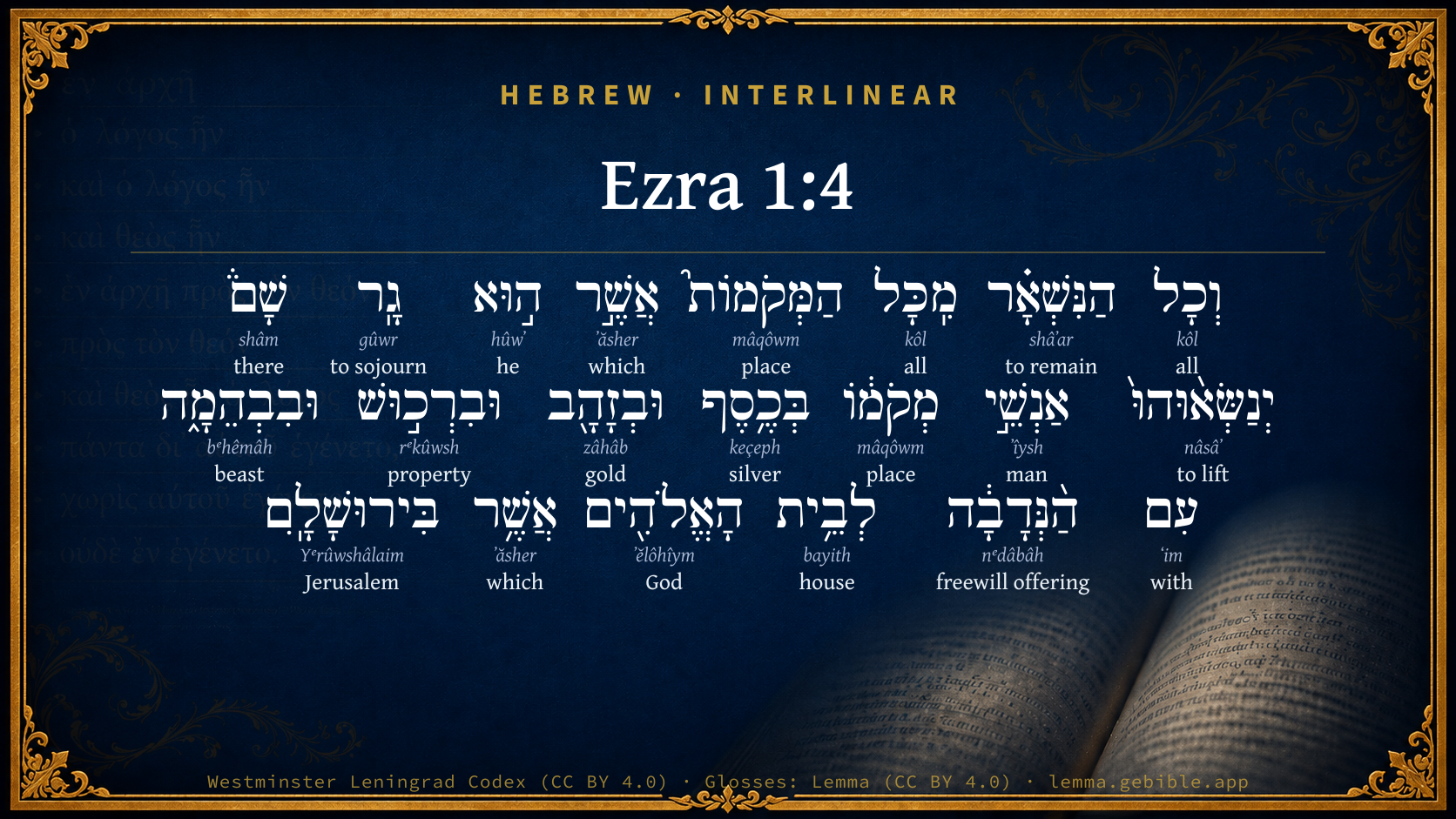
Hebrew (Westminster Leningrad Codex) Ezra 1:4 appears in the Hebrew Old Testament. The text above is from the Westminster Leningrad Codex. Each word links to its Strong’s number, a concise gloss, and parsing drawn from the Open Scriptures Hebrew Bible morphology. Click any word for its full Brown-Driver-Briggs (BDB) entry.
Download image
Cite this verse

Ezra 1:4 (World English Bible). Public Domain. Lemma interlinear Bible study tool, https://lemma.gebible.app/v/ezra/1/4.

Show BibTeX & RIS
BibTeX
RIS
English Translation
Whoever is left, in any place where he sojourns, let the men of his place help him with silver, and with gold, and with goods, and with animals, besides the freewill-offering for the house of God which is in Jerusalem.
World English Bible · Public Domain
Download a study sheet

One document with this verse’s original text, its word-by-word gloss line, the meaning frame, cross-references with their text, attributed commentary, and full source and license credits — printable, and it pastes into notes with its structure intact.

This verse Autodidact and up

Study sheet (.html) Plain text (.txt)

A passage Seminary Student

Up to 50 verses in one chapter. A passage sheet keeps up to 6 commentary sources and 12 cross-references per verse, in the order this page ranks them, and says so on the sheet whenever that leaves anything out. Ask for a single verse and you get the Autodidact verse sheet above.

Everything on this page stays free to read, with no account — the sheet is a download of what is already on screen, not access to it.

Want to remove ads? Support Godless Engineer
Compare translations 3

The same verse in 3 English versions, stacked beneath the original-language interlinear above. Click any original word for its lexicon entry.

Each is an independent rendering of the whole verse — the interlinear is not word-aligned to these translations.

Highlighted words mark where these versions differ — a whole-verse word diff, not a word-by-word alignment.

  • World English Bible Public Domain
    Whoever is left, in any place where he sojourns, let the men of his place help him with silver, and with gold, and with goods, and with animals, besides the freewill-offering for the house of God which is in Jerusalem.
  • King James Version Public Domain
    And whosoever remaineth in any place where he sojourneth, let the men of his place help him with silver, and with gold, and with goods, and with beasts, beside the freewill offering for the house of God that is in Jerusalem.
  • unfoldingWord Literal Text CC BY-SA 4.0
    And every one who is remaining in all of the places where he is sojourning there, let the men of his place lift him with silver and with gold, and with goods and with livestock, along with the freewill offering for the house of God, which is in Jerusalem.”

unfoldingWord Literal Text — © unfoldingWord, licensed CC BY-SA 4.0. Word-aligned USFM3 via Door43 (git.door43.org/unfoldingWord/en_ult).

Versions to compare (up to 4)

3 of 4 selected

Show all 18 translations

Every available English version of this verse, each an independent rendering of the whole verse.

  • World English Bible Public Domain
    Whoever is left, in any place where he sojourns, let the men of his place help him with silver, and with gold, and with goods, and with animals, besides the freewill-offering for the house of God which is in Jerusalem.
  • Berean Standard Bible Public Domain
    And let every survivor, wherever he lives, be assisted by the men of that region with silver, gold, goods, and livestock, along with a freewill offering for the house of God in Jerusalem.’”
  • Majority Standard Bible Public Domain
    And let every survivor, wherever he lives, be assisted by the men of that region with silver, gold, goods, and livestock, along with a freewill offering for the house of God in Jerusalem.’”
  • King James Version Public Domain
    And whosoever remaineth in any place where he sojourneth, let the men of his place help him with silver, and with gold, and with goods, and with beasts, beside the freewill offering for the house of God that is in Jerusalem.
  • American Standard Version (1901) Public Domain
    And whosoever is left, in any place where he sojourneth, let the men of his place help him with silver, and with gold, and with goods, and with beasts, besides the freewill-offering for the house of God which is in Jerusalem.
  • Revised Version (1885) Public Domain
    And whosoever is left, in any place where he sojourneth, let the men of his place help him with silver, and with gold, and with goods, and with beasts, beside the freewill offering for the house of God which is in Jerusalem.
  • Geneva Bible (1599) Public Domain
    And euery one that remayneth in any place (where he soiourneth) let the men of his place relieue him with siluer and with golde, and with substance, and with cattel, and with a willing offring, for the house of God that is in Ierusalem.
  • Douay-Rheims (1899) Public Domain
    And let all the restin all places wheresoever they dwell, help him every man from his place. with silver and gold, and goods, and cattle, besides that which they offer freely to the temple of God, which is in Jerusalem.
  • Young's Literal Translation Public Domain
    `And every one who is left, of any of the places where he `is' a sojourner, assist him do the men of his place with silver, and with gold, and with goods, and with beasts, along with a free-will offering for the house of God, that `is' in Jerusalem.'
  • Literal Standard Version CC BY-SA 4.0
    And everyone who is left, of any of the places where he [is] a sojourner, the men of his place assist him with silver, and with gold, and with goods, and with beasts, along with a free-will offering for the house of God, that [is] in Jerusalem.”
  • Unlocked Literal Bible CC BY-SA 4.0
    People of any part of the kingdom where survivors of that land are living should provide them with silver and gold, possessions and animals, as well as a freewill offering for God's house in Jerusalem.”
  • unfoldingWord Literal Text CC BY-SA 4.0
    And every one who is remaining in all of the places where he is sojourning there, let the men of his place lift him with silver and with gold, and with goods and with livestock, along with the freewill offering for the house of God, which is in Jerusalem.”
  • Darby Bible Public Domain
    And whosoever remains in any place where he sojourns, let the men of his place help him with silver, and with gold, and with goods, and with beasts, besides the voluntary offering for the house of God which is at Jerusalem.
  • World Messianic Bible Public Domain
    Whoever is left, in any place where he lives, let the men of his place help him with silver, with gold, with goods, and with animals, in addition to the free will offering for God’s house which is in Jerusalem.’”
  • Webster's Bible Public Domain
    And whoever remaineth in any place where he sojourneth, let the men of his place help him with silver, and with gold, and with goods, and with beasts, besides the free-will-offering for the house of God that is in Jerusalem.
  • Free Bible Version CC BY-SA 4.0
    Wherever survivors are currently living, let them be helped by the people of that region with silver, gold, goods, and livestock, together with a voluntary donation for God's Temple in Jerusalem.’”
  • Bible in Basic English Public Domain
    And whoever there may be of the rest of Israel, living in any place, let the men of that place give him help with offerings of silver and gold and goods and beasts, in addition to the offering freely given for the house of God in Jerusalem.
  • JPS Tanakh (1917) Public Domain
    And whosoever is left, in any place where he sojourneth, let the men of his place help him with silver, and with gold, and with goods, and with beasts, beside the freewill-offering for the house of God which is in Jerusalem.'

Literal Standard Version (2020), Covenant Press — licensed CC BY-SA 4.0. Text via the HelloAO Bible API (eBible.org). Unlocked Literal Bible (unfoldingWord) — licensed CC BY-SA 4.0. Text via the HelloAO Bible API (eBible.org). unfoldingWord Literal Text — © unfoldingWord, licensed CC BY-SA 4.0. Word-aligned USFM3 via Door43 (git.door43.org/unfoldingWord/en_ult). Free Bible Version, Dr. Jonathan Gallagher — licensed CC BY-SA 4.0. Text via the HelloAO Bible API (eBible.org).

Word by word

More ways to search: Search by grammar → Find every occurrence → Compare this word →

Practice this passage: Drill this verse → Learn its vocabulary →

הַ֨נְּדָבָ֔ה
nᵉdâbâh
H5071
“the · freewill offering”
Particle, Definite Article + Noun, Common, Feminine, Singular, Absolute
Part of Speech
Particle + Noun
Type
Common
Gender
Feminine
Number
Singular
State
Absolute
Full BDB Definition

Origin: from H5068

TWOT: 1299a

voluntariness, free-will offering - voluntariness - freewill, voluntary, offering
  1. וְכָל kôl H3605 “and · all of” Conjunction + Noun, Common, Masculine, Singular, Construct
  2. הַנִּשְׁאָ֗ר shâʼar H7604 “the · remaining” Particle, Definite Article + Verb, Niphal, Participle Active, Masculine, Singular, Absolute
  3. מִֽכָּל kôl H3605 “from · all of” Preposition + Noun, Common, Masculine, Singular, Construct
  4. הַמְּקֹמוֹת֮ mâqôwm H4725 “the · places” Particle, Definite Article + Noun, Common, Masculine, Plural, Absolute
  5. אֲשֶׁ֣ר ʼăsher H834 “which” Particle, Relative
  6. ה֣וּא hûwʼ H1931 “he” Pronoun, Personal, 3rd Person, Masculine, Singular
  7. גָֽר gûwr H1481 “sojourning” Verb, Qal, Participle Active, Masculine, Singular, Absolute
  8. שָׁם֒ shâm H8033 “there” Adverb
  9. יְנַשְּׂא֨וּהוּ֙ nâsâʼ H5375 “to lift · him” Verb, Piel, Imperfect, 3rd Person, Masculine, Plural + Suffix, Personal, 3rd Person, Masculine, Singular
  10. אַנְשֵׁ֣י ʼîysh H376 “men of” Noun, Common, Masculine, Plural, Construct
  11. מְקֹמ֔וֹ mâqôwm H4725 “place · his” Noun, Common, Masculine, Singular, Construct + Suffix, Personal, 3rd Person, Masculine, Singular
  12. בְּכֶ֥סֶף keçeph H3701 “in/at · silver” Preposition + Noun, Common, Masculine, Singular, Absolute
  13. וּבְזָהָ֖ב zâhâb H2091 “and · in/at · gold” Conjunction + Preposition + Noun, Common, Masculine, Singular, Absolute
  14. וּבִרְכ֣וּשׁ rᵉkûwsh H7399 “and · in/at · property” Conjunction + Preposition + Noun, Common, Masculine, Singular, Absolute
  15. וּבִבְהֵמָ֑ה bᵉhêmâh H929 “and · in/at · beast” Conjunction + Preposition + Noun, Common, Feminine, Singular, Absolute
  16. עִם ʻim H5973 “with” Preposition
  17. לְבֵ֥ית bayith H1004 “to/for · house of” Preposition + Noun, Common, Masculine, Singular, Construct
  18. הָאֱלֹהִ֖ים ʼĕlôhîym H430 “the · God(s)” Particle, Definite Article + Noun, Common, Masculine, Plural, Absolute
  19. אֲשֶׁ֥ר ʼăsher H834 “which” Particle, Relative
  20. בִּירוּשָׁלִָֽם Yᵉrûwshâlaim H3389 “in/at · Jerusalem” Preposition + Noun, Proper

About this verse

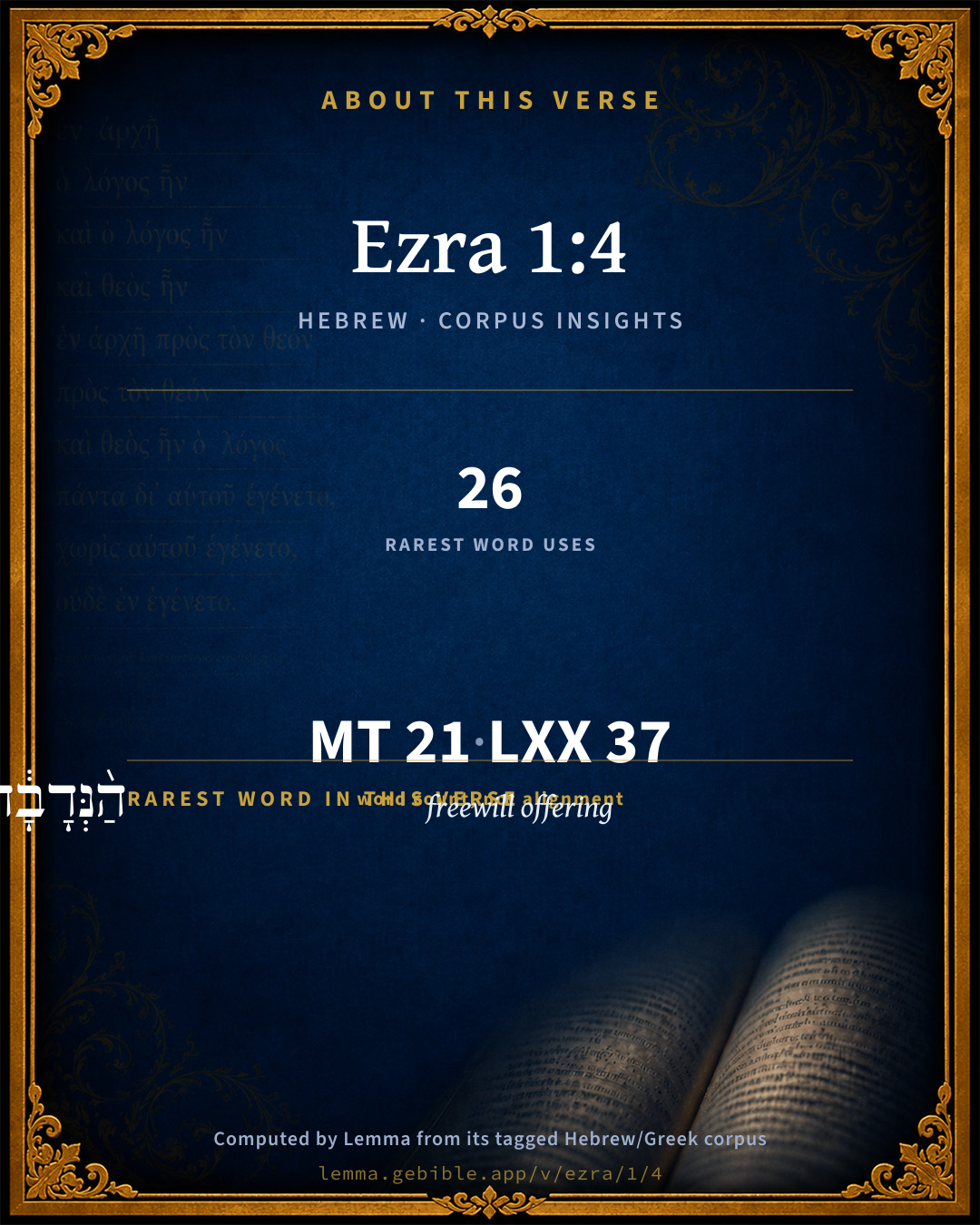
These counts appear in no published source. They are computed here, from the morphology-tagged text and Lemma’s own curated glosses. What Lemma adds →

21
words
18
distinct lemmas
Historical
section

Shared distinctive vocabulary

הַ֨נְּדָבָ֔ה freewill offering H5071 occurs in 25 verses of the Hebrew Bible. Also found in:

Grammatical profile

  • 3 verbs
  • 13 nouns
  • 1 pronoun
  • 1 preposition
  • 1 adverb
  • 2 particles

Verb forms

  • הַנִּשְׁאָ֗ר Niphal · Participle Active
  • גָֽר Qal · Participle Active
  • יְנַשְּׂא֨וּהוּ֙ Piel · Imperfect

Repetition

Words recur within this verse — often emphatic in Hebrew:

  • וְכָל all H3605 ×2
  • הַמְּקֹמוֹת֮ place H4725 ×2
  • אֲשֶׁ֣ר which H834 ×2

Hebrew & Septuagint length

In English translation the verse runs 40 words from the Hebrew and 45 from the Septuagint (LXX English) — closely comparable.

A rough comparison of the two English renderings, which tokenize alike — not a word-level alignment.

Word counts can differ between the Hebrew and the Greek without any difference in meaning — e.g. the Hebrew direct-object marker אֵת has no separate Greek word, and Greek often adds the article ὁ.

In the original languages it is 21 Hebrew tokens and 37 Greek tokens — but the two are counted differently (Hebrew bundles its prefixes and suffixes into one token; the Greek is in lemma form), so that isn’t a like-for-like length.

Cross-references

9

Topical passages linked to Ezra 1:4 in the Treasury of Scripture Knowledge — connected by theme and wording, ordered by reader-vote popularity; previews shown in the World English Bible.

  • 1 Chronicles 29:3 In addition, because I have set my affection on the house of my God, seeing that I have a treasure of my own of gold and silver, I give it to the house of my God, over and above all that I have prepared for the holy house,
  • 1 Chronicles 29:9 Then the people rejoiced, because they offered willingly, because with a perfect heart they offered willingly to Yahweh: and David the king also rejoiced with great joy.
  • 1 Chronicles 29:17 I know also, my God, that you try the heart, and have pleasure in uprightness. As for me, in the uprightness of my heart I have willingly offered all these things: and now have I seen with joy your people, that are present here, offer willingly to you.
  • Ezra 2:68–70 Some of the heads of fathers' [houses], when they came to the house of Yahweh which is in Jerusalem, offered willingly for the house of God to set it up in its place:
  • Ezra 7:16–18 and all the silver and gold that you shall find in all the province of Babylon, with the freewill-offering of the people, and of the priests, offering willingly for the house of their God which is in Jerusalem;
  • Ecclesiastes 4:9–10 Two are better than one, because they have a good reward for their labor.
  • Acts 24:17 Now after some years, I came to bring gifts for the needy to my nation, and offerings;
  • Galatians 6:2 Bear one another's burdens, and so fulfill the law of Christ.
  • 3 John 1:6–8 They have testified about your love before the assembly. You will do well to send them forward on their journey in a manner worthy of God,

Cross-references courtesy of OpenBible.info (CC BY 4.0).

Hebrew and Greek witnesses Masoretic Hebrew ↔ Greek Septuagint

The same verse in the two great witnesses to the Old Testament, shown verse-for-verse.

These are two independent witnesses, not word-aligned to each other, and the Septuagint is shown in lemma (dictionary) form.

Hebrew Ezra 1:4 Masoretic · Westminster Leningrad Codex

וְכָל הַנִּשְׁאָ֗ר מִֽכָּל הַמְּקֹמוֹת֮ אֲשֶׁ֣ר ה֣וּא גָֽר שָׁם֒ יְנַשְּׂא֨וּהוּ֙ אַנְשֵׁ֣י מְקֹמ֔וֹ בְּכֶ֥סֶף וּבְזָהָ֖ב וּבִרְכ֣וּשׁ וּבִבְהֵמָ֑ה עִם הַ֨נְּדָבָ֔ה לְבֵ֥ית הָאֱלֹהִ֖ים אֲשֶׁ֥ר בִּירוּשָׁלִָֽם

Whoever is left, in any place where he sojourns, let the men of his place help him with silver, and with gold, and with goods, and with animals, besides the freewill-offering for the house of God which is in Jerusalem.

World English Bible · Public Domain

Greek LXX Ezra 1:4 Septuagint · lemma form

καί πᾶς ὁ καταλείπω ἀπό πᾶς ὁ τόπος οὗ αὐτός παραοἰκέω ἐκεῖ καί λαμβάνω αὐτός ἀνήρ ὁ τόπος αὐτός ἐν ἀργύριον καί χρυσίον καί ἀποσκευή καί κτῆνος μετά ὁ ἑκούσιος εἰς οἶκος ὁ θεός ὁ ἐν ἰερουσαλήμ

And let every Jew that is left go from every place where he sojourns, and the men of his place shall help him with silver, and gold, and goods, and cattle, together with the voluntary offering for the house of God that is in Jerusalem.

LXX2012 (modern English Septuagint) · Public Domain

In the Septuagint this is one book — Esdras B (2 Esdras): Ezra is chapters 1–10, Nehemiah 11–23.

On this verse, The Cambridge Bible for Schools and Colleges discusses the Septuagint’s reading. Read the note in Commentary ↓

Hebrew: Westminster Leningrad Codex (CC BY 4.0). Greek: Septuagint (public domain); English from LXX2012 (modern English Septuagint) (Public Domain). How the Septuagint differs from the Hebrew →

Commentary

Notes on Ezra 1:4 from classic Christian and Jewish commentators (each source and its license shown beneath its notes). The classic Christian expositions comment on the surrounding passage and are grouped to its opening verse, so a note may address several verses; the Jewish commentaries on the Tanakh (Rashi and others) are per-verse, so they appear only where the commentator wrote on this verse.

Lemma curates 59 commentaries, every one of them public domain or Creative Commons licensed, each selected and text-cleaned for this edition rather than reprinted as found. About our sources →

Trapp's Complete Commentary

John Trapp

Ezr 1:4 And whosoever remaineth in any place where he sojourneth, let the men of his place help him with silver, and with gold, and with goods, and with beasts, beside the freewill offering for the house of God that [is] in Jerusalem.

Ver. 4. And whosoever remaineth in any place where he sojourneth] Heb. Gershom. A name that Moses gave his eldest son born in his banishment; for he said, "I have been a stranger in a strange land," Exo 2:22. These poor captives had been longer so than Moses in Midian, and met with more hard measure, Psa 137:1; Psa 137:8. But as those who are born in hell know no other heaven (as the proverb is), so fared it not with a few of these; loth to be at the pains and run the hazard of a voyage to the Holy Land. A little with ease is held best. Let us, who are strangers here, haste homeward, heavenward. Some of these poor Jews had a mind to return, but wanted means. For these necessitous people the king takes care and course here, that they be supplied and set forward on their journey, after a godly sort, or worthy of God, as St John phraseth it, 3Jn 1:6, who else will require it.

Let the men of his place] Whether Jews or proselytes, brethren by race, grace, or place only.

Help him with silver] Heb. Give him a lift out of the dust, as Job’s friends did him off the dunghill; as Joseph did his brethren when he filled their bags, and returned them their moneys; and as all Christians are bound and bid to support or shore up their weaker brethren, 1Th 5:14 (Aντεχεσθε των ασθενων).

With silver, and with gold] These are notable good levers at a dead lift in this present world where money bears the mastery, and answereth all things, Ecc 10:14, a satisfactory answer it giveth to whatsoever is desired or demanded. He that helpeth a man, therefore, in his necessity with silver and gold is a friend indeed. Let a man make God his friend, and then (saith Eliphaz) the Almighty shall be his gold, and he shall have plenty of silver, Job 22:25; Jacob shall be sure of so much as shall bring him to his journey’s end, a sufficiency, if not a superfluity, of all things needful to life and godliness.

And with goods] Heb. Recush (whence haply our English words riches and cash), chattels, movables, gathered substance, as the word signifieth, which whosoever he was that first called substance was utterly mistaken; sith wisdom only (that is, godliness) is durable substance, Pro 8:21. Wealth is but a semblance, Pro 23:5 1Co 7:31 And he that first called riches goods was a better husband than divine. But it may be thought the most are such husbands; since the common cry is, Who will show us any good? a good booty, a good bargain, a good beast? &c., Psa 4:6. That one thing necessary, that is both Bonum hominis, the good of man, Mic 6:8, and Totum hominis, the whole of man, Ecc 12:13, lieth wholly neglected by the most.

And with beasts] Those most serviceable creatures, both ad esum and ad usum, for food and other uses, as sheep, horses, camels, dromedaries, swift, patient, painful.

Besides the freewill offering] Which the king presumeth all God’s free-hearted people (volunteers, every soul of them, Psa 110:3) will be most forward unto in so good a work, so acceptable a service. See Lev 5:6; Lev 5:12; Lev 14:10; Lev 14:21; Lev 14:30. God straineth upon no man, Exo 25:2; Exo 35:5. Lex quaerit voluntarios, The law calleth for volunteers, saith Ambrose, see Isa 56:6 2Co 8:12; 2Co 9:7, and learn to come off roundly and readily in works of piety and charity; for else all is lost; since Virtus nolentium nulla est, unwilling service is nothing set by.

That is in Jerusalem] This city he so often nameth, that he may seem delighted with the very mention of it; and to be of the same mind with those pious captives that vowed to prefer Jerusalem (that joy of the whole earth) before their chief joy, to make it ascend above the head of their joy, as the Hebrew hath it, Psa 137:6. How then should it cheer up our hearts to think of heaven, and that we are written among the living in Jerusalem, Isa 4:3; fellow-citizens with the saints, and of the household of heaven, Eph 2:19.

John Trapp, A Commentary or Exposition upon All the Books of the Old and New Testament (1647–1656) — public domain. Text from a community e-Sword module.

The Biblical Illustrator

Joseph S. Exell

Ezr_1:4

Let the men of the place help him with silver.

Spontaneous offering

Not many years since, writes a clergyman, I had occasion to solicit funds to aid in the prosecution of a work of benevolence. I stepped into the office of a Christian friend, with whom I had a partial acquaintance, and incidentally mentioned the unpleasant business before me, and inquired of him for the residence of a certain benevolent individual, and added that I hoped to get one dollar of him. After receiving directions, I turned to go out. But stop, said this brother, suppose you let me have the privilege of contributing a little of the money which the Lord has lent me to this cause. Put down £20 for me. I expressed my surprise that he should contribute so liberally, and remarked that I should feel myself in duty bound not to call on him very soon on a similar errand. Well, then, said he, my brother, I think you will very much mistake your duty. If you knew how much pleasure it gave me to contribute of my substance to the Lord, you would feel no reluctance in calling again. And now let me charge you, when engaged in similar business, never to pass me by. Call, and I think I shall be able to do something; and if not, my prayers shall go with you. (Signal.)

A stimulus to generous offering

Two weeks ago I told you that three thousand dollars had got to be raised to pay for the repairs of this house. The plates were sent round, and about six hundred dollars were raised. I was heartily ashamed, and have not got over it yet. Last week the trustees came, and asked me if I would name the matter again, and I said, No, I will not. But this week, upon their renewed application, I have consented to speak once more. If this dont do, you may pay your debt how you can, for I will never mention it again. Im not going to be a pump to be thrust into mens pockets to force up what ought to come up freely. When the surgeon comes to a place where he must cut, he had better cut. For more than a year Ive seen that our plate collections grew meaner and meaner. I didnt want to face you with such things as Ive got to say to-day, and I put it off as long as I could. Now I shall speak plainly once for all, not having the face to bring the matter up again. This debt has got to be paid, and will you meet it honourably, and pay it like men, or will you let it drip, drip, drip out of you reluctantly, a few dollars st a time? You can take your choice. Im not going to try to drill money out of you as I would drill stones. The amount of meanness among respectable people is appalling. One needs to take a solar microscope in order to see some men. (H. W. Beecher.)

The Biblical Illustrator, edited by Joseph S. Exell (c. 1880s–1900s) — public domain. Text from a community e-Sword module.

Joseph Benson's Commentary

Ezr 1:4. Whosoever remaineth in any place where be sojourneth, &c. — This seems to relate to such as were desirous to go up with their brethren, but were forced to stay behind for want of necessaries to support them in so long a journey. To such he would have a supply of all things needful to be given by the inhabitants of the places where they lived, who could afford it, besides sending by them an offering toward the rebuilding of the temple.

Joseph Benson's Commentary on the Old and New Testaments (1811–1818) — public domain. Text from a community e-Sword module.

Tyndale Open Study Notes

Tyndale Open Resources

1:4 Cyrus was probably not urging Babylonian neighbors of the Jewish remnant to help the Hebrews. Rather, he was encouraging Jews who had decided to stay in Babylon to help their countrymen who were returning to Jerusalem.

Tyndale Open Study Notes — © Tyndale Open Resources, licensed CC BY-SA 4.0. Text via the HelloAO Bible API.

Geneva Bible (1599)

Geneva Bible translators

If any through poverty were not able to return, the king’s commission was that he should be furnished with necessaries.

Which they themselves should send toward the reparation of the Temple.

Geneva Bible (1599) marginal notes — public domain. Text via Bolls.life.

Adam Clarke's Commentary

Verse 4. Whosoever remaineth in any place] Every one was at liberty to go, but none was obliged to go. Thus their attachment to God was tried; he whose heart was right with God went; he who was comfortably settled in Babylon, might go if he chose. Those who did not go, were commanded to assist their brethren who went.

Adam Clarke's Commentary on the Bible (1810–1826) — public domain. Text from a community e-Sword/MySword module.

The Cambridge Bible for Schools and Colleges

gen. ed. J. J. S. Perowne

4. And whosoever remaineth in any place where he sojourneth] R.V. And whosoever is left, in any place where he sojourneth. The wording of this clause is a little ambiguous. The following paraphrase will give the meaning. ‘In any place where survivors of the Jewish captivity are to be found sojourning, there let the natives of the place, the non-Israelite neighbours, render him all assistance.’ That this is the right interpretation is shown by the passages Neh_1:2, ‘The Jews that had escaped, which were left of the captivity’ and Hag_2:3, ‘Who is left among you that saw this house in its former glory’. Cf. 2Ki_25:22 and ‘the residue’ (R.V.) in Jer_8:3; Jer_24:8; Jer_39:9, &c.

The A.V. gives no intelligible sense. The R.V. (1) by altering ‘remaineth’ to ‘is left’ preserves the application of the word in the original to the survivors of the Captivity, (2) by punctuation indicates the construction of the verse, in which ‘whosoever is left’ is placed independently as a heading to the whole sentence; while the words ‘in any place where he sojourneth’ do not belong to ‘whosoever is left’ but introduce the succeeding clause ‘let the men &c.’

The passage is somewhat awkwardly worded, but with the above explanation is rendered quite clear in meaning. The decree made no universal requisition for aid to the Jews. It only enjoined that local assistance should be given by neighbours, wherever any resident Jew availed himself of the king’s edict for the Return.

sojourneth] The word in the original regularly used in the sense of ‘to dwell as a stranger’. Cf. Lev_19:34.

help] The A.V. margin has ‘Heb. lift him up’. The word in the original is the intensive Mood of the verb ‘to lift or carry’, and occurs in 1Ki_9:11 = ‘furnished’. The LXX. (ἀντιλαμβανέσθωσαν αὐτοῦ) renders the sense well by the Greek word so familiar to English readers in the words ‘He hath holpen Israel his servant’ (Luk_1:54).

with silver, and with gold, and with goods, and with beasts] The assistance should be given in money for the journey, in necessaries for the new homes, and in means of transport.—“Goods” a vague word, reproducing the indefiniteness of the original. It occurs again Ezr_8:21, Ezr_10:8, = ‘substance’ in A.V. and R.V. (LXX. κτῆσις and ὕπαρξις, Vulgate ‘substantia’). Here the LXX. has ἀποσκευή and the Vulgate ‘substantia’. From its use in these passages and in Gen_12:5; Gen_13:6, we gather that the word means the moveables of a household. ‘Beasts’ i.e. beasts of burden—horses, camels and asses. Cf. Ezr_2:66-67.

besides the freewill offering] ‘beside’, i.e. along with (Vulg. wrongly ‘excepto quod’) certain voluntary gifts of a more private nature especially intended for the Temple, as in chap. Ezr_8:25. Compare the freewill-offerings mentioned in Exo_35:29; Lev_22:23. This freewill offering is not to be restricted, as by some commentators, to the gifts either of Cyrus or of the Jews who remained behind. Any one, Jew or Gentile, could make such offerings, in Ezr_3:5.

for the house of God] These words denote the object of the free-will offering: and are not, as the Hebrew accents interpret, to be taken as following after ‘help him’, the intervening words being taken parenthetically.

that is in Jerusalem] R.V. which is, consistently with Ezr_1:2-3. The clause refers to ‘the house’. Some understand ‘God’ as the antecedent to ‘which’; but see note on a similar interpretation in Ezr_1:3. The expression is in its explicitness similar to ‘Jerusalem which is in Judah’ (Ezr_1:2).

The Cambridge Bible for Schools and Colleges (gen. ed. J. J. S. Perowne; Cambridge University Press, 1878–1918) — public domain. Text from a community e-Sword module.

John Gill's Exposition

And whosoever remaineth in any place where he sojourneth,.... Is left behind, and cannot go up through poverty, not having a sufficiency to bear his charges in his journey to Jerusalem:

let the men of his place keep him with silver, and with gold, and with goods, and with beasts; with money to bear the expenses of his journey, with goods to furnish his house, or trade with, when he came to Judea, and with cattle to carry him, and his goods, and to till the ground with, when he came thither; and the men exhorted to this are either the Gentiles that dwelt in the cities where these poor Jews were, or the richer Jews, who chose as yet not to go up until they saw how things would succeed; and are therefore called upon to assist their brethren who had a will, but not ability:

besides the freewill offering for the house of God that is in Jerusalem: which they freely gave, and sent by them for the rebuilding of the temple.

John Gill's Exposition of the Whole Bible (1746–1763) — public domain (CC PDM 1.0). Text via the HelloAO Bible API.

Albert Barnes' Notes on the Bible

Let the men of his place help him - i. e., “Let the pagan population help him” (see Ezr 1:6).

The freewill offering - Probably that made by Cyrus himself Ezr 1:7-11.

Albert Barnes' Notes on the Bible (1834–1885) — public domain. Text from a community e-Sword/MySword module.

Haydock's Catholic Bible Commentary

Rest, who do not please to return. The Jews went at different times, and under the different leaders, Zorobabel, Esdras, and Nehemias. Many did not return at all. Cyrus allowed them full liberty. He permits money to be exported, particularly the half sicle, required [in] Exodus xxx. 13, and all voluntary contributions for the temple. (Grotius) (Calmet) --- He also enjoins the prefects of the provinces, (ver. 6., and chap. iii. 7.) whom Josephus styles "the king’s friends," to forward this work; and he even designed to perfect it at his own expence, chap. vi. 4.

George Leo Haydock (1774–1849), Haydock's Catholic Family Bible and Commentary, 1859 edition — public domain. Excludes Psalms (Douay-Rheims chapter numbering differs from Protestant) and Deuterocanonical books (Catholic canon only).

Matthew Poole's English Annotations

Whosoever remaineth; who, when his brethren were gone up, was desirous to go with them, but forced to tarry there for want of necessaries for his journey.

Let the men of his place help him; I require my officers to take care that they may be supplied, either by the voluntary contributions of the people, or by a moderate tax to be laid either only upon those Jews who were resolved to stay, or upon the Gentiles also, which the Persian monarchs, being absolute, had a power to do; and which was the more reasonable, because the king himself submitted to it, and bore a great part of the burden, and because it was for the house of that great God to whom they all owed their present peace and great felicity.

With silver and with gold, which upon this occasion I give you leave to transport.

Matthew Poole's English Annotations on the Holy Bible (1683–1685) — public domain. Text from a community e-Sword/MySword module.

Whedon's Commentary on the Bible

Daniel D. Whedon

4. Whosoever remaineth — Or rather, all the remnant, that is, all the exiles still living. Compare the use of the same word in Neh_1:2. The word is best taken as nominative absolute, and as for all the remnant.

In any place where he sojourneth — Rather, From all the places where he has been dwelling. This phrase is to be construed with what follows, thus: Let the inhabitants of any place out of all the places where the exiles have been dwelling, help those exiles, etc.

The men of his place — The non-Israelitish population, or any others who do not accompany the exiles that volunteer to return to Jerusalem. Josephus states that many of the wealthier Jews remained at Babylon, not being willing to leave their possessions there.

Goods — Movable property; perhaps especially, household goods.

Freewill offering — Gifts of money, or vessels, or beasts for sacrifice — any oblation that might be deemed appropriate or of value.

Daniel D. Whedon (gen. ed.), Commentary on the Old and New Testaments (1874–1909) — public domain. Text from a community e-Sword module.

The Pulpit Commentary

Whosoever remaineth in any place where he sojourneth. Literally correct; but the meaning is, "And with regard to all those who remain (of the captive people) in any part of the country where they have their temporary abode, let the men of his district help him with silver," etc.

Cyrus finishes his decree by calling upon his heathen subjects to come to the aid of the poorer Israelites, and assist them with money, cattle, and other commodities, in order that none may be hindered by poverty, or by the want of beasts of burthen, from joining the band of emigrants, and setting out on their return to Jerusalem. Again, the kindliness of his disposition is apparent. Beside the freewill offering. So the Septuagint; but the Vulgate has, Except the freewill offering," etc. The Septuagint and the A. V are right. Cyrus means that money, cattle, and goods are to be made over to the poorer Israelites, in addition to any offering that might be intrusted to them for conveyance to Jerusalem, either by himself or by his subjects. Individually, he was about to send "a freewill offering," consisting of a number of gold and silver vessels for the service of the temple. His words suggest that his subjects might follow this good example.

The Pulpit Commentary (1880–1919), ed. H.D.M. Spence-Jones & Joseph S. Exell — public domain. Text from a community e-Sword module.

Rashi

Rabbi Shlomo Yitzchaki (Rashi)

And whoever remains and every Jew who remains in his place, who cannot ascend because he has no money.

shall help him I command the people of his place to provide him and help him with silver, gold, possessions and cattle, in order that he be able to ascend to Jerusalem with the donation that the people of his place will donate for the building of the Temple, for also among the nations there were some who contributed donations to the building of the Temple.

to the House of God, which is in Jerusalem From “So said Cyrus” until here is the proclamation and the message of the written epistle.

Rashi on the Tanakh — English translations: “The Judaica Press complete Tanach with Rashi, translated by A. J. Rosenberg” (CC BY 4.0); “Pentateuch with Rashi's commentary by M. Rosenbaum and A.M. Silbermann, 1929-1934” (public domain); “The Metsudah Tanach series, Lakewood, N.J” (CC BY 4.0); and “The Book of Joshua, Metsudah Publications, 1997” (CC BY 4.0). Text via Sefaria.

Lesson kit

Teaching starters — assembled from the data on this page, not authored interpretation. Every prompt links to the verse data it draws on. Edit before teaching.

Ezra, in the Historical, opens this verse with 21 words (18 distinct Hebrew lemmas). Its most distinctive word is nᵉdâbâh (“freewill offering”). A historical commentator’s framing appears above. Read the whole chapter for the surrounding context.

Discussion questions

  1. The word nᵉdâbâh carries the sense “freewill offering.” How does it shape the verse?
  2. How does Exodus 35:29, which shares the word «freewill offering», read alongside this verse?
  3. What does the repetition of “all” (2× in this one verse) do in this verse?
  4. These translations render this verse differently. What is at stake in choosing one wording over another?
  5. «הַנִּשְׁאָ֗ר» is a Niphal Participle Active verb. How does that grammatical form shape the action described?
  6. Compare how Trapp's Complete Commentary and The Biblical Illustrator read this verse. Where do they agree or differ?

Things to notice

Reading settings

Reading text

Shown beneath each verse's original-language words.

Old Testament
Old Testament edition

Read the OT as the Masoretic Hebrew (MT) or the Greek Septuagint (LXX).

English shown for the Greek Septuagint (in the Hebrew ↔ Greek comparison).

Comparing translations? Open the Compare panel on any verse page to stack up to four side by side.