
2 Kings 25:27

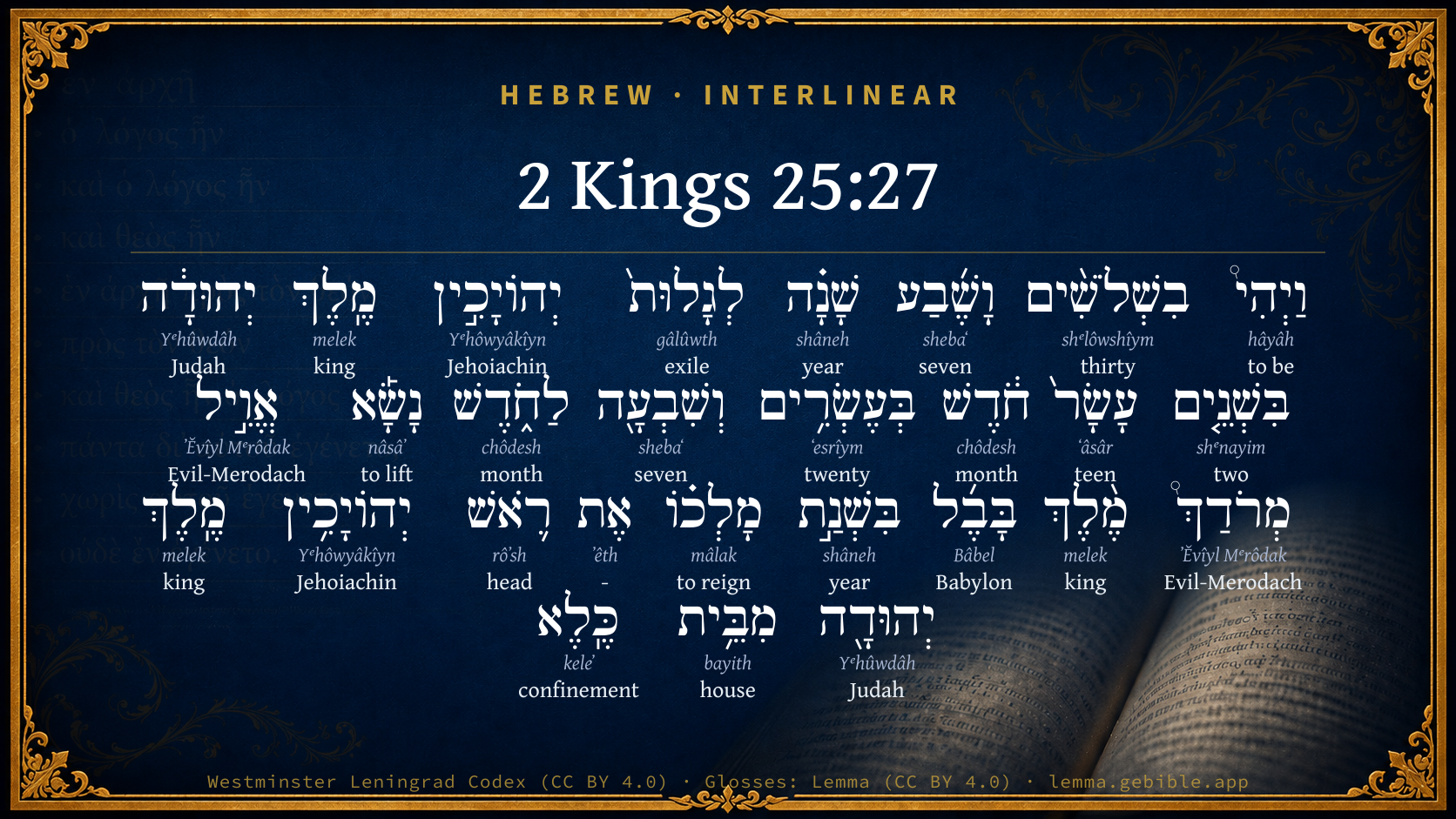
Hebrew (Westminster Leningrad Codex) 2 Kings 25:27 appears in the Hebrew Old Testament. The text above is from the Westminster Leningrad Codex. Each word links to its Strong’s number, a concise gloss, and parsing drawn from the Open Scriptures Hebrew Bible morphology. Click any word for its full Brown-Driver-Briggs (BDB) entry.
Download image
Cite this verse

2 Kings 25:27 (World English Bible). Public Domain. Lemma interlinear Bible study tool, https://lemma.gebible.app/v/2-kings/25/27.

Show BibTeX & RIS
BibTeX
RIS
English Translation
It happened in the seven and thirtieth year of the captivity of Jehoiachin king of Judah, in the twelfth month, on the seven and twentieth day of the month, that Evilmerodach king of Babylon, in the year that he began to reign, did lift up the head of Jehoiachin king of Judah out of prison;
World English Bible · Public Domain
Highlights
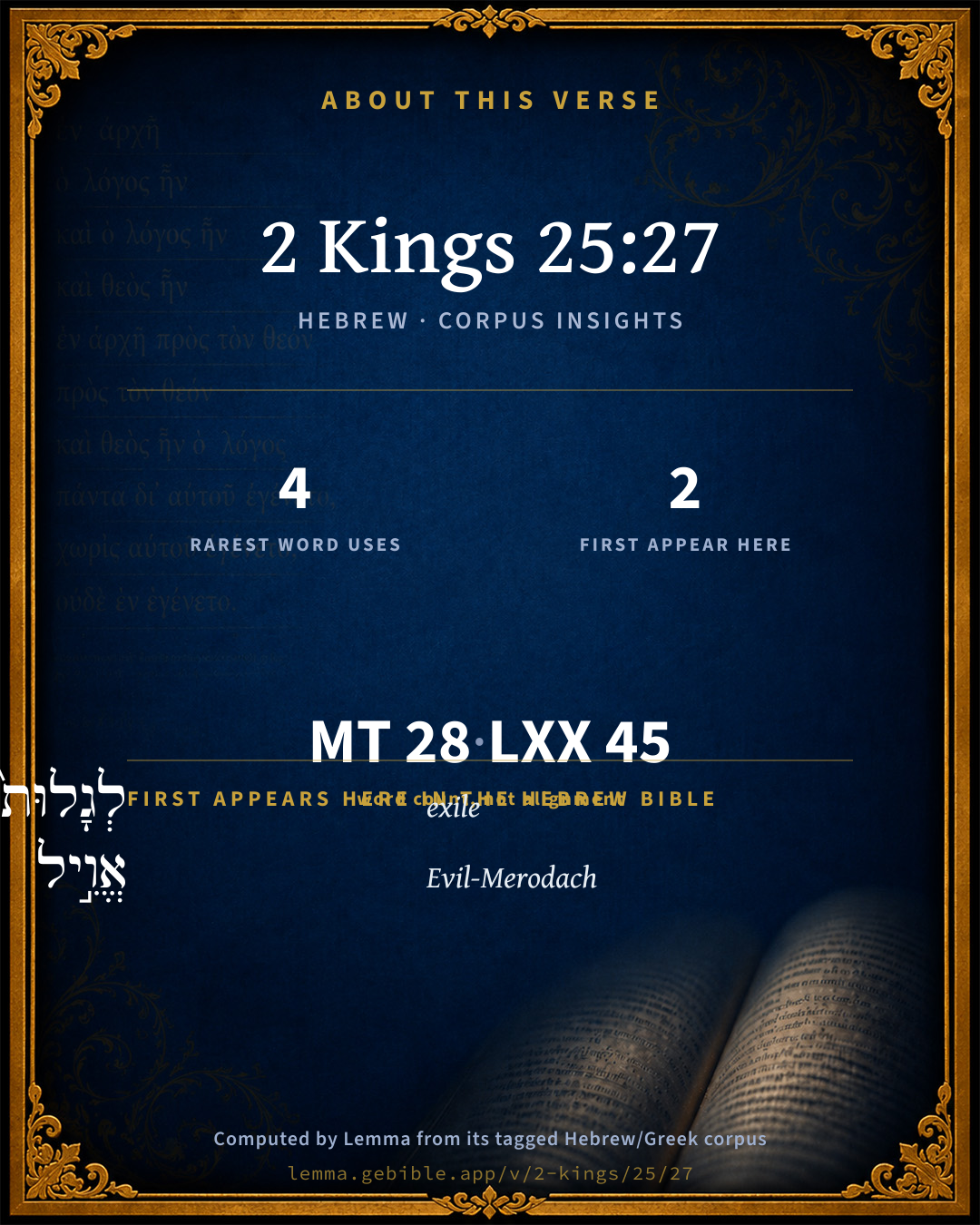
  • 2 first appearances in the Hebrew Bible
Full analysis ↓
Download a study sheet

One document with this verse’s original text, its word-by-word gloss line, the meaning frame, cross-references with their text, attributed commentary, and full source and license credits — printable, and it pastes into notes with its structure intact.

This verse Autodidact and up

Study sheet (.html) Plain text (.txt)

A passage Seminary Student

Up to 50 verses in one chapter. A passage sheet keeps up to 6 commentary sources and 12 cross-references per verse, in the order this page ranks them, and says so on the sheet whenever that leaves anything out. Ask for a single verse and you get the Autodidact verse sheet above.

Everything on this page stays free to read, with no account — the sheet is a download of what is already on screen, not access to it.

Want to remove ads? Support Godless Engineer
Compare translations 3

The same verse in 3 English versions, stacked beneath the original-language interlinear above. Click any original word for its lexicon entry.

Each is an independent rendering of the whole verse — the interlinear is not word-aligned to these translations.

Highlighted words mark where these versions differ — a whole-verse word diff, not a word-by-word alignment.

  • World English Bible Public Domain
    It happened in the seven and thirtieth year of the captivity of Jehoiachin king of Judah, in the twelfth month, on the seven and twentieth day of the month, that Evilmerodach king of Babylon, in the year that he began to reign, did lift up the head of Jehoiachin king of Judah out of prison;
  • King James Version Public Domain
    And it came to pass in the seven and thirtieth year of the captivity of Jehoiachin king of Judah, in the twelfth month, on the seven and twentieth day of the month, that Evilmerodach king of Babylon in the year that he began to reign did lift up the head of Jehoiachin king of Judah out of prison;
  • unfoldingWord Literal Text CC BY-SA 4.0
    And it happened in year 37 of the exile of Jehoiachin, the king of Judah, in month 12, on 27 of the month, Evil Merodach, the king of Babylon, in the year of his reigning, lifted the head of Jehoiachin, the king of Judah, from the house of imprisonment.

unfoldingWord Literal Text — © unfoldingWord, licensed CC BY-SA 4.0. Word-aligned USFM3 via Door43 (git.door43.org/unfoldingWord/en_ult).

Versions to compare (up to 4)

3 of 4 selected

Show all 18 translations

Every available English version of this verse, each an independent rendering of the whole verse.

  • World English Bible Public Domain
    It happened in the seven and thirtieth year of the captivity of Jehoiachin king of Judah, in the twelfth month, on the seven and twentieth day of the month, that Evilmerodach king of Babylon, in the year that he began to reign, did lift up the head of Jehoiachin king of Judah out of prison;
  • Berean Standard Bible Public Domain
    On the twenty-seventh day of the twelfth month of the thirty-seventh year of the exile of Judah’s King Jehoiachin, in the year Evil-merodach became king of Babylon, he released King Jehoiachin of Judah from prison.
  • Majority Standard Bible Public Domain
    On the twenty-seventh day of the twelfth month of the thirty-seventh year of the exile of Judah’s King Jehoiachin, in the year Evil-merodach became king of Babylon, he released King Jehoiachin of Judah from prison.
  • King James Version Public Domain
    And it came to pass in the seven and thirtieth year of the captivity of Jehoiachin king of Judah, in the twelfth month, on the seven and twentieth day of the month, that Evilmerodach king of Babylon in the year that he began to reign did lift up the head of Jehoiachin king of Judah out of prison;
  • American Standard Version (1901) Public Domain
    And it came to pass in the seven and thirtieth year of the captivity of Jehoiachin king of Judah, in the twelfth month, on the seven and twentieth day of the month, that Evil-merodach king of Babylon, in the year that he began to reign, did lift up the head of Jehoiachin king of Judah out of prison;
  • Revised Version (1885) Public Domain
    And it came to pass in the seven and thirtieth year of the captivity of Jehoiachin king of Judah, in the twelfth month, on the seven and twentieth day of the month, that Evil-merodach king of Babylon, in the year that he began to reign, did lift up the head of Jehoiachin king of Judah out of prison;
  • Geneva Bible (1599) Public Domain
    Notwithstanding in the seuen and thirtieth yeere after Iehoiachin King of Iudah was caried away, in the twelft moneth and the seuen and twentieth day of the moneth, Euil-merodach King of Babel in the yeere that hee began to reigne, did lift vp the head of Iehoiachin King of Iudah out of the prison,
  • Douay-Rheims (1899) Public Domain
    And it came to pass in the seven and thirtieth year of the captivity of Joachin king of Juda, in the twelfth month the seven and twentieth day of the month: Evilmerodach king of Babylon, in the year that he began to reign, lifted up the head of Joachin king of Juda out of prison.
  • Young's Literal Translation Public Domain
    And it cometh to pass, in the thirty and seventh year of the removal of Jehoiachin king of Judah, in the twelfth month, in the twenty and seventh of the month hath Evil-Merodach king of Babylon lifted up, in the year of his reigning, the head of Jehoiachin king of Judah, out of the house of restraint,
  • Literal Standard Version CC BY-SA 4.0
    And it comes to pass, in the thirty-seventh year of the expulsion of Jehoiachin king of Judah, in the twelfth month, on the twenty-seventh of the month, Evil-Merodach king of Babylon has lifted up, in the year of his reigning, the head of Jehoiachin king of Judah, out of the house of restraint,
  • Unlocked Literal Bible CC BY-SA 4.0
    It happened later in the thirty-seventh year of the exile of Jehoiachin king of Judah, in the twelfth month, on the twenty-seventh day of the month, that Awel-Marduk king of Babylon released Jehoiachin king of Judah from prison. This happened in the year that Awel-Marduk began to reign.
  • unfoldingWord Literal Text CC BY-SA 4.0
    And it happened in year 37 of the exile of Jehoiachin, the king of Judah, in month 12, on 27 of the month, Evil Merodach, the king of Babylon, in the year of his reigning, lifted the head of Jehoiachin, the king of Judah, from the house of imprisonment.
  • Darby Bible Public Domain
    And it came to pass in the thirty-seventh year of the captivity of Jehoiachin king of Judah, in the twelfth month, on the twenty-seventh of the month, [that] Evil-Merodach king of Babylon, in the year that he began to reign, lifted up the head of Jehoiachin king of Judah out of prison;
  • World Messianic Bible Public Domain
    In the thirty-seventh year of the captivity of Jehoiachin king of Judah, in the twelfth month, on the twenty-seventh day of the month, Evilmerodach king of Babylon, in the year that he began to reign, released Jehoiachin king of Judah out of prison,
  • Webster's Bible Public Domain
    And it came to pass in the seven and thirtieth year of the captivity of Jehoiachin king of Judah, in the twelfth month, on the seven and twentieth day of the month, that Evil-merodach king of Babylon, in the year that he began to reign, lifted up the head of Jehoiachin king of Judah out of prison;
  • Free Bible Version CC BY-SA 4.0
    In the year Evil-merodach became king of Babylon, he released Jehoiachin, king of Judah, from prison. This happened on the twenty-seventh day of the twelfth month of the thirty-seventh year of the exile of Jehoiachin, king of Judah.
  • Bible in Basic English Public Domain
    And in the thirty-seventh year after Jehoiachin, king of Judah, had been taken prisoner, in the twelfth month, on the twenty-seventh day of the month, Evil-merodach, king of Babylon, in the first year of his rule, took Jehoiachin, king of Judah, out of prison;
  • JPS Tanakh (1917) Public Domain
    And it came to pass in the seven and thirtieth year of the captivity of Jehoiachin king of Judah, in the twelfth month, on the seven and twentieth day of the month, that Evil-merodach king of Babylon, in the year that he began to reign, did lift up the head of Jehoiachin king of Judah out of prison.

Literal Standard Version (2020), Covenant Press — licensed CC BY-SA 4.0. Text via the HelloAO Bible API (eBible.org). Unlocked Literal Bible (unfoldingWord) — licensed CC BY-SA 4.0. Text via the HelloAO Bible API (eBible.org). unfoldingWord Literal Text — © unfoldingWord, licensed CC BY-SA 4.0. Word-aligned USFM3 via Door43 (git.door43.org/unfoldingWord/en_ult). Free Bible Version, Dr. Jonathan Gallagher — licensed CC BY-SA 4.0. Text via the HelloAO Bible API (eBible.org).

Word by word

More ways to search: Search by grammar → Find every occurrence → Compare this word →

Practice this passage: Drill this verse → Learn its vocabulary →

אֱוִ֣יל
ʼĔvîyl Mᵉrôdak
H192
“Evil-Merodach”
Adjective, Adjective, Masculine, Singular, Absolute
Part of Speech
Adjective
Type
Adjective
Gender
Masculine
Number
Singular
State
Absolute
Full BDB Definition

Origin: of Aramaic derivation and probably meaning soldier of merodach

TWOT: None

Evil Merodach = "man of Merodach" - son and successor of Nebuchadnezzar, king of Neo-Babylonian empire, 562-560 BC
  1. וַיְהִי֩ hâyâh H1961 “and · to be” Conjunction + Verb, Qal, Sequential Imperfect, 3rd Person, Masculine, Singular
  2. בִשְׁלֹשִׁ֨ים shᵉlôwshîym H7970 “in/at · thirty” Preposition + Adjective, Cardinal number, Both, Plural, Absolute
  3. וָשֶׁ֜בַע shebaʻ H7651 “and · seven” Conjunction + Adjective, Cardinal number, Feminine, Singular, Absolute
  4. שָׁנָ֗ה shâneh H8141 “year” Noun, Common, Feminine, Singular, Absolute
  5. לְגָלוּת֙ gâlûwth H1546 “to/for · exile of” Preposition + Noun, Common, Feminine, Singular, Construct
  6. יְהוֹיָכִ֣ין Yᵉhôwyâkîyn H3078 “Jehoiachin” Noun, Proper
  7. מֶֽלֶךְ melek H4428 “king of” Noun, Common, Masculine, Singular, Construct
  8. יְהוּדָ֔ה Yᵉhûwdâh H3063 “Judah” Noun, Proper
  9. בִּשְׁנֵ֤ים shᵉnayim H8147 “in/at · two” Preposition + Adjective, Cardinal number, Masculine, Dual, Absolute
  10. עָשָׂר֙ ʻâsâr H6240 “teen” Adjective, Cardinal number, Masculine, Singular, Absolute
  11. חֹ֔דֶשׁ chôdesh H2320 “month” Noun, Common, Masculine, Singular, Absolute
  12. בְּעֶשְׂרִ֥ים ʻesrîym H6242 “in/at · twenty” Preposition + Adjective, Cardinal number, Both, Plural, Absolute
  13. וְשִׁבְעָ֖ה shebaʻ H7651 “and · seven” Conjunction + Adjective, Cardinal number, Masculine, Singular, Absolute
  14. לַחֹ֑דֶשׁ chôdesh H2320 “to/for the · month” Preposition, Determined + Noun, Common, Masculine, Singular, Absolute
  15. נָשָׂ֡א nâsâʼ H5375 “to lift” Verb, Qal, Perfect, 3rd Person, Masculine, Singular
  16. מְרֹדַךְ֩ ʼĔvîyl Mᵉrôdak H192 “Evil-Merodach” Noun, Proper
  17. מֶ֨לֶךְ melek H4428 “king of” Noun, Common, Masculine, Singular, Construct
  18. בָּבֶ֜ל Bâbel H894 “Babylon” Noun, Proper
  19. בִּשְׁנַ֣ת shâneh H8141 “in/at · year of” Preposition + Noun, Common, Feminine, Singular, Construct
  20. מָלְכ֗וֹ mâlak H4427 “to reign · him” Verb, Qal, Infinitive Construct + Suffix, Personal, 3rd Person, Masculine, Singular
  21. אֶת ʼêth H853 “-” Particle, Direct Object
  22. רֹ֛אשׁ rôʼsh H7218 “head of” Noun, Common, Masculine, Singular, Construct
  23. יְהוֹיָכִ֥ין Yᵉhôwyâkîyn H3078 “Jehoiachin” Noun, Proper
  24. מֶֽלֶךְ melek H4428 “king of” Noun, Common, Masculine, Singular, Construct
  25. יְהוּדָ֖ה Yᵉhûwdâh H3063 “Judah” Noun, Proper
  26. מִבֵּ֥ית bayith H1004 “from · house of” Preposition + Noun, Common, Masculine, Singular, Construct
  27. כֶּֽלֶא keleʼ H3608 “confinement” Noun, Common, Masculine, Singular, Absolute

About this verse

These counts appear in no published source. They are computed here, from the morphology-tagged text and Lemma’s own curated glosses. What Lemma adds →

28
words
20
distinct lemmas
Historical
section

Notable vocabulary

The rarest word here is אֱוִ֣יל Evil-Merodach H192 — appearing just 4 times in the whole Hebrew Bible.

First appearance in Scripture

These words make their first canonical appearance in the Hebrew Bible here:

  • לְגָלוּת֙ exile H1546
  • אֱוִ֣יל Evil-Merodach H192

Shared distinctive vocabulary

אֱוִ֣יל Evil-Merodach H192 occurs in 2 verses of the Hebrew Bible. Also found in:

Grammatical profile

  • 3 verbs
  • 17 nouns
  • 7 adjectives
  • 1 particle

Verb forms

  • וַיְהִי֩ Qal · Sequential Imperfect
  • נָשָׂ֡א Qal · Perfect
  • מָלְכ֗וֹ Qal · Infinitive Construct

Repetition

Words recur within this verse — often emphatic in Hebrew:

  • מֶֽלֶךְ king H4428 ×3
  • וָשֶׁ֜בַע seven H7651 ×2
  • שָׁנָ֗ה year H8141 ×2
  • יְהוֹיָכִ֣ין Jehoiachin H3078 ×2
  • יְהוּדָ֔ה Judah H3063 ×2
  • חֹ֔דֶשׁ month H2320 ×2
  • אֱוִ֣יל Evil-Merodach H192 ×2

Hebrew & Septuagint length

In English translation the verse runs 55 words from the Hebrew and 57 from the Septuagint (LXX English) — closely comparable.

A rough comparison of the two English renderings, which tokenize alike — not a word-level alignment.

Word counts can differ between the Hebrew and the Greek without any difference in meaning — e.g. the Hebrew direct-object marker אֵת has no separate Greek word, and Greek often adds the article ὁ.

In the original languages it is 28 Hebrew tokens and 45 Greek tokens — but the two are counted differently (Hebrew bundles its prefixes and suffixes into one token; the Greek is in lemma form), so that isn’t a like-for-like length.

Cross-references

7

Topical passages linked to 2 Kings 25:27 in the Treasury of Scripture Knowledge — connected by theme and wording, ordered by reader-vote popularity; previews shown in the World English Bible.

  • Genesis 40:20 It happened the third day, which was Pharaoh's birthday, that he made a feast for all his servants, and he lifted up the head of the chief cupbearer and the head of the chief baker among his servants.
  • Jeremiah 52:31–34 It happened in the seven and thirtieth year of the captivity of Jehoiachin king of Judah, in the twelfth month, in the five and twentieth day of the month, that Evilmerodach king of Babylon, in the [first] year of his reign, lifted up the head of Jehoiachin king of Judah, and brought him forth out of prison;
  • Genesis 40:13 Within three more days, Pharaoh will lift up your head, and restore you to your office. You will give Pharaoh's cup into his hand, the way you did when you were his cupbearer.
  • 2 Kings 24:12 and Jehoiachin the king of Judah went out to the king of Babylon, he, and his mother, and his servants, and his princes, and his officers: and the king of Babylon took him in the eighth year of his reign.
  • Proverbs 21:1 The king's heart is in Yahweh's hand like the watercourses. He turns it wherever he desires.
  • 2 Kings 24:15 He carried away Jehoiachin to Babylon; and the king's mother, and the king's wives, and his officers, and the chief men of the land, carried he into captivity from Jerusalem to Babylon.
  • Jeremiah 24:5–6 Thus says Yahweh, the God of Israel: Like these good figs, so will I regard the captives of Judah, whom I have sent out of this place into the land of the Chaldeans, for good.

Cross-references courtesy of OpenBible.info (CC BY 4.0).

Hebrew and Greek witnesses Masoretic Hebrew ↔ Greek Septuagint

The same verse in the two great witnesses to the Old Testament, shown verse-for-verse.

These are two independent witnesses, not word-aligned to each other, and the Septuagint is shown in lemma (dictionary) form.

Hebrew 2 Kings 25:27 Masoretic · Westminster Leningrad Codex

וַיְהִי֩ בִשְׁלֹשִׁ֨ים וָשֶׁ֜בַע שָׁנָ֗ה לְגָלוּת֙ יְהוֹיָכִ֣ין מֶֽלֶךְ יְהוּדָ֔ה בִּשְׁנֵ֤ים עָשָׂר֙ חֹ֔דֶשׁ בְּעֶשְׂרִ֥ים וְשִׁבְעָ֖ה לַחֹ֑דֶשׁ נָשָׂ֡א אֱוִ֣יל מְרֹדַךְ֩ מֶ֨לֶךְ בָּבֶ֜ל בִּשְׁנַ֣ת מָלְכ֗וֹ אֶת רֹ֛אשׁ יְהוֹיָכִ֥ין מֶֽלֶךְ יְהוּדָ֖ה מִבֵּ֥ית כֶּֽלֶא

It happened in the seven and thirtieth year of the captivity of Jehoiachin king of Judah, in the twelfth month, on the seven and twentieth day of the month, that Evilmerodach king of Babylon, in the year that he began to reign, did lift up the head of Jehoiachin king of Judah out of prison;

World English Bible · Public Domain

Greek LXX 2 Kings 25:27 Septuagint · lemma form

καί γίγνομαι ἐν ὁ τριακοστός καί ἕβδομος ἔτος ὁ ἀποικεσία ὁ ιωακιμ βασιλεύς ιουδα ἐν ὁ δωδέκατος μήν ἕβδομος καί εἰκάς ὁ μήν ὑψόω ευιλμαρωδαχ βασιλεύς βαβυλών ἐν ὁ ἐνιαυτός ὁ βασιλεία αὐτός ὁ κεφαλή ιωακιμ βασιλεύς ιουδα καί ἐκἄγω αὐτός ἐκ οἶκος φυλακή αὐτός

And it came to pass in the thirty-seventh year of the carrying away of Joachim king of Juda, in the twelfth month, on the twenty-seventh day of the month, that Evialmarodec king of Babylon in the first year of his reign lifted up the head of Joachim king of Juda, and brought him out of his prison-house.

LXX2012 (modern English Septuagint) · Public Domain

On this verse, Ellicott's Commentary for English Readers discusses the Septuagint’s reading. Read the note in Commentary ↓

Hebrew: Westminster Leningrad Codex (CC BY 4.0). Greek: Septuagint (public domain); English from LXX2012 (modern English Septuagint) (Public Domain). How the Septuagint differs from the Hebrew →

Targum (Aramaic paraphrase)

1

The Targum is the ancient Jewish Aramaic paraphrase of the Hebrew Scriptures — an interpretive translation, not the Hebrew text itself. Onkelos (literal) and Pseudo-Jonathan (expansive) render the Torah, and Jonathan the Prophets. Coverage is partial: where no permissively-licensed English translation exists for a verse, only the Aramaic is shown. This is verse-level text, not a word-by-word alignment to the Hebrew.

  1. Targum Jonathan Prophets (Joshua–Malachi)
    וַהֲוָה בִּתְלָתִין וּשְׁבַע שְׁנִין לְגָלוּת יְהוֹיָכִין מֶלֶךְ שִׁבְטָא דְבֵית יְהוּדָה בִּתְרֵי עֲשַׂר יַרְחִין בְּעַשְׂרִין וְשַׁבְעָא לְיַרְחָא רַבֵּי אֱוִיל מְרוֹדָךְ מַלְכָּא דְבָּבֶל בִּשְׁנַת מַמְלְכֵיהּ יַת רֵישׁ יְהוֹיָכִין מֶלֶךְ שִׁבְטָא דְבֵית יְהוּדָה מִבֵּית אֲסִירֵי:

    (no public-domain English translation for this verse)

    Targum Jonathan — Aramaic: “Mikraot Gedolot” (public domain). English: “Sefaria Community Translation” (CC0 1.0 (public-domain dedication)); “London "Chaldee Paraphrase," 1871” (public domain). Text via Sefaria.

Commentary

Notes on 2 Kings 25:27 from classic Christian and Jewish commentators (each source and its license shown beneath its notes). The classic Christian expositions comment on the surrounding passage and are grouped to its opening verse, so a note may address several verses; the Jewish commentaries on the Tanakh (Rashi and others) are per-verse, so they appear only where the commentator wrote on this verse.

Lemma curates 59 commentaries, every one of them public domain or Creative Commons licensed, each selected and text-cleaned for this edition rather than reprinted as found. About our sources →

Trapp's Complete Commentary

John Trapp

2Ki 25:27 And it came to pass in the seven and thirtieth year of the captivity of Jehoiachin king of Judah, in the twelfth month, on the seven and twentieth [day] of the month, [that] Evilmerodach king of Babylon in the year that he began to reign did lift up the head of Jehoiachin king of Judah out of prison;

Ver. 27. And it came to pass in the seven and thirtieth year.] This was a long while to be held prisoner; but yet he had his life preserved - now, "a living dog is better than a dead lion" - and his eyes - which benefit Zedekiah was deprived of; and at length this high preferment: so little is there lost by doing or suffering aught for God’s sake; whose retributions are more than bountiful. Those "good figs" that were carried captive with him, had their share also, no doubt, in his comforts, though nothing be said of it.

On the seven and twentieth day of the month.] On the five and twentieth day he was released, {Jer 52:31} and on the seven and twentieth advanced.

That Evilmerodach king of Babylon.] Nebuchadnezzar’s son and successor. The Rabbis tell us that, his father returning to his right mind, after that he had for seven years’ space been turned a-grazing among the beasts of the field, cast Evilmerodach into the same prison with Jehoiachin, who told him his case, and thereby found this favour with him. They tell us further, that this Evilmerodach, in way of revenge, drew his father’s dead body out of the grave, cut it in pieces, burned it to ashes, parted the ashes, put them in several purses, bound them to four eagles necks, and caused them to fly to the four quarters of the world. See for this, Isa 14:19-20. Others tell us, that his courtiers called him Evilmerodach, that is, Foolmerodach, because he was so kind to Jehoiachin and his people. So they afterwards called Constantine the Great Pupillus, for his courtesy and bounty to the Christians.

John Trapp, A Commentary or Exposition upon All the Books of the Old and New Testament (1647–1656) — public domain. Text from a community e-Sword module.

The Biblical Illustrator

Joseph S. Exell

2Ki_25:27-30

And it came to pass in the seven and thirtieth year of the captivity of Jehoiachin.

Jehoiachin as a victim of tyrannic despotism and as an object of delivering mercy

The incident here recorded presents Jehoiachin--

I. As a victim of tyrannic despotism. He had been in prison for thirty-seven years and was fifty-five years of age. It was Nebuchadnezzar, the tyrannic King of Babylon, who stripped this man of liberty and freedom, and shut him up in a dungeon for this very long period of time. Such despotism has prevailed in all ages and lands. To the eternal dishonour of England, it has existed here for centuries, and is rampant even now. Look at this man--

II. As an object of delivering mercy. We are told that as soon as Evil-Morodach came to the throne on the death of his father Nebuchadnezzar, mercy stirred his heart and he relieved this poor victim of tyranny. Corrupt as this world is, the element of mercy is not entirely extinct. This mercy gave honour and liberty to the men who had been so long in confinement and disgrace. Let not the victims of tyranny--and they abound everywhere--despair. Mercy will ere long sound the trump of jubilee over all the land. The spirit of the Lord, said the great Redeemer of the race, is upon Me, because He hath anointed Me to preach the gospel to the poor, He hath sent Me to heal the broken-hearted, to preach deliverance to the captives, and recovery of sight to the blind, to set at liberty them that are bruised. (D. Thomas, D. D.)

The Biblical Illustrator, edited by Joseph S. Exell (c. 1880s–1900s) — public domain. Text from a community e-Sword module.

Joseph Benson's Commentary

2Ki 25:27-30. Evil-merodach, king of Babylon — “Nebuchadnezzar, the father of Evil-merodach, died in the year of the world 3442, and before Christ 562, after he had reigned from the death of his father, according to the Babylonish account, forty-three years. He was certainly one of the greatest princes that had appeared in the East for many years before him; and, according to Megasthenes, as he is cited by Josephus, both for his enterprises and performances, far excelled even Hercules himself. The same historian, as he is quoted by Eusebius, informs us, that a little before his death he foretold to his subjects the coming of the Persians, and their subduing the kingdom of Babylon, which he might gather from the Prophet Daniel, and especially from the interpretation of his dreams.” — Dodd.

In the year that he began to reign did lift up the head of Jehoiachin, &c. — He released him out of prison, where he had lain thirty-seven years, and was now fifty-five years old. And he spake kindly to him — Paid more respect to him than to any other of the kings his father had left in captivity, gave him princely clothing instead of his prison garments, maintained him in his own palace, and allowed him a pension for himself and his family, some way agreeable to his rank; a daily rate for every day as long as he lived. This was a very happy change of Jehoiachin’s condition. To have honour, liberty, and plenty, after he had been so long in confinement and disgrace, and compelled to endure the straits and miseries of a prison, was like the return of the morning after a very dark and tedious night. Let none say they shall never see good again, because they have long seen little but evil: the most miserable know not what blessed turn Providence may yet give to their affairs, nor what comforts they are reserved for, according to the days wherein they have been afflicted, Psa 90:15. It is likely Evil-merodach thought his father made the yoke of his captives too heavy; and, therefore, with the tenderness of a man, and the honour of a prince, he made it lighter. The Jews tell us, he had himself been imprisoned by his own father, after the latter was restored from his insanity, for some mal- administration at that time, and that in prison he contracted a friendship for Jehoiachin; and, therefore, as soon as he had it in his power, showed him this kindness as a sufferer, and as a fellow-sufferer. It should seem that all the kings he had in his power were favoured, but Jehoiachin above them all. Perhaps, as some have suggested, he had learned from Daniel and his fellows the principles of true religion, and was well affected to them, and upon that account favoured Jehoiachin. This undoubtedly happened by the good providence of God for the encouragement of the Jews in captivity, and the support of their faith and hope concerning their enlargement in due time. Thirty-six of the seventy years of their captivity were now past, and almost as many yet remained, when now, in this midnight of their bondage and misery, they see their king thus advanced as a comfortable earnest to them of their own release at the appointed season.

We are now come to the dreadful end of the Jewish monarchy, after it had stood four hundred and sixty-eight years from the time that David began to reign over it; three hundred and eighty-eight years from the revolt of the ten tribes from it; and one hundred and thirty-four years from the excision of the Israelitish commonwealth; and would have still continued under the sunshine of the divine protection, had it not been for the almost constant and horrid ingratitude of the people, and their invincible itch of imitating the idolatries and witcheries of other nations: crimes which, though abominable before God, were but too generally practised by mankind, through the amazing degeneracy of the human nature.

Having now gone through the history of the Jewish state, from its first beginning to its total captivity in a foreign land, we must acknowledge it to be a history of such remarkable particulars, as distinguish it from all other histories: a history of a state founded upon such principles, governed in such a manner, concerned in such extraordinary circumstances, distinguished by such wonderful facts, and its condition, from the beginning to the end, so corresponding to its obedience or disobedience to the principles upon which it was first founded, that it cannot be paralleled by the history of any people in the world.

Joseph Benson's Commentary on the Old and New Testaments (1811–1818) — public domain. Text from a community e-Sword module.

Whedon's Commentary on the Bible

Daniel D. Whedon

RELEASE OF JEHOIACHIN FROM PRISON, 2Ki_25:27-30.

27. Seven and thirtieth year — So identified was the captivity of Jehoiachin with that of the great mass of the Jewish exiles that its beginning formed a chronological epoch in their history. Compare Ezr_1:2. It was in Nebuchadnezzar’s eighth year that Jehoiachin was made captive, (2Ki_24:12,) and these thirty-seven years added would bring it to his forty-fifth year; but he had recently died, and a new king was on the throne, so that Nebuchadnezzar’s reign, according to these Scriptures, must have been forty-four years long. According to Ptolemy’s Canon and Josephus, it was forty-three years; but this slight difference is explained by the fact that the Scripture writer reckons his reign from the time he took command of the army of Babylon, a year, or, perhaps, a little more, before his father’s death. See note on 2Ki_24:1.

Seven and twentieth day — According to Jeremiah, five and twentieth.

Evil-merodach was son and successor of Nebuchadnezzar. According to Berosus, “he governed public affairs after an illegal and impure manner, and had a plot laid against him by Neriglissar, his sister’s husband, and was slain by him when he had reigned but two years.” — JOSEPHUS, Cont. Apion, 1:20. And this is about all that is known of him. The rabbies have a tradition that he contracted a friendship for Jehoiachin in prison, whither he himself had been cast by his father for a public offence.

In the year that he began to reign — He “seems to have wished to signalize the beginning of his reign by an act of kindness to the Jews.” Rawlinson suggests “that the marvellous events of his father’s life, which are recorded in the book of Daniel, had made a deep impression upon him, and that he was thence inclined to favour the persons, and perhaps the religion, of the Jews.”

Lift up the head… out of prison — An expression that evidently originated in the fact that a prisoner would naturally have his head bowed down under the weight of his sorrow and despondency, and liberation would cause him to lift up his head with gladness and comfort.

Daniel D. Whedon (gen. ed.), Commentary on the Old and New Testaments (1874–1909) — public domain. Text from a community e-Sword module.

Tyndale Open Study Notes

Tyndale Open Resources

25:27-30 Evil-merodach (Babylonian, Amel-marduk, “man of Marduk”) succeeded Nebuchadnezzar II at his death and reigned a short time (561–560 BC). • He was kind to Jehoiachin: Babylonian annals give details of the rations Jehoiachin received in prison. The narrator’s mention of Jehoiachin living in gracious circumstances is perhaps intended to provide hope that God would preserve and restore a repentant people to their land (see 1 Kgs 8:46-53; Isa 35:8-10; 51:11; Jer 29:10-14; Zeph 3:20).

Tyndale Open Study Notes — © Tyndale Open Resources, licensed CC BY-SA 4.0. Text via the HelloAO Bible API.

Geneva Bible (1599)

Geneva Bible translators

Thus long was he, his wife and his children in Babylon, whom Nebuchadnezzar’s son, after his father’s death preferred to honor: thus by God’s providence the seed of David was preserved even unto Christ.

Geneva Bible (1599) marginal notes — public domain. Text via Bolls.life.

Jamieson, Fausset & Brown

Robert Jamieson, A. R. Fausset & David Brown

seven and thirtieth year of the captivity of Jehoiachin--corresponding with the year of Nebuchadnezzar's death, and his son Evil-merodach's ascension to the throne.

Evil-merodach . . . did lift up the head of Jehoiachin . . . and spake kindly--gave him liberty upon parole. This kindly feeling is said to have originated in a familiar acquaintance formed in prison, in which Evil-merodach had lain till his father's death, on account of some malversation while acting as regent during Nebuchadnezzar's seven years' illness (Dan 4:32-33). But doubtless the improvement in Zedekiah's condition is to be traced to the overruling providence and grace of Him who still cherished purposes of love to the house of David (Sa2 7:14-15).

Jamieson, Fausset & Brown — Commentary Critical and Explanatory on the Whole Bible (1871) — public domain (CC PDM 1.0). Text via the HelloAO Bible API.

Adam Clarke's Commentary

Verse 27. And it came to pass] Nebuchadnezzar was just now dead; and Evil-merodach, his son, succeeded to the kingdom in the thirty-seventh year of the captivity of Jehoiachin: and on the seven and twentieth day [Jeremiah says five and twentieth] of the twelfth month of that year, (Tuesday, April 15, A.M. 3442,) he brought the long captivated Jewish king out of prison; treated him kindly; and ever after, during his life, reckoned him among the king's friends. This is particularly related in the four last verses of the book of Jeremiah.

Adam Clarke's Commentary on the Bible (1810–1826) — public domain. Text from a community e-Sword/MySword module.

Ellicott's Commentary for English Readers

(27) In the seven and thirtieth year . . .—Jehoiachin was now fifty-five years old (2Ki_24:8; 2Ki_24:12).

On the seven and twentieth day.—Jer_52:31 : five and twentieth, which is probably right. (See Note on 2Ki_25:19.)

Evil-merodach.—In Babylonian Amil-marduk, “man of Merodach.” (Comp. the Hebrew Eshbaal, “man of Baal.”) There are in the British Museum some contract tablets dated from his regnal years (562, 561, 560, B.C. ). He came to the throne 562 B.C. , upon the death of Nebuchadnezzar, who had reigned forty-three years. According to the canon of Ptolemy, Evil-merodach reigned two years. He was murdered by his brother-in-law Neriglissar—i.e., Nergal-sharezer.

Did lift up the head of Jehoiachin . . . out of prison—i.e., brought him out of prison (Gen_40:13; Gen_40:20). The LXX., Syriac, and Arabic add, “and brought him forth” before the words “out of prison.” So Jer_52:31.

(27-30) The captivity of Jehoiachin ameliorated by the new king of Babylon. (See Jer_52:31-34.)

A Bible Commentary for English Readers, edited by Charles John Ellicott (1878–1897) — public domain. Text from a community e-Sword module.

The Cambridge Bible for Schools and Colleges

gen. ed. J. J. S. Perowne

27–30. Jehoiachin king of Judah kindly treated by Evil-merodach king of Babylon (Jer_52:31-34)

27. the seven and thirtieth year of the captivity of Jehoiachin] Thus twenty-six years had elapsed since Jerusalem was overthrown.

on the seven and twentieth day of the month] In Jeremiah it is put down as the five-and-twentieth. That the year, month and day are so carefully noted (for the variation is easily understood) shews that the captive Jews regarded the act of Evil-merodach as a gleam of hope for all the nation.

Evil-merodach king of Babylon] He was the son and successor of Nebuchadnezzar. Coming to the throne b.c. 561, he ruled for two years till b.c. 559, and then was murdered by his brother-in-law, Neriglissar, who thus made himself king of Babylon.

did lift up the head of Jehoiachin] For the expression, signifying ‘to shew favour to’, compare Gen_40:13; Gen_40:20, where Pharaoh in a similar manner is said to have ‘lifted up the head’ of his chief butler, when he released him from prison and restored him to his post.

The Cambridge Bible for Schools and Colleges (gen. ed. J. J. S. Perowne; Cambridge University Press, 1878–1918) — public domain. Text from a community e-Sword module.

Albert Barnes' Notes on the Bible

The captivity of Jehoiachin commenced in the year 597 B.C. - the eighth year of Nebuchadnezzar. It terminated 561 B.C. - the first year of Evil-merodach, the son and successor of Nebuchadnezzar. He reigned only two years, being murdered by his brother-in-law, Neriglissar, or Nergal-shar-ezer. He is said to have provoked his fate by lawless government and intemperance.

Albert Barnes' Notes on the Bible (1834–1885) — public domain. Text from a community e-Sword/MySword module.

Haydock's Catholic Bible Commentary

Twentieth. Jeremias (lii. 31.) says the 25th, when Nabuchodonosor was buried, and (Du Hamel) the decree was made, though it was not put in execution till two days later. (Calmet) --- Evilmerodach, whose proper name was Baltassar, (Daniel v. 1.; Tirinus) or the latter was his son. The Jews say that he had been confined in prison, with Joachin, because he had not administered the kingdom well, during the seven years’ illness of his father Nabuchodonosor. Berosus (apud Josephus, contra Apion 1., and Eusebius, præp. ix. 40., who cites also Megasthenes) informs us that he reigned with insolence during two years, when he was treacherously murdered by his father-in-law, Neriglissor.

George Leo Haydock (1774–1849), Haydock's Catholic Family Bible and Commentary, 1859 edition — public domain. Excludes Psalms (Douay-Rheims chapter numbering differs from Protestant) and Deuterocanonical books (Catholic canon only).

Matthew Poole's English Annotations

On the seven and twentieth day; or, on the twenty-fifth day, as it is Jer 52:31; for then the decree was made, which was executed upon the twenty-seventh day.

Matthew Poole's English Annotations on the Holy Bible (1683–1685) — public domain. Text from a community e-Sword/MySword module.

The Pulpit Commentary

Vers. 27-30. Fate of Jehoiachin. The writer of Kings, whose general narrative, since the time of Hezekiah, has been gloomy and dispiriting, seems to have desired to terminate his history in a more cheerful strain. He therefore mentions, as his last incident, the fate of Jehoiachin, who, after thirty-six years of a cruel and seemingly hopeless imprisonment, experienced a happy change of circumstances. The king who succeeded Nebuchadnezzar, his son, Evil-Merodach, in the first year of his sovereignty had compassion upon the miserable captive, and releasing him from prison, changed his garments (ver. 29), and gave him a place at his table, among other dethroned monarchs, even exalting him above the rest (ver. 28), and making him an allowance for his support (ver. 30). This alleviation of their king"s condition could not but be felt by the captive Jews as a happy omen a portent of the time when their lot too would be alleviated, and the Almighty Disposer of events, having punished them sufficiently for their sins, would relent at last, and put an end to their banishment, and give them rest and peace in their native country.

And it came to pass in the seven and thirtieth year of the captivity of Jehoiachin King of Judah. According to Berosus and the Canon of Ptolemy, Nebuchadnezzar reigned forty-four years. He carried off Jehoiachin to Babylon in his eighth year, (2Ki_24:12) and thus the year of his death would exactly coincide with the thirty-seventh year of the captivity of the Jewish prince. In the twelfth month, on the seven and twentieth day of the month. The five and twentieth day, according Jer_52:31, (On the rarity of such exact dates in the historical Scriptures, see the comment on ver. 1.) That Evil-Merodach King of Babylon. The native name, which is thus expressed, seems to have been "Avil-Marduk." The meaning of avil is uncertain; but the name probably placed the prince under the protection of Merodach, who was Nebuchadnezzar"s favorite god. Avil-Marduk ascended the Babylonian throne in B.C. 561, and reigned two years only, when he was murdered by Neriglissar, or Nergal-sar-uzur, his brother-in-law. In the year that he began to reign the year B.C. 561did lift up the head of Jehoiachin King of Judah out of prison. (For the phrase used, see (Gen_40:13, Gen_40:19, Gen_40:20) The act was probably part of a larger measure of pardon and amnesty, intended to inaugurate favorably the new reign.

Vers. 27-30. The loving-kindness of the Lord.

God, "in his wrath, thinketh upon mercy." The captive king, and the captive nation, each of them suffered a long and severe punishment. Each of them must have been inclined to sink into a state of hopelessness and apathy. Each may have thought that God had forgotten them altogether, or at any rate had forgotten, and would forget, to be gracious. Thirty-six years how long a space is this in the life of a man! Jehoiachin had grown from youth to a man of full age, and from a man of full age almost into an old man, for he was in his fifty-fifth year, and Jewish monarchs rarely reached the age of sixty. Yet he had not really been forgotten. God had had his eye upon him all the while, and had kept in reserve for him a happy change of circumstances. The Disposer of events brought Evil-Merodach to the throne, and put it into the heart of that monarch to have compassion upon the aged captive. Jehoiachin passed from a dungeon to a chair of state (ver. 28), from prison food and prison dress to royal banquets and apparel fitting his rank, from the extreme of misery to happiness, dignity, and honor. This was the doing of the Almighty Father, using men as his instruments; and it was a strong evidence of his loving-kindness. Would not the nation likewise experience his mercy? The penal sentence passed upon it was well deserved, and might, in strict justice, have been final. But would God exact the uttermost farthing? No. By the release and restoration to honor of Jehoiachin, he sufficiently indicated to his people that for them too there was a place of repentance, a day of grace, a restoration to his favor. A ray of light thus broke in upon the long darkness of the Captivity. God"s gracious intent was indicated. The nation felt a stir of hope, and woke up to the expectation of a new life; Isaiah"s later prophecies, (Isa 40 Isa 66) which had seemed a dead letter, became living words, speaking to the heart of the people; and the later years of the Captivity were cheered by the prospect ever becoming brighter and clearer of a reinstatement in God"s favor, a return to the Holy Land, and a restoration of the sanctuary. (Dan_9:2-19)

Vers. 27-30. Jehoiachin as a victim of tyrannic despotism, and as an object of delivering mercy.

it came to pass in the seven and thirtieth year," etc. The life of this man has been already sketched. The incident here recorded presents him

I AS A VICTIM OF TYRANNIC DESPOTISM. He had been in prison for thirty-seven years, and was fifty-five years of age. It was Nebuchadnezzar, the tyrannic King of Babylon that stripped this man of liberty and freedom, and shut him up in a dungeon for this long period of time. Such despotism has prevailed in all egos and lands.

II As AN OBJECT OF DELIVERING MERCY. We are told that as soon as Evil. Merodach came to the throne on the death of his father Nebuchadnezzar, mercy stirred his heart and relieved this poor victim of tyranny. Corrupt as this world is, the element of mercy is not entirely extinct. This mercy gave honor and liberty to the man who had been so long in confinement and disgrace. Let not the victims of tyranny and they abound everywhere despair. Mercy will ere long sound the trump of jubilee over all the land. "The Spirit of the Lord," said the great Redeemer of the race, "is upon me, because he hath anointed me to preach the gospel to the poor; he hath sent me to heal the broken-hearted, to preach deliverance to the captives, and recovering of sight to the blind, to set at liberty them that are bruised. D.T.

Vers. 27-30. Jehoiachin"s restoration.

We have here

I A LONG CAPTIVITY. "In the thirty-seventh year of the reign of Jehoiachin King of Judah.

1. Weary years. Thirty-seven years was a long time to spend in prison. The king was but eighteen years of age when he was taken away, so that now he would be fifty-five. Existence must have seemed hopeless, yet he went on enduring. He was suffering even more for his fathers" sins, and for the nation"s sins, than for his own. Life is sweet, and hard to part with, and the love of it is nowhere more strongly seen than when men go on clinging to it under conditions which might, if anything could, suggest the question, "Is life worth living?" Jehoiachin must have had a stout heart to endure so long.

2. A change of rulers. Nebuchadnezzar at length died, and his son Evil-Meredach ascended the throne. Possibly this prince may have formed a friendship with Jehoiachin in prison, and this may have contributed to sustain the captive king"s hopes. A change of government usually brings many other changes in its train.

II A GLIMPSE OF SUNSHINE AT THE CLOSE.

1. At the close of Jehoiachin"s life. The new ruler treated Jehoiachin as a human being, a friend, and a king.

(1) He took him out of prison, charting the policy of harshness for one of kindness.

(2) He set his throne above the throne of the kings that were with him in Babylon. It was a shadowy honor; but is any earthly throne more than a shadow? Evil-Merodach himself kept his for only two years, and was then murdered.

(3) He gave him suitable provision. The ignominy of prison garments was changed for honorable clothing; the scarcity and hard fare of the dungeon was altered for the royal bounty of the king"s own table. Jehoiachin, in short, had now everything but freedom. But how much does that mean? He was still an exile. All he enjoyed was but an alleviation of captivity.

2. At the close of the book. It is not without purpose that the Book of Kings closes with this glimpse of brightness. The story it has had to tell has been a sad one a story of disappointment, failure, rejection, exile. But there is unshaken faith, even amidst the gloom, that God"s counsel will stand, and that he hath not cast off his people whom he foreknew. (Rom_11:2) Jeremiah had predicted the exile, but he had also predicted restoration after seventy years. (Jer_25:11, 12 29:10) That period had but half elapsed, but this kindness shown to Jehoiachin seemed prophetic of the end, and is inserted to sustain faith and hope in the minds of the exiles. The history of the world, like the history in this book, will close in peace and brightness under Christ"s reign. J.O.

The Pulpit Commentary (1880–1919), ed. H.D.M. Spence-Jones & Joseph S. Exell — public domain. Text from a community e-Sword module.

John Wesley's Explanatory Notes

Seven and twentieth - Or, on the twenty fifth day, as it is, Jer. lii, 31. For then the decree was made, which was executed upon the twenty seventh day.

John Wesley, Explanatory Notes Upon the Whole Bible (1754–1765) — public domain. Text via the GEBible commentary corpus.

Keil & Delitzsch

C. F. Keil & F. Delitzsch

Jehoiachin delivered from prison, and exalted to royal honours (cf. Jer. 42:31-34). - In the thirty-seventh year after his deportation Jehoiachin was taken out of prison by Evil-merodach when he came to the throne. מלכו בּשׁנת, in the year of his becoming king, probably immediately after he had ascended the throne, for it was no doubt an act of grace at the commencement of his reign. את־ראשׁ נשׂא, to lift up a persons' head, i.e., to release him from prison and exalt him to civil honours and dignities (cf. Gen 40:13). On the coincidence of the thirty-seventh year of Jehoiachin's imprisonment and the commencement of the reign of Evil-merodach see the remarks at Kg2 24:12. Instead of the 27th day of the month, the 25th is given in Jeremiah, again through the substitution of similar numeral letters (see at Kg2 25:8). Evil-merodach: מרדך אויל, Εὔιαλ Μαρώδαχ or Εὐιαλμαρωδέκ (lxx); Ἰλλοαροόδαμος, possibly a copyist's error for Ἰλμαροόδακος, in the Can. Ptol., and in other forms also: see M. v. Nieb. Gesch. Ass. p. 42, and Ges. thes. p. 41; compounded from the name of the Babylonian god Merodach (see at Kg2 20:12) and the prefix Evil, which has not yet been explained with certainty. He reigned two years, according to Berosus in Jos. c. Ap. i. 20, and the Can Ptol.; and according to the verdict of Berosus, προστὰς τῶν πραγμάτων ἀνόμως καὶ ἀσελγῶς; and was murdered by his brother-in-law Neriglissor. The statement in Jos. Ant. x. 11, 2, to the effect that he reigned eighteen years, and that of Alex. Polyh. in Euseb. Chr. arm. i. p. 45, that he reigned twelve years, are evidently false.

Kg2 25:28

"He spake kindly to him (cf. Jer 12:6), and set his throne above the throne of the kings who were with him in Babel." This is not to be understood literally, as signifying that he assigned him a loftier throne than the other kings (Hitzig, Thenius), but figuratively: loco honestiore eum habuit (Ros.). The "kings with him" were dethroned kings, who were kept at the court like Jehoiachin to add to its splendour, just as Cyrus kept the conquered Croesus by his side (Herod. i. 88).

Kg2 25:29-30

"And he (Jehoiachin) changed his prison garments," i.e., took them off and put other regal clothing on (cf. Gen 41:42). "And ate continually before him all his life," i.e., ate at the king's table (cf. Sa2 9:7). Moreover a daily ration of food was supplied to him by the king for the maintenance of his retainers, who formed his little court. The חיּיו כּל־ימי of Kg2 25:30, upon which Thenius throws suspicion without any reason, refers to Jehoiachin like that in Kg2 25:29; for the historian intended to show how Jehoiachin had fared from the day of his elevation to the end of his life. At the same time, we cannot infer from this with any certainty that Jehoiachin died before Evil-merodach; for the favour shown to him might be continued by Evil-merodach's successor. We cannot make any safe conjecture as to the motives which induced Evil-merodach to pardon Jehoiachin and confer this distinction upon him. The higher ground of this joyful termination of his imprisonment lay in the gracious decree of God, that the seed of David, though severely chastised for its apostasy from the Lord, should not be utterly rejected (Sa2 7:14-15). At the same time, this event was also intended as a comforting sign to the whole of the captive people, that the Lord would one day put an end to their banishment, if they would acknowledge that it was a well-merited punishment for this sins that they had been driven away from before His face, and would turn again to the Lord their God with all their heart.

Keil & Delitzsch — Biblical Commentary on the Old Testament (1861–1891) — public domain (CC PDM 1.0). Text via the HelloAO Bible API. (Old Testament only.)

Scofield Reference Notes

C. I. Scofield

twelfth month

i.e. March.

The Scofield Reference Bible (1917 edition), notes by C. I. Scofield — public domain. Text from a community e-Sword module.

unfoldingWord translationNotes

Door43 World Missions Community

in the thirty-seventh year

(See: Ordinal Numbers)

in the twelfth month, on the twenty-seventh day of the month

This is the twelfth month of the Hebrew calendar. The twenty-seventh day is near the beginning of April on Western calendars. (See: Hebrew Months and Ordinal Numbers)

Awel-Marduk

This is a man's name. (See: How to Translate Names)

translationWords

year

exile

Jehoiachin

king

kingdom of Judah

day

Babylon

prison

reign

unfoldingWord translationNotes — © Distant Shores Media and the Door43 World Missions Community, licensed CC BY-SA 4.0. Source: git.door43.org/Door43/en_tn.

Rashi

Rabbi Shlomo Yitzchaki (Rashi)

Evil Merodach … elevated. For Nevuchadnetzar died, and Evil Merodach reigned in his place.

On the twenty-seventh day of the month. But in Yirmiyohu it states, “On the twenty-fifth.” Rather, on the twenty-fifth Nevuchadnetzar died and he was buried on the twenty-sixth. On the twenty-seventh, Evil Merodach removed him from his grave and dragged him about, in order to nullify his decrees, as it is stated in Yeshayohu, ”and you have been cast out of your grave like a despised sapling, etc.”

Rashi on the Tanakh — English translations: “The Judaica Press complete Tanach with Rashi, translated by A. J. Rosenberg” (CC BY 4.0); “Pentateuch with Rashi's commentary by M. Rosenbaum and A.M. Silbermann, 1929-1934” (public domain); “The Metsudah Tanach series, Lakewood, N.J” (CC BY 4.0); and “The Book of Joshua, Metsudah Publications, 1997” (CC BY 4.0). Text via Sefaria.

Lesson kit

Teaching starters — assembled from the data on this page, not authored interpretation. Every prompt links to the verse data it draws on. Edit before teaching.

2 Kings, in the Historical, opens this verse with 28 words (20 distinct Hebrew lemmas). Its most distinctive word is ʼĔvîyl Mᵉrôdak (“Evil-Merodach”). A historical commentator’s framing appears above. Read the whole chapter for the surrounding context.

Discussion questions

  1. How does “Evil-Merodach” (ʼĔvîyl Mᵉrôdak) shape what this verse is saying?
  2. 2 words here appear for the first time in Scripture. What is being introduced at this debut?
  3. Jeremiah 52:31 shares the word «Evil-Merodach» with this verse. How do the two illuminate each other?
  4. “king” occurs 3× in this one verse. What is the effect of the repetition?
  5. These translations render this verse differently. What is at stake in choosing one wording over another?
  6. The verb «וַיְהִי֩» is Qal Sequential Imperfect. How does its form color the action?
  7. Reading how Trapp's Complete Commentary and The Biblical Illustrator read this verse, where do the two commentators agree and where do they part?

Things to notice

Reading settings

Reading text

Shown beneath each verse's original-language words.

Old Testament
Old Testament edition

Read the OT as the Masoretic Hebrew (MT) or the Greek Septuagint (LXX).

English shown for the Greek Septuagint (in the Hebrew ↔ Greek comparison).

Comparing translations? Open the Compare panel on any verse page to stack up to four side by side.