
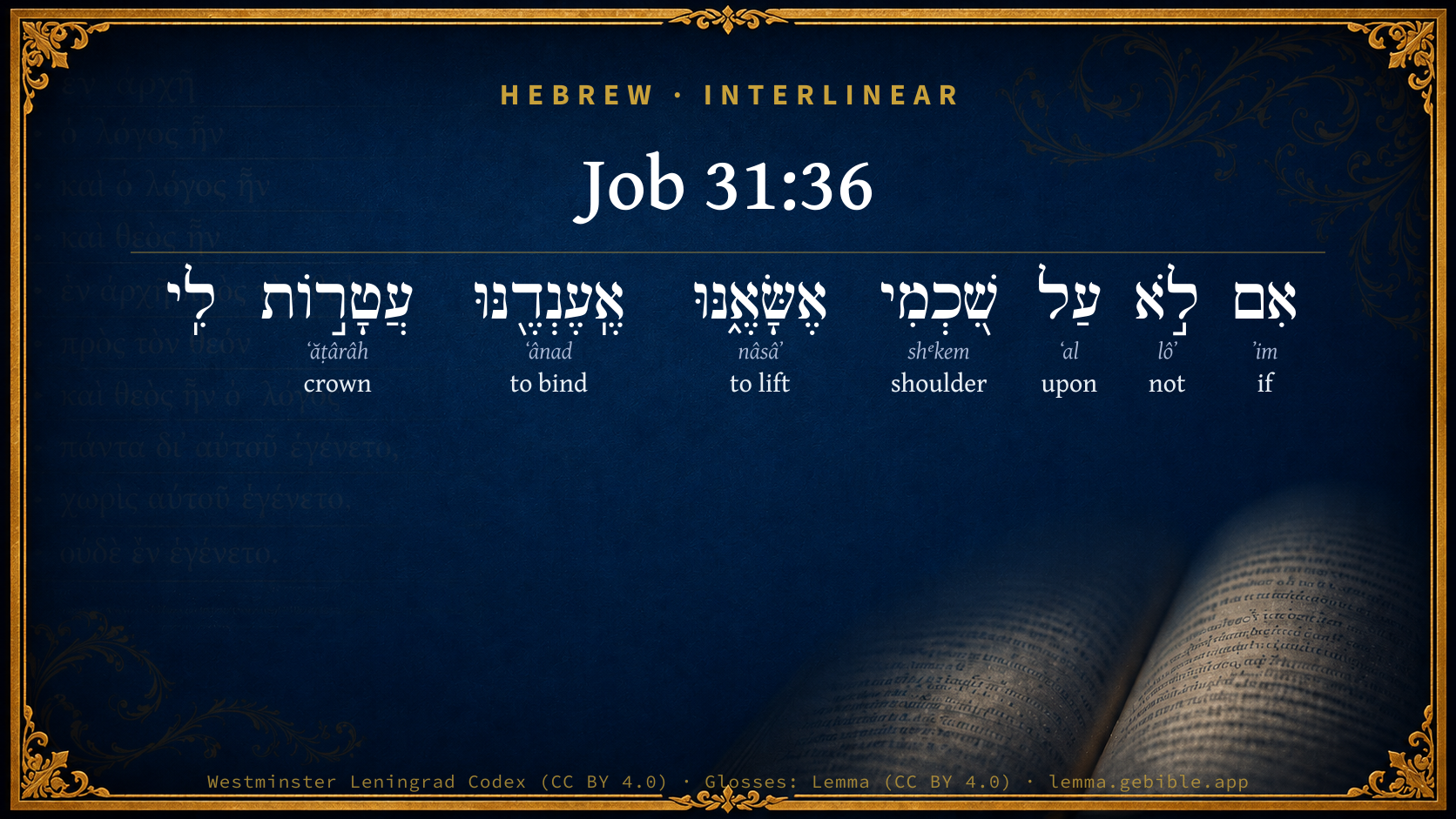
Job 31:36

Hebrew (Westminster Leningrad Codex) Job 31:36 appears in the Hebrew Old Testament. The text above is from the Westminster Leningrad Codex. Each word links to its Strong’s number, a concise gloss, and parsing drawn from the Open Scriptures Hebrew Bible morphology. Click any word for its full Brown-Driver-Briggs (BDB) entry.
Download image
Cite this verse

Job 31:36 (World English Bible). Public Domain. Lemma interlinear Bible study tool, https://lemma.gebible.app/v/job/31/36.

Show BibTeX & RIS
BibTeX
RIS
English Translation
Surely I would carry it on my shoulder; And I would bind it to me as a crown.
World English Bible · Public Domain
Highlights
  • 1 first appearance in the Hebrew Bible
Full analysis ↓
Download a study sheet

One document with this verse’s original text, its word-by-word gloss line, the meaning frame, cross-references with their text, attributed commentary, and full source and license credits — printable, and it pastes into notes with its structure intact.

This verse Autodidact and up

Study sheet (.html) Plain text (.txt)

A passage Seminary Student

Up to 50 verses in one chapter. A passage sheet keeps up to 6 commentary sources and 12 cross-references per verse, in the order this page ranks them, and says so on the sheet whenever that leaves anything out. Ask for a single verse and you get the Autodidact verse sheet above.

Everything on this page stays free to read, with no account — the sheet is a download of what is already on screen, not access to it.

Want to remove ads? Support Godless Engineer
Compare translations 3

The same verse in 3 English versions, stacked beneath the original-language interlinear above. Click any original word for its lexicon entry.

Each is an independent rendering of the whole verse — the interlinear is not word-aligned to these translations.

Highlighted words mark where these versions differ — a whole-verse word diff, not a word-by-word alignment.

  • World English Bible Public Domain
    Surely I would carry it on my shoulder; And I would bind it to me as a crown.
  • King James Version Public Domain
    Surely I would take it upon my shoulder, and bind it as a crown to me.
  • unfoldingWord Literal Text CC BY-SA 4.0
    If I would not bear it on my shoulder? I would bind it to me crowns!

unfoldingWord Literal Text — © unfoldingWord, licensed CC BY-SA 4.0. Word-aligned USFM3 via Door43 (git.door43.org/unfoldingWord/en_ult).

Versions to compare (up to 4)

3 of 4 selected

Show all 18 translations

Every available English version of this verse, each an independent rendering of the whole verse.

  • World English Bible Public Domain
    Surely I would carry it on my shoulder; And I would bind it to me as a crown.
  • Berean Standard Bible Public Domain
    Surely I would carry it on my shoulder and wear it like a crown.
  • Majority Standard Bible Public Domain
    Surely I would carry it on my shoulder and wear it like a crown.
  • King James Version Public Domain
    Surely I would take it upon my shoulder, and bind it as a crown to me.
  • American Standard Version (1901) Public Domain
    Surely I would carry it upon my shoulder; I would bind it unto me as a crown:
  • Revised Version (1885) Public Domain
    Surely I would carry it upon my shoulder; I would bind it unto me as a crown.
  • Geneva Bible (1599) Public Domain
    Woulde not I take it vpon my shoulder, and binde it as a crowne vnto me?
  • Douay-Rheims (1899) Public Domain
    That I may carry it on my shoulder, and put it about me as a crown?
  • Young's Literal Translation Public Domain
    If not -- on my shoulder I take it up, I bind it a crown on myself.
  • Literal Standard Version CC BY-SA 4.0
    If not—on my shoulder I take it up, || I bind it [as] a crown on myself.
  • Unlocked Literal Bible CC BY-SA 4.0
    Surely I would carry it openly on my shoulder; I would put it on like a crown.
  • unfoldingWord Literal Text CC BY-SA 4.0
    If I would not bear it on my shoulder? I would bind it to me crowns!
  • Darby Bible Public Domain
    Would I not take it upon my shoulder? I would bind it on to me [as] a crown;
  • World Messianic Bible Public Domain
    Surely I would carry it on my shoulder, and I would bind it to me as a crown.
  • Webster's Bible Public Domain
    Surely I would take it upon my shoulder, and bind it as a crown to me.
  • Free Bible Version CC BY-SA 4.0
    I would hold them up high; I would wear them on my head like a crown.
  • Bible in Basic English Public Domain
    Truly I would take up the book in my hands; it would be to me as a crown;
  • JPS Tanakh (1917) Public Domain
    Surely I would carry it upon my shoulder; I would bind it unto me as a crown.

Literal Standard Version (2020), Covenant Press — licensed CC BY-SA 4.0. Text via the HelloAO Bible API (eBible.org). Unlocked Literal Bible (unfoldingWord) — licensed CC BY-SA 4.0. Text via the HelloAO Bible API (eBible.org). unfoldingWord Literal Text — © unfoldingWord, licensed CC BY-SA 4.0. Word-aligned USFM3 via Door43 (git.door43.org/unfoldingWord/en_ult). Free Bible Version, Dr. Jonathan Gallagher — licensed CC BY-SA 4.0. Text via the HelloAO Bible API (eBible.org).

Word by word

More ways to search: Search by grammar → Find every occurrence → Compare this word →

Practice this passage: Drill this verse → Learn its vocabulary →

About this verse

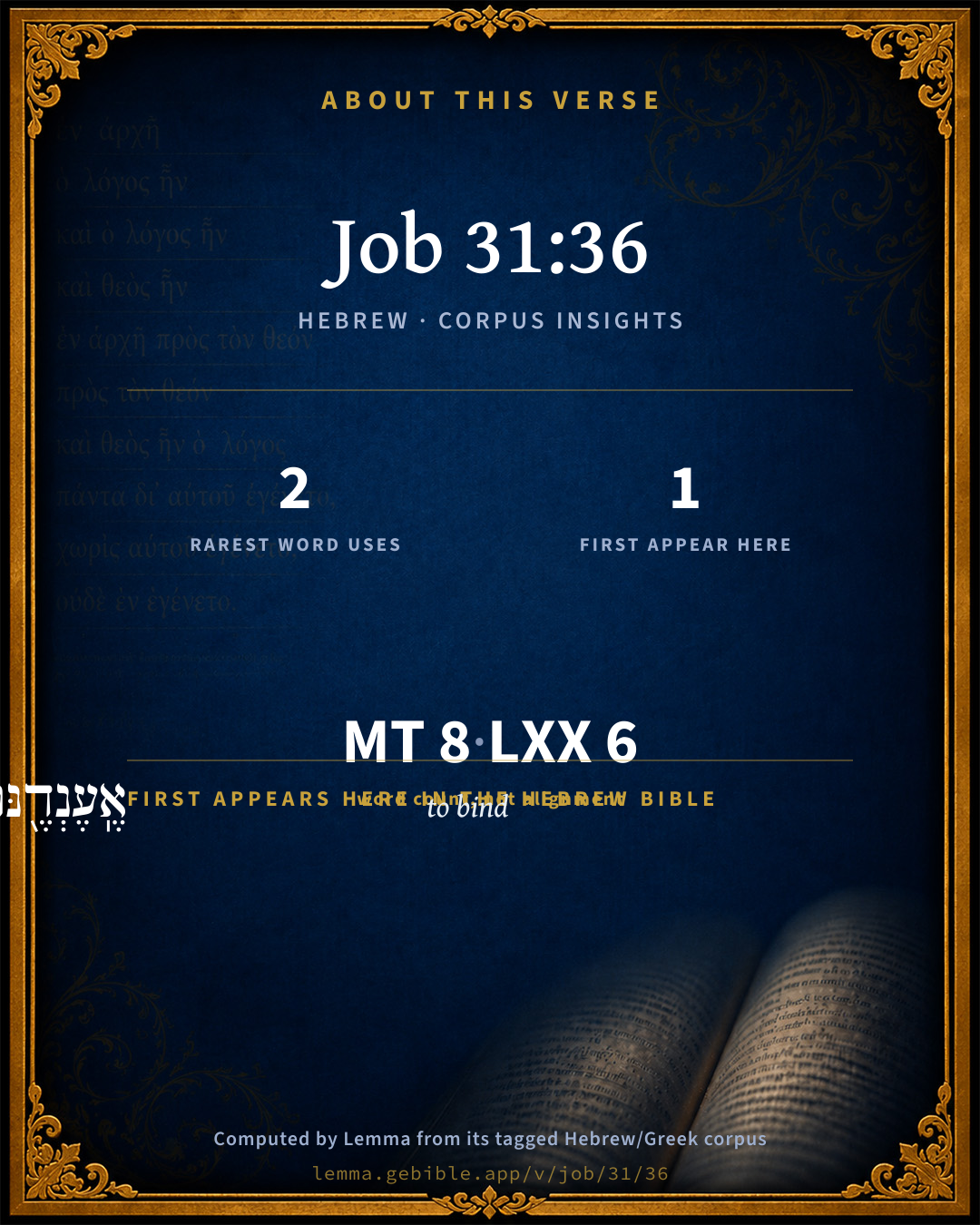
These counts appear in no published source. They are computed here, from the morphology-tagged text and Lemma’s own curated glosses. What Lemma adds →

8
words
7
distinct lemmas
Wisdom
section

Notable vocabulary

The rarest word here is אֶֽעֶנְדֶ֖נּוּ to bind H6029 — appearing just 2 times in the whole Hebrew Bible.

First appearance in Scripture

This word makes its first canonical appearance in the Hebrew Bible here:

  • אֶֽעֶנְדֶ֖נּוּ to bind H6029

Shared distinctive vocabulary

אֶֽעֶנְדֶ֖נּוּ to bind H6029 occurs in 2 verses of the Hebrew Bible. Also found in:

Grammatical profile

  • 2 verbs
  • 2 nouns
  • 2 prepositions
  • 1 conjunction
  • 1 particle

Verb forms

  • אֶשָּׂאֶ֑נּוּ Qal · Imperfect
  • אֶֽעֶנְדֶ֖נּוּ Qal · Imperfect

Hebrew & Septuagint length

In English translation the verse runs 18 words from the Hebrew and 13 from the Septuagint (LXX English) — closely comparable.

A rough comparison of the two English renderings, which tokenize alike — not a word-level alignment.

Word counts can differ between the Hebrew and the Greek without any difference in meaning — e.g. the Hebrew direct-object marker אֵת has no separate Greek word, and Greek often adds the article ὁ.

In the original languages it is 8 Hebrew tokens and 6 Greek tokens — but the two are counted differently (Hebrew bundles its prefixes and suffixes into one token; the Greek is in lemma form), so that isn’t a like-for-like length.

Cross-references

5

Topical passages linked to Job 31:36 in the Treasury of Scripture Knowledge — connected by theme and wording, ordered by reader-vote popularity; previews shown in the World English Bible.

  • Isaiah 22:22 The key of the house of David will I lay on his shoulder; and he shall open, and none shall shut; and he shall shut, and none shall open.
  • Exodus 28:12 You shall put the two stones on the shoulder-pieces of the ephod, to be stones of memorial for the children of Israel: and Aaron shall bear their names before Yahweh on his two shoulders for a memorial.
  • Job 29:14 I put on righteousness, and it clothed me. My justice was as a robe and a diadem.
  • Isaiah 62:3 You shall also be a crown of beauty in the hand of Yahweh, and a royal diadem in the hand of your God.
  • Philippians 4:1 Therefore, my brothers, beloved and longed for, my joy and crown, so stand firm in the Lord, my beloved.

Cross-references courtesy of OpenBible.info (CC BY 4.0).

Hebrew and Greek witnesses Masoretic Hebrew ↔ Greek Septuagint

The same verse in the two great witnesses to the Old Testament, shown verse-for-verse.

These are two independent witnesses, not word-aligned to each other, and the Septuagint is shown in lemma (dictionary) form.

Hebrew Job 31:36 Masoretic · Westminster Leningrad Codex

אִם לֹ֣א עַל שִׁ֭כְמִי אֶשָּׂאֶ֑נּוּ אֶֽעֶנְדֶ֖נּוּ עֲטָר֣וֹת לִֽי

Surely I would carry it on my shoulder; And I would bind it to me as a crown.

World English Bible · Public Domain

Greek LXX Job 31:36 Septuagint · lemma form

ἐπί ὦμος ἄν περιτίθημι στέφανος ἀναγιγνώσκω

I would place it as a chaplet on my shoulders, and read it.

LXX2012 (modern English Septuagint) · Public Domain

Hebrew: Westminster Leningrad Codex (CC BY 4.0). Greek: Septuagint (public domain); English from LXX2012 (modern English Septuagint) (Public Domain). How the Septuagint differs from the Hebrew →

Commentary

Notes on Job 31:36 from classic Christian and Jewish commentators (each source and its license shown beneath its notes). The classic Christian expositions comment on the surrounding passage and are grouped to its opening verse, so a note may address several verses; the Jewish commentaries on the Tanakh (Rashi and others) are per-verse, so they appear only where the commentator wrote on this verse.

Lemma curates 59 commentaries, every one of them public domain or Creative Commons licensed, each selected and text-cleaned for this edition rather than reprinted as found. About our sources →

Trapp's Complete Commentary

John Trapp

Job 31:36 Surely I would take it upon my shoulder, [and] bind it [as] a crown to me.

Ver. 36. Surely I would take it on my shoulder] As a father doth his darling, or as a standard bearer doth his ensign, or as a man carrieth his most desirable things out of a common combustion.

And bind it as a crown to me] Heb. Crowns. I should be very proud of it, as we use to speak, and take it for a great glory, as not doubting with much ease and in a trice to confute it; or at least to slight it. The lash of lewd tongues it is as impossible to avoid as necessary to contemn. The best apology to such is that of Isaac to his brother Ishmael, patience and silence. If any reply be made, it should be like that of the faithful steward to his passionate lord, who called him knave and worse, Your honour may speak as you please, but I believe not a word that you say, for I know myself an honest man. Do well and hear ill is written upon heaven’s gates, said that holy martyr. A bad report is the ordinary reward of very well doing, which made Luther wax proud even of his reproach, as he said himself, Indies magis mihi placeo, superbus fio, quod video nomen pessimum mihi crescere, I please myself herein every day more and more; I grow even proud of this, that I hear every day worse and worse for well doing; surely should such curs wag their tails and not their tongues, I should suspect mine own innocence; as Phocion did, when the Athenians liked his oration. And in another place he saith, Maior est mihi timor in laudibus; gaudium vero in maledictis et blasphemiis, When I am praised I am afraid all is not well; but when I am reproached and railed on it is a joy to me; for this will be accounted to my reckoning at the last day; this will add weight to my crown of glory. Reproaches, as they make graces more splendent, so they will make glory more radiant, as the more dirty feet tread and rub the more lustre they give the figure graven in gold. Hence Austin, whatsoever (saith he) willingly reproacheth me, the same doth, though against his will, add to my reward in heaven. And this I take for a great glory (saith Jerome), all the heretics rail at me.

John Trapp, A Commentary or Exposition upon All the Books of the Old and New Testament (1647–1656) — public domain. Text from a community e-Sword module.

Joseph Benson's Commentary

Job 31:36. Surely I would take it — The book, or writing, containing the charges against me; upon my shoulder — As a trophy, or badge of honour; and bind it as a crown to me — I would be so far from being ashamed or terrified, that I would glory, and rejoice, and triumph in it, nay, and openly expose it to be read by all, well knowing that so groundless and impotent an accusation would only serve the more to clear my innocence.

Joseph Benson's Commentary on the Old and New Testaments (1811–1818) — public domain. Text from a community e-Sword module.

Tyndale Open Study Notes

Tyndale Open Resources

31:36 face the accusation proudly (literally carry it on my shoulder; cp. Exod 28:12; Isa 22:22): He would take full responsibility for his actions.

Tyndale Open Study Notes — © Tyndale Open Resources, licensed CC BY-SA 4.0. Text via the HelloAO Bible API.

Geneva Bible (1599)

Geneva Bible translators

Should not this book of his accusations be a praise and commendation to me?

Geneva Bible (1599) marginal notes — public domain. Text via Bolls.life.

Jamieson, Fausset & Brown

Robert Jamieson, A. R. Fausset & David Brown

So far from hiding the adversary's "answer" or "charge" through fear,

I would take it on my shoulders--as a public honor (Isa 9:6).

a crown--not a mark of shame, but of distinction (Isa 62:3).

Jamieson, Fausset & Brown — Commentary Critical and Explanatory on the Whole Bible (1871) — public domain (CC PDM 1.0). Text via the HelloAO Bible API.

Adam Clarke's Commentary

Verse 36. Surely I would take it upon my shoulder] I would be contented to stand before the bar as a criminal, bearing upon my shoulder the board to which the accusation is affixed. In a book of Chinese punishments now before me, containing drawings representing various criminals brought to trial, in trial, and after trial, charged with different offences; in almost all of them a board appears, on which the accusation or crime of which they are accused, or for which they suffer, is fairly written. Where the punishment is capital, this board appears fastened to the instrument, or stuck near the place of punishment. In one case a large, heavy plank, through which there is a hole to pass the head, - or rather a hole fitting the neck, like that in the pillory, - with the crime written upon it, rests on the criminal's shoulders; and this he is obliged to carry about for the weeks or months during which the punishment lasts. It is probable that Job alludes to something of this kind, which he intimates he would bear about with him during the interim between accusation and the issue in judgment; and, far from considering this a disgrace, would clasp it as dearly as he would adjust a crown or diadem to his head; being fully assured, from his innocence, and the evidence of it, which would infallibly appear on the trial, that he would have the most honourable acquittal. There may also be an allusion to the manner of receiving a favour from a superior: it is immediately placed on the head, as a mark of respect; and if a piece of cloth be given at the temple, the receiver not only puts it on his head, but binds it there.

Adam Clarke's Commentary on the Bible (1810–1826) — public domain. Text from a community e-Sword/MySword module.

The Cambridge Bible for Schools and Colleges

gen. ed. J. J. S. Perowne

36. upon my shoulder] If Job but possessed the Almighty’s indictment against him he would not hide it as a thing that caused him shame, he would bear it in triumph before the world as that which was his greatest honour. He would even wear it as a diadem upon his brows, as that which would give him kingly dignity and adornment. The language expresses the strongest assurance of innocence and that the indictment could in truth contain nothing against him.

The Cambridge Bible for Schools and Colleges (gen. ed. J. J. S. Perowne; Cambridge University Press, 1878–1918) — public domain. Text from a community e-Sword module.

John Gill's Exposition

If my land cry against me,.... Some think that this verse and Job 31:39 stand out of their place, and should rather follow after Job 31:34; and some place them after Job 31:25; and others after Job 31:8; but this is the order of them in all copies and versions, as they stand in our Bibles; and here, after Job had expressed his desire to have a hearer and judge of his cause, and his charge exhibited in writing, and his confidence of the issue of it, should it be granted, returns to his former subject, to clear himself from any notorious vice he was suspected of or charged with; and as he had gone through what might respect him in private life, here he gives another instance in public life, with which he concludes; namely, purging himself from tyranny and oppression, with which his friends had charged him without any proof; and he denies that the land he lived on was possessed of, and of which he was the proprietor, cried against him as being unjustly gotten, either by fraud or by force, from others; or as being ill used by him either as being too much cultivated, having never any rest, or lying fallow; and so much weakened and drained of its strength, or neglected and overrun with weeds, thorns, and thistles; or on account of the dressers and tillers of it being badly dealt with, either overworked, or not having sufficiency of food, or their wages, detained from them; all which are crying sins, and by reason of which the land by a figure may be said to cry out as the stone out of the wall, and the beam out of the timber, because of the sins of spoil, violence, oppression, and covetousness, Hab 2:11;

or that the furrows likewise thereof complain; or "weep" (a), on account of the like ill usage. Jarchi, and so the Midrash, interpret this of not allowing the forgotten sheaf and corner of the field to the poor, and detaining the tithes; and of ploughing and making furrows with an ox and an ass together; but the laws respecting these things were not yet in being; and if they had been, were only binding on Israelites, and not on Job, and the men of his country.

(a) "defleant", Pagninus, Montanus; "flent", Beza, Piscator, Cocceius, &c.

John Gill's Exposition of the Whole Bible (1746–1763) — public domain (CC PDM 1.0). Text via the HelloAO Bible API.

Albert Barnes' Notes on the Bible

Surely, I would take it upon my shoulder - That is, the book or bill which the Almighty would write in the case. Job says that he has such confidence that what God would record in his case would be in his favor, such confidence that he had no charge of hypocrisy against him, and that he who knew him altogether would not bring such an accusation against him, that he would bear it off triumphantly on his shoulders. It would be all that he could desire. This does not refer to what a judge would decide if the cause were submitted to him, but to a case where an opponent or adversary in court should bring all that he could say against him. He says that he would bear even such a bill on his shoulders in triumph, and that it would be a full vindication of his innocence. It would afford him the best vindication of his character, and would be that which he had long desired.

And bind it as a crown to me - I would regard it as an ornament - a diadem. I would bind it on my head as a crown is worn by princes, and would march forth exultingly with it. Instead of covering me with shame, it would be the source of rejoicing, and I would exhibit it every where in the most triumphant manner. It is impossible for anyone to express a more entire consciousness of innocence from charges alleged against him than Job does by this language.

Albert Barnes' Notes on the Bible (1834–1885) — public domain. Text from a community e-Sword/MySword module.

Haydock's Catholic Bible Commentary

Crown. This shews that something pliable was then used to write on. The people of the East still lift up to their heads such letters as they respect. (Chardin Perse, p. 218.) See 4 Kings xi. 12. (Calmet)

George Leo Haydock (1774–1849), Haydock's Catholic Family Bible and Commentary, 1859 edition — public domain. Excludes Psalms (Douay-Rheims chapter numbering differs from Protestant) and Deuterocanonical books (Catholic canon only).

Matthew Poole's English Annotations

I would take it, i.e. that book containing my charge or accusation.

Upon my shoulder; as a trophy or badge of honour. I should not fear nor smother it, but glory in it, and make open show of it, as that which gave me the happy and long-desired occasion of vindicating myself, which I doubt not fully to do.

Matthew Poole's English Annotations on the Holy Bible (1683–1685) — public domain. Text from a community e-Sword/MySword module.

Whedon's Commentary on the Bible

Daniel D. Whedon

36. Surely — If not. God do so and more to me if I would not display it as a visible badge of honour; for Job was sure that his life contained nothing grossly criminal. Wilkinson tells us that the ancient Egyptian is sometimes represented after death as wearing round his neck the same vase which in the scales typified his good actions, or bearing on his head the ostrich feather of truth. They were both intended to show that he had been deemed worthy of admission to the mansions of the just. — The Ancient Egyptians, P.A., 2:383. Crown — Literally, crowns. The word differs from that of Job_29:14. The plural, עשׂרות, is either the plural of excellence, or is used descriptively of diadems arising each but of the other. Rev_19:12.

Daniel D. Whedon (gen. ed.), Commentary on the Old and New Testaments (1874–1909) — public domain. Text from a community e-Sword module.

The Pulpit Commentary

Surely I would take it upon my shoulder the place of honour (see Isa_9:6 Isa_22:22) and bind it as a crown to me; i.e. adorn my head with it, as with a diadem.

The Pulpit Commentary (1880–1919), ed. H.D.M. Spence-Jones & Joseph S. Exell — public domain. Text from a community e-Sword module.

John Wesley's Explanatory Notes

Take it - As a trophy or badge of honour.

John Wesley, Explanatory Notes Upon the Whole Bible (1754–1765) — public domain. Text via the GEBible commentary corpus.

Rashi

Rabbi Shlomo Yitzchaki (Rashi)

Would I not carry him The writer of the book.

bind it I will bind the book to me as crowns.

Rashi on the Tanakh — English translations: “The Judaica Press complete Tanach with Rashi, translated by A. J. Rosenberg” (CC BY 4.0); “Pentateuch with Rashi's commentary by M. Rosenbaum and A.M. Silbermann, 1929-1934” (public domain); “The Metsudah Tanach series, Lakewood, N.J” (CC BY 4.0); and “The Book of Joshua, Metsudah Publications, 1997” (CC BY 4.0). Text via Sefaria.

Lesson kit

Teaching starters — assembled from the data on this page, not authored interpretation. Every prompt links to the verse data it draws on. Edit before teaching.

Job, in the Wisdom, opens this verse with 8 words (7 distinct Hebrew lemmas). Its most distinctive word is ʻânad (“to bind”). A historical commentator’s framing appears above. Read the whole chapter for the surrounding context.

Discussion questions

  1. How does “to bind” (ʻânad) shape what this verse is saying?
  2. The word “to bind” first appears here in Scripture. What is being introduced at this debut?
  3. Proverbs 6:21 shares the word «to bind» with this verse. How do the two illuminate each other?
  4. These translations render this verse differently; the difference is in the English rendering, not the original. What questions does that raise?
  5. The verb «אֶשָּׂאֶ֑נּוּ» is Qal Imperfect. How does its form color the action?
  6. Reading how Trapp's Complete Commentary and Joseph Benson's Commentary read this verse, where do the two commentators agree and where do they part?

Things to notice

Reading settings

Reading text

Shown beneath each verse's original-language words.

Old Testament
Old Testament edition

Read the OT as the Masoretic Hebrew (MT) or the Greek Septuagint (LXX).

English shown for the Greek Septuagint (in the Hebrew ↔ Greek comparison).

Comparing translations? Open the Compare panel on any verse page to stack up to four side by side.