
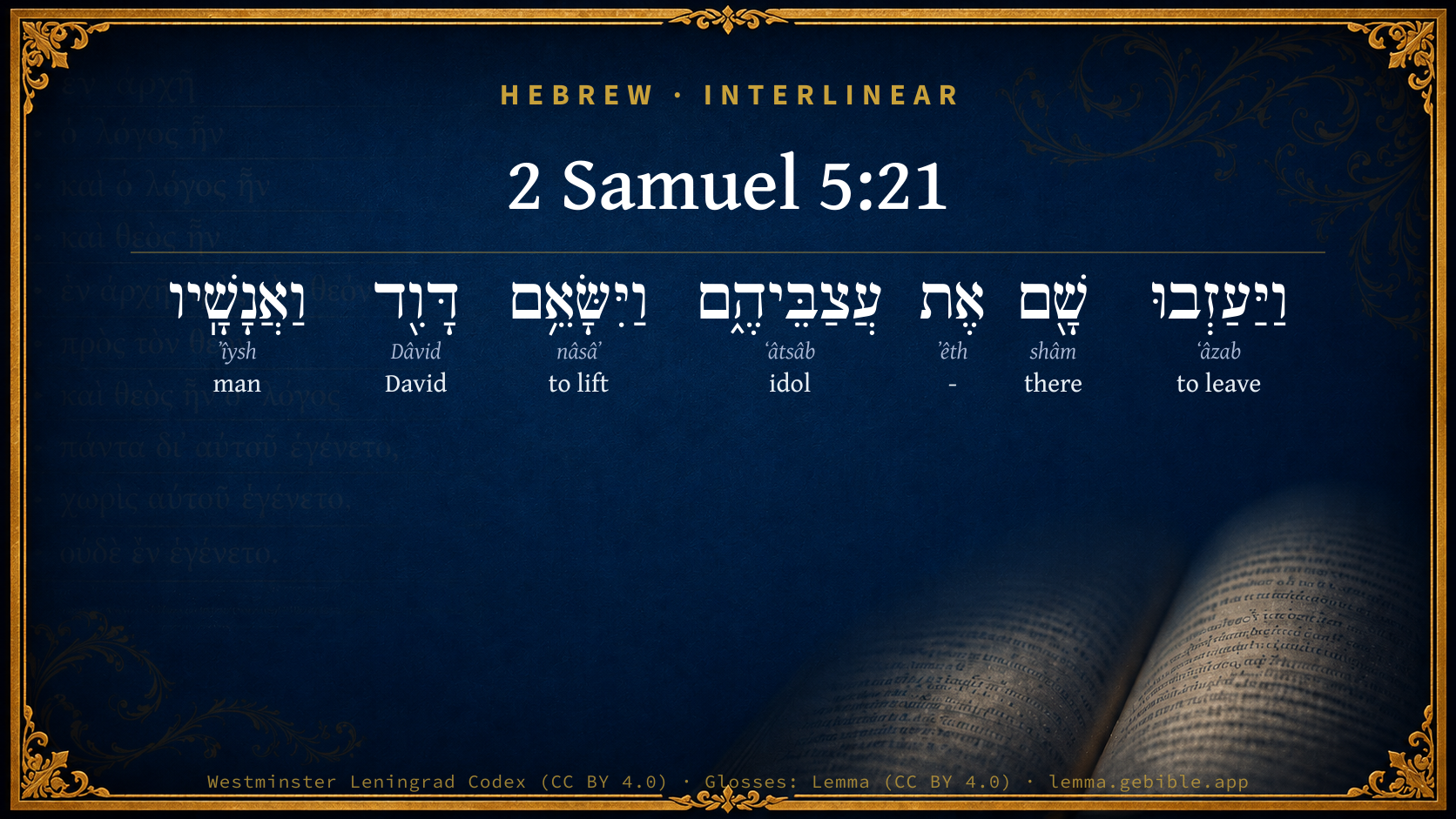
2 Samuel 5:21

Hebrew (Westminster Leningrad Codex) 2 Samuel 5:21 appears in the Hebrew Old Testament. The text above is from the Westminster Leningrad Codex. Each word links to its Strong’s number, a concise gloss, and parsing drawn from the Open Scriptures Hebrew Bible morphology. Click any word for its full Brown-Driver-Briggs (BDB) entry.
Download image
Cite this verse

2 Samuel 5:21 (World English Bible). Public Domain. Lemma interlinear Bible study tool, https://lemma.gebible.app/v/2-samuel/5/21.

Show BibTeX & RIS
BibTeX
RIS
English Translation
They left their images there; and David and his men took them away.
World English Bible · Public Domain
Download a study sheet

One document with this verse’s original text, its word-by-word gloss line, the meaning frame, cross-references with their text, attributed commentary, and full source and license credits — printable, and it pastes into notes with its structure intact.

This verse Autodidact and up

Study sheet (.html) Plain text (.txt)

A passage Seminary Student

Up to 50 verses in one chapter. A passage sheet keeps up to 6 commentary sources and 12 cross-references per verse, in the order this page ranks them, and says so on the sheet whenever that leaves anything out. Ask for a single verse and you get the Autodidact verse sheet above.

Everything on this page stays free to read, with no account — the sheet is a download of what is already on screen, not access to it.

Want to remove ads? Support Godless Engineer
Compare translations 3

The same verse in 3 English versions, stacked beneath the original-language interlinear above. Click any original word for its lexicon entry.

Each is an independent rendering of the whole verse — the interlinear is not word-aligned to these translations.

Highlighted words mark where these versions differ — a whole-verse word diff, not a word-by-word alignment.

  • World English Bible Public Domain
    They left their images there; and David and his men took them away.
  • King James Version Public Domain
    And there they left their images, and David and his men burned them.
  • unfoldingWord Literal Text CC BY-SA 4.0
    And they abandoned their idols there, and David and his men took them away.

unfoldingWord Literal Text — © unfoldingWord, licensed CC BY-SA 4.0. Word-aligned USFM3 via Door43 (git.door43.org/unfoldingWord/en_ult).

Versions to compare (up to 4)

3 of 4 selected

Show all 18 translations

Every available English version of this verse, each an independent rendering of the whole verse.

  • World English Bible Public Domain
    They left their images there; and David and his men took them away.
  • Berean Standard Bible Public Domain
    There the Philistines abandoned their idols, and David and his men carried them away.
  • Majority Standard Bible Public Domain
    There the Philistines abandoned their idols, and David and his men carried them away.
  • King James Version Public Domain
    And there they left their images, and David and his men burned them.
  • American Standard Version (1901) Public Domain
    And they left their images there; and David and his men took them away.
  • Revised Version (1885) Public Domain
    And they left their images there, and David and his men took them away.
  • Geneva Bible (1599) Public Domain
    And there they left their images, and Dauid and his men burnt them.
  • Douay-Rheims (1899) Public Domain
    And David came to Baal Pharisim: and defeated them there, and he said: The Lord hath divided my enemies before me, as waters are divided. Therefore the name of the place was called Baal Pharisim.
  • Young's Literal Translation Public Domain
    And they forsake there their idols, and David and his men lift them up.
  • Literal Standard Version CC BY-SA 4.0
    And they forsake their idols there, and David and his men lift them up.
  • Unlocked Literal Bible CC BY-SA 4.0
    The Philistines left their idols there, and David and his men carried them away.
  • unfoldingWord Literal Text CC BY-SA 4.0
    And they abandoned their idols there, and David and his men took them away.
  • Darby Bible Public Domain
    And they left their images there, and David and his men took them away.
  • World Messianic Bible Public Domain
    They left their images there, and David and his men took them away.
  • Webster's Bible Public Domain
    And there they left their images, and David and his men burned them.
  • Free Bible Version CC BY-SA 4.0
    The Philistines left their idols behind, and David and his men removed them.
  • Bible in Basic English Public Domain
    And the Philistines, when they went in flight, did not take their images with them, and David and his men took them away.
  • JPS Tanakh (1917) Public Domain
    And they left their images there, and David and his men took them away.

Literal Standard Version (2020), Covenant Press — licensed CC BY-SA 4.0. Text via the HelloAO Bible API (eBible.org). Unlocked Literal Bible (unfoldingWord) — licensed CC BY-SA 4.0. Text via the HelloAO Bible API (eBible.org). unfoldingWord Literal Text — © unfoldingWord, licensed CC BY-SA 4.0. Word-aligned USFM3 via Door43 (git.door43.org/unfoldingWord/en_ult). Free Bible Version, Dr. Jonathan Gallagher — licensed CC BY-SA 4.0. Text via the HelloAO Bible API (eBible.org).

Word by word

More ways to search: Search by grammar → Find every occurrence → Compare this word →

Practice this passage: Drill this verse → Learn its vocabulary →

About this verse

These counts appear in no published source. They are computed here, from the morphology-tagged text and Lemma’s own curated glosses. What Lemma adds →

7
words
7
distinct lemmas
Historical
section

Notable vocabulary

The rarest word here is עֲצַבֵּיהֶ֑ם idol H6091 — appearing just 17 times in the whole Hebrew Bible.

Shared distinctive vocabulary

עֲצַבֵּיהֶ֑ם idol H6091 occurs in 17 verses of the Hebrew Bible. Also found in:

Grammatical profile

  • 2 verbs
  • 3 nouns
  • 1 adverb
  • 1 particle

Verb forms

  • וַיַּעַזְבוּ Qal · Sequential Imperfect
  • וַיִּשָּׂאֵ֥ם Qal · Sequential Imperfect

Hebrew & Septuagint length

In English translation the verse runs 13 words from the Hebrew and 15 from the Septuagint (LXX English) — closely comparable.

A rough comparison of the two English renderings, which tokenize alike — not a word-level alignment.

Word counts can differ between the Hebrew and the Greek without any difference in meaning — e.g. the Hebrew direct-object marker אֵת has no separate Greek word, and Greek often adds the article ὁ.

Cross-references

7

Topical passages linked to 2 Samuel 5:21 in the Treasury of Scripture Knowledge — connected by theme and wording, ordered by reader-vote popularity; previews shown in the World English Bible.

  • 1 Chronicles 14:11–12 So they came up to Baal Perazim, and David struck them there; and David said, God has broken my enemies by my hand, like the breach of waters. Therefore they called the name of that place Baal Perazim.
  • Deuteronomy 7:5 But thus shall you deal with them: you shall break down their altars, and dash in pieces their pillars, and hew down their Asherim, and burn their engraved images with fire.
  • Deuteronomy 7:25 The engraved images of their gods shall you burn with fire: you shall not covet the silver or the gold that is on them, nor take it to you, lest you be snared therein; for it is an abomination to Yahweh your God.
  • 1 Samuel 5:2–6 The Philistines took the ark of God, and brought it into the house of Dagon, and set it by Dagon.
  • Isaiah 37:19 and have cast their gods into the fire: for they were no gods, but the work of men's hands, wood and stone; therefore they have destroyed them.
  • Isaiah 46:1–2 Bel bows down, Nebo stoops; their idols are on the animals, and on the cattle: the things that you carried about are made a load, a burden to the weary [animal].
  • Jeremiah 43:12 I will kindle a fire in the houses of the gods of Egypt; and he shall burn them, and carry them away captive: and he shall array himself with the land of Egypt, as a shepherd puts on his garment; and he shall go forth from there in peace.

Cross-references courtesy of OpenBible.info (CC BY 4.0).

Hebrew and Greek witnesses Masoretic Hebrew ↔ Greek Septuagint

The same verse in the two great witnesses to the Old Testament, shown verse-for-verse.

These are two independent witnesses, not word-aligned to each other, and the Septuagint is shown in lemma (dictionary) form.

Hebrew 2 Samuel 5:21 Masoretic · Westminster Leningrad Codex

וַיַּעַזְבוּ שָׁ֖ם אֶת עֲצַבֵּיהֶ֑ם וַיִּשָּׂאֵ֥ם דָּוִ֖ד וַאֲנָשָֽׁיו

They left their images there; and David and his men took them away.

World English Bible · Public Domain

Greek LXX 2 Samuel 5:21 Septuagint · lemma form

καί καταλιμπάνω ἐκεῖ ὁ θεός αὐτός καί λαμβάνω αὐτός δαυίδ καί ὁ ἀνήρ ὁ μετά αὐτός

And they leave there their gods, and David and his men with him took them.

LXX2012 (modern English Septuagint) · Public Domain

Hebrew: Westminster Leningrad Codex (CC BY 4.0). Greek: Septuagint (public domain); English from LXX2012 (modern English Septuagint) (Public Domain). How the Septuagint differs from the Hebrew →

Targum (Aramaic paraphrase)

1

The Targum is the ancient Jewish Aramaic paraphrase of the Hebrew Scriptures — an interpretive translation, not the Hebrew text itself. Onkelos (literal) and Pseudo-Jonathan (expansive) render the Torah, and Jonathan the Prophets. Coverage is partial: where no permissively-licensed English translation exists for a verse, only the Aramaic is shown. This is verse-level text, not a word-by-word alignment to the Hebrew.

  1. Targum Jonathan Prophets (Joshua–Malachi)
    וּשְׁבַקוּ תַּמָן יַת טַעֲוַתְהוֹן וְאוֹקֵידִינוּן דָוִד וְגַבְרוֹהִי:

    (no public-domain English translation for this verse)

    Targum Jonathan — Aramaic: “Mikraot Gedolot” (public domain). English: “Sefaria Community Translation” (CC0 1.0 (public-domain dedication)); “London "Chaldee Paraphrase," 1871” (public domain). Text via Sefaria.

Commentary

Notes on 2 Samuel 5:21 from classic Christian and Jewish commentators (each source and its license shown beneath its notes). The classic Christian expositions comment on the surrounding passage and are grouped to its opening verse, so a note may address several verses; the Jewish commentaries on the Tanakh (Rashi and others) are per-verse, so they appear only where the commentator wrote on this verse.

Lemma curates 59 commentaries, every one of them public domain or Creative Commons licensed, each selected and text-cleaned for this edition rather than reprinted as found. About our sources →

Trapp's Complete Commentary

John Trapp

2Sa 5:21 And there they left their images, and David and his men burned them.

Ver. 21. And there they left their images] Heb., Their terrors. {a} The Chaldee hath it, Their errors. See Psa 16:4. {See Trapp on "Psa 16:4"} These idols they had brought into the field with them, in hope of help by them; and perhaps in imitation of the Hebrews, who sometimes took the ark with them. It hath been before set forth how it befell the Popish Norfolk rebels in King Edward VI’s days, with their cart load of trinkets and relics brought into the battle, and there laid in the dust. {b}

{a} Terricula sua.

{b} Act. and Mon., fol. 1190.

John Trapp, A Commentary or Exposition upon All the Books of the Old and New Testament (1647–1656) — public domain. Text from a community e-Sword module.

Joseph Benson's Commentary

2Sa 5:21. And there they left their images — Their gods, which they had brought into the field with them to be carried before their host. Such was the consternation into which they were thrown. Thus we read, 2Ch 25:14, that the Edomites had their gods along with them when they fought with Amaziah. And perhaps they learned this from the Israelites, who carried the ark (the symbol of God’s presence) in their army when they went to fight with the Philistines; who saw it, and took it, as the Israelites now did their images, 1Sa 4:4-5, &c. But behold here the difference between the ark and these images! When the ark fell into the hands of the Philistines it consumed them; but when these images fell into the hands of the Israelites, they could neither hurt them, nor save themselves from being consumed.

Joseph Benson's Commentary on the Old and New Testaments (1811–1818) — public domain. Text from a community e-Sword module.

The Pulpit Commentary

They left their images. This is a further proof of the suddenness of the attack, and the completeness of the Philistine discomfiture. For images we find "gods" in the parallel place in 1Ch_14:12, and the word used here is rendered "idols" in 1Sa_31:9. As the Philistines supposed that these images of their deities would ensure their victory, they would set great store by them, as the Israelites did by the ark, (1Sa_4:4) and the French by the oriflamme. Their capture, therefore, was a feat as great as the winning of the eagle of a Roman legion. David and his men burned them; Hebrew, took them away. This translation of the Authorized Version, made to force the words into verbal agreement with 1Ch_14:12, is utterly indefensible; and, like most wrong things, it is absurd. The Bible cannot be improved by frauds, and really the two narratives complete one another. David and his men carried off these images as trophies, just as the Philistines carried off the ark. (1Sa_4:11) But the ark proved mightier than the Philistine gods, and in terror the people restored it to Israel. But no avenging hand interfered to rescue these gods, and, after being paraded in triumph, they were made into a bonfire.

Ver. 21 (BAAL-PERAZIM.) (1Ch_14:12)

The destruction of images.

The religion of the Canaanite people was "an apotheosis of the forces and laws of nature; an adoration of the objects in which those forces were seen and where they appeared most active" (Movers). The Philistines carried (probably on sacred carts) their images or gods (commonly regarded as identical) into battle, expecting victory by their aid; but so sudden was their defeat, and so hasty their flight, that they were compelled to leave them behind, and "David and his men took them away;" and "David gave a commandment, and they were burned with fire." "When the ark fell into the Philistines" hands it consumed them; but when these images fell into the hands of Israel they could not save themselves from being consumed" (Patrick). In their destruction we see:

1. A proof of the vanity of idols. These images (atsabim, equivalent to "things fashioned with labour") were only "the work of men"s hands", (Psa_115:4-8) and "profitable for nothing", (Isa_40:19 Isa_41:7 Isa_44:9-20 Isa_46:6, Isa_46:7) disappointing completely the confidence reposed in them. Who could henceforth regard them or others with fear or respect?

2. A testimony to the power of Jehovah, the living and true God, the Holy One of Israel. It was against him that the Philistines fought in attacking his people; and by him they and their idols were overthrown, as aforetime. (1Sa_5:3 1Sa_7:7 1Sa_17:38-54) Yet how persistent was their opposition (ver. 22)!

1. An expression of abhorrence of idolatry, and zeal for the worship of God alone; the personal fidelity of David to the fundamental principle of the theocracy. (Psa_16:4) During his reign idolatry found no place in Israel.

2. A fulfilment of the injunctions of the Law. "Thou shalt utterly overthrow them, and quite break down their images", (Exo_23:24) "and burn their graven images with fire". (Deu_7:5) Idolatry was a direct crime against the state, high treason against the Divine King of Israel, and might not be tolerated in any form.

3. A precaution against exposure to temptation, by the influence of their presence, forms, names, associations, on hearts always too prone to go astray. "Thou shalt not desire the silver or gold that is on them, nor take it unto thee, lest thou be snared therein," etc.. (Deu_7:25, Deu_7:26)

No sacrifice was too great to avoid such a snare. (Act_19:19) "Here, perhaps, the admirer of ancient sculpture will be ready to drop a tear of regret over the fine statues and other monuments of antiquity theft must have been destroyed in consequence of the Mosaic mandate; but he may safely dry it up, for the chef d"oeuvres of this period were not worth sparing" (Michaelis). Even if they had been the finest specimens of art, their preservation from the flames would have been an ill compensation for the moral evil which it would have induced.

4. A representation of the design of the true religion. "To destroy the works of the devil", (1Jn_3:8) and to maintain and extend the knowledge, love, and service of God; not, indeed, by force, but by the truth. (2Co_10:4; see 1Sa_5:3)

5. A prophecy and an earnest of the complete demolition of idols (Isa_2:18-20) and the earth being "filled with the glory of the Lord". (Num_14:21) "Thou hast kept me to be head of the heathen," etc. (2Sa_22:44, 2Sa_22:50)

All nations whom thou hast made, Shall come and bow themselves down before thee, O Lord; And shall give glory to thy Name. (Psa_86:9 Psa_22:27 Psa_97:7 Psa_96:3, Psa_96:5, Psa_96:10)

Conclusion. Those who are zealous in destroying the idols of others should not spare their own. What is an idol? That object (whatever it may be) which a man sets up before his face or in his heart, and which he thinks about, delights in, and relies upon, more than God. "Flee from idolatry!" (1Co_10:14; Col_3:5; Php_3:19; 1Jn_5:21) D.

The Pulpit Commentary (1880–1919), ed. H.D.M. Spence-Jones & Joseph S. Exell — public domain. Text from a community e-Sword module.

Tyndale Open Study Notes

Tyndale Open Resources

5:21 David . . . confiscated them: David’s confiscation of the Philistines’ idols was payback for their capture of the Ark during Eli’s time (1 Sam 4:1b-11). David burned the idols rather than carrying them off as trophies (1 Chr 14:12).

Tyndale Open Study Notes — © Tyndale Open Resources, licensed CC BY-SA 4.0. Text via the HelloAO Bible API.

Jamieson, Fausset & Brown

Robert Jamieson, A. R. Fausset & David Brown

there they left their images--probably their "lares" or household deities, which they had brought into the field to fight for them. They were burnt as ordained by law (Deu 7:5).

Jamieson, Fausset & Brown — Commentary Critical and Explanatory on the Whole Bible (1871) — public domain (CC PDM 1.0). Text via the HelloAO Bible API.

Adam Clarke's Commentary

Verse 21. They left their images] It was the custom of most nations to carry their gods with them to battle: in imitation of this custom the Israelites once took the ark and lost it in the field; see 1Sa 4:10-11.

Adam Clarke's Commentary on the Bible (1810–1826) — public domain. Text from a community e-Sword/MySword module.

Ellicott's Commentary for English Readers

(21) Their images.—The Philistines took their idols with them to battle, as the Israelites had formerly taken the ark, and the suddenness and completeness of their defeat is shown by their leaving them on the field. The statement that David “burned” them is taken from 1Ch_14:12, the Hebrew here being simply “took them away.” (See Deu_7:5.)

A Bible Commentary for English Readers, edited by Charles John Ellicott (1878–1897) — public domain. Text from a community e-Sword module.

The Cambridge Bible for Schools and Colleges

gen. ed. J. J. S. Perowne

21. their images] Cp. 1Sa_31:9 (E. V. idols). They brought them into the field to ensure victory, as the Edomites appear to have done (2Ch_25:14), and as the Israelites brought out the Ark (1Sa_4:3).

burnt them] Render, took them away, as spoil, perhaps to display in his triumphal procession. According to 1Ch_14:12 he afterwards burnt them, in compliance with the law of Deu_7:5; Deu_7:25. The E. V. here “burned them” is a gloss, adopted from the Targum and the passage in 1 Chr. Thus the old disgrace of the capture of the Ark by the Philistines was avenged.

The Cambridge Bible for Schools and Colleges (gen. ed. J. J. S. Perowne; Cambridge University Press, 1878–1918) — public domain. Text from a community e-Sword module.

John Gill's Exposition

And when David inquired of the Lord,.... For though he had success before, and got the victory, he would not engage again with them without having the mind and will of God, on whom he knew victory alone depended:

he said, thou shalt not go up; that is, directly, and in a straight line:

but fetch a compass behind them; and get to the rear of them, instead of falling upon them in the front:

and come upon them over against the mulberry trees: which grew in the valley of Rephaim, and near where the Philistines had pitched.

John Gill's Exposition of the Whole Bible (1746–1763) — public domain (CC PDM 1.0). Text via the HelloAO Bible API.

Albert Barnes' Notes on the Bible

And there they left their images - An indication of the precipitancy of their flight, and the suddenness with which the Israelites burst upon them like a “breach of waters.” The King James Version rendering “Burned them,” does not give a translation (compare the margin), but a gloss, warranted by the explanation given in marginal references

Albert Barnes' Notes on the Bible (1834–1885) — public domain. Text from a community e-Sword/MySword module.

Haydock's Catholic Bible Commentary

Away, and burnt. (Par.[1 Paralipomenon xiv. 12.?) The ark had on the contrary proved fatal to the gods, and to the people of the Philistines; who might hence perceive the difference there was between the true God and their false gods.

George Leo Haydock (1774–1849), Haydock's Catholic Family Bible and Commentary, 1859 edition — public domain. Excludes Psalms (Douay-Rheims chapter numbering differs from Protestant) and Deuterocanonical books (Catholic canon only).

Matthew Poole's English Annotations

Their images they seem to have brought into the field to fight for them, as the Israelites had formerly done the ark.

David burned them, as God had commanded, Deu 7:5.

Matthew Poole's English Annotations on the Holy Bible (1683–1685) — public domain. Text from a community e-Sword/MySword module.

Whedon's Commentary on the Bible

Daniel D. Whedon

21. Their images — Their idol-gods, (1Ch_14:13,) which they carried with them into battle, as Israel once did the ark, (1Sa_4:3,) expecting they would therefore be led to certain victory. The capture of them by the Israelites was a striking counterpart to the capture of the ark by the Philistines.

Burned them — As the law required. Deu_7:5; Deu_7:25. The Hebrew text reads, took them away. “Burned” has been supplied from Chronicles.

Daniel D. Whedon (gen. ed.), Commentary on the Old and New Testaments (1874–1909) — public domain. Text from a community e-Sword module.

John Wesley's Explanatory Notes

Images - When the ark fell into the hand of the Philistines, it consumed them: but when these images fell into the hands of Israel, they could not save themselves from being consumed.

John Wesley, Explanatory Notes Upon the Whole Bible (1754–1765) — public domain. Text via the GEBible commentary corpus.

Rashi

Rabbi Shlomo Yitzchaki (Rashi)

And Dovid burnt them. Dovid and his men burnt them.

Rashi on the Tanakh — English translations: “The Judaica Press complete Tanach with Rashi, translated by A. J. Rosenberg” (CC BY 4.0); “Pentateuch with Rashi's commentary by M. Rosenbaum and A.M. Silbermann, 1929-1934” (public domain); “The Metsudah Tanach series, Lakewood, N.J” (CC BY 4.0); and “The Book of Joshua, Metsudah Publications, 1997” (CC BY 4.0). Text via Sefaria.

Lesson kit

Teaching starters — assembled from the data on this page, not authored interpretation. Every prompt links to the verse data it draws on. Edit before teaching.

2 Samuel, in the Historical, opens this verse with 7 words (7 distinct Hebrew lemmas). Its most distinctive word is ʻâtsâb (“idol”). A historical commentator’s framing appears above. Read the whole chapter for the surrounding context.

Discussion questions

  1. The word ʻâtsâb carries the sense “idol.” How does it shape the verse?
  2. How does 1 Samuel 31:9, which shares the word «idol», read alongside this verse?
  3. These translations render this verse differently. What is at stake in choosing one wording over another?
  4. «וַיַּעַזְבוּ» is a Qal Sequential Imperfect verb. How does that grammatical form shape the action described?
  5. Compare how Trapp's Complete Commentary and Joseph Benson's Commentary read this verse. Where do they agree or differ?

Things to notice

Reading settings

Reading text

Shown beneath each verse's original-language words.

Old Testament
Old Testament edition

Read the OT as the Masoretic Hebrew (MT) or the Greek Septuagint (LXX).

English shown for the Greek Septuagint (in the Hebrew ↔ Greek comparison).

Comparing translations? Open the Compare panel on any verse page to stack up to four side by side.