
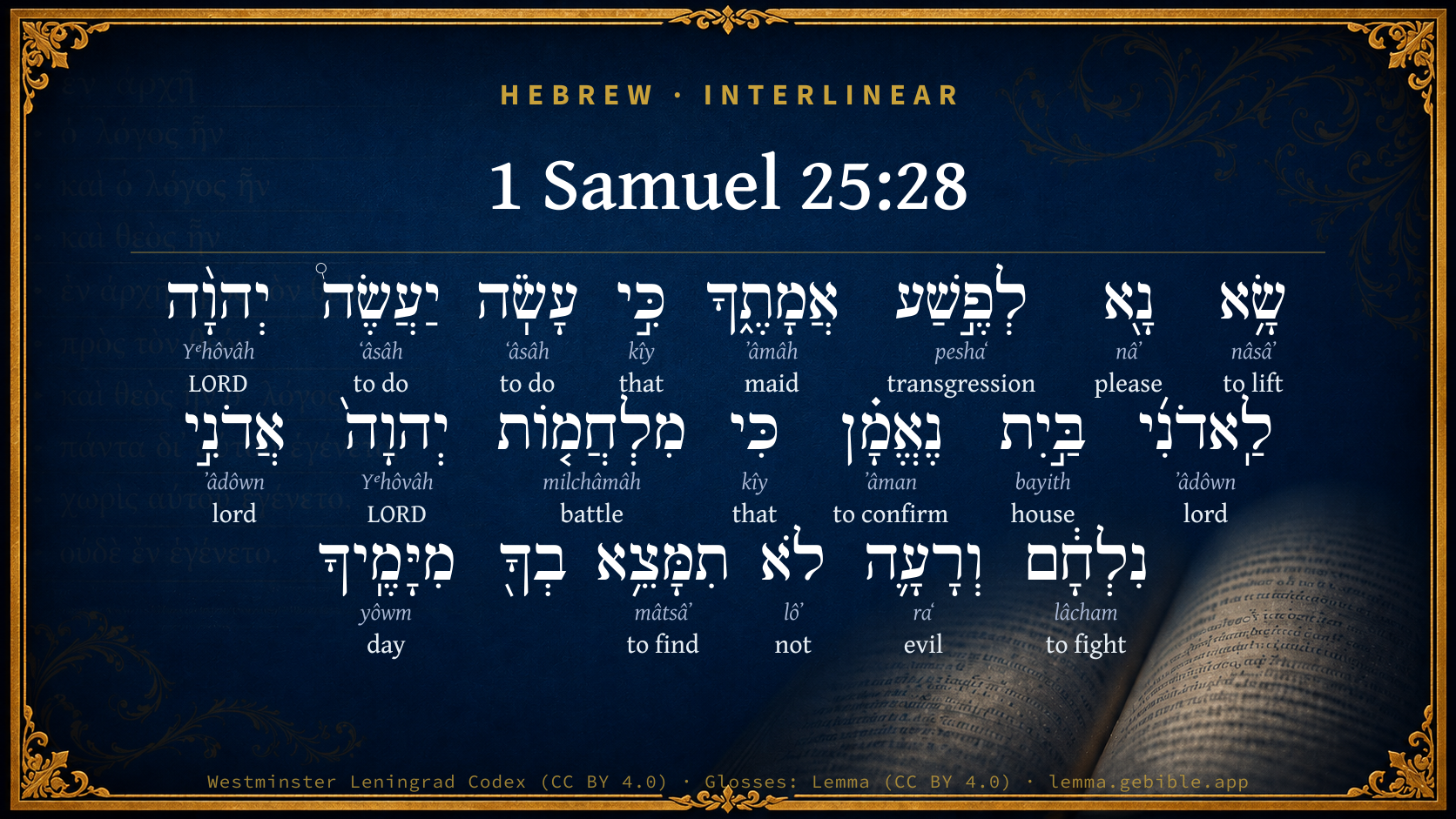
1 Samuel 25:28

Hebrew (Westminster Leningrad Codex) 1 Samuel 25:28 appears in the Hebrew Old Testament. The text above is from the Westminster Leningrad Codex. Each word links to its Strong’s number, a concise gloss, and parsing drawn from the Open Scriptures Hebrew Bible morphology. Click any word for its full Brown-Driver-Briggs (BDB) entry.
Download image
Cite this verse

1 Samuel 25:28 (World English Bible). Public Domain. Lemma interlinear Bible study tool, https://lemma.gebible.app/v/1-samuel/25/28.

Show BibTeX & RIS
BibTeX
RIS
English Translation
Please forgive the trespass of your handmaid: for Yahweh will certainly make my lord a sure house, because my lord fights the battles of Yahweh; and evil shall not be found in you all your days.
World English Bible · Public Domain
Download a study sheet

One document with this verse’s original text, its word-by-word gloss line, the meaning frame, cross-references with their text, attributed commentary, and full source and license credits — printable, and it pastes into notes with its structure intact.

This verse Autodidact and up

Study sheet (.html) Plain text (.txt)

A passage Seminary Student

Up to 50 verses in one chapter. A passage sheet keeps up to 6 commentary sources and 12 cross-references per verse, in the order this page ranks them, and says so on the sheet whenever that leaves anything out. Ask for a single verse and you get the Autodidact verse sheet above.

Everything on this page stays free to read, with no account — the sheet is a download of what is already on screen, not access to it.

Want to remove ads? Support Godless Engineer
Compare translations 3

The same verse in 3 English versions, stacked beneath the original-language interlinear above. Click any original word for its lexicon entry.

Each is an independent rendering of the whole verse — the interlinear is not word-aligned to these translations.

Highlighted words mark where these versions differ — a whole-verse word diff, not a word-by-word alignment.

  • World English Bible Public Domain
    Please forgive the trespass of your handmaid: for Yahweh will certainly make my lord a sure house, because my lord fights the battles of Yahweh; and evil shall not be found in you all your days.
  • King James Version Public Domain
    I pray thee, forgive the trespass of thine handmaid: for the LORD will certainly make my lord a sure house; because my lord fighteth the battles of the LORD, and evil hath not been found in thee all thy days.
  • unfoldingWord Literal Text CC BY-SA 4.0
    Please lift off the transgression of your maidservant. For making, Yahweh will make for my master an established house, because my master is fighting the battles of Yahweh. And evil will not be found in you from your days.

unfoldingWord Literal Text — © unfoldingWord, licensed CC BY-SA 4.0. Word-aligned USFM3 via Door43 (git.door43.org/unfoldingWord/en_ult).

Versions to compare (up to 4)

3 of 4 selected

Show all 18 translations

Every available English version of this verse, each an independent rendering of the whole verse.

  • World English Bible Public Domain
    Please forgive the trespass of your handmaid: for Yahweh will certainly make my lord a sure house, because my lord fights the battles of Yahweh; and evil shall not be found in you all your days.
  • Berean Standard Bible Public Domain
    Please forgive your servant’s offense, for the LORD will surely make a lasting dynasty for my lord, because he fights the LORD’s battles. May no evil be found in you as long as you live.
  • Majority Standard Bible Public Domain
    Please forgive your servant’s offense, for the LORD will surely make a lasting dynasty for my lord, because he fights the LORD’s battles. May no evil be found in you as long as you live.
  • King James Version Public Domain
    I pray thee, forgive the trespass of thine handmaid: for the LORD will certainly make my lord a sure house; because my lord fighteth the battles of the LORD, and evil hath not been found in thee all thy days.
  • American Standard Version (1901) Public Domain
    Forgive, I pray thee, the trespass of thy handmaid: for Jehovah will certainly make my lord a sure house, because my lord fighteth the battles of Jehovah; and evil shall not be found in thee all thy days.
  • Revised Version (1885) Public Domain
    Forgive, I pray thee, the trespass of thine handmaid: for the LORD will certainly make my lord a sure house, because my lord fighteth the battles of the LORD; and evil shall not be found in thee all thy days.
  • Geneva Bible (1599) Public Domain
    I pray thee, forgiue the trespasse of thine handmaide: for the Lord will make my lorde a sure house, because my lord fighteth the battels of the Lord, and none euill hath bene found in thee in all thy life.
  • Douay-Rheims (1899) Public Domain
    Forgive the iniquity of thy handmaid: for the Lord will surely make for my lord a faithful house, because thou, my lord, fightest the battles of the Lord: let not evil therefore be found in thee all the days of thy life.
  • Young's Literal Translation Public Domain
    `Bear, I pray thee, with the transgression of thy handmaid, for Jehovah doth certainly make to my lord a stedfast house; for the battles of Jehovah hath my lord fought, and evil is not found in thee `all' thy days.
  • Literal Standard Version CC BY-SA 4.0
    Please bear with the transgression of your handmaid, for YHWH certainly makes a steadfast house for my lord; for my lord has fought the battles of YHWH, and evil is not found in you [all] your days.
  • Unlocked Literal Bible CC BY-SA 4.0
    Please forgive the trespass of your servant, for Yahweh will certainly make my master a sure house, because my master is fighting the battles of Yahweh; and evil will not be found in you so long as you live.
  • unfoldingWord Literal Text CC BY-SA 4.0
    Please lift off the transgression of your maidservant. For making, Yahweh will make for my master an established house, because my master is fighting the battles of Yahweh. And evil will not be found in you from your days.
  • Darby Bible Public Domain
    I pray thee, forgive the transgression of thy handmaid: for Jehovah will certainly make my lord a lasting house; because my lord fights the battles of Jehovah, and evil has not been found in thee all thy days.
  • World Messianic Bible Public Domain
    Please forgive the trespass of your servant. For the LORD will certainly make my lord a sure house, because my lord fights the LORD’s battles. Evil will not be found in you all your days.
  • Webster's Bible Public Domain
    I pray thee, forgive the trespass of thy handmaid: for the LORD will certainly make my lord a sure house; because my lord fighteth the battles of the LORD, and evil hath not been found in thee all thy days.
  • Free Bible Version CC BY-SA 4.0
    Please forgive any offense that I, your servant, have committed, for the Lord is sure to set up a dynasty for you that will last for a long time, because you, sir, fight the battles of the Lord. Wickedness should not be found in you as long as you live.
  • Bible in Basic English Public Domain
    And may the sin of your servant have forgiveness: for the Lord will certainly make your family strong, because my lord is fighting in the Lord's war; and no evil will be seen in you all your days.
  • JPS Tanakh (1917) Public Domain
    Forgive, I pray thee, the trespass of thy handmaid; for the LORD will certainly make my lord a sure house, because my lord fighteth the battles of the LORD; and evil is not found in thee all thy days.

Literal Standard Version (2020), Covenant Press — licensed CC BY-SA 4.0. Text via the HelloAO Bible API (eBible.org). Unlocked Literal Bible (unfoldingWord) — licensed CC BY-SA 4.0. Text via the HelloAO Bible API (eBible.org). unfoldingWord Literal Text — © unfoldingWord, licensed CC BY-SA 4.0. Word-aligned USFM3 via Door43 (git.door43.org/unfoldingWord/en_ult). Free Bible Version, Dr. Jonathan Gallagher — licensed CC BY-SA 4.0. Text via the HelloAO Bible API (eBible.org).

Word by word

More ways to search: Search by grammar → Find every occurrence → Compare this word →

Practice this passage: Drill this verse → Learn its vocabulary →

אֲמָתֶ֑ךָ
ʼâmâh
H519
“maid · your”
Noun, Common, Feminine, Singular, Construct + Suffix, Personal, 2nd Person, Masculine, Singular
Part of Speech
Noun
Type
Common
Gender
Feminine
Number
Singular
State
Construct
Full BDB Definition

Origin: apparently a primitive word

TWOT: 112

maid-servant, female slave, maid, handmaid, concubine - of humility (figuratively)
  1. שָׂ֥א nâsâʼ H5375 “lift” Verb, Qal, Imperative, 2nd Person, Masculine, Singular
  2. נָ֖א nâʼ H4994 “please” Particle, Exhortation
  3. לְפֶ֣שַׁע peshaʻ H6588 “to/for · transgression of” Preposition + Noun, Common, Masculine, Singular, Construct
  4. כִּ֣י kîy H3588 “that” Conjunction
  5. עָשֹֽׂה ʻâsâh H6213 “to do” Verb, Qal, Infinitive Absolute
  6. יַעֲשֶׂה֩ ʻâsâh H6213 “to do” Verb, Qal, Imperfect, 3rd Person, Masculine, Singular
  7. יְהוָ֨ה Yᵉhôvâh H3068 “LORD” Noun, Proper
  8. לַֽאדֹנִ֜י ʼâdôwn H113 “to/for · lord · my” Preposition + Noun, Common, Masculine, Singular, Construct + Suffix, Personal, 1st Person, Common, Singular
  9. בַּ֣יִת bayith H1004 “house” Noun, Common, Masculine, Singular, Absolute
  10. נֶאֱמָ֗ן ʼâman H539 “confirming” Verb, Niphal, Participle Active, Masculine, Singular, Absolute
  11. כִּי kîy H3588 “that” Conjunction
  12. מִלְחֲמ֤וֹת milchâmâh H4421 “battles of” Noun, Common, Feminine, Plural, Construct
  13. יְהוָה֙ Yᵉhôvâh H3068 “LORD” Noun, Proper
  14. אֲדֹנִ֣י ʼâdôwn H113 “lord · my” Noun, Common, Masculine, Singular, Construct + Suffix, Personal, 1st Person, Common, Singular
  15. נִלְחָ֔ם lâcham H3898 “fighting” Verb, Niphal, Participle Active, Masculine, Singular, Absolute
  16. וְרָעָ֛ה raʻ H7451 “and · evil” Conjunction + Noun, Common, Feminine, Singular, Absolute
  17. לֹא lôʼ H3808 “not” Particle, Negative
  18. תִמָּצֵ֥א mâtsâʼ H4672 “to find” Verb, Niphal, Imperfect, 3rd Person, Feminine, Singular
  19. מִיָּמֶֽיךָ yôwm H3117 “from · days · your” Preposition + Noun, Common, Masculine, Plural, Construct + Suffix, Personal, 2nd Person, Masculine, Singular

About this verse

These counts appear in no published source. They are computed here, from the morphology-tagged text and Lemma’s own curated glosses. What Lemma adds →

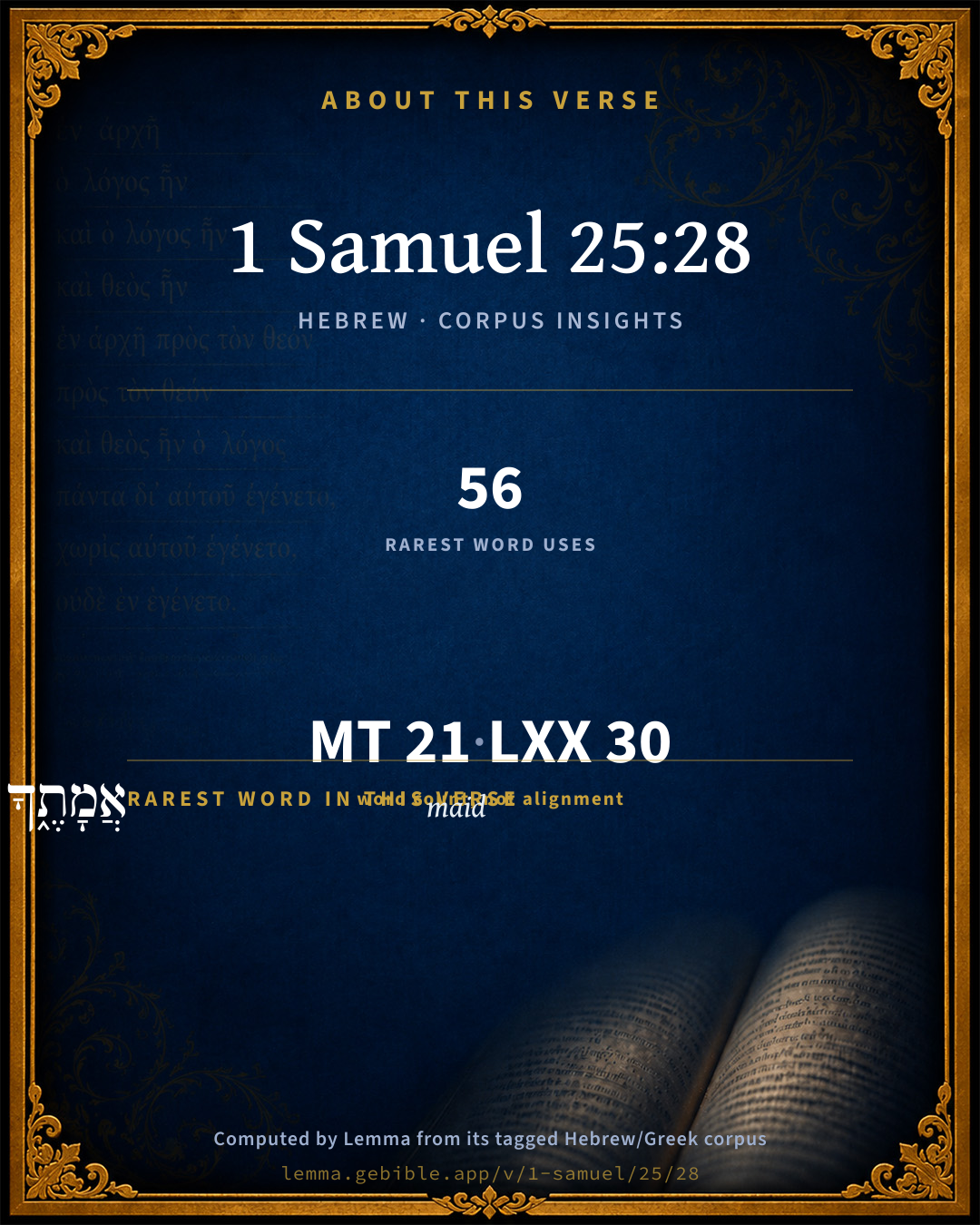
21
words
16
distinct lemmas
Historical
section

Shared distinctive vocabulary

אֲמָתֶ֑ךָ maid H519 occurs in 49 verses of the Hebrew Bible. Also found in:

Grammatical profile

  • 6 verbs
  • 10 nouns
  • 1 preposition
  • 2 conjunctions
  • 2 particles

Verb forms

  • שָׂ֥א Qal · Imperative
  • עָשֹֽׂה Qal · Infinitive Absolute
  • יַעֲשֶׂה֩ Qal · Imperfect
  • נֶאֱמָ֗ן Niphal · Participle Active
  • נִלְחָ֔ם Niphal · Participle Active
  • תִמָּצֵ֥א Niphal · Imperfect

Repetition

Words recur within this verse — often emphatic in Hebrew:

  • עָשֹֽׂה to do H6213 ×2
  • יְהוָ֨ה LORD H3068 ×2
  • לַֽאדֹנִ֜י lord H113 ×2
  • כִּ֣י that H3588 ×2

Hebrew & Septuagint length

In English translation the verse runs 36 words from the Hebrew and 40 from the Septuagint (LXX English) — closely comparable.

A rough comparison of the two English renderings, which tokenize alike — not a word-level alignment.

Word counts can differ between the Hebrew and the Greek without any difference in meaning — e.g. the Hebrew direct-object marker אֵת has no separate Greek word, and Greek often adds the article ὁ.

In the original languages it is 21 Hebrew tokens and 30 Greek tokens — but the two are counted differently (Hebrew bundles its prefixes and suffixes into one token; the Greek is in lemma form), so that isn’t a like-for-like length.

Cross-references

22

Topical passages linked to 1 Samuel 25:28 in the Treasury of Scripture Knowledge — connected by theme and wording, ordered by reader-vote popularity; previews shown in the World English Bible.

  • 1 Samuel 18:17 Saul said to David, Behold, my elder daughter Merab, her will I give you as wife: only be valiant for me, and fight Yahweh's battles. For Saul said, Don't let my hand be on him, but let the hand of the Philistines be on him.
  • 2 Samuel 7:11 and [as] from the day that I commanded judges to be over my people Israel; and I will cause you to rest from all your enemies. Moreover Yahweh tells you that Yahweh will make you a house.
  • 1 Samuel 24:11 Moreover, my father, behold, yes, see the skirt of your robe in my hand; for in that I cut off the skirt of your robe, and didn't kill you, know you and see that there is neither evil nor disobedience in my hand, and I have not sinned against you, though you hunt after my life to take it.
  • 1 Chronicles 17:25 For you, my God, have revealed to your servant that you will build him a house: therefore has your servant found [in his heart] to pray before you.
  • 2 Samuel 7:16 Your house and your kingdom shall be made sure for ever before you: your throne shall be established forever.
  • 1 Kings 9:5 then I will establish the throne of your kingdom over Israel forever, according as I promised to David your father, saying, There shall not fail you a man on the throne of Israel.
  • 1 Chronicles 17:10 and [as] from the day that I commanded judges to be over my people Israel; and I will subdue all your enemies. Moreover I tell you that Yahweh will build you a house.
  • 1 Samuel 15:28 Samuel said to him, Yahweh has torn the kingdom of Israel from you this day, and has given it to a neighbor of yours who is better than you.
  • 1 Samuel 17:47 and that all this assembly may know that Yahweh doesn't save with sword and spear: for the battle is Yahweh's, and he will give you into our hand.
  • 1 Samuel 24:6–7 He said to his men, Yahweh forbid that I should do this thing to my lord, Yahweh's anointed, to put forth my hand against him, seeing he is Yahweh's anointed.
  • 1 Samuel 24:17 He said to David, You are more righteous than I; for you have rendered to me good, whereas I have rendered to you evil.
  • 1 Samuel 25:24 She fell at his feet, and said, On me, my lord, on me be the iniquity; and please let your handmaid speak in your ears. Hear the words of your handmaid.
  • 2 Samuel 5:2 In times past, when Saul was king over us, it was you who led out and brought in Israel: and Yahweh said to you, You shall be shepherd of my people Israel, and you shall be prince over Israel.
  • 2 Samuel 7:27 For you, Yahweh of Hosts, the God of Israel, have revealed to your servant, saying, I will build you a house: therefore has your servant found in his heart to pray this prayer to you.
  • 1 Kings 15:5 because David did that which was right in the eyes of Yahweh, and didn't turn aside from anything that he commanded him all the days of his life, except only in the matter of Uriah the Hittite.
  • Psalms 89:29 I will also make his seed endure forever, And his throne as the days of heaven.
  • Psalms 119:1–3 Blessed are those whose ways are blameless, Who walk according to Yahweh's law.
  • Luke 23:41 And we indeed justly, for we receive the due reward for our deeds, but this man has done nothing wrong."
  • Luke 23:47 When the centurion saw what was done, he glorified God, saying, "Certainly this was a righteous man."
  • Ephesians 6:10–11 Finally, be strong in the Lord, and in the strength of his might.
  • 2 Chronicles 20:15 and he said, Listen you, all Judah, and you inhabitants of Jerusalem, and you king Jehoshaphat: Thus says Yahweh to you, Don't be afraid you, neither be dismayed by reason of this great multitude; for the battle is not yours, but God's.
  • Matthew 5:16 Even so, let your light shine before men; that they may see your good works, and glorify your Father who is in heaven.

Cross-references courtesy of OpenBible.info (CC BY 4.0).

Hebrew and Greek witnesses Masoretic Hebrew ↔ Greek Septuagint

The same verse in the two great witnesses to the Old Testament, shown verse-for-verse.

These are two independent witnesses, not word-aligned to each other, and the Septuagint is shown in lemma (dictionary) form.

Hebrew 1 Samuel 25:28 Masoretic · Westminster Leningrad Codex

שָׂ֥א נָ֖א לְפֶ֣שַׁע אֲמָתֶ֑ךָ כִּ֣י עָשֹֽׂה יַעֲשֶׂה֩ יְהוָ֨ה לַֽאדֹנִ֜י בַּ֣יִת נֶאֱמָ֗ן כִּי מִלְחֲמ֤וֹת יְהוָה֙ אֲדֹנִ֣י נִלְחָ֔ם וְרָעָ֛ה לֹא תִמָּצֵ֥א בְךָ֖ מִיָּמֶֽיךָ

Please forgive the trespass of your handmaid: for Yahweh will certainly make my lord a sure house, because my lord fights the battles of Yahweh; and evil shall not be found in you all your days.

World English Bible · Public Domain

Greek LXX 1 Samuel 25:28 Septuagint · lemma form

αἴρω δή ὁ ἀνόμημα ὁ δούλη σύ ὅτι ποιέω ποιέω κύριος ὁ κύριος ἐγώ οἶκος πιστός ὅτι πόλεμος κύριος ὁ κύριος ἐγώ πολεμέω καί κακία οὐ εὑρίσκω ἐν σύ πώποτε

Remove, I pray you, the trespass of your servant; for the Lord will surely make for my lord a sure house, for the Lord fights the battles of my lord, and there shall no evil be ever found in you.

LXX2012 (modern English Septuagint) · Public Domain

Hebrew: Westminster Leningrad Codex (CC BY 4.0). Greek: Septuagint (public domain); English from LXX2012 (modern English Septuagint) (Public Domain). How the Septuagint differs from the Hebrew →

Targum (Aramaic paraphrase)

1

The Targum is the ancient Jewish Aramaic paraphrase of the Hebrew Scriptures — an interpretive translation, not the Hebrew text itself. Onkelos (literal) and Pseudo-Jonathan (expansive) render the Torah, and Jonathan the Prophets. Coverage is partial: where no permissively-licensed English translation exists for a verse, only the Aramaic is shown. This is verse-level text, not a word-by-word alignment to the Hebrew.

  1. Targum Jonathan Prophets (Joshua–Malachi)
    שְׁבוֹק כְּעַן לְחוֹבֵי אַמְתָךְ אֲרֵי קְיָמָא יְקַיֵים יְיָ לְרִבּוֹנִי מַלְכוּ קְיָמָא אֲרֵי קְרָבֵי עַמָא דַייָ רִבּוֹנִי מְגִיחַ וּבִישְׁתָּא לָא אִשְׁתְּכַחַת בָּךְ מִיוֹמָךְ:

    (no public-domain English translation for this verse)

    Targum Jonathan — Aramaic: “Mikraot Gedolot” (public domain). English: “Sefaria Community Translation” (CC0 1.0 (public-domain dedication)); “London "Chaldee Paraphrase," 1871” (public domain). Text via Sefaria.

Commentary

Notes on 1 Samuel 25:28 from classic Christian and Jewish commentators (each source and its license shown beneath its notes). The classic Christian expositions comment on the surrounding passage and are grouped to its opening verse, so a note may address several verses; the Jewish commentaries on the Tanakh (Rashi and others) are per-verse, so they appear only where the commentator wrote on this verse.

Lemma curates 59 commentaries, every one of them public domain or Creative Commons licensed, each selected and text-cleaned for this edition rather than reprinted as found. About our sources →

Trapp's Complete Commentary

John Trapp

1Sa 25:28 I pray thee, forgive the trespass of thine handmaid: for the LORD will certainly make my lord a sure house; because my lord fighteth the battles of the LORD, and evil hath not been found in thee [all] thy days.

Ver. 28. Because my lord fighteth the battles of the Lord.] Non autem privatas ultiones tuas. {a} Here she argueth from his office, which was to fight the Lord’s battles, and not to revenge his own quarrel.

And evil hath not been found in thee,] i.e., Self revenge and cruelty; and, what! shall they now? Wilt thou cast such a slur upon all thy former brave parts and practices?

{a} Jun.

John Trapp, A Commentary or Exposition upon All the Books of the Old and New Testament (1647–1656) — public domain. Text from a community e-Sword module.

Joseph Benson's Commentary

1Sa 25:28. Forgive the trespass of thy handmaid — That is, the trespass which I have taken upon myself, and which, if it be punished, the punishment will reach to me. Sure house — Will give the kingdom to thee, and to thy house for ever, as he hath promised thee. And therefore let God’s kindness to thee make thee gentle and merciful to others; do not sully thy approaching glory with the stain of innocent blood; but consider that it is the glory of a king to pass by offences: and that it will be thy loss to cut off such as will shortly be thy subjects.

My lord fighteth the battles, &c. — For the Lord, and for the people of the Lord, against their enemies; especially the Philistines. And, as this is thy proper work, and therein thou mayest expect God’s blessing; so it is not thy work to draw thy sword in thy own private quarrel against any of the people of the Lord; and God will not bless thee in it. Evil hath not been found in thee, &c. — Though thou hast been charged with many crimes, by Saul and others, yet thy innocence is evident to all men. Do not therefore, by this cruel act, justify thine enemies’ reproaches, or blemish thy great and just reputation.

Joseph Benson's Commentary on the Old and New Testaments (1811–1818) — public domain. Text from a community e-Sword module.

Tyndale Open Study Notes

Tyndale Open Resources

25:28 a lasting dynasty: See 2 Sam 7. • fighting the Lord’s battles: David was known and loved for his victories over Israel’s enemies (1 Sam 18:7, 13, 16). • have not done wrong: This comment does not indicate that David was sinless, but rather that he was innocent in his quest for the throne (as 25:29-31 makes clear).

Tyndale Open Study Notes — © Tyndale Open Resources, licensed CC BY-SA 4.0. Text via the HelloAO Bible API.

Geneva Bible (1599)

Geneva Bible translators

Confirm his Kingdom to his posterity.

Hebrew, from thy days.

Geneva Bible (1599) marginal notes — public domain. Text via Bolls.life.

Adam Clarke's Commentary

Verse 28. And evil hath not been found in thee] Thou hast not committed any act of this kind hitherto.

Adam Clarke's Commentary on the Bible (1810–1826) — public domain. Text from a community e-Sword/MySword module.

Ellicott's Commentary for English Readers

(28) The trespass of thine handmaid.—Abigail again takes upon herself the wrong; the gracious act of forgiveness, of which she feels assured beforehand, she reminds David, will be shown to her. Thus all the chivalry of David’s character—if we may use a term which belongs to another age—was brought out by this wise and beautiful woman.

For the Lord will certainly make my lord a sure house.—Unconsciously, perhaps, without any very definite conception of their far reaching and magnificent meaning, the Israelitish lady repeats the words which she had heard perhaps in Samuel’s “Naioth” by Ramah—possibly from some trained or inspired disciple of the prophet’s school. She was thinking, perhaps, of the young captain then standing before her in all the pride of his early reputation, as the future hero-king of Israel, sitting on the throne of the insane and gloomy man—her evil husband’s friend—King Saul, and it may be of his son reigning after him; but the unconscious prophetess, we may be sure, never dreamed of that glorious and holy One in whose person, far down the stream of ages, the Eternal would make good her words, and indeed found for that outlawed chieftain, before whom she was then kneeling, a sure house.

The battles of the Lord.—Abigail, in common with the pious Israelites of her time, looked on the wars waged by the armies of Israel against the idolatrous tribes and nations around them as the wars of Jehovah. We frequently in these early records meet with the expressions, “fighting the battle of the Lord,” “the ranks of the living God,” “the battle is the Lord’s.” We hear, too, of an ancient collection of songs—ballads, perhaps, would be a more accurate designation—now lost, entitled “The Book of the Wars of the Lord” (Num_21:14). For several years now since his famous combat with the great champion of idolatry, Goliath, David had been the popular hero and the favourite subject of those folk-songs which ever loved to sing of these “Wars of Jehovah.”

Evil hath not been found in thee.—Rauh, “evil,” here signifies not “wickedness,” but “misfortune.” The wife of Nabal means to say that all through that stormy, restless life of David’s, the Lord had ever held him up. It had given him victory and crowned his efforts with splendid success; and in the later days of bitter persecution, the same invisible One had shielded him, and had turned what seemed to be the certain ruin of his prospects into a still more certain career of usefulness and popularity.

A Bible Commentary for English Readers, edited by Charles John Ellicott (1878–1897) — public domain. Text from a community e-Sword module.

The Cambridge Bible for Schools and Colleges

gen. ed. J. J. S. Perowne

28. the trespass of thine handmaid] She takes the blame of the wrong done to David upon herself, as in v.24.

for the Lord, &c.] Abigail grounds her request on the conviction that David will succeed to the kingdom, when, as she points out in 1Sa_25:30-31, such an act of violence as he was minded to commit would be a burden on his conscience. Her conviction rests (1) on the fact that he has proved himself the champion of Jehovah’s people (see on 1Sa_18:17); (2) on his blameless life. Doubtless the nation was already anxiously looking forward to David as its future king.

will certainly make my lord a sure house] Will establish him and his posterity on the throne. For the phrase see 1Sa_2:35; and compare the promise in 2Sa_7:16. The same epithet is applied to David himself in 1Sa_22:14 (E. V. faithful).

evil hath not been found in thee] Cp. 1Sa_24:11; Psa_7:3. David’s generous and winning character was in sharp contrast to Saul’s jealous suspicion and mad cruelty.

The Cambridge Bible for Schools and Colleges (gen. ed. J. J. S. Perowne; Cambridge University Press, 1878–1918) — public domain. Text from a community e-Sword module.

John Gill's Exposition

I pray thee, forgive the trespass of thine handmaid,.... The trespasses, as the Targum, either the sin of her husband, she had taken upon herself, or her boldness in troubling him with her petitions and solicitations, and even with the present she had brought:

for the Lord will certainly make my lord a sure house; or a firm kingdom, as the Targum; would raise him to the kingdom of Israel, and establish it in his posterity, that it should not be taken from him, as it would be from Saul:

because my lord fighteth the battles of the Lord; the battles of the people of the Lord, as the Targum, of the people of Israel against the Philistines; which he had often done with success, the Lord being with him, and prospering him and therefore would firmly settle him on the throne, and continue the kingdom in his posterity:

and evil hath not been found in thee all thy days; no unjust action had been committed by him against his king and country, however he had been reproached and calumniated; and she hoped that therefore none would be done by him now to stain so fair a character.

John Gill's Exposition of the Whole Bible (1746–1763) — public domain (CC PDM 1.0). Text via the HelloAO Bible API.

Albert Barnes' Notes on the Bible

For the Lord will make ... a sure house - Compare 1Sa 2:35, and 2Sa 7:16; 1Ki 11:38. Abigail’s firm persuasion of David’s kingdom stands upon the same footing as Rahab’s conviction of God’s gift of Canaan to the Israelites Jos 2:9-13. Both testified to God’s revelation and their own faith. This is doubtless the reason why Abigail’s speech is recorded.

Albert Barnes' Notes on the Bible (1834–1885) — public domain. Text from a community e-Sword/MySword module.

Haydock's Catholic Bible Commentary

House. Thy family shall long continue in the enjoyment of the royal power. Chaldean, "an established kingdom." (Haydock) --- Lord, as his general. --- Evil. Do no manner of injustice. Hebrew, "and evil hast not been found," &c. Hitherto thy life has been irreproachable. (Calmet)

George Leo Haydock (1774–1849), Haydock's Catholic Family Bible and Commentary, 1859 edition — public domain. Excludes Psalms (Douay-Rheims chapter numbering differs from Protestant) and Deuterocanonical books (Catholic canon only).

Matthew Poole's English Annotations

The trespass of thine handmaid, i.e. which I have taken upon myself, 1Sa 25:21, and which, if it be not pardoned, but punished, the punishment will reach to me.

Will certainly make my lord a sure house, i.e. will give the kingdom to thee, and to thy house for ever, as he hath promised thee. And therefore let God’s great kindness to thee make thee gentle and merciful to others; do not sully thy approaching glory with the stain of innocent blood; but consider that it is the glory of a king (which thou art by God’s appointment, and shall ere long actually be) to pass by offences, and that it will be thy loss to cut off such as will shortly be thy subjects.

The battles of the Lord, i.e. for the Lord, and for the people of the Lord, against their enemies, especially the Philistines. And as that this is thy proper work, and therein thou mayst expect God’s blessing and help; so it is not thy work to draw thy sword in thy own private quarrel against any of the people of the Lord, and God will not bless thee in it.

Evil hath not been found in thee all thy days; though thou hast been oft aspersed, and charged with many critics, by Saul and others; yet thy innocency hath been and is evident to all men: do not therefore now by this cruel act of vengeance justify thine enemies’ reproaches, nor blemish thy great and just reputation.

Matthew Poole's English Annotations on the Holy Bible (1683–1685) — public domain. Text from a community e-Sword/MySword module.

Whedon's Commentary on the Bible

Daniel D. Whedon

28. Forgive the trespass of thine handmaid — The trespass of coming unbidden into thy way and opposing thy purposes.

For — This casual particle refers to what is implied in the preceding words. Thou canst afford to forgive, for the Lord, etc.

Daniel D. Whedon (gen. ed.), Commentary on the Old and New Testaments (1874–1909) — public domain. Text from a community e-Sword module.

The Pulpit Commentary

Forgive the trespass of thine handmaid. Reverting to her words in ver. 24, that the blame and punishment must rest on her, she now prays for forgiveness; but the intermediate words in ver. 26, emphasised in ver. 31, have raised her request to a higher level. Her prayer rests on the ground that she was saving David from a sin, and that in his thirst for vengeance he was bringing upon himself guilt. If the form of Abigail"s address was most humble, the matter of it was brave and noble. A sure house. Ie. permanent prosperity. (see on 1Sa_2:35) Because my lord fighteth. Hebrew, "will fight." David was not fighting these battles now because he was not yet enthroned as the theocratic king. It was Saul"s business at present to fight "Jehovah"s battles," either in person or by his officers. (1Sa_18:17) The words, therefore, distinctly look forward to the time when David as king will have the duty imposed upon him of protecting Jehovah"s covenant people. Evil hath not been found in thee. Hebrew, "shall not be found in thee," i.e. when the time comes for thee to take the kingdom no one shall be able to allege against thee any offence by which thou hast lost thy title to the kingly office; nor afterwards as king shalt thou be guilty of any breach of thy duty to Jehovah, Israel"s supreme Ruler, so as to incur rejection as Saul has done.

The Pulpit Commentary (1880–1919), ed. H.D.M. Spence-Jones & Joseph S. Exell — public domain. Text from a community e-Sword module.

John Wesley's Explanatory Notes

The trespass - That is, which I have taken upon myself, and which, if it be punished, the punishment will reach to me. Sure house - Will give the kingdom to thee, and to thy house forever, as he hath promised thee. And therefore let God's kindness to thee, make thee gentle and merciful to others; do not sully thy approaching glory with the stain of innocent blood; but consider, that it is the glory of a king, to profit by offenses: and that it will be thy loss to cut off such as will shortly be thy subjects. The battles - For the Lord, and for the people of the Lord against their enemies; especially, the Philistines. And as this is thy proper work, and therein thou mayest expect God's blessing; so it is not thy work to draw thy sword in thy own private quarrel against any of the people of the Lord; and God will not bless thee in it. Evil hath not, &c. - Though thou hast been charged with many crimes by Saul and others; yet thy innocency is evident to all men: do not therefore by this cruel act, justify thine enemies reproaches, or blemish thy great and just reputation.

John Wesley, Explanatory Notes Upon the Whole Bible (1754–1765) — public domain. Text via the GEBible commentary corpus.

Rashi

Rabbi Shlomo Yitzchaki (Rashi)

For Adonoy will surely make for my master an everlasting house. To be king over Yisroel. Therefore, let no evil be found in you. It is therefore not fitting for you to do anything contrary to the law, to spread evil talk concerning your kingship.

Rashi on the Tanakh — English translations: “The Judaica Press complete Tanach with Rashi, translated by A. J. Rosenberg” (CC BY 4.0); “Pentateuch with Rashi's commentary by M. Rosenbaum and A.M. Silbermann, 1929-1934” (public domain); “The Metsudah Tanach series, Lakewood, N.J” (CC BY 4.0); and “The Book of Joshua, Metsudah Publications, 1997” (CC BY 4.0). Text via Sefaria.

Lesson kit

Teaching starters — assembled from the data on this page, not authored interpretation. Every prompt links to the verse data it draws on. Edit before teaching.

1 Samuel, in the Historical, opens this verse with 21 words (16 distinct Hebrew lemmas). Its most distinctive word is ʼâmâh (“maid”). A historical commentator’s framing appears above. Read the whole chapter for the surrounding context.

Discussion questions

  1. The word ʼâmâh carries the sense “maid.” How does it shape the verse?
  2. How does Genesis 20:17, which shares the word «maid», read alongside this verse?
  3. What does the repetition of “to do” (2× in this one verse) do in this verse?
  4. These translations render this verse differently. What is at stake in choosing one wording over another?
  5. «שָׂ֥א» is a Qal Imperative verb. How does that grammatical form shape the action described?
  6. Compare how Trapp's Complete Commentary and Joseph Benson's Commentary read this verse. Where do they agree or differ?

Things to notice

Reading settings

Reading text

Shown beneath each verse's original-language words.

Old Testament
Old Testament edition

Read the OT as the Masoretic Hebrew (MT) or the Greek Septuagint (LXX).

English shown for the Greek Septuagint (in the Hebrew ↔ Greek comparison).

Comparing translations? Open the Compare panel on any verse page to stack up to four side by side.