
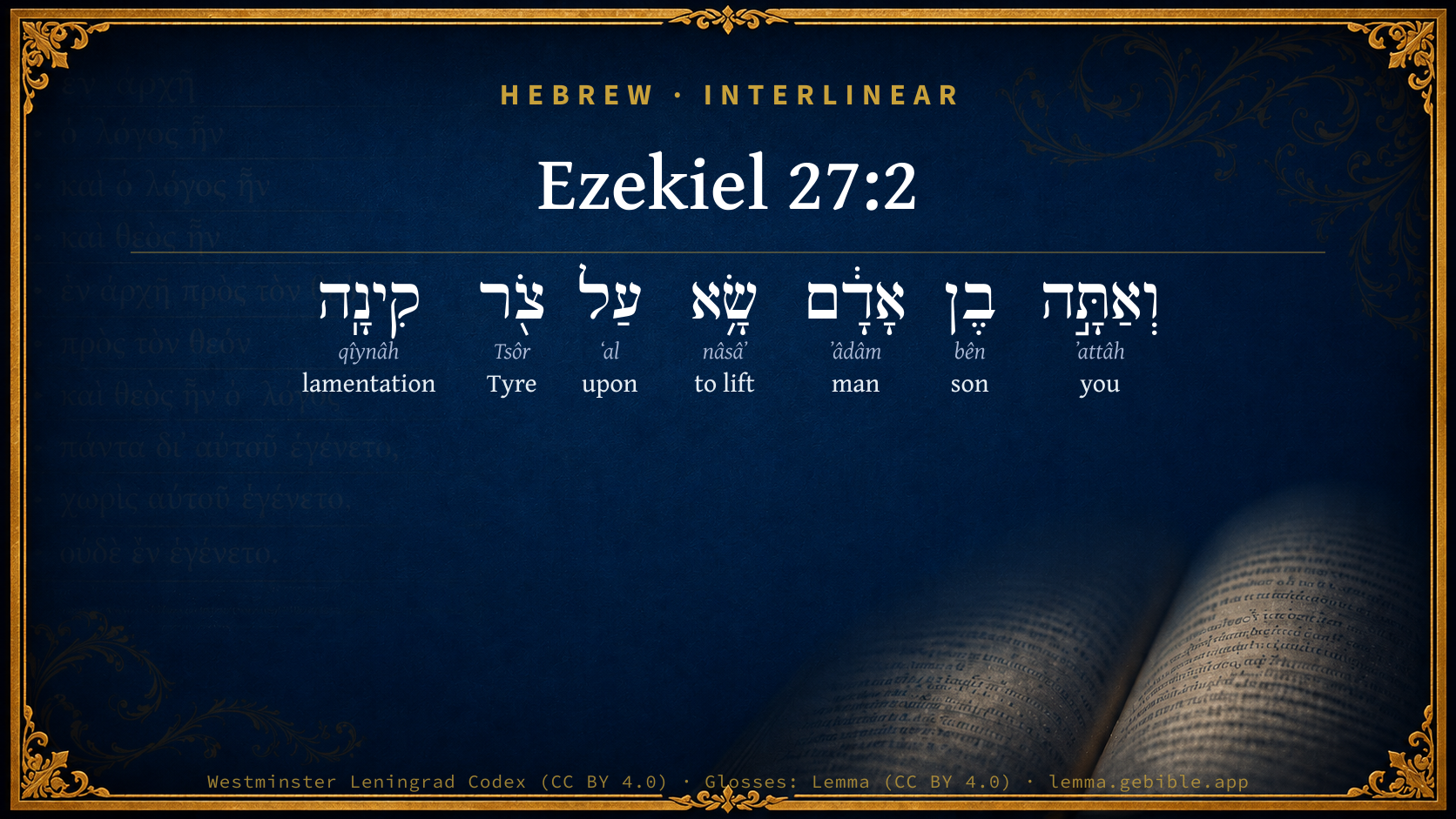
Ezekiel 27:2

Hebrew (Westminster Leningrad Codex) Ezekiel 27:2 appears in the Hebrew Old Testament. The text above is from the Westminster Leningrad Codex. Each word links to its Strong’s number, a concise gloss, and parsing drawn from the Open Scriptures Hebrew Bible morphology. Click any word for its full Brown-Driver-Briggs (BDB) entry.
Download image
Cite this verse

Ezekiel 27:2 (World English Bible). Public Domain. Lemma interlinear Bible study tool, https://lemma.gebible.app/v/ezekiel/27/2.

Show BibTeX & RIS
BibTeX
RIS
English Translation
You, son of man, take up a lamentation over Tyre;
World English Bible · Public Domain
Download a study sheet

One document with this verse’s original text, its word-by-word gloss line, the meaning frame, cross-references with their text, attributed commentary, and full source and license credits — printable, and it pastes into notes with its structure intact.

This verse Autodidact and up

Study sheet (.html) Plain text (.txt)

A passage Seminary Student

Up to 50 verses in one chapter. A passage sheet keeps up to 6 commentary sources and 12 cross-references per verse, in the order this page ranks them, and says so on the sheet whenever that leaves anything out. Ask for a single verse and you get the Autodidact verse sheet above.

Everything on this page stays free to read, with no account — the sheet is a download of what is already on screen, not access to it.

Want to remove ads? Support Godless Engineer
Compare translations 3

The same verse in 3 English versions, stacked beneath the original-language interlinear above. Click any original word for its lexicon entry.

Each is an independent rendering of the whole verse — the interlinear is not word-aligned to these translations.

Highlighted words mark where these versions differ — a whole-verse word diff, not a word-by-word alignment.

  • World English Bible Public Domain
    You, son of man, take up a lamentation over Tyre;
  • King James Version Public Domain
    Now, thou son of man, take up a lamentation for Tyrus;
  • unfoldingWord Literal Text CC BY-SA 4.0
    “Now you, son of man, begin a lamentation concerning Tyre,

unfoldingWord Literal Text — © unfoldingWord, licensed CC BY-SA 4.0. Word-aligned USFM3 via Door43 (git.door43.org/unfoldingWord/en_ult).

Versions to compare (up to 4)

3 of 4 selected

Show all 18 translations

Every available English version of this verse, each an independent rendering of the whole verse.

  • World English Bible Public Domain
    You, son of man, take up a lamentation over Tyre;
  • Berean Standard Bible Public Domain
    “Now you, son of man, take up a lament for Tyre.
  • Majority Standard Bible Public Domain
    “Now you, son of man, take up a lament for Tyre.
  • King James Version Public Domain
    Now, thou son of man, take up a lamentation for Tyrus;
  • American Standard Version (1901) Public Domain
    And thou, son of man, take up a lamentation over Tyre;
  • Revised Version (1885) Public Domain
    And thou, son of man, take up a lamentation for Tyre;
  • Geneva Bible (1599) Public Domain
    Sonne of man, take vp a lametation for Tyrus,
  • Douay-Rheims (1899) Public Domain
    Thou therefore, O son of man, take up a lamentation for Tyre:
  • Young's Literal Translation Public Domain
    `And thou, son of man, lift up concerning Tyre a lamentation, and thou hast said to Tyre:
  • Literal Standard Version CC BY-SA 4.0
    “And you, son of man, lift up a lamentation concerning Tyre, and you have said to Tyre:
  • Unlocked Literal Bible CC BY-SA 4.0
    “Now you, son of man, begin a lamentation concerning Tyre,
  • unfoldingWord Literal Text CC BY-SA 4.0
    “Now you, son of man, begin a lamentation concerning Tyre,
  • Darby Bible Public Domain
    And thou, son of man, take up a lamentation for Tyre,
  • World Messianic Bible Public Domain
    “You, son of man, take up a lamentation over Tyre;
  • Webster's Bible Public Domain
    Now, thou son of man, take up a lamentation for Tyre;
  • Free Bible Version CC BY-SA 4.0
    “Son of man, sing a funeral song for Tyre.
  • Bible in Basic English Public Domain
    And you, son of man, make a song of grief for Tyre;
  • JPS Tanakh (1917) Public Domain
    'And thou, son of man, take up a lamentation for Tyre,

Literal Standard Version (2020), Covenant Press — licensed CC BY-SA 4.0. Text via the HelloAO Bible API (eBible.org). Unlocked Literal Bible (unfoldingWord) — licensed CC BY-SA 4.0. Text via the HelloAO Bible API (eBible.org). unfoldingWord Literal Text — © unfoldingWord, licensed CC BY-SA 4.0. Word-aligned USFM3 via Door43 (git.door43.org/unfoldingWord/en_ult). Free Bible Version, Dr. Jonathan Gallagher — licensed CC BY-SA 4.0. Text via the HelloAO Bible API (eBible.org).

Word by word

More ways to search: Search by grammar → Find every occurrence → Compare this word →

Practice this passage: Drill this verse → Learn its vocabulary →

About this verse

These counts appear in no published source. They are computed here, from the morphology-tagged text and Lemma’s own curated glosses. What Lemma adds →

7
words
7
distinct lemmas
Prophets
section

Notable vocabulary

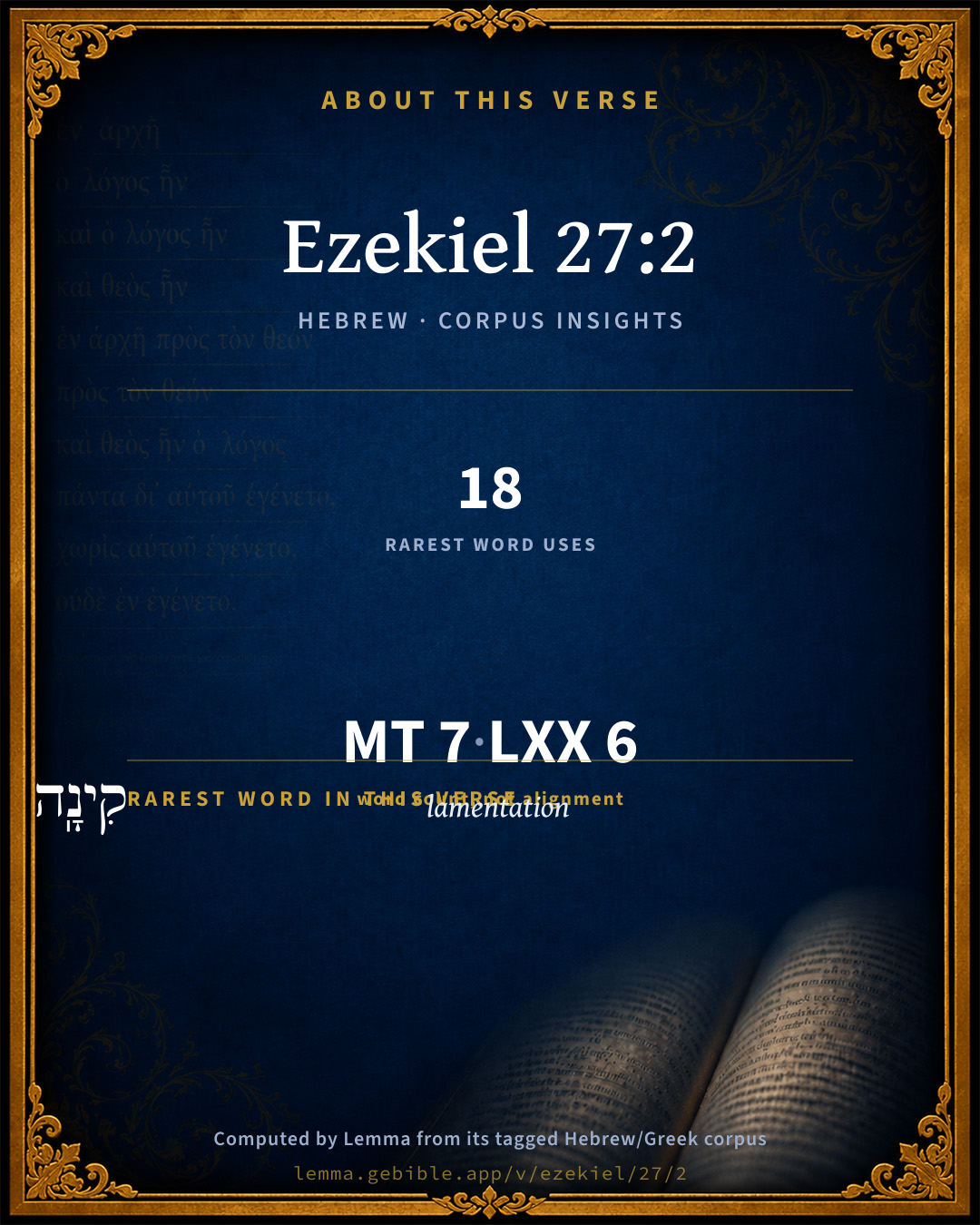
The rarest word here is קִינָֽה lamentation H7015 — appearing just 18 times in the whole Hebrew Bible.

Shared distinctive vocabulary

קִינָֽה lamentation H7015 occurs in 16 verses of the Hebrew Bible. Also found in:

Grammatical profile

  • 1 verb
  • 4 nouns
  • 1 pronoun
  • 1 preposition

Verb forms

  • שָׂ֥א Qal · Imperative

Hebrew & Septuagint length

In English translation the verse runs 10 words from the Hebrew and 11 from the Septuagint (LXX English) — closely comparable.

A rough comparison of the two English renderings, which tokenize alike — not a word-level alignment.

Word counts can differ between the Hebrew and the Greek without any difference in meaning — e.g. the Hebrew direct-object marker אֵת has no separate Greek word, and Greek often adds the article ὁ.

In the original languages it is 7 Hebrew tokens and 6 Greek tokens — but the two are counted differently (Hebrew bundles its prefixes and suffixes into one token; the Greek is in lemma form), so that isn’t a like-for-like length.

Cross-references

10

Topical passages linked to Ezekiel 27:2 in the Treasury of Scripture Knowledge — connected by theme and wording, ordered by reader-vote popularity; previews shown in the World English Bible.

  • Jeremiah 9:10 For the mountains will I take up a weeping and wailing, and for the pastures of the wilderness a lamentation, because they are burned up, so that none passes through; neither can men hear the voice of the cattle; both the birds of the sky and the animals are fled, they are gone.
  • Jeremiah 9:17–20 Thus says Yahweh of Hosts, Consider you, and call for the mourning women, that they may come; and send for the skillful women, that they may come:
  • Ezekiel 19:1 Moreover, take up a lamentation for the princes of Israel,
  • Ezekiel 28:12 Son of man, take up a lamentation over the king of Tyre, and tell him, Thus says the Lord Yahweh: You seal up the sum, full of wisdom, and perfect in beauty.
  • Jeremiah 7:20 Therefore thus says the Lord Yahweh: Behold, my anger and my wrath shall be poured out on this place, on man, and on animal, and on the trees of the field, and on the fruit of the ground; and it shall burn, and shall not be quenched.
  • Ezekiel 26:17 They shall take up a lamentation over you, and tell you, How are you destroyed, who were inhabited by seafaring men, the renowned city, who was strong in the sea, she and her inhabitants, who caused their terror to be on all who lived there!
  • Ezekiel 27:32 In their wailing they shall take up a lamentation for you, and lament over you, [saying], Who is there like Tyre, like her who is brought to silence in the midst of the sea?
  • Ezekiel 32:2 Son of man, take up a lamentation over Pharaoh king of Egypt, and tell him, You were likened to a young lion of the nations: yet are you as a monster in the seas; and you did break forth with your rivers, and troubled the waters with your feet, and fouled their rivers.
  • Amos 5:1 Listen to this word which I take up for a lamentation over you, O house of Israel.
  • Amos 5:16 Therefore thus says Yahweh, the God of hosts, the Lord: "Wailing will be in all the broad ways; And they will say in all the streets, 'Alas! Alas!' And they will call the farmer to mourning, And those who are skillful in lamentation to wailing.

Cross-references courtesy of OpenBible.info (CC BY 4.0).

Hebrew and Greek witnesses Masoretic Hebrew ↔ Greek Septuagint

The same verse in the two great witnesses to the Old Testament, shown verse-for-verse.

These are two independent witnesses, not word-aligned to each other, and the Septuagint is shown in lemma (dictionary) form.

Hebrew Ezekiel 27:2 Masoretic · Westminster Leningrad Codex

וְאַתָּ֣ה בֶן אָדָ֔ם שָׂ֥א עַל צֹ֖ר קִינָֽה

You, son of man, take up a lamentation over Tyre;

World English Bible · Public Domain

Greek LXX Ezekiel 27:2 Septuagint · lemma form

υἱός ἄνθρωπος λαμβάνω ἐπί σορ θρῆνος

And you, son of man, take up a lamentation against Sor;

LXX2012 (modern English Septuagint) · Public Domain

Hebrew: Westminster Leningrad Codex (CC BY 4.0). Greek: Septuagint (public domain); English from LXX2012 (modern English Septuagint) (Public Domain). How the Septuagint differs from the Hebrew →

Targum (Aramaic paraphrase)

1

The Targum is the ancient Jewish Aramaic paraphrase of the Hebrew Scriptures — an interpretive translation, not the Hebrew text itself. Onkelos (literal) and Pseudo-Jonathan (expansive) render the Torah, and Jonathan the Prophets. Coverage is partial: where no permissively-licensed English translation exists for a verse, only the Aramaic is shown. This is verse-level text, not a word-by-word alignment to the Hebrew.

  1. Targum Jonathan Prophets (Joshua–Malachi)
    וְאַתְּ בַּר אָדָם טוֹל עַל צוֹר אִלְיָא:

    (no public-domain English translation for this verse)

    Targum Jonathan — Aramaic: “Mikraot Gedolot” (public domain). English: “Sefaria Community Translation” (CC0 1.0 (public-domain dedication)); “London "Chaldee Paraphrase," 1871” (public domain). Text via Sefaria.

Commentary

Notes on Ezekiel 27:2 from classic Christian and Jewish commentators (each source and its license shown beneath its notes). The classic Christian expositions comment on the surrounding passage and are grouped to its opening verse, so a note may address several verses; the Jewish commentaries on the Tanakh (Rashi and others) are per-verse, so they appear only where the commentator wrote on this verse.

Lemma curates 59 commentaries, every one of them public domain or Creative Commons licensed, each selected and text-cleaned for this edition rather than reprinted as found. About our sources →

Trapp's Complete Commentary

John Trapp

Eze 27:2 Now, thou son of man, take up a lamentation for Tyrus;

Ver. 2. Take up a lamentation for Tyrus.] Fitly here compared to a goodly ship, {a} and her desolation to a dismal shipwreck. Theodoret’s note on the text is, that when we correct sinners, or threaten them, it should be done with commiseration and compassion. Here we have God’s own example for it.

“ Ille dolet quoties cogitur esse ferox. ”

{a} Apud Horat. Resp. navis nomine significatur. - Carm. lib. i. od. 14.

John Trapp, A Commentary or Exposition upon All the Books of the Old and New Testament (1647–1656) — public domain. Text from a community e-Sword module.

Joseph Benson's Commentary

Eze 27:2-4. Take up a lamentation for Tyrus — This alludes to the mournful lamentations used at funerals, wherein the mourning women recounted every thing that was valuable or praiseworthy belonging to the deceased, and then lamented the loss of him; and say, O thou that art situate at the entry of the sea — That art a sea-port, fitted by situation for carrying on trade with many countries: see Isa 23:1. Thou hast said, I am of perfect beauty — Thou hast boasted that thou hast every thing to render thee complete, and that there is nothing wanting to thee. Thy borders are in the midst of the seas — Thy dominions are not confined to the land, but extend far into the sea; where thou commandest without control, and sailest from place to place without interruption, to bring home thy riches. Thy builders have perfected thy beauty — Undoubtedly such a city as Tyre, which had store of riches, was built with great magnificence and beauty; but the following verses seem to show, that these words are chiefly to be understood of the builders of their ships, wherein the chief strength and glory of the Tyrians were placed.

Joseph Benson's Commentary on the Old and New Testaments (1811–1818) — public domain. Text from a community e-Sword module.

Adam Clarke's Commentary

Verse 2. Take up a lamentation for Tyrus] This is a singular and curious chapter. It gives a very circumstantial account of the trade of Tyre with different parts of the world, and the different sorts of merchandise in which she trafficked. The places and the imports are as regularly entered here as they could have been in a European custom-house.

Adam Clarke's Commentary on the Bible (1810–1826) — public domain. Text from a community e-Sword/MySword module.

The Cambridge Bible for Schools and Colleges

gen. ed. J. J. S. Perowne

Eze_27:1-11. Tyre as a gallant ship

2. For the phrase “take up a lamentation” cf. Eze_19:1, Eze_26:17, Eze_28:12, Eze_32:2. The word is technical for the dirge.

The Cambridge Bible for Schools and Colleges (gen. ed. J. J. S. Perowne; Cambridge University Press, 1878–1918) — public domain. Text from a community e-Sword module.

John Gill's Exposition

Now, thou son of man, take up a lamentation for Tyrus. Compose an elegy, and sing it; make a mournful noise, and deliver out a funeral ditty; such as the "praeficae", or mournful women, made at funerals, in which they said all they could in praise of the dead, and made very doleful lamentations for them: this the prophet was to do in a prophetic manner, for the confirmation of what was prophesied of by him; and it may teach us, that even wicked men are to be pitied, when in distress and calamity.

Now, thou son of man, take up a lamentation for Tyrus. Compose an elegy, and sing it; make a mournful noise, and deliver out a funeral ditty; such as the "praeficae", or mournful women, made at funerals, in which they said all they could in praise of the dead, and made very doleful lamentations for them: this the prophet was to do in a prophetic manner, for the confirmation of what was prophesied of by him; and it may teach us, that even wicked men are to be pitied, when in distress and calamity.

Ezekiel 27:3

eze 27:3

eze 27:3

eze 27:3And say unto Tyrus, O thou that art situate at the entry of the sea,.... Of the Mediterranean sea; at the eastern part of it, not above half a mile from the continent; and so fit for a seaport, and a harbour for shipping; so mystical Tyre sits on many waters, Rev 17:1,

which art a merchant of the people for many isles; the inhabitants of many isles brought the produce of them to her; who took them off their hands, or sold them for them to others; these came from several quarters to trade with her in her markets; and who supplied other isles and countries with all sorts of commodities, for which they either resorted to her, or she sent by ships unto them; so Rome is represented as the seat of merchandise, Rev 18:7,

thus saith the Lord God, O Tyrus, thou hast said; in thine heart, in the pride of it, and with thy mouth, praising and commending thyself; which is not right:

I am of perfect beauty: built on a good foundation, a rock; surrounded with walls and towers; the streets arranged in order, and filled with goodly houses; having a good harbour for shipping, and being a mart for all manner of merchandise, Jerusalem being destroyed, Tyre assumes her character, Psa 48:2.

John Gill's Exposition of the Whole Bible (1746–1763) — public domain (CC PDM 1.0). Text via the HelloAO Bible API.

Haydock's Catholic Bible Commentary

Lamentation. Such canticles were usual, and very poetical.

George Leo Haydock (1774–1849), Haydock's Catholic Family Bible and Commentary, 1859 edition — public domain. Excludes Psalms (Douay-Rheims chapter numbering differs from Protestant) and Deuterocanonical books (Catholic canon only).

Matthew Poole's English Annotations

Pen a mournful narrative of Tyre’s fall, tell the world what she was, and what she is come to; both city and citizens too.

Matthew Poole's English Annotations on the Holy Bible (1683–1685) — public domain. Text from a community e-Sword/MySword module.

Whedon's Commentary on the Bible

Daniel D. Whedon

2. A lamentation — Rather, dirge. (See also Eze_19:1; Eze_26:17; Eze_28:12; Eze_32:2.) So full of lifelike detail is this “dirge” that Dr. Plumptre can say, “Ezekiel, we must believe, had at some time or other in his life trod the sinful streets of the great city and noted the mingled crowd of many nations, in many costumes that he met there, just as we infer from Dante’s vivid descriptions of the dockyards of Venice (Inferno, Eze_21:7-15) that he had visited that city.”

Daniel D. Whedon (gen. ed.), Commentary on the Old and New Testaments (1874–1909) — public domain. Text from a community e-Sword module.

The Pulpit Commentary

Take up a lamentation for Tyrus. The dirge over the merchant-city that follows, the doom sic transit gloria mundi, worked out with a fullness of detail which reminds us of the Homeric catalogue of ships ("Iliad," 2:484-770), is almost, if not altogether, without a parallel in the history of literature. It can scarcely have rested on anything but personal knowledge. Ezekiel, we must believe, had, at some time or other in his life, trod the sinful streets of the great city, and noted the mingled crowd of many nations and in many costumes that he met there, just as we infer from Dante"s vivid description of the dockyards of Venice ("Inf.," 21:7-15) that he had visited that city. Apart from its poetic or prophetic interest, it is for us almost the locus classicus as to the geography and commerce of that old world of which Tyre was in some sense the center. We may compare it, from that point of view, with the ethnological statements in Genesis 10.; just as, from the standpoint of prophecy, it has to be compared with Isaiah"s "burden" against Babylon, (Isa 13:, Isa_13:14) and with St. John"s representation of Rome as the spiritual Babylon of the Apocalypse. (Re 18)

Ver. 2. A lamentation for Tyre.

In the previous chapter the prophet denounced judgment on Tyre; in this chapter he utters a lamentation over the doomed city. The one is in the spirit of vengeance, the other in the spirit of sympathy. The prophet thus reveals to us two elements in the Divine treatment of sin first the wrath that punishes, then the tenderness that commiserates.

I TYRE IS IN A LAMENTABLE CONDITION. At present she is wealthy and prosperous. But the prophet looks into the future and sees her doom approaching. Therefore he sings her funeral dirge while the thoughtless city still revels in luxury. Christ uttered his lament over Jerusalem before a shadow of approaching calamity had fallen on the wicked city.

1. It is lamentable to be living under a doom of destruction. In ignorance, unbelief, or carelessness, men enjoy life although they are guilty of sins that must bring down the wrath of Heaven. "As in the days that were before the Flood, they were eating and drinking, marrying and giving in marriage, until the day that Noah entered into the ark". (Mat_24:38) But to thoughtful spectators such unseemly gaiety is only a source of profound distress. Surely if men would but look up, the sword of Damocles above their heads should arrest the untimely mirth. It is fearful for the wise to be lamenting over the approaching fate which the foolish will not perceive.

2. It is more lamentable to be living in the sin that deserves this doom. Sin is worse than its punishment. Whatever men may believe about the future, the present case of the sinner is most deplorable. If he glories in his shame, that shame is only the more lamentable. The most wretched condition of the prodigal son is that before he has come to himself, when he revels insanely in his degradation.

II THE CONDITION OF TYRE EXCITES COMMISERATION IN THE SERVANT OF GOD. Ezekiel does not merely threaten vengeance, he bewails the ill-fated city. It was the crowning fault of Jonah that he had no pity for Nineveh. (Jon_4:1) No one is fit to speak of future punishment who is not moved to tenderness by a contemplation of its woes. A harsh denunciatory style is not in harmony with the example of Hebrew prophecy, much less does it agree with the New Testament model.

1. Sin should not destroy pity, but excite it. Jerusalem was most wicked; therefore Christ wept. (Luk_19:41)

2. The heathen call for our commiseration. Missionary enterprises are founded on two great motives the claims of Christ, and the pitiable condition of the Christless. Human brotherhood should excite sympathy for the condition of the most remote. This was here seen in Judaism; much more is it to be looked for in Christianity.

3. We should be most concerned at the sin and danger of our friends. Tyre was an old ally of Israel. If the Jews had been more faithful, possibly the Phoenicians might have been saved. Our negligence may be to blame for the fate of our friends.

III THE LAMENTATION FOR TYRE DID NOT SAVE THE CITY.

1. Lamentation will not save without repentance. The fear of future punishment will not give a means of escape from that punishment. We must go farther to a confession of sin and a desire for a better life.

2. The lamentation of others will not save the impenitent. Ezekiel"s elegy did not deliver Tyre. Even Christ"s tears did not save Jerusalem.

3. The cross of Christ is the supreme condition of salvation. Our own tears, a prophet"s tears, even Christ"s tears, will not save. But Christ"s death brings deliverance for all who will have it, by atoning for sin and reconciling the sinner to God. When no prophet"s lamentation will move the hardened sinner, the sight of Christ on the cross dying for him should melt him to penitence.

The Pulpit Commentary (1880–1919), ed. H.D.M. Spence-Jones & Joseph S. Exell — public domain. Text from a community e-Sword module.

John Wesley's Explanatory Notes

A lamentation - We ought to mourn for the miseries of other nations, as well as of our own, out of an affection for mankind in general; yea, tho' they have brought them upon themselves.

John Wesley, Explanatory Notes Upon the Whole Bible (1754–1765) — public domain. Text via the GEBible commentary corpus.

Lesson kit

Teaching starters — assembled from the data on this page, not authored interpretation. Every prompt links to the verse data it draws on. Edit before teaching.

Ezekiel, in the Prophets, opens this verse with 7 words (7 distinct Hebrew lemmas). Its most distinctive word is qîynâh (“lamentation”). A historical commentator’s framing appears above. Read the whole chapter for the surrounding context.

Discussion questions

  1. The word qîynâh carries the sense “lamentation.” How does it shape the verse?
  2. 2 Samuel 1:17 shares the word «lamentation» with this verse. How do the two illuminate each other?
  3. The translations on this page render this verse differently — a whole-verse word diff, not a word-by-word alignment. What might account for the different wordings?
  4. The verb «שָׂ֥א» is Qal Imperative. How does its form color the action?
  5. Reading how Trapp's Complete Commentary and Joseph Benson's Commentary read this verse, where do the two commentators agree and where do they part?

Things to notice

Reading settings

Reading text

Shown beneath each verse's original-language words.

Old Testament
Old Testament edition

Read the OT as the Masoretic Hebrew (MT) or the Greek Septuagint (LXX).

English shown for the Greek Septuagint (in the Hebrew ↔ Greek comparison).

Comparing translations? Open the Compare panel on any verse page to stack up to four side by side.