
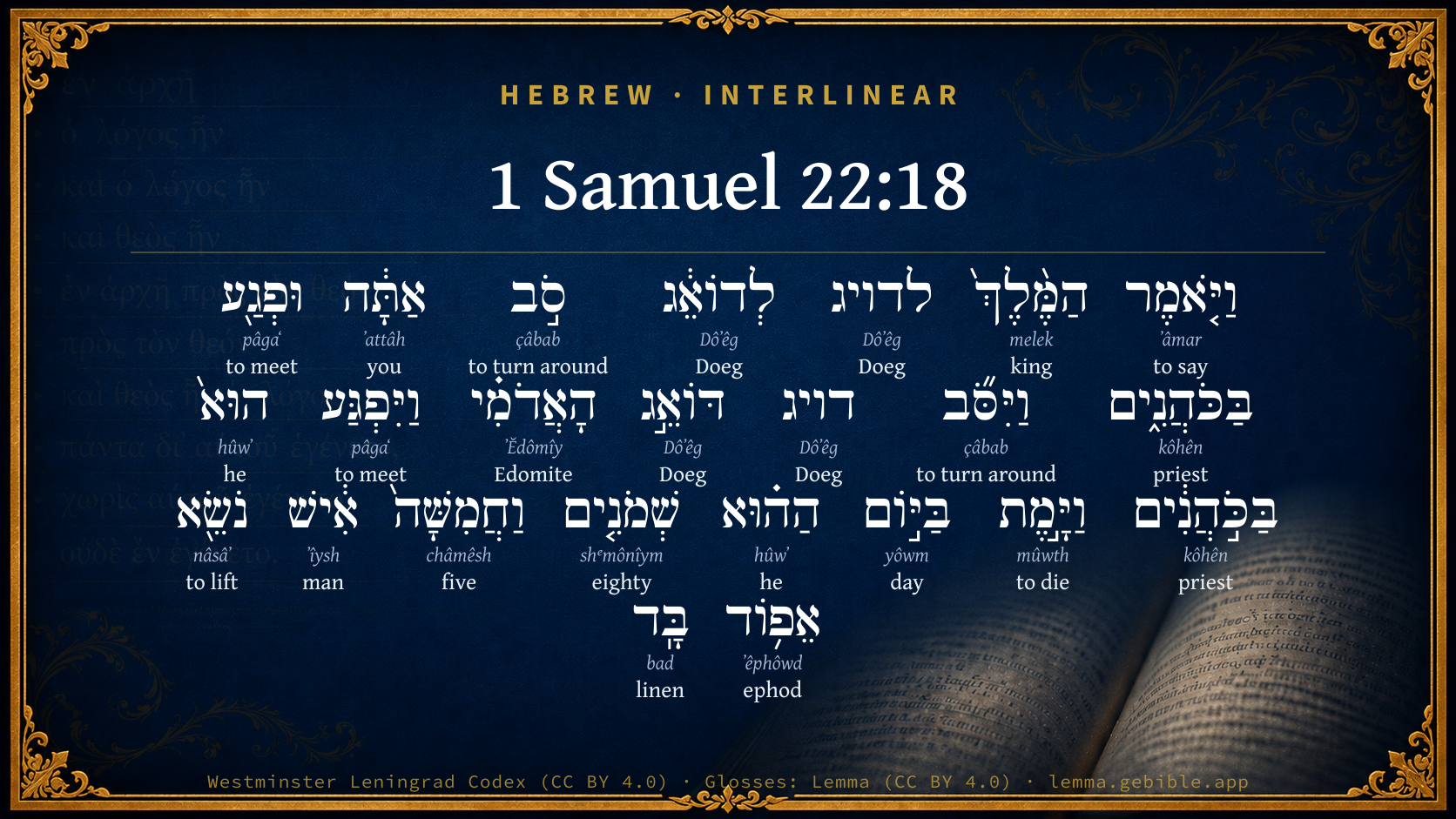
1 Samuel 22:18

Hebrew (Westminster Leningrad Codex) 1 Samuel 22:18 appears in the Hebrew Old Testament. The text above is from the Westminster Leningrad Codex. Each word links to its Strong’s number, a concise gloss, and parsing drawn from the Open Scriptures Hebrew Bible morphology. Click any word for its full Brown-Driver-Briggs (BDB) entry.
Download image
Cite this verse

1 Samuel 22:18 (World English Bible). Public Domain. Lemma interlinear Bible study tool, https://lemma.gebible.app/v/1-samuel/22/18.

Show BibTeX & RIS
BibTeX
RIS
English Translation
The king said to Doeg, Turn you, and fall on the priests. Doeg the Edomite turned, and he fell on the priests, and he killed on that day eighty-five persons who wore a linen ephod.
World English Bible · Public Domain
Download a study sheet

One document with this verse’s original text, its word-by-word gloss line, the meaning frame, cross-references with their text, attributed commentary, and full source and license credits — printable, and it pastes into notes with its structure intact.

This verse Autodidact and up

Study sheet (.html) Plain text (.txt)

A passage Seminary Student

Up to 50 verses in one chapter. A passage sheet keeps up to 6 commentary sources and 12 cross-references per verse, in the order this page ranks them, and says so on the sheet whenever that leaves anything out. Ask for a single verse and you get the Autodidact verse sheet above.

Everything on this page stays free to read, with no account — the sheet is a download of what is already on screen, not access to it.

Want to remove ads? Support Godless Engineer
Compare translations 3

The same verse in 3 English versions, stacked beneath the original-language interlinear above. Click any original word for its lexicon entry.

Each is an independent rendering of the whole verse — the interlinear is not word-aligned to these translations.

Highlighted words mark where these versions differ — a whole-verse word diff, not a word-by-word alignment.

  • World English Bible Public Domain
    The king said to Doeg, Turn you, and fall on the priests. Doeg the Edomite turned, and he fell on the priests, and he killed on that day eighty-five persons who wore a linen ephod.
  • King James Version Public Domain
    And the king said to Doeg, Turn thou, and fall upon the priests. And Doeg the Edomite turned, and he fell upon the priests, and slew on that day fourscore and five persons that did wear a linen ephod.
  • unfoldingWord Literal Text CC BY-SA 4.0
    So the king said to Doeg, “You turn and attack the priests!” So Doeg the Edomite turned and he himself attacked the priests. And on that day he killed 85 men wearing a linen ephod.

unfoldingWord Literal Text — © unfoldingWord, licensed CC BY-SA 4.0. Word-aligned USFM3 via Door43 (git.door43.org/unfoldingWord/en_ult).

Versions to compare (up to 4)

3 of 4 selected

Show all 18 translations

Every available English version of this verse, each an independent rendering of the whole verse.

  • World English Bible Public Domain
    The king said to Doeg, Turn you, and fall on the priests. Doeg the Edomite turned, and he fell on the priests, and he killed on that day eighty-five persons who wore a linen ephod.
  • Berean Standard Bible Public Domain
    So the king ordered Doeg, “You turn and strike down the priests!” And Doeg the Edomite turned and struck down the priests himself. On that day he killed eighty-five men who wore the linen ephod.
  • Majority Standard Bible Public Domain
    So the king ordered Doeg, “You turn and strike down the priests!” And Doeg the Edomite turned and struck down the priests himself. On that day he killed eighty-five men who wore the linen ephod.
  • King James Version Public Domain
    And the king said to Doeg, Turn thou, and fall upon the priests. And Doeg the Edomite turned, and he fell upon the priests, and slew on that day fourscore and five persons that did wear a linen ephod.
  • American Standard Version (1901) Public Domain
    And the king said to Doeg, Turn thou, and fall upon the priests. And Doeg the Edomite turned, and he fell upon the priests, and he slew on that day fourscore and five persons that did wear a linen ephod.
  • Revised Version (1885) Public Domain
    And the king said to Doeg, Turn thou, and fall upon the priests. And Doeg the Edomite turned, and he fell upon the priests, and he slew on that day fourscore and five persons that did wear a linen ephod.
  • Geneva Bible (1599) Public Domain
    Then the King sayde to Doeg, Turne thou and fall vpon the Priests. And Doeg the Edomite turned, and ran vpon the Priestes, and slewe that same daye foure score and fiue persons that did weare a linen Ephod.
  • Douay-Rheims (1899) Public Domain
    And the king said to Doeg: Turn thou, and fall upon the priests. And Doeg the Edomite turned, and fell upon the priests and slew in that day eighty-five men that wore the linen ephod.
  • Young's Literal Translation Public Domain
    And the king saith to Doeg, `Turn round thou, and come against the priests;' and Doeg the Edomite turneth round, and cometh himself against the priests, and putteth to death in that day eighty and five men bearing a linen ephod,
  • Literal Standard Version CC BY-SA 4.0
    And the king says to Doeg, “Turn around, and come against the priests”; and Doeg the Edomite turns around, and comes against the priests himself, and in that day puts to death eighty-five men bearing a linen ephod,
  • Unlocked Literal Bible CC BY-SA 4.0
    Then the king said to Doeg, “Turn and kill the priests.” So Doeg the Edomite turned and attacked the priests; he killed eighty-five persons who wore a linen ephod that day.
  • unfoldingWord Literal Text CC BY-SA 4.0
    So the king said to Doeg, “You turn and attack the priests!” So Doeg the Edomite turned and he himself attacked the priests. And on that day he killed 85 men wearing a linen ephod.
  • Darby Bible Public Domain
    And the king said to Doeg, Turn thou, and fall on the priests. And Doeg the Edomite turned, and fell on the priests, and put to death that day eighty-five persons who wore the linen ephod.
  • World Messianic Bible Public Domain
    The king said to Doeg, “Turn and attack the priests!” Doeg the Edomite turned, and he attacked the priests, and he killed on that day eighty-five people who wore a linen ephod.
  • Webster's Bible Public Domain
    And the king said to Doeg, Turn thou, and fall upon the priests. And Doeg the Edomite turned, and he fell upon the priests, and slew on that day eighty and five persons that wore a linen ephod.
  • Free Bible Version CC BY-SA 4.0
    So the king ordered Doeg, “You kill the priests!” Doeg the Edomite attacked and killed the priests, killing eighty-five men wearing the priestly ephod.
  • Bible in Basic English Public Domain
    Then the king said to Doeg, You are to put the priests to death. And Doeg the Edomite, turning on the priests and attacking them, put to death that day eighty-five men who took up the ephod.
  • JPS Tanakh (1917) Public Domain
    And the king said to Doeg: 'Turn thou, and fall upon the priests.' And Doeg the Edomite turned, and he fell upon the priests, and he slew on that day fourscore and five persons that did wear a linen ephod.

Literal Standard Version (2020), Covenant Press — licensed CC BY-SA 4.0. Text via the HelloAO Bible API (eBible.org). Unlocked Literal Bible (unfoldingWord) — licensed CC BY-SA 4.0. Text via the HelloAO Bible API (eBible.org). unfoldingWord Literal Text — © unfoldingWord, licensed CC BY-SA 4.0. Word-aligned USFM3 via Door43 (git.door43.org/unfoldingWord/en_ult). Free Bible Version, Dr. Jonathan Gallagher — licensed CC BY-SA 4.0. Text via the HelloAO Bible API (eBible.org).

Word by word

More ways to search: Search by grammar → Find every occurrence → Compare this word →

Practice this passage: Drill this verse → Learn its vocabulary →

לדויג
Dôʼêg
H1673
“to/for · Doeg”
Preposition + Noun, Proper
Part of Speech
Preposition + Noun
Type
Proper
Full BDB Definition

Origin: act. participle of H1672

TWOT: None

Doeg = "fearing" - an Edomite, chief of Saul's herdsmen, who slew all the priests
  1. וַיֹּ֤אמֶר ʼâmar H559 “and · to say” Conjunction + Verb, Qal, Sequential Imperfect, 3rd Person, Masculine, Singular
  2. הַמֶּ֨לֶךְ֙ melek H4428 “the · king” Particle, Definite Article + Noun, Common, Masculine, Singular, Absolute
  3. לְדוֹאֵ֔ג Dôʼêg H1673 “to/for · Doeg” Preposition + Noun, Proper
  4. סֹ֣ב çâbab H5437 “turn around” Verb, Qal, Imperative, 2nd Person, Masculine, Singular
  5. אַתָּ֔ה ʼattâh H859 “you” Pronoun, Personal, 2nd Person, Masculine, Singular
  6. וּפְגַ֖ע pâgaʻ H6293 “and · meet” Conjunction + Verb, Qal, Imperative, 2nd Person, Masculine, Singular
  7. בַּכֹּהֲנִ֑ים kôhên H3548 “in/at the · priests” Preposition, Determined + Noun, Common, Masculine, Plural, Absolute
  8. וַיִּסֹּ֞ב çâbab H5437 “and · to turn around” Conjunction + Verb, Qal, Sequential Imperfect, 3rd Person, Masculine, Singular
  9. דויג Dôʼêg H1673 “Doeg” Noun, Proper
  10. דּוֹאֵ֣ג Dôʼêg H1673 “Doeg” Noun, Proper
  11. הָאֲדֹמִ֗י ʼĔdômîy H130 “the · Edomite” Particle, Definite Article + Noun, Gentilic, Masculine, Singular, Absolute
  12. וַיִּפְגַּע pâgaʻ H6293 “and · to meet” Conjunction + Verb, Qal, Sequential Imperfect, 3rd Person, Masculine, Singular
  13. הוּא֙ hûwʼ H1931 “he” Pronoun, Personal, 3rd Person, Masculine, Singular
  14. בַּכֹּ֣הֲנִ֔ים kôhên H3548 “in/at the · priests” Preposition, Determined + Noun, Common, Masculine, Plural, Absolute
  15. וַיָּ֣מֶת mûwth H4191 “and · to die” Conjunction + Verb, Hiphil, Sequential Imperfect, 3rd Person, Masculine, Singular
  16. בַּיּ֣וֹם yôwm H3117 “in/at the · day” Preposition, Determined + Noun, Common, Masculine, Singular, Absolute
  17. הַה֗וּא hûwʼ H1931 “the · he” Particle, Definite Article + Pronoun, Personal, 3rd Person, Masculine, Singular
  18. שְׁמֹנִ֤ים shᵉmônîym H8084 “eighty” Adjective, Cardinal number, Both, Plural, Absolute
  19. וַחֲמִשָּׁה֙ châmêsh H2568 “and · five” Conjunction + Adjective, Cardinal number, Masculine, Singular, Absolute
  20. אִ֔ישׁ ʼîysh H376 “man” Noun, Common, Masculine, Singular, Absolute
  21. נֹשֵׂ֖א nâsâʼ H5375 “lifting” Verb, Qal, Participle Active, Masculine, Singular, Absolute
  22. אֵפ֥וֹד ʼêphôwd H646 “ephod of” Noun, Common, Masculine, Singular, Construct
  23. בָּֽד bad H906 “linen” Noun, Common, Masculine, Singular, Absolute

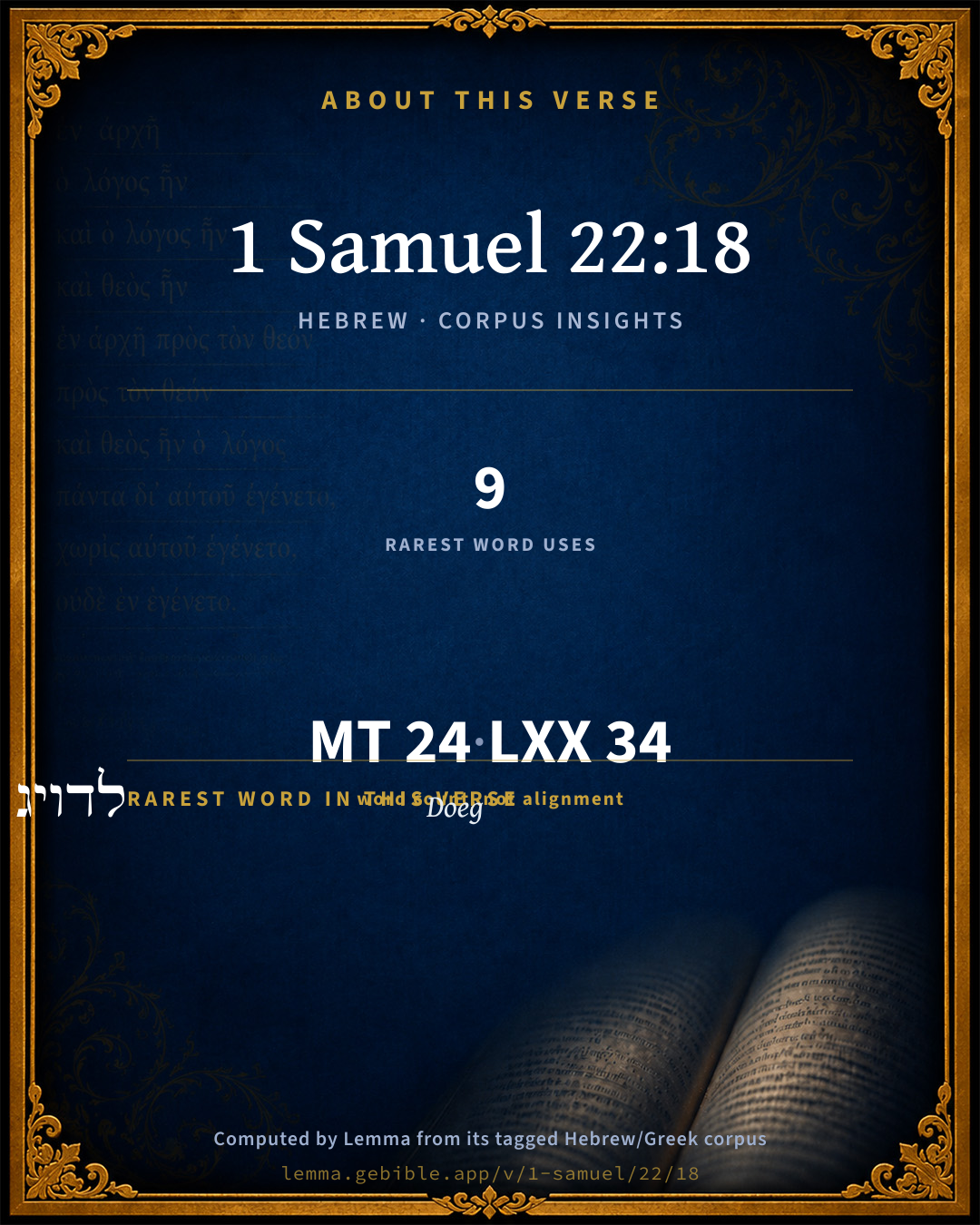
About this verse

These counts appear in no published source. They are computed here, from the morphology-tagged text and Lemma’s own curated glosses. What Lemma adds →

24
words
17
distinct lemmas
Historical
section

Notable vocabulary

The rarest word here is לדויג Doeg H1673 — appearing just 9 times in the whole Hebrew Bible.

Shared distinctive vocabulary

לדויג Doeg H1673 occurs in 5 verses of the Hebrew Bible. Also found in:

Grammatical profile

  • 7 verbs
  • 12 nouns
  • 2 adjectives
  • 3 pronouns

Verb forms

  • וַיֹּ֤אמֶר Qal · Sequential Imperfect
  • סֹ֣ב Qal · Imperative
  • וּפְגַ֖ע Qal · Imperative
  • וַיִּסֹּ֞ב Qal · Sequential Imperfect
  • וַיִּפְגַּע Qal · Sequential Imperfect
  • וַיָּ֣מֶת Hiphil · Sequential Imperfect
  • נֹשֵׂ֖א Qal · Participle Active

Repetition

Words recur within this verse — often emphatic in Hebrew:

  • לדויג Doeg H1673 ×4
  • סֹ֣ב to turn around H5437 ×2
  • וּפְגַ֖ע to meet H6293 ×2
  • בַּכֹּהֲנִ֑ים priest H3548 ×2
  • הוּא֙ he H1931 ×2

Hebrew & Septuagint length

In English translation the verse runs 35 words from the Hebrew and 37 from the Septuagint (LXX English) — closely comparable.

A rough comparison of the two English renderings, which tokenize alike — not a word-level alignment.

Word counts can differ between the Hebrew and the Greek without any difference in meaning — e.g. the Hebrew direct-object marker אֵת has no separate Greek word, and Greek often adds the article ὁ.

In the original languages it is 24 Hebrew tokens and 34 Greek tokens — but the two are counted differently (Hebrew bundles its prefixes and suffixes into one token; the Greek is in lemma form), so that isn’t a like-for-like length.

Cross-references

12

Topical passages linked to 1 Samuel 22:18 in the Treasury of Scripture Knowledge — connected by theme and wording, ordered by reader-vote popularity; previews shown in the World English Bible.

  • Acts 26:10–11 This I also did in Jerusalem. I both shut up many of the saints in prisons, having received authority from the chief priests, and when they were put to death I gave my vote against them.
  • Exodus 28:40 "You shall make coats for Aaron's sons, and you shall make sashes for them and headbands shall you make for them, for glory and for beauty.
  • 1 Samuel 2:18 But Samuel ministered before Yahweh, being a child, girded with a linen ephod.
  • 1 Samuel 2:28 and did I choose him out of all the tribes of Israel to be my priest, to go up to my altar, to burn incense, to wear an ephod before me? and did I give to the house of your father all the offerings of the children of Israel made by fire?
  • 1 Samuel 2:36 It shall happen, that everyone who is left in your house shall come and bow down to him for a piece of silver and a loaf of bread, and shall say, Please put me into one of the priests' offices, that I may eat a morsel of bread.
  • 1 Samuel 3:12–14 In that day I will perform against Eli all that I have spoken concerning his house, from the beginning even to the end.
  • 2 Chronicles 24:21 They conspired against him, and stoned him with stones at the commandment of the king in the court of the house of Yahweh.
  • Hosea 5:11 Ephraim is oppressed, He is crushed in judgment; Because he is intent in his pursuit of idols.
  • Hosea 7:3 They make the king glad with their wickedness, And the princes with their lies.
  • Micah 6:16 For the statutes of Omri are kept, And all the works of the house of Ahab. You walk in their counsels, That I may make you a ruin, And her inhabitants a hissing; And you will bear the reproach of my people."
  • Zephaniah 3:3 Her princes in the midst of her are roaring lions. Her judges are evening wolves. They leave nothing until the next day.
  • 1 Samuel 2:30–33 Therefore Yahweh, the God of Israel, says, I said indeed that your house, and the house of your father, should walk before me forever: but now Yahweh says, Be it far from me; for those who honor me I will honor, and those who despise me shall be lightly esteemed.

Cross-references courtesy of OpenBible.info (CC BY 4.0).

Hebrew and Greek witnesses Masoretic Hebrew ↔ Greek Septuagint

The same verse in the two great witnesses to the Old Testament, shown verse-for-verse.

These are two independent witnesses, not word-aligned to each other, and the Septuagint is shown in lemma (dictionary) form.

Hebrew 1 Samuel 22:18 Masoretic · Westminster Leningrad Codex

וַיֹּ֤אמֶר הַמֶּ֨לֶךְ֙ לדויג לְדוֹאֵ֔ג סֹ֣ב אַתָּ֔ה וּפְגַ֖ע בַּכֹּהֲנִ֑ים וַיִּסֹּ֞ב דויג דּוֹאֵ֣ג הָאֲדֹמִ֗י וַיִּפְגַּע הוּא֙ בַּכֹּ֣הֲנִ֔ים וַיָּ֣מֶת בַּיּ֣וֹם הַה֗וּא שְׁמֹנִ֤ים וַחֲמִשָּׁה֙ אִ֔ישׁ נֹשֵׂ֖א אֵפ֥וֹד בָּֽד

The king said to Doeg, Turn you, and fall on the priests. Doeg the Edomite turned, and he fell on the priests, and he killed on that day eighty-five persons who wore a linen ephod.

World English Bible · Public Domain

Greek LXX 1 Samuel 22:18 Septuagint · lemma form

καί εἶπον ὁ βασιλεύς ὁ δωηκ ἐπιστρέφω σύ καί ἀποἀντάω εἰς ὁ ἱερεύς καί ἐπιστρέφω δωηκ ὁ σύρος καί θανατόω ὁ ἱερεύς κύριος ἐν ὁ ἡμέρα ἐκεῖνος τριακόσιοι καί πέντε ἀνήρ πᾶς αἴρω εφουδ

And the king said to Doec, Turn you, and fall upon the priests: and Doec the Syrian turned, and killed the priests of the Lord in that day, three hundred and five men, all wearing an ephod.

LXX2012 (modern English Septuagint) · Public Domain

On this verse, Trapp's Complete Commentary discusses the Septuagint’s reading. Read the note in Commentary ↓

Hebrew: Westminster Leningrad Codex (CC BY 4.0). Greek: Septuagint (public domain); English from LXX2012 (modern English Septuagint) (Public Domain). How the Septuagint differs from the Hebrew →

Targum (Aramaic paraphrase)

1

The Targum is the ancient Jewish Aramaic paraphrase of the Hebrew Scriptures — an interpretive translation, not the Hebrew text itself. Onkelos (literal) and Pseudo-Jonathan (expansive) render the Torah, and Jonathan the Prophets. Coverage is partial: where no permissively-licensed English translation exists for a verse, only the Aramaic is shown. This is verse-level text, not a word-by-word alignment to the Hebrew.

  1. Targum Jonathan Prophets (Joshua–Malachi)
    וַאֲמַר מַלְכָּא לְדוֹאֵג אִסְתְּחַר אַתְּ וּשְׁלוֹט בְּכַהֲנַיָא וְאִסְתְּחַר דוֹאֵג אֱדוֹמָאָה וּשְׁלַט הוּא בְּכַהֲנַיָא וּקְטַל בְּיוֹמָא הַהוּא תַּמְנָן וְחַמְשָׁא גַבְרִין דְכַשְׁרִין לְמִלְבַּשׁ אֵפוֹד דְבוּץ:

    (no public-domain English translation for this verse)

    Targum Jonathan — Aramaic: “Mikraot Gedolot” (public domain). English: “Sefaria Community Translation” (CC0 1.0 (public-domain dedication)); “London "Chaldee Paraphrase," 1871” (public domain). Text via Sefaria.

Commentary

Notes on 1 Samuel 22:18 from classic Christian and Jewish commentators (each source and its license shown beneath its notes). The classic Christian expositions comment on the surrounding passage and are grouped to its opening verse, so a note may address several verses; the Jewish commentaries on the Tanakh (Rashi and others) are per-verse, so they appear only where the commentator wrote on this verse.

Lemma curates 59 commentaries, every one of them public domain or Creative Commons licensed, each selected and text-cleaned for this edition rather than reprinted as found. About our sources →

Trapp's Complete Commentary

John Trapp

1Sa 22:18 And the king said to Doeg, Turn thou, and fall upon the priests. And Doeg the Edomite turned, and he fell upon the priests, and slew on that day fourscore and five persons that did wear a linen ephod.

Ver. 18. And Doeg the Edomite.] Not the Syrian, as the Septuagint, by a mistake of letters, renders it, but the bloody Esavite.

And he fell upon the priests.] Who were privileged persons in all nations, and spared even in battle, as were the bards here.

And slew on that day forescore and five persons,] viz., By the help of his hacksters and assassins. Some say that Armoni and Mephibosheth, the two sons of Saul by his concubine Rizpa, who were afterwards hanged, helped Doeg: but that is uncertain.

That did wear a linen ephod.] And, as some think, {a} came to Saul now in those clothes, to move him rather to spare them.

{a} Lyra. Osiander.

John Trapp, A Commentary or Exposition upon All the Books of the Old and New Testament (1647–1656) — public domain. Text from a community e-Sword module.

Joseph Benson's Commentary

1Sa 22:18. Doeg the Edomite turned and fell upon the priests — The country of Doeg is very properly here mentioned, and again repeated, to wipe off the stain of this butchery from the Israelitish nation, and to show why he was so ready to do it; because he was one of that nation which had an implacable hatred against all Israelites, and against the priests of the Lord. And slew on that day fourscore and five persons — “The massacre of these innocent men was so outrageous, so bloody, and so horrible, that it paints the character of Saul in the blackest colours, and exposes him as a warning, not only to tyrannical monarchs, but likewise to private persons, who give a loose to the instigations of jealous suspicions and intemperate wrath.” — Chandler. That did wear a linen ephod — That is, ministered unto the Lord; but we are not to understand by the ephod such a garment as the high-priest wore, for this is distinguished from the high-priest’s ephod by the matter of it, which was merely linen. The priests had probably all put on this habit, on account of appearing before the king.

Joseph Benson's Commentary on the Old and New Testaments (1811–1818) — public domain. Text from a community e-Sword module.

Tyndale Open Study Notes

Tyndale Open Resources

22:18 Doeg the Edomite . . . killed them: As a non-Israelite, Doeg had no concern for the sanctity of God-anointed priests. He knew he was executing innocent men. This evil foreigner partially fulfilled the prophecy about the condemned priestly line of Eli (2:27-34; see 1 Kgs 2:27). • still wearing their priestly garments: This incident illustrates how mad Saul had become. Not even those holding a sacred office were safe.

Tyndale Open Study Notes — © Tyndale Open Resources, licensed CC BY-SA 4.0. Text via the HelloAO Bible API.

Adam Clarke's Commentary

Verse 18. And Doeg-fell upon the priests] A ruthless Edomite, capable of any species of iniquity.

Fourscore and five persons] The Septuagint read τριακοσιους και πεντε ανδρας, three hundred and five men; and Josephus has three hundred and eighty-five men. Probably the eighty-five were priests; the three hundred, the families of the priests; three hundred and eighty-five being the whole population of Nob.

That did wear a linen ephod.] That is, persons who did actually administer, or had a right to administer, in sacred things. The linen ephod was the ordinary clothing of the priests.

Adam Clarke's Commentary on the Bible (1810–1826) — public domain. Text from a community e-Sword/MySword module.

Ellicott's Commentary for English Readers

(18) And Doeg the Edomite . . . fell upon the priests, and slew on that day fourscore and five persons.—No doubt, assisted by his own attached servants, Doeg carried out this deed of unexampled barbarity. For this act the Edomite servant of Saul has been execrated in the most ancient Jewish writings perhaps above any other of the famous wicked men who meet us in the Holy Scriptures. For instance, we read in the Babylonian Talmud how “Doeg the Edomite, after his massacre of the priests, was encountered by three destructive demons. One deprived him of his learning (concerning which see above, in Note on 1Sa_22:9), a second burned his soul, and a third scattered his dust in the synagogues”—Treatise Sanhedrin, fol. 106, Colossians 2. The Babylonian Talmud has a still more curious comment on the iniquity of Doeg, in which David is bitterly reproached by the Most High for being the cause of Doeg’s great sin and its terrible consequences. “Rav Yehudah recorded that Rav had said . . . The Holy One, blessed be He! had said to David, How long shall this iniquity cling to thee? Through thee the priests of Nob were slain; through thee Doeg the Edomite became a reprobate; and through thee Saul and his three sons were slain.”—Treatise Sanhedrin, fol. 95, cols. 1, 2.

A linen ephod.—The ordinary priests appear to have worn a linen over garment, similar in form to the high priestly cape or ephod. They came probably from Nob to Gibeah (the distance was not great) clad in their official costume, out of respect to the king who sent for them. The murderous deed assumes a still more awful character when we recollect who were the victims—the priests of the living God, clad in their white ministering robes!

A Bible Commentary for English Readers, edited by Charles John Ellicott (1878–1897) — public domain. Text from a community e-Sword module.

The Cambridge Bible for Schools and Colleges

gen. ed. J. J. S. Perowne

18. that did wear a linen ephod] See on 1Sa_2:18. The distinctive priestly dress should have reminded Saul of the sacredness of their persons.

The Cambridge Bible for Schools and Colleges (gen. ed. J. J. S. Perowne; Cambridge University Press, 1878–1918) — public domain. Text from a community e-Sword module.

John Gill's Exposition

And the king said to Doeg, turn thou and fall upon the priests,.... For determined he was they should die; if one would not put them to death, another should, and who so fit for this bloody work as the false accuser of them, and false witness against them?

and Doeg the Edomite turned; immediately, he at once obeyed the king's orders, as brutish as they were:

and fell upon the priests; with his sword in hand:

and slew on that day fourscore and five persons that did wear a linen ephod; not the ephod of Urim and Thummim, which was only worn by the high priest, but a garment wholly linen, worn by common priests; the Targum is,"who are fit to be clothed with a linen ephod;''not that they were clothed with it, but were deserving of it; or it designs the great and more honourable among the servants of the Lord, as Kimchi observes, for such were clothed with this garment, as Samuel and David; and he thinks it suggests, that more were slain than these; and the Septuagint version makes them to be eight hundred five, and Josephus (h) three hundred eighty five; in the slaying of whom, as the same writer says, Doeg was assisted by some wicked men like himself; and the slaughter did not end here, as the Sa1 22:19 shows.

(h) Antiqu. l. 6. c. 12. sect. 6.

John Gill's Exposition of the Whole Bible (1746–1763) — public domain (CC PDM 1.0). Text via the HelloAO Bible API.

Albert Barnes' Notes on the Bible

We are not to suppose that Doeg killed them all with his own hand. He had a band of men under his command, many or all of whom were perhaps foreigners like himself, and very likely of a Bedouin caste, to whom bloodshed would be quite natural, and the priests of the Lord of no more account than so Early sheep or oxen.

Albert Barnes' Notes on the Bible (1834–1885) — public domain. Text from a community e-Sword/MySword module.

Haydock's Catholic Bible Commentary

Five. Josephus read "385." Septuagint, "305." --- Ephod. They all appeared in this dress, as they were priests. (Calmet) --- It was different from the sacred ephod. (Abulensis) --- Thus the posterity of Heli was almost entirely cut off, as God had threatened, chap. ii. (Du Hamel; Tirinus)

George Leo Haydock (1774–1849), Haydock's Catholic Family Bible and Commentary, 1859 edition — public domain. Excludes Psalms (Douay-Rheims chapter numbering differs from Protestant) and Deuterocanonical books (Catholic canon only).

Matthew Poole's English Annotations

Turn thou; or, go about, to wit, from man to man, till thou hast killed all.

The Edomite; which is noted to wipe off the stain of this butchery from the Israelitish nation, and to show why he was so ready to do it, because he was one of that nation which had an implacable hatred against all Israelites, and against the priests of the Lord.

Slew on that day fourscore and five persons, with his own hand; which was not difficult, when no resistance was made.

That did wear a linen ephod; not at that time, as some fancy, but usually; such as used to minister to the Lord in a linen ephod, which priests and Levites used to do. See Exo 28:40, &c.; 1Sa 2:18.

Matthew Poole's English Annotations on the Holy Bible (1683–1685) — public domain. Text from a community e-Sword/MySword module.

Whedon's Commentary on the Bible

Daniel D. Whedon

18. Doeg fell upon the priests — Assisted, no doubt, by many of the herdsmen of whom he had the command. 1Sa_21:7. Not only the priests, but the entire city of Nob was given over to destruction.

Daniel D. Whedon (gen. ed.), Commentary on the Old and New Testaments (1874–1909) — public domain. Text from a community e-Sword module.

The Pulpit Commentary

Vers. 18, 19. (GIBEAH.)

Doeg the Edomite.

Wicked men, especially when they occupy positions of authority and possess wealth and influence, attract to themselves others of like character, and become more wicked by association with them. Of the latter Doeg the Edomite was one. He belonged to a people between whom and Israel the bitterest enmity existed. But he had apparently become a proselyte, and, being a man of some ability, was made overseer of the herdsmen of Saul and one of his council. His real character seems to have been perceived by David before he fled from court (ver. 22); and it is very probable that he gave secret information to the king of what took place at the tabernacle at Nob previous to bearing open testimony in the council. He was

I A HEARTLESS WORSHIPPER; "detained before Jehovah". (1Sa_21:7) Whatever may have been the reason of his detention, there can be no doubt that he was present in the sacred place either unwillingly and by constraint, or offering a formal and hypocritical worship. "He concealed his heathen heart under Israelitish forms." He was more observant of the conduct of others in the house of God than careful to correct his own. He cherished "a wicked mind," and perhaps revolved therein how he could turn what he saw to his own advantage, or employ it for the gratification of his hatred and enmity. All who join in the outward forms of worship do not "lift up holy hands without wrath and disputation.

II A MALICIOUS INFORMER (vers. 9, 10). His immediate purpose in giving information may have been to avert the reproaches of the king from his courtiers; but he must have known what its effect would be with respect to the high priest, and doubtless deliberately aimed at producing it. He also appears to have gone beyond the truth; perchance supposing that when he saw the priest take "the sword of Goliath" from behind the ephod, he used the latter for the purpose of "inquiring of the Lord." "Thou lovest evil more than good; and lying rather than to speak righteousness. Thou lovest all devouring words, O thou deceitful tongue". (Psa_52:3, Psa_52:4)

III A RUTHLESS EXECUTIONER (vers. 18, 19). What others, whose consciences were not hardened, refused to do he willingly and readily accomplished, and probably found therein a gratification of the enmity of his race against Israel. The command of the king could not relieve him of his responsibility for his deed of blood. "Louis XIV, who had sanctioned the Dragonades, died declaring to the cardinals Rohan and Bissy, and to his confessor, that, being himself altogether ignorant of ecclesiastical questions, he had acted under their guidance and as their agent in all that he had done against the Jansenists or the Protestant heretics, and on those his spiritual advisers he devolved the responsibility to the supreme Judge" (Stephen, "Lect; on the Hist. of France").

IV A RETRIBUTORY INSTRUMENT (see last homily). When the great wickedness of men like Doeg is considered, it is not surprising that David (living under the former dispensation) should predict and desire their due punishment as public enemies; "not in a spirit of revenge, but rather in a spirit of zeal for the glory of God, desire for the vindication of right, and regard for the peace and purity of society" ("Expositor," 4:56), as he does in Psalm 52, "The punishment of an evil tongue" (see inscription):

Why boastest thou thyself in wickedness, O mighty man? The mercy of God endureth continually. Destruction doth thy tongue devise, Like a sharp razor, working guile. Thus then God will smite thee down forever. He will seize thee and pluck thee out of thy tent, And root thee out of the land of the living.

Other psalms have been supposed by some to refer to Doeg and the massacre of the priests, viz., 17., 35., 64., 109., 140. D.

Vers. 18-23.

Massacre and safeguard.

The tragic interest of this passage groups itself about four men:

(1) the furious king;

(2) the cruel officer;

(3) the innocent priest;

(4) the self-reproaching hero.

I SAUL AND HIS MAD TYRANNY. How much allowance may be made for actual insanity in the king God only knows. But it must not be forgotten that the disorder of his mind was largely due to his own indulgence of fierce and arrogant passions, and his wilful refusal to obey the commands of the Lord and the guidance of his prophet. He had now become quite furious in his jealousy of David and in his suspicion of all around him as plotting his downfall. Unable to capture David, he turned fiercely on those whom he supposed to be aiding and abetting him in rebellion; and the homicidal mania which he had already betrayed in hurling his javelin at David, and even at Jonathan, now broke out against the innocent priests. When one begins to indulge a bad passion, how little he can tell the length to which it may carry him! We remember how Saul at the outset of his reign would not have a man in Israel put to death on his account. But now he had no pity on the innocent. Nothing can be more shocking than the hardness of heart which disregarded the noble defence of the priests against unjust accusation, and condemned them and their families to immediate death. By this Saul forfeits all claim to our sympathy. He is a bloodstained tyrant. Nero on his accession to the imperial dignity at Rome showed a similar reluctance to sign a legal sentence of death on a criminal, and yet broke forth into horrid cruelty at the age of seventeen. Saul was not so precocious in cruelty, and seems to have been free from other vices that made Nero infamous. But it should be considered, on the other hand, that Saul had knowledge of Jehovah, while Nero knew only the gods of Rome; and that though Nero had a great teacher in Seneca, Saul had a still greater in Samuel. There is no palliation of his conduct admissible unless on the plea of disease of the brain an excuse which may also be advanced in behalf of such wretches as Antiochus Epiphanes and the Emperor Caligula. The lesson of admonition is that wickedness has horrible abysses unseen at first. Stop short at the beginnings of evil. Check your peril, calm your anger, correct your suspicions, hold back your hasty javelin; for if you lose self-control and a good conscience there is hardly any depth of injustice and infatuation to which you may not fall.

II DOEG AND HIS RUTHLESS SWORD. Cruel masters make cruel servants. Tyrants never lack convenient instruments. Caligula, Nero, and Domitian had favourites and freedmen ready to stimulate their jealous passions and carry out their merciless commands. At Saul"s elbow stood such a wretch, Doeg the Edomite. The repeated mention of this officer"s extraction seems to imply that he was actuated by the hereditary jealousy of Israel which filled the descendants of Esau, and took a malicious pleasure in widening the gulf between Saul and David and slaying the priests of Israel"s God. With his own hand he cut them down, when the Israelite officers shrank from the bloody deed; and no doubt it was he who executed the inhuman sentence against the women and children at Nob, and smote the very "oxen, asses, and sheep with the edge of the sword." Doeg has had many followers in those who have with fiendish relish tortured and slain the servants of our Lord and of his Christ. And indeed all who, without raising the hand of violence, take part with malicious purpose against servants of God, who misrepresent them and stab their reputations, are of one spirit with this Edomite whose memory is cursed.

III AHIMELECH IN HIS INTEGRITY. How fine the contrast between the calm bearing of the chief priest on the one hand, and the unreasoning fury of Saul and truculent temper of Doeg on the other! How straightforward was the vindication of Ahimelech! If Saul had not been blind with passion he must have seen its transparent truth and noble candour. When it became known through the land that Ahimelech and the priests had been killed by the king"s order on a mere suspicion of disaffection which was false, a thrill of horror must; have run through many bosoms, and those who feared the Lord must have had sore misgiving that he had forsaken his people and his land. Under such mishaps in later times similar fears have been awakened. Indeed men have been tempted to question whether there be any God of righteousness and truth actually governing the world; for the virtuous suffer, the innocent are crushed, might overrules right, victory seems to he to the proud and not the lowly. It is useless to deny that there are strange defeats of goodness and truth, and that blows fall on heads that seem least to deserve them. All that we can do is to cleave to our belief, firm on its own grounds, that God is, and to say that the calamities complained of have his permission for some good ends in his far reaching purpose. At all events we can go no further into the mystery on a survey of this present life. But there is another, and in it lies the abundant recompense for present wrongs. It seems strange that a life so precious as that of Paul should have been assailed, bruised, and finally taken by violence for no crime, but for the name of Jesus. But Paul himself has given us some clue to the compensation: "our light affliction, which is but for a moment, worketh for us a far more exceeding and eternal weight of glory." Ahimelech and the priests, we may be sure, though they suffered not directly for Christ, but on account of his human ancestor, lost nothing, but gained much, by forfeiting their lives in innocence.

IV DAVID AND HIS SELF-REPROACH. News of this massacre must have shocked all thoughtful men in Israel, and deepened the distrust with which Saul was now regarded. David, when he heard of it, felt, besides horror and indignation, a bitter pang of self-reproach. It was he who had played on the simplicity of the priests at Nob, and so had given occasion to Doeg to accuse them. Would that he had gone without bread, whatever the consequence to himself, rather than have exposed so many innocent persons to such a cruel fate! And now the horrid deed was done, and quite past remedy. What a lesson against crafty strokes and plausible pretexts! One may gain his point at the time by such devices, but after consequences little expected may fall on some innocent head; and surely there is no sting so sharp in the conscience of an honourable man as the feeling that, for his own safety or interest, he has misled his own friends, and unwittingly brought disaster on them. We can believe that David, on hearing what Abiathar told him, was bowed down with shame such as he never yet had needed to feel. In this respect he failed to typify Christ. Our Lord had no self-reproach to bear. He never had recourse to subterfuge, and no guile was found in his mouth. Those who have suffered for his sake have not been led into the risk of death unwittingly. It was of some comfort to David that he could give protection to Abiathar. "He that seeketh my life seeketh thy life." We have a common enemy. Thy life is in peril on my account; therefore stay with me; "thou shalt be in safeguard." Here we do seem to hear the voice of Christ in a figure. "If the world hate you, ye know," etc.. (Joh_15:18-20) Our Lord gives his people safeguard withhimself. "Abide in me." "Continue in my love." Such words are dear to mourners. As David gave to Abiathar immediate and sympathetic attention, so the Son of David hearkens at once to those who repair to him with the tale of their mishap and grief. He will take them all under the guarantee of his faithful safeguard. Whatever solace it is possible to have in this world they have who abide with him. And no one can pluck them out of his hand. F.

The Pulpit Commentary (1880–1919), ed. H.D.M. Spence-Jones & Joseph S. Exell — public domain. Text from a community e-Sword module.

John Wesley's Explanatory Notes

The Edomite - This is noted to wipe off the stain of this butchery from the Israelitish nation, and to shew, why he was so ready to do it, because he was one of that nation which had an implacable hatred against all Israelites, and against the priests of the Lord.

John Wesley, Explanatory Notes Upon the Whole Bible (1754–1765) — public domain. Text via the GEBible commentary corpus.

Keil & Delitzsch

C. F. Keil & F. Delitzsch

Saul then commanded Doeg to cut down the priests, and he at once performed the bloody deed. On the expression "wearing the linen ephod," compare the remarks at Sa1 2:18. The allusion to the priestly clothing, like the repetition of the expression "priests of Jehovah," serves to bring out into its true light the crime of the bloodthirsty Saul and his executioner Doeg. The very dress which the priests wore, as the consecrated servants of Jehovah, ought to have made them shrink from the commission of such a murder.

Keil & Delitzsch — Biblical Commentary on the Old Testament (1861–1891) — public domain (CC PDM 1.0). Text via the HelloAO Bible API. (Old Testament only.)

unfoldingWord translationNotes

Door43 World Missions Community

Turn and kill the priests ... turned and attacked the priests

Here "Turn" means to turn around or turn away from the king. See how you translated this in 1 Samuel 22:17. AT: "Go and kill the priests ... went and attacked" or "Kill the priest ... attacked the priests" (See: Idiom)

Doeg the Edomite turned and attacked ... he killed ... He also put to the sword ... he put to the sword

Possible meanings are 1) Doeg killed all the priests himself or 2) the word "Doeg" is a synecdoche for Doeg and the men who went with him. AT: "Doeg and his men turned and attacked ... they killed ... They put to the sword ... they put to the sword" (See: Assumed Knowledge and Implicit Information and Synecdoche)

eighty-five persons

"85 men" or "85 priests" (See: Numbers)

put to the sword

"killed with the sword"

Nob

Nob is the name of a city. Here the name "Nob" represents the people of that city. AT: "the people in the city of Nob" or "the people of Nob" (See: How to Translate Names and Metonymy)

translationWords

king

turn

priest

ephod

sword

children

cow

donkey

ewe

unfoldingWord translationNotes — © Distant Shores Media and the Door43 World Missions Community, licensed CC BY-SA 4.0. Source: git.door43.org/Door43/en_tn.

Rashi

Rabbi Shlomo Yitzchaki (Rashi)

To Doeg. [Doeg's] name changed [to Doyeig]. He said to him, "You are caught like a fish; you informed on them so you slay them."

Rashi on the Tanakh — English translations: “The Judaica Press complete Tanach with Rashi, translated by A. J. Rosenberg” (CC BY 4.0); “Pentateuch with Rashi's commentary by M. Rosenbaum and A.M. Silbermann, 1929-1934” (public domain); “The Metsudah Tanach series, Lakewood, N.J” (CC BY 4.0); and “The Book of Joshua, Metsudah Publications, 1997” (CC BY 4.0). Text via Sefaria.

Lesson kit

Teaching starters — assembled from the data on this page, not authored interpretation. Every prompt links to the verse data it draws on. Edit before teaching.

1 Samuel, in the Historical, opens this verse with 24 words (17 distinct Hebrew lemmas). Its most distinctive word is Dôʼêg (“Doeg”). A historical commentator’s framing appears above. Read the whole chapter for the surrounding context.

Discussion questions

  1. The word Dôʼêg carries the sense “Doeg.” How does it shape the verse?
  2. How does 1 Samuel 21:7, which shares the word «Doeg», read alongside this verse?
  3. What does the repetition of “Doeg” (4× in this one verse) do in this verse?
  4. The translations on this page render this verse differently — a whole-verse word diff, not a word-by-word alignment. What might account for the different wordings?
  5. «וַיֹּ֤אמֶר» is a Qal Sequential Imperfect verb. How does that grammatical form shape the action described?
  6. Compare how Trapp's Complete Commentary and Joseph Benson's Commentary read this verse. Where do they agree or differ?

Things to notice

Reading settings

Reading text

Shown beneath each verse's original-language words.

Old Testament
Old Testament edition

Read the OT as the Masoretic Hebrew (MT) or the Greek Septuagint (LXX).

English shown for the Greek Septuagint (in the Hebrew ↔ Greek comparison).

Comparing translations? Open the Compare panel on any verse page to stack up to four side by side.