
2 Samuel 18:28

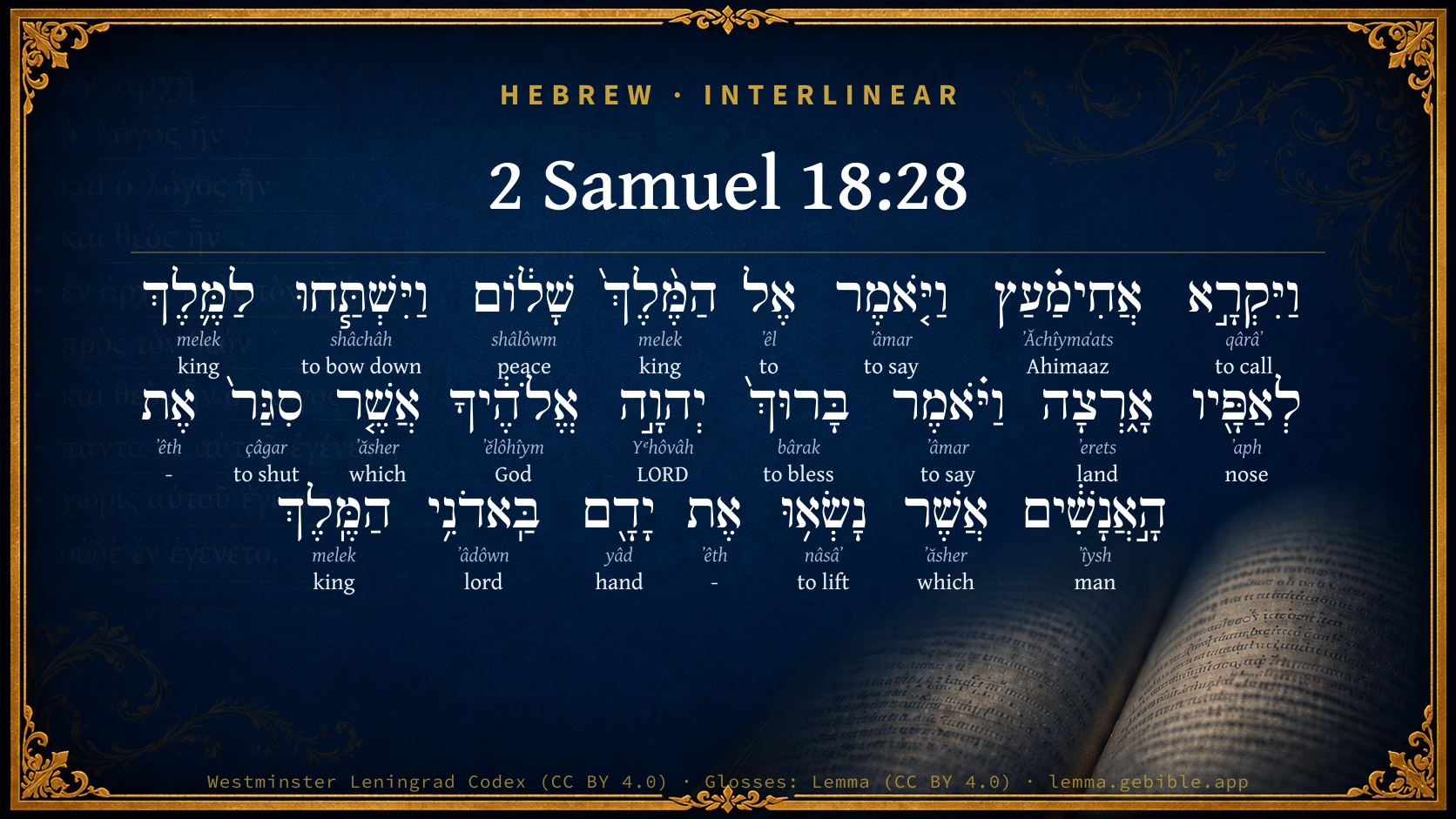
Hebrew (Westminster Leningrad Codex) 2 Samuel 18:28 appears in the Hebrew Old Testament. The text above is from the Westminster Leningrad Codex. Each word links to its Strong’s number, a concise gloss, and parsing drawn from the Open Scriptures Hebrew Bible morphology. Click any word for its full Brown-Driver-Briggs (BDB) entry.
Download image
Cite this verse

2 Samuel 18:28 (World English Bible). Public Domain. Lemma interlinear Bible study tool, https://lemma.gebible.app/v/2-samuel/18/28.

Show BibTeX & RIS
BibTeX
RIS
English Translation
Ahimaaz called, and said to the king, All is well. He bowed himself before the king with his face to the earth, and said, Blessed be Yahweh your God, who has delivered up the men who lifted up their hand against my lord the king.
World English Bible · Public Domain
Download a study sheet

One document with this verse’s original text, its word-by-word gloss line, the meaning frame, cross-references with their text, attributed commentary, and full source and license credits — printable, and it pastes into notes with its structure intact.

This verse Autodidact and up

Study sheet (.html) Plain text (.txt)

A passage Seminary Student

Up to 50 verses in one chapter. A passage sheet keeps up to 6 commentary sources and 12 cross-references per verse, in the order this page ranks them, and says so on the sheet whenever that leaves anything out. Ask for a single verse and you get the Autodidact verse sheet above.

Everything on this page stays free to read, with no account — the sheet is a download of what is already on screen, not access to it.

Want to remove ads? Support Godless Engineer
Compare translations 3

The same verse in 3 English versions, stacked beneath the original-language interlinear above. Click any original word for its lexicon entry.

Each is an independent rendering of the whole verse — the interlinear is not word-aligned to these translations.

Highlighted words mark where these versions differ — a whole-verse word diff, not a word-by-word alignment.

  • World English Bible Public Domain
    Ahimaaz called, and said to the king, All is well. He bowed himself before the king with his face to the earth, and said, Blessed be Yahweh your God, who has delivered up the men who lifted up their hand against my lord the king.
  • King James Version Public Domain
    And Ahimaaz called, and said unto the king, All is well. And he fell down to the earth upon his face before the king, and said, Blessed be the LORD thy God, which hath delivered up the men that lifted up their hand against my lord the king.
  • unfoldingWord Literal Text CC BY-SA 4.0
    And Ahimaaz called and said to the king, “Peace!” And he prostrated himself to the king with his nose to the ground. And he said, “Blessed be Yahweh your God, who has enclosed the men who lifted their hand against my lord the king.”

unfoldingWord Literal Text — © unfoldingWord, licensed CC BY-SA 4.0. Word-aligned USFM3 via Door43 (git.door43.org/unfoldingWord/en_ult).

Versions to compare (up to 4)

3 of 4 selected

Show all 18 translations

Every available English version of this verse, each an independent rendering of the whole verse.

  • World English Bible Public Domain
    Ahimaaz called, and said to the king, All is well. He bowed himself before the king with his face to the earth, and said, Blessed be Yahweh your God, who has delivered up the men who lifted up their hand against my lord the king.
  • Berean Standard Bible Public Domain
    Then Ahimaaz called out to the king, “All is well!” And he bowed facedown before the king. He continued, “Blessed be the LORD your God! He has delivered up the men who raised their hands against my lord the king.”
  • Majority Standard Bible Public Domain
    Then Ahimaaz called out to the king, “All is well!” And he bowed facedown before the king. He continued, “Blessed be the LORD your God! He has delivered up the men who raised their hands against my lord the king.”
  • King James Version Public Domain
    And Ahimaaz called, and said unto the king, All is well. And he fell down to the earth upon his face before the king, and said, Blessed be the LORD thy God, which hath delivered up the men that lifted up their hand against my lord the king.
  • American Standard Version (1901) Public Domain
    And Ahimaaz called, and said unto the king, All is well. And he bowed himself before the king with his face to the earth, and said, Blessed be Jehovah thy God, who hath delivered up the men that lifted up their hand against my lord the king.
  • Revised Version (1885) Public Domain
    And Ahimaaz called, and said unto the king, All is well. And he bowed himself before the king with his face to the earth, and said, Blessed be the LORD thy God, which hath delivered up the men that lifted up their hand against my lord the king.
  • Geneva Bible (1599) Public Domain
    And Ahimaaz called, and sayde vnto the King, Peace be with thee: and he fell downe to the earth vpon his face before the King, and saide, Blessed be the Lord thy God, who hath shut vp the men that lift vp their handes against my lorde the King.
  • Douay-Rheims (1899) Public Domain
    And Achimaas crying out, said to the king: God save thee, O king. And falling down before the king with his face to the ground, he said: Blessed be the Lord thy God, who hath shut up the men that have lifted up their hands against the lord my king.
  • Young's Literal Translation Public Domain
    And Ahimaaz calleth and saith unto the king, `Peace;' and he boweth himself to the king, on his face, to the earth, and saith, `Blessed `is' Jehovah thy God who hath shut up the men who lifted up their hand against my lord the king.'
  • Literal Standard Version CC BY-SA 4.0
    And Ahimaaz calls and says to the king, “Peace”; and he bows himself to the king, on his face, to the earth, and says, “Blessed [is] your God YHWH who has shut up the men who lifted up their hand against my lord the king.”
  • Unlocked Literal Bible CC BY-SA 4.0
    Then Ahimaaz called out and said to the king, “All is well.” He bowed himself before the king with his face to the ground and said, “Blessed be Yahweh your God! He has delivered the men who lifted up their hand against my master the king.”
  • unfoldingWord Literal Text CC BY-SA 4.0
    And Ahimaaz called and said to the king, “Peace!” And he prostrated himself to the king with his nose to the ground. And he said, “Blessed be Yahweh your God, who has enclosed the men who lifted their hand against my lord the king.”
  • Darby Bible Public Domain
    And Ahimaaz called and said to the king, Peace! And he fell down to the earth on his face before the king, and said, Blessed be Jehovah thy God, who has delivered up the men that lifted up their hand against my lord the king.
  • World Messianic Bible Public Domain
    Ahimaaz called, and said to the king, “All is well.” He bowed himself before the king with his face to the earth, and said, “Blessed is the LORD your God, who has delivered up the men who lifted up their hand against my lord the king!”
  • Webster's Bible Public Domain
    And Ahimaaz called, and said to the king, All is well. And he fell down to the earth upon his face before the king, and said, Blessed be the LORD thy God, who hath delivered up the men that raised their hand against my lord the king.
  • Free Bible Version CC BY-SA 4.0
    Ahimaaz shouted out greetings to the king. Then he came and he bowed facedown before the king. “Blessed be the Lord your God!” he said. “He has defeated the men who rebelled against Your Majesty!”
  • Bible in Basic English Public Domain
    And Ahimaaz, crying out to the king, said, It is well. And falling down before the king, with his face to the earth, he said, May the Lord your God be praised, who has given up the men who took up arms against my lord the king!
  • JPS Tanakh (1917) Public Domain
    And Ahimaaz called, and said unto the king: 'All is well.' And he bowed down before the king with his face to the earth, and said: 'Blessed be the LORD thy God, who hath delivered up the men that lifted up their hand against my lord the king.'

Literal Standard Version (2020), Covenant Press — licensed CC BY-SA 4.0. Text via the HelloAO Bible API (eBible.org). Unlocked Literal Bible (unfoldingWord) — licensed CC BY-SA 4.0. Text via the HelloAO Bible API (eBible.org). unfoldingWord Literal Text — © unfoldingWord, licensed CC BY-SA 4.0. Word-aligned USFM3 via Door43 (git.door43.org/unfoldingWord/en_ult). Free Bible Version, Dr. Jonathan Gallagher — licensed CC BY-SA 4.0. Text via the HelloAO Bible API (eBible.org).

Word by word

More ways to search: Search by grammar → Find every occurrence → Compare this word →

Practice this passage: Drill this verse → Learn its vocabulary →

אֲחִימַ֗עַץ
ʼĂchîymaʻats
H290
“Ahimaaz”
Noun, Proper
Part of Speech
Noun
Type
Proper
Full BDB Definition

Origin: from H251 and the equivalent of H4619

TWOT: None

Ahimaaz = "my brother is anger (wrath)" - father-in-law of Saul - Zadok's son who aided David during Absalom's rebellion - a supply officer of Solomon
  1. וַיִּקְרָ֣א qârâʼ H7121 “and · to call” Conjunction + Verb, Qal, Sequential Imperfect, 3rd Person, Masculine, Singular
  2. וַיֹּ֤אמֶר ʼâmar H559 “and · to say” Conjunction + Verb, Qal, Sequential Imperfect, 3rd Person, Masculine, Singular
  3. אֶל ʼêl H413 “to” Preposition
  4. הַמֶּ֨לֶךְ֙ melek H4428 “the · king” Particle, Definite Article + Noun, Common, Masculine, Singular, Absolute
  5. שָׁל֔וֹם shâlôwm H7965 “peace” Noun, Common, Masculine, Singular, Absolute
  6. וַיִּשְׁתַּ֧חוּ shâchâh H7812 “and · to bow down” Conjunction + Verb, Hithpael, Sequential Imperfect, 3rd Person, Masculine, Singular
  7. לַמֶּ֛לֶךְ melek H4428 “to/for the · king” Preposition, Determined + Noun, Common, Masculine, Singular, Absolute
  8. לְאַפָּ֖יו ʼaph H639 “to/for · nostrils · his” Preposition + Noun, Common, Masculine, Dual, Construct + Suffix, Personal, 3rd Person, Masculine, Singular
  9. אָ֑רְצָה ʼerets H776 “land · toward” Noun, Common, Both, Singular, Absolute + Suffix, Demonstrative
  10. וַיֹּ֗אמֶר ʼâmar H559 “and · to say” Conjunction + Verb, Qal, Sequential Imperfect, 3rd Person, Masculine, Singular
  11. בָּרוּךְ֙ bârak H1288 “blessed” Verb, Qal, Participle Passive, Masculine, Singular, Absolute
  12. יְהוָ֣ה Yᵉhôvâh H3068 “LORD” Noun, Proper
  13. אֱלֹהֶ֔יךָ ʼĕlôhîym H430 “God(s) · your” Noun, Common, Masculine, Plural, Construct + Suffix, Personal, 2nd Person, Masculine, Singular
  14. אֲשֶׁ֤ר ʼăsher H834 “which” Particle, Relative
  15. סִגַּר֙ çâgar H5462 “to shut” Verb, Piel, Perfect, 3rd Person, Masculine, Singular
  16. אֶת ʼêth H853 “-” Particle, Direct Object
  17. הָ֣אֲנָשִׁ֔ים ʼîysh H376 “the · men” Particle, Definite Article + Noun, Common, Masculine, Plural, Absolute
  18. אֲשֶׁר ʼăsher H834 “which” Particle, Relative
  19. נָשְׂא֥וּ nâsâʼ H5375 “to lift” Verb, Qal, Perfect, 3rd Person, Common, Plural
  20. אֶת ʼêth H853 “-” Particle, Direct Object
  21. יָדָ֖ם yâd H3027 “hand · their” Noun, Common, Both, Singular, Construct + Suffix, Personal, 3rd Person, Masculine, Plural
  22. בַּֽאדֹנִ֥י ʼâdôwn H113 “in/at · lord · my” Preposition + Noun, Common, Masculine, Singular, Construct + Suffix, Personal, 1st Person, Common, Singular
  23. הַמֶּֽלֶךְ melek H4428 “the · king” Particle, Definite Article + Noun, Common, Masculine, Singular, Absolute

About this verse

These counts appear in no published source. They are computed here, from the morphology-tagged text and Lemma’s own curated glosses. What Lemma adds →

24
words
19
distinct lemmas
Historical
section

Notable vocabulary

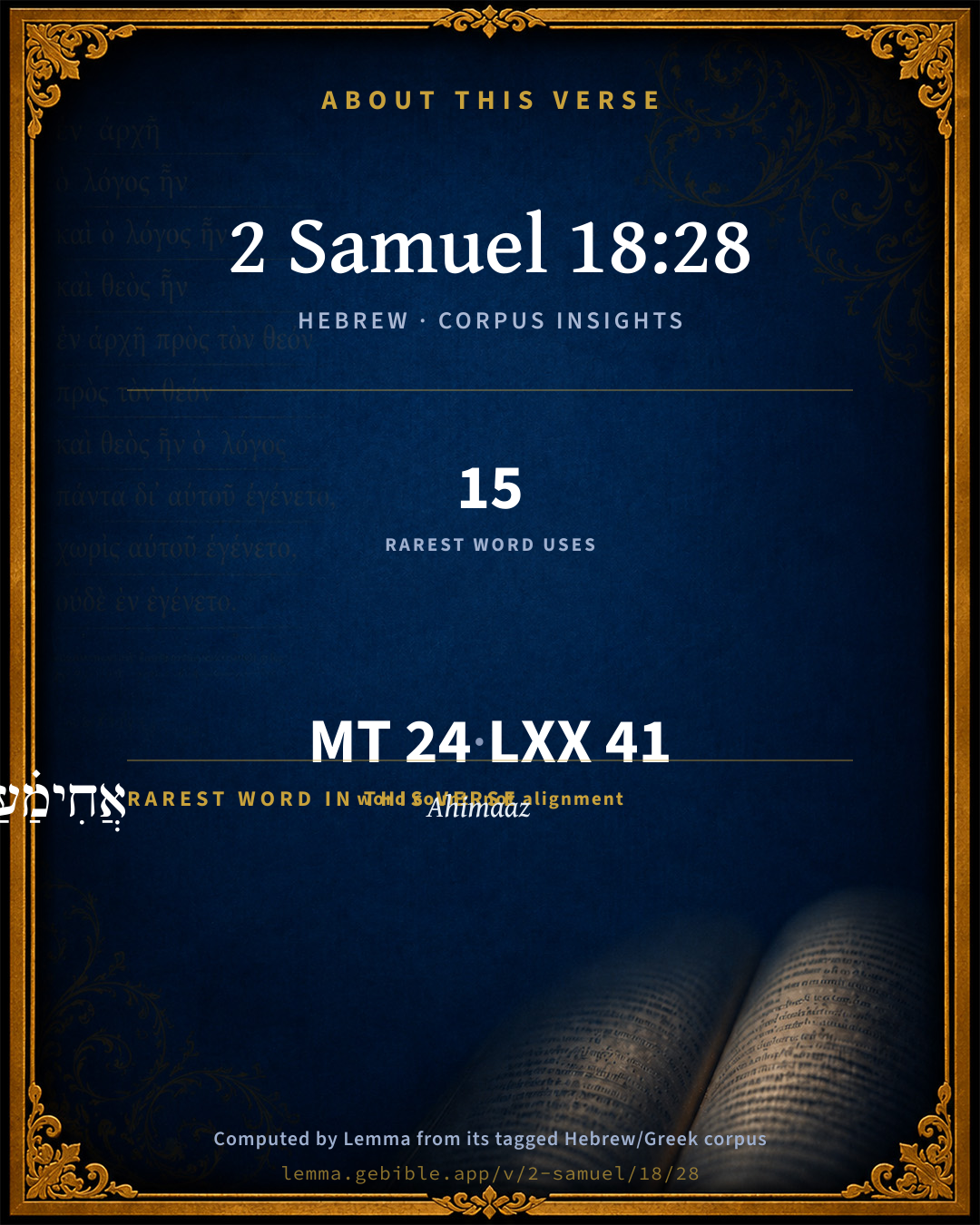
The rarest word here is אֲחִימַ֗עַץ Ahimaaz H290 — appearing just 15 times in the whole Hebrew Bible.

Shared distinctive vocabulary

אֲחִימַ֗עַץ Ahimaaz H290 occurs in 15 verses of the Hebrew Bible. Also found in:

Grammatical profile

  • 7 verbs
  • 12 nouns
  • 1 preposition
  • 4 particles

Verb forms

  • וַיִּקְרָ֣א Qal · Sequential Imperfect
  • וַיֹּ֤אמֶר Qal · Sequential Imperfect
  • וַיִּשְׁתַּ֧חוּ Hithpael · Sequential Imperfect
  • וַיֹּ֗אמֶר Qal · Sequential Imperfect
  • בָּרוּךְ֙ Qal · Participle Passive
  • סִגַּר֙ Piel · Perfect
  • נָשְׂא֥וּ Qal · Perfect

Repetition

Words recur within this verse — often emphatic in Hebrew:

  • הַמֶּ֨לֶךְ֙ king H4428 ×3
  • וַיֹּ֤אמֶר to say H559 ×2
  • אֲשֶׁ֤ר which H834 ×2

Hebrew & Septuagint length

In English translation the verse runs 45 words from the Hebrew and 47 from the Septuagint (LXX English) — closely comparable.

A rough comparison of the two English renderings, which tokenize alike — not a word-level alignment.

Word counts can differ between the Hebrew and the Greek without any difference in meaning — e.g. the Hebrew direct-object marker אֵת has no separate Greek word, and Greek often adds the article ὁ.

In the original languages it is 24 Hebrew tokens and 41 Greek tokens — but the two are counted differently (Hebrew bundles its prefixes and suffixes into one token; the Greek is in lemma form), so that isn’t a like-for-like length.

Cross-references

13

Topical passages linked to 2 Samuel 18:28 in the Treasury of Scripture Knowledge — connected by theme and wording, ordered by reader-vote popularity; previews shown in the World English Bible.

  • Genesis 14:20 and blessed be God Most High, who has delivered your enemies into your hand." Abram gave him a tenth of all.
  • 2 Samuel 14:4 When the woman of Tekoa spoke to the king, she fell on her face to the ground, and did obeisance, and said, Help, O king.
  • Genesis 24:27 He said, "Blessed be Yahweh, the God of my master Abraham, who has not forsaken his loving kindness and his truth toward my master. As for me, Yahweh has led me in the way to the house of my master's relatives."
  • 1 Samuel 24:18 You have declared this day how that you have dealt well with me, because when Yahweh had delivered me up into your hand, you didn't kill me.
  • 1 Samuel 26:8 Then said Abishai to David, God has delivered up your enemy into your hand this day: now therefore please let me strike him with the spear to the earth at one stroke, and I will not strike him the second time.
  • 2 Samuel 1:2 it happened on the third day, that behold, a man came out of the camp from Saul, with his clothes torn, and earth on his head: and so it was, when he came to David, that he fell to the earth, and did obeisance.
  • 2 Samuel 22:27 With the pure you will show yourself pure; With the crooked you will show yourself shrewd.
  • 2 Chronicles 20:26 On the fourth day they assembled themselves in the valley of Beracah; for there they blessed Yahweh: therefore the name of that place was called The valley of Beracah to this day.
  • Psalms 31:8 You have not shut me up into the hand of the enemy. You have set my feet in a large place.
  • Psalms 115:1 Not to us, Yahweh, not to us, But to your name give glory, For your loving kindness, and for your truth's sake.
  • Psalms 124:6 Blessed be Yahweh, Who has not given us as a prey to their teeth.
  • Psalms 144:1–2 Blessed be Yahweh, my rock, Who teaches my hands to war, And my fingers to battle:
  • Revelation 19:1–3 After these things I heard something like a loud voice of a great multitude in heaven, saying, "Hallelujah! Salvation, power, and glory belong to our God:

Cross-references courtesy of OpenBible.info (CC BY 4.0).

Hebrew and Greek witnesses Masoretic Hebrew ↔ Greek Septuagint

The same verse in the two great witnesses to the Old Testament, shown verse-for-verse.

These are two independent witnesses, not word-aligned to each other, and the Septuagint is shown in lemma (dictionary) form.

Hebrew 2 Samuel 18:28 Masoretic · Westminster Leningrad Codex

וַיִּקְרָ֣א אֲחִימַ֗עַץ וַיֹּ֤אמֶר אֶל הַמֶּ֨לֶךְ֙ שָׁל֔וֹם וַיִּשְׁתַּ֧חוּ לַמֶּ֛לֶךְ לְאַפָּ֖יו אָ֑רְצָה וַיֹּ֗אמֶר בָּרוּךְ֙ יְהוָ֣ה אֱלֹהֶ֔יךָ אֲשֶׁ֤ר סִגַּר֙ אֶת הָ֣אֲנָשִׁ֔ים אֲשֶׁר נָשְׂא֥וּ אֶת יָדָ֖ם בַּֽאדֹנִ֥י הַמֶּֽלֶךְ

Ahimaaz called, and said to the king, All is well. He bowed himself before the king with his face to the earth, and said, Blessed be Yahweh your God, who has delivered up the men who lifted up their hand against my lord the king.

World English Bible · Public Domain

Greek LXX 2 Samuel 18:28 Septuagint · lemma form

καί βοάω αχιμαας καί εἶπον πρός ὁ βασιλεύς εἰρήνη καί προςκυνέω ὁ βασιλεύς ἐπί πρόσωπον αὐτός ἐπί ὁ γῆ καί εἶπον εὐλογητός κύριος ὁ θεός σύ ὅς ἀποκλείω ὁ ἀνήρ ὁ μισέω ὁ χείρ αὐτός ἐν ὁ κύριος ἐγώ ὁ βασιλεύς

And Achimaas cried out and said to the king, Peace. And he did obeisance to the king with his face to the ground, and said, Blessed be the Lord your God, who has delivered up the men that lifted up their hands against my lord the king.

LXX2012 (modern English Septuagint) · Public Domain

Hebrew: Westminster Leningrad Codex (CC BY 4.0). Greek: Septuagint (public domain); English from LXX2012 (modern English Septuagint) (Public Domain). How the Septuagint differs from the Hebrew →

Targum (Aramaic paraphrase)

1

The Targum is the ancient Jewish Aramaic paraphrase of the Hebrew Scriptures — an interpretive translation, not the Hebrew text itself. Onkelos (literal) and Pseudo-Jonathan (expansive) render the Torah, and Jonathan the Prophets. Coverage is partial: where no permissively-licensed English translation exists for a verse, only the Aramaic is shown. This is verse-level text, not a word-by-word alignment to the Hebrew.

  1. Targum Jonathan Prophets (Joshua–Malachi)
    וּקְרָא אֲחִימַעַץ וַאֲמַר לְמַלְכָּא שְׁלָם וּסְגִיד לְמַלְכָּא עַל אַפּוֹהִי עַל אַרְעָא וַאֲמַר בְּרִיךְ יְיָ אֱלָהָךְ דִמְסַר יַת גַבְרַיָא דַאֲרִימוּ יַת יְדֵיהוֹן בְּרִבּוֹנִי מַלְכָּא:

    (no public-domain English translation for this verse)

    Targum Jonathan — Aramaic: “Mikraot Gedolot” (public domain). English: “Sefaria Community Translation” (CC0 1.0 (public-domain dedication)); “London "Chaldee Paraphrase," 1871” (public domain). Text via Sefaria.

Commentary

Notes on 2 Samuel 18:28 from classic Christian and Jewish commentators (each source and its license shown beneath its notes). The classic Christian expositions comment on the surrounding passage and are grouped to its opening verse, so a note may address several verses; the Jewish commentaries on the Tanakh (Rashi and others) are per-verse, so they appear only where the commentator wrote on this verse.

Lemma curates 59 commentaries, every one of them public domain or Creative Commons licensed, each selected and text-cleaned for this edition rather than reprinted as found. About our sources →

Trapp's Complete Commentary

John Trapp

2Sa 18:28 And Ahimaaz called, and said unto the king, All is well. And he fell down to the earth upon his face before the king, and said, Blessed [be] the LORD thy God, which hath delivered up the men that lifted up their hand against my lord the king.

Ver. 28. All is well.] Heb., Peace; or, There is peace, the daughter of war, εχηρος πατρος φιλτατον τεκνον, as the Romans said of Pompey, The lovely daughter of an ugly mother. By "peace" the Hebrews signify all prosperity and happiness.

John Trapp, A Commentary or Exposition upon All the Books of the Old and New Testament (1647–1656) — public domain. Text from a community e-Sword module.

Tyndale Open Study Notes

Tyndale Open Resources

18:28-29 Everything is all right! (Hebrew shalom): David then asked, “Is it shalom with the young Ab-shalom?” (What about young Absalom? . . . Is he all right?). Even though Absalom was David’s rival, he was also David’s son. David was more concerned about his son’s fate than the well-being of his fighting servants (19:5-6).

Tyndale Open Study Notes — © Tyndale Open Resources, licensed CC BY-SA 4.0. Text via the HelloAO Bible API.

Geneva Bible (1599)

Geneva Bible translators

Or, delivered up.

Geneva Bible (1599) marginal notes — public domain. Text via Bolls.life.

Ellicott's Commentary for English Readers

(28) All is well.—Literally, Peace, as in the margin. This is the cry with which Ahimaaz greets the king in his eager haste, as soon as he comes within hearing. He then approaches and falls down reverentially, with a distinct announcement of the victory.

A Bible Commentary for English Readers, edited by Charles John Ellicott (1878–1897) — public domain. Text from a community e-Sword module.

The Cambridge Bible for Schools and Colleges

gen. ed. J. J. S. Perowne

28. All is well] Lit. Peace! The usual word of greeting had special significance at such a time.

he fell down] An act of homage to the king. See note on ch. 2Sa_14:4, and cp. 1Sa_20:41; 1Sa_25:23.

delivered up] Lit. shut up: restrained and confined within bounds, instead of leaving them at large to work their will. Cp. 1Sa_17:46; Psa_31:8, and the opposite expression in ch. 2Sa_22:20.

The Cambridge Bible for Schools and Colleges (gen. ed. J. J. S. Perowne; Cambridge University Press, 1878–1918) — public domain. Text from a community e-Sword module.

John Gill's Exposition

And Ahimaaz called and said unto the king,.... As soon as he came so near as to be heard by him, before he came up to him, he said with a loud voice:

all is well; the king's army has had success, beat the rebels, and obtained a complete victory: or "peace" (e); for it is but one word in the original, which signifies all happiness and prosperity, and this he wished the king; and so it is the same as if he had said, God save the king, may all happiness attend him:

and he fell down to the earth upon his face before the king; when he came nearer to him, not only in reverence of him, but in thankfulness to God:

and said, blessed be the Lord thy God, which hath delivered up the men that lifted up their hand against my lord the king; in which he ascribes the victory, not to Joab and his army, but to the Lord, to whom he gives thanks; and this agreeably to his character as a good man, and a priest of the Lord.

(e) Sept. "pax", Montanus, Pagninus; "salus", Tigurine version; "salve rex", V. L.

John Gill's Exposition of the Whole Bible (1746–1763) — public domain (CC PDM 1.0). Text via the HelloAO Bible API.

Albert Barnes' Notes on the Bible

Ahimaaz called - This marks the eager haste with which, before he had quite reached the king, he shouted out the pithy decisive word of good tidings, “Shalom!” Peace!

Hath delivered - See the margin. The figure seems to be that of confining a person within the power of his enemy, in opposition to “giving him his liberty” “in a large room,” to work what mischief he pleases.

Albert Barnes' Notes on the Bible (1834–1885) — public domain. Text from a community e-Sword/MySword module.

Haydock's Catholic Bible Commentary

Shut up; frustrated the attempts of the enemy, and consigned many to the grave. (Haydock)

George Leo Haydock (1774–1849), Haydock's Catholic Family Bible and Commentary, 1859 edition — public domain. Excludes Psalms (Douay-Rheims chapter numbering differs from Protestant) and Deuterocanonical books (Catholic canon only).

Matthew Poole's English Annotations

Into thy hand and power; or, to destruction. Compare 1Sa 24:18; 26:8.

Matthew Poole's English Annotations on the Holy Bible (1683–1685) — public domain. Text from a community e-Sword/MySword module.

Whedon's Commentary on the Bible

Daniel D. Whedon

28. All is well — שׁלום, Peace. Equivalent to Hail!

Blessed be the Lord — Observe the indirect way in which the tidings are announced.

Daniel D. Whedon (gen. ed.), Commentary on the Old and New Testaments (1874–1909) — public domain. Text from a community e-Sword module.

The Pulpit Commentary

And said unto the king, All is well; Hebrew, Peace. This was the ordinary salutation among the Israelites, but its hurried exclamation on the part of the breathless runner was probably intended to convey the idea given in the Authorized Version. Hath delivered up the men, etc; Hebrew, hath hedged, or shut in (see upon this expression the note on 1Sa_17:46, and comp. Psa_31:8) Both there and in 2Sa_22:20 prosperity is compared to the being in a broad place, where there is freedom to act. (see also note on 2Sa_13:2)

The Pulpit Commentary (1880–1919), ed. H.D.M. Spence-Jones & Joseph S. Exell — public domain. Text from a community e-Sword module.

Keil & Delitzsch

C. F. Keil & F. Delitzsch

Ahimaaz then called out to the king, "Shalom," i.e., Hail! and fell down before him to greet him reverentially, and said, "Blessed be Jehovah thy God, who hath given up the men that lifted up their hand against my lord the king."

Keil & Delitzsch — Biblical Commentary on the Old Testament (1861–1891) — public domain (CC PDM 1.0). Text via the HelloAO Bible API. (Old Testament only.)

unfoldingWord translationNotes

Door43 World Missions Community

He bowed himself before the king with his face to the ground

He did this to honor the king. AT: "He bowed himself before the king with his face to the ground to honor the king" (See: Symbolic Action)

Blessed be Yahweh

"Praise Yahweh." Here "bless" means to praise.

the men who lifted up their hand against my master the king

Here Ahimaaz speaks of the men opposing the king as if they were were raising their hands before him. AT: "the men who opposed and fought against my master the king" (See: Metaphor)

a great disturbance

This means that people were acting as though things were not right.

Turn aside and stand here

"Move out of the way" or "Stand aside"

translationWords

bless

God

hand

lord

servant

know

turn

unfoldingWord translationNotes — © Distant Shores Media and the Door43 World Missions Community, licensed CC BY-SA 4.0. Source: git.door43.org/Door43/en_tn.

Lesson kit

Teaching starters — assembled from the data on this page, not authored interpretation. Every prompt links to the verse data it draws on. Edit before teaching.

2 Samuel, in the Historical, opens this verse with 24 words (19 distinct Hebrew lemmas). Its most distinctive word is ʼĂchîymaʻats (“Ahimaaz”). A historical commentator’s framing appears above. Read the whole chapter for the surrounding context.

Discussion questions

  1. How does “Ahimaaz” (ʼĂchîymaʻats) shape what this verse is saying?
  2. 1 Samuel 14:50 shares the word «Ahimaaz» with this verse. How do the two illuminate each other?
  3. “king” occurs 3× in this one verse. What is the effect of the repetition?
  4. These translations render this verse differently. What is at stake in choosing one wording over another?
  5. The verb «וַיִּקְרָ֣א» is Qal Sequential Imperfect. How does its form color the action?
  6. Reading how Trapp's Complete Commentary and Tyndale Open Study Notes read this verse, where do the two commentators agree and where do they part?

Things to notice

Reading settings

Reading text

Shown beneath each verse's original-language words.

Old Testament
Old Testament edition

Read the OT as the Masoretic Hebrew (MT) or the Greek Septuagint (LXX).

English shown for the Greek Septuagint (in the Hebrew ↔ Greek comparison).

Comparing translations? Open the Compare panel on any verse page to stack up to four side by side.