
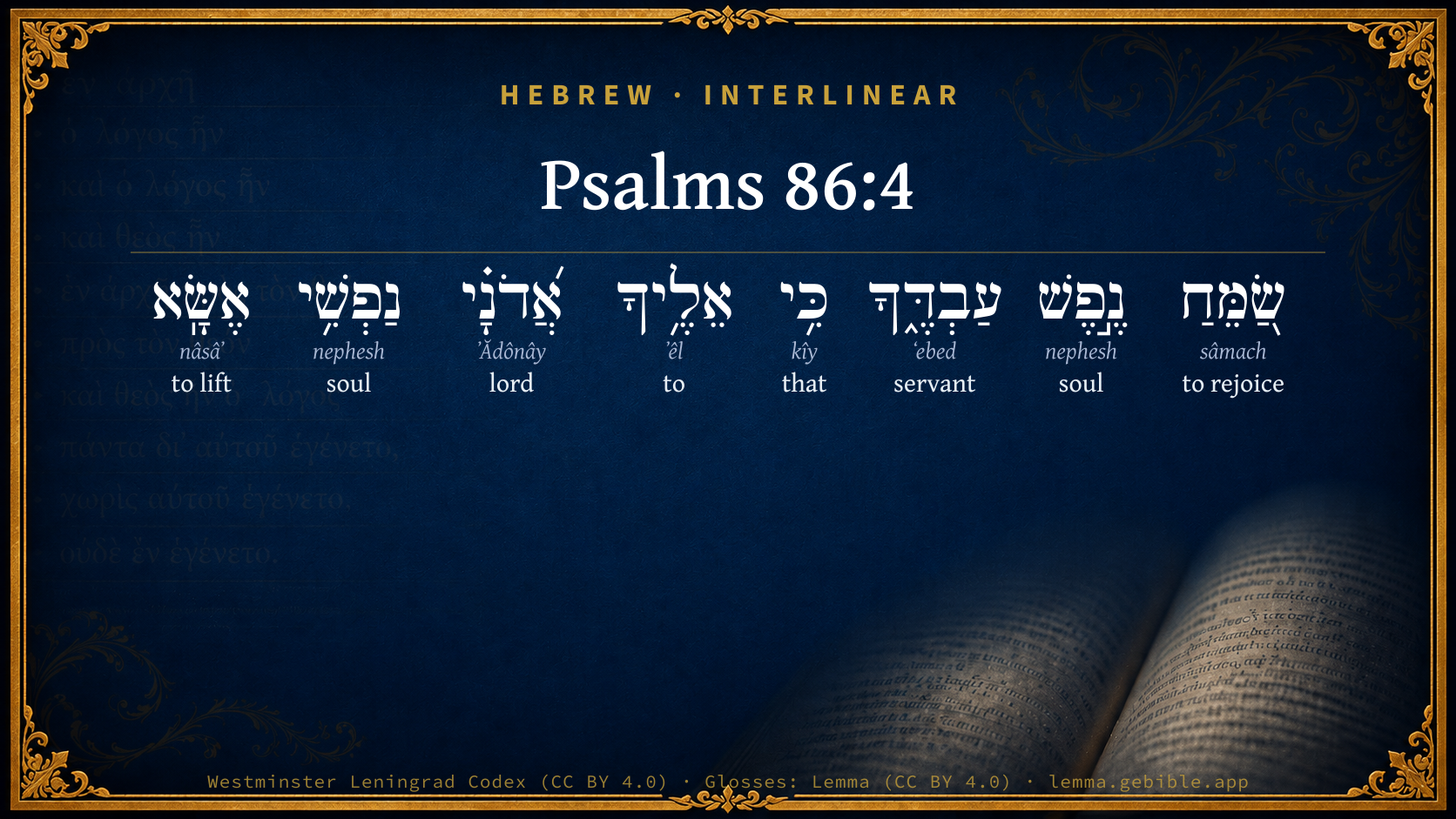
Psalms 86:4

Hebrew (Westminster Leningrad Codex) Psalms 86:4 appears in the Hebrew Old Testament. The text above is from the Westminster Leningrad Codex. Each word links to its Strong’s number, a concise gloss, and parsing drawn from the Open Scriptures Hebrew Bible morphology. Click any word for its full Brown-Driver-Briggs (BDB) entry.
Download image
Cite this verse

Psalms 86:4 (World English Bible). Public Domain. Lemma interlinear Bible study tool, https://lemma.gebible.app/v/psalms/86/4.

Show BibTeX & RIS
BibTeX
RIS
English Translation
Bring joy to the soul of your servant, For to you, Lord, do I lift up my soul.
World English Bible · Public Domain
Download a study sheet

One document with this verse’s original text, its word-by-word gloss line, the meaning frame, cross-references with their text, attributed commentary, and full source and license credits — printable, and it pastes into notes with its structure intact.

This verse Autodidact and up

Study sheet (.html) Plain text (.txt)

A passage Seminary Student

Up to 50 verses in one chapter. A passage sheet keeps up to 6 commentary sources and 12 cross-references per verse, in the order this page ranks them, and says so on the sheet whenever that leaves anything out. Ask for a single verse and you get the Autodidact verse sheet above.

Everything on this page stays free to read, with no account — the sheet is a download of what is already on screen, not access to it.

Want to remove ads? Support Godless Engineer
Compare translations 3

The same verse in 3 English versions, stacked beneath the original-language interlinear above. Click any original word for its lexicon entry.

Each is an independent rendering of the whole verse — the interlinear is not word-aligned to these translations.

Highlighted words mark where these versions differ — a whole-verse word diff, not a word-by-word alignment.

  • World English Bible Public Domain
    Bring joy to the soul of your servant, For to you, Lord, do I lift up my soul.
  • King James Version Public Domain
    Rejoice the soul of thy servant: for unto thee, O Lord, do I lift up my soul.
  • unfoldingWord Literal Text CC BY-SA 4.0
    Gladden the soul of your servant, for to you, Lord, I lift up my soul.

unfoldingWord Literal Text — © unfoldingWord, licensed CC BY-SA 4.0. Word-aligned USFM3 via Door43 (git.door43.org/unfoldingWord/en_ult).

Versions to compare (up to 4)

3 of 4 selected

Show all 18 translations

Every available English version of this verse, each an independent rendering of the whole verse.

  • World English Bible Public Domain
    Bring joy to the soul of your servant, For to you, Lord, do I lift up my soul.
  • Berean Standard Bible Public Domain
    Bring joy to Your servant, for to You, O Lord, I lift up my soul.
  • Majority Standard Bible Public Domain
    Bring joy to Your servant, for to You, O Lord, I lift up my soul.
  • King James Version Public Domain
    Rejoice the soul of thy servant: for unto thee, O Lord, do I lift up my soul.
  • American Standard Version (1901) Public Domain
    Rejoice the soul of thy servant; For unto thee, O Lord, do I lift up my soul.
  • Revised Version (1885) Public Domain
    Rejoice the soul of thy servant; for unto thee, O Lord, do I lift up my soul.
  • Geneva Bible (1599) Public Domain
    Reioyce the soule of thy seruant: for vnto thee, O Lord, doe I lift vp my soule.
  • Douay-Rheims (1899) Public Domain
    Give joy to the soul of thy servant, for to thee, O Lord, I have lifted up my soul.
  • Young's Literal Translation Public Domain
    Rejoice the soul of Thy servant, For unto Thee, O Lord, my soul I lift up.
  • Literal Standard Version CC BY-SA 4.0
    Make glad the soul of Your servant, || For to You, O Lord, I lift up my soul.
  • Unlocked Literal Bible CC BY-SA 4.0
    Make your servant glad, for to you, Lord, I lift up my soul.
  • unfoldingWord Literal Text CC BY-SA 4.0
    Gladden the soul of your servant, for to you, Lord, I lift up my soul.
  • Darby Bible Public Domain
    Rejoice the soul of thy servant; for unto thee, Lord, do I lift up my soul.
  • World Messianic Bible Public Domain
    Bring joy to the soul of your servant, for to you, Lord, do I lift up my soul.
  • Webster's Bible Public Domain
    Rejoice the soul of thy servant: for to thee, O Lord, do I lift up my soul.
  • Free Bible Version CC BY-SA 4.0
    Make me happy, Lord, for I've dedicated my life to you.
  • Bible in Basic English Public Domain
    Make glad the soul of your servant; for it is lifted up to you, O Lord.
  • JPS Tanakh (1917) Public Domain
    Rejoice the soul of Thy servant; for unto Thee, O Lord, do I lift up my soul.

Literal Standard Version (2020), Covenant Press — licensed CC BY-SA 4.0. Text via the HelloAO Bible API (eBible.org). Unlocked Literal Bible (unfoldingWord) — licensed CC BY-SA 4.0. Text via the HelloAO Bible API (eBible.org). unfoldingWord Literal Text — © unfoldingWord, licensed CC BY-SA 4.0. Word-aligned USFM3 via Door43 (git.door43.org/unfoldingWord/en_ult). Free Bible Version, Dr. Jonathan Gallagher — licensed CC BY-SA 4.0. Text via the HelloAO Bible API (eBible.org).

Word by word

More ways to search: Search by grammar → Find every occurrence → Compare this word →

Practice this passage: Drill this verse → Learn its vocabulary →

שַׂ֭מֵּחַ
sâmach
H8055
“rejoice”
Verb, Piel, Imperative, 2nd Person, Masculine, Singular
Part of Speech
Verb
Stem
Piel
Form
Imperative
Person
2nd Person
Gender
Masculine
Number
Singular
Full BDB Definition

Origin: a primitive root

TWOT: 2268

to rejoice, be glad - (Qal) - to rejoice - to rejoice (arrogantly), exult (at) - to rejoice (religiously) - (Piel) to cause to rejoice, gladden, make glad - (Hiphil) to cause to rejoice, gladden, make glad
  1. נֶ֣פֶשׁ nephesh H5315 “soul of” Noun, Common, Both, Singular, Construct
  2. עַבְדֶּ֑ךָ ʻebed H5650 “servant · your” Noun, Common, Masculine, Singular, Construct + Suffix, Personal, 2nd Person, Masculine, Singular
  3. כִּ֥י kîy H3588 “that” Conjunction
  4. אֵלֶ֥יךָ ʼêl H413 “to · you” Preposition + Suffix, Personal, 2nd Person, Masculine, Singular
  5. אֲ֝דֹנָ֗י ʼĂdônây H136 “Lord · my” Noun, Common, Masculine, Plural, Construct + Suffix, Personal, 1st Person, Common, Singular
  6. נַפְשִׁ֥י nephesh H5315 “soul · my” Noun, Common, Both, Singular, Construct + Suffix, Personal, 1st Person, Common, Singular
  7. אֶשָּֽׂא nâsâʼ H5375 “to lift” Verb, Qal, Imperfect, 1st Person, Common, Singular

About this verse

These counts appear in no published source. They are computed here, from the morphology-tagged text and Lemma’s own curated glosses. What Lemma adds →

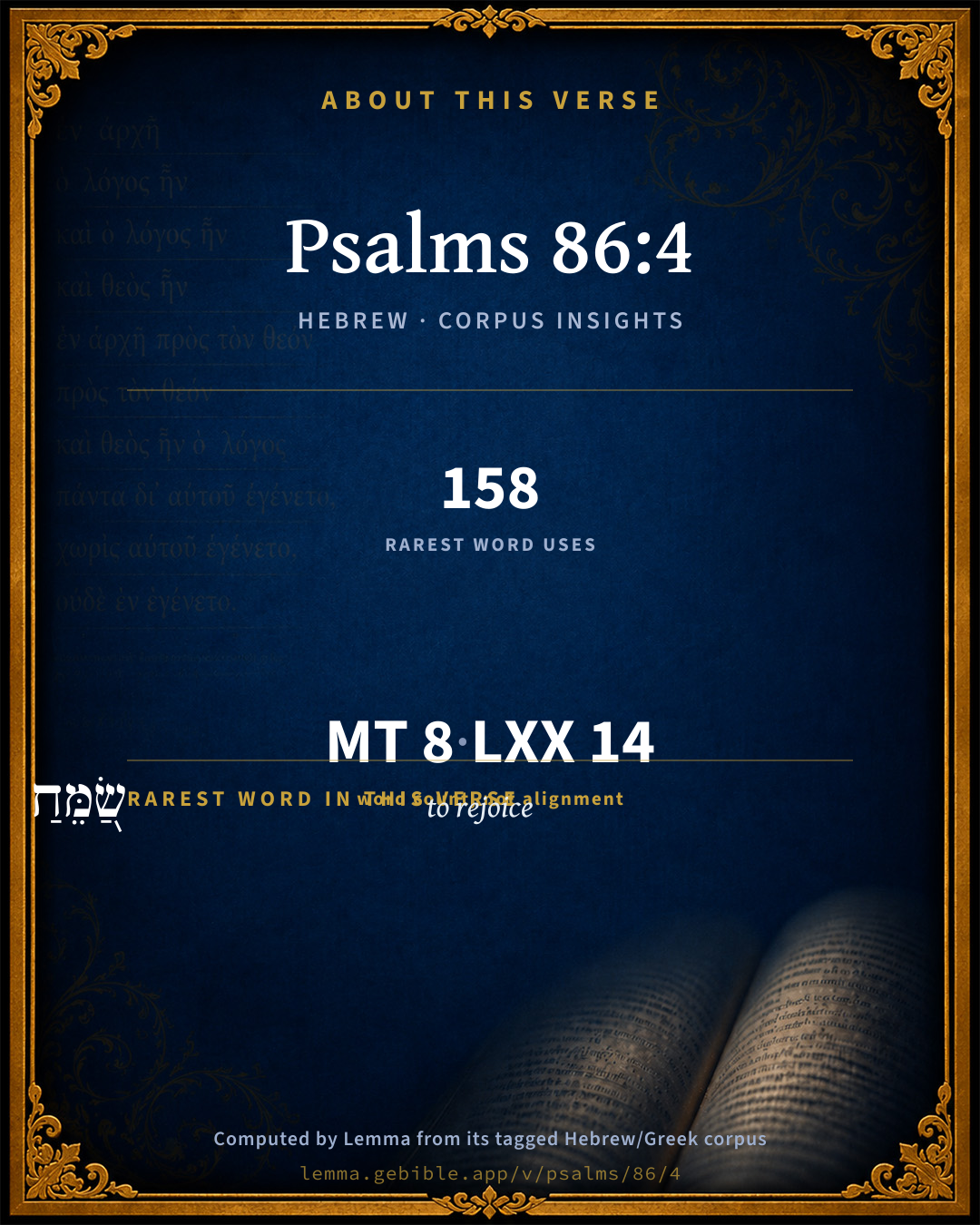
8
words
7
distinct lemmas
Wisdom
section

Grammatical profile

  • 2 verbs
  • 4 nouns
  • 1 preposition
  • 1 conjunction

Verb forms

  • שַׂ֭מֵּחַ Piel · Imperative
  • אֶשָּֽׂא Qal · Imperfect

Repetition

A word recurs within this verse — often emphatic in Hebrew:

  • נֶ֣פֶשׁ soul H5315 ×2

Hebrew & Septuagint length

In English translation the verse runs 18 words from the Hebrew and 17 from the Septuagint (LXX English) — closely comparable.

A rough comparison of the two English renderings, which tokenize alike — not a word-level alignment.

Word counts can differ between the Hebrew and the Greek without any difference in meaning — e.g. the Hebrew direct-object marker אֵת has no separate Greek word, and Greek often adds the article ὁ.

In the original languages it is 8 Hebrew tokens and 14 Greek tokens — but the two are counted differently (Hebrew bundles its prefixes and suffixes into one token; the Greek is in lemma form), so that isn’t a like-for-like length.

Cross-references

7

Topical passages linked to Psalms 86:4 in the Treasury of Scripture Knowledge — connected by theme and wording, ordered by reader-vote popularity; previews shown in the World English Bible.

  • Psalms 143:8 Cause me to hear your loving kindness in the morning, For I trust in you. Cause me to know the way in which I should walk, For I lift up my soul to you.
  • Psalms 25:1 To you, Yahweh, do I lift up my soul.
  • Isaiah 66:13–14 As one whom his mother comforts, so will I comfort you; and you shall be comforted in Jerusalem.
  • Psalms 51:12 Restore to me the joy of your salvation. Uphold me with a willing spirit.
  • Psalms 62:8 Trust in him at all times, you people. Pour out your heart before him. God is a refuge for us. Selah.
  • Isaiah 61:3 to appoint to those who mourn in Zion, to give to them a garland for ashes, the oil of joy for mourning, the garment of praise for the spirit of heaviness; that they may be called trees of righteousness, the planting of Yahweh, that he may be glorified.
  • Isaiah 65:18 But be you glad and rejoice forever in that which I create; for, behold, I create Jerusalem a rejoicing, and her people a joy.

Cross-references courtesy of OpenBible.info (CC BY 4.0).

Hebrew and Greek witnesses Masoretic Hebrew ↔ Greek Septuagint

The same verse in the two great witnesses to the Old Testament, shown verse-for-verse.

You’re reading Greek Psalm 85 (Hebrew Psalm 86). The Septuagint counts the superscription, so verse numbers can differ from the Hebrew — chapter-level alignment, not verse-by-verse. Numbering follows Rahlfs.

These are two independent witnesses, not word-aligned to each other, and the Septuagint is shown in lemma (dictionary) form.

Hebrew Psalms 86:4 Masoretic · Westminster Leningrad Codex

שַׂ֭מֵּחַ נֶ֣פֶשׁ עַבְדֶּ֑ךָ כִּ֥י אֵלֶ֥יךָ אֲ֝דֹנָ֗י נַפְשִׁ֥י אֶשָּֽׂא

Bring joy to the soul of your servant, For to you, Lord, do I lift up my soul.

World English Bible · Public Domain

Greek LXX Greek Psalm 85:4 Septuagint · lemma form

εὐφραίνω ὁ ψυχή ὁ δοῦλος σύ ὅτι πρός σύ κύριος αἴρω ὁ ψυχή ἐγώ

Rejoice the soul of your servant: for to you, O Lord, have I lifted up my soul.

LXX2012 (modern English Septuagint) · Public Domain

Hebrew: Westminster Leningrad Codex (CC BY 4.0). Greek: Septuagint (public domain); English from LXX2012 (modern English Septuagint) (Public Domain). How the Septuagint differs from the Hebrew →

Commentary

Notes on Psalms 86:4 from classic Christian and Jewish commentators (each source and its license shown beneath its notes). The classic Christian expositions comment on the surrounding passage and are grouped to its opening verse, so a note may address several verses; the Jewish commentaries on the Tanakh (Rashi and others) are per-verse, so they appear only where the commentator wrote on this verse.

Lemma curates 59 commentaries, every one of them public domain or Creative Commons licensed, each selected and text-cleaned for this edition rather than reprinted as found. About our sources →

Trapp's Complete Commentary

John Trapp

Psa 86:4 Rejoice the soul of thy servant: for unto thee, O Lord, do I lift up my soul.

Ver. 4. Rejoice the soul of thy servant] True and solid joy entereth the soul by the door of fervent prayer. Pray that your joy may be full.

I lift up my soul] In prayer, Psa 25:1, and confident expectation of an unmiscarrying return thereof, as Deu 24:15.

John Trapp, A Commentary or Exposition upon All the Books of the Old and New Testament (1647–1656) — public domain. Text from a community e-Sword module.

The Biblical Illustrator

Joseph S. Exell

Psa_86:4

Unto Thee, O Lord, do I lift up my soul.

Soul elevation

The souls true elevation is a progress--

I. Godward. Unto Thee. It does not really rise as it moves towards worldly wealth, position, influence, or knowledge; but only as it moves towards God.

II. By self-effort. Do I lift up my soul. It must rise, not as a stone rises into the air, by the application of a foreign force, and as soon as the force is expended comes down again; but as the lark rises, by its own energy, and the use of its own pinions. Self-lifting is the true lifting; and it requires aa effort, resolute, energetic, and persevering. (Homilist.)

The Biblical Illustrator, edited by Joseph S. Exell (c. 1880s–1900s) — public domain. Text from a community e-Sword module.

Joseph Benson's Commentary

Psa 86:4-5. Rejoice the soul of thy servant — It is God only that can put gladness into the heart, and make the soul rejoice; and it is the privilege of his servants to have joy, as well as peace, in believing: and they may pray in faith, not only that God would preserve their souls, but that he would rejoice their souls, and then the joy of the Lord will be their strength. For unto thee do I lift up my soul — Then we may expect comfort from God, when we take care to keep up our communion with him: prayer is the nurse of spiritual joy. For thou, Lord, art good — No less bountiful than I am indigent, which is a great encouragement to me in calling upon thee; and ready to forgive — Those that have offended thee; and plenteous in mercy unto all that call upon thee — Always prepared to show abundant kindness to them in their distresses, when with sincere desire, and true faith, they call upon thee.

Joseph Benson's Commentary on the Old and New Testaments (1811–1818) — public domain. Text from a community e-Sword module.

J. A. Alexander on Psalms

Joseph Addison Alexander

4. (Psa 86:4) Gladden the soul of thy servant, for unto thee, Lord, my soul do I raise. The first clause is not a mere periphrasis for "make me glad," or "cause me to rejoice." It means "make me heartily rejoice, because I am thy servant," thus suggesting a new ground of his petition, different in form although substantially identical with that in the preceding verse. A similar analogy exists between the second clause of that verse and the second clause of this, the form of which, however, is borrowed from Psa 25:1. Here, as there, to raise the soul to God is to regard him with affection and strong confidence. See above, on Psa 24:4. At the same time, there is an allusion to the strict sense of the Hebrew verb, as if he had said, "make my soul rejoice, since I bring it up or raise it to thee for this very purpose." The force of the future is the same as in Psa 86:4.

Joseph Addison Alexander, The Psalms Translated and Explained (1850) — public domain. Text from a community e-Sword module.

Adam Clarke's Commentary

Verse 4. Rejoice the soul of thy servant] I want spiritual blessings; I want such consolations as thou dost impart to them that love thee; I present that soul to thee which I wish thee to console.

Adam Clarke's Commentary on the Bible (1810–1826) — public domain. Text from a community e-Sword/MySword module.

The Cambridge Bible for Schools and Colleges

gen. ed. J. J. S. Perowne

4. Rejoice &c.] Cp. Psa_90:15.

for unto thee &c.] From Psa_25:1. God alone is the object of his desires, his aspirations, his prayers. Cp. Psa_143:8; Lam_3:41.

The Cambridge Bible for Schools and Colleges (gen. ed. J. J. S. Perowne; Cambridge University Press, 1878–1918) — public domain. Text from a community e-Sword module.

John Gill's Exposition

Rejoice the soul of thy servant,.... With the discoveries of love, of pardoning grace, and mercy, before made sad with sin or sufferings; and with the light of God's countenance, before troubled with the hidings of his face: this may be applied to Christ, in sorrowful circumstances, who was made full of joy with his Father's countenance, Mat 26:37.

for unto thee, O Lord, do I lift up my soul: in prayer, as the Targum adds; and it denotes the devotion, fervency, heartiness, and sincerity, of his prayer; the doing of it with a true heart, the lifting up of the heart with the hands unto God, Lam 3:41 or by way of offering unto the Lord, not the body only, but the soul or heart also; or as a depositum committed into his hands; so Christ lifted up his eyes, and his heart and soul, to his divine Father; and also made his soul an offering for sin, and at death commended his spirit into his hands, Joh 17:1; see Gill on Psa 25:1.

John Gill's Exposition of the Whole Bible (1746–1763) — public domain (CC PDM 1.0). Text via the HelloAO Bible API.

Albert Barnes' Notes on the Bible

Rejoice the soul of thy servant - Cause me to rejoice; to wit, by thy gracious interposition, and by delivering me from danger and death.

For unto thee, O Lord, do I lift up my soul - Compare the notes at Psa 24:4. The idea is that of arousing himself, or exerting himself, as one does who makes strenuous efforts to obtain an object. He was not languid, or indifferent; he did not put forth merely weak and fitful efforts to find God, but he bent his whole powers to that end; he arouses himself thoroughly to seek the divine help. Languid and feeble efforts in seeking after God will be attended with no success. In so great a matter - when so much depends on the divine favor - when such great interests are at stake - the whole soul should be roused to one great and strenuous effort; not that we can obtain his favor by force or power, and not that any strength of ours will prevail of itself, but

(a) because nothing less will indicate the proper intensity of desire; and

(b) because such is his appointment in regard to the manner in which we are to seek his favor.

Compare Mat 7:7-8; Luk 13:24; Luk 16:16.

Albert Barnes' Notes on the Bible (1834–1885) — public domain. Text from a community e-Sword/MySword module.

Matthew Poole's English Annotations

The expression notes fervent desire joined with hope or expectation, as appears by comparing Deu 24:15; Jer 22:27.

Matthew Poole's English Annotations on the Holy Bible (1683–1685) — public domain. Text from a community e-Sword/MySword module.

The Treasury of David

Charles H. Spurgeon

Ver. 4. Rejoice the soul of thy servant. Make my heart glad, O my Maker, for I count it my honour to call myself again and again thy servant, and I reckon thy favour to be all the wages I could desire. I look for all my happiness in thee only, and therefore

unto thee, O Lord, do I lift up my soul. As the heliotrope looks to the sun for its smile, so turn I my heart to thee. Thou art as the brazen serpent to my sick nature, and I lift up my soul's eye to thee that I may live. I know that the nearer I am to thee the greater is my joy, therefore be pleased to draw me nearer while I am labouring to draw near. It is not easy to lift a soul at all; it needs a strong shoulder at the wheel when a heart sticks in the miry clay of despondency: it is less easy to lift a soul up to the Lord, for the height is great as well as the weight oppressive; but the Lord will take the will for the deed, and come in with a hand of almighty grace to raise his poor servant out of the earth and up to heaven.

Ver. 4. Rejoice the soul of thy servant, etc. As I have not found rest in anything created, I have raised up my soul on the wings of thought and desire to thee my Creator. Love bears one's soul up; and it has been truly said, that the soul is more where it loves, than where it actually is. Thought and desire are the wings of love; for he that loves is borne on to, and abides in, what he loves, by thinking constantly on, and longing for, the object of his love. Whoever truly, and from his heart, loves God, by thinking on him and longing for him lifts up his soul to God; while, on the contrary, whoever loves the earth, by thinking on and coveting the things of the earth, lets his soul down to its level. Bellarmine.

Ver. 4. Unto thee, Lord, do I lift my soul. If thou hadst corn in thy rooms below, thou wouldest take it up higher, lest it should grow rotten. Wouldest thou remove thy corn, and dost thou suffer thy heart to rot on the earth? Thou wouldest take thy corn up higher: lift up thy heart to heaven. And how can I, dost thou say? What ropes are needed? What machines? What ladders? Thy affections are the steps; thy will the way. By loving thou mountest, by neglect thou descendest. Standing on the earth thou art in heaven, if thou lovest God. For the heart is not so raised as the body is raised: the body to be lifted up changes its place: the heart to be lifted up changes its will. Augstine.

Ver. 4. Unto thee, O Lord, do I lift my soul, intimates that he had brought himself to the Lord as a living sacrifice, even as the heave offering in the tabernacleto show that it belonged to God and to his altar, and, that man had no part in itwas lifted up by the hands of the priests. Benjamin Weiss.

Ver. 4. I lift up my soul. It denotes the devotion, fervency, heartiness, and sincerity of his prayer; the doing of it with a true heart, the lifting up of the heart with the hands unto God, La 3:41; or by way of offering unto the Lord, not the body only, but the soul or heart also; or as a deposition committed into is hands. John Gill.

Ver. 4. Lord. Here, and in all the verses in this psalm where ynda Adonai, occurs, many MSS read hwhy, Yehovah. The Jews, out of reverence to the incommunicable name Jehovah pronounce ynda where hwhy is in the text. It is, therefore, not improbable that hwhy is in the true reading in all these places. Note to Calvin in loc.

Ver. 4.

1. The believer's joy is from God"Rejoice", & c.

2. The believer's joy is in God"unto thee", & c. G.R.

Ver. 4.

1. The great lift.

(a) The heavy weight"my soul".

2. The weak worker"I lift".

3. The great height"unto thee".

4. The appointed machinerymeans of grace; and,

5. The expected aid"Rejoice", etc.

Psalms 86:5*

Charles H. Spurgeon's The Treasury of David (1869–1885) — public domain. Psalms only. Text from a community e-Sword/MySword module.

Whedon's Commentary on the Bible

Daniel D. Whedon

4. Thus far the psalmist’s prayer has been urged from personal considerations; he now ascends to a loftier view, and grounds his hope in the character of God.

Daniel D. Whedon (gen. ed.), Commentary on the Old and New Testaments (1874–1909) — public domain. Text from a community e-Sword module.

The Pulpit Commentary

Rejoice the soul of thy servant. The prayer rises from mere entreaties for relief and recovery from a state of suffering, into an earnest request for that which the heart of man is ever longing for and seeking after gladness and joy. The faithful are promised that they shall come ultimately to a condition of exceeding great joy; but even saints are sometimes impatient, and want their joy in this world and at once. For unto thee, O Lord, do I lift up my soul. (comp. Psa_25:1, entitled, like this, "a Psalm of David There is no more likely way of attaining to spiritual joy than to be always lifting up the soul to God.

The Pulpit Commentary (1880–1919), ed. H.D.M. Spence-Jones & Joseph S. Exell — public domain. Text from a community e-Sword module.

Rashi

Rabbi Shlomo Yitzchaki (Rashi)

I lift my soul I direct my heart.

Rashi on the Tanakh — English translations: “The Judaica Press complete Tanach with Rashi, translated by A. J. Rosenberg” (CC BY 4.0); “Pentateuch with Rashi's commentary by M. Rosenbaum and A.M. Silbermann, 1929-1934” (public domain); “The Metsudah Tanach series, Lakewood, N.J” (CC BY 4.0); and “The Book of Joshua, Metsudah Publications, 1997” (CC BY 4.0). Text via Sefaria.

Lesson kit

Teaching starters — assembled from the data on this page, not authored interpretation. Every prompt links to the verse data it draws on. Edit before teaching.

Psalms, in the Wisdom, opens this verse with 8 words (7 distinct Hebrew lemmas). Its most distinctive word is sâmach (“to rejoice”). A historical commentator’s framing appears above. Read the whole chapter for the surrounding context.

Discussion questions

  1. How does “to rejoice” (sâmach) shape what this verse is saying?
  2. Psalms 143:8 shares this passage’s theme. How do the two illuminate each other?
  3. “soul” occurs 2× in this one verse. What is the effect of the repetition?
  4. These translations render this verse differently. What is at stake in choosing one wording over another?
  5. The verb «שַׂ֭מֵּחַ» is Piel Imperative. How does its form color the action?
  6. Reading how Trapp's Complete Commentary and The Biblical Illustrator read this verse, where do the two commentators agree and where do they part?

Things to notice

Reading settings

Reading text

Shown beneath each verse's original-language words.

Old Testament
Old Testament edition

Read the OT as the Masoretic Hebrew (MT) or the Greek Septuagint (LXX).

English shown for the Greek Septuagint (in the Hebrew ↔ Greek comparison).

Comparing translations? Open the Compare panel on any verse page to stack up to four side by side.