
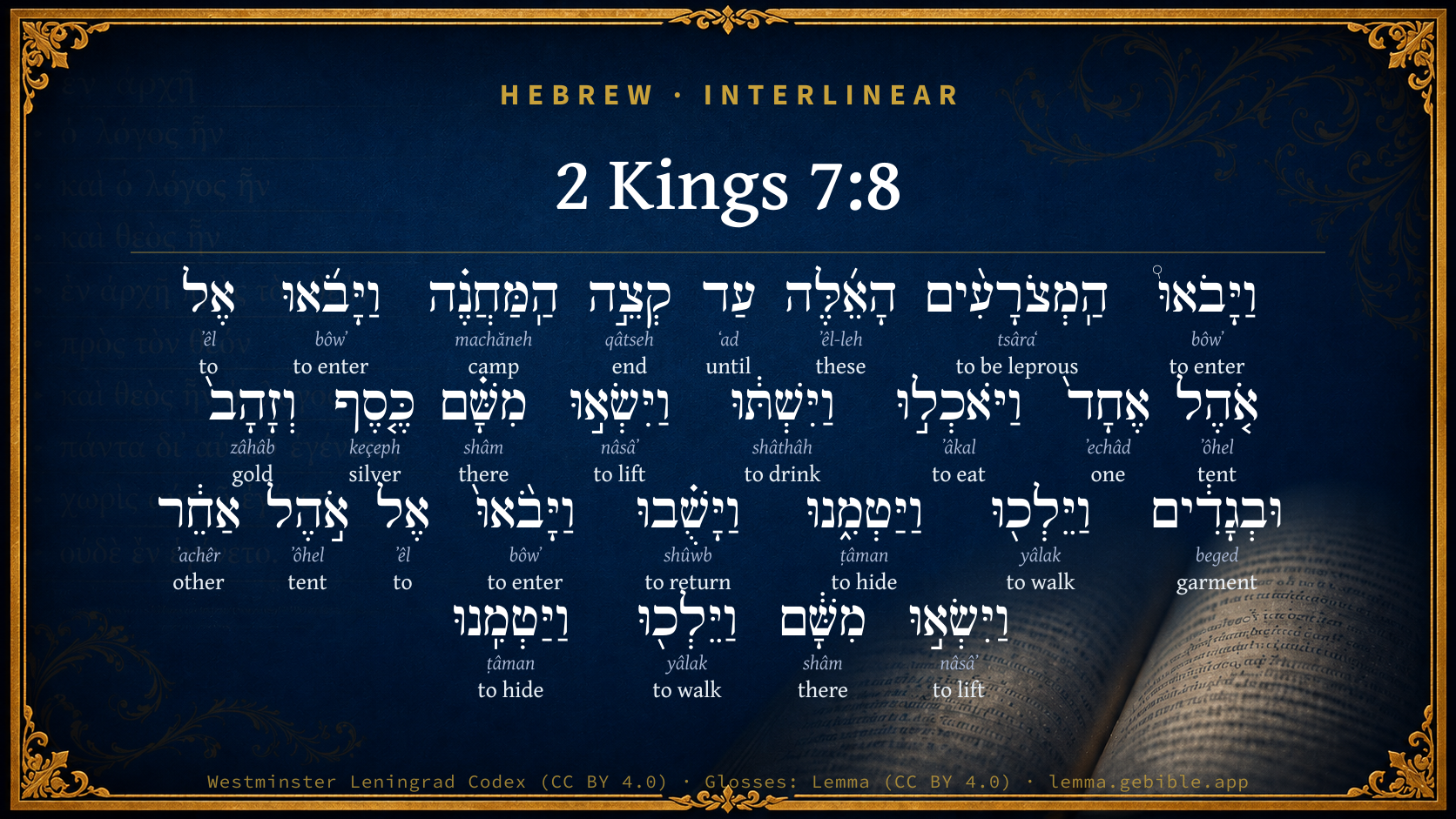
2 Kings 7:8

Hebrew (Westminster Leningrad Codex) 2 Kings 7:8 appears in the Hebrew Old Testament. The text above is from the Westminster Leningrad Codex. Each word links to its Strong’s number, a concise gloss, and parsing drawn from the Open Scriptures Hebrew Bible morphology. Click any word for its full Brown-Driver-Briggs (BDB) entry.
Download image
Cite this verse

2 Kings 7:8 (World English Bible). Public Domain. Lemma interlinear Bible study tool, https://lemma.gebible.app/v/2-kings/7/8.

Show BibTeX & RIS
BibTeX
RIS
English Translation
When these lepers came to the outermost part of the camp, they went into one tent, and ate and drink, and carried there silver, and gold, and clothing, and went and hid it; and they came back, and entered into another tent, and carried there also, and went and hid it.
World English Bible · Public Domain
Download a study sheet

One document with this verse’s original text, its word-by-word gloss line, the meaning frame, cross-references with their text, attributed commentary, and full source and license credits — printable, and it pastes into notes with its structure intact.

This verse Autodidact and up

Study sheet (.html) Plain text (.txt)

A passage Seminary Student

Up to 50 verses in one chapter. A passage sheet keeps up to 6 commentary sources and 12 cross-references per verse, in the order this page ranks them, and says so on the sheet whenever that leaves anything out. Ask for a single verse and you get the Autodidact verse sheet above.

Everything on this page stays free to read, with no account — the sheet is a download of what is already on screen, not access to it.

Want to remove ads? Support Godless Engineer
Compare translations 3

The same verse in 3 English versions, stacked beneath the original-language interlinear above. Click any original word for its lexicon entry.

Each is an independent rendering of the whole verse — the interlinear is not word-aligned to these translations.

Highlighted words mark where these versions differ — a whole-verse word diff, not a word-by-word alignment.

  • World English Bible Public Domain
    When these lepers came to the outermost part of the camp, they went into one tent, and ate and drink, and carried there silver, and gold, and clothing, and went and hid it; and they came back, and entered into another tent, and carried there also, and went and hid it.
  • King James Version Public Domain
    And when these lepers came to the uttermost part of the camp, they went into one tent, and did eat and drink, and carried thence silver, and gold, and raiment, and went and hid it; and came again, and entered into another tent, and carried thence also, and went and hid it.
  • unfoldingWord Literal Text CC BY-SA 4.0
    And those lepers came to the edge of the camp, and they went into one tent, and they ate, and they drank. And they carried away from there silver and gold and clothing, and they went, and they hid. Then they returned, and they went into another tent, and they carried away from there, and they went, and they hid.

unfoldingWord Literal Text — © unfoldingWord, licensed CC BY-SA 4.0. Word-aligned USFM3 via Door43 (git.door43.org/unfoldingWord/en_ult).

Versions to compare (up to 4)

3 of 4 selected

Show all 18 translations

Every available English version of this verse, each an independent rendering of the whole verse.

  • World English Bible Public Domain
    When these lepers came to the outermost part of the camp, they went into one tent, and ate and drink, and carried there silver, and gold, and clothing, and went and hid it; and they came back, and entered into another tent, and carried there also, and went and hid it.
  • Berean Standard Bible Public Domain
    When the lepers reached the edge of the camp, they went into a tent to eat and drink. Then they carried off the silver, gold, and clothing, and went and hid them. On returning, they entered another tent, carried off some items from there, and hid them.
  • Majority Standard Bible Public Domain
    When the lepers reached the edge of the camp, they went into a tent to eat and drink. Then they carried off the silver, gold, and clothing, and went and hid them. On returning, they entered another tent, carried off some items from there, and hid them.
  • King James Version Public Domain
    And when these lepers came to the uttermost part of the camp, they went into one tent, and did eat and drink, and carried thence silver, and gold, and raiment, and went and hid it; and came again, and entered into another tent, and carried thence also, and went and hid it.
  • American Standard Version (1901) Public Domain
    And when these lepers came to the outermost part of the camp, they went into one tent, and did eat and drink, and carried thence silver, and gold, and raiment, and went and hid it; and they came back, and entered into another tent, and carried thence also, and went and hid it.
  • Revised Version (1885) Public Domain
    And when these lepers came to the outermost part of the camp, they went into one tent, and did eat and drink, and carried thence silver, and gold, and raiment, and went and hid it; and they came back, and entered into another tent, and carried thence also, and went and hid it.
  • Geneva Bible (1599) Public Domain
    And when these lepers came to the vtmost part of the campe, they entred into one tent, and did eate and drinke, and caryed thence siluer and golde, and raiment, and went and hid it: after they returned, and entred into another tent, and caryed thence also, and went and hid it.
  • Douay-Rheims (1899) Public Domain
    So when these lepers were come to the beginning of the camp, they went into one tent, and ate and drank: and they took from thence silver, and gold, and raiment, and went, and hid it: and they came again, and went into another tent, and carried from thence in like manner, and hid it.
  • Young's Literal Translation Public Domain
    And these lepers come in unto the extremity of the camp, and come in unto one tent, and eat, and drink, and lift up thence silver, and gold, and garments, and go and hide; and they turn back and go in unto another tent, and lift up thence, and go and hide.
  • Literal Standard Version CC BY-SA 4.0
    And these lepers come to the extremity of the camp, and come into one tent, and eat, and drink, and lift up silver, and gold, and garments from there, and go and hide; and they turn back and go into another tent, and lift up from there, and go and hide.
  • Unlocked Literal Bible CC BY-SA 4.0
    When the men with leprosy came to the outermost part of the camp, they went into one tent and ate and drank, and carried away silver and gold and clothes, and went and hid them. They came back and entered into another tent and carried plunder away from there also, and went and hid it.
  • unfoldingWord Literal Text CC BY-SA 4.0
    And those lepers came to the edge of the camp, and they went into one tent, and they ate, and they drank. And they carried away from there silver and gold and clothing, and they went, and they hid. Then they returned, and they went into another tent, and they carried away from there, and they went, and they hid.
  • Darby Bible Public Domain
    And those lepers came to the extremity of the camp; and they went into one tent, and ate and drank, and carried thence silver and gold, and garments, and went and hid it; and they came again, and entered into another tent, and carried thence, and went and hid [it].
  • World Messianic Bible Public Domain
    When these lepers came to the outermost part of the camp, they went into one tent, and ate and drank, then carried away silver, gold, and clothing and went and hid it. Then they came back, and entered into another tent and carried things from there also, and went and hid them.
  • Webster's Bible Public Domain
    And when these lepers came to the uttermost part of the camp, they went into one tent, and ate and drank, and carried thence silver, and gold, and raiment, and went and hid it; and came again, and entered into another tent, and carried thence also, and went and hid it.
  • Free Bible Version CC BY-SA 4.0
    When the lepers got to the edge of the camp, they went into a tent and ate and drank. Then they took the silver, gold, and clothes, and hid them. After that they went back to another tent, took some things from there, and hid them.
  • Bible in Basic English Public Domain
    And when those lepers came to the outer line of tents, they went into one tent, and had food and drink, and took from it silver and gold and clothing, which they put in a secret place; then they came back and went into another tent from which they took more goods, which they put away in a secret place.
  • JPS Tanakh (1917) Public Domain
    And when these lepers came to the outermost part of the camp, they went into one tent, and did eat and drink, and carried thence silver, and gold, and raiment, and went and hid it; and they came back, and entered into another tent, and carried thence also, and went and hid it.

Literal Standard Version (2020), Covenant Press — licensed CC BY-SA 4.0. Text via the HelloAO Bible API (eBible.org). Unlocked Literal Bible (unfoldingWord) — licensed CC BY-SA 4.0. Text via the HelloAO Bible API (eBible.org). unfoldingWord Literal Text — © unfoldingWord, licensed CC BY-SA 4.0. Word-aligned USFM3 via Door43 (git.door43.org/unfoldingWord/en_ult). Free Bible Version, Dr. Jonathan Gallagher — licensed CC BY-SA 4.0. Text via the HelloAO Bible API (eBible.org).

Word by word

More ways to search: Search by grammar → Find every occurrence → Compare this word →

Practice this passage: Drill this verse → Learn its vocabulary →

הַֽמְצֹרָעִ֨ים
tsâraʻ
H6879
“the · leprous”
Particle, Definite Article + Verb, Pual, Participle Passive, Masculine, Plural, Absolute
Part of Speech
Particle + Verb
Stem
Pual
Form
Participle Passive
Gender
Masculine
Number
Plural
State
Absolute
Full BDB Definition

Origin: a primitive root

TWOT: 1971

to be diseased of skin, be leprous - (Qal) to be a leper - (Pual) to have leprosy
  1. וַיָּבֹאוּ֩ bôwʼ H935 “and · to enter” Conjunction + Verb, Qal, Sequential Imperfect, 3rd Person, Masculine, Plural
  2. הָאֵ֜לֶּה ʼêl-leh H428 “the · these” Particle, Definite Article + Pronoun, Demonstrative, Common, Plural
  3. עַד ʻad H5704 “until” Preposition
  4. קְצֵ֣ה qâtseh H7097 “end of” Noun, Common, Both, Singular, Construct
  5. הַֽמַּחֲנֶ֗ה machăneh H4264 “the · camp” Particle, Definite Article + Noun, Common, Both, Singular, Absolute
  6. וַיָּבֹ֜אוּ bôwʼ H935 “and · to enter” Conjunction + Verb, Qal, Sequential Imperfect, 3rd Person, Masculine, Plural
  7. אֶל ʼêl H413 “to” Preposition
  8. אֹ֤הֶל ʼôhel H168 “tent” Noun, Common, Masculine, Singular, Absolute
  9. אֶחָד֙ ʼechâd H259 “one” Adjective, Cardinal number, Masculine, Singular, Absolute
  10. וַיֹּאכְל֣וּ ʼâkal H398 “and · to eat” Conjunction + Verb, Qal, Sequential Imperfect, 3rd Person, Masculine, Plural
  11. וַיִּשְׁתּ֔וּ shâthâh H8354 “and · to drink” Conjunction + Verb, Qal, Sequential Imperfect, 3rd Person, Masculine, Plural
  12. וַיִּשְׂא֣וּ nâsâʼ H5375 “and · to lift” Conjunction + Verb, Qal, Sequential Imperfect, 3rd Person, Masculine, Plural
  13. מִשָּׁ֗ם shâm H8033 “from · there” Preposition + Adverb
  14. כֶּ֤סֶף keçeph H3701 “silver” Noun, Common, Masculine, Singular, Absolute
  15. וְזָהָב֙ zâhâb H2091 “and · gold” Conjunction + Noun, Common, Masculine, Singular, Absolute
  16. וּבְגָדִ֔ים beged H899 “and · garments” Conjunction + Noun, Common, Masculine, Plural, Absolute
  17. וַיֵּלְכ֖וּ yâlak H3212 “and · to walk” Conjunction + Verb, Qal, Sequential Imperfect, 3rd Person, Masculine, Plural
  18. וַיַּטְמִ֑נוּ ṭâman H2934 “and · to hide” Conjunction + Verb, Hiphil, Sequential Imperfect, 3rd Person, Masculine, Plural
  19. וַיָּשֻׁ֗בוּ shûwb H7725 “and · to return” Conjunction + Verb, Qal, Sequential Imperfect, 3rd Person, Masculine, Plural
  20. וַיָּבֹ֨אוּ֙ bôwʼ H935 “and · to enter” Conjunction + Verb, Qal, Sequential Imperfect, 3rd Person, Masculine, Plural
  21. אֶל ʼêl H413 “to” Preposition
  22. אֹ֣הֶל ʼôhel H168 “tent” Noun, Common, Masculine, Singular, Absolute
  23. אַחֵ֔ר ʼachêr H312 “other” Adjective, Adjective, Masculine, Singular, Absolute
  24. וַיִּשְׂא֣וּ nâsâʼ H5375 “and · to lift” Conjunction + Verb, Qal, Sequential Imperfect, 3rd Person, Masculine, Plural
  25. מִשָּׁ֔ם shâm H8033 “from · there” Preposition + Adverb
  26. וַיֵּלְכ֖וּ yâlak H3212 “and · to walk” Conjunction + Verb, Qal, Sequential Imperfect, 3rd Person, Masculine, Plural
  27. וַיַּטְמִֽנוּ ṭâman H2934 “and · to hide” Conjunction + Verb, Hiphil, Sequential Imperfect, 3rd Person, Masculine, Plural

About this verse

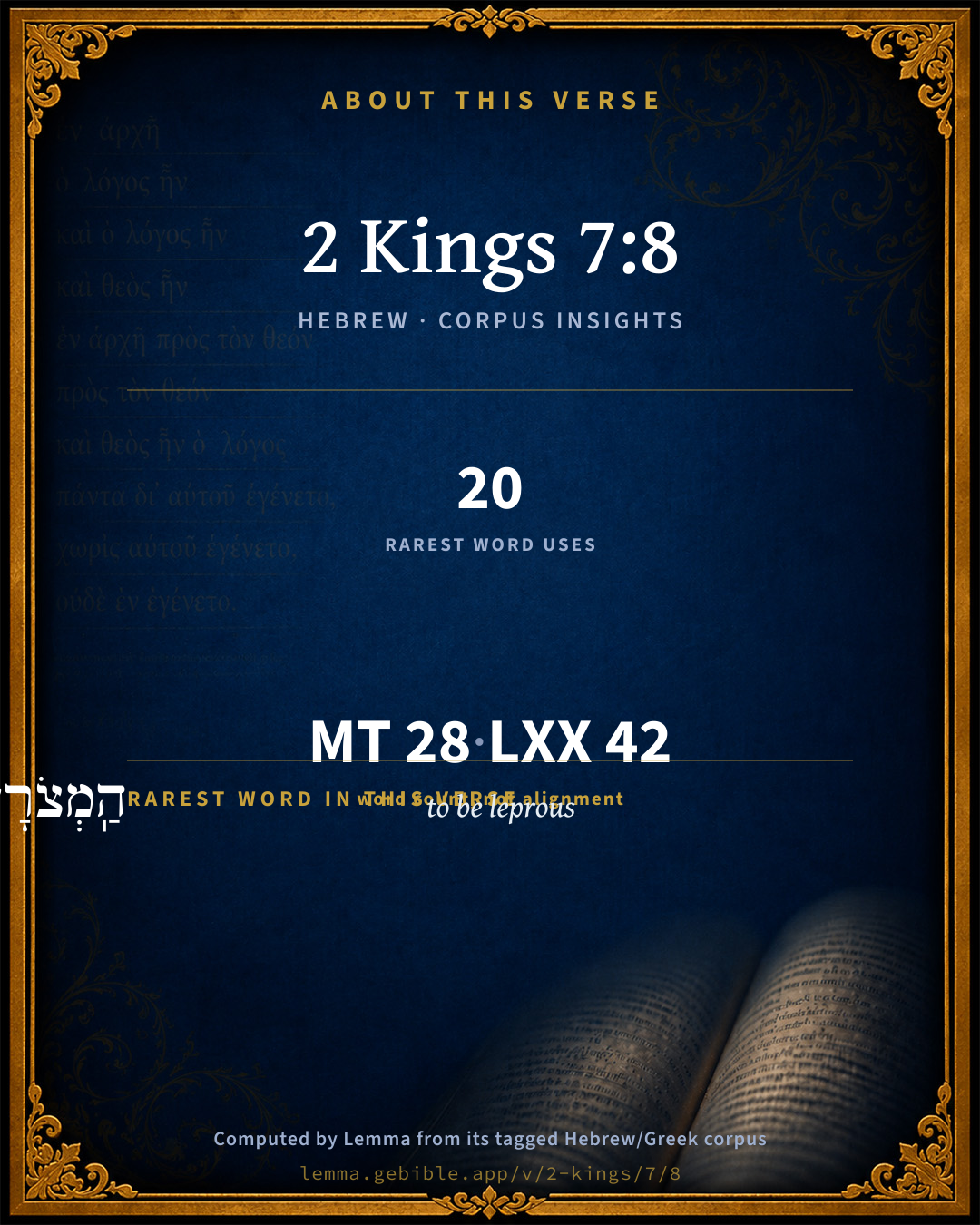
These counts appear in no published source. They are computed here, from the morphology-tagged text and Lemma’s own curated glosses. What Lemma adds →

28
words
20
distinct lemmas
Historical
section

Notable vocabulary

The rarest word here is הַֽמְצֹרָעִ֨ים to be leprous H6879 — appearing just 20 times in the whole Hebrew Bible.

Shared distinctive vocabulary

הַֽמְצֹרָעִ֨ים to be leprous H6879 occurs in 18 verses of the Hebrew Bible. Also found in:

Grammatical profile

  • 13 verbs
  • 7 nouns
  • 2 adjectives
  • 1 pronoun
  • 3 prepositions
  • 2 adverbs

Verb forms

  • וַיָּבֹאוּ֩ Qal · Sequential Imperfect
  • הַֽמְצֹרָעִ֨ים Pual · Participle Passive
  • וַיָּבֹ֜אוּ Qal · Sequential Imperfect
  • וַיֹּאכְל֣וּ Qal · Sequential Imperfect
  • וַיִּשְׁתּ֔וּ Qal · Sequential Imperfect
  • וַיִּשְׂא֣וּ Qal · Sequential Imperfect
  • וַיֵּלְכ֖וּ Qal · Sequential Imperfect
  • וַיַּטְמִ֑נוּ Hiphil · Sequential Imperfect
  • וַיָּשֻׁ֗בוּ Qal · Sequential Imperfect
  • וַיָּבֹ֨אוּ֙ Qal · Sequential Imperfect
  • וַיִּשְׂא֣וּ Qal · Sequential Imperfect
  • וַיֵּלְכ֖וּ Qal · Sequential Imperfect
  • וַיַּטְמִֽנוּ Hiphil · Sequential Imperfect

Repetition

Words recur within this verse — often emphatic in Hebrew:

  • וַיָּבֹאוּ֩ to enter H935 ×3
  • אֹ֤הֶל tent H168 ×2
  • וַיִּשְׂא֣וּ to lift H5375 ×2
  • מִשָּׁ֗ם there H8033 ×2
  • וַיֵּלְכ֖וּ to walk H3212 ×2
  • וַיַּטְמִ֑נוּ to hide H2934 ×2
  • אֶל to H413 ×2

Hebrew & Septuagint length

In English translation the verse runs 51 words from the Hebrew and 47 from the Septuagint (LXX English) — closely comparable.

A rough comparison of the two English renderings, which tokenize alike — not a word-level alignment.

Word counts can differ between the Hebrew and the Greek without any difference in meaning — e.g. the Hebrew direct-object marker אֵת has no separate Greek word, and Greek often adds the article ὁ.

In the original languages it is 28 Hebrew tokens and 42 Greek tokens — but the two are counted differently (Hebrew bundles its prefixes and suffixes into one token; the Greek is in lemma form), so that isn’t a like-for-like length.

Cross-references

5

Topical passages linked to 2 Kings 7:8 in the Treasury of Scripture Knowledge — connected by theme and wording, ordered by reader-vote popularity; previews shown in the World English Bible.

  • Joshua 7:21 when I saw among the spoil a goodly Babylonian mantle, and two hundred shekels of silver, and a wedge of gold of fifty shekels weight, then I coveted them, and took them; and, behold, they are hid in the earth in the midst of my tent, and the silver under it.
  • Matthew 13:44 "Again, the Kingdom of Heaven is like a treasure hidden in the field, which a man found, and hid. In his joy, he goes and sells all that he has, and buys that field.
  • 2 Kings 5:24 When he came to the hill, he took them from their hand, and bestowed them in the house; and he let the men go, and they departed.
  • Jeremiah 41:8 But ten men were found among those who said to Ishmael, Don't kill us; for we have stores hidden in the field, of wheat, and of barley, and of oil, and of honey. So he stopped, and didn't kill them among their brothers.
  • Matthew 25:18 But he who received the one went away and dug in the earth, and hid his lord's money.

Cross-references courtesy of OpenBible.info (CC BY 4.0).

Hebrew and Greek witnesses Masoretic Hebrew ↔ Greek Septuagint

The same verse in the two great witnesses to the Old Testament, shown verse-for-verse.

These are two independent witnesses, not word-aligned to each other, and the Septuagint is shown in lemma (dictionary) form.

Hebrew 2 Kings 7:8 Masoretic · Westminster Leningrad Codex

וַיָּבֹאוּ֩ הַֽמְצֹרָעִ֨ים הָאֵ֜לֶּה עַד קְצֵ֣ה הַֽמַּחֲנֶ֗ה וַיָּבֹ֜אוּ אֶל אֹ֤הֶל אֶחָד֙ וַיֹּאכְל֣וּ וַיִּשְׁתּ֔וּ וַיִּשְׂא֣וּ מִשָּׁ֗ם כֶּ֤סֶף וְזָהָב֙ וּבְגָדִ֔ים וַיֵּלְכ֖וּ וַיַּטְמִ֑נוּ וַיָּשֻׁ֗בוּ וַיָּבֹ֨אוּ֙ אֶל אֹ֣הֶל אַחֵ֔ר וַיִּשְׂא֣וּ מִשָּׁ֔ם וַיֵּלְכ֖וּ וַיַּטְמִֽנוּ

When these lepers came to the outermost part of the camp, they went into one tent, and ate and drink, and carried there silver, and gold, and clothing, and went and hid it; and they came back, and entered into another tent, and carried there also, and went and hid it.

World English Bible · Public Domain

Greek LXX 2 Kings 7:8 Septuagint · lemma form

καί εἰςἔρχομαι ὁ λεπρός οὗτος ἕως μέρος ὁ παρεμβολή καί εἰςἔρχομαι εἰς σκηνή εἷς καί ἐσθίω καί πίνω καί αἴρω ἐκεῖθεν ἀργύριον καί χρυσίον καί ἱματισμός καί πορεύομαι καί ἐπιστρέφω καί εἰςἔρχομαι εἰς σκηνή ἄλλος καί λαμβάνω ἐκεῖθεν καί πορεύομαι καί κατακρύπτω

And these lepers entered a little way into the camp, and went into one tent, and ate and drank, and took thence silver, and gold, and raiment; and they went and returned thence, and entered into another tent, and took thence, and went and hid the spoil.

LXX2012 (modern English Septuagint) · Public Domain

Hebrew: Westminster Leningrad Codex (CC BY 4.0). Greek: Septuagint (public domain); English from LXX2012 (modern English Septuagint) (Public Domain). How the Septuagint differs from the Hebrew →

Targum (Aramaic paraphrase)

1

The Targum is the ancient Jewish Aramaic paraphrase of the Hebrew Scriptures — an interpretive translation, not the Hebrew text itself. Onkelos (literal) and Pseudo-Jonathan (expansive) render the Torah, and Jonathan the Prophets. Coverage is partial: where no permissively-licensed English translation exists for a verse, only the Aramaic is shown. This is verse-level text, not a word-by-word alignment to the Hebrew.

  1. Targum Jonathan Prophets (Joshua–Malachi)
    וַאֲתוֹ סְגִירַיָא הָאִלֵין עַד סְיָפֵי מַשְׁרִיתָא וַעֲלוּ לְמַשְׁכְּנָא חַד וַאֲכַלוּ וּשְׁתִיאוּ וּנְסִיבוּ מִתַּמָן כַּסְפָּא וְדַהֲבָא וּלְבוּשִׁין וַאֲזָלוּ וְאַטְמָרוּ וְתָבוּ וַעֲלוּ לְמַשְׁכְּנָא אוֹחֲרָנָא וּנְסִיבוּ מִתַּמָן וַאֲזַלוּ וְאַטְמָרוּ:

    (no public-domain English translation for this verse)

    Targum Jonathan — Aramaic: “Mikraot Gedolot” (public domain). English: “Sefaria Community Translation” (CC0 1.0 (public-domain dedication)); “London "Chaldee Paraphrase," 1871” (public domain). Text via Sefaria.

Commentary

Notes on 2 Kings 7:8 from classic Christian and Jewish commentators (each source and its license shown beneath its notes). The classic Christian expositions comment on the surrounding passage and are grouped to its opening verse, so a note may address several verses; the Jewish commentaries on the Tanakh (Rashi and others) are per-verse, so they appear only where the commentator wrote on this verse.

Lemma curates 59 commentaries, every one of them public domain or Creative Commons licensed, each selected and text-cleaned for this edition rather than reprinted as found. About our sources →

Trapp's Complete Commentary

John Trapp

2Ki 7:8 And when these lepers came to the uttermost part of the camp, they went into one tent, and did eat and drink, and carried thence silver, and gold, and raiment, and went and hid [it]; and came again, and entered into another tent, and carried thence [also], and went and hid [it].

Ver. 8. And carried thence also, and went and hid it.] Covetousness is unsatisfiable in hiding and hoarding; it is, as one saith, a dry drunkenness, never saying, Satis est. it is enough.

John Trapp, A Commentary or Exposition upon All the Books of the Old and New Testament (1647–1656) — public domain. Text from a community e-Sword module.

Tyndale Open Study Notes

Tyndale Open Resources

7:8-9 The men realized that they needed to share their good fortune with the people in Samaria.

Tyndale Open Study Notes — © Tyndale Open Resources, licensed CC BY-SA 4.0. Text via the HelloAO Bible API.

Jamieson, Fausset & Brown

Robert Jamieson, A. R. Fausset & David Brown

these lepers . . . did eat and drink--After they had appeased their hunger and secreted as many valuables as they could carry, their consciences smote them for concealing the discovery and they hastened to publish it in the city.

Jamieson, Fausset & Brown — Commentary Critical and Explanatory on the Whole Bible (1871) — public domain (CC PDM 1.0). Text via the HelloAO Bible API.

Ellicott's Commentary for English Readers

(8) And when . . . tent.—Literally, And (so) those lepers came to the edge of the camp, and they went into one tent, taking up the thread of the narrative again at 2Ki_7:5, where it was broken by the parenthesis about the panic flight of the Syrians.

Went and hid it.—A common practice of Orientals, with whom holes in the ground or in the house wall supply the place of banks.

A Bible Commentary for English Readers, edited by Charles John Ellicott (1878–1897) — public domain. Text from a community e-Sword module.

The Cambridge Bible for Schools and Colleges

gen. ed. J. J. S. Perowne

8. they went into one tent, and did eat and drink] Hunger asserted the first claim; that satisfied, they began to think how they might make most gain for themselves, by hiding a store of the deserted wealth; and this they did till their consciences smote them for their selfishness.

The Cambridge Bible for Schools and Colleges (gen. ed. J. J. S. Perowne; Cambridge University Press, 1878–1918) — public domain. Text from a community e-Sword module.

John Gill's Exposition

And when these lepers came to the uttermost part of the camp, they went into one tent,.... The first they came to:

and did eat and drink; which was the first thing they did, being hungry, and almost starved:

and carried thence silver, and gold, and raiment, and went and hid it; in a place without the camp, where they thought it would be safe, and where they could come at it again:

and came again and entered into another tent, and carried thence also, and went and hid it; this, Josephus says (z), they did four times.

(z) Ut supra, (Antiqu. l. 9. c. 4.) sect. 5.

John Gill's Exposition of the Whole Bible (1746–1763) — public domain (CC PDM 1.0). Text via the HelloAO Bible API.

The Pulpit Commentary

And when these lepers came to the uttermost part of the comp. The narrative, begun in ver. 3, is here taken up from the point where it was broken off in ver. 5, and the phrase there used is repeated, to mark the connection. They went into one tent, and did eat and drink. The first necessity was to satisfy the cravings of their appetite, as they were well-nigh starving. Then their covetousness was excited by the riches exposed to view in the tent. And carried thence silver, and gold, and raiment. Oriental armies carried with them vast quantities of the precious metals, in the shape of gold and silver vases, goblets, dishes, as well as in collars, chains, furniture, and trappings. Herodotus says (ix. 80) that, when the camp of Mardonius at Plataea fell into the hands of the Greeks, there were found in it "many tents richly adorned with furniture of gold and silver, many couches covered with plates of the same, and many golden bowls, goblets, and other drinking-vessels. On the carriages were bags containing gold and silver kettles; and the bodies of the slain furnished bracelets and chains, and scimitars with golden ornaments not to mention era-broidered apparel, of which no one made any account." The camp of the Syrians would scarcely have been so richly provided; but still it contained, no doubt, a large amount of very valuable plunder. And went and hid it. The lepers had no right to the pick of the spoil. It belonged to the nation, and it was probably the king"s right to apportion it. The lepers had to conceal what they appropriated, lest it should he taken from them.

And came again, and entered into another tent, and carried thence also, and went and hid it. Plundering thus probably, not two tents only, but several. At last, either covetousness was satiated or conscience awoke.

The Pulpit Commentary (1880–1919), ed. H.D.M. Spence-Jones & Joseph S. Exell — public domain. Text from a community e-Sword module.

Keil & Delitzsch

C. F. Keil & F. Delitzsch

When these lepers (these, pointing back to Kg2 7:3.) came into the camp which the Syrians had left, they first of all satisfied their own hunger with the provisions which they found in the tents, and then took different valuables and concealed them. But their consciences were soon aroused, so that they said: We are not doing right; this day is a day of joyful tidings: if we are silent and wait till the morning light, guilt will overtake us; "for it is the duty of citizens to make known things relating to public safety" (Grotius). They then resolved to announce the joyful event in the king's palace, and reported it to the watchman at the city gate. העיר שׁער stands as a generic term in a collective sense for the persons who watched at the gate; hence the following plural להם, and in Kg2 7:11 השּׁערים. "And the gate-keepers cried out (what they had heard) and reported it in the king's palace."

Keil & Delitzsch — Biblical Commentary on the Old Testament (1861–1891) — public domain (CC PDM 1.0). Text via the HelloAO Bible API. (Old Testament only.)

Lesson kit

Teaching starters — assembled from the data on this page, not authored interpretation. Every prompt links to the verse data it draws on. Edit before teaching.

2 Kings, in the Historical, opens this verse with 28 words (20 distinct Hebrew lemmas). Its most distinctive word is tsâraʻ (“to be leprous”). A historical commentator’s framing appears above. Read the whole chapter for the surrounding context.

Discussion questions

  1. What does “to be leprous” (tsâraʻ) contribute to the verse as a whole?
  2. How does Exodus 4:6, which shares the word «to be leprous», read alongside this verse?
  3. What does the repetition of “to enter” (3× in this one verse) do in this verse?
  4. These translations render this verse differently. What is at stake in choosing one wording over another?
  5. «וַיָּבֹאוּ֩» is a Qal Sequential Imperfect verb. How does that grammatical form shape the action described?
  6. Compare how Trapp's Complete Commentary and Tyndale Open Study Notes read this verse. Where do they agree or differ?

Things to notice

Reading settings

Reading text

Shown beneath each verse's original-language words.

Old Testament
Old Testament edition

Read the OT as the Masoretic Hebrew (MT) or the Greek Septuagint (LXX).

English shown for the Greek Septuagint (in the Hebrew ↔ Greek comparison).

Comparing translations? Open the Compare panel on any verse page to stack up to four side by side.