

Job 22:26

Hebrew (Westminster Leningrad Codex) Job 22:26 appears in the Hebrew Old Testament. The text above is from the Westminster Leningrad Codex. Each word links to its Strong’s number, a concise gloss, and parsing drawn from the Open Scriptures Hebrew Bible morphology. Click any word for its full Brown-Driver-Briggs (BDB) entry.
Download image
Cite this verse

Job 22:26 (World English Bible). Public Domain. Lemma interlinear Bible study tool, https://lemma.gebible.app/v/job/22/26.

Show BibTeX & RIS
BibTeX
RIS
English Translation
For then shall you delight yourself in the Almighty, And shall lift up your face to God.
World English Bible · Public Domain
Download a study sheet

One document with this verse’s original text, its word-by-word gloss line, the meaning frame, cross-references with their text, attributed commentary, and full source and license credits — printable, and it pastes into notes with its structure intact.

This verse Autodidact and up

Study sheet (.html) Plain text (.txt)

A passage Seminary Student

Up to 50 verses in one chapter. A passage sheet keeps up to 6 commentary sources and 12 cross-references per verse, in the order this page ranks them, and says so on the sheet whenever that leaves anything out. Ask for a single verse and you get the Autodidact verse sheet above.

Everything on this page stays free to read, with no account — the sheet is a download of what is already on screen, not access to it.

Want to remove ads? Support Godless Engineer
Compare translations 3

The same verse in 3 English versions, stacked beneath the original-language interlinear above. Click any original word for its lexicon entry.

Each is an independent rendering of the whole verse — the interlinear is not word-aligned to these translations.

Highlighted words mark where these versions differ — a whole-verse word diff, not a word-by-word alignment.

  • World English Bible Public Domain
    For then shall you delight yourself in the Almighty, And shall lift up your face to God.
  • King James Version Public Domain
    For then shalt thou have thy delight in the Almighty, and shalt lift up thy face unto God.
  • unfoldingWord Literal Text CC BY-SA 4.0
    For then you will delight yourself in the Almighty, and you will lift your face to God.

unfoldingWord Literal Text — © unfoldingWord, licensed CC BY-SA 4.0. Word-aligned USFM3 via Door43 (git.door43.org/unfoldingWord/en_ult).

Versions to compare (up to 4)

3 of 4 selected

Show all 18 translations

Every available English version of this verse, each an independent rendering of the whole verse.

  • World English Bible Public Domain
    For then shall you delight yourself in the Almighty, And shall lift up your face to God.
  • Berean Standard Bible Public Domain
    Surely then you will delight in the Almighty and lift up your face to God.
  • Majority Standard Bible Public Domain
    Surely then you will delight in the Almighty and lift up your face to God.
  • King James Version Public Domain
    For then shalt thou have thy delight in the Almighty, and shalt lift up thy face unto God.
  • American Standard Version (1901) Public Domain
    For then shalt thou delight thyself in the Almighty, And shalt lift up thy face unto God.
  • Revised Version (1885) Public Domain
    For then shalt thou delight thyself in the Almighty, and shalt lift up thy face unto God.
  • Geneva Bible (1599) Public Domain
    And thou shalt then delite in the Almightie, and lift vp thy face vnto God.
  • Douay-Rheims (1899) Public Domain
    Then shalt thou abound in delights in the Almighty, and shalt lift up thy face to God.
  • Young's Literal Translation Public Domain
    For then on the Mighty thou delightest thyself, And dost lift up unto God thy face,
  • Literal Standard Version CC BY-SA 4.0
    For then you delight yourself on the Mighty, || And lift up your face to God,
  • Unlocked Literal Bible CC BY-SA 4.0
    For then you will take pleasure in the Almighty; you will lift up your face to God.
  • unfoldingWord Literal Text CC BY-SA 4.0
    For then you will delight yourself in the Almighty, and you will lift your face to God.
  • Darby Bible Public Domain
    Yea, then shalt thou delight thyself in the Almighty, and shalt lift up thy face unto +God:
  • World Messianic Bible Public Domain
    For then you will delight yourself in the Almighty, and will lift up your face to God.
  • Webster's Bible Public Domain
    For then shalt thou have thy delight in the Almighty, and shalt lift up thy face to God.
  • Free Bible Version CC BY-SA 4.0
    Then you will find delight in the Almighty, and be able to face him without feeling ashamed.
  • Bible in Basic English Public Domain
    For then you will have delight in the Ruler of all, and your face will be lifted up to God.
  • JPS Tanakh (1917) Public Domain
    Then surely shalt thou have thy delight in the Almighty, and shalt lift up thy face unto God.

Literal Standard Version (2020), Covenant Press — licensed CC BY-SA 4.0. Text via the HelloAO Bible API (eBible.org). Unlocked Literal Bible (unfoldingWord) — licensed CC BY-SA 4.0. Text via the HelloAO Bible API (eBible.org). unfoldingWord Literal Text — © unfoldingWord, licensed CC BY-SA 4.0. Word-aligned USFM3 via Door43 (git.door43.org/unfoldingWord/en_ult). Free Bible Version, Dr. Jonathan Gallagher — licensed CC BY-SA 4.0. Text via the HelloAO Bible API (eBible.org).

Word by word

More ways to search: Search by grammar → Find every occurrence → Compare this word →

Practice this passage: Drill this verse → Learn its vocabulary →

About this verse

These counts appear in no published source. They are computed here, from the morphology-tagged text and Lemma’s own curated glosses. What Lemma adds →

9
words
9
distinct lemmas
Wisdom
section

Notable vocabulary

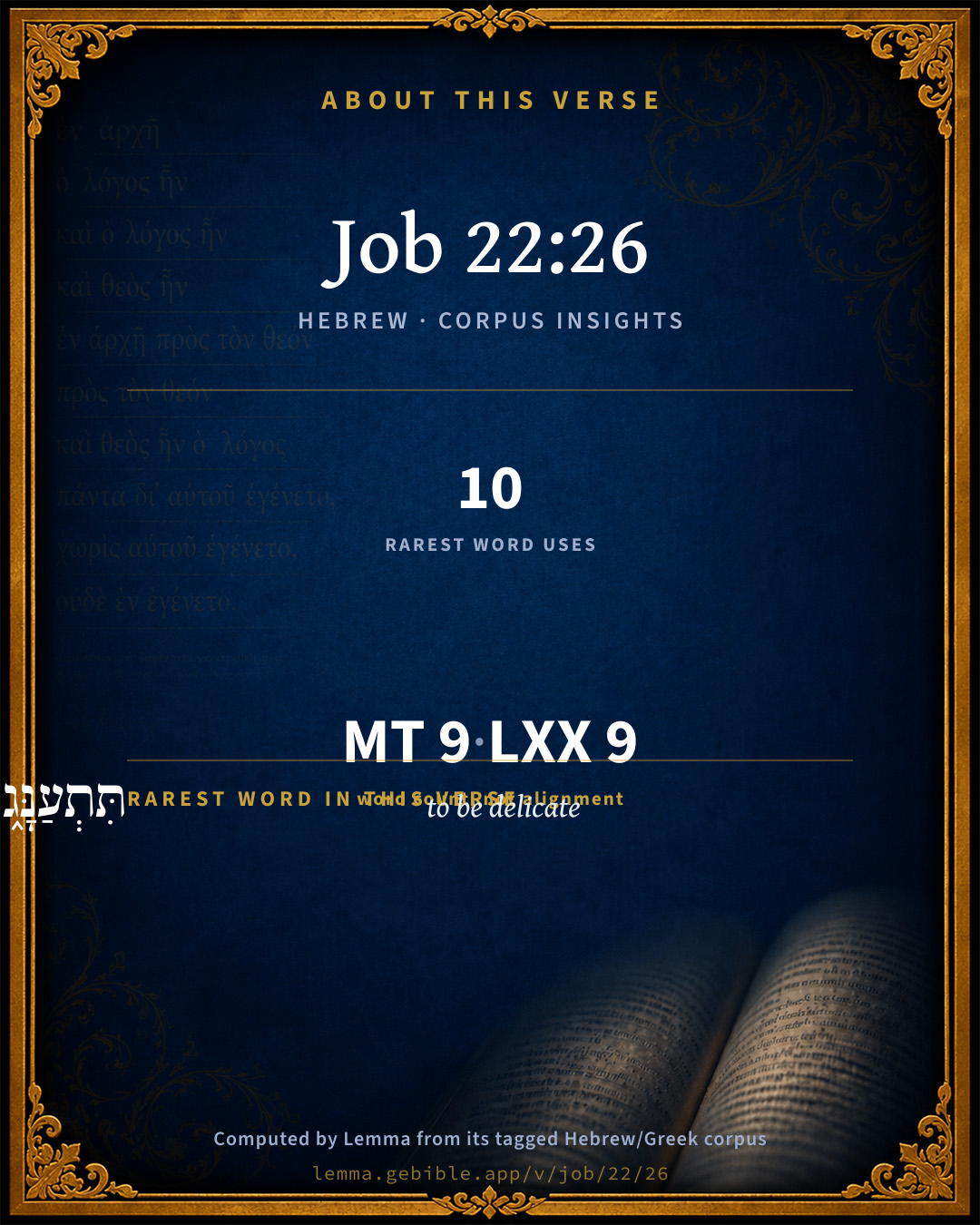
The rarest word here is תִּתְעַנָּ֑ג to be delicate H6026 — appearing just 10 times in the whole Hebrew Bible.

Shared distinctive vocabulary

תִּתְעַנָּ֑ג to be delicate H6026 occurs in 10 verses of the Hebrew Bible. Also found in:

Grammatical profile

  • 2 verbs
  • 3 nouns
  • 2 prepositions
  • 1 conjunction
  • 1 adverb

Verb forms

  • תִּתְעַנָּ֑ג Hithpael · Imperfect
  • וְתִשָּׂ֖א Qal · Imperfect

Hebrew & Septuagint length

In English translation the verse runs 17 words from the Hebrew and 13 from the Septuagint (LXX English) — closely comparable.

A rough comparison of the two English renderings, which tokenize alike — not a word-level alignment.

Word counts can differ between the Hebrew and the Greek without any difference in meaning — e.g. the Hebrew direct-object marker אֵת has no separate Greek word, and Greek often adds the article ὁ.

In the original languages it is 9 Hebrew tokens and 9 Greek tokens — but the two are counted differently (Hebrew bundles its prefixes and suffixes into one token; the Greek is in lemma form), so that isn’t a like-for-like length.

Cross-references

11

Topical passages linked to Job 22:26 in the Treasury of Scripture Knowledge — connected by theme and wording, ordered by reader-vote popularity; previews shown in the World English Bible.

  • Psalms 37:4 Also delight yourself in Yahweh, And he will give you the desires of your heart.
  • Isaiah 58:14 then shall you delight yourself in Yahweh; and I will make you to ride on the high places of the earth; and I will feed you with the heritage of Jacob your father: for the mouth of Yahweh has spoken it.
  • Job 27:10 Will he delight himself in the Almighty, And call on God at all times?
  • Job 11:15 Surely then shall you lift up your face without spot; Yes, you shall be steadfast, and shall not fear:
  • Romans 7:22 For I delight in God's law after the inward man,
  • Psalms 86:4 Bring joy to the soul of your servant, For to you, Lord, do I lift up my soul.
  • Psalms 143:8 Cause me to hear your loving kindness in the morning, For I trust in you. Cause me to know the way in which I should walk, For I lift up my soul to you.
  • Song of Solomon 2:3 As the apple tree among the trees of the wood, So is my beloved among the sons. I sat down under his shadow with great delight, His fruit was sweet to my taste.
  • 1 John 3:20–21 because if our heart condemns us, God is greater than our heart, and knows all things.
  • Job 34:9 For he has said, 'It profits a man nothing That he should delight himself with God.'
  • Psalms 25:1 To you, Yahweh, do I lift up my soul.

Cross-references courtesy of OpenBible.info (CC BY 4.0).

Hebrew and Greek witnesses Masoretic Hebrew ↔ Greek Septuagint

The same verse in the two great witnesses to the Old Testament, shown verse-for-verse.

These are two independent witnesses, not word-aligned to each other, and the Septuagint is shown in lemma (dictionary) form.

Hebrew Job 22:26 Masoretic · Westminster Leningrad Codex

כִּי אָ֭ז עַל שַׁדַּ֣י תִּתְעַנָּ֑ג וְתִשָּׂ֖א אֶל אֱל֣וֹהַּ פָּנֶֽיךָ

For then shall you delight yourself in the Almighty, And shall lift up your face to God.

World English Bible · Public Domain

Greek LXX Job 22:26 Septuagint · lemma form

εἶτα παρρησιάζομαι ἔναντι κύριος ἀναβλέπω εἰς ὁ οὐρανός ἱλαρῶς

Then shall you have boldness before the Lord, looking up cheerfully to heaven.

LXX2012 (modern English Septuagint) · Public Domain

On this verse, Keil & Delitzsch discusses the Septuagint’s reading. Read the note in Commentary ↓

Hebrew: Westminster Leningrad Codex (CC BY 4.0). Greek: Septuagint (public domain); English from LXX2012 (modern English Septuagint) (Public Domain). How the Septuagint differs from the Hebrew →

Commentary

Notes on Job 22:26 from classic Christian and Jewish commentators (each source and its license shown beneath its notes). The classic Christian expositions comment on the surrounding passage and are grouped to its opening verse, so a note may address several verses; the Jewish commentaries on the Tanakh (Rashi and others) are per-verse, so they appear only where the commentator wrote on this verse.

Lemma curates 59 commentaries, every one of them public domain or Creative Commons licensed, each selected and text-cleaned for this edition rather than reprinted as found. About our sources →

Trapp's Complete Commentary

John Trapp

Job 22:26 For then shalt thou have thy delight in the Almighty, and shalt lift up thy face unto God.

Ver. 26. For then shalt thou have thy delight in the Almighty] As in thine only portion. Thou shalt enjoy him, which is the peak of human happiness; solace thyself in the fruition of him, taste and see how good the Lord is, and thereupon love him dearly, Psa 18:1; not only with a love of desire, as Psa 42:1-2, but of complacence, as Psa 73:25-26, affecting not only a union, but a unity, with him; and conversing with him, as we may, in the mean while, in a fruitful and cheerful use of his holy ordinances.

And shall lift up thy face unto God] Wrapping thyself in Christ’s righteousness, thou shalt draw nigh to God with a humble boldness in duty, and not doubt but he will draw nigh to thee in mercy. It is said of Luther, that he prayed with so great reverence, as unto God; and yet with so great confidence, as to his friend (Melch. Ad. in Vita).

John Trapp, A Commentary or Exposition upon All the Books of the Old and New Testament (1647–1656) — public domain. Text from a community e-Sword module.

The Biblical Illustrator

Joseph S. Exell

Job_22:26-29

For then shalt thou have thy delight in the Almighty.

An outline of the devout life

These words can be raised to a higher level than that on which Eliphaz placed them, and regarded as describing the sweet and wonderful prerogatives of the devout life. So understood they may rebuke, and stimulate, and encourage us to make our lives conform to the ideal here.

I. Life may be full of delight and confidence in God. When we delight in a thing or person, we recognise that thing or person as fitting into a cleft of our hearts, and corresponding to some need of our natures. Without delight in God there is no real religion. The bulk of men are so sunken and embruted in animal tastes, and sensuous desires, and fleeting delights, that they have no care for the pure and calm joys which come to those who live near God. Above these stand the men whose religion is a matter of fear or of duty or of effort. And above them stand the men who serve because they trust God, but whose religion is seeking rather than finding, it is overshadowed by an unnatural and unwholesome gloom. He is the truly devout man who not only knows God to be great and holy, but feels Him to be sweet and sufficient; who not only fears, but loves. True religion is delighting in God. The next words, Thou shalt lift up thy face unto God, express frank confidence of approach to Him. The head hangs down in the consciousness of demerit and sin. But it is possible for men to go into Gods presence with a sense of peace, and to hold up their heads before their judge. There is no confidence possible for us unless we apprehend by faith, and thereon make our own the great work of Jesus Christ our Lord.

II. Such a life of delighting in God will be blessed by the frankest intercourse with him. Three stages of this blessed communion are possible. First a prayer, then the answer; and then the rendered thank offering. And so, in swift alternation and reciprocity, is carried on the commerce between heaven and earth, between man and God. The desires rise to heaven, but heaven comes down to earth first. Prayer is not the initial stage, but the second, in the process. God first gives His promise, and the best prayer is the catching up of Gods promise, and tossing it back again whence it came.

III. Such a life will neither know failure nor darkness. To serve God and to fall into the line of His purpose, and to determine nothing, nor absolutely want anything until we are sure that it is His will,--that is the secret of never failing in what we undertake.

IV. Such a life will be always hopeful and finally crowned with deliverance. Even in so blessed a life as has been described, times will come when the path plunges downward into some valley of the shadow of death. But even then the traveller will bate no jot of hope. The devout life is largely independent of circumstances, and is upheld and calmed by quiet certainty, that the general trend of its path is upward, which enables it to trudge hopefully down an occasional dip in the road. And the end will vindicate such confidence. Continuous partial deliverances lead on to, and bring about, final full salvation. (A. Maclaren, D. D.)

Delight in the Almighty

I. First, here is a desired position towards God. Many men forget God: He is no object of delight to them. Great numbers of men go a stage further: they believe in God, they cannot doubt that there is a Most High God who judgeth the children of men; but their only thought towards Him is that of dread and dislike. I am grieved to add that this principle even tinctures the thoughts of true friends of God: for when they bow before God it is not only with the reverence of a loving child, but with the terror of a slave; they are afraid of Him who should be their exceeding joy. God is still to them exceeding terrible, so that they fear and quake. Even though they are His children, they are not able to lift up their faces unto their own Father. Let us meditate a while upon what is here meant by delighting in the Almighty.

1. The man who experiences this delight is glad that there is a God. We delight to see God in the shadow of every passing cloud, in the colouring of every opening flower, in the glitter of every dewdrop, in the twinkling of every star.

2. To go a step further, the delight of the believer in his God is a delight in God as He really is; for there are in the world many false gods of mens own manufacture. Remember that your own thoughts of what God is are far from being correct unless they are drawn from His own revelation. We would not tone down a single attribute, we would not disturb the equilibrium of the Divine perfections; but we delight in God in all those aspects of His character which are mentioned in His Holy Word.

3. Further, he that delights in God delights not only in God as He is, but in all that God does, and this is a higher attainment than some have reached. It is the Lord, said one of old, let Him do what seemeth Him good.

4. Practically put, this delight in the Almighty shows itself in the Christian when nothing else remains to him. If he be stripped of everything, he cries, The Lord is my portion. You will see this delight in God exhibiting itself in frequent meditations upon God Delight thyself in the Lord. This will give you pleasure in the midst of pain. This will show itself in your life, for it will be a pleasure to do anything to exalt the name of God. I call your attention to the special name by which Eliphaz describes the ever-blessed God: he says, Delight thyself in the Almighty. Is it not singular that he should choose a term descriptive of omnipotence as the paramount cause of the believers delight? God is love, and I can readily understand how one might delight himself in God under that aspect; but the believer is taught to delight himself in God as strong and mighty. What a mercy it is that there is a power that makes for righteousness! Surely, when you see omnipotence linked with righteousness and mercy, you will delight yourself in the Almighty. Think also of the Lords almightiness in the matter of the keeping, preserving, defending, and perfecting of all His people. Now, let us turn with intense satisfaction to the other expression used by Eliphaz: Thou shalt lift up thy face unto God. What does it mean? Does it not mean, first, joy in God? When a man hangs his head down he is unhappy. Does it not signify, also, that this man is reconciled to God, and clear before Him? How can he look up who is guilty? Does not our text indicate fearlessness? Fear covers her face, and would fain hide herself altogether, even though to accomplish concealment the rocks must fall upon her. May it not also signify expectation? I will lift up mine eyes unto the hills, from whence cometh my help. Strive after this sacred peace: delight in the Almighty, and lift up your faces unto God.

II. When can we realise this?

1. First, a man can realise all this when he knows that he is reconciled to God.

2. Yet even this could not effect our delight in God unless there was something else; so there must be, in the next place, a renewed nature. Our old nature will never delight in God.

3. In addition to this, you will delight in God much more fully when the Spirit beareth witness with your spirit that you are born of God. The spirit of sonship is the spirit of delight in God.

We shall delight ourselves in God, and lift up our face when we do as Eliphaz here tells us.

1. First, when we live in communion with Him.

2. Then, further, we must, if we are to know this delight, lay up Gods words in our hearts (Job_22:22).

3. There must be added to this delight in the Word a constant cleansing of the way. If thou return to the Almighty, thou shalt be built up, thou shalt put away iniquity far from thy tabernacles. There must be purification of life, or there cannot be fellowship with the Lord.

4. In addition to this, there must be a constant trust. Yea, the Almighty shall be thy defence, and thou shalt have plenty of silver (Job_22:25). He who does not trust God cannot delight in Him. You cannot lift up your face to Him while you think Him untrue. A childlike confidence is essential to a holy joy.

5. Let us abide in continual prayer (Job_22:27). (C. H. Spurgeon.)

The Biblical Illustrator, edited by Joseph S. Exell (c. 1880s–1900s) — public domain. Text from a community e-Sword module.

Joseph Benson's Commentary

Job 22:26. For then shalt thou have thy delight in the Almighty — Thou shalt find delight, not only or chiefly in these outward comforts, but also and especially in God, whose face shall shine upon thee; and who shall give thee these things, not in anger, as he doth to wicked men, but as pledges of his love and favour to thee, and of those greater and eternal blessings which he hath in store for thee. And accordingly thou shalt delight thyself in him as worldly people delight themselves in their money, and shalt find real and continual pleasure in worshipping, obeying, and serving him in and with all his mercies. Thus these words contain a reason why he might confidently expect all those forementioned blessings, because he should set his affections on God, and possess his favour, which is the spring and foundation of all good. And lift up thy face unto God — Look up to him with cheerfulness and confidence.

Joseph Benson's Commentary on the Old and New Testaments (1811–1818) — public domain. Text from a community e-Sword module.

MacLaren's Expositions of Holy Scripture

Alexander MacLaren

Job

WHAT LIFE MAY BE MADE

Job 22:26 - Job 22:29.

These words are a fragment of one of the speeches of Job’s friends, in which the speaker has been harping on the old theme that affliction is the consequence and evidence of sin. He has much ado to square his theory with facts, and especially with the fact which brought him to Job’s dunghill. But he gets over the difficulty by the simple method of assuming that, since his theory must be true, there must be unknown facts which vindicate it in Job’s case; and since affliction is a sign of sin, Job’s afflictions are proof that he has been a sinner. So he charges him with grossest crimes, without a shadow of other reason; and after having poured this oil of vitriol into his wounds by way of consolation, he advises him to be good, on the decidedly low and selfish ground that it will pay.

His often-quoted exhortation, ‘Acquaint thyself with God, and be at peace: thereby good shall come unto thee,’ is, in his meaning of it, an undisguised appeal to purely selfish considerations, and its promise is not in accordance with facts. Whether that saying is noble and true or ignoble and false, depends on the meanings attached to ‘peace’ and ‘good.’ A similar flaw mars the words of our text, as understood by the speaker. But they can be raised to a higher level than that on which he placed them, and regarded as describing the sweet and wonderful prerogatives of the devout life. So understood, they may rebuke and stimulate and encourage us to make our lives conformed to the ideal here.

I. I note, first, that life may be full of delight and confidence in God.

‘Then shalt thou delight thyself in the Almighty, and shalt lift up thy face unto God.’ Now when we ‘delight’ in a thing or a person, we recognise that that thing, or person, fits into a cleft in our hearts, and corresponds to some need in our natures. We not only recognise its good, sweetness, and adaptation to ourselves, but we actually possess in real fruition the sweetness that we recognise, and the good which we apprehend in it. And so these things, the recognition of the supreme sweetness and all-perfect adaptation and sufficiency of God to all that I need; the suppression of tastes and desires which may conflict with that sweetness, and the actual enjoyment and fruition of the sweetness and preciousness which I apprehend-these things are the very heart of a man’s religion. Without delight in God, there is no real religion.

The bulk of men are so sunken and embruted in animal tastes and sensuous desires and fleeting delights, that they have no care for the pure and calm joys which come to those who live near God. But above these stand the men, of whom there are a good many amongst us, whose religion is a matter of fear or of duty or of effort. And above them there stand the men who serve because they trust God, but whose religion is seeking rather than finding, and either from deficient consecration or from false conceptions of Him and of their relation to Him, is overshadowed by an unnatural and unwholesome gloom. And all these kinds of religion, the religion of fear, of duty, of effort, of seeking, and of doubt fighting with faith, are at the best wofully imperfect, and are, some of them, radically erroneous types of the religious life. He is the truly devout man who not only knows God to be great and holy, but feels Him to be sweet and sufficient; who not only fears, but loves; who not only seeks and longs, but possesses; or, in one word, true religion is delighting in God.

So herein is supplied a very sharp test for us. Do our tastes and inclinations set towards Him, and is He better to us than anything beside? Is God to me my dearest faith, the very home of my heart, to which I instinctively turn? Is the brightness of my day the light of His face? Is He the gladness of my joy? Is my Christianity a mill-horse round of service that I am not glad to render? Do I worship because I think it is duty, and are my prayers compulsory and mechanical; or do I worship because my heart goes out to Him? And is my life calm and sweet because I ‘delight in the Lord’?

The next words of my text will help us to answer. ‘Thou shalt lift up thy face unto God.’ That is a clear enough metaphor to express frank confidence of approach to Him. The head hangs down in the consciousness of demerit and sin. ‘Mine iniquities have taken hold upon me,’ wailed the Psalmist, ‘so that I am not able to look up.’ But it is possible for men to go into God’s presence with a sense of peace, and to hold up their heads before their Judge and look Him in the eyes and not be afraid. And unless we have that confidence in Him, not because of our merits, but because of His certain love, there will be no ‘delight in the Lord.’ And there will be no such confidence in Him unless we have ‘access with confidence by faith’ in that Christ who has taken away our sins, and prepared the way for us into the Father’s presence, and by whose death and sacrifice, and by it alone, we sinful men, with open face and uplifted foreheads, can stand to receive upon our visage the full beams of His light, and expatiate and be glad therein. There is no religion worth naming, of which the inmost characteristic is not delight in God. There is no ‘delighting in God’ possible for sinful men unless they can come to Him with frank confidence, and there is no such confidence possible for us unless we apprehend by faith, and thereby make our own, the great work of Jesus Christ our Lord.

II. So, secondly, note, such a life of delighting in God will be blessed by the frankest intercourse with Him.

‘Thou shalt make thy prayer unto Him, and He shall hear thee, and thou shalt pay thy vows.’ These are three stages of this blessed communion that is possible for men. And note, prayer is not regarded in this aspect as duty, nor is it even dwelt upon as privilege, but as being the natural outcome and issue of that delighting in God and confident access to Him which have preceded. That is to say, if a man really has set his heart on God, and knows that in Him is all that he needs, then, of course, he will tell Him everything. As surely as the sunshine draws out the odours from the opening petals of the flowers, will the warmth of the felt divine light and love draw from our hearts the sweet confidence, which it is impossible not to give to Him in whom we delight.

If you have to be driven to prayer by a sense of duty, and if there be no impulse in your heart whispering ever to you, ‘Tell your Love about it!’ you have much need to examine into the reality, and certainly into the depth of your religion. For as surely as instinctive impulse, which needs no spurring from conscience or will, leads us to breathe our confidences to those that we love best, and makes us restless whilst we have a secret hid from them, so surely will a true love to God make it the most natural thing in the world to put all our circumstances, wants, and feeling into the shape of prayers. They may be in briefest words. They may scarcely be vocalised at all, but there will be, if there be a true love to Him, an instinctive turning to Him in every circumstance; and the single-worded cry, if it be no more, for help is sufficient. The arrow may be shot towards Heaven, though it be but slender and short, and it will reach its goal.

For my text goes on to the second stage, ‘He shall hear thee.’ That was not true as Eliphaz meant it. But it is true if we remember the preceding conditions. The fundamental passage, which I suppose underlies part, at least, of our text, is that great word in the psalm, ‘Delight thyself in the Lord, and He shall give thee the desires of thine heart.’ Does that mean that if a man loves God he may get everything he wants? Yes! and No! If it is supposed to mean that our religion is a kind of key to God’s storehouse, enabling us to go in there and rifle it at our pleasure, then it is not true; if it means that a man who delights himself in God will have his supreme desire set upon God, and so will be sure to get it, then it is true. Fulfil the conditions and you are sure of the promise. If our prayer in its deepest essence be ‘Not my will, but Thine,’ it will be answered. When the desires of our heart are for God, and for conformity to His will, as they will be when we ‘delight ourselves in Him,’ then we get our heart’s desires. There is no promise of our being able to impose our wills upon God, which would be a calamity, and not a blessing, but a promise that they who make Him their joy and their desire will never be defrauded of their desire nor robbed of their joy.

And so the third stage of this frank intercourse comes. ‘Thou shalt pay thy vows.’ All life may become a thank-offering to God for the benefits that have flowed unceasing from His hands. First a prayer, then the answer, then the rendered thank-offering. Thus, in swift alternation and reciprocity, is carried on the commerce between Heaven and earth, between man and God. The desires rise to Heaven, but Heaven comes down to earth first; and prayer is not the initial stage, but the second, in the process. God first gives His promise, and the best prayer is the catching up of God’s promise and tossing it back again whence it came. Then comes the second downward motion, which is the answer to prayer, in blessing, and on it follows, finally, the reflection upwards, in thankful surrender and service, of the love that has descended on us, in answer to our desires. So like sunbeams from a mirror, or heat from polished metal, backwards and forwards, in continual alternation and reciprocation of influence and of love, flash and travel bright gleams between the soul and God. ‘Truth springs out of the earth, and righteousness looks down from Heaven. Our God shall give that which is good, and the earth shall yield her increase.’ Is there any other life of which such alternation is the privilege and the joy?

III. Then thirdly, such a life will neither know failure nor darkness.

‘Thou shalt also decree a thing, and it shall be established unto thee, and the light shall shine upon thy ways.’ Then is my will to be omnipotent, and am I to be delivered from the experiences of disappointments and failures and frustrated plans that are common to all humanity, and an essential part of its discipline, because I am a Christian man? Eliphaz may have meant that, but we know something far nobler. Again, I say, remember the conditions precedent. First of all, there must be the delight in God, and the desire towards Him, the submission of the will to Him, and the waiting before Him for guidance. I decree a thing-if I am a true Christian, and in the measure in which I am-only when I am quite sure that God has decreed it. And it is only His decrees, registered in the chancery of my will, of which I may be certain that they shall be established. There will be no failures to the man whose life’s purpose is to serve God, and to grow like Him; but if our purpose is anything less than that, or if we go arbitrarily and self-willedly resolving and saying, ‘Thus I will; thus I command; let my will stand instead of all reason,’ we shall have our contemptuous ‘decrees’ disestablished many a time. If we run our heads against stone walls in that fashion, the walls will stand, and our heads will be broken. To serve Him and to fall into the line of His purpose, and to determine nothing, nor obstinately want anything until we are sure that it is His will-that is the secret of never failing in what we undertake.

We must understand a little more deeply than we are apt to do what is meant by ‘success,’ before we predict unfailing success for any man. But if we have obeyed the commandment from the psalm already quoted, which may be again alluded to in the words of my text-’Commit thy way unto the Lord; trust also in Him’-we shall inherit the ancient promise, ‘and He shall bring it to pass.’ ‘All things work together for good to them that love God,’ and in the measure of our love to Him are our discernment and realisation of what is truly good. Religion gives no screen to keep the weather off us, but it gives us an insight into the truth that storms and rain are good for the only crop that is worth growing here. If we understand what we are here for, we shall be very slow to call sorrow evil, and to crown joy with the exclusive title of blessing and good; and we shall have a deeper canon of interpretation for the words of my text than he who is represented as speaking them ever dreamed of.

So with the promise of light to shine upon our paths. It is ‘the light which never was on sea or land,’ and not the material light which sense-bound eyes can see. That may all go. But if we have God in our hearts, there will be a light upon our way ‘which knows no variableness, neither shadow of turning.’ The Arctic winter, sunless though it be, has a bright heaven radiant with myriad stars, and flashing with strange lights born of no material or visible orb. And so you and I, if we delight ourselves ‘in the Lord,’ will have an unsetting sun to light our paths; ‘and at eventide,’ and in the mirkest midnight, ‘there will be light’ in the darkness.

IV. Lastly, such a life will be always hopeful, and finally crowned with deliverance.

‘When they’-that is, the ways that he has been speaking about-’when they are cast down, thou shalt say, Lifting up.’ That is an exclamation or a prayer, and we might simply render, ‘thou shalt say, Up!’ Even in so blessed a life as has been described, times will come when the path plunges downwards into some ‘valley of the shadow of death.’ But even then the traveller will bate no jot of hope. He will in his heart say ‘Up!’ even while sense says ‘Down!’ either as expressing indomitable confidence and good cheer in the face of depressing circumstances, or as pouring out a prayer to Him who ‘has showed him great and sore troubles’ that He would ‘bring him up again from the depths of the earth.’ The devout life is largely independent of circumstances, and is upheld and calmed by a quiet certainty that the general trend of its path is upward, which enables it to trudge hopefully down an occasional dip in the road.

Such an obstinate hopefulness and cheery confidence are the natural result of the experiences already described in the text. If we delight in God, hold communion with Him and have known Him as answering prayer, prospering our purposes and illuminating our paths, how shall we not hope? Nothing need depress nor perturb those whose joys and treasures are safe above the region of change and loss. If our riches are there where neither moth, rust, nor thieves can reach, our hearts will be there also, and an inward voice will keep singing, ‘Lift up your heart.’ It is the prerogative of experience to light up the future. It is the privilege of Christian experience to make hope certainty. If we live the life outlined in these verses we shall be able to bring June into December, and feel the future warmth whilst our bones are chilled with the present cold. ‘When the paths are made low, thou shalt say, Up!’

And the end will vindicate such confidence. For the issue of all will be, ‘He will save the humble person’; namely, the man who is of the character described, and who is ‘lowly of eyes’ in conscious unworthiness, even while he lifts up his face to God in confidence in his Father’s love. The ‘saving’ meant here is, of course, temporary and temporal deliverance from passing outward peril. But we may permissibly give it wider and deeper meaning. Continuous partial deliverances lead on to and bring about final full salvation.

We read that into the words, of course. But nothing less than a complete and conclusive deliverance can be the legitimate end of the experience of the Christian life here. Absurdity can no further go than to suppose that a soul which has delighted itself in God, and looked in His face with frank confidence, and poured out his desires to Him, and been the recipient of numberless answers, and the seat of numberless thank-offerings, has travelled along life’s common way in cheerful godliness, has had the light of heaven shining on the path, and has found an immortal hope springing as the natural result of present experience, shall at the last be frustrated of all, and lie down in unconscious sleep, which is nothingness. If that were the end of a Christian life, then ‘the pillared firmament were rottenness, and earth’s base built on stubble.’ No, no! A heaven of endless blessedness and close communion with God is the only possible ending to the facts of the devout life on earth.

We have such a life offered to us all and made possible through faith in Jesus Christ, in whom we may delight ourselves in the Lord, by whom we have ‘access with confidence,’ who is Himself the light of our hope, the answer of our prayers, the joy of our hearts, and who will ‘deliver us from every evil work’ as we travel along the road; ‘and save us’ at last ‘into His heavenly kingdom,’ where we shall be joined to the Delight of our souls, and drink for evermore of the fountain of life.

Alexander MacLaren, Expositions of Holy Scripture (1904–1910) — public domain. Text from a community e-Sword module.

Jamieson, Fausset & Brown

Robert Jamieson, A. R. Fausset & David Brown

lift up . . . face, &c.--repeated from Zophar (Job 11:15).

Jamieson, Fausset & Brown — Commentary Critical and Explanatory on the Whole Bible (1871) — public domain (CC PDM 1.0). Text via the HelloAO Bible API.

Adam Clarke's Commentary

Verse 26. For then shalt thou have thy delight] Thou shalt know, from thy temporal prosperity, that God favours thee; and for his bounty thou shalt be grateful. How different is this doctrine from that of St. Paul and St. John! "Being justified by faith, we have peace with God, through our Lord Jesus." "Because ye are sons, God hath sent forth the Spirit of his Son into your hearts, crying, Abba, Father!" "The Spirit himself beareth witness with our spirits that we are the children of God." "We glory in tribulation also, knowing that tribulation worketh patience; and patience, experience; and experience, hope: and hope maketh not ashamed, because the love of God is shed abroad in our hearts by the Holy Ghost, which is given unto us." "We love him because he first loved us." Tribulation itself was often a mark of God's favour.

Adam Clarke's Commentary on the Bible (1810–1826) — public domain. Text from a community e-Sword/MySword module.

Ellicott's Commentary for English Readers

(26) Then shalt thou have thy delight in the Almighty.—Zophar had told him the same thing, that he should lift up his face without spot (Job_11:15).

A Bible Commentary for English Readers, edited by Charles John Ellicott (1878–1897) — public domain. Text from a community e-Sword module.

The Cambridge Bible for Schools and Colleges

gen. ed. J. J. S. Perowne

26. lift up thy face unto God] i. e. in confidence, and no more ashamed by God’s afflictions. Cf. Job_10:15 and Job_11:15.

The Cambridge Bible for Schools and Colleges (gen. ed. J. J. S. Perowne; Cambridge University Press, 1878–1918) — public domain. Text from a community e-Sword module.

John Gill's Exposition

Thou shalt make thy prayer unto him,.... To God, and him only; for not a creature, angels, or men, are to be prayed to; and this is to be done in a supplicating, entreating way, as the word signifies; not pleading merit, but mercy, not presenting prayers and supplications for a man's own righteousness' sake, but for the Lord's mercy's sake, and for the sake of Christ and his righteousness; and prayer is to be made in this manner frequently, to be multiplied, as the word also signifies; prayer should be made always, and without ceasing; and this is not only a duty, but a privilege; and as such it is here observed, even as a benefit and blessing to be enjoyed; as it is when a man can come to God as his Father, through Christ the Mediator, with boldness and confidence, in the faith of him, and to God as on a throne of grace, where he may find grace and mercy to help him in time of need, and especially it is so when attended with the success following:

and he shall hear thee; as he does hear those that pray to him in the name of Christ, in the exercise of faith, and in the sincerity and uprightness of their hearts; and answers their requests, fulfils their desires, and gives them what they ask of him; for he is a God hearing prayer, and sooner or later, in his own time and way, grants the petitions of his people:

and thou shalt pay thy vows; the sacrifices of praise and thanksgiving which he promised to offer up to God, should he grant him the desires of his heart; and these being granted, he would be laid under obligation to perform his promises; so that this also is to be considered as a benefit and blessing; for it does not so much regard the payment of vows, as it is designed to observe to him that he should have that done for him which would be a sufficient ground and reason for paying his vows, or making good what he promised in the time of his distress; since what he then requested, and was the condition of his vow, should now be granted; see Psa 56:12.

John Gill's Exposition of the Whole Bible (1746–1763) — public domain (CC PDM 1.0). Text via the HelloAO Bible API.

Albert Barnes' Notes on the Bible

Shalt thou have thy delight in the Almighty - Instead of complaining of him as you now do, you would then find calm enjoyment in contemplating his character and his moral government. This is a correct account of the effects of reconciliation. He who becomes truly “acquainted” with God has pleasure in his existence and attributes; in his law and administration. No longer disposed to complain, he confides in him when he is afflicted; flees to him when he is persecuted; seeks him in the day of prosperity; prefers him to all that this world can give, and finds his supremest joys in turning away from all created good to hold communion with the Uncreated One.

And shalt lift up thy face unto God - An emblem of prosperity, happiness, and conscious innocence. We hang our face down when we are conscious of guilt; we bow the head in adversity. When conscious of uprightness; when blessed with prosperity, and when we have evidence that we are the children of God, we look up toward heaven. This was the natural condition of human beings - made to look upward, while all other animals look grovelling on the earth. So Milton describes the creation of man:

There wanted yet the master-work, the end

Of all yet done; a creature, who, not prone

And brute as other creatures, but endued

With sanctity of reason, might erect

His stature, and upright with front serene

Govern the rest, self-knowing; and from thence

Magnanimous to correspond with heaven,

But grateful to acknowledge whence his good

Directed in devotion, to adore

And worship God supreme, who made him chief

Of all his works.

Paradise Lost, B. vii.

The Classic reader will instantly recollect the description in Ovid:

Pronaque cum spectent animalia caetera terram;

Os homini sublime dedit; coelumque tueri

Jussit, et erectos ad sidera tollere vultus.

Meta. 1:84.

Albert Barnes' Notes on the Bible (1834–1885) — public domain. Text from a community e-Sword/MySword module.

Haydock's Catholic Bible Commentary

Face, with confidence of being in favour and accepted. (Calmet)

George Leo Haydock (1774–1849), Haydock's Catholic Family Bible and Commentary, 1859 edition — public domain. Excludes Psalms (Douay-Rheims chapter numbering differs from Protestant) and Deuterocanonical books (Catholic canon only).

Matthew Poole's English Annotations

For; — so this verse contains a reason why he might confidently expect all those former outward blessings, because he should have God’s favour, which is the spring and foundation of them. Or, surely, or, yea, moreover; for this particle chi is sometimes used by way of aggravation, or amplification, as Gen 45:26; 1Sa 14:41; Isa 7:9; 32:13. And this suits very well here; yea, God will do greater things than these for thee.

Thou shalt have thy delight in the Almighty; thou shalt find delight not only in these outward comforts, but also and especially in God, whose face shall shine upon thee; who shall give time these things not in anger and wrath, as he doth to wicked men, but as pledges of his love and favour to thee, and of those greater and eternal blessings which he hath in store for thee; and accordingly thou shalt delight thyself in worshipping, enjoying, obeying, and serving God in and with all his mercies.

Shalt lift up thy face unto God, i.e. look up to him by meditation and prayer, not as now thou dost, with horror and grief, which is signified by a dejected countenance, 2Sa 2:22; Luk 18:13; but with cheerfulness and confidence, as this phrase oft notes, as Luk 21:28. See Poole "Job 11:15".

Matthew Poole's English Annotations on the Holy Bible (1683–1685) — public domain. Text from a community e-Sword/MySword module.

The Pulpit Commentary

For then shalt thou have thy delight in the Almighty. God shall no longer be a terror and alarm to thee, as he is at present, (Job_7:17-20 Job_9:17, 34 10:15-17 13:21 19:6-13, etc.) but a source of rejoicing and joy. Thou shalt have blessings at his hands instead of sufferings, rewards instead of punishments. Therefore shalt thou delight in him, and shalt lift up thy rites unto God; i.e. "shalt turn towards him, like the sunflower towards the sun, end bask in the light of his countenance.

The joy of the Lord.

I THE INTERIOR EXPERIENCE. "Delight in the Almighty.

1. God gives joy. As we have but to acquaint ourselves with God to be at peace (ver. 21), so we have but go appreciate his intentions go see that he does not wish us to be in distress.

2. This joy is in himself. We have to learn by experience how this is the case, for no words can express it. "Eye hath not seen, nor ear heard,... the things which God hath prepared for them that love him". (1Co_2:9) But Christian experience shows how real this Divine joy is.

(1) The joy of pardon. The soul has been estranged from God, darkened with the gloom of the wrath of Heaven; now the cloud is broken up and God smiles forgiveness.

(2) The joy of love. This is mutual the soul loving God in exchange for his love.

(3) The joy of trust. No fear need disturb the soul that is at peace with God. Its confidence is a source of deep gladness, because it dispels the most terrible alarms.

(4) The joy of service. It is a happy thing to be working for God, especially when we perceive that we can be "fellow-workers with God." He is the inspiring energy of all our work.

(5) The joy of communion. To be walking with God is itself a joy. The blessedness of the pure in heart who enjoy the vision of God is deeper than any earthly delight.

II THE SPIRITUAL ATTITUDE. "And shall lift up thy face unto God.

1. Confidence. While we fear and distrust God we cannot look up to him. We rather shrink from his gaze and hide ourselves, like Adam and Eve in the garden. We may even cry go God for help without daring go look up, like the publican in Christ"s parable. (Luk_18:13) It is happy for the soul when the shame of sin and the fear of doubt are removed by the forgiving love of God, so that the child can look quite naturally and confidently into the face of his Father.

2. Contemplation. To lift up the face to God is go gaze upon him as well as to submit go his gaze. This is no vision of the eye of sense, for God is Spirit, and must therefore be always invisible to the bodily eye. But the spirit of man may contemplate the Divine Spirit. Theology tries to do this, but theology consists of purely intellectual conceptions. There is a deeper contemplation of sympathy which is only possible go the soul that is in living communion with God.

3. Expectation. Our contemplation should be an act of pure worship in which we forget ourselves, rejoicing only in the beauty of God"s goodness. Yet personal wants will make themselves felt, and when they do, there is no one more ready or able to supply them than our Father in heaven. Therefore it is natural to look to him for help in prayer, patience, and hope.

(1) Prayer, because the help should be sought from God;

(2) patience, because it may not come immediately; and

(3) hope, because it can be anticipated with the assurance that God will not disappoint his children.

4. Beatification. The face that is lifted up-to God is illumined by the glory of God. His light falls upon it and glorifies it. There is a great blessedness springing directly from communion with heaven. If we looked up more, our countenances would be brighter.

CONCLUSION. Observe that these blessings follow a penitent return to God, and are conditioned by it. "Then thou shalt have thy delight," etc., pointing back to ver. 23. W.F.A.

The Pulpit Commentary (1880–1919), ed. H.D.M. Spence-Jones & Joseph S. Exell — public domain. Text from a community e-Sword module.

John Wesley's Explanatory Notes

Lift up - Look up to him, with chearfulness and confidence.

John Wesley, Explanatory Notes Upon the Whole Bible (1754–1765) — public domain. Text via the GEBible commentary corpus.

Keil & Delitzsch

C. F. Keil & F. Delitzsch

26 For then thou shalt delight thyself in the Almighty,

And lift up they countenance to Eloah;

27 If thou prayest to Him, He will hear thee,

And thou shalt pay thy vows.

28 And thou devisest a plan, and it shall be established to thee,

And light shineth upon thy ways.

29 If they are cast down, thou sayest, "Arise!"

And him that hath low eyes He saveth.

30 He shall rescue him who is not guiltless,

And he is rescued by the purity of thy hands.

כּי־אז might also be translated "then indeed" (vid., on Job 11:15), as an emphatic resumption of the promissory והיה (tum erit), Job 22:25; but what follows is really the confirmation of the promise that God will be to him a rich recompense for the earthly treasures that he resigns; therefore: for then thou shalt delight thyself in the Almighty (vid., the primary passage, Psa 37:4, and the dependent one, Isa 58:14; comp. infra, Job 27:10), i.e., He will become a source of highest, heartfelt joy to thee (על as interchanging with בּ by שׂמח). Then shall he be able to raise his countenance, which was previously depressed (נפלוּ, Gen 4:6.), in the consciousness of his estrangement from God by dearly cherished sin and unexpiated guilt, free and open, confident and joyous, to God. If he prays to Him (תּעתּיר may be thus regarded as the antecedent of a conditional clause, like יברח, Job 20:24), He will hear him; and what he has vowed in prayer he will now, after that which he supplicated is granted, thankfully perform; the Hiph. העתּיר (according to its etymon: to offer the incense of prayer) occurs only in Ex 8-10 beside this passage, whereas גּזר (to cut in pieces, cut off) occurs here for the first time in the signification, to decide, resolve, which is the usual meaning of the word in the later period of the language. On ותגזר (with Pathach, according to another reading with Kametz-chatuph), vid., Ges. 47, rem. 2. Moreover, the paratactic clauses of Job 22:28 are to be arranged as we have translated them; קוּם signifies to come to pass, as freq. (e.g., Isa 7:7, in connection with היה, to come into being). That which he designs (אמר) is successful, and is realized, and light shines upon his ways, so that he cannot stumble and does not miss his aim, - light like moonlight or morning light; for, as the author of the introductory Proverbs, to which we have already so often referred as being borrowed from the book of Job (comp. Job 21:24 with Pro 3:8), ingeniously says, ch. Job 4:18 : "The path of the righteous is as the morning light (כּאור נגהּ, comp. Dan 6:20), which shineth brighter and brighter into the height of day (i.e., noonday brightness)."

Job 22:29

השׁפּילוּ refers to דּרכיך; for if it is translated: in case they lower (Schlottm., Renan, and others), the suff. is wanting, and the thought is halting. As השׁפּיל signifies to make low, it can also signify to go down (Jer 13:18), and said of ways, "to lead downwards" (Rosenm., Ew., Hahn). The old expositors go altogether astray in Job 22:29, because they did not discern the exclamative idea of גּוה. The noun גּוה - which is formed from the verb גּוה = גּאה, as גּאהּ, arrogance, Pro 8:13; גּהה, healing, Pro 17:22; כּהה, mitigation, Nah 3:19 (distinct from גּוה, the body, the fem. of גּו), without the necessity of regarding it as syncopated from גּאוה (Olsh. 154, b), as שׁלה, Sa1 1:17, from שׁאלה - does not here signify pride or haughtiness, as in Job 33:17; Jer 13:17, but signifies adverbially sursum (therefore synon. of סלה, which, being formed from סל, elevatio, with He of direction and Dag. forte implic., as פּדּנה, הרה = paddannah, harrah, - perhaps, however, it is to be read directly סלּה, with He fem., - is accordingly a substantive made directly into an adverb, like גּוה): suppose that (כּי = ἐάν, as אם = εἰ) thy ways lead downwards, thou sayest: on high! i.e., thy will being mighty in God, thy confidence derived from the Almighty, will all at once give them another and more favourable direction: God will again place in a condition of prosperity and happiness, - which יושׁע (defectively written; lxx: σώσει; Jer. and Syr., however, reading יוּשׁע: salvabitur), according to its etymon, Arab. 'ws‛, signifies, - him who has downcast eyes (lxx κύφοντα ὀφθαλμοῖς).

Job 22:30

It may seem at first sight, that by אי־נקי, the not-guiltless (אי

(Note: In Rabbinic also this abbreviated negative is not אי (as Dukes and Gieger point it), but according to the traditional pronunciation, אי, e.g., אי אפשׁר (impossibilie).)

= אין = אין, e.g., Isa 40:29; Ch2 14:10, Ges. 152, 1), Eliphaz means Job himself in his present condition; it would then be a mild periphrastic expression for "the guilty, who has merited his suffering." If thou returnest in this manner to God, He will - this would be the idea of Job 22:30 - free thee, although thy suffering is not undeserved. Instead now of proceeding: and thou shalt be rescued on account of the purity of thy hands, i.e., because thou hast cleansed them from wrong, Eliphaz would say: and this not-guiltless one will be rescued, i.e., thou, the not-guiltless, wilt be rescued, by the purity of thy hands. But one feels at once how harsh this synallage would be. Even Hirzel, who refers Job 22:30 to Job, refers Job 22:30 to some one else. In reality, however, another is intended in both cases (Ew., Schlottm., Hahn, Olsh.); and Job 22:30 is just so arranged as to be supplemented by בּבר כּפּיך, Job 22:30. Even old expositors, as Seb. Schmid and J. H. Michaelis, have correctly perceived the relation: liberabit Deus et propter puritatem manuum tuarum alios, quos propria innocentia ipsos deficiens non esset liberatura. The purity of the hands (Psa 18:21) is that which Job will have attained when he has put from him that which defiles him (comp. Job 9:30 with Job 17:9). Hirzel has referred to Mat 6:33 in connection with Job 22:24; one is here reminded of the words of our Lord to Peter, Luk 22:32 : σύ ποτὲ ἐπιστρέψας στήριξον τοὺς ἀδελφούς σου. Eliphaz, although unconsciously, in these last words expresses prophetically what will be fulfilled in the issue of the history in Job himself.

The speech of Eliphaz opens the third course of the controversy. In the first course of the controversy the speeches of the friends, though bearing upon the question of punishment, were embellished with alluring promises; but these promises were incapable of comforting Job, because they proceeded upon the assumption that he is suffering as a sinner deserving of punishment, and can only become free from his punishment by turning to God. In the second course of the controversy, since Job gave no heed to their exhortations to penitence, the friends drew back their promises, and began the more unreservedly to punish and to threaten, by presenting to Job, in the most terrifying pictures of the ruin of the evil-doer, his own threatening destruction. The misconstruction which Job experiences from the friends has the salutary effect on him of rooting him still more deeply in the hope that God will not let him die without having borne witness to his innocence. But the mystery of the present is nevertheless not cleared up for Job by this glimpse of faith into the future. On the contrary, the second course of the controversy ends so, that to the friends who unjustly and uncharitably deny instead of solving the mystery of his individual lot, Job now presents that which is mysterious in the divine distribution of human fortune in general, the total irreconcilableness of experience with the idea of the just divine retribution maintained by them. In that speech of his, Job 21, which forms the transition to the third course of the controversy, Job uses the language of the doubter not without sinning against God. But since it is true that the outward lot of man by no means always corresponds to his true moral condition, and never warrants an infallible conclusion respecting it, he certainly in that speech gives the death-blow to the dogma of the friends. The poet cannot possibly allow them to be silent over it. Eliphaz, the most discreet and intelligent, speaks. His speech, considered in itself, is the purest truth, uttered in the most appropriate and beautiful form. But as an answer to the speech of Job the dogma of the friends itself is destroyed in it, by the false conclusion by which it is obliged to justify itself to itself. The greatness of the poet is manifest from this, that he makes the speeches of the friends, considered in themselves, and apart from the connection of the drama, express the most glorious truths, while they are proved to be inadequate, indeed perverted and false, in so far as they are designed to solve the existing mystery. According to their general substance, these speeches are genuine diamonds; according to their special application, they are false ones.

How true is what Eliphaz says, that God neither blesses the pious because he is profitable to Him, nor punishes the wicked because he is hurtful to Him; that the pious is profitable not to God, but to himself; the wicked is hurtful not to God, but himself; that therefore the conduct of God towards both is neither arbitrary nor selfish! But if we consider the conclusion to which, in these thoughts, Eliphaz only takes a spring, they prove themselves to be only the premises of a false conclusion. For Eliphaz infers from them that God rewards virtue as such, and punishes vice as such; that therefore where a man suffers, the reason of it is not to be sought in any secondary purpose on the part of God, but solely and absolutely in the purpose of God to punish the sins of the man. The fallacy of the conclusion is this, that the possibility of any other purpose, which is just as far removed from self-interest, in connection with God's purpose of punishing the sins of the man, is excluded. It is now manifest how near theoretical error and practical falsehood border on one another, so that dogmatical error is really in the rule at the same time ἀδικία. For after Eliphaz, in order to defend the justice of divine retribution against Job, has again indissolubly connected suffering and the punishment of sin, without acknowledging any other form of divine rule but His justice, any other purpose in decreeing suffering than the infliction of punishment (from the recognition of which the right and true comfort for Job would have sprung up), he is obliged in the present instance, against his better knowledge and conscience, to distort an established fact, to play the hypocrite to himself, and persuade himself of the existence of sins in Job, of which the confirmation fails him, and to become false and unjust towards Job even in favour of the false dogma. For the dogma demands wickedness in an equal degree to correspond to a great evil, unlimited sins to unlimited sufferings. Therefore the former wealth of Job must furnish him with the ground of heavy accusations, which he now expresses directly and unconditionally to Job. He whose conscience, however, does not accuse him of mammon-worship, Job 31:24, is suffering the punishment of a covetous and compassionless rich man. Thus is the dogma of the justice of God rescued by the unjust abandonment of Job.

Further, how true is Eliphaz' condemnatory judgment against the free-thinking, which, if it does not deny the existence of God, still regards God as shut up in the heavens, without concerning himself about anything that takes place on earth! The divine judgment of total destruction came upon a former generation that had thought thus insolently of God, and to the joy of the righteous the same judgment is still executed upon evil-doers of the same mind. This is true, but it does not apply to Job, for whom it is intended. Job has denied the universality of a just divine retribution, but not the special providence of God. Eliphaz sets retributive justice and special providence again here in a false correlation. He thinks that, so far as a man fails to perceive the one, he must at once doubt the other, - another instance of the absurd reasoning of their dogmatic one-sidedness. Such is Job's relation to God, that even if he failed to discover a single trace of retributive justice anywhere, he would not deny His rule in nature and among men. For his God is not a mere notion, but a person to whom he stands in a living relation. A notion falls to pieces as soon as it is found to be self-contradictory; but God remains what He is, however much the phenomenon of His rule contradicts the nature of His person. The rule of God on earth Job firmly holds, although in manifold instances he can only explain it by God's absolute and arbitrary power. Thus he really knows no higher motive in God to which to refer his affliction; but nevertheless he knows that God interests himself about him, and that He who is even now his Witness in heaven will soon arise on the dust of the grave in his behalf. For such utterances of Job's faith Eliphaz has no ear. He knows no faith beyond the circle of his dogma.

The exhortations and promises by which Eliphaz then (Job 22:21-30) seeks to lead Job back to God are in and of themselves true and most glorious. There is also somewhat in them which reflects shame on Job; they direct him to that inward peace, to that joy in God, which he had entirely lost sight of when he spoke of the misfortune of the righteous in contrast with the prosperity of the wicked.

(Note: Brentius: Prudentia carnis existimat benedictionem extrinsecus in hoc seculo piis contingere, impiis vero maledictionem, sed veritas docet, benedictionem piis in hoc seculo sub maledictione, vitam sub morte, salutem sub damnatione, e contra impiis sub benedictoine maledictionem, sub vita mortem, sub salute damnationem contingere.)

But even these beauteous words of promise are blemished by the false assumption from which they proceed. The promise, the Almighty shall become Job's precious ore, rests on the assumption that Job is now suffering the punishment of his avarice, and has as its antecedent: "Lay thine ore in the dust, and thine Ophir beneath the pebbles of the brook." Thus do even the holiest and truest words lose their value when they are not uttered at the right time, and the most brilliant sermon that exhorts to penitence remains without effect when it is prompted by pharisaic uncharitableness. The poet, who is general has regarded the character of Eliphaz as similar to that of a prophet (vid., Job 4:12.), makes him here at the close of his speech against his will prophesy the issue of the controversy. He who now, considering himself as נקי, preaches penitence to Job, shall at last stand forth as אי נקי, and will be one of the first who need Job's intercession as the servant of God, and whom he is able mediatorially to rescue by the purity of his hands.

Keil & Delitzsch — Biblical Commentary on the Old Testament (1861–1891) — public domain (CC PDM 1.0). Text via the HelloAO Bible API. (Old Testament only.)

unfoldingWord translationNotes

Door43 World Missions Community

Connecting Statement:

Eliphaz continues speaking to Job.

you will lift up your face to God

This means Job will no longer be ashamed but will trust in God. AT: "you will be able to approach God confidently" (See: Idiom)

it will be confirmed for you

This can be stated in active form. AT: "God will cause you to succeed" (See: Active or Passive)

light will shine on your paths

God's blessing is compared to a light on all of Job's paths. AT: "it will be like a light shining on the road in front of you" (See: Metaphor)

translationWords

Almighty

face

pray

vow

decree

light

unfoldingWord translationNotes — © Distant Shores Media and the Door43 World Missions Community, licensed CC BY-SA 4.0. Source: git.door43.org/Door43/en_tn.

Rashi

Rabbi Shlomo Yitzchaki (Rashi)

and lift your countenance to God You will not come to lift your face except to ask Him for your needs.

Rashi on the Tanakh — English translations: “The Judaica Press complete Tanach with Rashi, translated by A. J. Rosenberg” (CC BY 4.0); “Pentateuch with Rashi's commentary by M. Rosenbaum and A.M. Silbermann, 1929-1934” (public domain); “The Metsudah Tanach series, Lakewood, N.J” (CC BY 4.0); and “The Book of Joshua, Metsudah Publications, 1997” (CC BY 4.0). Text via Sefaria.

Lesson kit

Teaching starters — assembled from the data on this page, not authored interpretation. Every prompt links to the verse data it draws on. Edit before teaching.

Job, in the Wisdom, opens this verse with 9 words (9 distinct Hebrew lemmas). Its most distinctive word is ʻânag (“to be delicate”). A historical commentator’s framing appears above. Read the whole chapter for the surrounding context.

Discussion questions

  1. The word ʻânag carries the sense “to be delicate.” How does it shape the verse?
  2. How does Deuteronomy 28:56, which shares the word «to be delicate», read alongside this verse?
  3. These translations render this verse differently. What is at stake in choosing one wording over another?
  4. «תִּתְעַנָּ֑ג» is a Hithpael Imperfect verb. How does that grammatical form shape the action described?
  5. Compare how Trapp's Complete Commentary and The Biblical Illustrator read this verse. Where do they agree or differ?

Things to notice

Reading settings

Reading text

Shown beneath each verse's original-language words.

Old Testament
Old Testament edition

Read the OT as the Masoretic Hebrew (MT) or the Greek Septuagint (LXX).

English shown for the Greek Septuagint (in the Hebrew ↔ Greek comparison).

Comparing translations? Open the Compare panel on any verse page to stack up to four side by side.