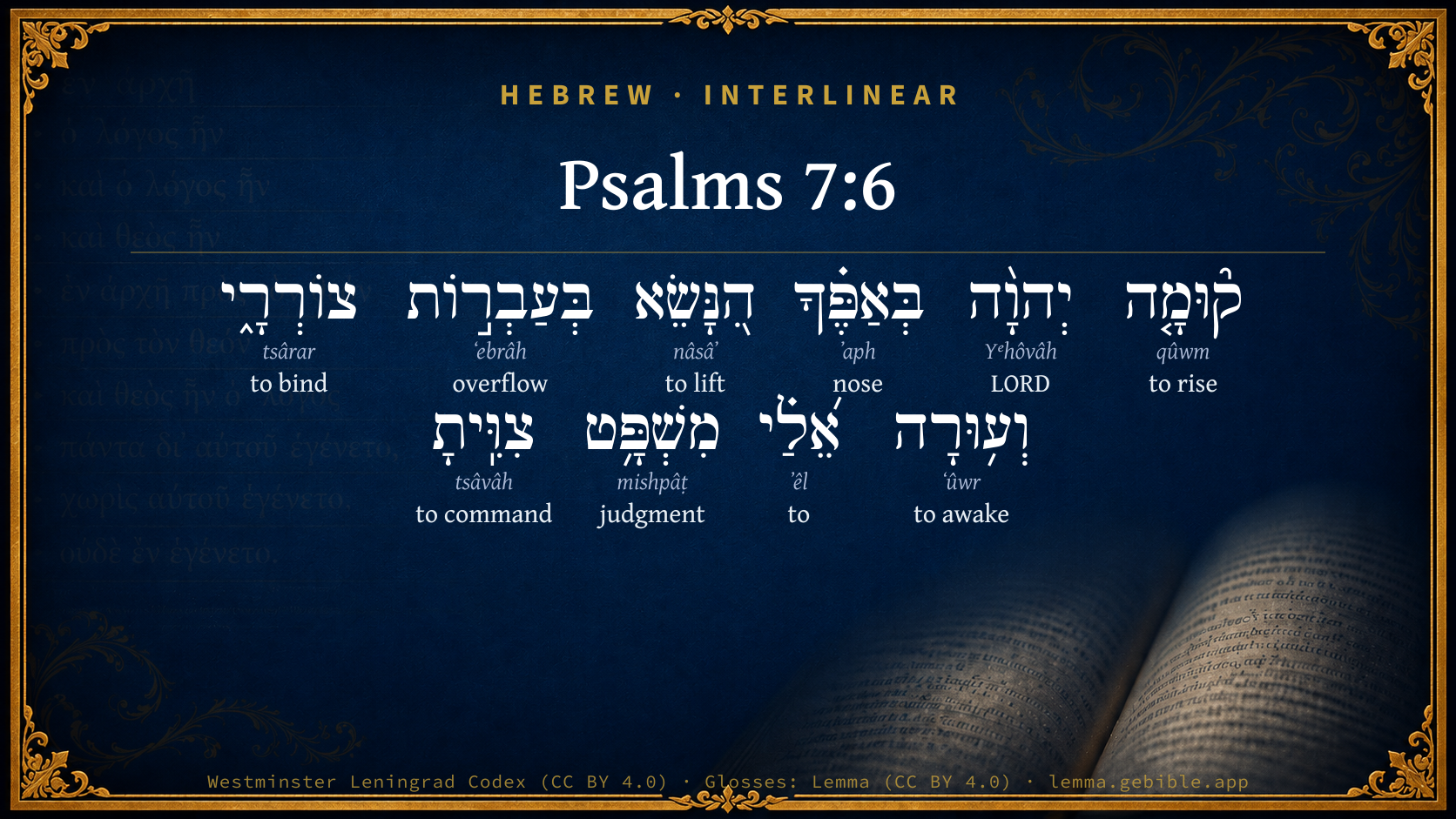
Psalms 7:6

Hebrew (Westminster Leningrad Codex) Psalms 7:6 appears in the Hebrew Old Testament. The text above is from the Westminster Leningrad Codex. Each word links to its Strong’s number, a concise gloss, and parsing drawn from the Open Scriptures Hebrew Bible morphology. Click any word for its full Brown-Driver-Briggs (BDB) entry.
Download image
Cite this verse

Psalms 7:6 (World English Bible). Public Domain. Lemma interlinear Bible study tool, https://lemma.gebible.app/v/psalms/7/6.

Show BibTeX & RIS
BibTeX
RIS
English Translation
Arise, Yahweh, in your anger. Lift up yourself against the rage of my adversaries. Awake for me. You have commanded judgment.
World English Bible · Public Domain
Download a study sheet

One document with this verse’s original text, its word-by-word gloss line, the meaning frame, cross-references with their text, attributed commentary, and full source and license credits — printable, and it pastes into notes with its structure intact.

This verse Autodidact and up

Study sheet (.html) Plain text (.txt)

A passage Seminary Student

Up to 50 verses in one chapter. A passage sheet keeps up to 6 commentary sources and 12 cross-references per verse, in the order this page ranks them, and says so on the sheet whenever that leaves anything out. Ask for a single verse and you get the Autodidact verse sheet above.

Everything on this page stays free to read, with no account — the sheet is a download of what is already on screen, not access to it.

Want to remove ads? Support Godless Engineer
Compare translations 3

The same verse in 3 English versions, stacked beneath the original-language interlinear above. Click any original word for its lexicon entry.

Each is an independent rendering of the whole verse — the interlinear is not word-aligned to these translations.

Highlighted words mark where these versions differ — a whole-verse word diff, not a word-by-word alignment.

  • World English Bible Public Domain
    Arise, Yahweh, in your anger. Lift up yourself against the rage of my adversaries. Awake for me. You have commanded judgment.
  • King James Version Public Domain
    Arise, O LORD, in thine anger, lift up thyself because of the rage of mine enemies: and awake for me to the judgment that thou hast commanded.
  • unfoldingWord Literal Text CC BY-SA 4.0
    Arise, Yahweh! In your nose, be lifted with the rage of my adversaries! And wake up for me! You have ordered judgment.

unfoldingWord Literal Text — © unfoldingWord, licensed CC BY-SA 4.0. Word-aligned USFM3 via Door43 (git.door43.org/unfoldingWord/en_ult).

Versions to compare (up to 4)

3 of 4 selected

Show all 18 translations

Every available English version of this verse, each an independent rendering of the whole verse.

  • World English Bible Public Domain
    Arise, Yahweh, in your anger. Lift up yourself against the rage of my adversaries. Awake for me. You have commanded judgment.
  • Berean Standard Bible Public Domain
    Arise, O LORD, in Your anger; rise up against the fury of my enemies. Awake, my God, and ordain judgment.
  • Majority Standard Bible Public Domain
    Arise, O LORD, in Your anger; rise up against the fury of my enemies. Awake, my God, and ordain judgment.
  • King James Version Public Domain
    Arise, O LORD, in thine anger, lift up thyself because of the rage of mine enemies: and awake for me to the judgment that thou hast commanded.
  • American Standard Version (1901) Public Domain
    Arise, O Jehovah, in thine anger; Lift up thyself against the rage of mine adversaries, And awake for me; thou hast commanded judgment.
  • Revised Version (1885) Public Domain
    Arise, O LORD, in thine anger, lift up thyself against the rage of mine adversaries: and awake for me; thou hast commanded judgment.
  • Geneva Bible (1599) Public Domain
    Arise, O Lord, in thy wrath, and lift vp thy selfe against the rage of mine enemies, and awake for mee according to the iudgement that thou hast appointed.
  • Douay-Rheims (1899) Public Domain
    Let the enemy pursue my soul, and take it, and tread down my life on the earth, and bring down my glory to the dust.
  • Young's Literal Translation Public Domain
    Rise, O Jehovah, in Thine anger, Be lifted up at the wrath of mine adversaries, And awake Thou for me: Judgment Thou hast commanded:
  • Literal Standard Version CC BY-SA 4.0
    Rise, O YHWH, in Your anger, || Be lifted up at the wrath of my adversaries, || And awake Yourself for me: You have commanded judgment.
  • Unlocked Literal Bible CC BY-SA 4.0
    Arise, Yahweh, in your anger; stand up against the rage of my enemies; wake up for my sake and carry out the righteous decrees that you have commanded for them.
  • unfoldingWord Literal Text CC BY-SA 4.0
    Arise, Yahweh! In your nose, be lifted with the rage of my adversaries! And wake up for me! You have ordered judgment.
  • Darby Bible Public Domain
    Arise, Jehovah, in thine anger; lift thyself up against the raging of mine oppressors, and awake for me: thou hast commanded judgment.
  • World Messianic Bible Public Domain
    Arise, LORD, in your anger. Lift up yourself against the rage of my adversaries. Awake for me. You have commanded judgment.
  • Webster's Bible Public Domain
    \\7:5\\Let the enemy persecute my soul, and take it; yes, let him tread down my life upon the earth, and lay my honor in the dust. Selah.
  • Free Bible Version CC BY-SA 4.0
    Stand up, Lord, in your anger, rise up against the fury of my enemies; wake up, Lord, and bring me justice!
  • Bible in Basic English Public Domain
    Come up, Lord, in your wrath; be lifted up against my haters; be awake, my God, give orders for the judging.
  • JPS Tanakh (1917) Public Domain
    (7-7) Arise, O LORD, in Thine anger, lift up Thyself in indignation against mine adversaries; yea, awake for me at the judgment which Thou hast commanded.

Literal Standard Version (2020), Covenant Press — licensed CC BY-SA 4.0. Text via the HelloAO Bible API (eBible.org). Unlocked Literal Bible (unfoldingWord) — licensed CC BY-SA 4.0. Text via the HelloAO Bible API (eBible.org). unfoldingWord Literal Text — © unfoldingWord, licensed CC BY-SA 4.0. Word-aligned USFM3 via Door43 (git.door43.org/unfoldingWord/en_ult). Free Bible Version, Dr. Jonathan Gallagher — licensed CC BY-SA 4.0. Text via the HelloAO Bible API (eBible.org).

Word by word

More ways to search: Search by grammar → Find every occurrence → Compare this word →

Practice this passage: Drill this verse → Learn its vocabulary →

בְּעַבְר֣וֹת
ʻebrâh
H5678
“in/at · overflows of”
Preposition + Noun, Common, Feminine, Plural, Construct
Part of Speech
Preposition + Noun
Type
Common
Gender
Feminine
Number
Plural
State
Construct
Full BDB Definition

Origin: from H5676

TWOT: 1556d

outpouring, overflow, excess, fury, wrath, arrogance - overflow, excess, outburst - arrogance - overflowing rage or fury
  1. ק֘וּמָ֤ה qûwm H6965 “rise” Verb, Qal, Imperative, 2nd Person, Masculine, Singular + Suffix, h
  2. יְהוָ֨ה Yᵉhôvâh H3068 “LORD” Noun, Proper
  3. בְּאַפֶּ֗ךָ ʼaph H639 “in/at · nose · your” Preposition + Noun, Common, Masculine, Singular, Construct + Suffix, Personal, 2nd Person, Masculine, Singular
  4. הִ֭נָּשֵׂא nâsâʼ H5375 “lift” Verb, Niphal, Imperative, 2nd Person, Masculine, Singular
  5. צוֹרְרָ֑י tsârar H6887 “binding · me” Verb, Qal, Participle Active, Masculine, Plural, Construct + Suffix, Personal, 1st Person, Common, Singular
  6. וְע֥וּרָה ʻûwr H5782 “and · awake” Conjunction + Verb, Qal, Imperative, 2nd Person, Masculine, Singular + Suffix, h
  7. אֵ֝לַ֗י ʼêl H413 “to · me” Preposition + Suffix, Personal, 1st Person, Common, Singular
  8. מִשְׁפָּ֥ט mishpâṭ H4941 “judgment” Noun, Common, Masculine, Singular, Absolute
  9. צִוִּֽיתָ tsâvâh H6680 “to command” Verb, Piel, Perfect, 2nd Person, Masculine, Singular

About this verse

These counts appear in no published source. They are computed here, from the morphology-tagged text and Lemma’s own curated glosses. What Lemma adds →

10
words
10
distinct lemmas
Wisdom
section

Shared distinctive vocabulary

בְּעַבְר֣וֹת overflow H5678 occurs in 34 verses of the Hebrew Bible. Also found in:

Grammatical profile

  • 5 verbs
  • 4 nouns
  • 1 preposition

Verb forms

  • ק֘וּמָ֤ה Qal · Imperative
  • הִ֭נָּשֵׂא Niphal · Imperative
  • צוֹרְרָ֑י Qal · Participle Active
  • וְע֥וּרָה Qal · Imperative
  • צִוִּֽיתָ Piel · Perfect

Hebrew & Septuagint length

In English translation the verse runs 21 words from the Hebrew and 28 from the Septuagint (LXX English) — closely comparable.

A rough comparison of the two English renderings, which tokenize alike — not a word-level alignment.

Word counts can differ between the Hebrew and the Greek without any difference in meaning — e.g. the Hebrew direct-object marker אֵת has no separate Greek word, and Greek often adds the article ὁ.

Cross-references

20

Topical passages linked to Psalms 7:6 in the Treasury of Scripture Knowledge — connected by theme and wording, ordered by reader-vote popularity; previews shown in the World English Bible.

  • Psalms 35:23 Wake up! Rise up to defend me, my God! My Lord, contend for me!
  • Psalms 44:23 Wake up! Why do you sleep, Lord? Arise! Don't reject us forever.
  • Psalms 3:7 Arise, Yahweh! Save me, my God! For you have struck all of my enemies on the cheek bone. You have broken the teeth of the wicked.
  • Isaiah 33:10 Now will I arise, says Yahweh; now will I lift up myself; now will I be exalted.
  • Psalms 44:26 Rise up to help us. Redeem us for your loving kindness' sake.
  • Psalms 103:6 Yahweh executes righteous acts, And justice for all who are oppressed.
  • Psalms 138:7 Though I walk in the midst of trouble, you will revive me. You will stretch forth your hand against the wrath of my enemies. Your right hand will save me.
  • Isaiah 37:20 Now therefore, Yahweh our God, save us from his hand, that all the kingdoms of the earth may know that you are Yahweh, even you only.
  • Isaiah 51:9 Awake, awake, put on strength, arm of Yahweh; awake, as in the days of old, the generations of ancient times. Isn't it you who did cut Rahab in pieces, who pierced the monster?
  • 2 Samuel 17:14 Absalom and all the men of Israel said, The counsel of Hushai the Archite is better than the counsel of Ahithophel. For Yahweh had ordained to defeat the good counsel of Ahithophel, to the intent that Yahweh might bring evil on Absalom.
  • Psalms 12:5 "Because of the oppression of the weak and because of the groaning of the needy, I will now arise," says Yahweh; "I will set him in safety from those who malign him."
  • Psalms 35:1 Contend, Yahweh, with those who contend with me. Fight against those who fight against me.
  • Psalms 59:5 You, Yahweh God of hosts, the God of Israel, Rouse yourself to punish the nations. Show no mercy to the wicked traitors. Selah.
  • Psalms 68:1–2 Let God arise! Let his enemies be scattered! Let them who hate him also flee before him.
  • Psalms 73:20 As a dream when one wakes up, So, Lord, when you awake, you will despise their fantasies.
  • Psalms 74:3 Lift up your feet to the perpetual ruins, All the evil that the enemy has done in the sanctuary.
  • Psalms 76:8–9 You pronounced judgment from heaven. The earth feared, and was silent,
  • Psalms 78:65 Then the Lord awakened as one out of sleep, Like a mighty man who shouts by reason of wine.
  • Psalms 94:1–2 Yahweh, you God to whom vengeance belongs, You God to whom vengeance belongs, shine forth.
  • Isaiah 3:13 Yahweh stands up to contend, And stands to judge the peoples.

Cross-references courtesy of OpenBible.info (CC BY 4.0).

Hebrew and Greek witnesses Masoretic Hebrew ↔ Greek Septuagint

The same verse in the two great witnesses to the Old Testament, shown verse-for-verse.

You’re reading Greek Psalm 7 (Hebrew Psalm 7). The Septuagint counts the superscription, so verse numbers can differ from the Hebrew — chapter-level alignment, not verse-by-verse. Numbering follows Rahlfs.

These are two independent witnesses, not word-aligned to each other, and the Septuagint is shown in lemma (dictionary) form.

Hebrew Psalms 7:6 Masoretic · Westminster Leningrad Codex

ק֘וּמָ֤ה יְהוָ֨ה בְּאַפֶּ֗ךָ הִ֭נָּשֵׂא בְּעַבְר֣וֹת צוֹרְרָ֑י וְע֥וּרָה אֵ֝לַ֗י מִשְׁפָּ֥ט צִוִּֽיתָ

Arise, Yahweh, in your anger. Lift up yourself against the rage of my adversaries. Awake for me. You have commanded judgment.

World English Bible · Public Domain

Greek LXX Greek Psalm 7:6 Septuagint · lemma form

καταδιώκω ἄρα ὁ ἐχθρός ὁ ψυχή ἐγώ καί καταλαμβάνω καί καταπατέω εἰς γῆ ὁ ζωή ἐγώ καί ὁ δόξα ἐγώ εἰς χοῦς κατασκηνόω διάψαλμα

Arise, O Lord, in your wrath; be exalted in the utmost boundaries of my enemies: awake, O Lord my God, according to the decree which you did command.

LXX2012 (modern English Septuagint) · Public Domain

On this verse, Ellicott's Commentary for English Readers discusses the Septuagint’s reading. Read the note in Commentary ↓

Hebrew: Westminster Leningrad Codex (CC BY 4.0). Greek: Septuagint (public domain); English from LXX2012 (modern English Septuagint) (Public Domain). How the Septuagint differs from the Hebrew →

Commentary

Notes on Psalms 7:6 from classic Christian and Jewish commentators (each source and its license shown beneath its notes). The classic Christian expositions comment on the surrounding passage and are grouped to its opening verse, so a note may address several verses; the Jewish commentaries on the Tanakh (Rashi and others) are per-verse, so they appear only where the commentator wrote on this verse.

Lemma curates 59 commentaries, every one of them public domain or Creative Commons licensed, each selected and text-cleaned for this edition rather than reprinted as found. About our sources →

Trapp's Complete Commentary

John Trapp

Psa 7:6 Arise, O LORD, in thine anger, lift up thyself because of the rage of mine enemies: and awake for me [to] the judgment [that] thou hast commanded.

Ver. 6. Arise, O Lord, in thine anger] Here David repeateth and reinforceth his suit, filling his mouth with arguments for that purpose, such as he well knew would be of avail.

Lift up thyself &c.] Wherein they deal proudly be thou above them, to control and topple them over.

And awake for me] Sometimes God seemeth to be asleep, we must awake him; to forget, we must remind him; to have lost his mercy, we must find it for him. "Where is thy zeal and thy strength?" &c., Isa 63:15

To the judyment that thou hast commanded] That is, promised, viz. that thou wilt command deliverances out of Zion. Or, which thou hast commanded to men in case of wrong done, to relieve the oppressed: and wilt not thou for me, great Judge, much more do it?

John Trapp, A Commentary or Exposition upon All the Books of the Old and New Testament (1647–1656) — public domain. Text from a community e-Sword module.

The Biblical Illustrator

Joseph S. Exell

Psa_7:6

Arise, O Lord, in Thine anger: lift up Thyself because of the rage of mine enemies.

The first of the imprecatory Psalms

Comminations are present in verses 11-17, and imprecations upon the writer himself (under certain contingencies) in verse 5.

I. The psalm is not vindictive.

1. It is certainly Davids composition, and by his twice sparing Saul we know this was not his character. Cush the Benjamite was some follower of Saul who had plotted against David. It is probable that in 1Sa_24:1-22. we have the historic setting of the Psalm. The points of contact between the two are many.

2. And Cush was flagrantly an evil-doer (verses 2, 3, 4, 14, 15). Hence these denunciations are uttered.

II. See what he prays for. It is simply that God will awake.

III. What he predicts. That the Lord will whet His sword, etc. Neither in prayer nor prediction is there any disproportion between the sin and its punishment. It is less than what God had Himself said He would do (Deu_32:23; Deu_32:42).

IV. Why he thus denounces. Not because although he had spared his enemy, yet in his heart he was thirsting for revenge. If he had wanted revenge he could have taken it. But--

1. From the instinct of self-preservation.

2. Desire for the repression of crime.

3. For the glory of God. We deny, therefore, that the Psalm is vindictive. (Joseph Hammond.)

The Biblical Illustrator, edited by Joseph S. Exell (c. 1880s–1900s) — public domain. Text from a community e-Sword module.

Joseph Benson's Commentary

Psa 7:6. Arise, O Lord, in thine anger — Oppose thy just anger to their causeless and sinful rage against me. Lift up thyself — Hebrew, הנשׂא, hinnasee, Be thou exalted; glorify thyself, and show thyself to be above them. Awake for me to the judgment, &c. — To execute that righteous sentence which thou hast commanded — That is, appointed and declared by thy holy prophet Samuel. Thus to a protestation of innocence he adds a prayer for judgment upon the case, formed on two considerations: 1st, the unreasonable and unrelenting fury of his persecutors; 2d, the justice which God commanded others to execute, and which, therefore, he himself would doubtless execute on such occasions.

Joseph Benson's Commentary on the Old and New Testaments (1811–1818) — public domain. Text from a community e-Sword module.

Whedon's Commentary on the Bible

Daniel D. Whedon

6. Arise, O Lord, in thine anger—From the judgment seat of Jehovah, before which he had just brought his cause, he hears the voice of acquittal, and now (Psa_7:6-8) calls upon God to arise to immediate execution of the sentence upon his enemies, and the public vindication of his own righteousness.

Thou hast commanded—Judgment had not only been given in the case, but a special order for its enforcement, and hence the urgency and confidence of this prayer of the persecuted, righteous man.

Hupfeld gives the construction: “Awake for me; thou hast ordained judgment.” The idea is the same as that above given.

Daniel D. Whedon (gen. ed.), Commentary on the Old and New Testaments (1874–1909) — public domain. Text from a community e-Sword module.

J. A. Alexander on Psalms

Joseph Addison Alexander

7. (Psa 7:6). Upon this protestation of his innocence he founds a fresh prayer for protection and deliverance. Arise, arouse thyself, O Lord, Jehovah. See above, on Psa 3:8 (7). Arise in thine anger, raise thyself, or be exalted, in, i. e. amidst, the ragings of my enemies. The idea because of my enemies is rather implied than expressed. The sense directly intended seems to be that, as his enemies are raging, it is time for God to arise in anger too. As they rage against him, he calls upon God to rise in anger against them. And awake, a still stronger figure than arise, because implying sleep as well as inactivity. Awake unto me, at my call and for my benefit. Judgment hast thou commanded, or ordained. Let that judgment now be executed. He appeals to the general administration of God's justice, as a ground for expecting it in this one case. As it was part of the divine plan or purpose to do justice, both on friends and foes, here was an opportunity to put it into execution.

Joseph Addison Alexander, The Psalms Translated and Explained (1850) — public domain. Text from a community e-Sword module.

Tyndale Open Study Notes

Tyndale Open Resources

7:6-9 With this appeal to God for justice in the world, the psalmist also submits to God’s examination.

7:6 God’s judgment brings justice, despite the chaos created by adversaries (see 7:11).

Tyndale Open Study Notes — © Tyndale Open Resources, licensed CC BY-SA 4.0. Text via the HelloAO Bible API.

Geneva Bible (1599)

Geneva Bible translators

In promising me the kingdom.

Geneva Bible (1599) marginal notes — public domain. Text via Bolls.life.

Jamieson, Fausset & Brown

Robert Jamieson, A. R. Fausset & David Brown

God is involved as if hitherto careless of him (Psa 3:7; Psa 9:18).

rage--the most violent, like a flood rising over a river's banks.

the judgment . . . commanded--or, "ordained"; a just decision.

Jamieson, Fausset & Brown — Commentary Critical and Explanatory on the Whole Bible (1871) — public domain (CC PDM 1.0). Text via the HelloAO Bible API.

Adam Clarke's Commentary

Verse 6. Arise, O Lord, in thine anger] To thee I commit my cause; arise, and sit on the throne of thy judgment in my behalf.

Adam Clarke's Commentary on the Bible (1810–1826) — public domain. Text from a community e-Sword/MySword module.

John Calvin's Commentaries

6 Arise, O Jehovah David here sets the anger of God in opposition to the rage of his enemies; and when we are in similar circumstances we should act in the same manner. When the ungodly are inflamed against us, and cast forth their rage and fury to destroy us, we ought humbly to beseech God to be inflamed also on his side; in other words, to show in truth that he has, no less zeal and power to preserve us, than they have inclination to destroy us. The word, Arise, is taken in a figurative sense, for to ascend into a judgment-seat, or rather to prepare one’s self to make resistance; and it is here applied to God, because, while he delays to succour us, we are very apt to think him asleep. Accordingly, David also, a little after, beseeches him to awake; for it seemed on the part of God something like the forgetfulness of sleep to give no assistance to an individual who was so much afflicted and oppressed on all hands.

In the end of the verse he shows that he asks nothing but what is according to the appointment of God. And this is the rule which ought to be observed by us in our prayers; we should in every thing conform our requests to the divine will, as John also instructs us, (1 John 5:14.) And, indeed, we can never pray in faith unless we attend, in the first place, to what God commands, that our minds may not rashly and at random start aside in desiring more than we are permitted to desire and pray for. David, therefore, in order to pray aright, reposes himself on the word and prose mise of God; and the import of his exercise is this: Lord, I am not led by ambition, or foolish headstrong passion, or depraved desire, inconsiderately to ask from thee whatever is pleasing to my flesh; but it is the clear light of thy word which directs me, and upon it I securely depend. Since God, of his own good pleasure, had called him to be one day king, it belonged to him to defend and maintain the rights of the man whom he had chosen for his servant. David’s language, therefore, is the same as if he had said, “When I was well contented with my humble condition in private life, it was thy pleasure to set me apart to the honourable station of being a king; now, therefore, it belongs to thee to maintain this cause against Saul and his associates who are using their efforts to defeat thy decree in making war upon me.” The Hebrew word עורה, urah, which we have rendered awake thou, “Lequel nous avons traduit Veille.”—Fr.

John Calvin's Commentaries (1540-1563) — public domain. Text from the Calvin Translation Society English edition (1840s-50s) via the Christian Classics Ethereal Library (ccel.org). Calvin's coverage is partial (roughly two-thirds of the Bible); uncommented books and verses are honest gaps, never fabricated. The 19th-century editor's footnotes and remarks are omitted so the notes are faithfully Calvin's own voice.

Ellicott's Commentary for English Readers

(6) In the rapid succession of abrupt utterance of feeling in ejaculations, we see the excitement of the poet’s mind.

Of the rage.—Better, against the rage, unless we may correct to “in thy rage.” The LXX. and Vulg. read, “in the ends of,” which Jerome explains as meaning, “exalt thyself by making an end of my enemies.” Syriac, “Be thou lifted up upon the necks of my enemies.”

And awake for me.—Better, arranged in two petitions: yea, awake for me; prepare the judgment. There is some difficulty about the syntax of the last clause, but the imperatives suit the parallelism of the context better than the past tenses.

A Bible Commentary for English Readers, edited by Charles John Ellicott (1878–1897) — public domain. Text from a community e-Sword module.

The Cambridge Bible for Schools and Colleges

gen. ed. J. J. S. Perowne

6. Arise … lift up thyself … awake] Cp. Psa_3:7, Psa_9:19, Psa_10:12, Psa_44:23, Psa_94:2, and many similar invocations; couched in human language, as though God could be an otiose spectator, or even like a sentinel negligently slumbering on his watch, though the Psalmists well knew that Israel’s watchman neither slumbered nor slept (Psa_121:3-4).

in thine anger] Cp. Psa_6:1. Holiness and Justice can only be manifested as anger in their judicial relation to sin and wrong.

because of the rage of mine enemies] Or, against the ragings of mine adversaries.

and awake for me to the judgment that thou hast commanded] The R.V., and awake for me; thou hast commanded judgement, represents the abruptness of the original. The exact turn of the thought is obscure. Perhaps, with a sudden intuition of faith, David realises that his prayer for God’s interposition is answered, and, so to speak, the commission issued for holding the assize which he proceeds to describe in Psa_7:7-8. Or the words may give the ground of his prayer: ‘arise, inasmuch as judgement is Thy ordinance and function’ (Gen_18:25).

6–8. Conscious of his integrity, David appeals to Jehovah, as the Judge of the world, to hold an assize, and vindicate his innocence.

The Cambridge Bible for Schools and Colleges (gen. ed. J. J. S. Perowne; Cambridge University Press, 1878–1918) — public domain. Text from a community e-Sword module.

John Gill's Exposition

Arise, O Lord, in thine anger,.... This and the following phrase do not suppose local motion in God, to whom it cannot belong, being infinite and immense, but are spoken of him after the manner of men, who seems sometimes as though he had laid himself down, and was unconcerned about and took no notice of human affairs, of the insults of the wicked and the oppressions of the righteous; wherefore the psalmist beseeches him to "arise", which he may be said to do when he comes forth in his power in the defence of his people, and against their enemies; see Psa 12:5; and he also prays him to arise in anger, to show himself displeased, and give some tokens of his resentment, by letting his enemies feel the lighting down of his arm with the indignation of his anger;

lift up thyself, because of the rage of mine enemies; ascend the throne of judgment, and there sit judging right; show thyself to be the Judge of the earth, high and lifted up; let it appear that thou art above all mine enemies, higher and more powerful than they; stop their rage, break the force of their fury, lift up a standard against them, who, likes mighty flood, threaten to bear all before them: or "lift up thyself in rage", or "fierce wrath, because of", or "against mine enemies" (y): and so the sense is the same as before; and this way go many of the Jewish interpreters (z);

and awake for me to the judgment that thou hast commanded; not that sleep falls upon God, for the keeper of Israel neither slumbers nor sleeps; nor does it fall on any but corporeal beings, not upon angels, nor the souls of men, much less on God; but he sometimes in his providence seems to lie dormant and inactive, as if he disregarded what is done in this world; and therefore his people address him as if he was asleep, and call upon him to arise to their help and assistance; see Psa 44:23; and so David here, "awake for me", that is, hasten to come to me and help me; suggesting that he was in great distress and danger, by reason of his enemies, should he delay coming to him. By "judgment" is either meant the vengeance which God had ordered him to execute upon his enemies, as Jarchi interprets it, and therefore he entreats him to arise and put him in a capacity of doing it; or else his innocence, and the vindication of it, which God had promised him, and then the petition is much the same with Psa 7:8. But the generality of Jewish (a) writers understand it of the kingdom which God had appointed for him, and for which he was anointed by Samuel; and who had told Saul that God had found a man after his own heart, whom he had "commanded" to be captain over his people, Sa1 13:14; wherefore the psalmist prays that God would hasten the fulfilment of his purpose and promise, and set him on the throne, that so he might administer justice and judgment to the people.

(y) "in furore contra hostes meos", Mariana; "gravissimo furore percitus in eos qui me opprimunt", Junius & Tremellius. (z) Targum, Jarchi, & Kimchi, in loc. (a) R. Moses in Aben Ezra in loc. R. Obadiah Gaon, Kimchi, & Ben Melech in loc.

John Gill's Exposition of the Whole Bible (1746–1763) — public domain (CC PDM 1.0). Text via the HelloAO Bible API.

Albert Barnes' Notes on the Bible

Arise, O Lord, in thine anger - That is, to punish him who thus unjustly persecutes me. See the notes at Psa 3:7.

Lift up thyself - As if he had been lying in repose and inaction. The idea is derived from a warrior who is called on to go forth and meet an enemy.

Because of the rage of mine enemies - Not only of this particular enemy, but of those who were associated with him, and perhaps of all his foes. David felt, on this occasion, that he was surrounded by enemies; and he calls on God to interfere and save him.

And awake for me - Or, in my behalf. The word “awake” is a still stronger expression than those which he had before used. It implies that one had been asleep, and insensible to what had occurred, and he addresses God “as if” He had thus been insensible to the dangers which surrounded him.

To the judgment that thou hast commanded - To execute the judgment which thou hast appointed or ordered. That is, God had, in his law, commanded that justice should be done, and had proclaimed himself a God of justice - requiring that right should be done on the earth, and declaring himself in all cases the friend of right. David now appeals to him, and calls on him to manifest himself in that character, as executing in this case the justice which he required under the great principles of his administration. He had commanded justice to be done in all cases. He had required that the wicked should be punished. He had ordered magistrates to execute justice. In accordance with these great principles, David now calls on God to manifest “himself” as the friend of justice, and to show, in this case, the same principles, and the same regard to justice which he required in others. It is an earnest petition that he would vindicate his own principles of administration.

Albert Barnes' Notes on the Bible (1834–1885) — public domain. Text from a community e-Sword/MySword module.

Matthew Poole's English Annotations

Arise in thine anger; oppose thy just anger to their causeless and sinful rage against me.

Lift up thyself, that thou mayst give them a deadly blow. A metaphor from men who arise and lift up themselves to do so. Heb.

be thou exalted; glorify thyself, and show thyself to be above them.

To the judgment that thou hast commanded; to execute that just and righteous sentence of Saul’s deposition, and my advancement, which thou hast

commanded, i.e. appointed, (as that word is used, Psa 148:5; 1Ki 17:4, and in this very case, 1Sa 13:14) and declared by thy holy prophet Samuel.

Matthew Poole's English Annotations on the Holy Bible (1683–1685) — public domain. Text from a community e-Sword/MySword module.

The Treasury of David

Charles H. Spurgeon

Ver. 6. We now listen to a fresh prayer, based upon the avowal which he has just made. We cannot pray too often, and when our heart is true, we shall turn to God in prayer as naturally as the needle to its pole.

Arise, O Lord, in thine anger. His sorrow makes him view the Lord as a judge who had left the judgment-seat and retired into his rest. Faith would move the Lord to avenge the quarrel of his saints.

Lift up thyself because of the rage of mine enemiesa still stronger figure to express his anxiety that the Lord would assume his authority and mount the throne. Stand up, O God, rise thou above them all, and let thy justice tower above their villainies.

Awake for me to the judgment that thou hast commanded. This is a bolder utterance still, for it implies sleep as well as inactivity, and can only be applied to God in a very limited sense. He never slumbers, yet doth he often seem to do so; for the wicked prevail, and the saints are trodden in the dust. God's silence is the patience of longsuffering, and if wearisome to the saints, they should bear it cheerfully in the hope that sinners may thereby be led to repentance.

Ver. 6. The judgment which thou hast ordained. In the end of the verse he shows that he asks nothing but what is according to the appointment of God. And this is the rule which ought to be observed by us in our prayers; we should in everything conform our requests to the divine will, as John also instructs us. 1Jo 4:14. And, indeed, we can never pray in faith unless we attend, in the first place, to what God commands, that our minds may not rashly and at random start aside in desiring more than we are permitted to desire and pray for. David, therefore, in order to pray aright, reposes himself on the word and promise of God; and the import of his exercise is this: Lord, I am not led by ambition, or foolish headstrong passion, or depraved desire, inconsiderately to ask from thee whatever is pleasing to my flesh; but it is the clear light of thy word which directs me, and upon it I securely depend. John Calvin.

Ver. 6. How and in what sense divine anger may become the hope of the righteous.

Fire fought by fire, or man's anger overcome by God's anger.

Ver. 7. So shall the congregation of the people compass thee about. Thy saints shall crowd to thy tribunal with their complaints, or shall surround it with their solemn homage:

for their sakes therefore return thou on high. As when a judge travels at the assizes, all men take their cases to his court that they may be heard, so will the righteous gather to their Lord. Here he fortifies himself in prayer by pleading that if the Lord will mount the throne of judgment, multitudes of the saints would be blessed as well as himself. If I be too base to be remembered, yet,

for their sakes, for the love thou bearest to thy chosen people, come forth from thy secret pavilion, and sit in the gate dispensing justice among the people. When my suit includes the desires of all the righteous it shall surely speed, for, "shall not God avenge his own elect?"

Charles H. Spurgeon's The Treasury of David (1869–1885) — public domain. Psalms only. Text from a community e-Sword/MySword module.

The Pulpit Commentary

Arise, O Lord, in thine anger. To call on God to "arise" is to ask him to take action, to lay aside the neutral attitude in which he most commonly shows himself to man, and to interfere openly in the concerns of earth. To call on him to "arise in his anger" is to entreat him to vindicate our cause against those opposed in us, and to visit them with some open manifestation of his displeasure. (comp. Psa_3:7 Psa_9:19 Psa_10:12 Psa_17:13 Psa_44:26 Psa_68:1) Lift up thyself. This is even a stronger expression than "arise". (Isa_33:10) It is a call on God to appear in his full strength. Because of the rage of mine enemies; or, against the rage of mine enemies (Kay, Revised Version). Force must be met by force. David justifies his appeal for aid by alleging the violence and fury of those whose attacks he has to meet. And awake for me to the judgment that thou hast commanded. The two clauses are not connected in the original, which runs, "Awake for me: thou hast commanded judgment." The meaning seems to be, "Arouse thyself on my behalf judgment is a thing which thou hast ordained surely now is the time for it."

The Pulpit Commentary (1880–1919), ed. H.D.M. Spence-Jones & Joseph S. Exell — public domain. Text from a community e-Sword module.

John Wesley's Explanatory Notes

Lift up - Glorify thyself, and shew thyself to be above them. Commanded - To execute that righteous sentence, which thou hast commanded, appointed, and declared by thy prophet Samuel.

John Wesley, Explanatory Notes Upon the Whole Bible (1754–1765) — public domain. Text via the GEBible commentary corpus.

Keil & Delitzsch

C. F. Keil & F. Delitzsch

(Heb.: 7:7-9) In the consciousness of his own innocence he calls upon Jahve to sit in judgment and to do justice to His own. His vision widens and extends from the enemies immediately around to the whole world in its hostility towards Jahve and His anointed one. In the very same way special judgments and the judgment of the world are portrayed side by side, as it were on one canvas, in the prophets. The truth of this combination lies in the fact of the final judgment being only the finale of that judgment which is in constant execution in the world itself. The language here takes the highest and most majestic flight conceivable. By קוּמה (Milra, ass in Psa 3:8), which is one of David's words of prayer that he has taken from the lips of Moses (Psa 9:20; Psa 10:12), he calls upon Jahve to interpose. The parallel is הנּשׂא lift Thyself up, show thyself in Thy majesty, Psa 94:2, Isa 33:10. The anger, in which He is to arise, is the principle of His judicial righteousness. With this His anger He is to gird Himself (Psa 76:11) against the ragings of the oppressors of God's anointed one, i.e., taking vengeance on their many and manifold manifestations of hostility. עברות is a shorter form of the construct (instead of עברות Job 40:11, cf. Psa 21:1-13 :31) of עברה which describes the anger as running over, breaking forth from within and passing over into words and deeds (cf. Arab. fšš, used of water: it overflows the dam, of wrath: it breaks forth). It is contrary to the usage of the language to make משׁפּט the object to עוּרה in opposition to the accents, and it is unnatural to regard it as the accus. of direction = למּשׂפט (Psa 35:23), as Hitzig does. The accents rightly unite עוּרה אלי: awake (stir thyself) for me i.e., to help me (אלי like לקלאתי, Psa 59:5). The view, that צוּית is then precative and equivalent to צוּה: command judgment, is one that cannot be established according to syntax either here, or in Psa 71:3. It ought at least to have been וצוּית with Waw consec. On the other hand the relative rendering: Thou who hast ordered judgment (Maurer, Hengst.), is admissible, but unnecessary. We take it by itself in a confirmatory sense, not as a circumstantial clause: having commanded judgment (Ewald), but as a co-ordinate clause: Thou hast indeed enjoined the maintaining of right (Hupfeld).

The psalmist now, so to speak, arranges the judgment scene: the assembly of the nations is to form a circle round about Jahve, in the midst of which He will sit in judgment, and after the judgment He is to soar away (Gen 17:22) aloft over it and return to the heights of heaven like a victor after the battle (see Psa 68:19). Although it strikes one as strange that the termination of the judgment itself is not definitely expressed, yet the rendering of Hupfeld and others: sit Thou again upon Thy heavenly judgment-seat to judge, is to be rejected on account of the שׁוּבה (cf. on the other hand 21:14) which is not suited to it; שׁוב למּרום can only mean Jahve's return to His rest after the execution of judgment. That which Psa 7:7 and Psa 7:8 in the boldness of faith desire, the beginning of Psa 7:9 expresses as a prophetic hope, from which proceeds the prayer, that the Judge of the earth may also do justice to him (שׁפתני vindica me, as in Psa 26:1; Psa 35:24) according to his righteousness and the purity of which he is conscious, as dwelling in him. עלי is to be closely connected with תּמּי, just as one says נפשׁי עלי (Psychol. S. 152 [tr. p. 180]). That which the individual as ego, distinguishes from itself as being in it, as subject, it denotes by עלי. In explaining it elliptically: "come upon me" (Ew., Olsh., Hupf.) this psychologically intelligible usage of the language is not recognised. On תּם vid., on Psa 25:21; Psa 26:1.

Keil & Delitzsch — Biblical Commentary on the Old Testament (1861–1891) — public domain (CC PDM 1.0). Text via the HelloAO Bible API. (Old Testament only.)

unfoldingWord translationNotes

Door43 World Missions Community

Arise, Yahweh, in your anger

Arising represents doing something or taking action. AT: "Do something in your anger" or "Be angry at my enemies and take action: (See: Metonymy)

stand up against the rage of my enemies

Fighting against people is spoken of as standing up against them. AT: "fight against the rage of my enemies" or "attack my enemies who rage against me" (See: Metonymy)

the rage of my enemies

Their rage represents their attacks. AT: "the attacks of my enemies" or "my enemies who attack me" (See: Metonymy)

wake up

Waking up represents starting to do something or take action. AT: "Take action" or "Do something" (See: Metaphor)

for my sake

"for me" or "to help me"

The countries are assembled

Here the word "countries" represents all of the armies that have gathered to attack. (See: Synecdoche)

take once more your rightful place over them

Ruling people is spoken of as being over them. Yahweh's rightful place refers either to heaven or to ruling in general. AT: "Rule over them from heaven" or "Rule over them" (See: Metaphor)

translationWords

raise

anger

righteous

decree

command

assembly

unfoldingWord translationNotes — © Distant Shores Media and the Door43 World Missions Community, licensed CC BY-SA 4.0. Source: git.door43.org/Door43/en_tn.

Radak

Rabbi David Kimhi (Radak)

The enemy doth pursue my soul: – This word (יִרַדּףֹ, “pursue”) is a combination of the Kal and dageshed (i.e. piel) conjugations; from the Kal is said יִרְדֹּף, and from the piel is said יְרַדֵּף; and the word is compounded of these two (forms). And the meaning of the compound (form) is that the enemy pursues him himself and pursues him with respect to others when he bids others pursue him; so Saul was pursuing him (רודפו) and chasing him (מרדפו) with reference to Israel. And he says my soul, for he does not pursue me to bind me with a cord, but to kill me – as, indeed, he proposed so many times to slay him with his own hand.

And should he overtake he will tread my life to the earth: – And if he should overtake me he will tread my life to the earth, for he will give me no rest till he slay me. And the word “if” is lacking, as (similarly, Isaiah 30:20): “And the Lord will give you the bread of adversity and water of affliction” which is to be interpreted “if He give”; and (another instance) “and thou hast refused to let him go” (Exod. 4:23) = “and if thou refusest.” The waw in וְיִרְמֹם is equivalent (in meaning) to the rapheh in Arabic; or its interpretation (may be) he is thinking within himself, as he pursues me, that he will overtake me and tread my life to the earth and lay my glory in the dust.

And lay my glory in the dust. Selah: – My glory is “my soul,” and his plan is to lay my glory in the dust. And although at a man's death his soul does not lie in the dust, the expression is figurative, as, “My soul cleaveth to the dust” (Ps. 119:25). Or it is in accordance with the thought of the enemy, for he thinks there is no resurrection for my soul, because he considers me a wicked man and a murderer. And the word Selah I have explained (Ps. 3:3) to be a raising of the voice in the music; and it has no (special) significance in the context here, nor is it necessary to explain it on every occurrence.

Radak on the Tanakh — English translations: “Sefaria Community Translation” (CC0 1.0 (public-domain dedication)); “Eliyahu Munk, HaChut Hameshulash” (CC BY 4.0); “Rabbi Mike Feuer, Jerusalem Anthology” (CC BY 4.0); and “R. David Kimhi on the first book of Psalms, Translated by R.G. Finch, London, 1919” (public domain). Text via Sefaria.

Lesson kit

Teaching starters — assembled from the data on this page, not authored interpretation. Every prompt links to the verse data it draws on. Edit before teaching.

Psalms, in the Wisdom, opens this verse with 10 words (10 distinct Hebrew lemmas). Its most distinctive word is ʻebrâh (“overflow”). A historical commentator’s framing appears above. Read the whole chapter for the surrounding context.

Discussion questions

  1. What does “overflow” (ʻebrâh) contribute to the verse as a whole?
  2. How does Genesis 49:7, which shares the word «overflow», read alongside this verse?
  3. These translations render this verse differently; the difference is in the English rendering, not the original. What questions does that raise?
  4. «ק֘וּמָ֤ה» is a Qal Imperative verb. How does that grammatical form shape the action described?
  5. Compare how Trapp's Complete Commentary and The Biblical Illustrator read this verse. Where do they agree or differ?

Things to notice

Reading settings

Reading text

Shown beneath each verse's original-language words.

Old Testament
Old Testament edition

Read the OT as the Masoretic Hebrew (MT) or the Greek Septuagint (LXX).

English shown for the Greek Septuagint (in the Hebrew ↔ Greek comparison).

Comparing translations? Open the Compare panel on any verse page to stack up to four side by side.