Haggai 2:19

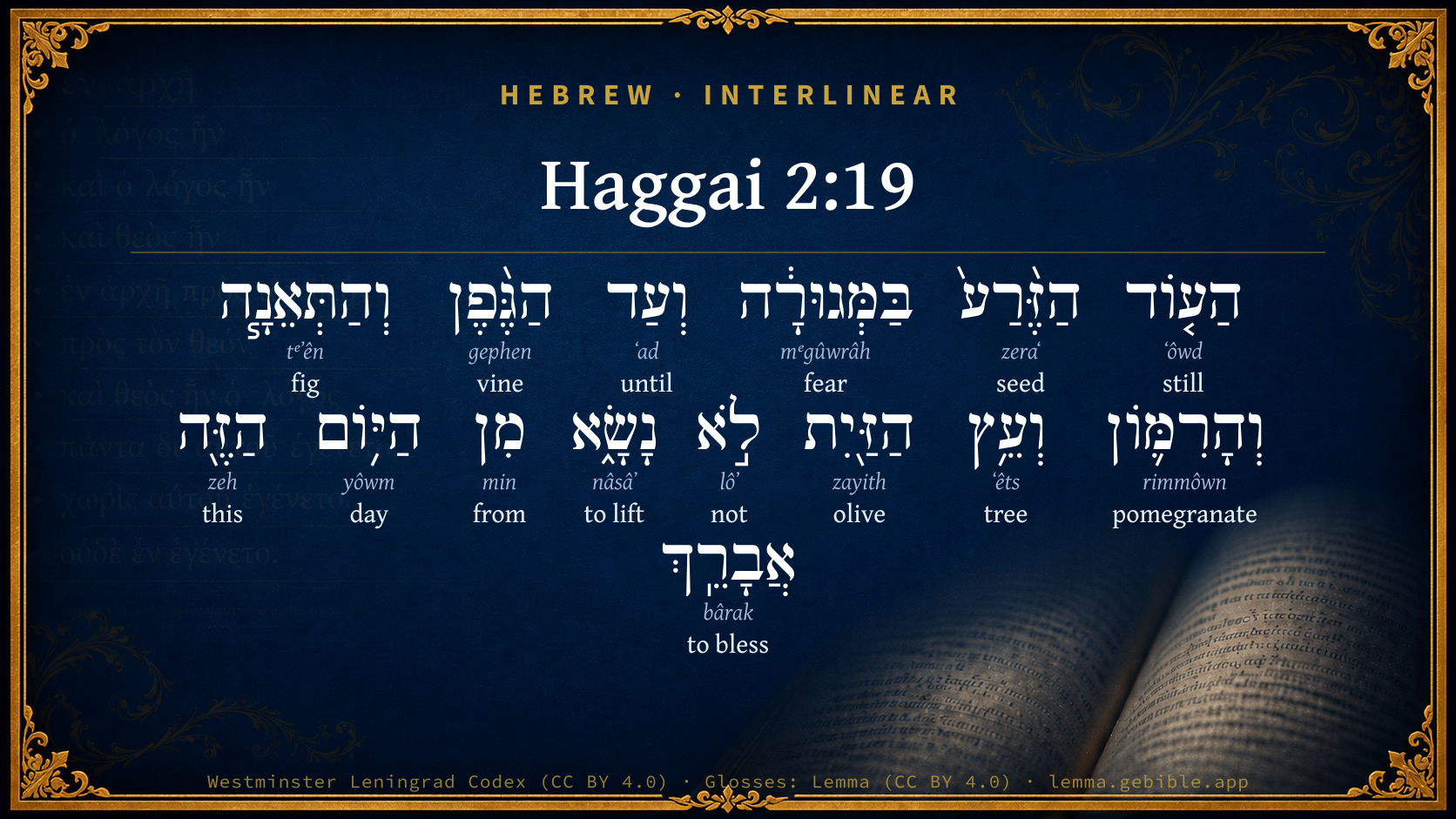
Hebrew (Westminster Leningrad Codex) Haggai 2:19 appears in the Hebrew Old Testament. The text above is from the Westminster Leningrad Codex. Each word links to its Strong’s number, a concise gloss, and parsing drawn from the Open Scriptures Hebrew Bible morphology. Click any word for its full Brown-Driver-Briggs (BDB) entry.
Download image
Cite this verse

Haggai 2:19 (World English Bible). Public Domain. Lemma interlinear Bible study tool, https://lemma.gebible.app/v/haggai/2/19.

Show BibTeX & RIS
BibTeX
RIS
English Translation
Is the seed yet in the barn? Yes, the vine, the fig tree, the pomegranate, and the olive tree haven't brought forth. From this day will I bless you.'"
World English Bible · Public Domain
Download a study sheet

One document with this verse’s original text, its word-by-word gloss line, the meaning frame, cross-references with their text, attributed commentary, and full source and license credits — printable, and it pastes into notes with its structure intact.

This verse Autodidact and up

Study sheet (.html) Plain text (.txt)

A passage Seminary Student

Up to 50 verses in one chapter. A passage sheet keeps up to 6 commentary sources and 12 cross-references per verse, in the order this page ranks them, and says so on the sheet whenever that leaves anything out. Ask for a single verse and you get the Autodidact verse sheet above.

Everything on this page stays free to read, with no account — the sheet is a download of what is already on screen, not access to it.

Want to remove ads? Support Godless Engineer
Compare translations 3

The same verse in 3 English versions, stacked beneath the original-language interlinear above. Click any original word for its lexicon entry.

Each is an independent rendering of the whole verse — the interlinear is not word-aligned to these translations.

Highlighted words mark where these versions differ — a whole-verse word diff, not a word-by-word alignment.

  • World English Bible Public Domain
    Is the seed yet in the barn? Yes, the vine, the fig tree, the pomegranate, and the olive tree haven't brought forth. From this day will I bless you.'"
  • King James Version Public Domain
    Is the seed yet in the barn? yea, as yet the vine, and the fig tree, and the pomegranate, and the olive tree, hath not brought forth: from this day will I bless you.
  • unfoldingWord Literal Text CC BY-SA 4.0
    the seed yet in the storehouse? And the vine and the fig tree and the pomegranate tree and the olive tree have not yet produced! From this day I will bless!’”

unfoldingWord Literal Text — © unfoldingWord, licensed CC BY-SA 4.0. Word-aligned USFM3 via Door43 (git.door43.org/unfoldingWord/en_ult).

Versions to compare (up to 4)

3 of 4 selected

Show all 18 translations

Every available English version of this verse, each an independent rendering of the whole verse.

  • World English Bible Public Domain
    Is the seed yet in the barn? Yes, the vine, the fig tree, the pomegranate, and the olive tree haven't brought forth. From this day will I bless you.'"
  • Berean Standard Bible Public Domain
    Is there still seed in the barn? The vine, the fig, the pomegranate, and the olive tree have not yet yielded fruit. But from this day on, I will bless you.”
  • Majority Standard Bible Public Domain
    Is there still seed in the barn? The vine, the fig, the pomegranate, and the olive tree have not yet yielded fruit. But from this day on, I will bless you.”
  • King James Version Public Domain
    Is the seed yet in the barn? yea, as yet the vine, and the fig tree, and the pomegranate, and the olive tree, hath not brought forth: from this day will I bless you.
  • American Standard Version (1901) Public Domain
    Is the seed yet in the barn? yea, the vine, and the fig-tree, and the pomegranate, and the olive-tree have not brought forth; from this day will I bless `you'.
  • Revised Version (1885) Public Domain
    Is the seed yet in the barn? yea, the vine, and the fig tree, and the pomegranate, and the olive tree hath not brought forth; from this day will I bless you.
  • Geneva Bible (1599) Public Domain
    Consider, I pray you, in your mindes, from this day, and afore from the foure and twentieth day of the ninth moneth, euen from the day that the foundation of the Lords Temple was laide: consider it in your mindes.
  • Douay-Rheims (1899) Public Domain
    Set your hearts from this day, and henceforward, from the four and twentieth day of the ninth month: from the day that the foundations of the temple of the Lord were laid, and lay it up in your hearts.
  • Young's Literal Translation Public Domain
    Is the seed yet in the barn? And hitherto the vine and the fig, And the pomegranate, and the olive-tree, Have not borne -- from this day I bless.'
  • Literal Standard Version CC BY-SA 4.0
    Is the seed yet in the barn? And until now the vine and the fig, || And the pomegranate, and the olive-tree, || Have not borne—from this day I bless.”
  • Unlocked Literal Bible CC BY-SA 4.0
    Is there still seed in the storehouse? The vine, the fig tree, the pomegranate, and the olive tree have not produced! But from this day will I bless you!”
  • unfoldingWord Literal Text CC BY-SA 4.0
    the seed yet in the storehouse? And the vine and the fig tree and the pomegranate tree and the olive tree have not yet produced! From this day I will bless!’”
  • Darby Bible Public Domain
    Is the seed yet in the barn? yea, the vine, and the fig-tree, and the pomegranate, and the olive-tree have not brought forth: from this day will I bless [you].
  • World Messianic Bible Public Domain
    Is the seed yet in the barn? Yes, the vine, the fig tree, the pomegranate, and the olive tree haven’t produced. From today I will bless you.’”
  • Webster's Bible Public Domain
    Is the seed yet in the barn? yes, as yet the vine, and the fig-tree, and the pomegranate, and the olive-tree, hath not brought forth: from this day will I bless you.
  • Free Bible Version CC BY-SA 4.0
    the seed is still in the barn. The vine, the fig tree, the pomegranate tree, and the olive tree have not yet given fruit. But from this day on I will bless you.
  • Bible in Basic English Public Domain
    Is the seed still in the store-house? have the vine and the fig-tree, the pomegranate and the olive-tree, still not given their fruit? from this day I will send my blessing on you.
  • JPS Tanakh (1917) Public Domain
    is the seed yet in the barn? yea, the vine, and the fig-tree, and the pomegranate, and the olive-tree hath not brought forth — from this day will I bless you.'

Literal Standard Version (2020), Covenant Press — licensed CC BY-SA 4.0. Text via the HelloAO Bible API (eBible.org). Unlocked Literal Bible (unfoldingWord) — licensed CC BY-SA 4.0. Text via the HelloAO Bible API (eBible.org). unfoldingWord Literal Text — © unfoldingWord, licensed CC BY-SA 4.0. Word-aligned USFM3 via Door43 (git.door43.org/unfoldingWord/en_ult). Free Bible Version, Dr. Jonathan Gallagher — licensed CC BY-SA 4.0. Text via the HelloAO Bible API (eBible.org).

Word by word

More ways to search: Search by grammar → Find every occurrence → Compare this word →

Practice this passage: Drill this verse → Learn its vocabulary →

בַּמְּגוּרָ֔ה
mᵉgûwrâh
H4035
“in/at the · fear”
Preposition, Determined + Noun, Common, Feminine, Singular, Absolute
Part of Speech
Preposition + Noun
Type
Common
Gender
Feminine
Number
Singular
State
Absolute
Full BDB Definition

Origin: from H4032 or H4033

TWOT: 330d

fear, terror - storehouse, granary
  1. הַע֤וֹד ʻôwd H5750 “still” Particle, Interrogative + Adverb
  2. הַזֶּ֨רַע֙ zeraʻ H2233 “the · seed” Particle, Definite Article + Noun, Common, Masculine, Singular, Absolute
  3. וְעַד ʻad H5704 “and · until” Conjunction + Preposition
  4. הַגֶּ֨פֶן gephen H1612 “the · vine” Particle, Definite Article + Noun, Common, Both, Singular, Absolute
  5. וְהַתְּאֵנָ֧ה tᵉʼên H8384 “and · the · fig” Conjunction + Particle, Definite Article + Noun, Common, Feminine, Singular, Absolute
  6. וְהָרִמּ֛וֹן rimmôwn H7416 “and · the · pomegranate” Conjunction + Particle, Definite Article + Noun, Common, Masculine, Singular, Absolute
  7. וְעֵ֥ץ ʻêts H6086 “and · tree of” Conjunction + Noun, Common, Masculine, Singular, Construct
  8. הַזַּ֖יִת zayith H2132 “the the · olive” Preposition, Determined + Noun, Common, Masculine, Singular, Absolute
  9. לֹ֣א lôʼ H3808 “not” Particle, Negative
  10. נָשָׂ֑א nâsâʼ H5375 “to lift” Verb, Qal, Perfect, 3rd Person, Masculine, Singular
  11. מִן min H4480 “from” Preposition
  12. הַיּ֥וֹם yôwm H3117 “the · day” Particle, Definite Article + Noun, Common, Masculine, Singular, Absolute
  13. הַזֶּ֖ה zeh H2088 “the · this” Particle, Definite Article + Pronoun, Demonstrative, Masculine, Singular
  14. אֲבָרֵֽךְ bârak H1288 “to bless” Verb, Piel, Imperfect, 1st Person, Common, Singular

About this verse

These counts appear in no published source. They are computed here, from the morphology-tagged text and Lemma’s own curated glosses. What Lemma adds →

15
words
15
distinct lemmas
Prophets
section

Notable vocabulary

The rarest word here is בַּמְּגוּרָ֔ה fear H4035 — appearing just 2 times in the whole Hebrew Bible.

Shared distinctive vocabulary

בַּמְּגוּרָ֔ה fear H4035 occurs in 2 verses of the Hebrew Bible. Also found in:

Grammatical profile

  • 2 verbs
  • 8 nouns
  • 1 pronoun
  • 2 prepositions
  • 1 adverb
  • 1 particle

Verb forms

  • נָשָׂ֑א Qal · Perfect
  • אֲבָרֵֽךְ Piel · Imperfect

Hebrew & Septuagint length

In English translation the verse runs 29 words from the Hebrew and 36 from the Septuagint (LXX English) — closely comparable.

A rough comparison of the two English renderings, which tokenize alike — not a word-level alignment.

Word counts can differ between the Hebrew and the Greek without any difference in meaning — e.g. the Hebrew direct-object marker אֵת has no separate Greek word, and Greek often adds the article ὁ.

Cross-references

12

Topical passages linked to Haggai 2:19 in the Treasury of Scripture Knowledge — connected by theme and wording, ordered by reader-vote popularity; previews shown in the World English Bible.

  • Malachi 3:10 Bring the whole tithe into the store-house, that there may be food in my house, and test me now in this," says Yahweh of hosts, "if I will not open you the windows of heaven, and pour you out a blessing, that there shall not be room enough for.
  • Habakkuk 3:17–18 For though the fig tree doesn't flourish, Nor fruit be in the vines; The labor of the olive fails, The fields yield no food; The flocks are cut off from the fold, And there is no herd in the stalls:
  • Proverbs 3:9–10 Honor Yahweh with your substance, With the first fruits of all your increase:
  • Matthew 6:33 But seek first God's Kingdom, and his righteousness; and all these things will be given to you as well.
  • Genesis 26:12 Isaac sowed in that land, and reaped in the same year one hundred times what he planted. Yahweh blessed him.
  • Zechariah 8:11–15 But now I will not be to the remnant of this people as in the former days," says Yahweh of Hosts.
  • Deuteronomy 15:10 You shall surely give him, and your heart shall not be grieved when you give to him; because that for this thing Yahweh your God will bless you in all your work, and in all that you put your hand to.
  • Psalms 84:12 Yahweh of Hosts, Blessed is the man who trusts in you.
  • Psalms 128:1–5 Blessed is everyone who fears Yahweh, Who walks in his ways.
  • Leviticus 26:3–13 "'If you walk in my statutes, and keep my commandments, and do them;
  • Deuteronomy 28:2–15 and all these blessings shall come on you, and overtake you, if you shall listen to the voice of Yahweh your God.
  • Psalms 133:3 Like the dew of Hermon, That comes down on the hills of Zion: For there Yahweh gives the blessing, Even life forevermore.

Cross-references courtesy of OpenBible.info (CC BY 4.0).

Hebrew and Greek witnesses Masoretic Hebrew ↔ Greek Septuagint

The same verse in the two great witnesses to the Old Testament, shown verse-for-verse.

These are two independent witnesses, not word-aligned to each other, and the Septuagint is shown in lemma (dictionary) form.

Hebrew Haggai 2:19 Masoretic · Westminster Leningrad Codex

הַע֤וֹד הַזֶּ֨רַע֙ בַּמְּגוּרָ֔ה וְעַד הַגֶּ֨פֶן וְהַתְּאֵנָ֧ה וְהָרִמּ֛וֹן וְעֵ֥ץ הַזַּ֖יִת לֹ֣א נָשָׂ֑א מִן הַיּ֥וֹם הַזֶּ֖ה אֲבָרֵֽךְ

Is the seed yet in the barn? Yes, the vine, the fig tree, the pomegranate, and the olive tree haven't brought forth. From this day will I bless you.'"

World English Bible · Public Domain

Greek LXX Haggai 2:19 Septuagint · lemma form

εἰ ἔτι ἐπιγιγνώσκω ἐπί ὁ ἅλως καί εἰ ἔτι ὁ ἄμπελος καί ὁ συκῆ καί ὁ ῥόα καί ὁ ξύλον ὁ ἐλαία ὁ οὐ φέρω καρπός ἀπό ὁ ἡμέρα οὗτος εὐλογέω

Set your hearts now to think from this day and upward, from the four and twentieth day of the ninth month, even from the day when the foundation of the temple of the Lord was laid;

LXX2012 (modern English Septuagint) · Public Domain

On this verse, The Pulpit Commentary discusses the Septuagint’s reading. Read the note in Commentary ↓

Hebrew: Westminster Leningrad Codex (CC BY 4.0). Greek: Septuagint (public domain); English from LXX2012 (modern English Septuagint) (Public Domain). How the Septuagint differs from the Hebrew →

Targum (Aramaic paraphrase)

1

The Targum is the ancient Jewish Aramaic paraphrase of the Hebrew Scriptures — an interpretive translation, not the Hebrew text itself. Onkelos (literal) and Pseudo-Jonathan (expansive) render the Torah, and Jonathan the Prophets. Coverage is partial: where no permissively-licensed English translation exists for a verse, only the Aramaic is shown. This is verse-level text, not a word-by-word alignment to the Hebrew.

  1. Targum Jonathan Prophets (Joshua–Malachi)
    הַעוֹד כְּעַן עִבּוּרָא בְּאִידְרָא וְעַד כְּעַן גוּפְנַיָא וְתֵינַיָא וְרִימוֹנַיָא וְאִילָנֵי זֵיתָא לָא טְעָנוּ יוֹמָא הָדֵין אֲבָרֵךְ:

    (no public-domain English translation for this verse)

    Targum Jonathan — Aramaic: “Mikraot Gedolot” (public domain). English: “Sefaria Community Translation” (CC0 1.0 (public-domain dedication)); “London "Chaldee Paraphrase," 1871” (public domain). Text via Sefaria.

Commentary

Notes on Haggai 2:19 from classic Christian and Jewish commentators (each source and its license shown beneath its notes). The classic Christian expositions comment on the surrounding passage and are grouped to its opening verse, so a note may address several verses; the Jewish commentaries on the Tanakh (Rashi and others) are per-verse, so they appear only where the commentator wrote on this verse.

Lemma curates 59 commentaries, every one of them public domain or Creative Commons licensed, each selected and text-cleaned for this edition rather than reprinted as found. About our sources →

Trapp's Complete Commentary

John Trapp

Hag 2:19 Is the seed yet in the barn? yea, as yet the vine, and the fig tree, and the pomegranate, and the olive tree, hath not brought forth: from this day will I bless [you].

Ver. 19. Is the seed yet in the barn?] Jerome rendereth it, in germine, in the sprouting, or spirting, as they call it, and so far enough from the harvest; and yet farther, if yet in the barn, and not put into the ground. Nevertheless, for your diligence in building God’s house, I assure you, in the word of truth, that you shall have a very great increase, a plentiful harvest.

From this day will I bless you] And it is the blessing of God that maketh rich, as is to be seen in the examples of the patriarchs, Abraham, Isaac, Jacob. Others, whose godliness was their gain, whose piety was profitable to all things, as having the promises of both lives, 1Ti 4:8. Now all that are of faith are blessed with faithful Abraham, Gal 3:9, are heirs of the world with him, Rom 4:13, and so have right to all things in Christ, the heir of all things, 1Co 3:22 Heb 1:2; though these things on earth be detained from them for the present by those men of God’s hand, Psa 17:14, as Canaan was from Israel by the cursed Amorites, till their sins were full; yet they shall shortly have power over the nations, and (which is better) Christ will give them the morning star, Rev 2:28; Rev 22:16, that is, himself, and with himself a cornucopia of spiritual blessings, Eph 1:3. The Lord that made heaven and earth will bless them out of Zion, that is, with better blessings than heaven or earth afforded. We read not here of any other blessings but increase of corn, wine, oil, &c., because this people was wholly almost affixed to earthly things. The prophet could not speak wisdom among those that were perfect, 1Co 2:6. But better things were implied and assured to the godly, as appeareth by the ensuing oracle.

John Trapp, A Commentary or Exposition upon All the Books of the Old and New Testament (1647–1656) — public domain. Text from a community e-Sword module.

The Biblical Illustrator

Joseph S. Exell

Hag_2:19

From this day will I bless you.

The birthday of blessing

The cause of much ill success in life is often to be found in the want of zeal for Gods house. The temple was a type of that Church of which every individual believer is a living stone. From the day when the foundation of that temple is laid, the promise of the text is ours. When is the foundation day from which the blessing dates? In one sense it is from everlasting, for Gods people are, in purpose, part of the building from before all time. But the day of conversion is the day on which is laid--as far as our experience is concerned--the foundation of our salvation.

I. A specified day. This blessed day goes by different names in Scripture. A day of espousals: the day in which Jesus, our heavenly Bridegroom, wins the heart of His bride. A day of power. It is a mighty act to convert a sinner, infinitely beyond the power of man, and glorifying even to the omnipotence of God. The day of salvation. This name describes itself.

1. This day often has a cloudy dawning. The day of grace begins before there is actual light. Just before the light breaks in, the power of darkness makes its most desperate resistance.

2. The day has often a secret dawning. There are those who cannot say exactly when or how they were converted. Foolishly they fear they can never have been converted at all, as they are unable to say it was then, and it was there.

3. Sometimes this day has an early, and sometimes a long-delayed dawn. God has no fixed age at which to convert.

4. This day, like all others, has a silent dawn. It is seen, but not heard.

5. The dawning of this day, like the dawning of all other days, is irresistible. If it is the work of God, it must stand.

6. The dawn is but the commencement of the day. The morning is the noon in childhood; the noon is but the dawn fully developed.

II. A declared blessing. It includes all spiritual blessings; pardon, peace, etc. It rests on all our temporal affairs. It extends to all future things. (Archibald G. Brown.)

Promises to bless encouragements to work

1. Concerning the great Promiser, the following considerations are interesting.

(1) He is Jehovah.

(2) The Promiser is the God of the people to whom the promises are made.

(3) The Promiser is strong and faithful round about.

(4) The Promiser is Lord of elements and seasons.

2. Concerning the good things which the Lord our God promises. Comprehended in the term, bless. Includes--

(1) The removal of material evils.

(2) Means of fertility and plenty.

(3) A blessing with the means.

(4) A blessing upon the possession and use of those good things which the Lord produces by the means.

3. The people whom the Lord promiseth to bless.

(1) They were His own people.

(2) A people for whom the Promiser had lately done great things.

(3) A people who had been negligent and slothful in the work which the authority of the Promiser required, and gratitude to their Redeemer bound them to perform.

(4) A people whose negligence had been chastised.

(5) A people who were now learning to do well.

4.The day on which the Lord promiseth to bless His people.

(1) A specified day.

(2) The day on which they turned to the Lord, and began to build.

(3) The day on which the promise began to be performed.

Learn--

1. For the good things of this life the people of God have His covenant and promises.

2. Operations of material power are operations of God.

3. The zeal of the Lord of hosts hath done ,great things for the house of His name.

4. Building the house of the Lord is connected with blessing. (A. Shanks.)

The benediction of Haggai

These are the words of Haggai, whom the Lord raised up in his old age for the purpose of calling His people from the sin of religious indifference to the earnest performance of duty. As Gods prophet, it was his duty to expostulate, to trace the connection between sinful neglect and its effects, to picture in dark but true colours the woes of the people, but also to pronounce the promise of benediction and peace.

I. The promise asserts that in God and from God is the blessedness of his people.

1. There is nothing we can satisfactorily substitute for the blessing of God.

2. If we have it we need fear no evil from any other source.

II. The promise directly refers to temporal blessing, but includes spiritual. The picture presented is descriptive of the peoples estate. We ought to connect the goodness and love of God with all the material blessedness of life, as well as with the higher spiritual side of it. There is no department of life from which God need be shut out. But the promise certainly includes the higher blessings belonging to spiritual life and development.

III. The promise is given as the result of obedience, the sincerity of which practical proof has been supplied. We must not try to drive a bargain with God. The service our Lord wants is the service of faith and love. Let that be rendered and the blessing may tarry, but come it will, and just because it has tarried it may be all the richer and better.

IV. The promise is fixed and continuous. From this day. That is definite enough. The benediction had been stored up--now it was to fall like the refreshing ram over all the land. And the blessing is to be continuous. To-day, and every succeeding day, I will bless you. The premiss is most reliable. From the words of the promise we look to Him who made it. He is able to fulfil it. (Adam Scott.)

The day of dedication to God is the day of blessing

I. The promise--blessing. This blessing of the Lord conveys a promise that He would not only withdraw the evils under which they suffered, and send fertility and plenty, but also pour down on them the Spirit of His grace. Esau was blessed with outward prosperity. Jacob had the full blessing, spiritual and temporal. He whom God blesses is blessed here and hereafter in body and in soul.

II. The time of it--from this day; that is, from the day the foundation of the temple was laid. On this the prophet lays great stress. Who has not noticed a turn of providence in favour of those who have returned into the way of duty; and that, from that very day, God has blessed them? Indeed, this is aa unchangeable law in Gods government of the world.

III. The reason of this promise of the Lord. It seems that the people busied themselves with their own temporal affairs, purposing to build the temple when they could better afford it. God frustrated their selfish policy, by sending blasting and mildew in their fields, and causing their money to waste away insensibly, as though it had been put into a bag with holes. But when they reversed their mode of proceeding, from that very day God blessed them. God ordinarily proceeds to deal with men as they deal with Him. They who freely offer to Him their goods to carry on His work are blessed by Him with increase.

IV. This temple at Jerusalem was typical of the Church of Christ, of which He is the foundation and the superstructure. In this spiritual house we are all more immediately interested than in the building of the material temple. As Christians, we are all members of this spiritual building. Are we building on Christ, the only foundation? (Alfred Jones, T. A.)

The Biblical Illustrator, edited by Joseph S. Exell (c. 1880s–1900s) — public domain. Text from a community e-Sword module.

Tyndale Open Study Notes

Tyndale Open Resources

2:19 I am giving you a promise now while the seed is still in the barn: The promise of a bountiful crop calls attention to God’s faithfulness to his covenant people. The Temple was not yet complete, but God was promising to extend its blessings at once. • But from this day onward I will bless you: God was gracious in responding immediately to his people’s efforts toward spiritual renewal and obedience (see Ps 111:4-5).

Tyndale Open Study Notes — © Tyndale Open Resources, licensed CC BY-SA 4.0. Text via the HelloAO Bible API.

Geneva Bible (1599)

Geneva Bible translators

From the time they began to build the Temple, he promiseth that God would bless them: and albeit as yet the fruit was not come forth, yet in the gathering they should have plenty.

Geneva Bible (1599) marginal notes — public domain. Text via Bolls.life.

Jamieson, Fausset & Brown

Robert Jamieson, A. R. Fausset & David Brown

Is the seed yet in the barn?--implying, It is not. It has been already sown this month, and there are no more signs of its bearing a good crop, much less of its being safely stored in the barn, than there were in the past season, when there was such a failure; yet I promise to you from this day (emphatically marking by the repetition the connection of the blessing with the day of their obedience) a blessing in an abundant harvest. So also the vine, &c., which heretofore have borne little or nothing, shall be blessed with productiveness. Thus it will be made evident that the blessing is due to Me, not to nature. We may trust God's promise to bless us, though we see no visible sign of its fulfilment (Hab 2:3).

Jamieson, Fausset & Brown — Commentary Critical and Explanatory on the Whole Bible (1871) — public domain (CC PDM 1.0). Text via the HelloAO Bible API.

Ellicott's Commentary for English Readers

(19) Is the seed yet in the barn?—i.e., There is no grain as yet in the barn, the harvest having been blighted in the last season. The term rendered in the Authorised Version “seed” does not imply grain for sowing, but grain for provision. The fruit harvest was as defective as that of cereals, having been cut off by the hail. (See Hag_2:17.) The prospect was thus one of deepest gloom. But human helplessness is God’s opportunity. He pledges His word even at this crisis by the mouth of Haggai, “From this day I will bless.”

A Bible Commentary for English Readers, edited by Charles John Ellicott (1878–1897) — public domain. Text from a community e-Sword module.

The Cambridge Bible for Schools and Colleges

gen. ed. J. J. S. Perowne

19. Is the seed yet in the barn?] i.e. Is it any longer in the barn? Is it not all exhausted and used up? The meagre yield of the blighted corn was soon consumed and the granary left empty. Some have thought that by “the seed” is here meant what would be required to sow the land for another year, and that the dearth and distress are heightened by the fact that there is not even corn enough left to sow. But as the word is frequently used, not of seed corn, but of produce (e.g. 1Sa_8:15; Isa_23:3; Job_39:12), and as the remainder of the verse refers to produce, it is better taken in that sense here.

yea, as yet] There is no reason to depart from the usual meaning of the Hebrew word here rendered “as yet,” viz. “unto,” or “as regards,” “And unto or as regards (extending our notice from the corn to) the vine, etc. it (i.e. each one of these trees) hath not brought forth (fruit).” It would then best accord with the English idiom to leave the word untranslated, as in R. V. The rendering of A. V. is however thought by some to be supported by Job_1:18; 1Sa_14:19.

from this day will I bless you] It might be asked, why not from the day three months earlier than this (ch. Hag_1:14-15), when they first resumed the building of the temple? It has been suggested in explanation that up to this time, though they had indeed begun again to build, they had been slack and remiss in their efforts, but that from this day, instigated by this fresh appeal of Haggai, they had taken a new departure of zeal and earnestness, and that consequently from this day the blessing was to begin. But there is no proof whatever that this was so, and it is therefore better to suppose that up to this day the effects of the failure of the last harvest were still apparent, and no outward change had yet taken place in their prospects. “He would then say, that even in these last months, since they had begun the work, there were as yet no signs for the better. There was yet no seed in the barn, the harvest having been blighted, and the fruit-trees stripped by the hail before the close of the sixth month, when they resumed the work. Yet though there were as yet no signs of change, no earnest that the promise should be fulfilled, God pledges His word, from this day I will bless you.” Pusey.

The Cambridge Bible for Schools and Colleges (gen. ed. J. J. S. Perowne; Cambridge University Press, 1878–1918) — public domain. Text from a community e-Sword module.

John Gill's Exposition

And again the word of the Lord came unto Haggai,.... Or a "second" (s) time, even on the same day as the former:

in the four and twentieth day of the month; of the ninth month Chisleu, Hag 2:10,

saying; as follows:

(s) "secundo", V. L. Pagninus, Montanus, Junius & Tremellius, Piscator, Cocceius; "secunda vice", Burkius.

John Gill's Exposition of the Whole Bible (1746–1763) — public domain (CC PDM 1.0). Text via the HelloAO Bible API.

Matthew Poole's English Annotations

Your seed for the next harvest is yet in your barns, unsown, and no one can make any conjecture yet, whether next year’s increase shall be great and blessed, or whether it shall be blasted and little; I do not speak, saith Haggai, on conjecture, but in the name of the Lord foretell and promise you, that it shall be a plentiful harvest to you. Nor have your fruit trees yet put forth, no sign yet appears what vintage you shall have, what store of wine, oil, figs, and pomegranates, which are your choice and rich fruits; but in the word of God I tell you, you shall be blessed in them all, and have a large produce, a joyful vintage.

From this day: see Hag 2:10,15.

I will bless you, in all your labour; as before you were blasted in all because you neglected, so now you shall be blessed in all because you diligently build, the temple of the Lord.

Matthew Poole's English Annotations on the Holy Bible (1683–1685) — public domain. Text from a community e-Sword/MySword module.

The Pulpit Commentary

Is the seed yet in the barn? Is there any of your poor crop still left in your granaries? Is it not already expended? "The seed" is here the produce of the seed, the grain (1Sa_8:15; Job_39:12) The corn crop is mentioned first, then the fruit harvest. The Vulgate has, Numquid jam semen in germine est? Has the seed begun to grow? Is there any sign of abundance? Yet the harvest shall be prolific. But there is no doubt that megurah means "barn," not "sprout." LXX, Eij ejpignwsqhsetai ejpi thv alw, "If it shall be known upon the threshing floor." Jerome must have read ghv for thv, as he renders, "Si ultra cognoscetur super terram area." He expounds it thus: So abundant shall be the produce that the threshing floor shall not recognize its own corn. or that the threshers shall be forced to join floor to floor to make room for all the grain, "et arearnm separatio nesciatur in terra" Yea, as yet; kai eij eti (Septuagint); et adhuc (Vulgate); as Jud_1:3:26; Job_1:18. Otherstranslate, "as regards." Though there was no sign of leaf or fruit on the trees, nothing by which one could judge of the future produce, yet the prophet predicts an abundant crop, dating from the people"s obedience. (Lev_26:3, etc.; Deu_28:2, etc.) From this day will I bless you. "This day" is the twenty-fourth day of the ninth month (ver. 10). From now the improvement in the season should begin and make itself evident. "Bless" is a term often used for sending fruitful seasons. (Deu_28:8; Mal_3:10)

The Pulpit Commentary (1880–1919), ed. H.D.M. Spence-Jones & Joseph S. Exell — public domain. Text from a community e-Sword module.

John Wesley's Explanatory Notes

Is the seed - Your seed for the next harvest is yet in your barns. Hath not brought forth - No sign yet appears what vintage you shall have, what store of wine, oil, figs, and pomegranates. Yet in the word of God I tell you, you shall be blest in them all, and have a large produce.

John Wesley, Explanatory Notes Upon the Whole Bible (1754–1765) — public domain. Text via the GEBible commentary corpus.

Rashi

Rabbi Shlomo Yitzchaki (Rashi)

The seed is still in the granary You have not yet sown this year, and the trees have not yet ripened their fruits. From now on you shall sow at a time of blessing, for the building of the Temple will bring blessing into the work of your hands.

Rashi on the Tanakh — English translations: “The Judaica Press complete Tanach with Rashi, translated by A. J. Rosenberg” (CC BY 4.0); “Pentateuch with Rashi's commentary by M. Rosenbaum and A.M. Silbermann, 1929-1934” (public domain); “The Metsudah Tanach series, Lakewood, N.J” (CC BY 4.0); and “The Book of Joshua, Metsudah Publications, 1997” (CC BY 4.0). Text via Sefaria.

Lesson kit

Teaching starters — assembled from the data on this page, not authored interpretation. Every prompt links to the verse data it draws on. Edit before teaching.

Haggai, in the Prophets, opens this verse with 15 words (15 distinct Hebrew lemmas). Its most distinctive word is mᵉgûwrâh (“fear”). A historical commentator’s framing appears above. Read the whole chapter for the surrounding context.

Discussion questions

  1. The word mᵉgûwrâh carries the sense “fear.” How does it shape the verse?
  2. How does Isaiah 66:4, which shares the word «fear», read alongside this verse?
  3. These translations render this verse differently; the difference is in the English rendering, not the original. What questions does that raise?
  4. «נָשָׂ֑א» is a Qal Perfect verb. How does that grammatical form shape the action described?
  5. Compare how Trapp's Complete Commentary and The Biblical Illustrator read this verse. Where do they agree or differ?

Things to notice

Reading settings

Reading text

Shown beneath each verse's original-language words.

Old Testament
Old Testament edition

Read the OT as the Masoretic Hebrew (MT) or the Greek Septuagint (LXX).

English shown for the Greek Septuagint (in the Hebrew ↔ Greek comparison).

Comparing translations? Open the Compare panel on any verse page to stack up to four side by side.