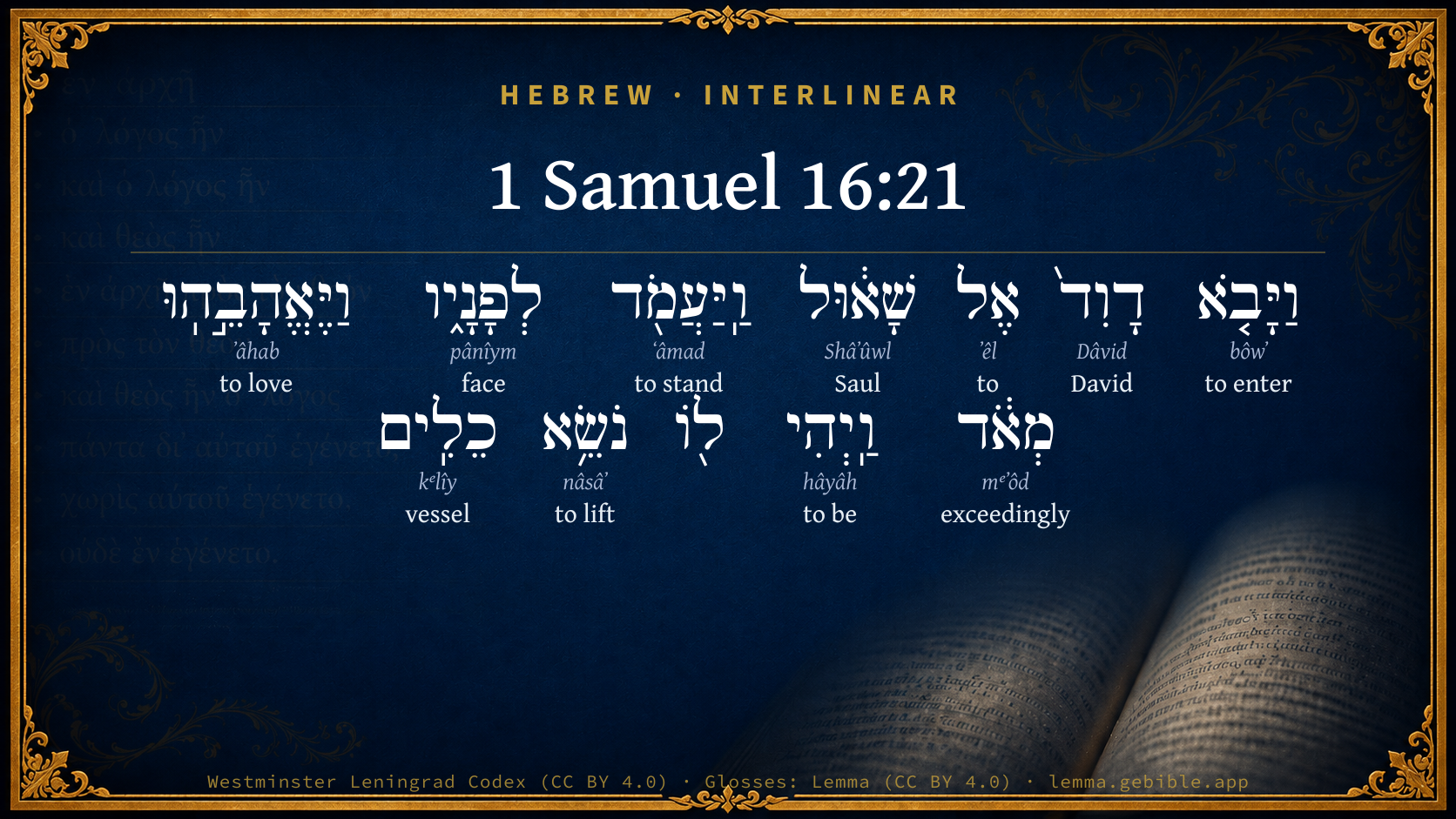
1 Samuel 16:21

Hebrew (Westminster Leningrad Codex) 1 Samuel 16:21 appears in the Hebrew Old Testament. The text above is from the Westminster Leningrad Codex. Each word links to its Strong’s number, a concise gloss, and parsing drawn from the Open Scriptures Hebrew Bible morphology. Click any word for its full Brown-Driver-Briggs (BDB) entry.
Download image
Cite this verse

1 Samuel 16:21 (World English Bible). Public Domain. Lemma interlinear Bible study tool, https://lemma.gebible.app/v/1-samuel/16/21.

Show BibTeX & RIS
BibTeX
RIS
English Translation
David came to Saul, and stood before him: and he loved him greatly; and he became his armor bearer.
World English Bible · Public Domain
Download a study sheet

One document with this verse’s original text, its word-by-word gloss line, the meaning frame, cross-references with their text, attributed commentary, and full source and license credits — printable, and it pastes into notes with its structure intact.

This verse Autodidact and up

Study sheet (.html) Plain text (.txt)

A passage Seminary Student

Up to 50 verses in one chapter. A passage sheet keeps up to 6 commentary sources and 12 cross-references per verse, in the order this page ranks them, and says so on the sheet whenever that leaves anything out. Ask for a single verse and you get the Autodidact verse sheet above.

Everything on this page stays free to read, with no account — the sheet is a download of what is already on screen, not access to it.

Want to remove ads? Support Godless Engineer
Compare translations 3

The same verse in 3 English versions, stacked beneath the original-language interlinear above. Click any original word for its lexicon entry.

Each is an independent rendering of the whole verse — the interlinear is not word-aligned to these translations.

Highlighted words mark where these versions differ — a whole-verse word diff, not a word-by-word alignment.

  • World English Bible Public Domain
    David came to Saul, and stood before him: and he loved him greatly; and he became his armor bearer.
  • King James Version Public Domain
    And David came to Saul, and stood before him: and he loved him greatly; and he became his armourbearer.
  • unfoldingWord Literal Text CC BY-SA 4.0
    And David came to Saul, and he stood to his face. And he loved him greatly, and he became to him a carrier of equipment.

unfoldingWord Literal Text — © unfoldingWord, licensed CC BY-SA 4.0. Word-aligned USFM3 via Door43 (git.door43.org/unfoldingWord/en_ult).

Versions to compare (up to 4)

3 of 4 selected

Show all 18 translations

Every available English version of this verse, each an independent rendering of the whole verse.

  • World English Bible Public Domain
    David came to Saul, and stood before him: and he loved him greatly; and he became his armor bearer.
  • Berean Standard Bible Public Domain
    When David came to Saul and entered his service, Saul admired him greatly, and David became his armor-bearer.
  • Majority Standard Bible Public Domain
    When David came to Saul and entered his service, Saul loved him very much, and David became his armor-bearer.
  • King James Version Public Domain
    And David came to Saul, and stood before him: and he loved him greatly; and he became his armourbearer.
  • American Standard Version (1901) Public Domain
    And David came to Saul, and stood before him: and he loved him greatly; and he became his armorbearer.
  • Revised Version (1885) Public Domain
    And David came to Saul, and stood before him: and he loved him greatly; and he became his armourbearer.
  • Geneva Bible (1599) Public Domain
    And Dauid came to Saul, and stoode before him: and he loued him verie well, and he was his armour bearer.
  • Douay-Rheims (1899) Public Domain
    And David came to Saul, and stood before him: and he loved him exceedingly, and made him his armourbearer.
  • Young's Literal Translation Public Domain
    And David cometh in unto Saul, and standeth before him, and he loveth him greatly; and he is a bearer of his weapons.
  • Literal Standard Version CC BY-SA 4.0
    And David comes to Saul, and stands before him, and he loves him greatly; and he is a bearer of his weapons.
  • Unlocked Literal Bible CC BY-SA 4.0
    Then David came to Saul and entered his service. Saul loved him greatly, and he became his armor bearer.
  • unfoldingWord Literal Text CC BY-SA 4.0
    And David came to Saul, and he stood to his face. And he loved him greatly, and he became to him a carrier of equipment.
  • Darby Bible Public Domain
    And David came to Saul, and stood before him; and he loved him greatly; and he became his armour-bearer.
  • World Messianic Bible Public Domain
    David came to Saul and stood before him. He loved him greatly; and he became his armor bearer.
  • Webster's Bible Public Domain
    And David came to Saul, and stood before him: and he loved him greatly; and he became his armor-bearer.
  • Free Bible Version CC BY-SA 4.0
    David came to Saul and began working for him. Saul thought a great deal of him, and David became his armor-bearer.
  • Bible in Basic English Public Domain
    And David came to Saul, waiting before him: and he became very dear to Saul, who made him his servant, giving him the care of his arms.
  • JPS Tanakh (1917) Public Domain
    And David came to Saul, and stood before him; and he loved him greatly; and he became his armour-bearer.

Literal Standard Version (2020), Covenant Press — licensed CC BY-SA 4.0. Text via the HelloAO Bible API (eBible.org). Unlocked Literal Bible (unfoldingWord) — licensed CC BY-SA 4.0. Text via the HelloAO Bible API (eBible.org). unfoldingWord Literal Text — © unfoldingWord, licensed CC BY-SA 4.0. Word-aligned USFM3 via Door43 (git.door43.org/unfoldingWord/en_ult). Free Bible Version, Dr. Jonathan Gallagher — licensed CC BY-SA 4.0. Text via the HelloAO Bible API (eBible.org).

Word by word

More ways to search: Search by grammar → Find every occurrence → Compare this word →

Practice this passage: Drill this verse → Learn its vocabulary →

וַיֶּאֱהָבֵ֣הֽוּ
ʼâhab
H157
“and · to love · him”
Conjunction + Verb, Qal, Sequential Imperfect, 3rd Person, Masculine, Singular + Suffix, Personal, 3rd Person, Masculine, Singular
Part of Speech
Conjunction + Verb
Stem
Qal
Form
Sequential Imperfect
Person
3rd Person
Gender
Masculine
Number
Singular
Full BDB Definition

Origin: a primitive root

TWOT: 29

to love - (Qal) - human love for another, includes family, and sexual - human appetite for objects such as food, drink, sleep, wisdom - human love for or to God - act of being a friend - lover (participle) - friend (participle) - God's love toward man - to individual men - to people Israel - to righteousness - (Niphal) - lovely (participle) - loveable (participle) - (Piel) - friends - lovers (figuratively of adulterers) - to like
  1. וַיָּבֹ֤א bôwʼ H935 “and · to enter” Conjunction + Verb, Qal, Sequential Imperfect, 3rd Person, Masculine, Singular
  2. דָוִד֙ Dâvid H1732 “David” Noun, Proper
  3. אֶל ʼêl H413 “to” Preposition
  4. שָׁא֔וּל Shâʼûwl H7586 “Saul” Noun, Proper
  5. וַֽיַּעֲמֹ֖ד ʻâmad H5975 “and · to stand” Conjunction + Verb, Qal, Sequential Imperfect, 3rd Person, Masculine, Singular
  6. לְפָנָ֑יו pânîym H6440 “to/for · face(s) · his” Preposition + Noun, Common, Both, Plural, Construct + Suffix, Personal, 3rd Person, Masculine, Singular
  7. מְאֹ֔ד mᵉʼôd H3966 “exceedingly” Adverb
  8. וַֽיְהִי hâyâh H1961 “and · to be” Conjunction + Verb, Qal, Sequential Imperfect, 3rd Person, Masculine, Singular
  9. נֹשֵׂ֥א nâsâʼ H5375 “lifting” Verb, Qal, Participle Active, Masculine, Singular, Construct
  10. כֵלִֽים kᵉlîy H3627 “vessels” Noun, Common, Masculine, Plural, Absolute

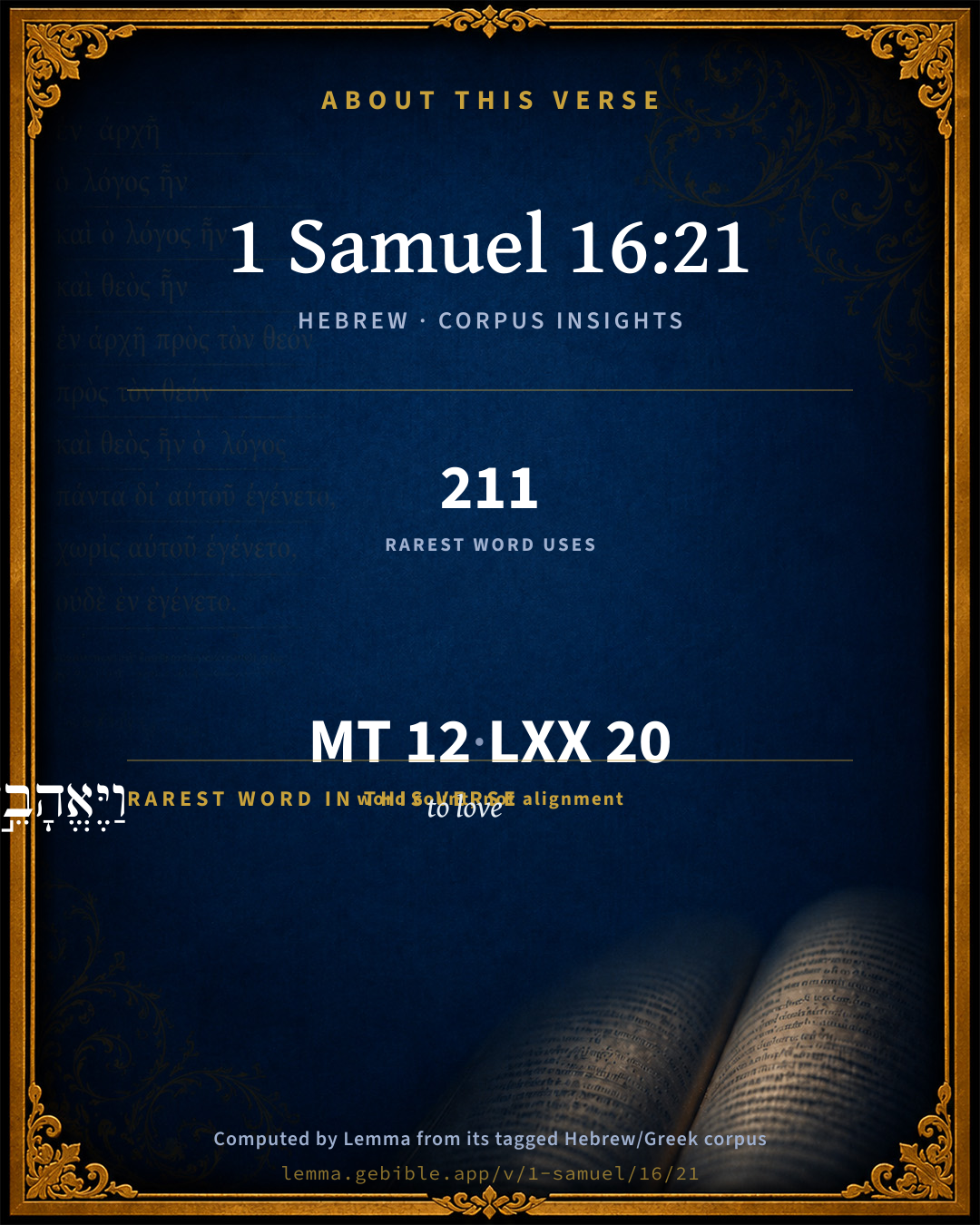
About this verse

These counts appear in no published source. They are computed here, from the morphology-tagged text and Lemma’s own curated glosses. What Lemma adds →

12
words
11
distinct lemmas
Historical
section

Grammatical profile

  • 5 verbs
  • 4 nouns
  • 2 prepositions
  • 1 adverb

Verb forms

  • וַיָּבֹ֤א Qal · Sequential Imperfect
  • וַֽיַּעֲמֹ֖ד Qal · Sequential Imperfect
  • וַיֶּאֱהָבֵ֣הֽוּ Qal · Sequential Imperfect
  • וַֽיְהִי Qal · Sequential Imperfect
  • נֹשֵׂ֥א Qal · Participle Active

Hebrew & Septuagint length

In English translation the verse runs 19 words from the Hebrew and 20 from the Septuagint (LXX English) — closely comparable.

A rough comparison of the two English renderings, which tokenize alike — not a word-level alignment.

Word counts can differ between the Hebrew and the Greek without any difference in meaning — e.g. the Hebrew direct-object marker אֵת has no separate Greek word, and Greek often adds the article ὁ.

In the original languages it is 12 Hebrew tokens and 20 Greek tokens — but the two are counted differently (Hebrew bundles its prefixes and suffixes into one token; the Greek is in lemma form), so that isn’t a like-for-like length.

Cross-references

8

Topical passages linked to 1 Samuel 16:21 in the Treasury of Scripture Knowledge — connected by theme and wording, ordered by reader-vote popularity; previews shown in the World English Bible.

  • Genesis 41:46 Joseph was thirty years old when he stood before Pharaoh king of Egypt. Joseph went out from the presence of Pharaoh, and went throughout all the land of Egypt.
  • Proverbs 22:29 Do you see a man skilled in his work? He will serve kings; He won't serve obscure men.
  • Psalms 146:3 Don't put your trust in princes, Each a son of man in whom there is no help.
  • Deuteronomy 10:8 At that time Yahweh set apart the tribe of Levi, to bear the ark of the covenant of Yahweh, to stand before Yahweh to minister to him, and to bless in his name, to this day.
  • Psalms 118:9 It is better to take refuge in Yahweh, Than to put confidence in princes.
  • Deuteronomy 1:38 Joshua the son of Nun, who stands before you, he shall go in there: encourage you him; for he shall cause Israel to inherit it.
  • 1 Kings 10:8 Happy are your men, happy are these your servants, who stand continually before you, [and] who hear your wisdom.
  • Psalms 62:9 Surely men of low degree are just a breath, And men of high degree are a lie. In the balances they will go up. They are together lighter than a breath.

Cross-references courtesy of OpenBible.info (CC BY 4.0).

Hebrew and Greek witnesses Masoretic Hebrew ↔ Greek Septuagint

The same verse in the two great witnesses to the Old Testament, shown verse-for-verse.

These are two independent witnesses, not word-aligned to each other, and the Septuagint is shown in lemma (dictionary) form.

Hebrew 1 Samuel 16:21 Masoretic · Westminster Leningrad Codex

וַיָּבֹ֤א דָוִד֙ אֶל שָׁא֔וּל וַֽיַּעֲמֹ֖ד לְפָנָ֑יו וַיֶּאֱהָבֵ֣הֽוּ מְאֹ֔ד וַֽיְהִי ל֖וֹ נֹשֵׂ֥א כֵלִֽים

David came to Saul, and stood before him: and he loved him greatly; and he became his armor bearer.

World English Bible · Public Domain

Greek LXX 1 Samuel 16:21 Septuagint · lemma form

καί εἰςἔρχομαι δαυίδ πρός σαούλ καί παραἵστημι ἐνώπιον αὐτός καί ἀγαπάω αὐτός σφόδρα καί γίγνομαι αὐτός αἴρω ὁ σκεῦος αὐτός

And David went in to Saul, and stood before him; and he loved him greatly; and he became his armor-bearer.

LXX2012 (modern English Septuagint) · Public Domain

Hebrew: Westminster Leningrad Codex (CC BY 4.0). Greek: Septuagint (public domain); English from LXX2012 (modern English Septuagint) (Public Domain). How the Septuagint differs from the Hebrew →

Targum (Aramaic paraphrase)

1

The Targum is the ancient Jewish Aramaic paraphrase of the Hebrew Scriptures — an interpretive translation, not the Hebrew text itself. Onkelos (literal) and Pseudo-Jonathan (expansive) render the Torah, and Jonathan the Prophets. Coverage is partial: where no permissively-licensed English translation exists for a verse, only the Aramaic is shown. This is verse-level text, not a word-by-word alignment to the Hebrew.

  1. Targum Jonathan Prophets (Joshua–Malachi)
    וַאֲתָא דָוִד לְוַת שָׁאוּל וְשַׁמֵשׁ קֳדָמוֹהִי וְרִחֲמֵיהּ לַחֲדָא וַהֲוָה לֵיהּ נָטַל זְיָנִין:

    (no public-domain English translation for this verse)

    Targum Jonathan — Aramaic: “Mikraot Gedolot” (public domain). English: “Sefaria Community Translation” (CC0 1.0 (public-domain dedication)); “London "Chaldee Paraphrase," 1871” (public domain). Text via Sefaria.

Commentary

Notes on 1 Samuel 16:21 from classic Christian and Jewish commentators (each source and its license shown beneath its notes). The classic Christian expositions comment on the surrounding passage and are grouped to its opening verse, so a note may address several verses; the Jewish commentaries on the Tanakh (Rashi and others) are per-verse, so they appear only where the commentator wrote on this verse.

Lemma curates 59 commentaries, every one of them public domain or Creative Commons licensed, each selected and text-cleaned for this edition rather than reprinted as found. About our sources →

Trapp's Complete Commentary

John Trapp

1Sa 16:21 And David came to Saul, and stood before him: and he loved him greatly; and he became his armourbearer.

Ver. 21. And he loved him greatly.] But better he had loved him little, so he had loved him long. Trust not in princes. {Psa 146:3} Alvarez de Luna told them that admired his fortune and great favour with the king of Castile, You do wrong to commend the building before it is finished.

John Trapp, A Commentary or Exposition upon All the Books of the Old and New Testament (1647–1656) — public domain. Text from a community e-Sword module.

The Biblical Illustrator

Joseph S. Exell

1Sa_16:21

And David came to Saul, and stood before him.

Life in a palace

1. We see one seated on a throne, and yet not happy. We see his royal magnificence, and just as plainly we see his knitted brow and wild eye. Let our riches be ever so great, we are not rich enough to buy a house into which trouble cannot come. We wish, with a deep, restless eagerness, for more of the world. Our secret feeling is, that our pains are well spent if the outcome be that we stand higher in the world, or grasp more of it. We are sure that happy circumstances shall bring happiness into our heart. Let us but climb the throne, and we shall sit down pleased. Vain, then, were the lordliest mansion reared for us, and crowded with friends, and stored with plenty, if we already have not a happy heart. The heart is its own place, and of itself can make a heaven of hell, a hell of heaven. A heart at one with God, and like His, is the only spring of true joy. Such a heart has Gods smile for its light. His praise and the hope of His glory make a music that never wearies us. All outward pleasure is brightened by the bliss within.

2. Once more we turn our eyes on the king, and we see one healed by the world and yet not cured. We see David as he lifts his harp and strikes the strings, and we mark how the music softens the hard lines in that troubled face, and brings a glint of pleasure into that gloomy eye. We see the worlds medicine in conflict with mans worst ailment. For the king is not ill in body, but in spirit. His spiritual health is ruined, and the flickering goodness that is left only shows him what might have been, and what ought to be, without arousing any will or power to change He is fatally sick in spirit, but he does not seek a cure by returning to breathe the pure air of Divine truth, and to exercise himself in holy doings. He catches at the advice of his lords, and calls for music. Since the worldly pleasures he has do not please, he is fain to try yet another. And the harp in the skilful hand of David does drive away the throng of vexing thoughts. For the time he enjoys a higher and calmer mood. He indeed is healed by the world, but he is not cured. That is an instance of how the world treats its stricken ones. It can only prescribe the medicine which it has. It offers amusements, business, ambitions, and the like as the cure for ills that are in the spirit, and deeper than such things can go. It is successful in thrilling the nerves, in engrossing the energies, and in thus turning a mans thought away from himself. He is happy, as the sleeper is happy in his dreams. Let the young put themselves beforehand on guard against the worlds nostrums for spiritual ills. A harp--a harp is the charm for a spirit in which heaven and hell are at war and eternity at stake! Go not to one who does but trifle with death. If no saintly Samuel is known to you, from whose goodly wisdom you may win guidance, then all the more keenly listen to God Himself, as at the very centre of your being He echoes the words of Jesus, and sends you to that sole Physician of the spirit. Face to face to the sated but unsatisfied man of the world there stands a robust youth. As yet he is fresh to the city and the court. He has been spoken of to the king as a brave and accomplished man. As we look further, and think of his life heretofore and its results, we see a like contrast to the history and character of Saul.

3. We see one who links lowly duty with lofty hope. David felt the stirrings of genius, and the anointing had confirmed him in high hopes, yet he did not despise his crook. He was not forever grumbling that such a clever fellow as he should be condemned to common toil. In the full expectancy of a great future he gave his best energy to the lowly business which now was duty. And the duty of today is ever Gods apprenticeship of us for the greater things of the morrow. To kick at the lowly work set before us is to kick down the ladder God has brought to our feet. See how David rose by fidelity to the present. But, unfaltering in his hope, he was not hurried away by it. He did not let it carry him off to the court or the camp in chase of fortune. He bade his eager spirit bide its time. And now, in the due time of Gods choosing, and still but following the duty of the hour, David has taken another step forward. He has come to be Sauls minstrel. Let us be faithful to the calls of each day as they come, and we too shall grow royal and reach our own throne. Jehovah is no respecter of persons, but deals with us as wisely and as lovingly as He dealt with His servant David.

4. We see one who links pleasant leisure with rich profit. The shepherds day was long, but it was not without many spare moments. In that solitude which was full of God this man, like others called to lofty tasks, was made great. Slowly he was ennobled and made royal in heart. Without having seen the court he had a grace which indeed no earthly palace could have given. Not for David alone, but for every youth, fate lies hid in those leisure hours. As he deals with them he is dealing with his whole future. Out of them shall spring his fortune in this life and in the next. Who makes himself worthy of success shall find it at last coming to meet him by the way on which he journeys. And, just as surely, the time which is not filled with good is room kept for evil. It is not merely that the man robs himself of the accomplishments and character and capabilities which might have been his. For lack of noble interests and patient work he deteriorates. He falls beneath himself. And, looking back on this subject, let us be warned from Saul to distrust the world for our peace. Let us copy David and make the Lord our portion. Jehovah is now more easily known and more readily found than in those ancient, days. (David Burns.)

David before the King

1. This is a melancholy picture l The collapse of what gave promise of being a brilliant career is very affecting, particularly when it is the result of moral failure (1Sa_10:2). What contrast could be sharper than that, which is expressed by the words, The Spirit of the Lord departed from Saul, and an evil spirit from the Lord troubled him (ver 14)!

2. But to turn to the other side, how mysterious are the methods of Divine Providence! The successor of Saul is admitted into his presence on account of his musical capabilities Thus natural gifts were made to subserve Divine purposes. Little did David think, when he was playing in the tent of Jesse, that the pastime was a preparation for his future destiny; and evidently little did Jesse think that the youngest of his sons was the one who should be taken from the sheepfolds to feed Israel.

I. Sauls condition.

1. First he was in a state of dejection. I use the word dejection, because it is a stronger term than depression; depression is but a degree of dejection (Crabb). Then dejection seems to be oftentimes measured by the height of previous exaltation, and so to be a very suitable term in the ease of Saul, Wordsworth says:--

As high as we have mounted in delight,

In our dejection do we sink as low.

There are those who would go further than this, and describe the king as suffering from melancholia, and the hypochondriacal term of it. Perhaps the tendency is too common to attribute moral disease to mental. Saul was a disappointed man, and became the prey of his evil passions.

2. But this is only a part of the matter Sauls miserable condition is attributed in the Bible to the workings of an evil spirit. It is a very unwarrantable method of dealing with the statements of holy Scripture, to assert that this is only the Jewish way of saying Saul was mad. No one can read the New Testament accounts of demoniacs, or our Lords words as to devil-possession, and be satisfied with such an explanation. The same words describe the departure of the Spirit of God, and the arrival of an evil spirit,.

3. Again, this spirit is said to be from the Lord, for even over evil spirits God has sovereignty. Satan could not tempt Job without Divine permission and Divine restrictions; his emissaries must therefore be allowed by God to tempt or torment man. This was a part of Sauls punishment; as, bodily and mental disorders are often the penalties of personal sin.

II. Davids remedy.

1. Saul, when these spiritual paroxysms were upon him, was soothed and calmed by the sweet strains from Davids harp. Commentators say, that this power of music is well known.

2. Such an effect bears testimony to the source from which music had been said to come--the land of peace. Newman could not believe that, such effects as music wrought could be produced by that which is unsubstantial and transitory. Similarly, Kingsley says, Music has been called the speech of angels. Music is a language, a universal language, which appeals to the heart of man; and as it gives expression to every feeling and emotion, so it has the power of calling every movement of the soul into play.

3. But they were the strains of Davids harp alone which allayed the commotion in Sauls spirit, and drove off the evil influence. There is music and music. There is music which elevates and calms and spiritualises, and there is music which stirs evil passions and excites sensuous impulses It is music which appeals to what is Divine in man, and lifts up his thoughts and affections to the far-off land, which has the power by its stern sweetness of pacifying the passions, and dissipating the gloom which hides the face of God.

III. Lessons.

1. To take warning from the history of Saul, lest through unfaithfulness to God we should forfeit the opportunities of service which He gives us, and so through disappointment become the prey of evil passions and evil powers.

2. To realise the need of watchfulness (Eph_6:12).

3. That music in the service of the sanctuary is not for purposes of entertainment, but to lift up the soul to God.

4. Finally, we may surely, with the mystical interpreter, see an image in this incident of the work of Christ, the true David, the Prince of Peace, who came to deliver mankind from the tyranny of Satan, and to restore to peace and harmony those who were distracted by divers lusts and passions; and further, inquire whether we have obtained that peace which Christ came to bring. (Canon Hutchings.)

The Sweet Psalmist in the Court of Saul

The scene changes. We are no longer sitting among the sheep with David, watching the departure of the prophet, and the dispersion of the guests; we are not now among the home circle in Jesses house, but in the court of Gibeah. Here is state and grandeur and Eastern magnificence. The king has evidently all the absolute power of an Eastern monarch. But these things will make no man happy; for we read (verse 24): The Spirit, of the Lord departed from Saul, and an evil spirit from the Lord troubled him. Is it so? that powers and talents are taken from one man and given to another? Are we so far stewards of all our faculties, that if we misuse or abuse them, God will transfer them to our neighbour? The kingdom was taken from Saul, so Samuel had told him, and was given to another. You recollect what our Lord says in the parable of the pounds: And he said to them that stood by, Take from him the pound, and give it to him that hath ten pounds. For I say unto you, That unto everyone which hath shall be given, and from him that hath not, even that he hath shall be taken away from him. The more you act as faithful stewards of your money, your talents, and your faculties, the more God will commit to your trust. But if, like the unjust steward, you waste your Lords goods, then you will lose what you have, and be no longer stewards. Sin draws after it many consequences. Little did Saul think that he should lose the kingdom, when he spared the king of the Amalekites; and he never could have foreseen that, fearful visitation that was coming on him. Boast not of your gifts or your mental powers, it needs but for God to remove His hand, and what a multitude of evil spirits may possess our souls! It is only by Gods will that we live? What a contrast between Saul returning from the slaughter of the Ammonites, and Saul, as now, a prey to fits of mental derangement! Yes, we are in Gods hands, and everything is at His disposal. Now we may be conscious of some power of mind and a consciousness of power, of course, gives pleasure. But a stroke of paralysis might lay us prostrate in a moment; the faculty of speech, the faculty of memory, might be taken from us, and we be enfeebled in mind for the rest of our days. This affliction of Sauls is called an evil spirit from the Lord. The Spirit of the Lord was gone from Saul, gone because of his sin; and the evil spirit from God had come upon him. The servants prescribe only a half-remedy: the music may drive away his sadness, may restore the balance of his mind; but this, because it cannot bring back the favour of God, will not restore peace to his soul. Only the gospel can give real comfort. And now one of the servants of Saul, perhaps a man with more religious feeling than the rest, mentions Davids name. And so David is sent for to the court of Saul. Gods purposes are sure to come to pass. When Moses was forty years old, he thought the time had come for him to deliver his brethren; but there were to be forty years of discipline yet both for him and them. When Saul was arrested by the vision on the road to Damascus, he was told of Gods designs about him; but many years passed before he was ordained to the apostleship Davids faith and patience were put to the test in the interval that elapsed between his anointing and his summons to the court; and now, in a very humble capacity indeed, he enters the palace: he is nothing more than a musician, and afterwards made one of the bodyguard. Music has a wonderful power over the spirit. Saul felt its influence, and his spirit was refreshed, but he remained the same character; his soul was in no way the better for it. It is very difficult to distinguish between natural sentiment and religious enthusiasm, between genuine spiritual ecstacy and mere sensuous delight. God forbid our church music should not be good of its kind! We ought to offer the best of everything to God; only with this passage in Sauls life before us, let us be careful that while we delight in the singing, we are not insensible to the deep meaning of the words. When you think that a musical service has really been a blessing to your soul, then ask yourself these questions: Have I been humbled in my own eyes? Do I loathe myself? Is Christ more precious to me as the Saviour who has died for me? and Do I feel more abhorrence of the sin that is close and natural to me? For if you have been excited, but not really moved to humiliation and prayer, the musical service will only have strengthened your natural propensities; and though I say nothing against the singing of the Psalms of David, yet I say thin--and that in the face of the musical taste of the present day--that the effect of a high musical service upon soma natures may be baneful in the extreme. God has given to some of you great talents; mind that, like David, you use them to His glory. Have you beauty? Have you intellect? Have you musical talent? Thank God for every gift: but remember that it is a trust: you may use it in the service of God, or in the devils service. (C. Bosanquet, M. A.)

The Biblical Illustrator, edited by Joseph S. Exell (c. 1880s–1900s) — public domain. Text from a community e-Sword module.

Joseph Benson's Commentary

1Sa 16:21. David came to Saul and stood before him — Ministered unto him among the rest of his servants. This sufficiently shows that Saul had no knowledge of the anointing of David, otherwise it cannot be supposed that he would have had him brought to his court. And he loved him greatly — So there was something good in Saul still; he had not lost all, though he had lost the kingdom. He became his armour-bearer — He had that place conferred upon him, though we do not read that he ever exercised it; for it seems he was gone back to his father upon some occasion not related; and had abode with him some considerable time before the war, described chap. 17., happened.

Joseph Benson's Commentary on the Old and New Testaments (1811–1818) — public domain. Text from a community e-Sword module.

Tyndale Open Study Notes

Tyndale Open Resources

16:21 Although at first Saul loved David very much, this love soon turned to intense jealousy and hatred (see 18:8-14). • An armor bearer in ancient Israel served as the personal attendant of a warrior chieftain (see 14:1-15; 31:4-6; Judg 9:54; 2 Sam 18:15).

Tyndale Open Study Notes — © Tyndale Open Resources, licensed CC BY-SA 4.0. Text via the HelloAO Bible API.

Geneva Bible (1599)

Geneva Bible translators

Or, served him.

Geneva Bible (1599) marginal notes — public domain. Text via Bolls.life.

Jamieson, Fausset & Brown

Robert Jamieson, A. R. Fausset & David Brown

David came to Saul--Providence thus prepared David for his destiny, by placing him in a way to become acquainted with the manners of the court, the business of government, and the general state of the kingdom.

became his armour-bearer--This choice, as being an expression of the king's partiality, shows how honorable the office was held to be.

Jamieson, Fausset & Brown — Commentary Critical and Explanatory on the Whole Bible (1871) — public domain (CC PDM 1.0). Text via the HelloAO Bible API.

Ellicott's Commentary for English Readers

(21) And he became his armour-bearer.—But probably only for a very short time. David returned, we should conclude, to Samuel, whose pupil and friend we know he was. The seer was watching over the young man with a view to his lofty destiny. Saul apparently, from his question in 1Sa_17:55, “Whose son is this youth?” had forgotten all about him. There is no “note of time,” so we are not able to determine how long a period had elapsed between the events narrated in this chapter and the combat with the Philistines told in 1 Samuel 17. It is, however, likely that the king’s malady, which was making rapid progress in this period of his reign, had already obscured his once powerful mind; his memory for the past was likely enough to have been treacherous.

A Bible Commentary for English Readers, edited by Charles John Ellicott (1878–1897) — public domain. Text from a community e-Sword module.

John Gill's Exposition

And David came to Saul, and stood before him,.... As a servant, and ministered to him in the way, and for the purpose for which he was sent:

and he loved him greatly; being a comely person, and a well behaved youth, and especially as he was serviceable to him with his music, in driving away melancholy from him:

and he became his armourbearer; that is, he appointed him to this office, though we never read that he exercised it; nor did he go with Saul in this capacity to the battle related in the following chapter: it may be literally rendered: "and he was to him a bearer of vessels", or "instruments" (q); and Abarbinel thinks this is to be understood not of instruments of war, but of instruments of music to play with; which he brought in and bare before him when he went in to the king.

(q) "et fuit ei ferens vasa", Montanus; "ferens instrumenta", Piscator.

John Gill's Exposition of the Whole Bible (1746–1763) — public domain (CC PDM 1.0). Text via the HelloAO Bible API.

Albert Barnes' Notes on the Bible

The difficulty of reconciling this verse with 1Sa 17:55-58, is met thus: The words here are the ultimate sequence of David’s first visit to Saul, and of his skill in music, and are therefore placed here; but they did not really come to pass until after David’s victory over Goliath (see 1Sa 18:2). It is quite conceivable that if David had only played once or twice to Saul, and then returned to his father’s house for some months, Saul might not recognize him.

Albert Barnes' Notes on the Bible (1834–1885) — public domain. Text from a community e-Sword/MySword module.

Haydock's Catholic Bible Commentary

Bearer. This was an honourable office. (Haydock) --- Cyrus had been employed by his grandfather Astyages in the same capacity, before he came to the empire. (Atheneus xiv.) (Calmet)

George Leo Haydock (1774–1849), Haydock's Catholic Family Bible and Commentary, 1859 edition — public domain. Excludes Psalms (Douay-Rheims chapter numbering differs from Protestant) and Deuterocanonical books (Catholic canon only).

Matthew Poole's English Annotations

Stood before him, i.e. ministered unto him; or (as we use to speak) waited upon him, as that phrase oft signifies; as Deu 1:38; 10:8.

He became his armour-bearer; he had that place conferred upon him, though we do not read that he ever exercised it; for it seems he was gone back to his father upon some occasion not related, and had abode with him some considerable time before the war described, 1Sa 17, happened.

Matthew Poole's English Annotations on the Holy Bible (1683–1685) — public domain. Text from a community e-Sword/MySword module.

Whedon's Commentary on the Bible

Daniel D. Whedon

21. He became his armourbearer — That is, Saul conferred upon him this office as a token of confidence and love; but he never actually exercised its duties, unless, perhaps, for a short time after his victory over Goliath.

Daniel D. Whedon (gen. ed.), Commentary on the Old and New Testaments (1874–1909) — public domain. Text from a community e-Sword module.

The Pulpit Commentary

Vers. 21-23. David came to Saul, and stood before him. The latter phrase means, "became one of his regular attendants." This, and his being appointed one of Saul"s armour bearers, happened only after the lapse of some time. The armour bearer, like the esquire in the middle ages, had to carry his lord"s lance, and sword, and shield, and was always a tried soldier, and one whom the king trusted. It was apparently after the combat with Goliath that Saul sent to Jesse, and asked that David might be always with him; and until his jealousy burst forth David was very dear to him, and his music exercised a soothing influence upon his melancholy. At first, probably, these fits of insanity came upon Saul only at distant intervals, but afterwards more frequently, and with such loss of self-control that he more than once tried to murder David, and even Jonathan, his own son. We have, then, here a summary of the relations of Saul to David until the unfortunate day when the king heard the women ascribe to the youthful soldier the higher honor; (1Sa_18:7) and thenceforward these friendly feelings gave way to a growing dislike which deprived Saul of a faithful servant, and finally cost him his crown and life on Mount Gilboa.

The Pulpit Commentary (1880–1919), ed. H.D.M. Spence-Jones & Joseph S. Exell — public domain. Text from a community e-Sword module.

John Wesley's Explanatory Notes

Stood before him - That is, waited upon him. And he loved him greatly - So there was something good in Saul still: he had not lost all, tho' he had lost the kingdom. armour-bearer - He had that place conferred upon him, though we do not read that he ever exercised it; for it seems he was gone back to his father upon some occasion not related; and had abode with him some considerable time before the war described, chap. xvii, 1-53, happened.

John Wesley, Explanatory Notes Upon the Whole Bible (1754–1765) — public domain. Text via the GEBible commentary corpus.

Scofield Reference Notes

C. I. Scofield

And David Cf. 1Sa 17:55; 1Sa 17:56. The order of events is:

(1) David, whose skill on the harp, and valour in the combat with the lion and bear 1Sa 17:34; 1Sa 17:36 were known to "one of the servants" of Saul, was brought to play before the king 1Sa 16:17; 1Sa 16:18.

(2) David returns to Bethlehem 1Sa 17:15.

(3) David is sent to Saul’s camp 1Sa 17:17; 1Sa 17:18 and performs his great exploit.

(4) Saul’s question 1Sa 17:55; 1Sa 17:56 implies only that he had forgotten the name of David’s father --not remarkable certainly in an oriental king.

The Scofield Reference Bible (1917 edition), notes by C. I. Scofield — public domain. Text from a community e-Sword module.

Lesson kit

Teaching starters — assembled from the data on this page, not authored interpretation. Every prompt links to the verse data it draws on. Edit before teaching.

1 Samuel, in the Historical, opens this verse with 12 words (11 distinct Hebrew lemmas). Its most distinctive word is ʼâhab (“to love”). A historical commentator’s framing appears above. Read the whole chapter for the surrounding context.

Discussion questions

  1. The word ʼâhab carries the sense “to love.” How does it shape the verse?
  2. Genesis 41:46 shares this passage’s theme. How do the two illuminate each other?
  3. These translations render this verse differently. What is at stake in choosing one wording over another?
  4. The verb «וַיָּבֹ֤א» is Qal Sequential Imperfect. How does its form color the action?
  5. Reading how Trapp's Complete Commentary and The Biblical Illustrator read this verse, where do the two commentators agree and where do they part?

Things to notice

Reading settings

Reading text

Shown beneath each verse's original-language words.

Old Testament
Old Testament edition

Read the OT as the Masoretic Hebrew (MT) or the Greek Septuagint (LXX).

English shown for the Greek Septuagint (in the Hebrew ↔ Greek comparison).

Comparing translations? Open the Compare panel on any verse page to stack up to four side by side.