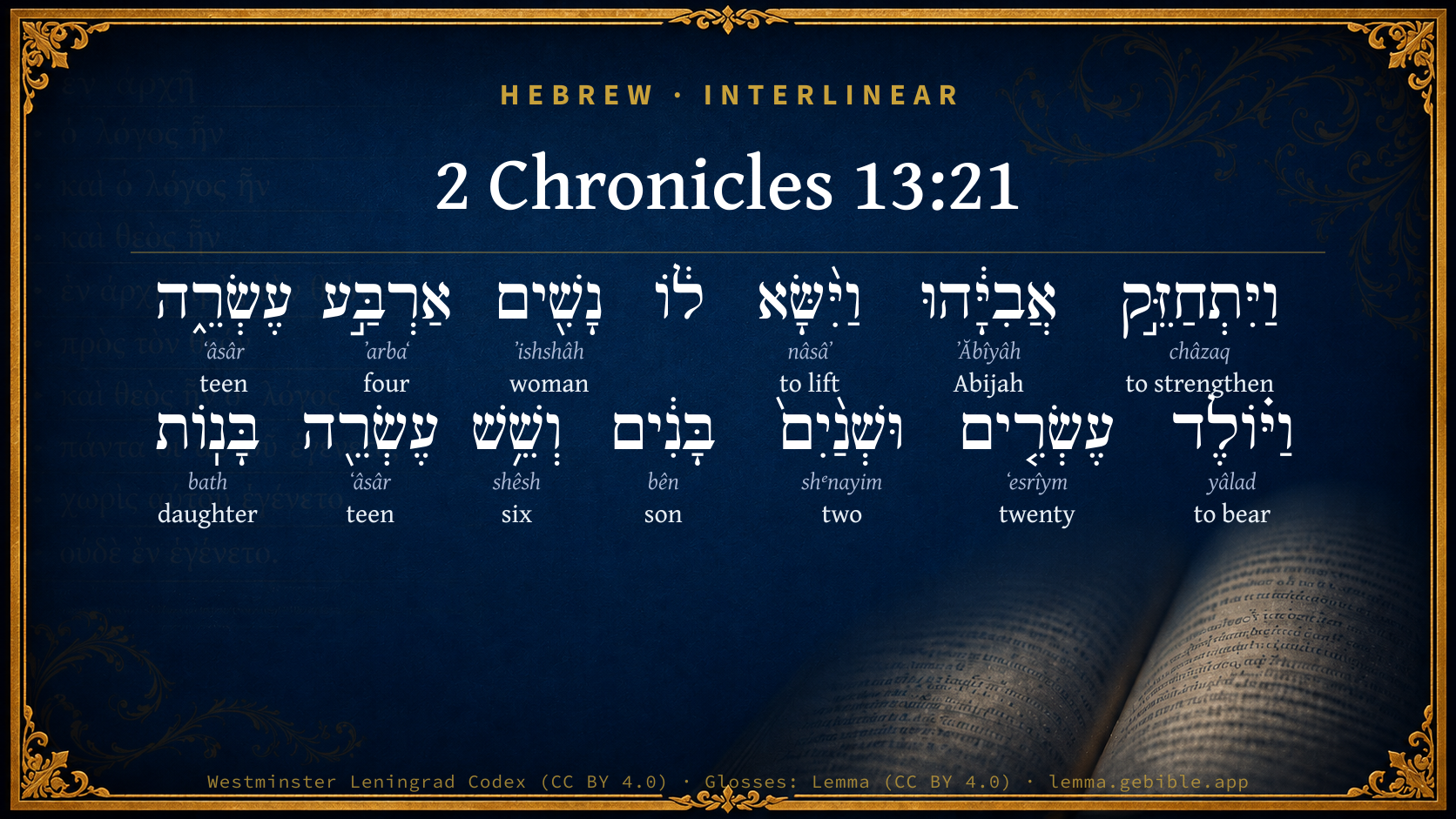
2 Chronicles 13:21

Hebrew (Westminster Leningrad Codex) 2 Chronicles 13:21 appears in the Hebrew Old Testament. The text above is from the Westminster Leningrad Codex. Each word links to its Strong’s number, a concise gloss, and parsing drawn from the Open Scriptures Hebrew Bible morphology. Click any word for its full Brown-Driver-Briggs (BDB) entry.
Download image
Cite this verse

2 Chronicles 13:21 (World English Bible). Public Domain. Lemma interlinear Bible study tool, https://lemma.gebible.app/v/2-chronicles/13/21.

Show BibTeX & RIS
BibTeX
RIS
English Translation
But Abijah grew mighty, and took to himself fourteen wives, and became the father of twenty-two sons, and sixteen daughters.
World English Bible · Public Domain
Download a study sheet

One document with this verse’s original text, its word-by-word gloss line, the meaning frame, cross-references with their text, attributed commentary, and full source and license credits — printable, and it pastes into notes with its structure intact.

This verse Autodidact and up

Study sheet (.html) Plain text (.txt)

A passage Seminary Student

Up to 50 verses in one chapter. A passage sheet keeps up to 6 commentary sources and 12 cross-references per verse, in the order this page ranks them, and says so on the sheet whenever that leaves anything out. Ask for a single verse and you get the Autodidact verse sheet above.

Everything on this page stays free to read, with no account — the sheet is a download of what is already on screen, not access to it.

Want to remove ads? Support Godless Engineer
Compare translations 3

The same verse in 3 English versions, stacked beneath the original-language interlinear above. Click any original word for its lexicon entry.

Each is an independent rendering of the whole verse — the interlinear is not word-aligned to these translations.

Highlighted words mark where these versions differ — a whole-verse word diff, not a word-by-word alignment.

  • World English Bible Public Domain
    But Abijah grew mighty, and took to himself fourteen wives, and became the father of twenty-two sons, and sixteen daughters.
  • King James Version Public Domain
    But Abijah waxed mighty, and married fourteen wives, and begat twenty and two sons, and sixteen daughters.
  • unfoldingWord Literal Text CC BY-SA 4.0
    And Abijah strengthened himself; and he lifted to himself 14 wives, and he fathered 22 sons and 16 daughters.

unfoldingWord Literal Text — © unfoldingWord, licensed CC BY-SA 4.0. Word-aligned USFM3 via Door43 (git.door43.org/unfoldingWord/en_ult).

Versions to compare (up to 4)

3 of 4 selected

Show all 18 translations

Every available English version of this verse, each an independent rendering of the whole verse.

  • World English Bible Public Domain
    But Abijah grew mighty, and took to himself fourteen wives, and became the father of twenty-two sons, and sixteen daughters.
  • Berean Standard Bible Public Domain
    But Abijah grew strong, married fourteen wives, and became the father of twenty-two sons and sixteen daughters.
  • Majority Standard Bible Public Domain
    But Abijah grew strong, married fourteen wives, and became the father of twenty-two sons and sixteen daughters.
  • King James Version Public Domain
    But Abijah waxed mighty, and married fourteen wives, and begat twenty and two sons, and sixteen daughters.
  • American Standard Version (1901) Public Domain
    But Abijah waxed mighty, and took unto himself fourteen wives, and begat twenty and two sons, and sixteen daughters.
  • Revised Version (1885) Public Domain
    But Abijah waxed mighty, and took unto himself fourteen wives, and begat twenty and two sons, and sixteen daughters.
  • Geneva Bible (1599) Public Domain
    So Abiiah waxed mightie, and marryed foureteene wiues, and begate two and twentie sonnes, and sixteene daughters.
  • Douay-Rheims (1899) Public Domain
    But Abia, being strengthened in his kingdom, took fourteen wives: and begot two and twenty sons, and sixteen daughters.
  • Young's Literal Translation Public Domain
    And Abijah strengtheneth himself, and taketh to him fourteen wives, and begetteth twenty and two sons, and sixteen daughters,
  • Literal Standard Version CC BY-SA 4.0
    And Abijah strengthens himself, and takes fourteen wives for himself, and begets twenty-two sons and sixteen daughters;
  • Unlocked Literal Bible CC BY-SA 4.0
    But Abijah became powerful; he took fourteen wives for himself and became the father of twenty-two sons and sixteen daughters.
  • unfoldingWord Literal Text CC BY-SA 4.0
    And Abijah strengthened himself; and he lifted to himself 14 wives, and he fathered 22 sons and 16 daughters.
  • Darby Bible Public Domain
    But Abijah strengthened himself, and took fourteen wives, and begot twenty-two sons and sixteen daughters.
  • World Messianic Bible Public Domain
    But Abijah grew mighty and took for himself fourteen wives, and became the father of twenty-two sons and sixteen daughters.
  • Webster's Bible Public Domain
    But Abijah became mighty, and married fourteen wives, and begat twenty and two sons, and sixteen daughters.
  • Free Bible Version CC BY-SA 4.0
    But Abijah grew stronger and stronger. He married fourteen wives and had twenty-two sons and sixteen daughters.
  • Bible in Basic English Public Domain
    But Abijah became great, and had fourteen wives, and became the father of twenty-two sons and sixteen daughters.
  • JPS Tanakh (1917) Public Domain
    But Abijah waxed mighty, and took unto himself fourteen wives, and begot twenty and two sons, and sixteen daughters.

Literal Standard Version (2020), Covenant Press — licensed CC BY-SA 4.0. Text via the HelloAO Bible API (eBible.org). Unlocked Literal Bible (unfoldingWord) — licensed CC BY-SA 4.0. Text via the HelloAO Bible API (eBible.org). unfoldingWord Literal Text — © unfoldingWord, licensed CC BY-SA 4.0. Word-aligned USFM3 via Door43 (git.door43.org/unfoldingWord/en_ult). Free Bible Version, Dr. Jonathan Gallagher — licensed CC BY-SA 4.0. Text via the HelloAO Bible API (eBible.org).

Word by word

More ways to search: Search by grammar → Find every occurrence → Compare this word →

Practice this passage: Drill this verse → Learn its vocabulary →

אֲבִיָּ֔הוּ
ʼĂbîyâh
H29
“Abijah”
Noun, Proper
Part of Speech
Noun
Type
Proper
Full BDB Definition

Origin: from H1 and H3050

TWOT: None

Abia or Abiah or Abijah = "Jehovah is (my) father" - king of Judah, son and successor of Rehoboam - second son of Samuel - son of Jeroboam the first, king of Israel - son of Becher, a Benjamite - head of a priestly house (one of the 24 Levite groups) - head of a priestly house (after the exile) - wife of Hezron - mother of Hezekiah (compare H21 )
  1. וַיִּתְחַזֵּ֣ק châzaq H2388 “and · to strengthen” Conjunction + Verb, Hithpael, Sequential Imperfect, 3rd Person, Masculine, Singular
  2. וַיִּ֨שָּׂא nâsâʼ H5375 “and · to lift” Conjunction + Verb, Qal, Sequential Imperfect, 3rd Person, Masculine, Singular
  3. נָשִׁ֖ים ʼishshâh H802 “women” Noun, Common, Feminine, Plural, Absolute
  4. אַרְבַּ֣ע ʼarbaʻ H702 “four” Adjective, Cardinal number, Feminine, Singular, Absolute
  5. עֶשְׂרֵ֑ה ʻâsâr H6240 “teen” Adjective, Cardinal number, Feminine, Singular, Absolute
  6. וַיּ֗וֹלֶד yâlad H3205 “and · to bear” Conjunction + Verb, Hiphil, Sequential Imperfect, 3rd Person, Masculine, Singular
  7. עֶשְׂרִ֤ים ʻesrîym H6242 “twenty” Adjective, Cardinal number, Both, Plural, Absolute
  8. וּשְׁנַ֨יִם֙ shᵉnayim H8147 “and · two” Conjunction + Adjective, Cardinal number, Masculine, Dual, Absolute
  9. בָּנִ֔ים bên H1121 “sons” Noun, Common, Masculine, Plural, Absolute
  10. וְשֵׁ֥שׁ shêsh H8337 “and · six” Conjunction + Adjective, Cardinal number, Feminine, Singular, Absolute
  11. עֶשְׂרֵ֖ה ʻâsâr H6240 “teen” Adjective, Cardinal number, Feminine, Singular, Absolute
  12. בָּנֽוֹת bath H1323 “daughters” Noun, Common, Feminine, Plural, Absolute

About this verse

These counts appear in no published source. They are computed here, from the morphology-tagged text and Lemma’s own curated glosses. What Lemma adds →

14
words
12
distinct lemmas
Historical
section

Notable vocabulary

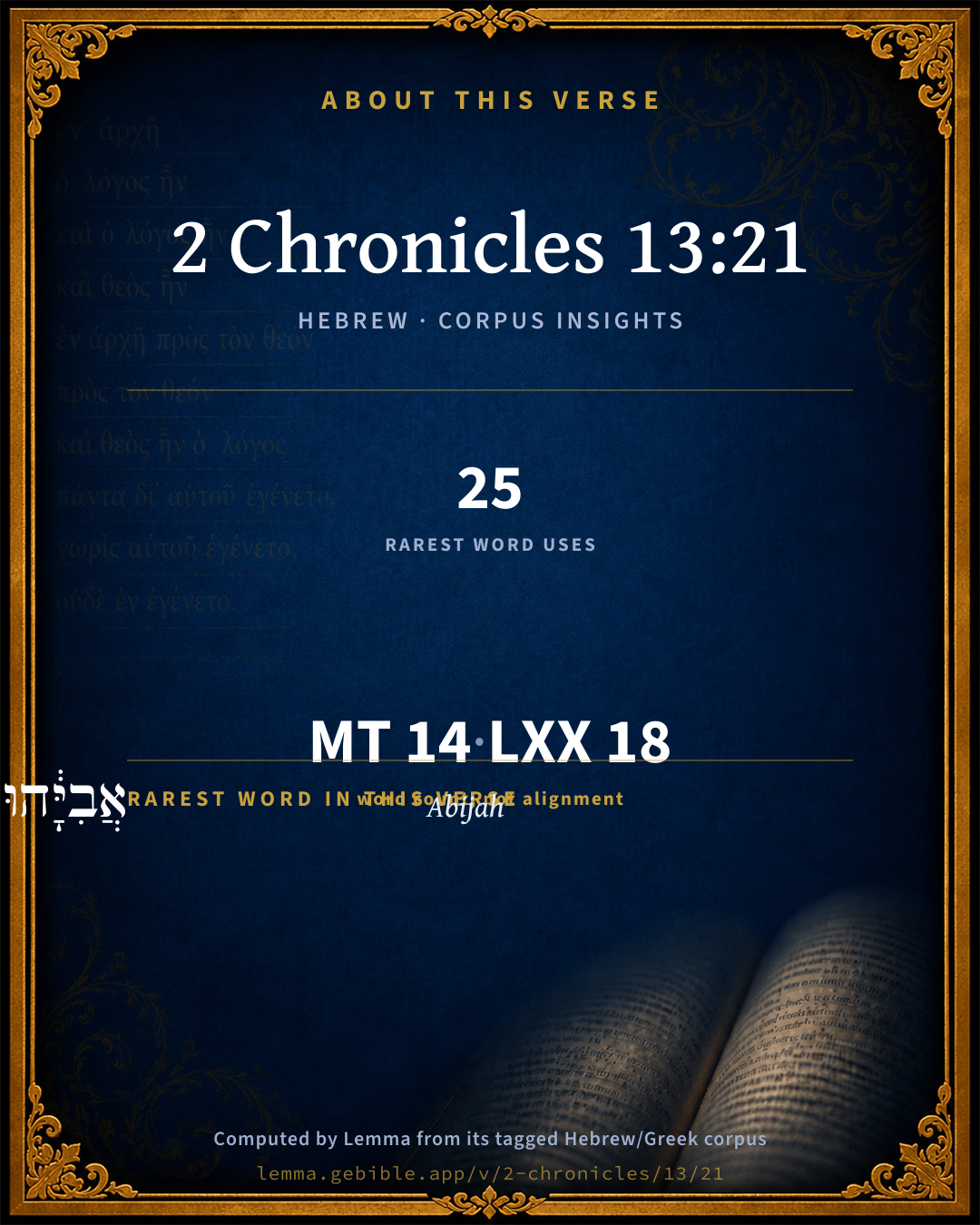
The rarest word here is אֲבִיָּ֔הוּ Abijah H29 — appearing just 25 times in the whole Hebrew Bible.

Shared distinctive vocabulary

אֲבִיָּ֔הוּ Abijah H29 occurs in 25 verses of the Hebrew Bible. Also found in:

Grammatical profile

  • 3 verbs
  • 4 nouns
  • 6 adjectives
  • 1 preposition

Verb forms

  • וַיִּתְחַזֵּ֣ק Hithpael · Sequential Imperfect
  • וַיִּ֨שָּׂא Qal · Sequential Imperfect
  • וַיּ֗וֹלֶד Hiphil · Sequential Imperfect

Repetition

A word recurs within this verse — often emphatic in Hebrew:

  • עֶשְׂרֵ֑ה teen H6240 ×2

Hebrew & Septuagint length

In English translation the verse runs 20 words from the Hebrew and 18 from the Septuagint (LXX English) — closely comparable.

A rough comparison of the two English renderings, which tokenize alike — not a word-level alignment.

Word counts can differ between the Hebrew and the Greek without any difference in meaning — e.g. the Hebrew direct-object marker אֵת has no separate Greek word, and Greek often adds the article ὁ.

In the original languages it is 14 Hebrew tokens and 18 Greek tokens — but the two are counted differently (Hebrew bundles its prefixes and suffixes into one token; the Greek is in lemma form), so that isn’t a like-for-like length.

Cross-references

5

Topical passages linked to 2 Chronicles 13:21 in the Treasury of Scripture Knowledge — connected by theme and wording, ordered by reader-vote popularity; previews shown in the World English Bible.

  • Judges 8:30–31 Gideon had seventy sons conceived from his body; for he had many wives.
  • Judges 9:5 He went to his father's house at Ophrah, and killed his brothers the sons of Jerubbaal, being seventy persons, on one stone: but Jotham the youngest son of Jerubbaal was left; for he hid himself.
  • Judges 10:4 He had thirty sons who rode on thirty donkey colts, and they had thirty cities, which are called Havvoth Jair to this day, which are in the land of Gilead.
  • 2 Samuel 5:12–13 David perceived that Yahweh had established him king over Israel, and that he had exalted his kingdom for his people Israel's sake.
  • 2 Chronicles 11:21 Rehoboam loved Maacah the daughter of Absalom above all his wives and his concubines: (for he took eighteen wives, and sixty concubines, and became the father of twenty-eight sons and sixty daughters.)

Cross-references courtesy of OpenBible.info (CC BY 4.0).

Hebrew and Greek witnesses Masoretic Hebrew ↔ Greek Septuagint

The same verse in the two great witnesses to the Old Testament, shown verse-for-verse.

These are two independent witnesses, not word-aligned to each other, and the Septuagint is shown in lemma (dictionary) form.

Hebrew 2 Chronicles 13:21 Masoretic · Westminster Leningrad Codex

וַיִּתְחַזֵּ֣ק אֲבִיָּ֔הוּ וַיִּ֨שָּׂא ל֔וֹ נָשִׁ֖ים אַרְבַּ֣ע עֶשְׂרֵ֑ה וַיּ֗וֹלֶד עֶשְׂרִ֤ים וּשְׁנַ֨יִם֙ בָּנִ֔ים וְשֵׁ֥שׁ עֶשְׂרֵ֖ה בָּנֽוֹת

But Abijah grew mighty, and took to himself fourteen wives, and became the father of twenty-two sons, and sixteen daughters.

World English Bible · Public Domain

Greek LXX 2 Chronicles 13:21 Septuagint · lemma form

καί καταἰσχύω αβια καί λαμβάνω ἑαυτοῦ γυνή δέκα τέσσαρες καί γεννάω υἱός εἴκοσι δύο καί θυγάτηρ δέκα ἕξ

But Abia strengthened himself, and took to himself fourteen wives, and he begot twenty-two sons, and sixteen daughters.

LXX2012 (modern English Septuagint) · Public Domain

Hebrew: Westminster Leningrad Codex (CC BY 4.0). Greek: Septuagint (public domain); English from LXX2012 (modern English Septuagint) (Public Domain). How the Septuagint differs from the Hebrew →

Commentary

Notes on 2 Chronicles 13:21 from classic Christian and Jewish commentators (each source and its license shown beneath its notes). The classic Christian expositions comment on the surrounding passage and are grouped to its opening verse, so a note may address several verses; the Jewish commentaries on the Tanakh (Rashi and others) are per-verse, so they appear only where the commentator wrote on this verse.

Lemma curates 59 commentaries, every one of them public domain or Creative Commons licensed, each selected and text-cleaned for this edition rather than reprinted as found. About our sources →

Trapp's Complete Commentary

John Trapp

2Ch 13:21 But Abijah waxed mighty, and married fourteen wives, and begat twenty and two sons, and sixteen daughters.

Ver. 21. And married fourteen wives.] Some of them before he came to the kingdom. Junius well readeth it, He had married fourteen wives. This was against an express law, {Deu 17:17} besides the utter unlawfulness of polygamy, whereof before. But many great men make little of laws; it is plea sufficient for their offence that it is -

“ facinus maioris abollae. ”

John Trapp, A Commentary or Exposition upon All the Books of the Old and New Testament (1647–1656) — public domain. Text from a community e-Sword module.

Joseph Benson's Commentary

2Ch 13:21. Abijah married fourteen wives — Not now after this victory, for he died soon after it; but in the whole time of his life, before he was king, and afterward.

Joseph Benson's Commentary on the Old and New Testaments (1811–1818) — public domain. Text from a community e-Sword module.

Keil & Delitzsch

C. F. Keil & F. Delitzsch

Wives and children of Abijah. His death. - Ch2 13:21. While Jeroboam was not able to recover from the defeat he had suffered, Abijah established himself in his kingdom (יתחזּק, cf. Ch2 12:13), and took to himself fourteen wives. The taking of these wives is not to be regarded as later in time than his establishment of his rule after the victory over Jeroboam. Since Abijah reigned only three years, he must have already had the greater number of his wives and children when he ascended the throne, as we may gather also from Ch2 11:21-23. The ו consec. with ישּׂא serves only to connect logically the information as to his wives and children with the preceding, as the great increase of his family was a sign of Abijah's increase in strength, while Jeroboam's dynasty was soon extirpated.

Ch2 13:22

As to the מדרשׁ of the prophet Iddo, see the Introduction.

13:23 (Ch2 14:1). This is remarked here, because this rest was also a result of Abijah's great victory over Jeroboam.

Keil & Delitzsch — Biblical Commentary on the Old Testament (1861–1891) — public domain (CC PDM 1.0). Text via the HelloAO Bible API. (Old Testament only.)

Adam Clarke's Commentary

Verse 21. Married fourteen wives] Probably he made alliances with the neighbouring powers, by taking their daughters to him for wives.

Adam Clarke's Commentary on the Bible (1810–1826) — public domain. Text from a community e-Sword/MySword module.

Ellicott's Commentary for English Readers

(21) But Abijah waxed mighty.—And Abijah strengthened himself, after his life-and-death struggle with Jeroboam. (See on 2Ch_12:13.)

And married fourteen wives, and begat twenty-two sons and sixteen daughters.—Abijah reigned only three years altogether. He must, therefore, have had most of these wives and children before his accession. (2Ch_11:21-23 may be said to imply this; see Note on 2Ch_11:23.) A stop should be placed after the first clause, thus: “And Abijah strengthened himself. And he took him fourteen wives, and begat twenty-two sons,” etc. The two facts are merely placed side by side, though a tacit contrast may be suggested between the number of Abijah’s off-spring, and the speedy extirpation of the house of Jeroboam.

A Bible Commentary for English Readers, edited by Charles John Ellicott (1878–1897) — public domain. Text from a community e-Sword module.

The Cambridge Bible for Schools and Colleges

gen. ed. J. J. S. Perowne

21, 22. The Epilogue of Abijah’s Reign

21. married] R.V. took unto himself. The many wives (fourteen) are mentioned here as a symbol of the wealth and state of Abijah.

The Cambridge Bible for Schools and Colleges (gen. ed. J. J. S. Perowne; Cambridge University Press, 1878–1918) — public domain. Text from a community e-Sword module.

John Gill's Exposition

And the rest of the acts of Abijah, and his ways, and his sayings,.... Not only his warlike actions, and his course of life, but some remarkable sayings of his, he being a man of wisdom and eloquence, as his above speech shows:

are written in the story of the prophet Iddo; who might write the history of his own times; see Kg1 15:7.

Next: 2 Chronicles Chapter 14

John Gill's Exposition of the Whole Bible (1746–1763) — public domain (CC PDM 1.0). Text via the HelloAO Bible API.

Matthew Poole's English Annotations

Not now after this victory, for he died presently after it; but in the whole time of his life, before he was king and afterward.

Matthew Poole's English Annotations on the Holy Bible (1683–1685) — public domain. Text from a community e-Sword/MySword module.

The Pulpit Commentary

Waxed mighty. For this our Authorized Version reads, "waxed fat and wanton" (Hebrew, qZejtyi), and grew too like his father Rehoboam and his grandfather Solomon, forgetting the "Law". (Deu_17:17)

Vers. 21, 22.

Abijah: the lessons of his life.

These concluding verses, which dispose of the latter end of the life of Abijah, may bring before us the lessons which are to be gathered from his career.

I THE SLIGHTNESS AND VALUELESSNESS OF HUMAN FAME. He was a descendant of David, and a king reigning at Jerusalem, and he gained a somewhat brilliant victory over his rival at Mount Ephraim rest of his acts and his ways and sayings are written in the story of the Prophet Iddo;" but who reads them there, or who can tell us anything of what is there contained? In the Book of the Kings (1Ki_5:7) we are referred to our text for the details of his career. But how scanty we find them to be! How little do we know of this once proud and "mighty" monarch; and how content we are that we know so little! And of what entire valuelessness to him would any fuller knowledge on our part be! We need not be concerned that our name and fame will traverse so small a part of this globe, and travel so short a space of time; that we shall be so soon forgotten. Kings and statesmen, whose chances of fame were far greater than ours, have found how ephemeral and how worthless a thing is fame. To be loved by those whom we have blessed, to be esteemed by the good and true, to be honoured of God to take some part in the promotion of his glorious kingdom, that is the heritage to be coveted and to be gained.

II THE BRITTLENESS OF EARTHLY FORTUNE. When Abijah ascended the throne of Judah, he had, probably, good reason for expecting a long period of honour and enjoyment. But three short years brought his hopes down to the ground. Some disease showed itself in his frame, or some accident befell him, or some treacherous blow struck him, and he went down to the grave with his early hopes unfulfilled. And who shall say that the young man of our acquaintance, of our connection, of our affection, who has such bright prospects before him, will not find, by a sad disillusion, that the term of his happiness and his honour is a very brief one; that a few years, or even months, will bring him to his grave? "Love not the world, neither the things which are in the world The world passeth away but he that doeth the will of God abideth for ever.

III THE DANGER OF GREAT SUCCESS. We read in the preceding verse (ver. 20) that Jeroboam never "recovered strength again" after his humiliating defeat at Mount Ephraim. We might with equal truth say of Abijah that he never recovered from his success. He was apparently elated by it, and, in the perilous mood of complacency, he gave himself up to culpable domestic licence (ver. 21). His latter days were spent in home luxuries and (it is only too likely) in revelries and follies. His success was too much for him; as, indeed, success very often proves to be. Many men can stand misfortune; comparatively few can stand prosperity. It is a "slippery place," where the unguarded human spirit falls, and is badly bruised, if not broken. If the tide of success should set in, whether of wealth, or honour, or power, or affection, let there be unusual watchfulness and multiplied devotion; for the hour of prosperity is that hour when the archers of the enemy will be busy with their arrows.

IV THE VALUE OF WHOLE-HEARTEDNESS IN THE SERVICE OF THE SUPREME. Where shall we look to find the fatal flaw that accounts for this royal failure? We find it here. (1Ki_15:3) Abijah"s heart was "not perfect with the Lord his God;" that is to say, his heart was "divided," and therefore he was "found faulty". (Hos_10:2) He did not seek God "with his whole heart." He was willing enough to try and charm with the Divine Name and the Divine will and Law (see vers. 5-10), but he was not prepared to walk uprightly and faithfully, as "the heart of David his father," before the Lord his God. If our devotion be nothing more than a desire to have God on our side in the day of battle, we shall show small consistency of conduct and little excellence of character. The religious character that will stand the test both of sunshine and shadow is that of the man who realizes the supreme claims of God, his Father and his Saviour, and who solemnly and determinately dedicates himself, heart and life, to "the Lord his God." It is only whole-heartedness in the service of Christ that will ensure us against the perils of adversity and prosperity. C.

The Pulpit Commentary (1880–1919), ed. H.D.M. Spence-Jones & Joseph S. Exell — public domain. Text from a community e-Sword module.

John Wesley's Explanatory Notes

Married - Not after this victory, for he died presently after it, but in the whole time of his life.

John Wesley, Explanatory Notes Upon the Whole Bible (1754–1765) — public domain. Text via the GEBible commentary corpus.

Lesson kit

Teaching starters — assembled from the data on this page, not authored interpretation. Every prompt links to the verse data it draws on. Edit before teaching.

2 Chronicles, in the Historical, opens this verse with 14 words (12 distinct Hebrew lemmas). Its most distinctive word is ʼĂbîyâh (“Abijah”). A historical commentator’s framing appears above. Read the whole chapter for the surrounding context.

Discussion questions

  1. What does “Abijah” (ʼĂbîyâh) contribute to the verse as a whole?
  2. How does 1 Samuel 8:2, which shares the word «Abijah», read alongside this verse?
  3. What does the repetition of “teen” (2× in this one verse) do in this verse?
  4. The translations on this page render this verse differently — a whole-verse word diff, not a word-by-word alignment. What might account for the different wordings?
  5. «וַיִּתְחַזֵּ֣ק» is a Hithpael Sequential Imperfect verb. How does that grammatical form shape the action described?
  6. Compare how Trapp's Complete Commentary and Joseph Benson's Commentary read this verse. Where do they agree or differ?

Things to notice

Reading settings

Reading text

Shown beneath each verse's original-language words.

Old Testament
Old Testament edition

Read the OT as the Masoretic Hebrew (MT) or the Greek Septuagint (LXX).

English shown for the Greek Septuagint (in the Hebrew ↔ Greek comparison).

Comparing translations? Open the Compare panel on any verse page to stack up to four side by side.