
Exodus 4:20

Hebrew (Westminster Leningrad Codex) Exodus 4:20 appears in the Hebrew Old Testament. The text above is from the Westminster Leningrad Codex. Each word links to its Strong’s number, a concise gloss, and parsing drawn from the Open Scriptures Hebrew Bible morphology. Click any word for its full Brown-Driver-Briggs (BDB) entry.
Download image
Cite this verse

Exodus 4:20 (World English Bible). Public Domain. Lemma interlinear Bible study tool, https://lemma.gebible.app/v/exodus/4/20.

Show BibTeX & RIS
BibTeX
RIS
English Translation
Moses took his wife and his sons, and set them on a donkey, and he returned to the land of Egypt. Moses took God's rod in his hand.
World English Bible · Public Domain
Download a study sheet

One document with this verse’s original text, its word-by-word gloss line, the meaning frame, cross-references with their text, attributed commentary, and full source and license credits — printable, and it pastes into notes with its structure intact.

This verse Autodidact and up

Study sheet (.html) Plain text (.txt)

A passage Seminary Student

Up to 50 verses in one chapter. A passage sheet keeps up to 6 commentary sources and 12 cross-references per verse, in the order this page ranks them, and says so on the sheet whenever that leaves anything out. Ask for a single verse and you get the Autodidact verse sheet above.

Everything on this page stays free to read, with no account — the sheet is a download of what is already on screen, not access to it.

Want to remove ads? Support Godless Engineer
Compare translations 3

The same verse in 3 English versions, stacked beneath the original-language interlinear above. Click any original word for its lexicon entry.

Each is an independent rendering of the whole verse — the interlinear is not word-aligned to these translations.

Highlighted words mark where these versions differ — a whole-verse word diff, not a word-by-word alignment.

  • World English Bible Public Domain
    Moses took his wife and his sons, and set them on a donkey, and he returned to the land of Egypt. Moses took God's rod in his hand.
  • King James Version Public Domain
    And Moses took his wife and his sons, and set them upon an ass, and he returned to the land of Egypt: and Moses took the rod of God in his hand.
  • unfoldingWord Literal Text CC BY-SA 4.0
    And Moses took his wife and his sons and caused them to ride on a donkey, and he returned toward the land of Egypt. And Moses took the staff of God in his hand.

unfoldingWord Literal Text — © unfoldingWord, licensed CC BY-SA 4.0. Word-aligned USFM3 via Door43 (git.door43.org/unfoldingWord/en_ult).

Versions to compare (up to 4)

3 of 4 selected

Show all 18 translations

Every available English version of this verse, each an independent rendering of the whole verse.

  • World English Bible Public Domain
    Moses took his wife and his sons, and set them on a donkey, and he returned to the land of Egypt. Moses took God's rod in his hand.
  • Berean Standard Bible Public Domain
    So Moses took his wife and sons, put them on a donkey, and headed back to Egypt. And he took the staff of God in his hand.
  • Majority Standard Bible Public Domain
    So Moses took his wife and sons, put them on a donkey, and headed back to Egypt. And he took the staff of God in his hand.
  • King James Version Public Domain
    And Moses took his wife and his sons, and set them upon an ass, and he returned to the land of Egypt: and Moses took the rod of God in his hand.
  • American Standard Version (1901) Public Domain
    And Moses took his wife and his sons, and set them upon an ass, and he returned to the land of Egypt: and Moses took the rod of God in his hand.
  • Revised Version (1885) Public Domain
    And Moses took his wife and his sons, and set them upon an ass, and he returned to the land of Egypt: and Moses took the rod of God in his hand.
  • Geneva Bible (1599) Public Domain
    Then Moses tooke his wife, and his sonnes, and put them on an asse, and returned towarde the lande of Egypt, and Moses tooke the rod of God in his hand.
  • Douay-Rheims (1899) Public Domain
    Moses therefore took his wife, and his sons, and set them upon an ass: and returned into Egypt, carrying the rod of God in his hand.
  • Young's Literal Translation Public Domain
    and Moses taketh his wife, and his sons, and causeth them to ride on the ass, and turneth back to the land of Egypt, and Moses taketh the rod of God in his hand.
  • Literal Standard Version CC BY-SA 4.0
    and Moses takes his wife, and his sons, and causes them to ride on the donkey, and turns back to the land of Egypt, and Moses takes the rod of God in his hand.
  • Unlocked Literal Bible CC BY-SA 4.0
    Moses took his wife and his sons and put them on a donkey. He returned to the land of Egypt, and he took the staff of God in his hand.
  • unfoldingWord Literal Text CC BY-SA 4.0
    And Moses took his wife and his sons and caused them to ride on a donkey, and he returned toward the land of Egypt. And Moses took the staff of God in his hand.
  • Darby Bible Public Domain
    And Moses took his wife and his sons, and set them riding upon an ass, and he returned to the land of Egypt. And Moses took the staff of God in his hand.
  • World Messianic Bible Public Domain
    Moses took his wife and his sons, and set them on a donkey, and he returned to the land of Egypt. Moses took God’s rod in his hand.
  • Webster's Bible Public Domain
    And Moses took his wife, and his sons, and set them upon an ass, and he returned to the land of Egypt. And Moses took the rod of God in his hand.
  • Free Bible Version CC BY-SA 4.0
    Moses put his wife and sons on a donkey and went back to Egypt, carrying the walking stick that God had used to perform miracles.
  • Bible in Basic English Public Domain
    And Moses took his wife and his sons and put them on an ass and went back to the land of Egypt: and he took the rod of God in his hand.
  • JPS Tanakh (1917) Public Domain
    And Moses took his wife and his sons, and set them upon an ass, and he returned to the land of Egypt; and Moses took the rod of God in his hand.

Literal Standard Version (2020), Covenant Press — licensed CC BY-SA 4.0. Text via the HelloAO Bible API (eBible.org). Unlocked Literal Bible (unfoldingWord) — licensed CC BY-SA 4.0. Text via the HelloAO Bible API (eBible.org). unfoldingWord Literal Text — © unfoldingWord, licensed CC BY-SA 4.0. Word-aligned USFM3 via Door43 (git.door43.org/unfoldingWord/en_ult). Free Bible Version, Dr. Jonathan Gallagher — licensed CC BY-SA 4.0. Text via the HelloAO Bible API (eBible.org).

Word by word

More ways to search: Search by grammar → Find every occurrence → Compare this word →

Practice this passage: Drill this verse → Learn its vocabulary →

וַיַּרְכִּבֵם֙
râkab
H7392
“and · to ride · them”
Conjunction + Verb, Hiphil, Sequential Imperfect, 3rd Person, Masculine, Singular + Suffix, Personal, 3rd Person, Masculine, Plural
Part of Speech
Conjunction + Verb
Stem
Hiphil
Form
Sequential Imperfect
Person
3rd Person
Gender
Masculine
Number
Singular
Full BDB Definition

Origin: a primitive root

TWOT: 2163

to mount and ride, ride - (Qal) - to mount, mount and sit or ride - to ride, be riding - rider (substantive) - (Hiphil) - to cause to ride, cause to (mount and) ride - to cause to draw (plough, etc) - to cause to ride upon (figuratively)
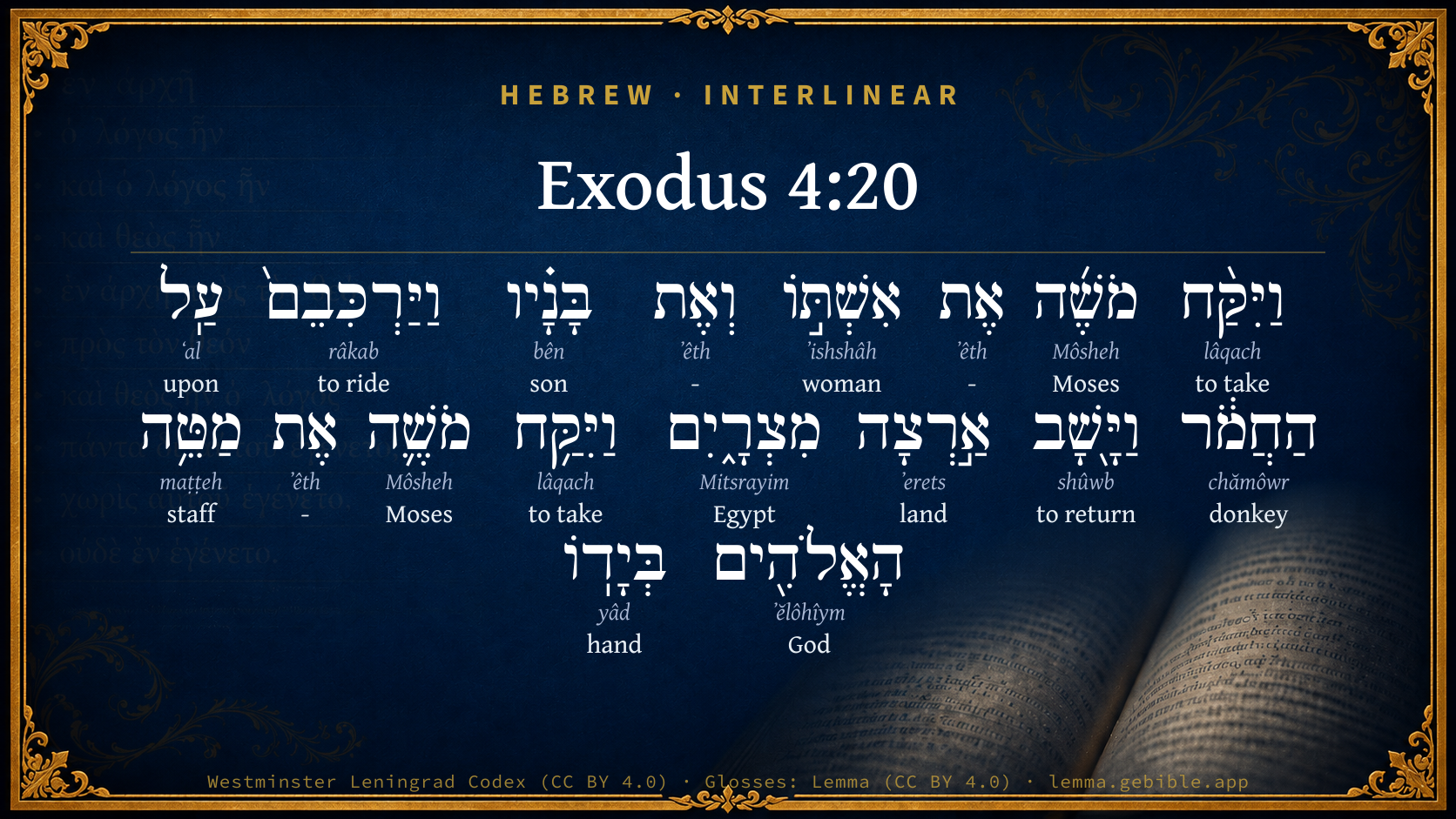
  1. וַיִּקַּ֨ח lâqach H3947 “and · to take” Conjunction + Verb, Qal, Sequential Imperfect, 3rd Person, Masculine, Singular
  2. מֹשֶׁ֜ה Môsheh H4872 “Moses” Noun, Proper
  3. אֶת ʼêth H853 “-” Particle, Direct Object
  4. אִשְׁתּ֣וֹ ʼishshâh H802 “woman · his” Noun, Common, Feminine, Singular, Construct + Suffix, Personal, 3rd Person, Masculine, Singular
  5. וְאֶת ʼêth H853 “and · -” Conjunction + Particle, Direct Object
  6. בָּנָ֗יו bên H1121 “sons · his” Noun, Common, Masculine, Plural, Construct + Suffix, Personal, 3rd Person, Masculine, Singular
  7. עַֽל ʻal H5921 “upon” Preposition
  8. הַחֲמֹ֔ר chămôwr H2543 “the · donkey” Particle, Definite Article + Noun, Common, Both, Singular, Absolute
  9. וַיָּ֖שָׁב shûwb H7725 “and · to return” Conjunction + Verb, Qal, Sequential Imperfect, 3rd Person, Masculine, Singular
  10. אַ֣רְצָה ʼerets H776 “land · toward” Noun, Common, Both, Singular, Construct + Suffix, Demonstrative
  11. מִצְרָ֑יִם Mitsrayim H4714 “Egypt” Noun, Proper
  12. וַיִּקַּ֥ח lâqach H3947 “and · to take” Conjunction + Verb, Qal, Sequential Imperfect, 3rd Person, Masculine, Singular
  13. מֹשֶׁ֛ה Môsheh H4872 “Moses” Noun, Proper
  14. אֶת ʼêth H853 “-” Particle, Direct Object
  15. מַטֵּ֥ה maṭṭeh H4294 “staff of” Noun, Common, Masculine, Singular, Construct
  16. הָאֱלֹהִ֖ים ʼĕlôhîym H430 “the · God(s)” Particle, Definite Article + Noun, Common, Masculine, Plural, Absolute
  17. בְּיָדֽוֹ yâd H3027 “in/at · hand · his” Preposition + Noun, Common, Both, Singular, Construct + Suffix, Personal, 3rd Person, Masculine, Singular

About this verse

These counts appear in no published source. They are computed here, from the morphology-tagged text and Lemma’s own curated glosses. What Lemma adds →

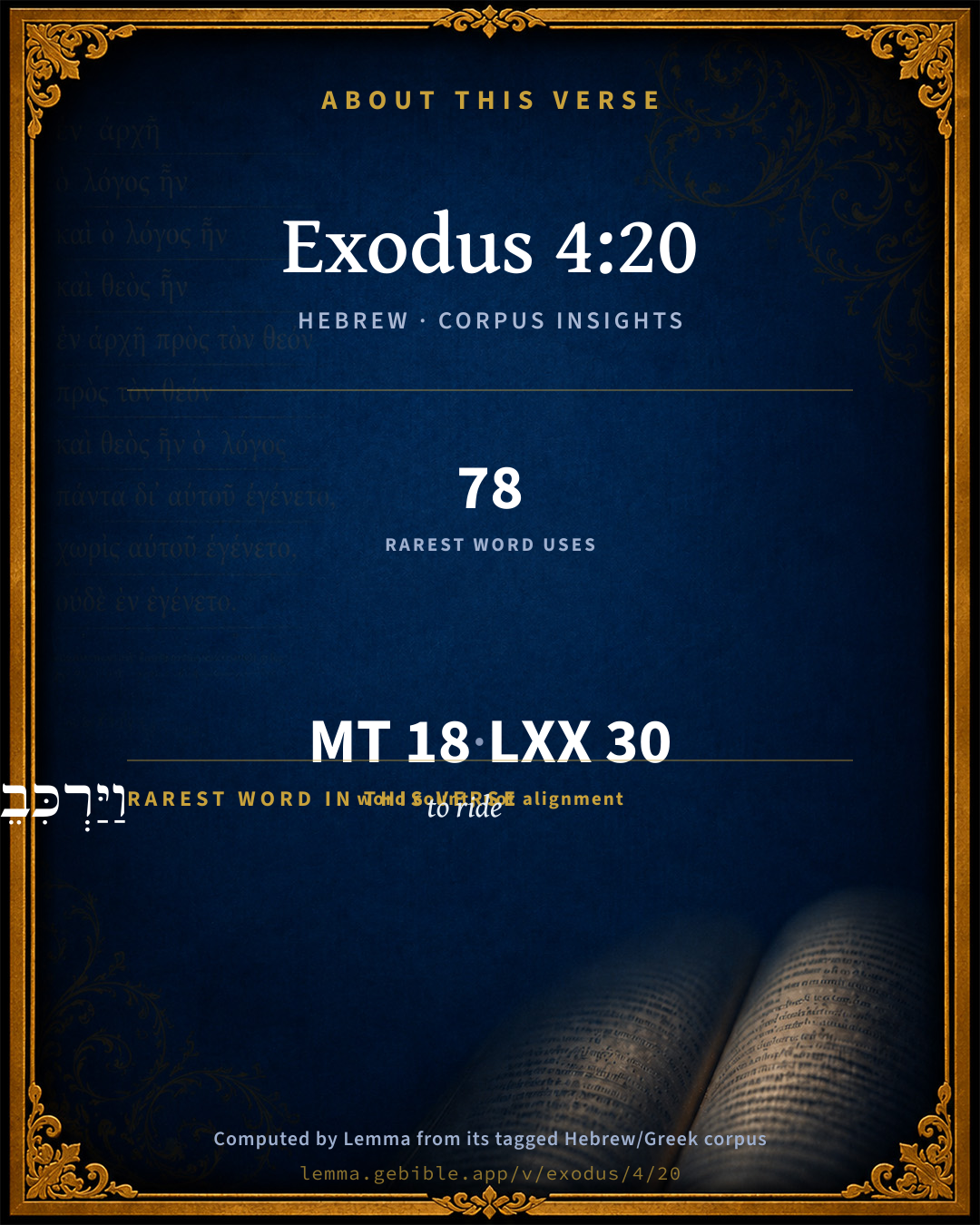
18
words
14
distinct lemmas
Pentateuch
section

Grammatical profile

  • 4 verbs
  • 10 nouns
  • 1 preposition
  • 3 particles

Verb forms

  • וַיִּקַּ֨ח Qal · Sequential Imperfect
  • וַיַּרְכִּבֵם֙ Hiphil · Sequential Imperfect
  • וַיָּ֖שָׁב Qal · Sequential Imperfect
  • וַיִּקַּ֥ח Qal · Sequential Imperfect

Repetition

Words recur within this verse — often emphatic in Hebrew:

  • וַיִּקַּ֨ח to take H3947 ×2
  • מֹשֶׁ֜ה Moses H4872 ×2

Hebrew & Septuagint length

In English translation the verse runs 28 words from the Hebrew and 31 from the Septuagint (LXX English) — closely comparable.

A rough comparison of the two English renderings, which tokenize alike — not a word-level alignment.

Word counts can differ between the Hebrew and the Greek without any difference in meaning — e.g. the Hebrew direct-object marker אֵת has no separate Greek word, and Greek often adds the article ὁ.

In the original languages it is 18 Hebrew tokens and 30 Greek tokens — but the two are counted differently (Hebrew bundles its prefixes and suffixes into one token; the Greek is in lemma form), so that isn’t a like-for-like length.

Cross-references

6

Topical passages linked to Exodus 4:20 in the Treasury of Scripture Knowledge — connected by theme and wording, ordered by reader-vote popularity; previews shown in the World English Bible.

  • Exodus 17:9 Moses said to Joshua, "Choose men for us, and go out, fight with Amalek. Tomorrow I will stand on the top of the hill with God's rod in my hand."
  • Numbers 20:8–9 Take the rod, and assemble the congregation, you, and Aaron your brother, and speak you to the rock before their eyes, that it give forth its water; and you shall bring forth to them water out of the rock; so you shall give the congregation and their cattle drink.
  • Exodus 4:2 Yahweh said to him, "What is that in your hand?" He said, "A rod."
  • Exodus 18:3–4 and her two sons. The name of one son was Gershom, for Moses said, "I have lived as a foreigner in a foreign land".
  • Numbers 20:11 Moses lifted up his hand, and struck the rock with his rod twice: and water came forth abundantly, and the congregation drank, and their cattle.
  • Exodus 4:17 You shall take this rod in your hand, with which you shall do the signs."

Cross-references courtesy of OpenBible.info (CC BY 4.0).

Hebrew and Greek witnesses Masoretic Hebrew ↔ Greek Septuagint

The same verse in the two great witnesses to the Old Testament, shown verse-for-verse.

These are two independent witnesses, not word-aligned to each other, and the Septuagint is shown in lemma (dictionary) form.

Hebrew Exodus 4:20 Masoretic · Westminster Leningrad Codex

וַיִּקַּ֨ח מֹשֶׁ֜ה אֶת אִשְׁתּ֣וֹ וְאֶת בָּנָ֗יו וַיַּרְכִּבֵם֙ עַֽל הַחֲמֹ֔ר וַיָּ֖שָׁב אַ֣רְצָה מִצְרָ֑יִם וַיִּקַּ֥ח מֹשֶׁ֛ה אֶת מַטֵּ֥ה הָאֱלֹהִ֖ים בְּיָדֽוֹ

Moses took his wife and his sons, and set them on a donkey, and he returned to the land of Egypt. Moses took God's rod in his hand.

World English Bible · Public Domain

Greek LXX Exodus 4:20 Septuagint · lemma form

ἀναλαμβάνω δέ μωυσῆς ὁ γυνή καί ὁ παιδίον ἀναβιβάζω αὐτός ἐπί ὁ ὑποζύγιον καί ἐπιστρέφω εἰς αἴγυπτος λαμβάνω δέ μωυσῆς ὁ ῥάβδος ὁ παρά ὁ θεός ἐν ὁ χείρ αὐτός

And Moses took his wife and his children, and mounted them on the beasts, and returned to Egypt; and Moses took the rod which he had from God in his hand.

LXX2012 (modern English Septuagint) · Public Domain

On this verse, Jamieson, Fausset & Brown discusses the Septuagint’s reading. Read the note in Commentary ↓

Hebrew: Westminster Leningrad Codex (CC BY 4.0). Greek: Septuagint (public domain); English from LXX2012 (modern English Septuagint) (Public Domain). How the Septuagint differs from the Hebrew →

Targum (Aramaic paraphrase)

2

The Targum is the ancient Jewish Aramaic paraphrase of the Hebrew Scriptures — an interpretive translation, not the Hebrew text itself. Onkelos (literal) and Pseudo-Jonathan (expansive) render the Torah, and Jonathan the Prophets. Coverage is partial: where no permissively-licensed English translation exists for a verse, only the Aramaic is shown. This is verse-level text, not a word-by-word alignment to the Hebrew.

  1. Targum Onkelos Torah (Genesis–Deuteronomy)
    וּדְבַר משֶׁה יָת אִתְּתֵהּ וְיָת בְּנוֹהִי וְאַרְכְּבִנוּן עַל חֲמָרָא וְתָב לְאַרְעָא דְמִצְרָיִם וּנְסִיב משֶׁה יָת חוּטְרָא דְאִתְעֲבִידוּ בֵּהּ נִסִין מִן קֳדָם יְיָ בִּידֵהּ:

    (no public-domain English translation for this verse)

    Targum Onkelos — Aramaic: “Onkelos Genesis” (public domain); “Onkelos Exodus” (public domain); “Onkelos Leviticus” (public domain); “Onkelos Numbers” (public domain); “Onkelos Deuteronomy” (public domain). English: “Sefaria Community Translation” (CC0 1.0 (public-domain dedication)); “J.W. Etheridge. The Targums of Onkelos and Jonathan Ben Uzziel on the Pentateuch. London: Longmans, Green, 1862” (public domain). Text via Sefaria.

  2. Targum Pseudo-Jonathan Torah (Genesis–Deuteronomy)
    וּדְבַר משֶׁה יַת אִינְתְּתֵיהּ וְיַת בְּנוֹי וְאַרְכְּבִינוּן עַל חַמְרָא וְתַב לְאַרְעָא דְמִצְרַיִם וּנְסֵיב משֶׁה יַת חוּטְרָא דְנָסַב מִן גִנוּנִיתָא דְחָמוֹי וְהוּא מִסַפִּיר כּוּרְסֵי יְקָרָא מַתְקְלֵיהּ אַרְבְּעִין סְאִין וְעִילוֹ חָקוּק וּמְפָרֵשׁ שְׁמָא רַבָּא וְיַקִירָא וּבֵיהּ אִתְעֲבִידוּ נִיסִין מִן קֳדָם יְיָ בִּידֵיהּ

    And Mosheh took his wife and his sons, and made them ride on the ass, and returned to the land of Mizraim. And Mosheh took the rod which he had brought away from the chamber of his father-in-law; and it was from the sapphire Throne of glory, in weight forty sein; and upon it was engraven and set forth the Great and Glorious Name by which the signs should be wrought before the Lord by his hand.

    Targum Pseudo-Jonathan — Aramaic: “Targum Jonathan on Genesis” (public domain); “Targum Jonathan on Exodus” (public domain); “Targum Jonathan on Leviticus” (public domain); “Targum Jonathan on Numbers” (public domain); “Targum Jonathan on Deuteronomy” (public domain). English: “The Targum of Jonathan ben Uzziel, trans. J. W. Etheridge, London, 1862” (public domain). Text via Sefaria.

Commentary

Notes on Exodus 4:20 from classic Christian and Jewish commentators (each source and its license shown beneath its notes). The classic Christian expositions comment on the surrounding passage and are grouped to its opening verse, so a note may address several verses; the Jewish commentaries on the Tanakh (Rashi and others) are per-verse, so they appear only where the commentator wrote on this verse.

Lemma curates 59 commentaries, every one of them public domain or Creative Commons licensed, each selected and text-cleaned for this edition rather than reprinted as found. About our sources →

Trapp's Complete Commentary

John Trapp

Exo 4:20 And Moses took his wife and his sons, and set them upon an ass, and he returned to the land of Egypt: and Moses took the rod of God in his hand.

Ver. 20. Upon an ass.] This may argue his poverty, as Zec 9:9. Especially if he had but one ass for the whole family.

John Trapp, A Commentary or Exposition upon All the Books of the Old and New Testament (1647–1656) — public domain. Text from a community e-Sword module.

The Biblical Illustrator

Joseph S. Exell

Exo_4:20

Returned to the land of Egypt.

The journey to Egypt

I. That a good man journeying on the service of God should take his family with him. Never go on any good errand without your family; teach the youthful feet to walk in obedience to God.

II. That a good man journeying on the service of God should take his rod with him. Never go on a journey of moral service without God. Especially if you are a minister of the gospel, take the rod on your journey to Egypt.

1. It will keep you humble. It will remind you of your humble occupation in the desert, when you are tempted to pride, in the great service to which God has called you. Every Christian worker needs to have something within his soul to inspire humility.

2. It will make you happy. When you are desponding and sad, when the work does not open up to your effort as you would wish, the rod will remind you of the vision at the bush, and of the miracles wrought at the commencement of the mission. The reason why there are so many unhappy workers in the Church, is because they have left the rod at home.

3. It will make you powerful. With this rod Moses was to work miracles. So if Christian workers had the rod of God in their hand, they would be able to show to the world much more effectively than they do, the holy tokens of their mission. (J. S. Exell, M. A.)

The Biblical Illustrator, edited by Joseph S. Exell (c. 1880s–1900s) — public domain. Text from a community e-Sword module.

The Preacher's Complete Homiletical Commentary

Joseph S. Exell (gen. ed.)

MAIN HOMILETICS OF THE PARAGRAPH.—Exo_4:20

THE JOURNEY TO EGYPT

I. That a good man journeying on the service of God should take his family with him. “And Moses took his wife and sons,” &c. When a man is going on the errands of God he should always take his family with him, that they may participate in his work, its responsibility, its sorrow, and its victory. Never go on any good errand without your family; it is well to teach the youthful feet to walk in obedience to God. Many a young man has learned the art, and gathered the spirit and desire for Christian service, by being taken to it by a godly parent. Are you journeying to heaven? Take your family with you.

II. That a good man journeying on the service of God should take his rod with him. Never go on a journey of moral service without God. Especially if you are a minister of the Gospel, take the rod on your journey to Egypt.

1. It will keep you humble. It will remind you of your humble occupation in the desert, when you are tempted to pride, in the great service to which God has called you. Every Christian worker needs to have something within his soul to inspire humility.

2. It will make you happy. When you are desponding and sad, when the work does not open up to your effort as you would wish, the rod will remind you of the vision at the bush, and of the miracles wrought at the commencement of the mission. The reason why there are so many unhappy workers in the Church is because they have left the rod at home.

3. It will make you powerful. With this rod Moses was to work miracles. So if Christian workers had the rod of God in their hand, they would be able to show to the world much more effectively than they do, the holy tokens of their mission. To all the emancipators of the souls of men we would say, Never journey to Egypt without your rod. God has given it to you. He has consecrated it by His promise. He has made it the symbol of his power. You cannot afford to travel without it. No other rod can supply its place.

The Preacher's Complete Homiletical Commentary (gen. ed. Joseph S. Exell; Funk & Wagnalls, c. 1892) — public domain (pre-1929). A full-Bible homiletical/sermon-outline anthology covering 65 of 66 books (2 John is absent from the source module). Text from a community e-Sword module.

Tyndale Open Study Notes

Tyndale Open Resources

4:20 he carried the staff of God: Whatever he may have said to Jethro, Moses was going to Egypt in obedience to God and in the expectation of being used by God (see 4:17).

Tyndale Open Study Notes — © Tyndale Open Resources, licensed CC BY-SA 4.0. Text via the HelloAO Bible API.

Geneva Bible (1599)

Geneva Bible translators

Hebrew, caused them to ride.

Whereby he wrought the miracles.

Geneva Bible (1599) marginal notes — public domain. Text via Bolls.life.

Jamieson, Fausset & Brown

Robert Jamieson, A. R. Fausset & David Brown

Moses took his wife and his sons, and set them upon an ass--Septuagint, "asses." Those animals are not now used in the desert of Sinai except by the Arabs for short distances.

returned--entered on his journey towards Egypt.

he took the rod of God--so called from its being appropriated to His service, and because whatever miracles it might be employed in performing would be wrought not by its inherent properties, but by a divine power following on its use. (Compare Act 3:12).

Jamieson, Fausset & Brown — Commentary Critical and Explanatory on the Whole Bible (1871) — public domain (CC PDM 1.0). Text via the HelloAO Bible API.

Adam Clarke's Commentary

Verse 20. His wife and his sons] Both Gershom and Eliezer, though the birth of the latter has not yet been mentioned in the Hebrew text. See Clarke on Ex 2:22.

Set them upon an ass] The Septuagint reads the word in the plural, εκι τα ὑποζυγια, upon asses, as it certainly required more than one to carry Zipporah, Gershom, and Eliezer.

The rod of God] The sign of sovereign power, by which he was to perform all his miracles; once the badge of his shepherd's office, and now that by which he is to feed, rule, and protect his people Israel.

Adam Clarke's Commentary on the Bible (1810–1826) — public domain. Text from a community e-Sword/MySword module.

Ellicott's Commentary for English Readers

(20) His sons.—Only one had been mentioned previously, viz., Gershom (Exo_2:22), unless we accept the Vulgate addition to that place. But another had been recently born to him.

Set them upon an ass.—Heb., upon the ass, i.e., cither “upon his ass,” or, according to some, “upon asses.” The singular of a substantive with the article is sometimes used for the genus (Gen_15:11).

He returned.—Rather, set out to return (ἐπέστρεψεν, LXX.).

The rod of God.—An emphatic phrase. God’s endowment of the rod with miraculous power had made it “the rod of God.” It was the instrument by means of which most of the plagues and the other miracles were wrought (Exo_7:20; Exo_8:6; Exo_8:17; Exo_9:23; Exo_10:13; Exo_14:16; Exo_17:5; Num_20:9; &c).

A Bible Commentary for English Readers, edited by Charles John Ellicott (1878–1897) — public domain. Text from a community e-Sword module.

The Cambridge Bible for Schools and Colleges

gen. ed. J. J. S. Perowne

20a (J). his wife, &c.] according to E Moses went alone into Egypt, and was only joined by his wife and sons afterwards (Exo_18:5).

his sons] The birth of only one son has been hitherto mentioned (Exo_2:22); and Exo_4:25 suggests strongly that only one son was with Moses at the time: Di. and others are therefore probably right in thinking that we should read his son, the plural being an alteration due to an editor or scribe who thought that account should be taken of Exo_18:2-4.

20b (E). the rod of God] So Exo_17:9, cf. on Exo_4:17.

The Cambridge Bible for Schools and Colleges (gen. ed. J. J. S. Perowne; Cambridge University Press, 1878–1918) — public domain. Text from a community e-Sword module.

John Gill's Exposition

And Moses took his wife, and his sons,.... Gershom and Eliezer; by which it appears that he intended to stay in Egypt, and that he believed that God would work deliverance by him:

and set them upon an ass: which though with us a mean creature, yet in those times and countries were rode upon by great personages; and these, as Aben Ezra says, were reckoned in Egypt more honourable than mules. It may be the singular is put for the plural, and that each of them was set upon an ass, with servants to take care of them:

and he returned to the land of Egypt; that is, he set forward to go thither; for before he got thither, various things are related which befell him:

and Moses took the rod of God in his hand: his shepherd's staff, so called, because God ordered him to take it; and besides, he had wrought signs and wonders by it already, and would do many more.

John Gill's Exposition of the Whole Bible (1746–1763) — public domain (CC PDM 1.0). Text via the HelloAO Bible API.

Albert Barnes' Notes on the Bible

An ass - Literally, “the ass,” which, according to Hebrew idiom, means that he set them upon asses. This is the first notice of other sons besides Gershom.

The rod of God - The staff of Moses was consecrated by the miracle Exo 4:2 and became “the rod of God.”

Albert Barnes' Notes on the Bible (1834–1885) — public domain. Text from a community e-Sword/MySword module.

Matthew Poole's English Annotations

His sons, Gershom, Exo 2:22, and Eliezer, Exo 18:4, whom he intended to carry with him; but afterwards observing that they were like to be impediments to him in his great business, and being well assured that it would not be long ere he returned to them, he sent them back to Jethro, as may seem from Exo 18:5.

Upon an ass: one ass might be sufficient for her and her two children, because one of them was but little, Exo 4:25. Or ass may be put for asses, which changes of the numbers is very frequent in Scripture.

The rod of God; his shepherd’s rod so called, partly because it was appropriated to God’s special service, to be the instrument in all his glorious works; and partly to show that whatsoever was done by that rod, was not done by any virtue in the rod, or in Moses’s hand, but merely by the power of God, who was pleased for the greater confusion of his enemies to use so mean an instrument.

Matthew Poole's English Annotations on the Holy Bible (1683–1685) — public domain. Text from a community e-Sword/MySword module.

Whedon's Commentary on the Bible

Daniel D. Whedon

20. And Moses took his wife — Zipporah. And his (two) sons — Gershom and Eliezer.

Set thereupon an ass — Rather, made them ride upon the ass. Probably only Zipporah and the child Eliezer rode, while Moses and Gershom walked by the side of the ass. This was an humble, an unostentatious, entry of the commander of the hosts of Israel!

Daniel D. Whedon (gen. ed.), Commentary on the Old and New Testaments (1874–1909) — public domain. Text from a community e-Sword module.

The Pulpit Commentary

His sons. Gershom, already mentioned, (Exo_2:22) and Eliezer, (Exo_18:4) who was probably an infant. Set them upon an ass. Literally, "the ass," i.e. the one ass that belonged to him. The word might best be translated his ass." When Moses is said to have "set them upon" the animal, we need not understand "all of them." Probably Zipporah and her baby rode, while Gershom walked with his father. Though horses were known in Egypt before this, they could not be used in the Sinaitic peninsula, and the employment of an ass by Moses is thoroughly appropriate. Returned. Ie. "set out to return." Took the rod of God in his hand. This is of course the "rod" of ver. 2, which had become "the rod of God" by the miracle of vers. 3 and 4, and which God had commanded him to take to Egypt (ver. 17).

The Pulpit Commentary (1880–1919), ed. H.D.M. Spence-Jones & Joseph S. Exell — public domain. Text from a community e-Sword module.

John Wesley's Explanatory Notes

The rod of God - His shepherd's crook so called, as it was God's instrument in so many glorious works.

John Wesley, Explanatory Notes Upon the Whole Bible (1754–1765) — public domain. Text via the GEBible commentary corpus.

Rashi

Rabbi Shlomo Yitzchaki (Rashi)

על החמור UPON “THE” ASS — the ass designated for this purpose: this was the ass which Abraham had saddled for the purpose of travelling to bind Isaac on Mount Moriah, and this, too, is the ass upon which King Messiah will once show himself in public, as it is said, (Zechariah 9:9) “[Behold, thy king cometh unto thee, …] lowly and riding upon an ass” (Pirkei DeRabbi Eliezer 31).

וישב ארצה מצרים ויקח משה את מטה AND HE RETURNED TO THE LAND OF EGYPT: AND MOSES TOOK THE STAFF [OF GOD] — “Earlier and later” are not strictly observed in the Scriptures (i. e. incidents are not necessarily related in the exact order in which they occur. Here it should state: He took the staff etc. and returned to Egypt; cf. v. 17).

Rashi on the Tanakh — English translations: “The Judaica Press complete Tanach with Rashi, translated by A. J. Rosenberg” (CC BY 4.0); “Pentateuch with Rashi's commentary by M. Rosenbaum and A.M. Silbermann, 1929-1934” (public domain); “The Metsudah Tanach series, Lakewood, N.J” (CC BY 4.0); and “The Book of Joshua, Metsudah Publications, 1997” (CC BY 4.0). Text via Sefaria.

Ramban (Nachmanides)

Rabbi Moshe ben Nachman (Ramban / Nachmanides)

AND MOSES TOOK HIS WIFE AND HIS SONS. The intent thereof is like that of the verse, And the sons of Pallu: Eliab. At that time, he had only Gershom, as Scripture mentions, and his wife became pregnant with Eliezer on the way [to Egypt] or in Egypt, if she went there. It is possible that before the Divine communication came to him on the mountain of G-d, only Gershom had been born. Zipporah however was already pregnant [with Eliezer], and when he returned to Jether his father-in-law, she gave birth, but because the King’s business required haste, he did not circumcise him, nor did he give him a name. On the way when his mother circumcised him, she did not give him a name, as Moses was met at that time by the angel. It was after he came to Egypt and saw that he was saved from all those who sought his life that he then called him Eliezer, for the G-d of my father was my help, and delivered me from the sword of Pharaoh. Our Rabbis have also stated that the child that was circumcised [by Zipporah, as mentioned here in Verse 25], was Eliezer.

AND HE RETURNED TO THE LAND OF EGYPT. I.e., with those mentioned [at the beginning of the verse, namely, his wife and his sons]. Rabbi Abraham ibn Ezra said that the expression, and he returned to the land of Egypt, means that Moses alone returned. When he was met by G-d,. See above, Note 298. Eliezer was circumcised, and when he was healed, Zipporah together with her children returned to her father.This [explanation of Ibn Ezra] is possible, for due to the fact that Eliezer was circumcised, Moses could not take him on the road until the child would become strong. At the same time, he did not want to delay the mission of the Holy One, blessed be He, and therefore he left them in the lodging-place and commanded Zipporah to return to her father’s home when the child will become healed. This is the purport of the expression, after he had sent her away. It is also probable that they all went to Egypt, and after they stayed there for some time, she longed for her father and so Moses sent her with the children. This then would be the sense of the word shilucheha (after ‘he had sent her away’), since Jethro feared that perhaps it was Moses’ intent to divorce her.And in V’eileh Shemoth Rabbah, [the Rabbis have said]: “And Moses went and returned to Jether his father-in-law. Where did he go? He went to take his wife and sons. Jethro said to him, ‘Where do you take them?’ Moses replied, ‘To Egypt.’ Jethro said to him, ‘Now that those who are in Egypt wish to leave it, do you desire to lead them there?’ Moses replied, ‘Very soon [those held in bondage] are destined to go forth from there and stand at Mount Sinai and hear the words of the Almighty, I am the Eternal thy G-d Who brought thee out of the land of Egypt. Should my children not hear it together with them?’ Jethro said to Moses, ‘Go in peace.’” In accordance with the opinion of the Rabbis [in the above Midrash], it is proper that we explain that after Moses and Jethro agreed on Moses’ returning to Egypt, the Holy One, blessed be He, commanded him thereon, thus confirming the word of His servant, and he returned to Egypt with his sons and his wife, as I have explained.

Ramban (Nachmanides) on the Tanakh — English translation: “Commentary on the Torah by Ramban (Nachmanides). Translated and annotated by Charles B. Chavel. New York, Shilo Pub. House, 1971-1976” (CC BY 4.0). Text via Sefaria.

Lesson kit

Teaching starters — assembled from the data on this page, not authored interpretation. Every prompt links to the verse data it draws on. Edit before teaching.

Exodus, in the Pentateuch, opens this verse with 18 words (14 distinct Hebrew lemmas). Its most distinctive word is râkab (“to ride”). A historical commentator’s framing appears above. Read the whole chapter for the surrounding context.

Discussion questions

  1. The word râkab carries the sense “to ride.” How does it shape the verse?
  2. Exodus 17:9 shares this passage’s theme. How do the two illuminate each other?
  3. “to take” occurs 2× in this one verse. What is the effect of the repetition?
  4. These translations render this verse differently; the difference is in the English rendering, not the original. What questions does that raise?
  5. The verb «וַיִּקַּ֨ח» is Qal Sequential Imperfect. How does its form color the action?
  6. Reading how Trapp's Complete Commentary and The Biblical Illustrator read this verse, where do the two commentators agree and where do they part?

Things to notice

Reading settings

Reading text

Shown beneath each verse's original-language words.

Old Testament
Old Testament edition

Read the OT as the Masoretic Hebrew (MT) or the Greek Septuagint (LXX).

English shown for the Greek Septuagint (in the Hebrew ↔ Greek comparison).

Comparing translations? Open the Compare panel on any verse page to stack up to four side by side.