
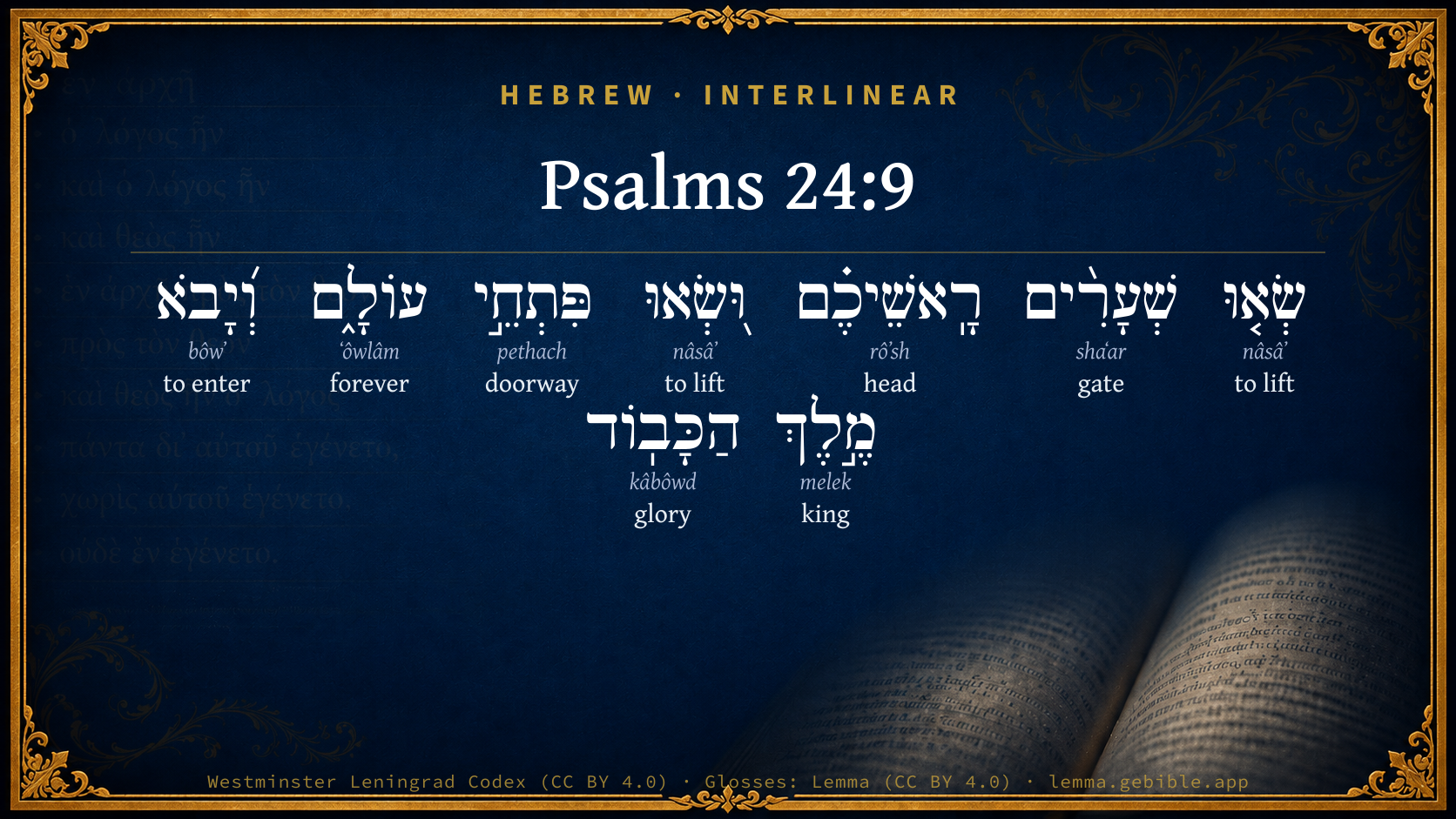
Psalms 24:9

Hebrew (Westminster Leningrad Codex) Psalms 24:9 appears in the Hebrew Old Testament. The text above is from the Westminster Leningrad Codex. Each word links to its Strong’s number, a concise gloss, and parsing drawn from the Open Scriptures Hebrew Bible morphology. Click any word for its full Brown-Driver-Briggs (BDB) entry.
Download image
Cite this verse

Psalms 24:9 (World English Bible). Public Domain. Lemma interlinear Bible study tool, https://lemma.gebible.app/v/psalms/24/9.

Show BibTeX & RIS
BibTeX
RIS
English Translation
Lift up your heads, you gates; Yes, lift them up, you everlasting doors: The King of glory will come in.
World English Bible · Public Domain
Download a study sheet

One document with this verse’s original text, its word-by-word gloss line, the meaning frame, cross-references with their text, attributed commentary, and full source and license credits — printable, and it pastes into notes with its structure intact.

This verse Autodidact and up

Study sheet (.html) Plain text (.txt)

A passage Seminary Student

Up to 50 verses in one chapter. A passage sheet keeps up to 6 commentary sources and 12 cross-references per verse, in the order this page ranks them, and says so on the sheet whenever that leaves anything out. Ask for a single verse and you get the Autodidact verse sheet above.

Everything on this page stays free to read, with no account — the sheet is a download of what is already on screen, not access to it.

Want to remove ads? Support Godless Engineer
Compare translations 3

The same verse in 3 English versions, stacked beneath the original-language interlinear above. Click any original word for its lexicon entry.

Each is an independent rendering of the whole verse — the interlinear is not word-aligned to these translations.

Highlighted words mark where these versions differ — a whole-verse word diff, not a word-by-word alignment.

  • World English Bible Public Domain
    Lift up your heads, you gates; Yes, lift them up, you everlasting doors: The King of glory will come in.
  • King James Version Public Domain
    Lift up your heads, O ye gates; even lift them up, ye everlasting doors; and the King of glory shall come in.
  • unfoldingWord Literal Text CC BY-SA 4.0
    Lift up your heads, gates, and lift up, ancient doors, so that the King of Glory may come in.

unfoldingWord Literal Text — © unfoldingWord, licensed CC BY-SA 4.0. Word-aligned USFM3 via Door43 (git.door43.org/unfoldingWord/en_ult).

Versions to compare (up to 4)

3 of 4 selected

Show all 18 translations

Every available English version of this verse, each an independent rendering of the whole verse.

  • World English Bible Public Domain
    Lift up your heads, you gates; Yes, lift them up, you everlasting doors: The King of glory will come in.
  • Berean Standard Bible Public Domain
    Lift up your heads, O gates! Be lifted up, O ancient doors, that the King of Glory may enter!
  • Majority Standard Bible Public Domain
    Lift up your heads, O gates! Be lifted up, O ancient doors, that the King of Glory may enter!
  • King James Version Public Domain
    Lift up your heads, O ye gates; even lift them up, ye everlasting doors; and the King of glory shall come in.
  • American Standard Version (1901) Public Domain
    Lift up your heads, O ye gates; Yea, lift them up, ye everlasting doors: And the King of glory will come in.
  • Revised Version (1885) Public Domain
    Lift up your heads, O ye gates; yea, lift them up, ye everlasting doors: and the King of glory shall come in.
  • Geneva Bible (1599) Public Domain
    Lift vp your heads, ye gates, and lift vp your selues, ye euerlasting doores, and the King of glorie shall come in.
  • Douay-Rheims (1899) Public Domain
    Lift up your gates, O ye princes, and be ye lifted up, O eternal gates: and the King of Glory shall enter in.
  • Young's Literal Translation Public Domain
    Lift up, O gates, your heads, And be lifted up, O doors age-during, And come in doth the king of glory!
  • Literal Standard Version CC BY-SA 4.0
    Lift up your heads, O gates! And be lifted up, O perpetual doors! And the King of Glory comes in!
  • Unlocked Literal Bible CC BY-SA 4.0
    Lift up your heads, you gates; be lifted up, everlasting doors, so that the King of glory may come in!
  • unfoldingWord Literal Text CC BY-SA 4.0
    Lift up your heads, gates, and lift up, ancient doors, so that the King of Glory may come in.
  • Darby Bible Public Domain
    Lift up your heads, ye gates; yea, lift up, ye everlasting doors, and the King of glory shall come in.
  • World Messianic Bible Public Domain
    Lift up your heads, you gates; yes, lift them up, you everlasting doors, and the King of glory will come in.
  • Webster's Bible Public Domain
    Lift up your heads, O ye gates; even lift them up, ye everlasting doors; and the King of glory shall come in.
  • Free Bible Version CC BY-SA 4.0
    Open up, you gates! Swing wide, you ancient doors! Let the King of glory come in!
  • Bible in Basic English Public Domain
    Let your heads be lifted up, O doors; let them be lifted up, O you eternal doors: that the King of glory may come in.
  • JPS Tanakh (1917) Public Domain
    Lift up your heads, O ye gates, yea, lift them up, ye everlasting doors; that the King of glory may come in.

Literal Standard Version (2020), Covenant Press — licensed CC BY-SA 4.0. Text via the HelloAO Bible API (eBible.org). Unlocked Literal Bible (unfoldingWord) — licensed CC BY-SA 4.0. Text via the HelloAO Bible API (eBible.org). unfoldingWord Literal Text — © unfoldingWord, licensed CC BY-SA 4.0. Word-aligned USFM3 via Door43 (git.door43.org/unfoldingWord/en_ult). Free Bible Version, Dr. Jonathan Gallagher — licensed CC BY-SA 4.0. Text via the HelloAO Bible API (eBible.org).

Word by word

More ways to search: Search by grammar → Find every occurrence → Compare this word →

Practice this passage: Drill this verse → Learn its vocabulary →

About this verse

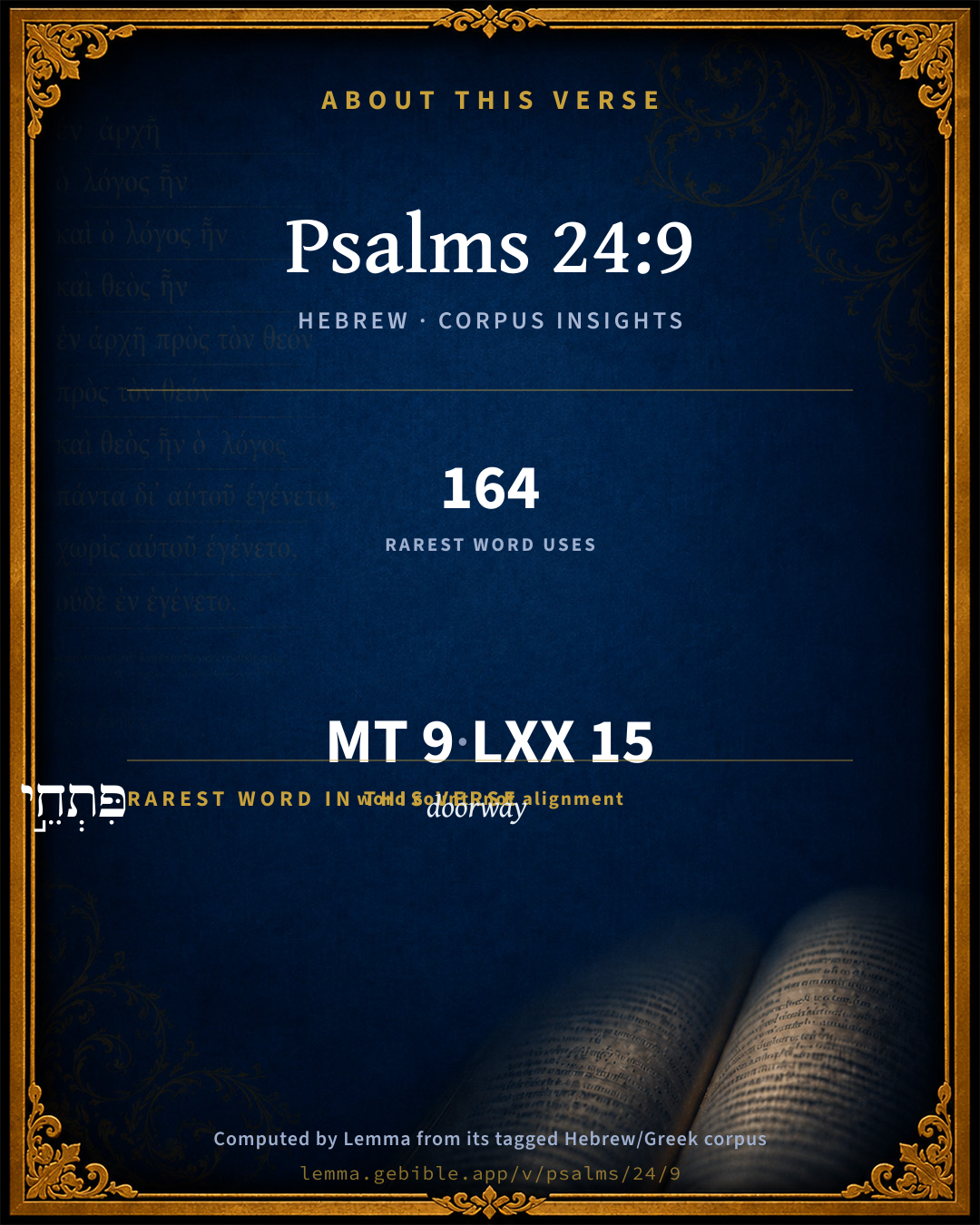
These counts appear in no published source. They are computed here, from the morphology-tagged text and Lemma’s own curated glosses. What Lemma adds →

9
words
8
distinct lemmas
Wisdom
section

Grammatical profile

  • 3 verbs
  • 6 nouns

Verb forms

  • שְׂא֤וּ Qal · Imperative
  • וּ֭שְׂאוּ Qal · Imperative
  • וְ֝יָבֹא Qal · Imperfect

Repetition

A word recurs within this verse — often emphatic in Hebrew:

  • שְׂא֤וּ to lift H5375 ×2

Hebrew & Septuagint length

In English translation the verse runs 20 words from the Hebrew and 22 from the Septuagint (LXX English) — closely comparable.

A rough comparison of the two English renderings, which tokenize alike — not a word-level alignment.

Word counts can differ between the Hebrew and the Greek without any difference in meaning — e.g. the Hebrew direct-object marker אֵת has no separate Greek word, and Greek often adds the article ὁ.

In the original languages it is 9 Hebrew tokens and 15 Greek tokens — but the two are counted differently (Hebrew bundles its prefixes and suffixes into one token; the Greek is in lemma form), so that isn’t a like-for-like length.

Hebrew and Greek witnesses Masoretic Hebrew ↔ Greek Septuagint

The same verse in the two great witnesses to the Old Testament, shown verse-for-verse.

You’re reading Greek Psalm 23 (Hebrew Psalm 24). The Septuagint counts the superscription, so verse numbers can differ from the Hebrew — chapter-level alignment, not verse-by-verse. Numbering follows Rahlfs.

These are two independent witnesses, not word-aligned to each other, and the Septuagint is shown in lemma (dictionary) form.

Hebrew Psalms 24:9 Masoretic · Westminster Leningrad Codex

שְׂא֤וּ שְׁעָרִ֨ים רָֽאשֵׁיכֶ֗ם וּ֭שְׂאוּ פִּתְחֵ֣י עוֹלָ֑ם וְ֝יָבֹא מֶ֣לֶךְ הַכָּבֽוֹד

Lift up your heads, you gates; Yes, lift them up, you everlasting doors: The King of glory will come in.

World English Bible · Public Domain

Greek LXX Greek Psalm 23:9 Septuagint · lemma form

αἴρω πύλη ὁ ἄρχων σύ καί ἐπιαἴρω πύλη αἰώνιος καί εἰςἔρχομαι ὁ βασιλεύς ὁ δόξα

Lift up your gates, you⌃ princes; and be you⌃ lift up, you⌃ everlasting doors; and the king of glory shall come in.

LXX2012 (modern English Septuagint) · Public Domain

Hebrew: Westminster Leningrad Codex (CC BY 4.0). Greek: Septuagint (public domain); English from LXX2012 (modern English Septuagint) (Public Domain). How the Septuagint differs from the Hebrew →

Commentary

Notes on Psalms 24:9 from classic Christian and Jewish commentators (each source and its license shown beneath its notes). The classic Christian expositions comment on the surrounding passage and are grouped to its opening verse, so a note may address several verses; the Jewish commentaries on the Tanakh (Rashi and others) are per-verse, so they appear only where the commentator wrote on this verse.

Lemma curates 59 commentaries, every one of them public domain or Creative Commons licensed, each selected and text-cleaned for this edition rather than reprinted as found. About our sources →

Trapp's Complete Commentary

John Trapp

Psa 24:9 Lift up your heads, O ye gates; even lift [them] up, ye everlasting doors; and the King of glory shall come in.

Ver. 9. Lift up your heads, &c.] See Psa 24:7. And learn, that in matters of moment we must be more than ordinarily earnest and importunate with ourselves and others.

John Trapp, A Commentary or Exposition upon All the Books of the Old and New Testament (1647–1656) — public domain. Text from a community e-Sword module.

The Biblical Illustrator

Joseph S. Exell

Psa_24:9

Lift up your heads, O ye gates.

A triumphal entrance

I. The great thing to desire is the entrance of the king of glory into our souls. Without it thou wilt be like a house without a tenant--cold, cheerless, dilapidated, desolate. Thy heart will be as a nest without a bird--a poor, sad thing.

II. There are impediments to this coming into our hearts. The text speaks about doors and gates, and there are such to our hearts, and they need to be lifted up ere the King of glory can come in, Sometimes it is our wicked prejudice. We do not want to know the Gospel; or our love of sin, which we do not care to give up. Then there is the door which I may call the iron gate, that entereth into the city--the door of unbelief. That unbelief is the ruin of souls.

III. If Christ is to enter we must be willing to remove all these. The text says, Lift up your heads, as if they were to lift them up themselves. Though salvation is of grace, it is never against, but always with our will.

IV. It is grace that must enable you to be thus willing. Picture the inhabitants trying to lift up the gates themselves. They cannot, and what shall they do? An invisible spirit stands by them, puts his power with theirs, and up go the gates.

V. Jesus will enter. He was willing to come in before: the unwillingness was all in us.

VI. And He is the King of glory. This title belongs to the Saviour. It proclaims Him in His highest authority. What peerless prince is this, with a name above every name? (C. H. Spurgeon.)

Christ the High Priest of our profession in heaven

The common notion seems to be that all the offices of the Mediator to us-ward took place before the ascension. Consistently with this belief that high festival is despised and neglected. The truth is, that His acts after His ascension are as distinct and important as those which took place before that event. It was not till the ascension that He offered gifts and sacrifices for men. As the efficacy of the slain victim of old depended on its blood being brought into the holiest of all, so the efficacy of that sacrifice consummated on the Cross depends and is assured to us by its continual presentation by our Mediator in heaven. The heavenly gates have been lifted up, and the King of glory has gone in. But who is this King of glory? The Eternal Son of the Father, clad with the white robe of expiation, girt with the golden zone of the priesthood, pleading the cause not only of the Church at large, but of every individual member thereof. There is not a trial we have, as we pass through this vale of tears, but He knows it and recognises it as the lot of humanity from His own actual experience. (T. Huntington, M. A.)

The triumphant ascension of Christ into heaven

Every circumstance in this description is suited to impress us with a lofty sense of the majesty of the Son of God.

1. He is described as a powerful conqueror. In what conflicts has He been engaged? We can speak of Him as having overcome the world, and as subduing the great enemy of man and bruising the serpents head.

2. The universal sovereign. Note His preeminent dignity. He is seated upon the throne of the universe.

3. He is the King of glory. This title includes in its meaning the substance of the description previously given. This is a subject in which we all are deeply concerned. For henceforth we can look to Christ as our Mediator at the right hand of God; as the Head of His Church, and the Author of all spiritual blessings; and as opening the kingdom of heaven to all believers. Lessons--

(1) The subject is suited to inspire us with a sure trust in the Captain of our Salvation.

(2) It invites us to have our thoughts and affections in heaven.

(3) It teaches us to look forward to another ascension yet in futurity, and calls us to prepare for it. (Will. Dealtry, D. D.)

The ascension of Christ

Consider the prophetic reference of these striking words. The ark was the type of Christ. We may regard the removal of the ark to Mount Zion as typifying Christs ascension to the heavenly Jerusalem.

I. The title which is here given to Him. The King of glory. When He lived among men little did He appear like a king at all. But in spite of all mockeries He was a King even then. There are multitudes who have still low thoughts of the Lord Jesus, and there are many religious systems whose tendency is to produce such a result.

II. The dignity and blessedness claimed for Him. Admission into the heavenly mansions. Who are the persons that Claim for Him this high honour? The angelic hosts. And the spirits of just men made perfect took part. See the right which He had to the honour and blessedness which were now claimed for Him. That is taken for granted. No favour is craved. Admission is not a privilege implored or supplicated. He had a right to the heavenly kingdom as the promised reward of His toils and sufferings. He had also a right on the ground of conquest. The connection between the victory which He won and the glories which awaited Him is quite obvious.

III. The reception which awaited Him. Here we can say but little, for on such a theme poor is thought, and altogether impotent the most emphatic expressions. Well may we, therefore, rejoice in the ascension of Christ. With the fact of the ascension we should combine its special objects and purposes. They relate not to Himself alone, but to us likewise. The ascension of Christ should remind us of the glorious, yet solemn and momentous, fact of His second coming. (Expository Outlines.)

An urgent demand, and an earnest inquiry

I. The demand. It may be applied to three events--

1. To the entrance of the ark into the holy city (2Sa_6:1-23; l Chronicles 15).

2. To the advent of Christ at His incarnation. The doors and gates of the worlds heart were shut against Him. He came to His own, etc.

3. To the ascension of Christ into heaven.

4. To the admission of Christ into the human heart. In the Gospel history, says an old writer, Christ had a four-fold entertainment amongst men. Some received Him into their house, but not into their heart, as Simon the Pharisee (Luk_7:44). Some into the heart, but not into the house, as the faithful centurion (Mat_8:8). Some into neither, as the faithless Gergesenes (Mat_8:34). Some into both, as Lazarus, Martha, and Mary. And Christ now seeks admission into mens hearts, but the gates are closed.

5. To the return of Christ to heaven at last. After the judgment, says Keble, He will pass again through the everlasting doors with a greater company than before; for He will lead along with Him into the heavenly habitation all those who shall have been raised from their graves and found worthy (1Th_4:14-18).

II. An earnest inquiry. Who is this King of glory? The question is twice put. None can be of greater importance. The answer tells.

1. That He is one strong in Himself. The Lord strong.

2. That He is mighty in battle. His conquests are moral, and how numerous, constant, universal, and ever-multiplying they are.

3. That He is vast in command. The Lord of hosts. All material existences, all spiritual are His hosts: the heavenly orbs are His hosts. He marshals them as a commander his battalions. (D. Thomas, D. D.)

The God who dwells with men

Notice the application, the historical and original application, to the King who dwelt with Israel. But the texts speak of the Christ who dwells with men. The devout hearts in Israel felt that there was something more needed than this dwelling of Jehovah within an earthly temple, and the process of revelation familiarised them with the thought that there was yet in the future a coming of the Lord in some special manner unknown to them. When was that fulfilled? Christ is the highest raying out of the Divine light, and the mightiest exhibition of the Divine power. Application of these words to the Christ who will dwell in your hearts. His historical manifestation here upon earth, and His incarnation, which is the true dwelling of Deity amongst men, are not enough. They have left something more than a memory to the world. He is as ready to abide, as really within our spirits, as He was to tabernacle upon earth amongst men. And the very central idea of that Gospel which is proclaimed to you all is this, that if you will open the gates of your hearts He will come in, in all the plenitude of His victorious power, and dwell in your hearts, their Conqueror and their King. What a strange contrast, and yet what a close analogy there is between the victorious tones and martial air of this summons of my text, Lift up your heads, O ye gates! that the King of glory may come in, and the gentle words of the Apocalypse, Behold. I stand at the door and knock; if any man hear My voice and open the door I will come in to him. But He that in the Old Covenant, arrayed in warrior arms, summoned the rebels to surrender, is the same as He who in the New, with the night dews in His hair and patience on His face and gentleness in the touch of His hand upon the door, waits to enter in. Open your hearts, and the King of glory shall come in. And He will come in as a King that might seek to enter sonic besieged and beleaguered city far away on the outposts of His kingdom. If the relieving force can be thrown into Khartoum, the clouds of enemies will scatter. If the King comes in, the city will be impregnable. If you open your hearts for Him He will come and keep you from all your foes, and give you the victory over them all. So to every hard-pressed heart, waging an unequal contest with toils and temptations and sorrows and sins, this great hope is given, that Christ the Victor will come in His power to garrison heart and mind. As of old the encouragement was given to Hezekiah in his hour of peril, when the might of Sennacherib insolently threatened Jerusalem, so the same stirring assurances are given to each who admits Christs succours to his heart. He shall not come into this city, for I will defend this city to save it for Mine own sake. Open your hearts and the conquering King shall come in. And do not forget that there is another possible application of these words, lying in the future, to the conquering Christ who shall come again. The whole history of the past points onwards to yet a last time when the Lord shall suddenly come to His Temple, and that Christ shall so come in like manner as He went into heaven. Again shall the summons ring out. Again shall He come arrayed in flashing brightness, and the visible robes of His imperial majesty. Again shall He appear mighty in battle, when in righteousness He shall judge and make war. For a Christian one great memory tills the past--Christ has come; and one great hope brightens the else waste future--Christ shall come. That hope has been far too much left to be cherished only by those who hold a particular opinion as to the chronology of unfulfilled prophecy. But it should be to every Christian heart the blessed hope, even the appearing of the glory of Him who has come in the past. He is with and in us in the present. He will come in the future in His glory, and shall sit upon the throne of His glory. All our pardon and hope of Gods love depends upon that great fact in the past, that the Lord was made flesh and dwelt among us, and we beheld His glory. Our purity which will fit us to dwell with God, our present blessedness, all our power for daily strife, and our companionship in daily loneliness, depend on the present fact that He dwells in our hearts by faith, the seed of all good, and the conquering antagonist of every evil. And the one light which fills the future with hope, peaceful because assured, streams from that most sure promise that He will come again, sweeping from the highest heavens, on His head the many crowns of universal monarchy, in His hand the weapons of all-conquering power, and none shall need to ask, Who is this King of glory? for every eye shall know Him, the Judge upon His throne, to be the Christ of the Cross. Open the doors of your hearts to Him, as He sues for entrance now in the meekness of His patient love, that on you may fall in that day of the coming of the King the blessing of the servants who wait for their returning Lord, that when He cometh and knocketh they may open unto Him immediately. (A. Maclaren, D. D.)

Christ demanding admission into sinners hearts

1. Entrance solemnly demanded. The demand is addressed to the gates (that is, princes or heads.

Vulg.). Hence it is understood of Christs ascension into heaven. Literally, by the gates are recant those of the Temple, which was a type of heaven. The gates were to be thrown wide open, as was fitting when the ark should enter. It tells of the receiving of Christ into the soul.

2. For whom the demand is made--for the Lord Jesus Christ. When the ark of Gospel ordinances comes, Christ Himself comes to the hearts of sinners for admission.

I. Inquire what is the ark of Gospel ordinances.

1. The Word read and preached.

2. The two sacraments.

II. How Christ comes to sinners.

1. With the offer of Himself.

2. Exhibiting Himself in the sacraments.

3. In both He demands admission.

III. Inferences from the foregoing.

1. The presence of Gospel ordinances shows that Christ is come to our hearts seeking admission.

2. This coming will aggravate the condemnation of those who refuse.

IV. What is it to open the heart to Christ? There is an initial opening at conversion, and a progressive one afterwards. The opening of the door of the understanding and of the will.

V. Why we should do this? The house is His own. The Father who gave it to Him demands this. It was solemnly made over to Him at your baptism. Some will not so much as open the outer door. Others, not the inner door.

1. It is Satan who keeps Christ out.

2. See who it is that seeks admission. The King of glory.

3. How unworthy the house is of Him.

4. Note His condescension--He will come if you open.

5. This offer cost Him dear.

6. Your positions will be one day reversed.

7. You are solemnly called now.

8. The offer will not last always.

9. There is no other way to be saved. (T. Boston, D. D.)

Mans Brother in heaven

When we were in Cuba a young woman over at Marianne told us she walked over to Morro Castle every morning. It was a long walk, and she said she did it because her brother was a prisoner there. She had never been inside that castle, and had no interest in it until her brother had been incarcerated there; and then every morning that sister walked all the way from Marianne to the great castle, and looked at it until she could count every stone and knew every tower, and knew the colour of every archway, and recognised the position of every sentry. She was interested in the castle because she had a brother there. We would be interested in heavens towers, and would count its embattlements, and would love to read about and study it, if we appreciated the value of our Christ who is there. (R. H. Conwell, D. D.)

.

Psa_25:1-22

The Biblical Illustrator, edited by Joseph S. Exell (c. 1880s–1900s) — public domain. Text from a community e-Sword module.

Joseph Benson's Commentary

Psa 24:9-10. Lift up your heads, &c. — The same verse is repeated again, to awaken the dulness of mankind, who are so hardly brought to a serious preparation for such solemnities; and to signify the great importance of the matter contained under these expressions. The Lord of hosts — Under whose command are all the hosts of heaven and earth, angels and men, and all other creatures. The reader will be pleased to see Dr. Horne’s application of these verses to the ascension of our Lord. “We must now,” says he, “form to ourselves an idea of the Lord of glory, after his resurrection from the dead, making his entry into the eternal temple in heaven; as of old, by the symbol of his presence, he took possession of that figurative and temporary structure which once stood upon the hill of Sion. We are to conceive him gradually rising from mount Olivet into the air, taking the clouds for his chariot, and ascending up on high; while some of the angels, like the Levites in procession, attendant on the triumphant Messiah, in the day of his power, demand that those everlasting gates and doors, hitherto shut and barred against the race of Adam, should be thrown open, for his admission into the realms of bliss. Lift up your heads, &c. — On hearing this voice of jubilee and exultation from the earth, the abode of misery and sorrow, the rest of the angels, astonished at the thought of a man claiming a right of entrance into their happy regions, ask, from within, like the Levites in the temple, Who is this King of glory? To which question the attendant angels answer, in a strain of joy and triumph — and let the church of the redeemed answer with them — The Lord strong and mighty, &c. — The LORD JESUS, victorious over sin, death, and hell. Therefore we say, and with holy transport we repeat it, Lift up your heads, &c. And if any ask, Who is the King of glory? to heaven and earth we proclaim aloud, THE LORD OF HOSTS, the all-conquering MESSIAH, head over every creature, the leader of the armies of JEHOVAH, he is the King of glory. Even so, glory be to thee, O Lord most high! Amen. Hallelujah.”

Joseph Benson's Commentary on the Old and New Testaments (1811–1818) — public domain. Text from a community e-Sword module.

J. A. Alexander on Psalms

Joseph Addison Alexander

9. (Psa 24:9) Lift up, O gates, your heads, and lift (them) up, ye doors of perpetuity, and in will come the king of glory. In order to conclude with an emphatic repetition of the epithets in Psa 24:8, it was necessary that the question in that verse should be repeated likewise; and in order to this the summons in Psa 24:7 is repeated here, but, as in most like cases, with a variation, which, though slight, relieves the repetition from entire sameness. The variation here consists in the exchange of the passive form, be lifted up, for the corresponding active, lift up, so your heads, the object being readily suggested by the other clause.

Joseph Addison Alexander, The Psalms Translated and Explained (1850) — public domain. Text from a community e-Sword module.

The Cambridge Bible for Schools and Colleges

gen. ed. J. J. S. Perowne

9. even lift &c.] Yea, lift them up … that the King of glory may come in.

9, 10. Challenge and response are repeated, with some slight variations, and one important change.

The Cambridge Bible for Schools and Colleges (gen. ed. J. J. S. Perowne; Cambridge University Press, 1878–1918) — public domain. Text from a community e-Sword module.

John Gill's Exposition

Lift up your heads, O ye gates even lift them up, ye everlasting doors; and the King of glory shall come in. See Gill on Psa 24:7. This is repeated on account of the backwardness and negligence of churches, and particular believers, to open and let Christ in; as may be seen in the case of the church in Sol 5:2; as well as the more to set forth the greatness and glory of Christ, about to make his entrance, and to command a proper awe and reverence of him: some think respect is had to the twofold coming of Christ; first into the second temple, and next at the last judgment; though rather the certainty of his coming, in a spiritual manner, to his church and people, is here designed.

Psalms 24:10

John Gill's Exposition of the Whole Bible (1746–1763) — public domain (CC PDM 1.0). Text via the HelloAO Bible API.

Albert Barnes' Notes on the Bible

Lift up your heads ... - The repetition here is designed to give force and emphasis to what is uttered. The response in Psa 24:5 is slightly varied from the response in Psa 24:8; but the same general sentiment is expressed. The design is to announce in a solemn manner that the symbol of the divine presence and majesty was about to be introduced into the place of its permanent abode, and that this was an event worthy to be celebrated; that even the gates of the city should voluntarily open themselves to admit the great and glorious King who was to reign there forever.

Albert Barnes' Notes on the Bible (1834–1885) — public domain. Text from a community e-Sword/MySword module.

Matthew Poole's English Annotations

The same verse is repeated again, partly to shame and awaken the dulness of mankind, who are so hardly brought to a serious preparation for such solemnities; and partly to signify the great worth and importance of the matter, contained under these expressions.

Matthew Poole's English Annotations on the Holy Bible (1683–1685) — public domain. Text from a community e-Sword/MySword module.

The Treasury of David

Charles H. Spurgeon

Ver. 9. Lift up your heads, O ye gates; even lift them up, ye everlasting doors; and the King of glory shall come in. The words are repeated with a pleasing variation. There are times of deep earnest feeling when repetitions are not vain but full of force. Doors were often taken from their hinges when Easterners would show welcome to a guest, and some doors were drawn up and down like a portcullis, and may possibly have protruded from the top; thus literally lifting up their heads. The picture is highly poetical, and shows how wide heaven's gate is set by the ascension of our Lord. Blessed be God, the gates have never been shut since. The opened gates of heaven invite the weakest believer to enter.

Dear reader, it is possible that you are saying, "I shall never enter into the heaven of God, for I have neither clean hands nor a pure heart." Look then to Christ, who has already climbed the holy hill. He has entered as the forerunner of those who trust him. Follow in his footsteps, and repose upon his merit. He rides triumphantly into heaven, and you shall ride there too if you trust him. "But how can I get the character described?" say you. The Spirit of God will give you that. He will create in you a new heart and a right spirit. Faith in Jesus is the work of the Holy Spirit, and has all virtues wrapped up in it. Faith stands by the fountain filled with blood, and as she washes therein, clean hands and a pure heart, a holy soul and a truthful tongue are given to her.

Charles H. Spurgeon's The Treasury of David (1869–1885) — public domain. Psalms only. Text from a community e-Sword/MySword module.

The Pulpit Commentary

Lift up your heads, O ye gates; even lift them up, ye everlasting doors; and the King of glory shall come in. A repetition of ver. 7, the first part of the choir reiterating its challenge.

The Pulpit Commentary (1880–1919), ed. H.D.M. Spence-Jones & Joseph S. Exell — public domain. Text from a community e-Sword module.

John Wesley's Explanatory Notes

Lift up - The same verse is repeated again, to awaken the dulness of mankind, who are so hardly brought to a serious preparation for such solemnities; and to signify the great importance of the matter, contained under these expressions.

John Wesley, Explanatory Notes Upon the Whole Bible (1754–1765) — public domain. Text via the GEBible commentary corpus.

unfoldingWord translationNotes

Door43 World Missions Community

Lift up your heads, you gates; be lifted up, everlasting doors

The two phases are very similar in meaning. The words "gates" and "doors" refer to the gates of the temple. The writer is speaking to the gates as if they were a person. A gatekeeper would be the one to open the gates. See how you translated this in Psalms 24:7. AT: "Open up, you ancient gates" or "Open these ancient gates" (See: Parallelism and Personification)

Lift up your heads

It is uncertain what specific part of the gate is the "head." But, it stands for the gate as a whole. (See: Synecdoche)

Selah

This may be a musical term that tells people how to sing or play their instruments here. Some translations write the Hebrew word, and some translations do not include it. See how you translated this in Psalms 3:2. (See: Copy or Borrow Words)

translationWords

gate

king

glory

Yahweh of hosts

unfoldingWord translationNotes — © Distant Shores Media and the Door43 World Missions Community, licensed CC BY-SA 4.0. Source: git.door43.org/Door43/en_tn.

Rashi

Rabbi Shlomo Yitzchaki (Rashi)

everlasting portals Portals whose sanctity is everlasting.

Rashi on the Tanakh — English translations: “The Judaica Press complete Tanach with Rashi, translated by A. J. Rosenberg” (CC BY 4.0); “Pentateuch with Rashi's commentary by M. Rosenbaum and A.M. Silbermann, 1929-1934” (public domain); “The Metsudah Tanach series, Lakewood, N.J” (CC BY 4.0); and “The Book of Joshua, Metsudah Publications, 1997” (CC BY 4.0). Text via Sefaria.

Radak

Rabbi David Kimhi (Radak)

Lift up your head, O ye gates: – The repetition is according to the idiom of the language; he repeats the thought with a change of terms. And the learned Rabbi Abraham ben Ezra wrote that this second verse hints to the return of the Glory at the coming of the Redeemer. And he expounds

Yea, lift up, ye everlasting doors – (supplying) your heads, for your heads, which he has mentioned, is to be understood again (lit. stands in the place of two), according to the idiom of the language,

that the King of Glory may come in. –

Radak on the Tanakh — English translations: “Sefaria Community Translation” (CC0 1.0 (public-domain dedication)); “Eliyahu Munk, HaChut Hameshulash” (CC BY 4.0); “Rabbi Mike Feuer, Jerusalem Anthology” (CC BY 4.0); and “R. David Kimhi on the first book of Psalms, Translated by R.G. Finch, London, 1919” (public domain). Text via Sefaria.

Lesson kit

Teaching starters — assembled from the data on this page, not authored interpretation. Every prompt links to the verse data it draws on. Edit before teaching.

Psalms, in the Wisdom, opens this verse with 9 words (8 distinct Hebrew lemmas). Its most distinctive word is pethach (“doorway”). A historical commentator’s framing appears above. Read the whole chapter for the surrounding context.

Discussion questions

  1. How does “doorway” (pethach) shape what this verse is saying?
  2. What does the repetition of “to lift” (2× in this one verse) do in this verse?
  3. The translations on this page render this verse differently — a whole-verse word diff, not a word-by-word alignment. What might account for the different wordings?
  4. «שְׂא֤וּ» is a Qal Imperative verb. How does that grammatical form shape the action described?
  5. Compare how Trapp's Complete Commentary and The Biblical Illustrator read this verse. Where do they agree or differ?

Things to notice

Reading settings

Reading text

Shown beneath each verse's original-language words.

Old Testament
Old Testament edition

Read the OT as the Masoretic Hebrew (MT) or the Greek Septuagint (LXX).

English shown for the Greek Septuagint (in the Hebrew ↔ Greek comparison).

Comparing translations? Open the Compare panel on any verse page to stack up to four side by side.