
Genesis 46:5

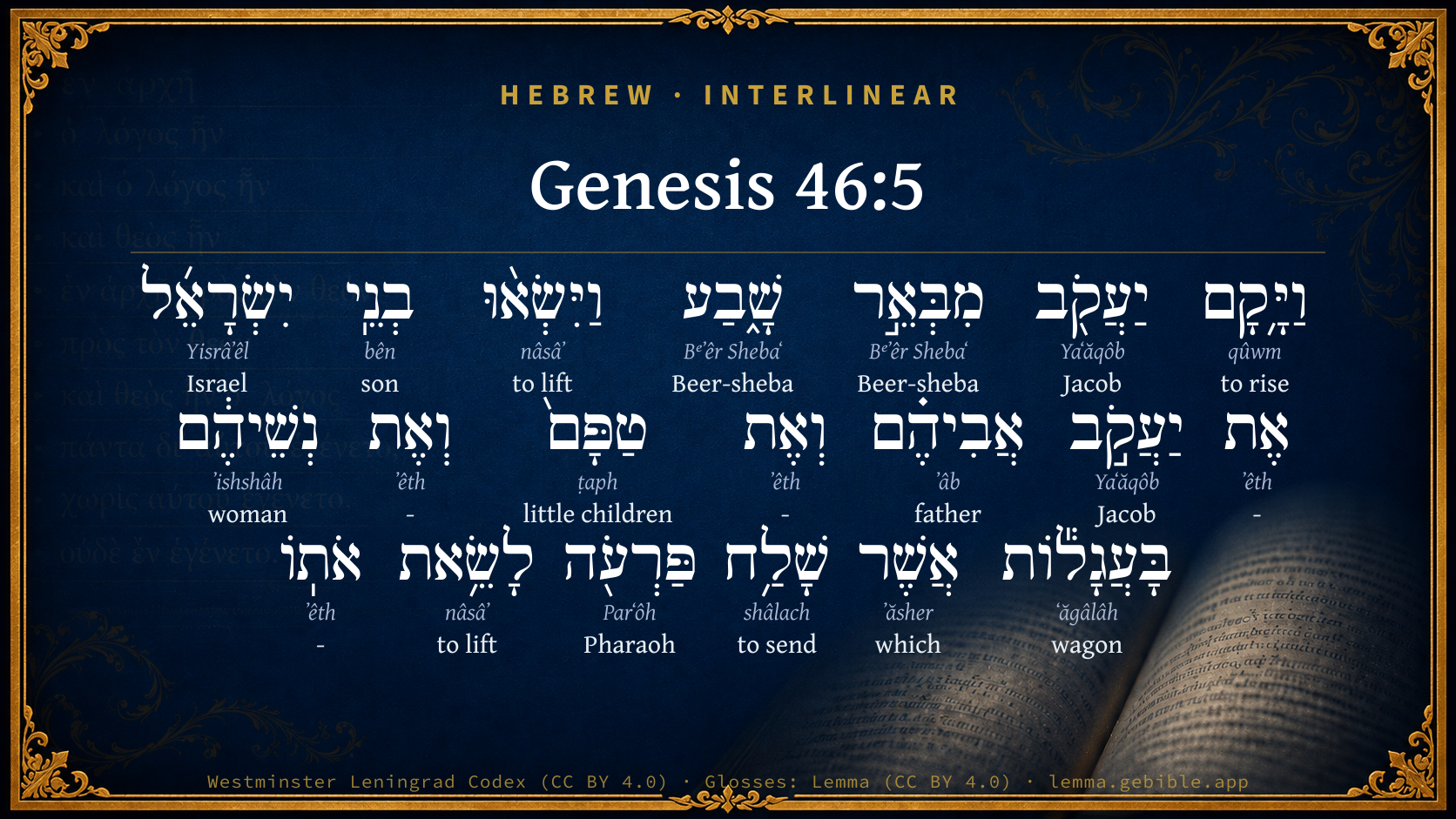
Hebrew (Westminster Leningrad Codex) Genesis 46:5 appears in the Hebrew Old Testament. The text above is from the Westminster Leningrad Codex. Each word links to its Strong’s number, a concise gloss, and parsing drawn from the Open Scriptures Hebrew Bible morphology. Click any word for its full Brown-Driver-Briggs (BDB) entry.
Download image
Cite this verse

Genesis 46:5 (World English Bible). Public Domain. Lemma interlinear Bible study tool, https://lemma.gebible.app/v/genesis/46/5.

Show BibTeX & RIS
BibTeX
RIS
English Translation
Jacob rose up from Beersheba, and the sons of Israel carried Jacob, their father, their little ones, and their wives, in the wagons which Pharaoh had sent to carry him.
World English Bible · Public Domain
Download a study sheet

One document with this verse’s original text, its word-by-word gloss line, the meaning frame, cross-references with their text, attributed commentary, and full source and license credits — printable, and it pastes into notes with its structure intact.

This verse Autodidact and up

Study sheet (.html) Plain text (.txt)

A passage Seminary Student

Up to 50 verses in one chapter. A passage sheet keeps up to 6 commentary sources and 12 cross-references per verse, in the order this page ranks them, and says so on the sheet whenever that leaves anything out. Ask for a single verse and you get the Autodidact verse sheet above.

Everything on this page stays free to read, with no account — the sheet is a download of what is already on screen, not access to it.

Want to remove ads? Support Godless Engineer
Compare translations 3

The same verse in 3 English versions, stacked beneath the original-language interlinear above. Click any original word for its lexicon entry.

Each is an independent rendering of the whole verse — the interlinear is not word-aligned to these translations.

Highlighted words mark where these versions differ — a whole-verse word diff, not a word-by-word alignment.

  • World English Bible Public Domain
    Jacob rose up from Beersheba, and the sons of Israel carried Jacob, their father, their little ones, and their wives, in the wagons which Pharaoh had sent to carry him.
  • King James Version Public Domain
    And Jacob rose up from Beersheba: and the sons of Israel carried Jacob their father, and their little ones, and their wives, in the wagons which Pharaoh had sent to carry him.
  • unfoldingWord Literal Text CC BY-SA 4.0
    Then Jacob got up from Beersheba, and the sons of Israel carried Jacob their father and their little ones and their wives in the carts that Pharaoh had sent to carry him.

unfoldingWord Literal Text — © unfoldingWord, licensed CC BY-SA 4.0. Word-aligned USFM3 via Door43 (git.door43.org/unfoldingWord/en_ult).

Versions to compare (up to 4)

3 of 4 selected

Show all 18 translations

Every available English version of this verse, each an independent rendering of the whole verse.

  • World English Bible Public Domain
    Jacob rose up from Beersheba, and the sons of Israel carried Jacob, their father, their little ones, and their wives, in the wagons which Pharaoh had sent to carry him.
  • Berean Standard Bible Public Domain
    Then Jacob departed from Beersheba, and the sons of Israel took their father Jacob in the wagons Pharaoh had sent to carry him, along with their children and wives.
  • Majority Standard Bible Public Domain
    Then Jacob departed from Beersheba, and the sons of Israel took their father Jacob in the wagons Pharaoh had sent to carry him, along with their children and wives.
  • King James Version Public Domain
    And Jacob rose up from Beersheba: and the sons of Israel carried Jacob their father, and their little ones, and their wives, in the wagons which Pharaoh had sent to carry him.
  • American Standard Version (1901) Public Domain
    And Jacob rose up from Beer-sheba: and the sons of Israel carried Jacob their father, and their little ones, and their wives, in the wagons which Pharaoh had sent to carry him.
  • Revised Version (1885) Public Domain
    And Jacob rose up from Beer-sheba: and the sons of Israel carried Jacob their father, and their little ones, and their wives, in the wagons which Pharaoh had sent to carry him.
  • Geneva Bible (1599) Public Domain
    Then Iaakob rose vp from Beer-sheba: and the sonnes of Israel caried Iaakob their father, and their children, and their wiues in the charets, which Pharaoh had sent to cary him.
  • Douay-Rheims (1899) Public Domain
    And Jacob rose up from the well of the oath: and his sons took him up, with their children and wives in the wagons, which Pharao had sent to carry the old man,
  • Young's Literal Translation Public Domain
    And Jacob riseth from Beer-Sheba, and the sons of Israel bear away Jacob their father, And their infants, and their wives, in the waggons which Pharaoh hath sent to bear him,
  • Literal Standard Version CC BY-SA 4.0
    And Jacob rises from Beer-Sheba, and the sons of Israel carry away their father Jacob, and their infants, and their wives, in the wagons which Pharaoh has sent to carry him,
  • Unlocked Literal Bible CC BY-SA 4.0
    Jacob rose up from Beersheba. The sons of Israel transported Jacob their father, their children, and their wives, in the carts that Pharaoh had sent to carry him.
  • unfoldingWord Literal Text CC BY-SA 4.0
    Then Jacob got up from Beersheba, and the sons of Israel carried Jacob their father and their little ones and their wives in the carts that Pharaoh had sent to carry him.
  • Darby Bible Public Domain
    And Jacob rose up from Beer-sheba; and the sons of Israel carried Jacob their father, and their little ones, and their wives, on the waggons that Pharaoh had sent to carry him.
  • World Messianic Bible Public Domain
    Jacob rose up from Beersheba, and the sons of Israel carried Jacob, their father, their little ones, and their wives, in the wagons which Pharaoh had sent to carry him.
  • Webster's Bible Public Domain
    And Jacob rose up from Beer-sheba: and the sons of Israel carried Jacob their father, and their little ones, and their wives, in the wagons which Pharaoh had sent to carry him.
  • Free Bible Version CC BY-SA 4.0
    Then Jacob left Beersheba. His sons took him, their children, and their wives to Egypt using the wagons Pharaoh had sent.
  • Bible in Basic English Public Domain
    Then Jacob went on from Beer-sheba; and the sons of Jacob took their father and their little ones and their wives in the carts which Pharaoh had sent for them.
  • JPS Tanakh (1917) Public Domain
    And Jacob rose up from Beer-sheba; and the sons of Israel carried Jacob their father, and their little ones, and their wives, in the wagons which Pharaoh had sent to carry him.

Literal Standard Version (2020), Covenant Press — licensed CC BY-SA 4.0. Text via the HelloAO Bible API (eBible.org). Unlocked Literal Bible (unfoldingWord) — licensed CC BY-SA 4.0. Text via the HelloAO Bible API (eBible.org). unfoldingWord Literal Text — © unfoldingWord, licensed CC BY-SA 4.0. Word-aligned USFM3 via Door43 (git.door43.org/unfoldingWord/en_ult). Free Bible Version, Dr. Jonathan Gallagher — licensed CC BY-SA 4.0. Text via the HelloAO Bible API (eBible.org).

Word by word

More ways to search: Search by grammar → Find every occurrence → Compare this word →

Practice this passage: Drill this verse → Learn its vocabulary →

בָּעֲגָל֕וֹת
ʻăgâlâh
H5699
“in/at the · wagons”
Preposition, Determined + Noun, Common, Feminine, Plural, Absolute
Part of Speech
Preposition + Noun
Type
Common
Gender
Feminine
Number
Plural
State
Absolute
Full BDB Definition

Origin: from the same as H5696

TWOT: 1560d

cart, wagon
  1. וַיָּ֥קָם qûwm H6965 “and · to rise” Conjunction + Verb, Qal, Sequential Imperfect, 3rd Person, Masculine, Singular
  2. יַעֲקֹ֖ב Yaʻăqôb H3290 “Jacob” Noun, Proper
  3. מִבְּאֵ֣ר Bᵉʼêr Shebaʻ H884 “from · Beer-sheba” Preposition + Noun, Proper
  4. שָׁ֑בַע Bᵉʼêr Shebaʻ H884 “Beer-sheba” Noun, Proper
  5. וַיִּשְׂא֨וּ nâsâʼ H5375 “and · to lift” Conjunction + Verb, Qal, Sequential Imperfect, 3rd Person, Masculine, Plural
  6. בְנֵֽי bên H1121 “sons of” Noun, Common, Masculine, Plural, Construct
  7. יִשְׂרָאֵ֜ל Yisrâʼêl H3478 “Israel” Noun, Proper
  8. אֶת ʼêth H853 “-” Particle, Direct Object
  9. יַעֲקֹ֣ב Yaʻăqôb H3290 “Jacob” Noun, Proper
  10. אֲבִיהֶ֗ם ʼâb H1 “father · their” Noun, Common, Masculine, Singular, Construct + Suffix, Personal, 3rd Person, Masculine, Plural
  11. וְאֶת ʼêth H853 “and · -” Conjunction + Particle, Direct Object
  12. טַפָּם֙ ṭaph H2945 “little children · their” Noun, Common, Masculine, Singular, Construct + Suffix, Personal, 3rd Person, Masculine, Plural
  13. וְאֶת ʼêth H853 “and · -” Conjunction + Particle, Direct Object
  14. נְשֵׁיהֶ֔ם ʼishshâh H802 “women · their” Noun, Common, Feminine, Plural, Construct + Suffix, Personal, 3rd Person, Masculine, Plural
  15. אֲשֶׁר ʼăsher H834 “which” Particle, Relative
  16. שָׁלַ֥ח shâlach H7971 “to send” Verb, Qal, Perfect, 3rd Person, Masculine, Singular
  17. פַּרְעֹ֖ה Parʻôh H6547 “Pharaoh” Noun, Proper
  18. לָשֵׂ֥את nâsâʼ H5375 “to lift” Preposition + Verb, Qal, Infinitive Construct
  19. אֹתֽוֹ ʼêth H853 “- · him” Particle, Direct Object + Suffix, Personal, 3rd Person, Masculine, Singular

About this verse

These counts appear in no published source. They are computed here, from the morphology-tagged text and Lemma’s own curated glosses. What Lemma adds →

20
words
14
distinct lemmas
Pentateuch
section

Notable vocabulary

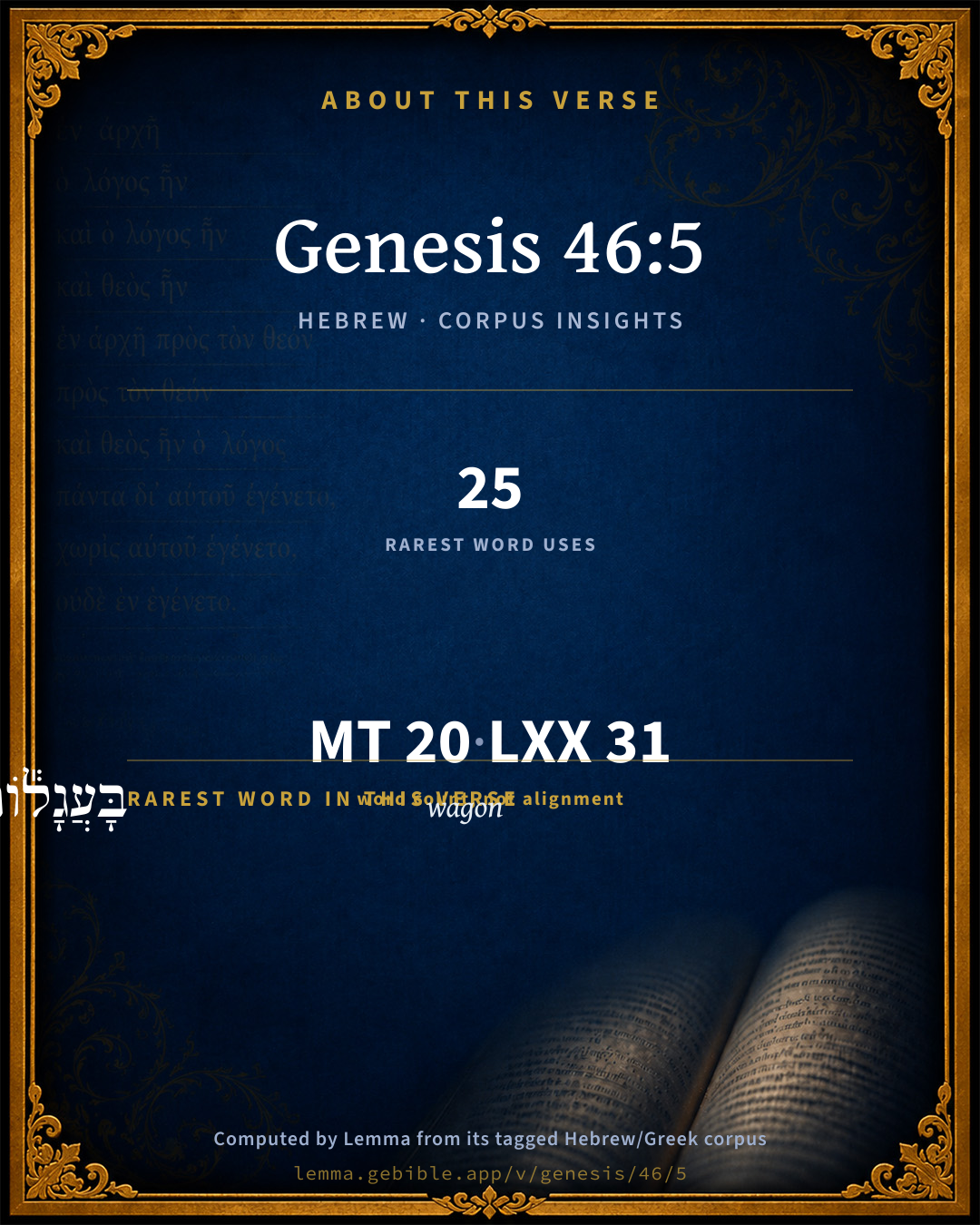
The rarest word here is בָּעֲגָל֕וֹת wagon H5699 — appearing just 25 times in the whole Hebrew Bible.

Shared distinctive vocabulary

בָּעֲגָל֕וֹת wagon H5699 occurs in 20 verses of the Hebrew Bible. Also found in:

Grammatical profile

  • 4 verbs
  • 11 nouns
  • 5 particles

Verb forms

  • וַיָּ֥קָם Qal · Sequential Imperfect
  • וַיִּשְׂא֨וּ Qal · Sequential Imperfect
  • שָׁלַ֥ח Qal · Perfect
  • לָשֵׂ֥את Qal · Infinitive Construct

Repetition

Words recur within this verse — often emphatic in Hebrew:

  • יַעֲקֹ֖ב Jacob H3290 ×2
  • מִבְּאֵ֣ר Beer-sheba H884 ×2
  • וַיִּשְׂא֨וּ to lift H5375 ×2

Hebrew & Septuagint length

In English translation the verse runs 30 words from the Hebrew and 34 from the Septuagint (LXX English) — closely comparable.

A rough comparison of the two English renderings, which tokenize alike — not a word-level alignment.

Word counts can differ between the Hebrew and the Greek without any difference in meaning — e.g. the Hebrew direct-object marker אֵת has no separate Greek word, and Greek often adds the article ὁ.

In the original languages it is 20 Hebrew tokens and 31 Greek tokens — but the two are counted differently (Hebrew bundles its prefixes and suffixes into one token; the Greek is in lemma form), so that isn’t a like-for-like length.

Cross-references

7

Topical passages linked to Genesis 46:5 in the Treasury of Scripture Knowledge — connected by theme and wording, ordered by reader-vote popularity; previews shown in the World English Bible.

  • Genesis 45:19 Now you are commanded: do this. Take wagons out of the land of Egypt for your little ones, and for your wives, and bring your father, and come.
  • Genesis 45:21 The sons of Israel did so. Joseph gave them wagons, according to the commandment of Pharaoh, and gave them provision for the way.
  • Genesis 45:27 They told him all the words of Joseph, which he had said to them. When he saw the wagons which Joseph had sent to carry him, the spirit of Jacob, their father, revived.
  • Genesis 31:17–18 Then Jacob rose up, and set his sons and his wives on the camels,
  • Exodus 10:24 Pharaoh called to Moses, and said, "Go, serve Yahweh. Only let your flocks and your herds stay behind. Let your little ones also go with you."
  • Exodus 10:26 Our cattle also shall go with us. There shall not a hoof be left behind, for of it we must take to serve Yahweh our God; and we don't know with what we must serve Yahweh, until we come there."
  • Acts 7:15 Jacob went down into Egypt, and he died, himself and our fathers,

Cross-references courtesy of OpenBible.info (CC BY 4.0).

Hebrew and Greek witnesses Masoretic Hebrew ↔ Greek Septuagint

The same verse in the two great witnesses to the Old Testament, shown verse-for-verse.

These are two independent witnesses, not word-aligned to each other, and the Septuagint is shown in lemma (dictionary) form.

Hebrew Genesis 46:5 Masoretic · Westminster Leningrad Codex

וַיָּ֥קָם יַעֲקֹ֖ב מִבְּאֵ֣ר שָׁ֑בַע וַיִּשְׂא֨וּ בְנֵֽי יִשְׂרָאֵ֜ל אֶת יַעֲקֹ֣ב אֲבִיהֶ֗ם וְאֶת טַפָּם֙ וְאֶת נְשֵׁיהֶ֔ם בָּעֲגָל֕וֹת אֲשֶׁר שָׁלַ֥ח פַּרְעֹ֖ה לָשֵׂ֥את אֹתֽוֹ

Jacob rose up from Beersheba, and the sons of Israel carried Jacob, their father, their little ones, and their wives, in the wagons which Pharaoh had sent to carry him.

World English Bible · Public Domain

Greek LXX Genesis 46:5 Septuagint · lemma form

ἀναἵστημι δέ ἰακώβ ἀπό ὁ φρέαρ ὁ ὅρκος καί ἀναλαμβάνω ὁ υἱός ἰσραήλ ὁ πατήρ αὐτός καί ὁ ἀποσκευή καί ὁ γυνή αὐτός ἐπί ὁ ἅμαξα ὅς ἀποστέλλω ιωσηφ αἴρω αὐτός

And Jacob rose up from the well of the oath; and the sons of Israel took up their father, and the baggage, and their wives on the wagons, which Joseph sent to take them.

LXX2012 (modern English Septuagint) · Public Domain

On this verse, Matthew Henry's Commentary discusses the Septuagint’s reading. Read the note in Commentary ↓

Hebrew: Westminster Leningrad Codex (CC BY 4.0). Greek: Septuagint (public domain); English from LXX2012 (modern English Septuagint) (Public Domain). How the Septuagint differs from the Hebrew →

Targum (Aramaic paraphrase)

2

The Targum is the ancient Jewish Aramaic paraphrase of the Hebrew Scriptures — an interpretive translation, not the Hebrew text itself. Onkelos (literal) and Pseudo-Jonathan (expansive) render the Torah, and Jonathan the Prophets. Coverage is partial: where no permissively-licensed English translation exists for a verse, only the Aramaic is shown. This is verse-level text, not a word-by-word alignment to the Hebrew.

  1. Targum Onkelos Torah (Genesis–Deuteronomy)
    וְקָם יַעֲקֹב מִבְּאֵרָא דְשָׁבַע וּנְטָלוּ בְנֵי יִשְׂרָאֵל יָת יַעֲקֹב אֲבוּהוֹן וְיָת טַפְלְהוֹן וְיָת נְשֵׁיהוֹן בַּעֲגַלְתָּא דִּי שְׁלַח פַּרְעֹה לְמִטַּל יָתֵהּ

    (no public-domain English translation for this verse)

    Targum Onkelos — Aramaic: “Onkelos Genesis” (public domain); “Onkelos Exodus” (public domain); “Onkelos Leviticus” (public domain); “Onkelos Numbers” (public domain); “Onkelos Deuteronomy” (public domain). English: “Sefaria Community Translation” (CC0 1.0 (public-domain dedication)); “J.W. Etheridge. The Targums of Onkelos and Jonathan Ben Uzziel on the Pentateuch. London: Longmans, Green, 1862” (public domain). Text via Sefaria.

  2. Targum Pseudo-Jonathan Torah (Genesis–Deuteronomy)
    וְקָם יַעֲקב מִבֵּירָא דְשָׁבַע וּנְטָלוּ בְּנֵי יִשְרָאֵל יַת יַעֲקב אֲבוּהוֹן וְיַת טַפְלְהוֹן וְיַת נְשֵׁיהוֹן בִּסְדָנֵי דְשָׁדַר פַּרְעה לְמֵיטַל יָתֵיהּ

    And Jakob arose from Beer de Sheba; and the sons of Israel journeyed, with Jakob their father, their little ones, and their wives, in the waggons which Pharoh had sent to carry him.

    Targum Pseudo-Jonathan — Aramaic: “Targum Jonathan on Genesis” (public domain); “Targum Jonathan on Exodus” (public domain); “Targum Jonathan on Leviticus” (public domain); “Targum Jonathan on Numbers” (public domain); “Targum Jonathan on Deuteronomy” (public domain). English: “The Targum of Jonathan ben Uzziel, trans. J. W. Etheridge, London, 1862” (public domain). Text via Sefaria.

Commentary

Notes on Genesis 46:5 from classic Christian and Jewish commentators (each source and its license shown beneath its notes). The classic Christian expositions comment on the surrounding passage and are grouped to its opening verse, so a note may address several verses; the Jewish commentaries on the Tanakh (Rashi and others) are per-verse, so they appear only where the commentator wrote on this verse.

Lemma curates 59 commentaries, every one of them public domain or Creative Commons licensed, each selected and text-cleaned for this edition rather than reprinted as found. About our sources →

Matthew Henry's Commentary

Old Jacob is here flitting. Little did he think of ever leaving Canaan; he expected, no doubt, to die in his nest, and to leave his seed in actual possession of the promised land: but Providence orders it otherwise. Note, Those that think themselves well settled may yet be unsettled in a little time. Even old people, who think of no other removal than that to the grave (which Jacob had much upon his heart, Gen 37:35; Gen 42:38), sometimes live to see great changes in their family. It is good to be ready, not only for the grave, but for whatever may happen betwixt us and the grave. Observe, 1. How Jacob was conveyed; not in a chariot, though chariots were then used, but in a wagon, Gen 46:5. Jacob had the character of a plain man, who did not affect any thing stately or magnificent; his son rode in a chariot (Gen 41:43), but a wagon would serve him. 2. The removal of what he had with him. (1.) His effects (Gen 46:6), cattle and goods; these he took with him that he might not wholly be beholden to Pharaoh for a livelihood, and that it might not afterwards be said of them, "that they came beggars to Egypt." (2.) His family, all his seed, Gen 46:7. It is probable that they had continued to live together in common with their father; and therefore when he went they all went, which perhaps they were the more willing to do, because, though they had heard that the land of Canaan was promised them, yet, to this day, they had none of it in possession. We have here a particular account of the names of Jacob's family, his sons' sons, most of whom are afterwards mentioned as heads of houses in the several tribes. See Num 26:5, etc. Bishop Patrick observes that Issachar called his eldest son Tola, which signifies a worm, probably because when he was born he was a very little weak child, a worm, and no man, not likely to live; and yet there sprang from him a very numerous offspring, Ch1 7:2. Note, Living and dying do not go by probability. The whole number that went down into Egypt was sixty-six (Gen 46:26), to which add Joseph and his two sons, who were there before, and Jacob himself, the head of the family, and you have the number of seventy, Gen 46:27. The Septuagint makes them seventy-five, and Stephen follows them (Act 7:14), the reason of which we leave to the conjecture of the critics; but let us observe, [1.] Masters of families ought to take care of all under their charge, and to provide for those of their own house food convenient both for body and soul. When Jacob himself removed to a land of plenty, he would not leave any of his children behind him to starve in a barren land. [2.] Though the accomplishment of promises is always sure, yet it is often slow. It was now 215 years since God had promised Abraham to make of him a great nation (Gen 12:2); and yet that branch of his seed on which the promise was entailed had increased only to seventy, of which this particular account is kept, that the power of God in multiplying these seventy to so vast a multitude, even in Egypt, may appear the more illustrious. When God pleases, a little one shall become a thousand, Isa 60:22.

Matthew Henry's Commentary on the Whole Bible (1708–1710) — public domain (CC PDM 1.0). Text via the HelloAO Bible API.

Jamieson, Fausset & Brown

Robert Jamieson, A. R. Fausset & David Brown

IMMIGRATION TO EGYPT. (Gen. 46:5-27)

And Jacob rose up from Beer-sheba--to cross the border and settle in Egypt. However refreshed and invigorated in spirit by the religious services at Beer-sheba, he was now borne down by the infirmities of advanced age; and, therefore, his sons undertook all the trouble and toil of the arrangements, while the enfeebled old patriarch, with the wives and children, was conveyed by slow and leisurely stages in the Egyptian vehicles sent for their accommodation.

Jamieson, Fausset & Brown — Commentary Critical and Explanatory on the Whole Bible (1871) — public domain (CC PDM 1.0). Text via the HelloAO Bible API.

Trapp's Complete Commentary

John Trapp

Gen 46:5 And Jacob rose up from Beersheba: and the sons of Israel carried Jacob their father, and their little ones, and their wives, in the wagons which Pharaoh had sent to carry him.

Ver. 5. And Jacob rose up from Beersheba.] The word "rose up" is emphatical, and imports that his heart was lightened, and his joints oiled and nimbled, as it were, with the heavenly vision. As when he had seen God at Bethel, he "lift up his feet," and went on his way lustily; {Gen 29:1} so here, as fast as his old legs would carry him; as Father Latimer said to Ridley, when they were going to the stake. {a} And as it is recorded of good old Rawlins White, martyr; that whereas before he was wont to go stooping, or rather crooked, through infirmity of age, having a sad countenance and very feeble complexion, and, with it, very soft in speech and gesture; now he went and stretched up himself, not only bolt upright, as he went to the stake, but also bare, with it, a most pleasant and comfortable countenance, not without great courage and audacity, both in speech and behaviour. {b} In like sort, Jacob here, having sought God, and received a gracious promise of his presence and protection, rose up merrily from Beersheba, and doubts not to follow God whithersoever he shall lead him.

{a} Act. and Mon.

{b} Ibidem, fol. 1415.

John Trapp, A Commentary or Exposition upon All the Books of the Old and New Testament (1647–1656) — public domain. Text from a community e-Sword module.

John Calvin's Commentaries

5. And Jacob rose up. By using the words “rose up,” Moses seems to denote that Jacob received new vigor from the vision. For although the former promises were not forgotten, yet the addition of the recent memorial came most opportunely, in order that he, bearing the land of Canaan in his heart, might endure his absence from it with equanimity. When it is said that he took with him all that he had acquired, or possessed in the land of Canaan, it is probable that his servants and handmaids came together with his cattle. But, on his departure, no mention is made of them: nay, a little afterwards, when Moses enumerates the separate heads of each tribe, he says that only seventy souls came with him. Should any one say that Jacob had been compelled to liberate his slaves, on account of the famine, or that he lost them through some misfortune to us unknown, the conjecture is unsatisfactory; for it is most incredible that he, who had been an industrious master of a family, and had abounded in the earthly blessings of God, should have become so entirely destitute, that not even one little servant remained to him. It is more probable that, when the children of Israel were themselves employed in servile works, they were then deprived of their servants in Egypt; or, at least, a sufficient number was not left them, to inspire them with confidence in any enterprise. And although, in the account of their deliverance, Moses is silent respecting their servants, yet it may be easily gathered from other passages, that they did not depart without servants.

John Calvin's Commentaries (1540-1563) — public domain. Text from the Calvin Translation Society English edition (1840s-50s) via the Christian Classics Ethereal Library (ccel.org). Calvin's coverage is partial (roughly two-thirds of the Bible); uncommented books and verses are honest gaps, never fabricated. The 19th-century editor's footnotes and remarks are omitted so the notes are faithfully Calvin's own voice.

The Cambridge Bible for Schools and Colleges

gen. ed. J. J. S. Perowne

5. Beer-sheba] Jacob’s home, as of his fathers, according to E (Gen_21:31, Gen_22:19).

the sons of Israel … Jacob their father] It is not often that the two names are found in such close collocation in the same clause; see note on Gen_46:2. In all probability it betokens the work of editing and compiling the parallel narratives, of which J uses “Israel,” and E and P prefer “Jacob.”

6, 7 (P). P’s summarized account of the descent into Egypt. Observe the characteristic words “their goods which they had gotten”; “his seed”; “sons’ sons” and “sons’ daughters”; and the marked redundancy in style, similar to what is found in Gen_12:5; Gen_31:18; Gen_36:6; which are all from the P narrative.

8–27 (P). We have here a list of “the names of the children of Israel which came into Egypt.”

(a) With certain variations and expansions, the list appears also in Num_26:5-51 (with the omission of Levi), and in 1 Chronicles 2-8. Moreover in Exo_6:14-16 we find the same list, so far as relates to Reuben, Simeon, and Levi (Gen_46:9-11).

(b) It cannot accurately be described either as a list of Jacob’s descendants, for it includes Jacob himself: or as a list of those who went down into Egypt, for it includes the names of Joseph and his sons, and the names of Benjamin’s sons.

(c) There is an element of artificiality in the computation of the list. Thus the names of Er and Onan are only mentioned to be excluded from the total (Gen_46:12). Dinah, the daughter of Jacob, is included in the list of thirty and three “souls of his sons and his daughters,” her name being the only female name up to that point. And Jacob himself is reckoned in the thirty-three.

(d) It should be noted, in the same connexion, that Leah’s sons are 32, and Zilpah’s 16; Rachel’s are 14, and Bilhah’s 7. Each concubine thus is credited with just half the number of sons that the real wife has. This arrangement is probably designed to assist the memory.

(e) The order which is followed in the list is that of the wives: (1) the sons of Leah (Gen_46:8-15); (2) the sons of Zilpah (Gen_46:16-18); (3) the sons of Rachel (Gen_46:19-22); (4) the sons of Bilhah (Gen_46:23-25).

The Cambridge Bible for Schools and Colleges (gen. ed. J. J. S. Perowne; Cambridge University Press, 1878–1918) — public domain. Text from a community e-Sword module.

John Gill's Exposition

And Jacob rose up from Beersheba,.... In high spirits, and proceeded on in his journey, being encouraged and animated by the promises of God now made unto him:

and the sons of Israel carried Jacob their father, and their little ones, and their wives, in the wagons which Pharaoh had sent to carry him; it may be wondered at that Joseph did not send his chariot to fetch his father; it could not be for want of due respect and honour to him, but it may be such a carriage was not fit for so long a journey, and especially to travel in, in some parts of the road through which they went: no mention being made of Jacob's wives, it may be presumed they were all now dead; it is certain Rachel was, see Gen 35:19; and it is more than probable that Leah died before this time, since Jacob says he buried her himself in Machpelah in Canaan, Gen 49:31; and it is very likely also that his two concubine wives Bilhah and Zilpah were also dead, since no notice is taken of them.

John Gill's Exposition of the Whole Bible (1746–1763) — public domain (CC PDM 1.0). Text via the HelloAO Bible API.

Whedon's Commentary on the Bible

Daniel D. Whedon

5. In the wagons which Pharaoh had sent to carry him — “Instead of transporting them upon camels and asses, as was usual in Palestine. The use of the Egyptian wagons, and the fact that they were sent by Pharaoh himself, evidently made a deep impression, and is emphasized by the writer. See note on Genesis 14:27. On the direct route from Hebron to Beer-sheba the hills are too steep and sharp, and the surface is too rocky, to allow of travel on wheeled vehicles. Artificial wagon roads have never been constructed through that country. But wheels could pass from Beer-sheba east of the direct route, through the great Wady el-Khulil, and thence through the valleys to Hebron. (Robinson, 1:215.)” — Newhall.

Daniel D. Whedon (gen. ed.), Commentary on the Old and New Testaments (1874–1909) — public domain. Text from a community e-Sword module.

The Pulpit Commentary

Vers. 5-7. And Jacob rose up having received new vigor from the vision (Calvin)from Beersheba (it is not probable that his stay there was of more than a day or two"s, perhaps only a night"s, duration): and the sons of Israel carried Jacob their father, and their little ones, and their wives, the heathen tribes around them, and Oriental nations generally, the family of Jacob gave honor to the wife as to the weaker vessel" (Lawson)in the wagons which Pharaoh had sent to carry him. (vide Gen_45:19, Gen_45:21) And they took their cattle, and their goods (including probably their servants), which they had gotten in the land of Canaan , Pharaoh had desired Jacob not to regard his stuff, because the good of all the land of Egypt was before him; but he wished not to take advantage of Pharaoh"s goodness, or to owe greater obligations to him than he found necessary" (Lawson) and came into Egypt, a scene depicted on the tomb of Chumhotep, the near relative and successor of Osirtasen I, at Benihassan, represents a company of immigrants, apparently Shemitic in their origin, entering Egypt with their goods, as well as women and children, borne upon asses. Without affirming that this was the Egyptian version of the descent of Israel into Egypt, it may serve as a striking illustration of that event (vide. Wilkinson, "Ancient Egyptians," vol. 1. p. 480, ed. 1878; Brugsch, "Histoire d"Egypte," p. 63; Hengstenberg"s "Egypt and the Books of Moses," p. 37)Jacob, and all his seed (i.e. his descendants) with him: his sons, and his sons" sons with him, his daughters (this need not imply that Jacob had more daughters than Dinah, but may include his sons wives, who are not otherwise mentioned in this enumeration), and his sons" daughters, and all his seed brought he with him into Egypt. The date of this event was in the 130th year of Jacob"s, (Gen_47:9) and 215 years after the call of Abraham, (Gen_12:4) i.e. B.C. 1728 (Usher), 1885 (Hales); or A.M. 2276 (Usher), 3526 (Hales).

The Pulpit Commentary (1880–1919), ed. H.D.M. Spence-Jones & Joseph S. Exell — public domain. Text from a community e-Sword module.

unfoldingWord translationNotes

Door43 World Missions Community

rose up from

"set out from"

in the carts

"Carts" are wagons with two or four wheels. Animals pull the carts. See how you translated "carts" in Genesis 45:19.

they had accumulated

"they had acquired" or "they had gained"

He brought with him

"Jacob brought with him"

his sons' sons

"his grandsons"

his sons' daughters

"his granddaughters"

translationWords

Jacob

Beersheba

Pharaoh

livestock

possess

Canaan

Egypt

descend

unfoldingWord translationNotes — © Distant Shores Media and the Door43 World Missions Community, licensed CC BY-SA 4.0. Source: git.door43.org/Door43/en_tn.

Lesson kit

Teaching starters — assembled from the data on this page, not authored interpretation. Every prompt links to the verse data it draws on. Edit before teaching.

Genesis, in the Pentateuch, opens this verse with 20 words (14 distinct Hebrew lemmas). Its most distinctive word is ʻăgâlâh (“wagon”). A historical commentator’s framing appears above. Read the whole chapter for the surrounding context.

Discussion questions

  1. The word ʻăgâlâh carries the sense “wagon.” How does it shape the verse?
  2. How does Genesis 45:19, which shares the word «wagon», read alongside this verse?
  3. What does the repetition of “Jacob” (2× in this one verse) do in this verse?
  4. The translations on this page render this verse differently — a whole-verse word diff, not a word-by-word alignment. What might account for the different wordings?
  5. «וַיָּ֥קָם» is a Qal Sequential Imperfect verb. How does that grammatical form shape the action described?
  6. Compare how Matthew Henry's Commentary and Jamieson, Fausset & Brown read this verse. Where do they agree or differ?

Things to notice

Reading settings

Reading text

Shown beneath each verse's original-language words.

Old Testament
Old Testament edition

Read the OT as the Masoretic Hebrew (MT) or the Greek Septuagint (LXX).

English shown for the Greek Septuagint (in the Hebrew ↔ Greek comparison).

Comparing translations? Open the Compare panel on any verse page to stack up to four side by side.