
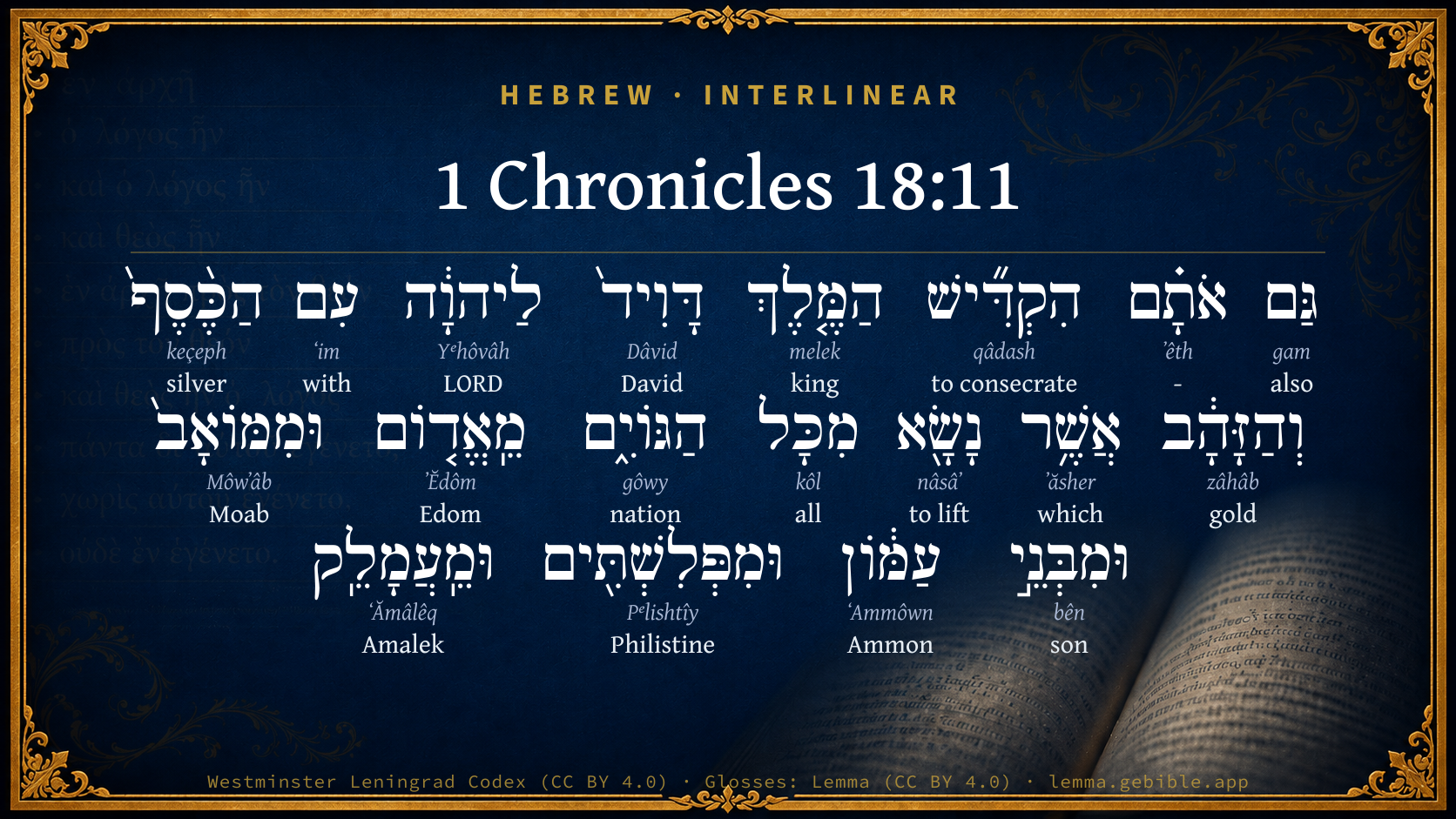
1 Chronicles 18:11

Hebrew (Westminster Leningrad Codex) 1 Chronicles 18:11 appears in the Hebrew Old Testament. The text above is from the Westminster Leningrad Codex. Each word links to its Strong’s number, a concise gloss, and parsing drawn from the Open Scriptures Hebrew Bible morphology. Click any word for its full Brown-Driver-Briggs (BDB) entry.
Download image
Cite this verse

1 Chronicles 18:11 (World English Bible). Public Domain. Lemma interlinear Bible study tool, https://lemma.gebible.app/v/1-chronicles/18/11.

Show BibTeX & RIS
BibTeX
RIS
English Translation
These also did king David dedicate to Yahweh, with the silver and the gold that he carried away from all the nations; from Edom, and from Moab, and from the children of Ammon, and from the Philistines, and from Amalek.
World English Bible · Public Domain
Download a study sheet

One document with this verse’s original text, its word-by-word gloss line, the meaning frame, cross-references with their text, attributed commentary, and full source and license credits — printable, and it pastes into notes with its structure intact.

This verse Autodidact and up

Study sheet (.html) Plain text (.txt)

A passage Seminary Student

Up to 50 verses in one chapter. A passage sheet keeps up to 6 commentary sources and 12 cross-references per verse, in the order this page ranks them, and says so on the sheet whenever that leaves anything out. Ask for a single verse and you get the Autodidact verse sheet above.

Everything on this page stays free to read, with no account — the sheet is a download of what is already on screen, not access to it.

Want to remove ads? Support Godless Engineer
Compare translations 3

The same verse in 3 English versions, stacked beneath the original-language interlinear above. Click any original word for its lexicon entry.

Each is an independent rendering of the whole verse — the interlinear is not word-aligned to these translations.

Highlighted words mark where these versions differ — a whole-verse word diff, not a word-by-word alignment.

  • World English Bible Public Domain
    These also did king David dedicate to Yahweh, with the silver and the gold that he carried away from all the nations; from Edom, and from Moab, and from the children of Ammon, and from the Philistines, and from Amalek.
  • King James Version Public Domain
    Them also king David dedicated unto the LORD, with the silver and the gold that he brought from all these nations; from Edom, and from Moab, and from the children of Ammon, and from the Philistines, and from Amalek.
  • unfoldingWord Literal Text CC BY-SA 4.0
    King David also consecrated them to Yahweh with the silver and the gold that he had lifted from all of the nations, from Edom and from Moab and from the sons of Ammon and from the Philistines and from Amalek.

unfoldingWord Literal Text — © unfoldingWord, licensed CC BY-SA 4.0. Word-aligned USFM3 via Door43 (git.door43.org/unfoldingWord/en_ult).

Versions to compare (up to 4)

3 of 4 selected

Show all 18 translations

Every available English version of this verse, each an independent rendering of the whole verse.

  • World English Bible Public Domain
    These also did king David dedicate to Yahweh, with the silver and the gold that he carried away from all the nations; from Edom, and from Moab, and from the children of Ammon, and from the Philistines, and from Amalek.
  • Berean Standard Bible Public Domain
    and King David dedicated these to the LORD, along with the silver and gold he had carried off from all these nations—from Edom and Moab, and from the Ammonites, Philistines, and Amalekites.
  • Majority Standard Bible Public Domain
    and King David dedicated these to the LORD, along with the silver and gold he had carried off from all these nations—from Edom and Moab, and from the Ammonites, Philistines, and Amalekites.
  • King James Version Public Domain
    Them also king David dedicated unto the LORD, with the silver and the gold that he brought from all these nations; from Edom, and from Moab, and from the children of Ammon, and from the Philistines, and from Amalek.
  • American Standard Version (1901) Public Domain
    These also did king David dedicate unto Jehovah, with the silver and the gold that he carried away from all the nations; from Edom, and from Moab, and from the children of Ammon, and from the Philistines, and from Amalek.
  • Revised Version (1885) Public Domain
    These also did king David dedicate unto the LORD, with the silver and the gold that he carried away from all the nations; from Edom, and from Moab, and from the children of Ammon, and from the Philistines, and from Amalek.
  • Geneva Bible (1599) Public Domain
    And King Dauid did dedicate them vnto the Lord, with the siluer and golde that hee brought from all the nations, from Edom, and from Moab, and from the children of Ammon, and from the Philistims, and from Amalek.
  • Douay-Rheims (1899) Public Domain
    And all the vessels of gold, and silver, and brass king David consecrated to the Lord, with the silver and gold which he had taken from all the nations, as well from Edom, and from Moab, and from the sons of Ammon, as from the Philistines, and from Amalec.
  • Young's Literal Translation Public Domain
    also them hath king David sanctified to Jehovah with the silver and the gold that he hath taken from all the nations, from Edom, and from Moab, and from the sons of Ammon, and from the Philistines, and from Amalek.
  • Literal Standard Version CC BY-SA 4.0
    King David has also sanctified them to YHWH with the silver and the gold that he has taken from all the nations, from Edom, and from Moab, and from the sons of Ammon, and from the Philistines, and from Amalek.
  • Unlocked Literal Bible CC BY-SA 4.0
    King David set these objects apart to Yahweh, together with the silver and the gold that he carried away from all the nations: Edom, Moab, the people of Ammon, the Philistines, and Amalek.
  • unfoldingWord Literal Text CC BY-SA 4.0
    King David also consecrated them to Yahweh with the silver and the gold that he had lifted from all of the nations, from Edom and from Moab and from the sons of Ammon and from the Philistines and from Amalek.
  • Darby Bible Public Domain
    Them also king David dedicated to Jehovah, with the silver and the gold that he had brought from all the nations: from the Edomites, and from the Moabites, and from the children of Ammon, and from the Philistines, and from the Amalekites.
  • World Messianic Bible Public Domain
    King David also dedicated these to the LORD, with the silver and the gold that he carried away from all the nations: from Edom, from Moab, from the children of Ammon, from the Philistines, and from Amalek.
  • Webster's Bible Public Domain
    Them also king David dedicated to the LORD, with the silver and the gold that he brought from all these nations; from Edom, and from Moab, and from the children of Ammon, and from the Philistines, and from Amalek.
  • Free Bible Version CC BY-SA 4.0
    King David dedicated these gifts to the Lord, along with the silver and gold he had taken from all the following nations: Edom, Moab, the Ammonites, the Philistines, and Amalekites.
  • Bible in Basic English Public Domain
    These King David made holy to the Lord, together with the silver and gold he had taken from all nations; from Edom and Moab and from the children of Ammon and from the Philistines and from Amalek.
  • JPS Tanakh (1917) Public Domain
    These also did king David dedicate unto the LORD, with the silver and the gold that he carried away from all the nations; from Edom, and from Moab, and from the children of Ammon, and from the Philistines, and from Amalek.

Literal Standard Version (2020), Covenant Press — licensed CC BY-SA 4.0. Text via the HelloAO Bible API (eBible.org). Unlocked Literal Bible (unfoldingWord) — licensed CC BY-SA 4.0. Text via the HelloAO Bible API (eBible.org). unfoldingWord Literal Text — © unfoldingWord, licensed CC BY-SA 4.0. Word-aligned USFM3 via Door43 (git.door43.org/unfoldingWord/en_ult). Free Bible Version, Dr. Jonathan Gallagher — licensed CC BY-SA 4.0. Text via the HelloAO Bible API (eBible.org).

Word by word

More ways to search: Search by grammar → Find every occurrence → Compare this word →

Practice this passage: Drill this verse → Learn its vocabulary →

וּמֵֽעֲמָלֵֽק
ʻĂmâlêq
H6002
“and · from · Amalek”
Conjunction + Preposition + Noun, Proper
Part of Speech
Conjunction + Preposition + Noun
Type
Proper
Full BDB Definition

Origin: probably of foreign origin

TWOT: None

Amalek = "dweller in a valley" - son of Eliphaz by his concubine Timnah, grandson of Esau, and progenitor of a tribe of people in southern Canaan - descendants of Amalek
  1. גַּם gam H1571 “also” Particle, Accusative
  2. אֹתָ֗ם ʼêth H853 “- · them” Particle, Direct Object + Suffix, Personal, 3rd Person, Masculine, Plural
  3. הִקְדִּ֞ישׁ qâdash H6942 “to consecrate” Verb, Hiphil, Perfect, 3rd Person, Masculine, Singular
  4. הַמֶּ֤לֶךְ melek H4428 “the · king” Particle, Definite Article + Noun, Common, Masculine, Singular, Absolute
  5. דָּוִיד֙ Dâvid H1732 “David” Noun, Proper
  6. לַיהוָ֔ה Yᵉhôvâh H3068 “to/for · LORD” Preposition + Noun, Proper
  7. עִם ʻim H5973 “with” Preposition
  8. הַכֶּ֨סֶף֙ keçeph H3701 “the · silver” Particle, Definite Article + Noun, Common, Masculine, Singular, Absolute
  9. וְהַזָּהָ֔ב zâhâb H2091 “and · the · gold” Conjunction + Particle, Definite Article + Noun, Common, Masculine, Singular, Absolute
  10. אֲשֶׁ֥ר ʼăsher H834 “which” Particle, Relative
  11. נָשָׂ֖א nâsâʼ H5375 “to lift” Verb, Qal, Perfect, 3rd Person, Masculine, Singular
  12. מִכָּל kôl H3605 “from · all of” Preposition + Noun, Common, Masculine, Singular, Construct
  13. הַגּוֹיִ֑ם gôwy H1471 “the · nations” Particle, Definite Article + Noun, Common, Masculine, Plural, Absolute
  14. מֵֽאֱד֤וֹם ʼĔdôm H123 “from · Edom” Preposition + Noun, Proper
  15. וּמִמּוֹאָב֙ Môwʼâb H4124 “and · from · Moab” Conjunction + Preposition + Noun, Proper
  16. וּמִבְּנֵ֣י bên H1121 “and · from · sons of” Conjunction + Preposition + Noun, Common, Masculine, Plural, Construct
  17. עַמּ֔וֹן ʻAmmôwn H5983 “Ammon” Noun, Proper
  18. וּמִפְּלִשְׁתִּ֖ים Pᵉlishtîy H6430 “and · from · Philistines” Conjunction + Preposition + Noun, Gentilic, Masculine, Plural, Absolute

About this verse

These counts appear in no published source. They are computed here, from the morphology-tagged text and Lemma’s own curated glosses. What Lemma adds →

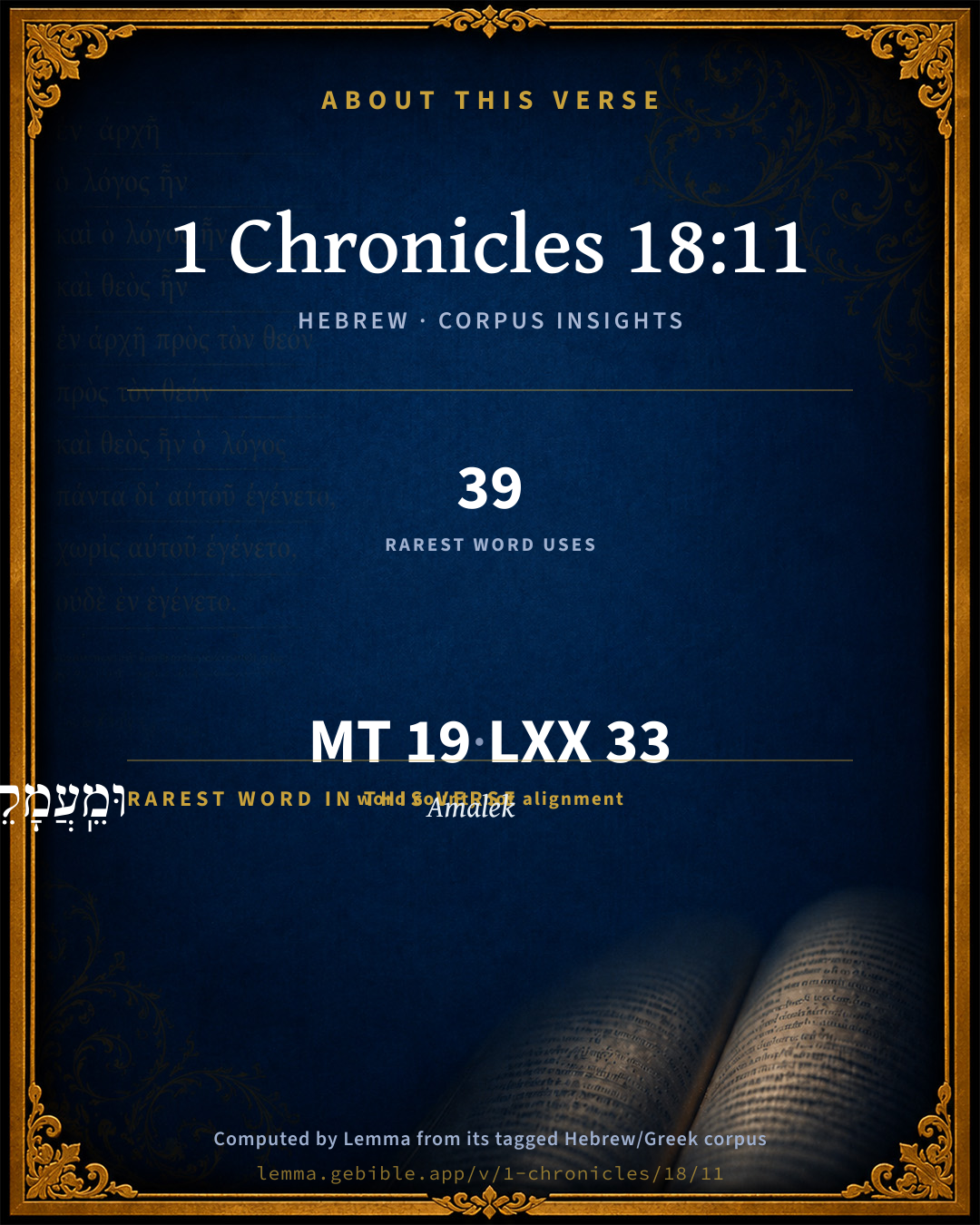
19
words
19
distinct lemmas
Historical
section

Shared distinctive vocabulary

וּמֵֽעֲמָלֵֽק Amalek H6002 occurs in 37 verses of the Hebrew Bible. Also found in:

Grammatical profile

  • 2 verbs
  • 13 nouns
  • 1 preposition
  • 3 particles

Verb forms

  • הִקְדִּ֞ישׁ Hiphil · Perfect
  • נָשָׂ֖א Qal · Perfect

Hebrew & Septuagint length

In English translation the verse runs 40 words from the Hebrew and 47 from the Septuagint (LXX English) — closely comparable.

A rough comparison of the two English renderings, which tokenize alike — not a word-level alignment.

Word counts can differ between the Hebrew and the Greek without any difference in meaning — e.g. the Hebrew direct-object marker אֵת has no separate Greek word, and Greek often adds the article ὁ.

In the original languages it is 19 Hebrew tokens and 33 Greek tokens — but the two are counted differently (Hebrew bundles its prefixes and suffixes into one token; the Greek is in lemma form), so that isn’t a like-for-like length.

Cross-references

17

Topical passages linked to 1 Chronicles 18:11 in the Treasury of Scripture Knowledge — connected by theme and wording, ordered by reader-vote popularity; previews shown in the World English Bible.

  • Exodus 35:5 'Take from among you an offering to Yahweh. Whoever is of a willing heart, let him bring it, Yahweh's offering: gold, silver, brass,
  • Exodus 35:21–24 They came, everyone whose heart stirred him up, and everyone whom his spirit made willing, and brought Yahweh's offering, for the work of the tent of meeting, and for all of its service, and for the holy garments.
  • Joshua 6:19 But all the silver, and gold, and vessels of brass and iron, are holy to Yahweh: they shall come into the treasury of Yahweh.
  • 1 Samuel 27:8–9 David and his men went up, and made a raid on the Geshurites, and the Girzites, and the Amalekites; for those [nations] were the inhabitants of the land, who were of old, as you go to Shur, even to the land of Egypt.
  • 1 Samuel 30:13 David said to him, To whom belong you? and whence are you? He said, I am a young man of Egypt, servant to an Amalekite; and my master left me, because three days ago I fell sick.
  • 1 Samuel 30:20 David took all the flocks and the herds, [which] they drove before those [other] cattle, and said, This is David's spoil.
  • 2 Samuel 8:11–12 These also did king David dedicate to Yahweh, with the silver and gold that he dedicated of all the nations which he subdued;
  • 1 Kings 7:51 Thus all the work that king Solomon worked in the house of Yahweh was finished. Solomon brought in the things which David his father had dedicated, [even] the silver, and the gold, and the vessels, and put them in the treasuries of the house of Yahweh.
  • 2 Kings 12:18 Jehoash king of Judah took all the holy things that Jehoshaphat and Jehoram and Ahaziah, his fathers, kings of Judah, had dedicated, and his own holy things, and all the gold that was found in the treasures of the house of Yahweh, and of the king's house, and sent it to Hazael king of Syria: and he went away from Jerusalem.
  • 1 Chronicles 20:1–2 It happened, at the time of the return of the year, at the time when kings go out [to battle], that Joab led forth the army, and wasted the country of the children of Ammon, and came and besieged Rabbah. But David stayed at Jerusalem. Joab struck Rabbah, and overthrew it.
  • 1 Chronicles 22:14 Now, behold, in my affliction I have prepared for the house of Yahweh one hundred thousand talents of gold, and one thousand thousand talents of silver, and of brass and iron without weight; for it is in abundance: timber also and stone have I prepared; and you may add to them.
  • 1 Chronicles 26:20 Of the Levites, Ahijah was over the treasures of the house of God, and over the treasures of the dedicated things.
  • 1 Chronicles 26:26–27 This Shelomoth and his brothers were over all the treasures of the dedicated things, which David the king, and the heads of the fathers' [houses], the captains over thousands and hundreds, and the captains of the host, had dedicated.
  • 1 Chronicles 29:14 But who am I, and what is my people, that we should be able to offer so willingly as this? For all things come of you, and of your own have we given you.
  • 2 Chronicles 5:1 Thus all the work that Solomon did for the house of Yahweh was finished. Solomon brought in the things that David his father had dedicated, even the silver, and the gold, and all the vessels, and put them in the treasuries of the house of God.
  • Psalms 83:6–7 The tents of Edom and the Ishmaelites; Moab, and the Hagrites;
  • Micah 4:13 Arise and thresh, daughter of Zion; For I will make your horn iron, And I will make your hoofs brass; And you will beat in pieces many peoples: And I will devote their gain to Yahweh, And their substance to the Lord of the whole earth.

Cross-references courtesy of OpenBible.info (CC BY 4.0).

Hebrew and Greek witnesses Masoretic Hebrew ↔ Greek Septuagint

The same verse in the two great witnesses to the Old Testament, shown verse-for-verse.

These are two independent witnesses, not word-aligned to each other, and the Septuagint is shown in lemma (dictionary) form.

Hebrew 1 Chronicles 18:11 Masoretic · Westminster Leningrad Codex

גַּם אֹתָ֗ם הִקְדִּ֞ישׁ הַמֶּ֤לֶךְ דָּוִיד֙ לַיהוָ֔ה עִם הַכֶּ֨סֶף֙ וְהַזָּהָ֔ב אֲשֶׁ֥ר נָשָׂ֖א מִכָּל הַגּוֹיִ֑ם מֵֽאֱד֤וֹם וּמִמּוֹאָב֙ וּמִבְּנֵ֣י עַמּ֔וֹן וּמִפְּלִשְׁתִּ֖ים וּמֵֽעֲמָלֵֽק

These also did king David dedicate to Yahweh, with the silver and the gold that he carried away from all the nations; from Edom, and from Moab, and from the children of Ammon, and from the Philistines, and from Amalek.

World English Bible · Public Domain

Greek LXX 1 Chronicles 18:11 Septuagint · lemma form

καί οὗτος ἁγιάζω δαυίδ ὁ κύριος μετά ὁ ἀργύριον καί ὁ χρυσίον ὅς λαμβάνω ἐκ πᾶς ὁ ἔθνος ἐκ ιδουμαία καί μωαβ καί ἐκ υἱός αμμων καί ἐκ ὁ ἀλλόφυλος καί ἐκ αμαληκ

And all the golden and silver and brazen vessels, even these king David consecrated to the Lord, with the silver and the gold which he took from all the nations; from Idumaea, and Moab, and from the children of Ammon, and from the Philistines, and from Amalec.

LXX2012 (modern English Septuagint) · Public Domain

On this verse, Ellicott's Commentary for English Readers discusses the Septuagint’s reading. Read the note in Commentary ↓

Hebrew: Westminster Leningrad Codex (CC BY 4.0). Greek: Septuagint (public domain); English from LXX2012 (modern English Septuagint) (Public Domain). How the Septuagint differs from the Hebrew →

Commentary

Notes on 1 Chronicles 18:11 from classic Christian and Jewish commentators (each source and its license shown beneath its notes). The classic Christian expositions comment on the surrounding passage and are grouped to its opening verse, so a note may address several verses; the Jewish commentaries on the Tanakh (Rashi and others) are per-verse, so they appear only where the commentator wrote on this verse.

Lemma curates 59 commentaries, every one of them public domain or Creative Commons licensed, each selected and text-cleaned for this edition rather than reprinted as found. About our sources →

Joseph Benson's Commentary

1Ch 18:11. Them also King David dedicated to the Lord — Not only the spoils of his enemies, but the presents of his friends, he devoted to God, and laid up toward the building and enriching of the temple. Thus, we must honour God with that wherewith he blesseth us. And, indeed, that is most truly and most comfortably our own, which we have consecrated to the Lord, and which we use for his glory. Let our merchandise and our hire be holiness to the Lord.

Joseph Benson's Commentary on the Old and New Testaments (1811–1818) — public domain. Text from a community e-Sword module.

Geneva Bible (1599)

Geneva Bible translators

Because the Edomites and the Syrians joined their power together, it is said, 2 Sam. 8:12, that the Aramites were spoiled.

Geneva Bible (1599) marginal notes — public domain. Text via Bolls.life.

Ellicott's Commentary for English Readers

(11) He brought.—Samuel, “dedicated.” Chronicles avoids the tautology.

These nations.—The nations—scil., “whom he had reduced” (Samuel).

From Edom.—Samuel, “from Aram,” but LXX., Syriac, and Arabic, “Edom;” (Targum and Vulg., “Aram”). All the versions read “Edom” here, which appears correct. Edom and Moab were conterminous, and the reference includes all the nations whom David conquered and despoiled.

And from Amalek may refer to 1Sa_30:16, seq., but more probably to an unrecorded campaign. Samuel adds, “and from the spoil of Hadadezer son of Rehob, king of Zobah,” which Chronicles omits, as implied already in 1Ch_18:7-8.

A Bible Commentary for English Readers, edited by Charles John Ellicott (1878–1897) — public domain. Text from a community e-Sword module.

The Cambridge Bible for Schools and Colleges

gen. ed. J. J. S. Perowne

11. from Amalek] So 2Sa_8:12, but we have no record of any war of David with Amalek except the account in 1 Samuel 30.

The Cambridge Bible for Schools and Colleges (gen. ed. J. J. S. Perowne; Cambridge University Press, 1878–1918) — public domain. Text from a community e-Sword module.

Haydock's Catholic Bible Commentary

Edom, or rather Syria, (Aram) which might easily be exchanged for Edom, 2 Kings viii. David could not satisfy his devotion by building a temple; but he made preparations. Solomon left part of the treasures unconsumed, 1 Paralipomenon xxvi. 26. (Calmet) --- These effects, being destined for sacred uses, are said to be consecrated to the Lord. (Worthington)

George Leo Haydock (1774–1849), Haydock's Catholic Family Bible and Commentary, 1859 edition — public domain. Excludes Psalms (Douay-Rheims chapter numbering differs from Protestant) and Deuterocanonical books (Catholic canon only).

The Pulpit Commentary

From Edom. This is probably the correct reading, and not, as in the parallel, "from Aram," unless, as some think, both places were named in the original authority. From the children of Ammon. Perhaps the events narrated in our succeeding chapter are here referred to by the compiler. From Amalek. (see 1Sa_30:1-20, 1Sa_30:26-31)

Dedication of gifts.

David was a generous giver. In his many campaigns he won great spoils from his enemies. We need not approve his conduct in all these military expeditions. But we cannot do other than commend the princely generosity which he displayed in the disposal of his booty. Though not himself permitted to build the temple, he was allowed to accumulate treasures to be used by his son and successor in the construction of the sacred edifice. He freely parted with his wealth for this purpose, and for the maintenance of Divine worship in suitable dignity and splendour. His example in thus dedicating gifts to the service of Jehovah is one which all Christians should follow; the more so, as their motives to consecration are more powerful, and their opportunities of service are more numerous.

I ALL GIFTS ARE OF AND FROM THE LORD. "The earth is the Lord"s, and the fulness thereof;" "The silver and the gold are the Lord"s;" his are "the cattle upon a thousand hills." We can, accordingly, only offer unto the Lord of what is really his. "Of his own" we give unto him.

II ALL THAT CHRISTIANS CAN OFFER TO GOD IS THE PURCHASE OF CHRIST"S BLOOD. When our Saviour redeemed us, he ransomed all our powers and possessions. "Body, soul, and spirit" are his of right. It is the Christian"s privilege to feel that nothing which he has is his own; all is his Lord"s.

III The gifts of Christians are THE EXPRESSION OF THEIR GRATEFUL LOVE. They do not give to the cause of their Redeemer merely because they feel that they ought to do so, but because they delight in any opportunity of showing their affection. The most costly, lavish gifts are poor and worthless, if not the expression of the heart"s love and loyalty. When the heart is offered, the meanest gifts are sufficient to represent its love. The two mites" of the widow were accepted and approved; for they cost her much to give, and yet she gave them with a willing mind.

IV DEDICATED GIFTS MAY SERVE TO WORK OUT THE SPIRITUAL PLAN"S OF GOD. Some professing Christians disparage expenditure for religious objects, on the ground that God cannot care for such trifles as our material wealth. But they forget that, in the order of Divine providence, God"s kingdom upon earth is mysteriously bound up with both the wealth and the work of men. And they forget that Christ regards what is given to his people and to his cause as given to himself. It is, therefore, an honour to be permitted to dedicate of our substance to ends so lofty, to a Master so gracious.

V GIFTS OFFERED IN A RIGHT SPIRIT ARE ACCEPTABLE TO GOD. There is much in Scripture which proves that this is so. "The Lord loveth a cheerful giver;" "It is accepted according to that a man hath;" "He that soweth bountifully shall reap bountifully." If our offerings be dedicated from Christian motives, and to wise and scriptural objects, we need be under no apprehension lest our Lord should despise the givers or reject their gifts. T.

Vers. 11-17.

God"s preserving kindness.

The key-note of this chapter is the passage, "Thus the Lord preserved David whithersoever he went" (vers. 6, 13). We may let the other verses of the text take their tone from this.

I GOD"S PRESERVING KINDNESS TO DAVID. This was manifested in various ways: God preserved him from:

1. Injury in battle. He was neither slain nor wounded by the darts that musthave been levelled at him by many a foe.

2. Defeat in war. He was never beaten by any enemy he encountered, and,finally, all his foes submitted to his rule.

3. Serious mistakes in public policy. Solomon, his brilliant son, committeda most serious error in overtaxing his people; and Rehoboam, his grandson, started on his royal career with a fatal blunder. (2Ch 10) But David had been thus far preserved from taking any step which endangered his own position or enfeebled his kingdom; hence he was delivered from:

4. Disloyalty on the part of his subjects. "Executing judgment and justiceamong all his people" (ver. 14), placing competent men at the head of the different departments of the state (vers. 15-17), he was secure of the attachment of his people, and "reigned over all Israel" without (at this time) any danger of rivalry or disturbance.

5. Special spiritual perils. David was exposed to the peculiar danger ofkings, and very particularly to the peril of complacency and self-glorification. He had risen from the sheepcote to the throne, had enlarged and magnified the Hebrew kingdom, had attained to considerable distinction in the world (so far as it was known to him), and he must, as a fallible man, have been under a strong temptation to glorify himself and take great credit for enterprise and sagacity. From this "the Lord preserved David." The human sovereign laid his victorious position at the feet of the Divine King. He did not apply the spoils of war to the embellishment of his own house, but "dedicated them unto the Lord" (ver. 11). But he did something more and better than this: he ascribed his successful career witness his psalms of thanksgiving to the good hand of his God upon him. He gave God the glory. Thus "the Lord preserved him whithersoever he went," even when he went far along that "slippery place prominence, power, success in battle.

II GOD"S PRESERVING KINDNESS TO US. We have to bless God as our Creator, Provider, Father, Redeemer; we have also to magnify him as our continual Preserver. He preserves us.

1. In life; both in the retention of our being, (Job_10:12) and in the continuance of our existence on earth.

2. In health; in freedom from disease, in deliverance from mental failure, inthe possession of "heart and hope.

3. In favourable circumstance; saving from overwhelming loss and fromcrushing disappointment, and (often for very long periods together) from saddening bereavement.

4. In spiritual integrity. When other things had gone, David could findunspeakable consolation in the thought, "As for me, thou upholdest me in mine integrity". (Psa_41:12) And whatever may betide; though God should remove health, treasure, kindred, friends, from the path on which we walk, yet if he is maintaining us in his fear and in the love of our Redeemer, if he is delivering us from the shipwreck of the soul, (1Ti_1:19) and sustaining us by the upholding power of his Holy Spirit, (Psa_51:12) then may we exclaim, not in the accents of despondency like the broken patriarch, (Job_7:20) but in the joyous and thankful tones of a successful spiritual warrior," What shall I do unto thee, O thou Preserver of men? C.

Loyalty to God in the time of success.

It is noted that the best of the spoils of David"s wars he loyally "dedicated unto the Lord," thus proving himself as faithful in the time of prosperity and success as he had proved himself in the time of failure and trouble. The testing power of adversity is often considered, and D, indeed, one of the familiar topics of public teaching; but the testing power of prosperity is not worthily estimated or efficiently treated. Yet God works by both, and the second provides the more searching and severe forms of testing. Many a man"s root-weakness of character has been discovered by success. It is harder work to go up in life, keeping hold of God"s hand, than it is to go down. And it says much for David, and little for Solomon, that under God"s temporal blessings David held fast his integrity, and Solomon virtually forsook the God of his fathers. In the instance now before us, David had a grand present from Tou, the King of Hamath. Such a present would seem to be his own exclusive property, and no man could have blamed him if he had added it to his private estate. But, in pious loyalty to God, he looked upon it as a part of the success.with which God had attended his labours, so he dedicated it to the honour and service of God, and gained a far richer blessing out of the gift than if he had kept it for himself.

I SUCCESS IN LIFE MAY SEPARATE US FROM GOD. It may, by filling our life with fresh interests, and crowding out God. It may, by nourishing pride, and destroying the conditions on which alone God can dwell with us. It may, by making the real god of our worship to be self, and so dethroning the living God. It may, by declaring our unfaithfulness as we use the success for self, and not for God, and so bring ourselves under Divine judgments. Or it may, by nourishing carnal security, and bringing us into a spiritual condition that must grieve and quench the Holy Spirit.

II SUCCESS IN LIFE MAY BIND US CLOSELY TO GOD. It will, if we fully recognize the Source whence all success comes. It will, if we are watchful over our spiritual culture, through the means of grace, while the success is growing. It will, if we are fully resolved to consecrate to God"s use any success we may gain. It will, if we carefully reproportion our gifts, to God"s house and service, as our success advances. Compare Jacob"s early vow at Bethel, (Gen_28:22) "Of all that thou shalt give me, I will surely give a tenth to thee." And illustrate David"s sacrifices for the tabernacle and temple during his reign, culminating in his splendid gift out of his "own proper good," his own private property, just at the close of his career. (1Ch_29:3-5) We may be directly helped in maintaining the right spirit, under advancing prosperities, by the devotement of portions of our success to pious uses. Making the gift of portions testify that we hold the whole as God"s, and only entrusted to our stewardship in the mystery of the Divine grace. What have we that we have not received?" Offer what we may to God"s service, of it we must say but this, "Of thine own have we given thee. R.T.

The Pulpit Commentary (1880–1919), ed. H.D.M. Spence-Jones & Joseph S. Exell — public domain. Text from a community e-Sword module.

Lesson kit

Teaching starters — assembled from the data on this page, not authored interpretation. Every prompt links to the verse data it draws on. Edit before teaching.

1 Chronicles, in the Historical, opens this verse with 19 words (19 distinct Hebrew lemmas). Its most distinctive word is ʻĂmâlêq (“Amalek”). A historical commentator’s framing appears above. Read the whole chapter for the surrounding context.

Discussion questions

  1. The word ʻĂmâlêq carries the sense “Amalek.” How does it shape the verse?
  2. Genesis 36:12 shares the word «Amalek» with this verse. How do the two illuminate each other?
  3. These translations render this verse differently; the difference is in the English rendering, not the original. What questions does that raise?
  4. The verb «הִקְדִּ֞ישׁ» is Hiphil Perfect. How does its form color the action?
  5. Reading how Joseph Benson's Commentary and Geneva Bible (1599) read this verse, where do the two commentators agree and where do they part?

Things to notice

Reading settings

Reading text

Shown beneath each verse's original-language words.

Old Testament
Old Testament edition

Read the OT as the Masoretic Hebrew (MT) or the Greek Septuagint (LXX).

English shown for the Greek Septuagint (in the Hebrew ↔ Greek comparison).

Comparing translations? Open the Compare panel on any verse page to stack up to four side by side.