Numbers 23:24

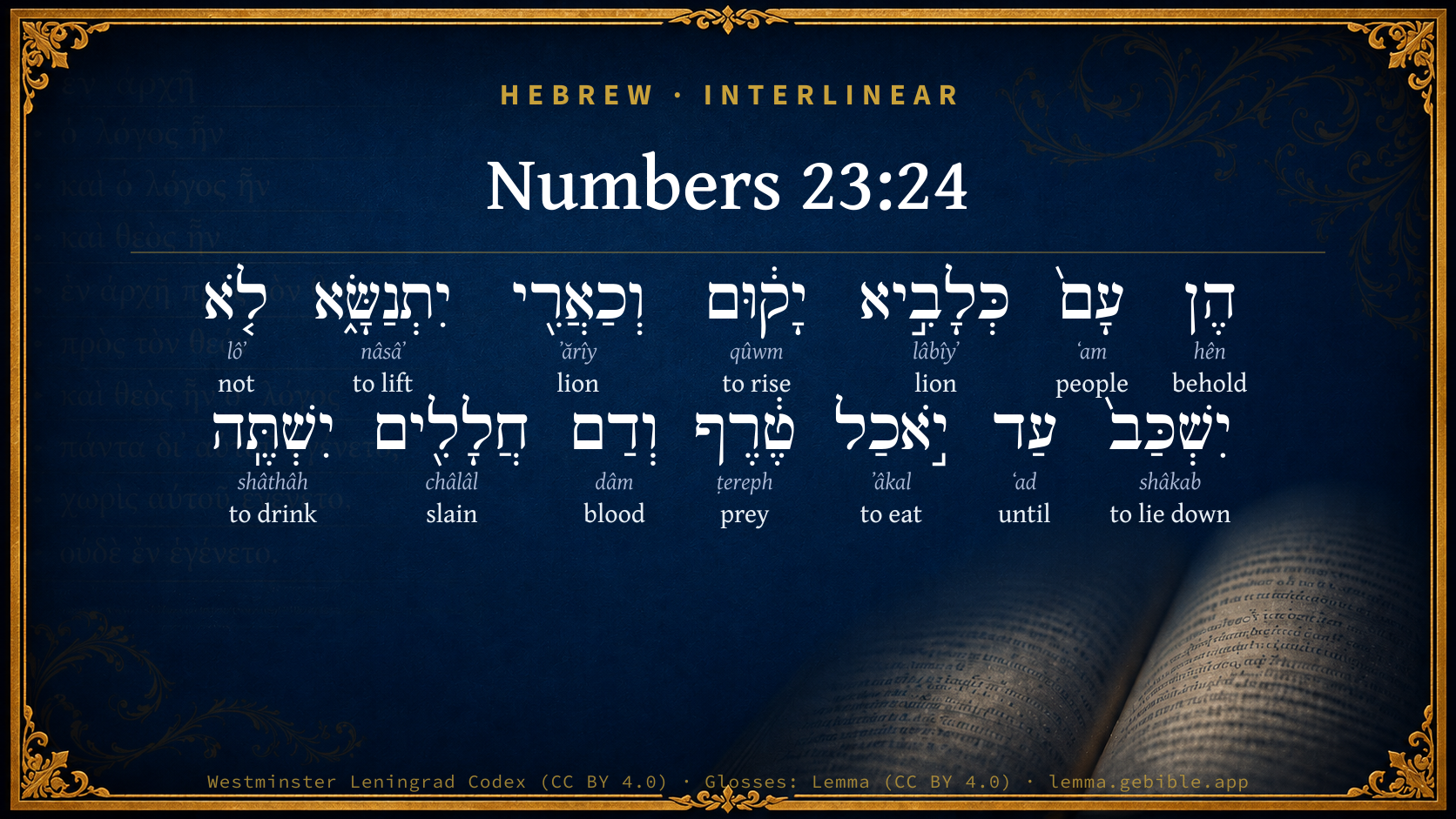
Hebrew (Westminster Leningrad Codex) Numbers 23:24 appears in the Hebrew Old Testament. The text above is from the Westminster Leningrad Codex. Each word links to its Strong’s number, a concise gloss, and parsing drawn from the Open Scriptures Hebrew Bible morphology. Click any word for its full Brown-Driver-Briggs (BDB) entry.
Download image
Cite this verse

Numbers 23:24 (World English Bible). Public Domain. Lemma interlinear Bible study tool, https://lemma.gebible.app/v/numbers/23/24.

Show BibTeX & RIS
BibTeX
RIS
English Translation
Behold, the people rises up as a lioness, As a lion does he lift himself up: He shall not lie down until he eat of the prey, Drink the blood of the slain.
World English Bible · Public Domain
Download a study sheet

One document with this verse’s original text, its word-by-word gloss line, the meaning frame, cross-references with their text, attributed commentary, and full source and license credits — printable, and it pastes into notes with its structure intact.

This verse Autodidact and up

Study sheet (.html) Plain text (.txt)

A passage Seminary Student

Up to 50 verses in one chapter. A passage sheet keeps up to 6 commentary sources and 12 cross-references per verse, in the order this page ranks them, and says so on the sheet whenever that leaves anything out. Ask for a single verse and you get the Autodidact verse sheet above.

Everything on this page stays free to read, with no account — the sheet is a download of what is already on screen, not access to it.

Want to remove ads? Support Godless Engineer
Compare translations 3

The same verse in 3 English versions, stacked beneath the original-language interlinear above. Click any original word for its lexicon entry.

Each is an independent rendering of the whole verse — the interlinear is not word-aligned to these translations.

Highlighted words mark where these versions differ — a whole-verse word diff, not a word-by-word alignment.

  • World English Bible Public Domain
    Behold, the people rises up as a lioness, As a lion does he lift himself up: He shall not lie down until he eat of the prey, Drink the blood of the slain.
  • King James Version Public Domain
    Behold, the people shall rise up as a great lion, and lift up himself as a young lion: he shall not lie down until he eat of the prey, and drink the blood of the slain.
  • unfoldingWord Literal Text CC BY-SA 4.0
    Behold, a people rises up like a lioness, and like a lion it lifts itself up. It will not lie down until it eats prey and drinks the blood of the slain.”

unfoldingWord Literal Text — © unfoldingWord, licensed CC BY-SA 4.0. Word-aligned USFM3 via Door43 (git.door43.org/unfoldingWord/en_ult).

Versions to compare (up to 4)

3 of 4 selected

Show all 18 translations

Every available English version of this verse, each an independent rendering of the whole verse.

  • World English Bible Public Domain
    Behold, the people rises up as a lioness, As a lion does he lift himself up: He shall not lie down until he eat of the prey, Drink the blood of the slain.
  • Berean Standard Bible Public Domain
    Behold, the people rise like a lioness; they rouse themselves like a lion, not resting until they devour their prey and drink the blood of the slain.”
  • Majority Standard Bible Public Domain
    Behold, the people rise like a lioness; they rouse themselves like a lion, not resting until they devour their prey and drink the blood of the slain.”
  • King James Version Public Domain
    Behold, the people shall rise up as a great lion, and lift up himself as a young lion: he shall not lie down until he eat of the prey, and drink the blood of the slain.
  • American Standard Version (1901) Public Domain
    Behold, the people riseth up as a lioness, And as a lion doth he lift himself up: He shall not lie down until he eat of the prey, And drink the blood of the slain.
  • Revised Version (1885) Public Domain
    Behold, the people riseth up as a lioness, And as a lion doth he lift himself up: He shall not lie down until he eat of the prey, And drink the blood of the slain.
  • Geneva Bible (1599) Public Domain
    Behold, the people shall rise vp as a lyon, and lift vp himselfe as a yong lyon: hee shall not lye downe, till he eate of the pray, and till he drinke the blood of the slayne.
  • Douay-Rheims (1899) Public Domain
    Behold the people shall rise up as a lioness, and shall lift itself up as a lion: it shall not lie down till it devour the prey, and drink the blood of the slain.
  • Young's Literal Translation Public Domain
    Lo, the people as a lioness riseth, And as a lion he lifteth himself up, He lieth not down till he eateth prey, And blood of pierced ones doth drink.'
  • Literal Standard Version CC BY-SA 4.0
    Behold, the people rises as a lioness, || And he lifts himself up as a lion; He does not lie down until he eats prey, || And drinks blood of pierced ones.”
  • Unlocked Literal Bible CC BY-SA 4.0
    Look, the people rise like a lioness, as a lion emerges and attacks. He does not lie down until he eats his victim and drinks the blood of what he has killed.”
  • unfoldingWord Literal Text CC BY-SA 4.0
    Behold, a people rises up like a lioness, and like a lion it lifts itself up. It will not lie down until it eats prey and drinks the blood of the slain.”
  • Darby Bible Public Domain
    Lo, the people will rise up as a lioness, and lift himself up as a lion. He shall not lie down until he have eaten the prey and drunk the blood of the slain.
  • World Messianic Bible Public Domain
    Behold, a people rises up as a lioness. As a lion he lifts himself up. He shall not lie down until he eats of the prey, and drinks the blood of the slain.”
  • Webster's Bible Public Domain
    Behold, the people shall rise up as a great lion, and lift up himself as a young lion: he shall not lie down until he shall eat of the prey, and drink the blood of the slain.
  • Free Bible Version CC BY-SA 4.0
    Look! The Israelites go out hunting like a lioness; they chase like a lion. They don't rest until they eat their prey, and drink the blood of their dead victim.”
  • Bible in Basic English Public Domain
    See, Israel comes up like a she-lion, lifting himself up like a lion: he will take no rest till he has made a meal of those he has overcome, drinking the blood of those he has put to death.
  • JPS Tanakh (1917) Public Domain
    Behold a people that riseth up as a lioness, and as a lion doth he lift himself up; he shall not lie down until he eat of the prey, and drink the blood of the slain.

Literal Standard Version (2020), Covenant Press — licensed CC BY-SA 4.0. Text via the HelloAO Bible API (eBible.org). Unlocked Literal Bible (unfoldingWord) — licensed CC BY-SA 4.0. Text via the HelloAO Bible API (eBible.org). unfoldingWord Literal Text — © unfoldingWord, licensed CC BY-SA 4.0. Word-aligned USFM3 via Door43 (git.door43.org/unfoldingWord/en_ult). Free Bible Version, Dr. Jonathan Gallagher — licensed CC BY-SA 4.0. Text via the HelloAO Bible API (eBible.org).

Word by word

More ways to search: Search by grammar → Find every occurrence → Compare this word →

Practice this passage: Drill this verse → Learn its vocabulary →

כְּלָבִ֣יא
lâbîyʼ
H3833
“like/as · lion”
Preposition + Noun, Common, Both, Singular, Absolute
Part of Speech
Preposition + Noun
Type
Common
Gender
Both
Number
Singular
State
Absolute
Full BDB Definition

Origin: from an unused root men. to roar

TWOT: 1070b , 1070c

lion (noun masculine) - lioness (noun feminine)
  1. הֶן hên H2005 “behold” Particle, Interjection
  2. עָם֙ ʻam H5971 “people” Noun, Common, Masculine, Singular, Absolute
  3. יָק֔וּם qûwm H6965 “to rise” Verb, Qal, Imperfect, 3rd Person, Masculine, Singular
  4. וְכַאֲרִ֖י ʼărîy H738 “and · like/as · lion” Conjunction + Preposition + Noun, Common, Masculine, Singular, Absolute
  5. יִתְנַשָּׂ֑א nâsâʼ H5375 “to lift” Verb, Hithpael, Imperfect, 3rd Person, Masculine, Singular
  6. לֹ֤א lôʼ H3808 “not” Particle, Negative
  7. יִשְׁכַּב֙ shâkab H7901 “to lie down” Verb, Qal, Imperfect, 3rd Person, Masculine, Singular
  8. עַד ʻad H5704 “until” Preposition
  9. יֹ֣אכַל ʼâkal H398 “to eat” Verb, Qal, Imperfect, 3rd Person, Masculine, Singular
  10. טֶ֔רֶף ṭereph H2964 “prey” Noun, Common, Masculine, Singular, Absolute
  11. וְדַם dâm H1818 “and · blood of” Conjunction + Noun, Common, Masculine, Singular, Construct
  12. חֲלָלִ֖ים châlâl H2491 “slain” Adjective, Adjective, Masculine, Plural, Absolute
  13. יִשְׁתֶּֽה shâthâh H8354 “to drink” Verb, Qal, Imperfect, 3rd Person, Masculine, Singular

About this verse

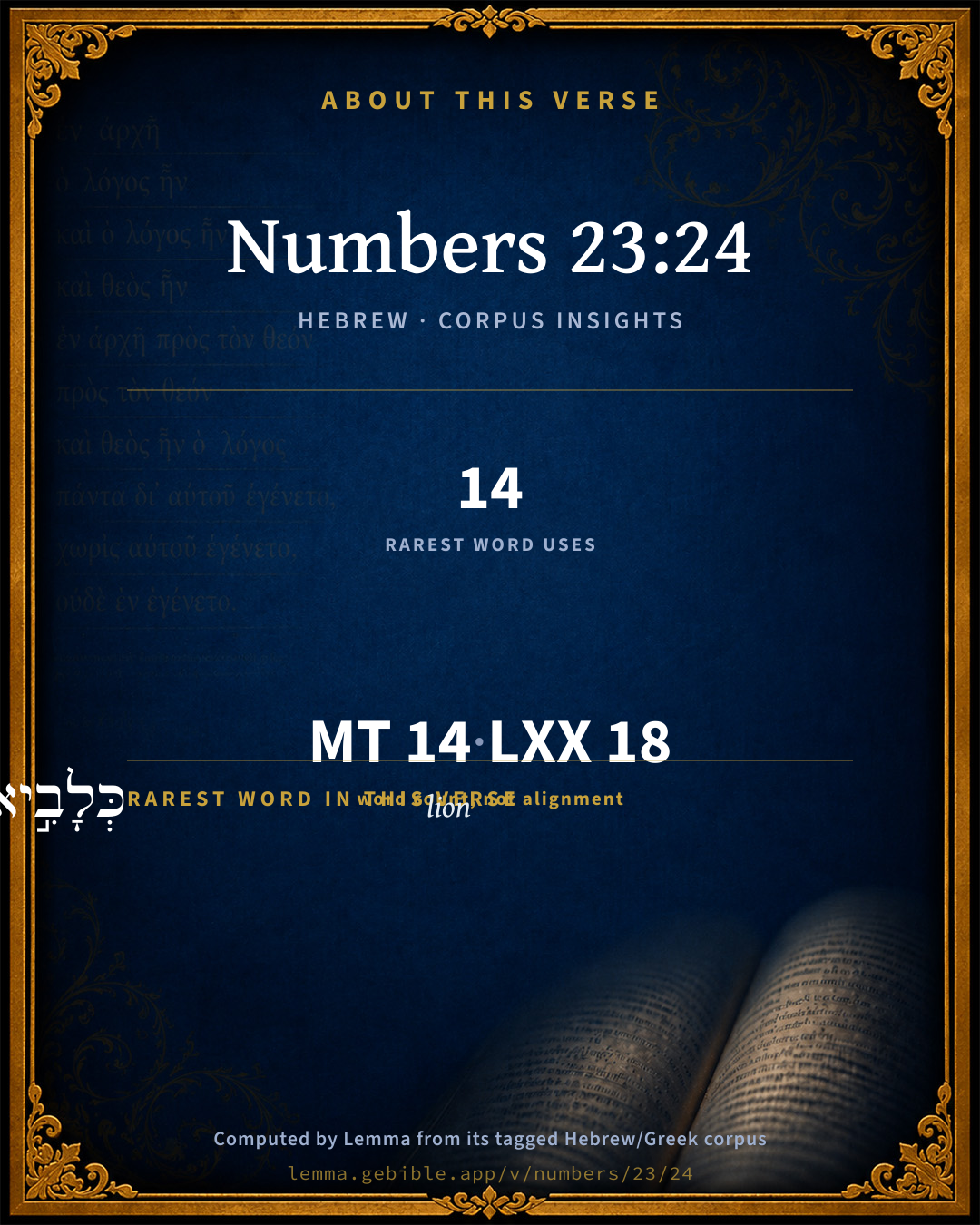
These counts appear in no published source. They are computed here, from the morphology-tagged text and Lemma’s own curated glosses. What Lemma adds →

14
words
14
distinct lemmas
Pentateuch
section

Notable vocabulary

The rarest word here is כְּלָבִ֣יא lion H3833 — appearing just 14 times in the whole Hebrew Bible.

Shared distinctive vocabulary

כְּלָבִ֣יא lion H3833 occurs in 14 verses of the Hebrew Bible. Also found in:

Grammatical profile

  • 5 verbs
  • 5 nouns
  • 1 adjective
  • 1 preposition
  • 2 particles

Verb forms

  • יָק֔וּם Qal · Imperfect
  • יִתְנַשָּׂ֑א Hithpael · Imperfect
  • יִשְׁכַּב֙ Qal · Imperfect
  • יֹ֣אכַל Qal · Imperfect
  • יִשְׁתֶּֽה Qal · Imperfect

Hebrew & Septuagint length

In English translation the verse runs 33 words from the Hebrew and 37 from the Septuagint (LXX English) — closely comparable.

A rough comparison of the two English renderings, which tokenize alike — not a word-level alignment.

Word counts can differ between the Hebrew and the Greek without any difference in meaning — e.g. the Hebrew direct-object marker אֵת has no separate Greek word, and Greek often adds the article ὁ.

In the original languages it is 14 Hebrew tokens and 18 Greek tokens — but the two are counted differently (Hebrew bundles its prefixes and suffixes into one token; the Greek is in lemma form), so that isn’t a like-for-like length.

Cross-references

16

Topical passages linked to Numbers 23:24 in the Treasury of Scripture Knowledge — connected by theme and wording, ordered by reader-vote popularity; previews shown in the World English Bible.

  • Genesis 49:27 "Benjamin is a ravenous wolf. In the morning he will devour the prey. At evening he will divide the spoil."
  • Genesis 49:9 Judah is a lion's cub. From the prey, my son, you have gone up. He stooped down, he crouched as a lion, As a lioness. Who will rouse him up?
  • Numbers 24:8–9 God brings him forth out of Egypt; He has as it were the strength of the wild-ox: He shall eat up the nations his adversaries, Shall break their bones in pieces, Smite [them] through with his arrows.
  • Numbers 24:17 I see him, but not now; I see him, but not near: There shall come forth a star out of Jacob, A scepter shall rise out of Israel, Shall strike through the corners of Moab, Break down all the sons of tumult.
  • Zechariah 12:6 In that day I will make the chieftains of Judah like a pan of fire among wood, and like a flaming torch among sheaves; and they will devour all the surrounding peoples, on the right hand and on the left; and Jerusalem will yet again dwell in their own place, even in Jerusalem.
  • Revelation 5:5 One of the elders said to me, "Don't weep. Behold, the Lion who is of the tribe of Judah, the Root of David, has overcome; he who opens the book and its seven seals."
  • Deuteronomy 33:20 Of Gad he said, Blessed be he who enlarges Gad: He dwells as a lioness, Tears the arm, yes, the crown of the head.
  • Psalms 17:12 He is like a lion that is greedy of his prey, As it were a young lion lurking in secret places.
  • Proverbs 30:30 The lion, which is mightiest among animals, And doesn't turn away for any;
  • Isaiah 31:4 For thus says Yahweh to me, As the lion and the young lion growling over his prey, if a multitude of shepherds are called forth against him, will not be dismayed at their voice, nor abase himself for the noise of them: so will Yahweh of Hosts come down to fight on Mount Zion, and on the hill of it.
  • Amos 3:8 The lion has roared. Who will not fear? The Lord Yahweh has spoken. Who can but prophesy?
  • Micah 5:8–9 The remnant of Jacob will be among the nations, In the midst of many peoples, Like a lion among the animals of the forest, Like a young lion among the flocks of sheep; Who, if he goes through, treads down and tears in pieces, And there is no one to deliver.
  • Nahum 2:11 Where is the den of the lions, and the feeding-place of the young lions, where the lion and the lioness walked, the lion's cubs, and no one made them afraid?
  • Zechariah 10:4–5 From him will come forth the corner-stone, From him the nail, From him the battle bow, From him every ruler together.
  • Revelation 19:11–21 I saw the heaven opened, and behold, a white horse, and he who sat on it is called Faithful and True. In righteousness he judges and makes war.
  • Daniel 2:44 In the days of those kings shall the God of heaven set up a kingdom which shall never be destroyed, nor shall the sovereignty of it be left to another people; but it shall break in pieces and consume all these kingdoms, and it shall stand forever.

Cross-references courtesy of OpenBible.info (CC BY 4.0).

Hebrew and Greek witnesses Masoretic Hebrew ↔ Greek Septuagint

The same verse in the two great witnesses to the Old Testament, shown verse-for-verse.

These are two independent witnesses, not word-aligned to each other, and the Septuagint is shown in lemma (dictionary) form.

Hebrew Numbers 23:24 Masoretic · Westminster Leningrad Codex

הֶן עָם֙ כְּלָבִ֣יא יָק֔וּם וְכַאֲרִ֖י יִתְנַשָּׂ֑א לֹ֤א יִשְׁכַּב֙ עַד יֹ֣אכַל טֶ֔רֶף וְדַם חֲלָלִ֖ים יִשְׁתֶּֽה

Behold, the people rises up as a lioness, As a lion does he lift himself up: He shall not lie down until he eat of the prey, Drink the blood of the slain.

World English Bible · Public Domain

Greek LXX Numbers 23:24 Septuagint · lemma form

ἰδού λαός ὡς σκύμνος ἀναἵστημι καί ὡς λέων γαυριόω οὐ κοιμάω ἕως ἐσθίω θήρα καί αἷμα τραυματίας πίνω

Behold, the people shall rise up as a lion's whelp, and shall exalt himself as a lion; he shall not lie down till he have eaten the prey, and he shall drink the blood of the slain.

LXX2012 (modern English Septuagint) · Public Domain

On this verse, Haydock's Catholic Bible Commentary discusses the Septuagint’s reading. Read the note in Commentary ↓

Hebrew: Westminster Leningrad Codex (CC BY 4.0). Greek: Septuagint (public domain); English from LXX2012 (modern English Septuagint) (Public Domain). How the Septuagint differs from the Hebrew →

Targum (Aramaic paraphrase)

2

The Targum is the ancient Jewish Aramaic paraphrase of the Hebrew Scriptures — an interpretive translation, not the Hebrew text itself. Onkelos (literal) and Pseudo-Jonathan (expansive) render the Torah, and Jonathan the Prophets. Coverage is partial: where no permissively-licensed English translation exists for a verse, only the Aramaic is shown. This is verse-level text, not a word-by-word alignment to the Hebrew.

  1. Targum Onkelos Torah (Genesis–Deuteronomy)
    הָא עַמָא כְּלֵיתָא שָׁרֵי וּכְאַרְיָא יִתְנַטֵל לָא יִשְׁרֵי בְאַרְעֵיהּ עַד דְיִקְטוֹל קְטוֹל וְנִכְסֵי עֲמְמַיָא יֵירָת

    (no public-domain English translation for this verse)

    Targum Onkelos — Aramaic: “Onkelos Genesis” (public domain); “Onkelos Exodus” (public domain); “Onkelos Leviticus” (public domain); “Onkelos Numbers” (public domain); “Onkelos Deuteronomy” (public domain). English: “Sefaria Community Translation” (CC0 1.0 (public-domain dedication)); “J.W. Etheridge. The Targums of Onkelos and Jonathan Ben Uzziel on the Pentateuch. London: Longmans, Green, 1862” (public domain). Text via Sefaria.

  2. Targum Pseudo-Jonathan Torah (Genesis–Deuteronomy)
    יְחִידָאָה הוּא עַמָא הָדֵין נְיַיח וְשָׁרֵי כְּאַרְיָא בִּגְבוּרְתָּא וּכְלֵיתָא מִתְנַטְלִין לָא דַמְכִין הִינוּן עַד דִיקַטְלוּן קְטוֹל רַב בְּבַעֲלֵי דְבָבֵיהוֹן וּבִיזַת קְטוֹלַיָא יִרְתוּן

    This people reposeth alone, and dwelleth strong as a lion, and reareth himself as an old lion. They sleep not till with great slaughter they have slain their adversaries, and taken the spoils of the slain.

    Targum Pseudo-Jonathan — Aramaic: “Targum Jonathan on Genesis” (public domain); “Targum Jonathan on Exodus” (public domain); “Targum Jonathan on Leviticus” (public domain); “Targum Jonathan on Numbers” (public domain); “Targum Jonathan on Deuteronomy” (public domain). English: “The Targum of Jonathan ben Uzziel, trans. J. W. Etheridge, London, 1862” (public domain). Text via Sefaria.

Commentary

Notes on Numbers 23:24 from classic Christian and Jewish commentators (each source and its license shown beneath its notes). The classic Christian expositions comment on the surrounding passage and are grouped to its opening verse, so a note may address several verses; the Jewish commentaries on the Tanakh (Rashi and others) are per-verse, so they appear only where the commentator wrote on this verse.

Lemma curates 59 commentaries, every one of them public domain or Creative Commons licensed, each selected and text-cleaned for this edition rather than reprinted as found. About our sources →

Trapp's Complete Commentary

John Trapp

Num 23:24 Behold, the people shall rise up as a great lion, and lift up himself as a young lion: he shall not lie down until he eat [of] the prey, and drink the blood of the slain.

Ver. 24. Behold the people.] This is chiefly true of God’s peculiar people, subduing their spiritual enemies, {Mic 5:8-9} being bold as lions.

John Trapp, A Commentary or Exposition upon All the Books of the Old and New Testament (1647–1656) — public domain. Text from a community e-Sword module.

Joseph Benson's Commentary

Num 23:24. As a great lion — As a lion rouseth up himself to fight, or to go out to the prey, so shall Israel stir up themselves to warlike attempts against their enemies. He shall not lie down until he eat of the prey — They shall not lay down their arms until they have made an entire conquest of their enemies; just as the lion, risen up to pursue his prey, doth not usually lie down till he hath taken that prey, and drunk the blood of the beasts he has slain. The prophecy seems to have a peculiar respect to the conquest of the Canaanites. This was the condition of Israel at present, and during the days of Joshua and David. But alas! their sins and follies often so enfeebled them that they themselves became an easy prey to their enemies! And there is no truth more plain or more incontestable than this, that piety and virtue are at once the strength and glory of a nation, and that ungodliness and vice are the surest and saddest presages of the ruin of any people.

Joseph Benson's Commentary on the Old and New Testaments (1811–1818) — public domain. Text from a community e-Sword module.

Adam Clarke's Commentary

Verse 24. Behold, the people shall rise up as a great lion] לביא labi, the great, mighty, or old lion, the king of the forest, who is feared and respected by all the other beasts of the field; so shall Israel be the subduer and possessor of the whole land of Canaan. And as a young lion, ארי ari from ארה arah, to tear off, the predatory lion, or the lion in the act of seizing and tearing his prey; - the nations against whom the Israelites are now going shall be no more able to defend themselves against their attacks, than the feeblest beasts of the forest are against the attacks of the strong lion.

Adam Clarke's Commentary on the Bible (1810–1826) — public domain. Text from a community e-Sword/MySword module.

Ellicott's Commentary for English Readers

(24) As a great lion.—Better, as a lioness. (Comp. Gen_49:9.) Balaam transfers to the whole nation that which Jacob had prophesied of Judah.

A Bible Commentary for English Readers, edited by Charles John Ellicott (1878–1897) — public domain. Text from a community e-Sword module.

The Cambridge Bible for Schools and Colleges

gen. ed. J. J. S. Perowne

24. Cf. Mic_5:8.

The Cambridge Bible for Schools and Colleges (gen. ed. J. J. S. Perowne; Cambridge University Press, 1878–1918) — public domain. Text from a community e-Sword module.

John Gill's Exposition

Behold, the people shall rise up as a great lion,.... Or rather, "as the lioness" (n), which, as Aelianus says (o), is the strongest and most warlike beast, the most fierce and furious, as is believed both by Greeks and Barbarians; and he mentions the heroism of Perdiccas the Macedonian, and Semiramis the Assyrian, in engaging with and killing, not the lion or leopard, but lioness:

and shall lift up himself as a young lion; both phrases denoting the courage and strength of the people of Israel, in attacking their enemies and engaging them:

he shall not lie down; being once roused up and engaged in war:

until he eat of the prey, and drink the blood of the slain; as the lion does when it has seized on a creature, tears it to pieces, eats its flesh and drinks its blood: this may refer to the slaughter of the Midianites that would be quickly made, and among the slain of whom Balaam himself was, Num 31:7, and to the slaughter and conquest of the Canaanites under Joshua, and taking their spoils.

(n) "ut leaena", V. L. Tigurine version. (o) Var. Hist. l. 12. c. 39. Vid. Herodot. Thalia, sive, l. 3. c. 108.

John Gill's Exposition of the Whole Bible (1746–1763) — public domain (CC PDM 1.0). Text via the HelloAO Bible API.

Haydock's Catholic Bible Commentary

Lioness. Septuagint, "lion’s whelp." Some explain the Hebrew, "a lion" of full growth and strength. But the antithesis of the Vulgate is more natural and beautiful. (Calmet) --- The lioness, being solicitous for its young ones, becomes more furious. --- A lion, ready to fall upon its prey. So Israel will not lay down the sword till he has conquered the nations of Chanaan, (Menochius) and those who dare to molest him. The allusion to the prediction of Jacob in favour of Juda seems very plain, Genesis xlix. 9. (Haydock)

George Leo Haydock (1774–1849), Haydock's Catholic Family Bible and Commentary, 1859 edition — public domain. Excludes Psalms (Douay-Rheims chapter numbering differs from Protestant) and Deuterocanonical books (Catholic canon only).

Matthew Poole's English Annotations

As a lion rouseth up himself to fight, or to go out to the prey; so shall Israel stir up themselves to warlike attempts against all their enemies, as occasion shall offer itself.

He shall not lie down, i.e. not rest or cease from fighting and pursuing.

Matthew Poole's English Annotations on the Holy Bible (1683–1685) — public domain. Text from a community e-Sword/MySword module.

Whedon's Commentary on the Bible

Daniel D. Whedon

24. As a great lion — Under the imagery of the king of the forest the invincibility of the Hebrew military power, or of Jehovah energizing obedient Israel, is strikingly set forth. The prediction of Jacob respecting Judah (Gen_49:9) is here extended to the whole nation, to blast the hope of Balak that he should destroy Israel. See Num_24:8-9, notes.

Drink the blood — The cruelty and rapacity which these words might seem to indicate are not intended. The simile must not bepressed too far. Strength, courage, and national superiority are symbolized by the lion. Gen_49:9, note.

Daniel D. Whedon (gen. ed.), Commentary on the Old and New Testaments (1874–1909) — public domain. Text from a community e-Sword module.

The Pulpit Commentary

As a great lion. aybil, generally translated "old lion," as in Gen_49:9. By some it is rendered lioness. (cf. Job_4:11 Nah_2:12) As a young lion. yria, the ordinary term for a lion without further distinction. It is altogether fantastic to suppose that Balaam had just seen a lieu coming up from the ghor of Jordan, and that this "omen" inspired his mashal." The rising of a lion from its covert was one of the most common of the more striking phenomena of nature in those regions, and the imagery it afforded was in constant use; but in truth it is evident that these similes are borrowed from Jacob"s dying prophecy concerning Judah, (Gen_49:9) in which the word "prey" (Hebrew, prf, a torn thing) is also found. Balaam was acquainted with that prophecy, as he was with the promises made to Abraham. (cf. verse 10 with Gen_13:16 Gen_28:14)

The Pulpit Commentary (1880–1919), ed. H.D.M. Spence-Jones & Joseph S. Exell — public domain. Text from a community e-Sword module.

John Wesley's Explanatory Notes

As a great Lion - As a lion rouseth up himself to fight, or to go out to the prey, so shall Israel stir up themselves to warlike attempts against their enemies. He shall not lie down - Not rest or cease from fighting and pursuing.

John Wesley, Explanatory Notes Upon the Whole Bible (1754–1765) — public domain. Text via the GEBible commentary corpus.

unfoldingWord translationNotes

Door43 World Missions Community

the people rise like a lioness ... he has killed

This verse is a long metaphor that speaks of Israel defeating her enemies as if Israel was a lion devouring its prey. (See: Metaphor)

translationWords

lions

blood

unfoldingWord translationNotes — © Distant Shores Media and the Door43 World Missions Community, licensed CC BY-SA 4.0. Source: git.door43.org/Door43/en_tn.

Rashi

Rabbi Shlomo Yitzchaki (Rashi)

הן עם כלביא יקום וגו׳ BEHOLD, THE PEOPLE RISES AS A LIONESS, etc. — When they rise from their sleep in the morning they show themselves strong as a lioness and as a lion to “snatch at” the Divine precepts (to perform them immediately) — to clothe themselves with the Tallith, to read the Shema and to lay Tephillin (cf. Midrash Tanchuma, Balak 14).

לא ישכב HE LIES NOT DOWN at night on his bed until he consumes (עד יאכל) and destroys every noxious thing which comes to prey upon him (טרף). How so? He reads the Shema at his bedside and commends his spirit into the hands of the Omnipresent (Midrash Tanchuma, Balak 14). If a camp or troop comes to injure them, the Holy One, blessed be He, protects them and fights their battles and causes them (the enemies) to fall slain (חללים).— Another explanation of הן עם כלביא יקום is as the Targum has it (“Behold the people shall dwell as a lioness and as a lion shall he raise himself; he will not dwell in his land until he hath slaughtered and he will inherit the wealth of the peoples”).

ודם חללים ישתה AND HE SHALL DRINK THE BLOOD OF THE SLAIN — He unwittingly foretold the future — that Moses would not die until he will have made the kings of Midean fall slain (חללים) and he (Balaam) will have been slain with them, — as it is said, (Joshua 13:22) “And Balaam the son of Beor, the soothsayer, did the children of Israel slay with the sword among the rest of their slain (חלליהם)" (cf. Midrash Tanchuma, Balak 14).

Rashi on the Tanakh — English translations: “The Judaica Press complete Tanach with Rashi, translated by A. J. Rosenberg” (CC BY 4.0); “Pentateuch with Rashi's commentary by M. Rosenbaum and A.M. Silbermann, 1929-1934” (public domain); “The Metsudah Tanach series, Lakewood, N.J” (CC BY 4.0); and “The Book of Joshua, Metsudah Publications, 1997” (CC BY 4.0). Text via Sefaria.

Ramban (Nachmanides)

Rabbi Moshe ben Nachman (Ramban / Nachmanides)

Balaam prophesied also about them [Israel] that he will rise up ‘k’lavi,’ which is the lion’s whelp, and afterwards he will lift himself up like a [fully-grown] lion, and he will not rest in his Land until he eat of the prey, and drink the blood of the kings of Canaan, as Onkelos explained it.Thus Balaam added now in this second prophecy [to the words of his first prophecy], telling Balak that they [the Israelites] would conquer the Land and kill mighty kings. Now Balak knew that the Israelites would not receive his land as an inheritance, and therefore although Balaam told them now that the Israelites would ultimately conquer the kings of Canaan, Balak still wanted [Balaam] to curse them so that [Balak] would be victorious [over them], and that he would be able to overcome them, and possibly he could fight against them and inflict losses on them. Therefore he still said, [Come now], I will take thee unto another place; peradventure it will please G-d that thou mayest curse me them from thence. Balak did not [ask Balaam] to withdraw the blessing [which he had previously given Israel], since he had already informed him, G-d is not a man, that He should lie, neither the son of man, that He should repent, but he thought: “Indeed the Israelites are destined to conquer the land of Canaan, which is their inheritance, and to kill their kings; but it is still possible that I will prevail over them and inflict losses on them, as did the Amalekite and the Canaanite who dwelt in that hill-country, who smote them even unto Hormah.” Balak intended to do this because of his fear of them, as he mentioned to the elders of Midian, 22:3-4. or it may be that his purpose was that he should be able to reconquer all [that land] which the Israelites had captured from the possession of Sihon which originally belonged to Moab, as is stated explicitly in the words of Jephthah. I have already mentioned this.

Ramban (Nachmanides) on the Tanakh — English translation: “Commentary on the Torah by Ramban (Nachmanides). Translated and annotated by Charles B. Chavel. New York, Shilo Pub. House, 1971-1976” (CC BY 4.0). Text via Sefaria.

Ibn Ezra

Rabbi Abraham ibn Ezra

Behold, a people that rises like a young lion. This is a hint that they will conquer the Canaanite kings in a similar way, for example, as their victory against Midian which was unheard of. Not a single person from Israel was lost, five kings were killed, and the number of women captives who had not had relations with a man was thirty-two thousand.

And drinks the blood of its kill. The entire army and all the spoils. This verse could also be interpreted as: Moshe does not lie down until he devours his prey. Similarly, the verse says (31:2), Take revenge for Bnei Yisroel against the Midianites, afterwards, you shall be gathered to your people (die).

Ibn Ezra on the Tanakh — English translations: “Sefaria Community Translation” (CC0 1.0 (public-domain dedication)); “Yalkut, Sifsei Chachomim Chumash, Metsudah Publications, 2009” (CC BY 4.0); and “Commentary of Ibn Ezra on Isaiah - trans. by M. Friedlander, 1873” (public domain). Text via Sefaria.

Lesson kit

Teaching starters — assembled from the data on this page, not authored interpretation. Every prompt links to the verse data it draws on. Edit before teaching.

Numbers, in the Pentateuch, opens this verse with 14 words (14 distinct Hebrew lemmas). Its most distinctive word is lâbîyʼ (“lion”). A historical commentator’s framing appears above. Read the whole chapter for the surrounding context.

Discussion questions

  1. The word lâbîyʼ carries the sense “lion.” How does it shape the verse?
  2. How does Genesis 49:9, which shares the word «lion», read alongside this verse?
  3. These translations render this verse differently. What is at stake in choosing one wording over another?
  4. «יָק֔וּם» is a Qal Imperfect verb. How does that grammatical form shape the action described?
  5. Compare how Trapp's Complete Commentary and Joseph Benson's Commentary read this verse. Where do they agree or differ?

Things to notice

Reading settings

Reading text

Shown beneath each verse's original-language words.

Old Testament
Old Testament edition

Read the OT as the Masoretic Hebrew (MT) or the Greek Septuagint (LXX).

English shown for the Greek Septuagint (in the Hebrew ↔ Greek comparison).

Comparing translations? Open the Compare panel on any verse page to stack up to four side by side.