
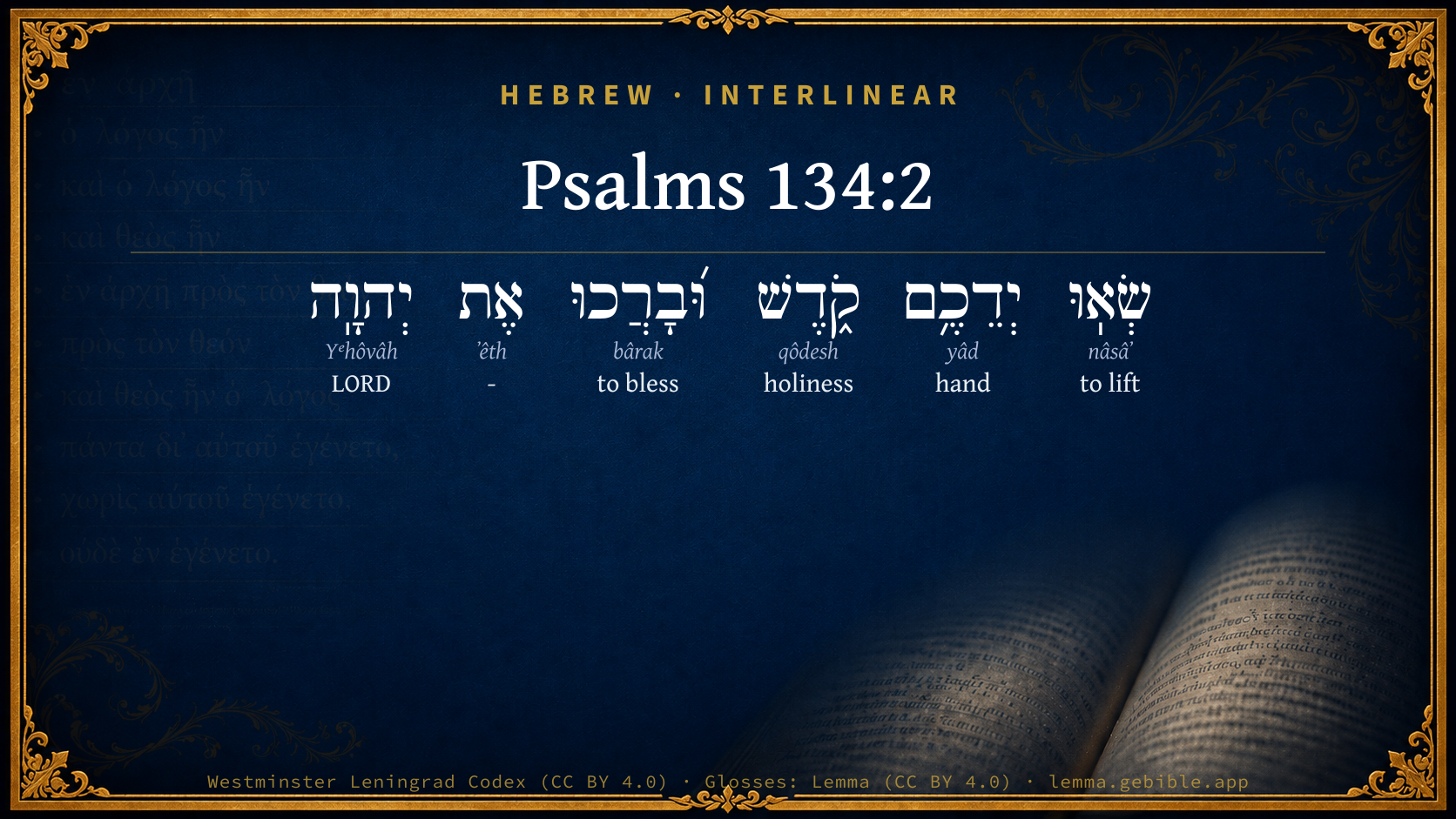
Psalms 134:2

Hebrew (Westminster Leningrad Codex) Psalms 134:2 appears in the Hebrew Old Testament. The text above is from the Westminster Leningrad Codex. Each word links to its Strong’s number, a concise gloss, and parsing drawn from the Open Scriptures Hebrew Bible morphology. Click any word for its full Brown-Driver-Briggs (BDB) entry.
Download image
Cite this verse

Psalms 134:2 (World English Bible). Public Domain. Lemma interlinear Bible study tool, https://lemma.gebible.app/v/psalms/134/2.

Show BibTeX & RIS
BibTeX
RIS
English Translation
Lift up your hands in the sanctuary. Praise Yahweh!
World English Bible · Public Domain
Download a study sheet

One document with this verse’s original text, its word-by-word gloss line, the meaning frame, cross-references with their text, attributed commentary, and full source and license credits — printable, and it pastes into notes with its structure intact.

This verse Autodidact and up

Study sheet (.html) Plain text (.txt)

A passage Seminary Student

Up to 50 verses in one chapter. A passage sheet keeps up to 6 commentary sources and 12 cross-references per verse, in the order this page ranks them, and says so on the sheet whenever that leaves anything out. Ask for a single verse and you get the Autodidact verse sheet above.

Everything on this page stays free to read, with no account — the sheet is a download of what is already on screen, not access to it.

Want to remove ads? Support Godless Engineer
Compare translations 3

The same verse in 3 English versions, stacked beneath the original-language interlinear above. Click any original word for its lexicon entry.

Each is an independent rendering of the whole verse — the interlinear is not word-aligned to these translations.

Highlighted words mark where these versions differ — a whole-verse word diff, not a word-by-word alignment.

  • World English Bible Public Domain
    Lift up your hands in the sanctuary. Praise Yahweh!
  • King James Version Public Domain
    Lift up your hands in the sanctuary, and bless the LORD.
  • unfoldingWord Literal Text CC BY-SA 4.0
    Lift up your hands holiness, and bless Yahweh.

unfoldingWord Literal Text — © unfoldingWord, licensed CC BY-SA 4.0. Word-aligned USFM3 via Door43 (git.door43.org/unfoldingWord/en_ult).

Versions to compare (up to 4)

3 of 4 selected

Show all 18 translations

Every available English version of this verse, each an independent rendering of the whole verse.

  • World English Bible Public Domain
    Lift up your hands in the sanctuary. Praise Yahweh!
  • Berean Standard Bible Public Domain
    Lift up your hands to the sanctuary and bless the LORD!
  • Majority Standard Bible Public Domain
    Lift up your hands to the sanctuary and bless the LORD!
  • King James Version Public Domain
    Lift up your hands in the sanctuary, and bless the LORD.
  • American Standard Version (1901) Public Domain
    Lift up your hands to the sanctuary, And bless ye Jehovah.
  • Revised Version (1885) Public Domain
    Lift up your hands to the sanctuary, and bless ye the LORD.
  • Geneva Bible (1599) Public Domain
    Lift vp your hands to the Sanctuarie, and praise the Lord.
  • Douay-Rheims (1899) Public Domain
    Like the precious ointment on the head, that ran down upon the beard, the beard of Aaron, Which ran down to the skirt of his garment:
  • Young's Literal Translation Public Domain
    Lift up your hands `in' the sanctuary, And bless ye Jehovah.
  • Literal Standard Version CC BY-SA 4.0
    Lift up your hands [in] the sanctuary, || And bless YHWH.
  • Unlocked Literal Bible CC BY-SA 4.0
    Lift up your hands to the holy place and bless Yahweh.
  • unfoldingWord Literal Text CC BY-SA 4.0
    Lift up your hands holiness, and bless Yahweh.
  • Darby Bible Public Domain
    Lift up your hands in the sanctuary, and bless Jehovah.
  • World Messianic Bible Public Domain
    Lift up your hands in the sanctuary. Praise the LORD!
  • Webster's Bible Public Domain
    Lift up your hands in the sanctuary, and bless the LORD.
  • Free Bible Version CC BY-SA 4.0
    Lift up your hands towards the holy place and praise the Lord.
  • Bible in Basic English Public Domain
    Give praise to the Lord, lifting up your hands in his holy place.
  • JPS Tanakh (1917) Public Domain
    Lift up your hands to the sanctuary, and bless ye the LORD.

Literal Standard Version (2020), Covenant Press — licensed CC BY-SA 4.0. Text via the HelloAO Bible API (eBible.org). Unlocked Literal Bible (unfoldingWord) — licensed CC BY-SA 4.0. Text via the HelloAO Bible API (eBible.org). unfoldingWord Literal Text — © unfoldingWord, licensed CC BY-SA 4.0. Word-aligned USFM3 via Door43 (git.door43.org/unfoldingWord/en_ult). Free Bible Version, Dr. Jonathan Gallagher — licensed CC BY-SA 4.0. Text via the HelloAO Bible API (eBible.org).

Word by word

More ways to search: Search by grammar → Find every occurrence → Compare this word →

Practice this passage: Drill this verse → Learn its vocabulary →

וּ֝בָרֲכוּ
bârak
H1288
“and · bless”
Conjunction + Verb, Piel, Imperative, 2nd Person, Masculine, Plural
Part of Speech
Conjunction + Verb
Stem
Piel
Form
Imperative
Person
2nd Person
Gender
Masculine
Number
Plural
Full BDB Definition

Origin: a primitive root

TWOT: 285

to bless, kneel - (Qal) - to kneel - to bless - (Niphal) to be blessed, bless oneself - (Piel) to bless - (Pual) to be blessed, be adored - (Hiphil) to cause to kneel - (Hithpael) to bless oneself - (TWOT) to praise, salute, curse
  1. שְׂאֽוּ nâsâʼ H5375 “lift” Verb, Qal, Imperative, 2nd Person, Masculine, Plural
  2. יְדֵכֶ֥ם yâd H3027 “hands · your” Noun, Common, Both, Dual, Construct + Suffix, Personal, 2nd Person, Masculine, Plural
  3. קֹ֑דֶשׁ qôdesh H6944 “holiness” Noun, Common, Masculine, Singular, Absolute
  4. אֶת ʼêth H853 “-” Particle, Direct Object
  5. יְהוָֽה Yᵉhôvâh H3068 “LORD” Noun, Proper

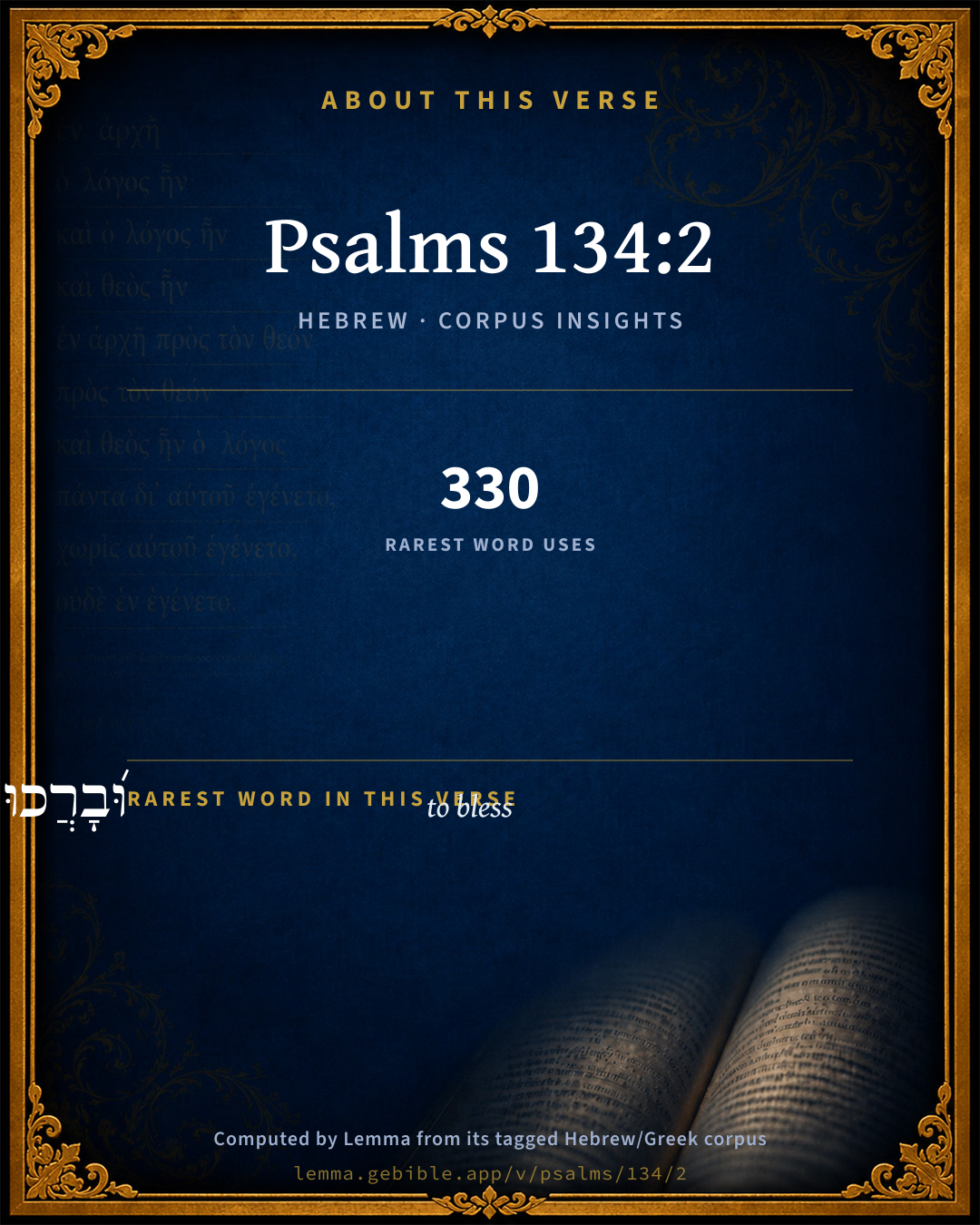
About this verse

These counts appear in no published source. They are computed here, from the morphology-tagged text and Lemma’s own curated glosses. What Lemma adds →

6
words
6
distinct lemmas
Wisdom
section

Grammatical profile

  • 2 verbs
  • 3 nouns
  • 1 particle

Verb forms

  • שְׂאֽוּ Qal · Imperative
  • וּ֝בָרֲכוּ Piel · Imperative

Hebrew & Septuagint length

In English translation the verse runs 9 words from the Hebrew and 13 from the Septuagint (LXX English) — closely comparable.

A rough comparison of the two English renderings, which tokenize alike — not a word-level alignment.

Word counts can differ between the Hebrew and the Greek without any difference in meaning — e.g. the Hebrew direct-object marker אֵת has no separate Greek word, and Greek often adds the article ὁ.

Cross-references

8

Topical passages linked to Psalms 134:2 in the Treasury of Scripture Knowledge — connected by theme and wording, ordered by reader-vote popularity; previews shown in the World English Bible.

  • Psalms 28:2 Hear the voice of my petitions, when I cry to you, When I lift up my hands toward your Most Holy Place.
  • 1 Timothy 2:8 I desire therefore that the men in every place pray, lifting up holy hands without wrath and doubting.
  • Psalms 63:4 So I will bless you while I live. I will lift up my hands in your name.
  • Psalms 141:2 Let my prayer be set before you like incense; The lifting up of my hands like the evening sacrifice.
  • Lamentations 3:41 Let us lift up our heart with our hands to God in the heavens.
  • Lamentations 2:19 Arise, cry out in the night, at the beginning of the watches; Pour out your heart like water before the face of the Lord: Lift up your hands toward him for the life of your young children, that faint for hunger at the head of every street.
  • Psalms 26:6 I will wash my hands in innocence, So I will go about your altar, Yahweh;
  • Psalms 63:2 So I have seen you in the sanctuary, Watching your power and your glory.

Cross-references courtesy of OpenBible.info (CC BY 4.0).

Hebrew and Greek witnesses Masoretic Hebrew ↔ Greek Septuagint

The same verse in the two great witnesses to the Old Testament, shown verse-for-verse.

You’re reading Greek Psalm 133 (Hebrew Psalm 134). The Septuagint counts the superscription, so verse numbers can differ from the Hebrew — chapter-level alignment, not verse-by-verse. Numbering follows Rahlfs.

These are two independent witnesses, not word-aligned to each other, and the Septuagint is shown in lemma (dictionary) form.

Hebrew Psalms 134:2 Masoretic · Westminster Leningrad Codex

שְׂאֽוּ יְדֵכֶ֥ם קֹ֑דֶשׁ וּ֝בָרֲכוּ אֶת יְהוָֽה

Lift up your hands in the sanctuary. Praise Yahweh!

World English Bible · Public Domain

Greek LXX Greek Psalm 133:2 Septuagint · lemma form

ἐν ὁ νύξ ἐπιαἴρω ὁ χείρ σύ εἰς ὁ ἅγιος καί εὐλογέω ὁ κύριος

Lift up your hands by night in the sanctuaries, and bless the Lord.

LXX2012 (modern English Septuagint) · Public Domain

On this verse, Adam Clarke's Commentary discusses the Septuagint’s reading. Read the note in Commentary ↓

Hebrew: Westminster Leningrad Codex (CC BY 4.0). Greek: Septuagint (public domain); English from LXX2012 (modern English Septuagint) (Public Domain). How the Septuagint differs from the Hebrew →

Commentary

Notes on Psalms 134:2 from classic Christian and Jewish commentators (each source and its license shown beneath its notes). The classic Christian expositions comment on the surrounding passage and are grouped to its opening verse, so a note may address several verses; the Jewish commentaries on the Tanakh (Rashi and others) are per-verse, so they appear only where the commentator wrote on this verse.

Lemma curates 59 commentaries, every one of them public domain or Creative Commons licensed, each selected and text-cleaned for this edition rather than reprinted as found. About our sources →

Trapp's Complete Commentary

John Trapp

Psa 134:2 Lift up your hands [in] the sanctuary, and bless the LORD.

Ver. 2. Lift up your hands in the sanctuary] Or, Lift up holy hands, as 1Ti 2:8. One readeth it, out of the Hebrew, Lift up your hands, sanctuary, that is, ye sanctuary men, continens pro contento. Hearts and hands must both up to heaven, Lam 3:41, and God be glorified both with spirits and bodies, which are the Lord’s, 1Co 6:20.

And bless the Lord] Like so many earthly angels; and as if ye were in heaven already, say,

John Trapp, A Commentary or Exposition upon All the Books of the Old and New Testament (1647–1656) — public domain. Text from a community e-Sword module.

The Biblical Illustrator

Joseph S. Exell

Psa_134:2

Lift up your hands in the sanctuary.

The sanctuary

The uses and meaning of this word sanctuary are very interesting and instructive. In all countries and in all ages the word has been used to denote a place set apart for special and sacred uses: among the heathen, to the temples of their first deities; among the Jews, to the temple of the true Jehovah; among ourselves, to the places of our holy assembling. But there is a yet deeper sense in which this word sanctuary is used of a holy place. It is made to denote the sacredest part of sacred places: among the heathen, to the inner shrines of their gods; among the Jews, the Holy of Holies, into which the high priest alone could enter; among ourselves, that sacredest part of our sacred places where the mysteries of the blessed Sacrament are celebrated. Then, again, the word is used to denote a place of refuge: such places the heathen had in their shrines of justice; such places the Jews had in those cities of refuge of which we read in the books of Moses; such place we have had in Christendom until very lately; places, as the lawyers call them, places of sanctuary. One of the last of these was in the precinct of the Savoy in London; I believe there is one still remaining in the palace of Holy-rood in Edinburgh. Then, again, the word sanctuary is used to denote a place of purification. Such places the heathen had, and still have, in their various rites of ablution; such places the Jews had in the ceremonies of purification; such places we have in the font of holy baptism. And then, lastly, this word is used to denote a place of rest and refreshment, of joy and of hope. Such places both heathen and Jew had in those groves which they used to plant, and those wells which they used to dig in the arid, burning deserts, where the pilgrims found shelter from the sun, and water to quench their thirst. Such places we have in Christendom in abundance. Every hospital in this city, every orphanage, every penitentiary, every almshouse, every school,--all these are places of sanctuary, where the young can be taught to love and serve God, where the sick can be healed and gladdened, where the orphan can be cherished and cared for, where old age can be tended and sheltered from the outside world. There are times in the most sheltered life when we long to find some quiet refuge where we may pour out our souls before God. We need constant cleansing, and the word denotes a place of purification. We are ever tempted to think that in this sin-stained world such purification is impossible, and there are some who find purity in the seclusion of the convent or monastery. But most of us must find it whilst in contact with the worlds dangers and difficulties, and we may do it without missing our way. Ye may be in the world without being of the world. This aim of purity may consecrate all we do, and we can never rest until our aim of purity is every day higher, and our attainment every day richer and truer. The sanctuary is a place of refreshment, and of joy, peace, and hope. In this hard-working world we need a place where the world cannot worry us. At the time of the plague in Milan a great cardinal used to say that if it had not been for the morning and evening rest in the sanctuary he should never have been able, as he did, to pass through that trial of strength and courage which his devoted work in the city involved. And when we enter the sanctuary for rest, and for a blessing, our work itself becomes a rest and a stimulating refreshment. Lastly, the sanctuary is the home of hope. Whatever the world may have to promise us in the day of prosperity, it offers us nothing when the day of darkness and distress comes, or when disappointment overtakes us. This beautiful grace of hope may not seem so necessary for us when the sun of our life is shining brightly, when friends are many, and fortune is favourable, and prospects good; but wait until the days of loss and sickness come, when friends have taken to themselves wings, when you are covered with disaster; wait till you follow to the grave a wife, a sister, a brother, a friend; then where shall tope be found? Not on earth, not in the world, but in the sanctuary we learn what true consolation is. That hope gives us to know even hero something of the life which is beyond, a hope of immortality. (H. White, M. A.)

The Biblical Illustrator, edited by Joseph S. Exell (c. 1880s–1900s) — public domain. Text from a community e-Sword module.

J. A. Alexander on Psalms

Joseph Addison Alexander

2. (Psa 134:2) Raise your hands to the holy place, and bless Jehovah! The gesture mentioned in the first clause symbolized the raising of the heart to God. See above, on Psa 28:2; Psa 63:4. The word for holy place or sanctuary is the same in form with that so frequently translated as an abstract, holiness. For its local meaning, see above, on Psa 20:2. It here denotes the temple or its site, as distinguished from the courts around it. As to the act of praying to or towards it, see above, on Psa 5:7; Psa 99:5.

Joseph Addison Alexander, The Psalms Translated and Explained (1850) — public domain. Text from a community e-Sword module.

Geneva Bible (1599)

Geneva Bible translators

For their charge was not only to keep the Temple, but to pray there, and to give God thanks.

Geneva Bible (1599) marginal notes — public domain. Text via Bolls.life.

Adam Clarke's Commentary

Verse 2. Lift up your hands in the sanctuary] קדש kodesh, "in holiness:" or, as the SYRIAC, [Syriac] lekoudishe, "to holiness;" in sancta, VULGATE; and εις τα ἁγια, SEPTUAGINT; "in holy things; or, as the AETHIOPIC, in the house of the sanctuary." The expression seems very similar to that of St. Paul, 1Ti 2:8: "Lifting up holy hands, without wrath and doubting."

Bless the Lord.] That is, speak good of his name: tell the wonders he has wrought, and show that his name is exalted.

Adam Clarke's Commentary on the Bible (1810–1826) — public domain. Text from a community e-Sword/MySword module.

Ellicott's Commentary for English Readers

(2) Lift up your hands (see Note, Psa_28:2) (in) the sanctuary.—The usual meaning would be to the sanctuary (see reference above), but since the servants of Jehovah are here addressed as standing in the sanctuary, this direction seems unreasonable. Render, therefore, in holiness, and comp. “lifting up holy hands” (1Ti_2:8).

A Bible Commentary for English Readers, edited by Charles John Ellicott (1878–1897) — public domain. Text from a community e-Sword module.

The Cambridge Bible for Schools and Colleges

gen. ed. J. J. S. Perowne

2. Lift up your hands] The gesture of prayer. Cp. Psa_28:2; 1Ti_2:8.

in the sanctuary] Rather to the sanctuary, towards the most holy place, as the earthly dwelling-place of Jehovah. The rendering of R.V. marg., in holiness, is less probable.

The Cambridge Bible for Schools and Colleges (gen. ed. J. J. S. Perowne; Cambridge University Press, 1878–1918) — public domain. Text from a community e-Sword module.

John Gill's Exposition

Lift up your hands in the sanctuary,.... Which Aben Ezra interprets of the priests lifting up their hands to bless the people; but Kimchi, better, of lifting up of the hands to God in prayer; see Psa 141:2; which should be done "with holiness", as the Targum renders it, in a holy manner; and is the same with lifting up holy hands, Ti1 2:8; or towards the holy place; the oracle in the holy of holies, and the ark of the covenant, typical of Christ; see Kg1 8:29, Psa 28:2; so Kimchi; or rather, according to Arama, unto the holy name of God, to whom prayer is to be directed;

and bless the Lord; which is repeated, to show the importance of the work, that it might not be forgotten and neglected; this being a principal part of spiritual service, and greatly acceptable to God.

John Gill's Exposition of the Whole Bible (1746–1763) — public domain (CC PDM 1.0). Text via the HelloAO Bible API.

Albert Barnes' Notes on the Bible

Lift up your hands in the sanctuary - Margin, In holiness. The Hebrew word properly means holiness, but it may be applied to a holy place. See Psa 20:2. The lifting up of the hands is properly expressive of prayer, but the phrase may be used to denote praise or worship in general.

And bless the Lord - In the night-watches - while all around is still, - let there be one place where the voice of praise shall ascend on high.

Albert Barnes' Notes on the Bible (1834–1885) — public domain. Text from a community e-Sword/MySword module.

Matthew Poole's English Annotations

Lift up your hands unto God in prayer and praises, thus expressing and exciting your inward devotion. In the sanctuary; in that holy house of God Where you stand, Psa 134:1. Or, in or with holiness, lift up your hands, as it is prescribed, 1Ti 2:8. Do not content yourselves with lifting up your hands, but see that this be done with pure and holy hearts.

Matthew Poole's English Annotations on the Holy Bible (1683–1685) — public domain. Text from a community e-Sword/MySword module.

The Treasury of David

Charles H. Spurgeon

Ver. 2. Lift up your hands in the sanctuary. In the holy place they must be busy, full of strength, wide awake, energetic, and moved with holy ardour. Hands, heart, and every other part of their manhood must be upraised, elevated, and consecrated to the adoring service of the Lord. As the angels praise God day without night, so must the angels of the churches be instant in season and out of season.

And bless the LORD. This is their main business. They are to bless men by their teaching, but they must yet more bless Jehovah with their worship. Too often men look at public worship only from the side of its usefulness to the people; but the other matter is of even higher importance: we must see to it that the Lord God is adored, extolled, and had in reverence. For a second time the word "bless" is used, and applied to Jehovah. Bless the Lord, O my soul, and let every other soul bless him. There will be no drowsiness about even midnight devotion if the heart is set upon blessing God in Christ Jesus, which is the gospel translation of God in the sanctuary.

Ver. 2. Lift up your hands, etc. The lifting up of the hands was a gesture in prayer, it was an intimation of their expectation of receiving blessings from the Lord, and it was also an acknowledgment of their having received the same. Samuel Eyles Pierce.

Ver. 2. In the sanctuary. The Hebrew work signifying holiness as well as the holy place may here be taken in the former sense, the latter having been sufficiently expressed (Ps 134:1) by "the house of the Lord" ...The priests (which are here spoken to) before their officiating, which is here expressed by lifting up their hands, were obliged to wash their hands. Henry Hammond.

Ver. 2. Ingredients of worship.

1. Uplifted hands. Energy, courage, prayer, aspiration.

2. Uplifted hearts. Thank, praise, adore, and love the Lord.

Charles H. Spurgeon's The Treasury of David (1869–1885) — public domain. Psalms only. Text from a community e-Sword/MySword module.

Whedon's Commentary on the Bible

Daniel D. Whedon

2. Lift up your hands—That is, in prayer and benediction. Exo_17:11; 1Ti_2:8.

In the sanctuary—Toward the holy oracle, as in Psa_28:2, where see note.

Daniel D. Whedon (gen. ed.), Commentary on the Old and New Testaments (1874–1909) — public domain. Text from a community e-Sword module.

The Pulpit Commentary

Lift up your hands. The attitude of prayer and praise. (Psa_63:4 Psa_119:48 Psa_141:2) In the sanctuary; rather, towards the sanctuary; i.e. towards the holy of holies. Others render, "in holiness." And bless the Lord (compare the first clause of ver. 1).

"Holy hands.

For the high-priestly benediction, see Num_6:24. Raising suppliant hands is the formal, bodily sign of earnest prayer. Every mental or moral state has its corresponding natural bodily attitude or movement; and raising and stretching forth the opened hands in a receptive attitude is the natural bodily attitude accompanying petition. There is an important alteration in this sentence. It should be, "Lift up your hands to the sanctuary;" and the figure is of the priests turning towards the holy of holies, where the symbol of God"s presence rested, and stretching forth hands of supplication towards it (see Solomon"s attitude at the dedication of the temple).

I THERE IS AN ELEMENT OF PRAYER IN ALL BLESSING OF GOD. There is for man; there may not be for angels. Man can never offer even his praise without a sense of his unworthiness. So he must always mingle a prayer for pardon and for pitying mercy with his thanksgivings. And he can never draw near to the Divine presence without a sense of need. So say what he may of God, or to God, in his praises, he finds that he always has something to ask for. His dependence always wants to find expression. We are always wrong if there is no prayer in our praises.

II THE ELEMENT OF PRAYER FINDS EXPRESSION IN UPLIFTED HANDS. Kneeling in prayer is to a great extent a modern device. Easterns stand to pray. So did our forefathers. And so do those who now lead prayers at prayer-meetings. Stretching forth the hands is now regarded as the act of benediction, as in the Catholic and Scotch Protestant Churches. But it is such a universal and natural expression of supplication that it might very wisely be restored to use in private as well as public acts of prayer and praise. The apostle bids us "lift up holy hands, without wrath and doubting.

III THE UPLIFTED HANDS MUST BE HOLY HANDS. The priests had to wash their hands, as a sign of their putting away all self-indulgence and self-will and all gathered evil before engaging in the praises of Jehovah. And it is the absolutely universal law, "Be ye clean that bear the vessels of the Lord." The symbol of the soul-cleanness which goes with sincerity and gains for us acceptance, is the washed and holy uplifted hands. R.T.

The Pulpit Commentary (1880–1919), ed. H.D.M. Spence-Jones & Joseph S. Exell — public domain. Text from a community e-Sword module.

Lesson kit

Teaching starters — assembled from the data on this page, not authored interpretation. Every prompt links to the verse data it draws on. Edit before teaching.

Psalms, in the Wisdom, opens this verse with 6 words (6 distinct Hebrew lemmas). Its most distinctive word is bârak (“to bless”). A historical commentator’s framing appears above. Read the whole chapter for the surrounding context.

Discussion questions

  1. The word bârak carries the sense “to bless.” How does it shape the verse?
  2. Psalms 28:2 shares this passage’s theme. How do the two illuminate each other?
  3. These translations render this verse differently. What is at stake in choosing one wording over another?
  4. The verb «שְׂאֽוּ» is Qal Imperative. How does its form color the action?
  5. Reading how Trapp's Complete Commentary and The Biblical Illustrator read this verse, where do the two commentators agree and where do they part?

Things to notice

Reading settings

Reading text

Shown beneath each verse's original-language words.

Old Testament
Old Testament edition

Read the OT as the Masoretic Hebrew (MT) or the Greek Septuagint (LXX).

English shown for the Greek Septuagint (in the Hebrew ↔ Greek comparison).

Comparing translations? Open the Compare panel on any verse page to stack up to four side by side.