
1 Chronicles 18:6

Hebrew (Westminster Leningrad Codex) 1 Chronicles 18:6 appears in the Hebrew Old Testament. The text above is from the Westminster Leningrad Codex. Each word links to its Strong’s number, a concise gloss, and parsing drawn from the Open Scriptures Hebrew Bible morphology. Click any word for its full Brown-Driver-Briggs (BDB) entry.
Download image
Cite this verse

1 Chronicles 18:6 (World English Bible). Public Domain. Lemma interlinear Bible study tool, https://lemma.gebible.app/v/1-chronicles/18/6.

Show BibTeX & RIS
BibTeX
RIS
English Translation
Then David put [garrisons] in Syria of Damascus; and the Syrians became servants to David, and brought tribute. Yahweh gave victory to David wherever he went.
World English Bible · Public Domain
Download a study sheet

One document with this verse’s original text, its word-by-word gloss line, the meaning frame, cross-references with their text, attributed commentary, and full source and license credits — printable, and it pastes into notes with its structure intact.

This verse Autodidact and up

Study sheet (.html) Plain text (.txt)

A passage Seminary Student

Up to 50 verses in one chapter. A passage sheet keeps up to 6 commentary sources and 12 cross-references per verse, in the order this page ranks them, and says so on the sheet whenever that leaves anything out. Ask for a single verse and you get the Autodidact verse sheet above.

Everything on this page stays free to read, with no account — the sheet is a download of what is already on screen, not access to it.

Want to remove ads? Support Godless Engineer
Compare translations 3

The same verse in 3 English versions, stacked beneath the original-language interlinear above. Click any original word for its lexicon entry.

Each is an independent rendering of the whole verse — the interlinear is not word-aligned to these translations.

Highlighted words mark where these versions differ — a whole-verse word diff, not a word-by-word alignment.

  • World English Bible Public Domain
    Then David put [garrisons] in Syria of Damascus; and the Syrians became servants to David, and brought tribute. Yahweh gave victory to David wherever he went.
  • King James Version Public Domain
    Then David put garrisons in Syriadamascus; and the Syrians became David's servants, and brought gifts. Thus the LORD preserved David whithersoever he went.
  • unfoldingWord Literal Text CC BY-SA 4.0
    And David put in Aram of Damascus, and Aram became servants to David, lifters of tribute. And Yahweh saved David in every where he went.

unfoldingWord Literal Text — © unfoldingWord, licensed CC BY-SA 4.0. Word-aligned USFM3 via Door43 (git.door43.org/unfoldingWord/en_ult).

Versions to compare (up to 4)

3 of 4 selected

Show all 18 translations

Every available English version of this verse, each an independent rendering of the whole verse.

  • World English Bible Public Domain
    Then David put [garrisons] in Syria of Damascus; and the Syrians became servants to David, and brought tribute. Yahweh gave victory to David wherever he went.
  • Berean Standard Bible Public Domain
    Then he placed garrisons in Aram of Damascus, and the Arameans became subject to David and brought him tribute. So the LORD made David victorious wherever he went.
  • Majority Standard Bible Public Domain
    Then he placed garrisons in Aram of Damascus, and the Arameans became subject to David and brought him tribute. So the LORD made David victorious wherever he went.
  • King James Version Public Domain
    Then David put garrisons in Syriadamascus; and the Syrians became David's servants, and brought gifts. Thus the LORD preserved David whithersoever he went.
  • American Standard Version (1901) Public Domain
    Then David put `garrisons' in Syria of Damascus; and the Syrians became servants to David, and brought tribute. And Jehovah gave victory to David whithersoever he went.
  • Revised Version (1885) Public Domain
    Then David put garrisons in Syria of Damascus; and the Syrians became servants to David, and brought presents. And the LORD gave victory to David whithersoever he went.
  • Geneva Bible (1599) Public Domain
    And Dauid put a garison in Aram of Damascus, and the Aramites became Dauids seruants, and brought giftes: and the Lord preserued Dauid wheresoeuer he went.
  • Douay-Rheims (1899) Public Domain
    And he put a garrison in Damascus, that Syria also should serve him, and bring gifts. And the Lord assisted him in all things to which he went.
  • Young's Literal Translation Public Domain
    and David putteth `garrisons' in Aram of Damascus, and the Aramaeans are to David for servants, bearing a present, and Jehovah giveth salvation to David whithersoever he hath gone.
  • Literal Standard Version CC BY-SA 4.0
    and David puts [garrisons] in Aram of Damascus, and the Arameans are for servants to David, carrying a present, and YHWH gives salvation to David wherever he has gone.
  • Unlocked Literal Bible CC BY-SA 4.0
    Then David put garrisons in Aram of Damascus, and the Arameans became servants to him and brought him tribute. Yahweh gave victory to David wherever he went.
  • unfoldingWord Literal Text CC BY-SA 4.0
    And David put in Aram of Damascus, and Aram became servants to David, lifters of tribute. And Yahweh saved David in every where he went.
  • Darby Bible Public Domain
    And David put [garrisons] in Syria of Damascus; and the Syrians became servants to David, [and] brought gifts. And Jehovah preserved David whithersoever he went.
  • World Messianic Bible Public Domain
    Then David put garrisons in Syria of Damascus; and the Syrians became servants to David and brought tribute. The LORD gave victory to David wherever he went.
  • Webster's Bible Public Domain
    Then David put garrisons in Syria-damascus; and the Syrians became David's servants, and brought gifts. Thus the LORD preserved David whithersoever he went.
  • Free Bible Version CC BY-SA 4.0
    David placed forces in the Aramean town of Damascus, and also made them subject to him and required them to pay taxes. The Lord gave David victories wherever he went.
  • Bible in Basic English Public Domain
    Then David put armed forces in Damascus, and the Aramaeans became his servants and gave him offerings. And the Lord made David overcome wherever he went.
  • JPS Tanakh (1917) Public Domain
    Then David put garrisons in Aram Damascus; and the Arameans became servants to David, and brought presents. And the LORD gave victory to David whithersoever he went.

Literal Standard Version (2020), Covenant Press — licensed CC BY-SA 4.0. Text via the HelloAO Bible API (eBible.org). Unlocked Literal Bible (unfoldingWord) — licensed CC BY-SA 4.0. Text via the HelloAO Bible API (eBible.org). unfoldingWord Literal Text — © unfoldingWord, licensed CC BY-SA 4.0. Word-aligned USFM3 via Door43 (git.door43.org/unfoldingWord/en_ult). Free Bible Version, Dr. Jonathan Gallagher — licensed CC BY-SA 4.0. Text via the HelloAO Bible API (eBible.org).

Word by word

More ways to search: Search by grammar → Find every occurrence → Compare this word →

Practice this passage: Drill this verse → Learn its vocabulary →

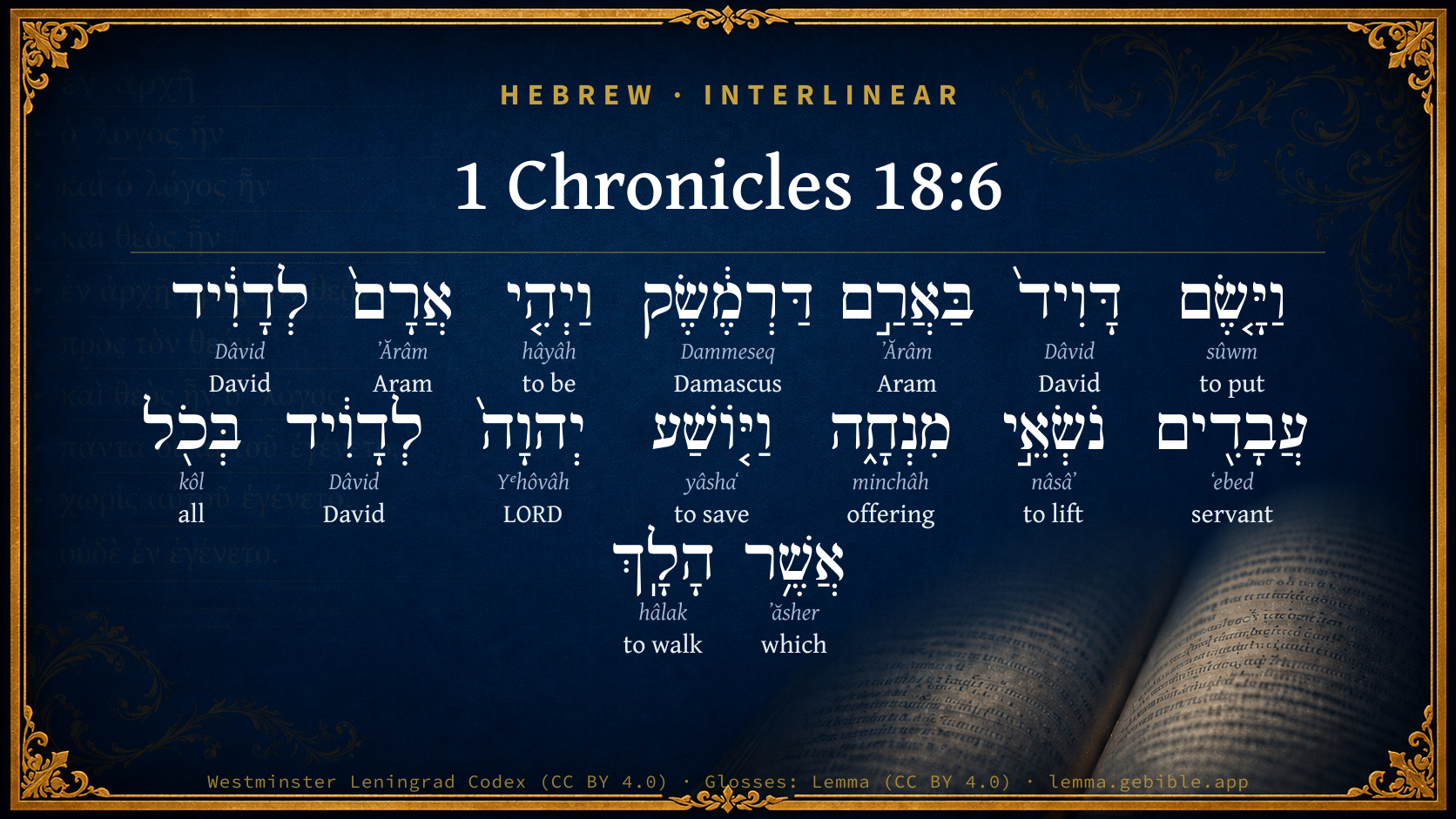
דַּרְמֶ֔שֶׂק
Dammeseq
H1834
“Damascus”
Noun, Proper
Part of Speech
Noun
Type
Proper
Full BDB Definition

Origin: of foreign origin

TWOT: None

Damascus = "silent is the sackcloth weaver" - an ancient trading city, capital of Syria, located in the plain east of Hermon, 130 (205 kilometers) miles northeast of Jerusalem
  1. וַיָּ֤שֶׂם sûwm H7760 “and · to put” Conjunction + Verb, Qal, Sequential Imperfect, 3rd Person, Masculine, Singular
  2. דָּוִיד֙ Dâvid H1732 “David” Noun, Proper
  3. בַּאֲרַ֣ם ʼĂrâm H758 “in/at · Aram” Preposition + Noun, Proper
  4. וַיְהִ֤י hâyâh H1961 “and · to be” Conjunction + Verb, Qal, Sequential Imperfect, 3rd Person, Masculine, Singular
  5. אֲרָם֙ ʼĂrâm H758 “Aram” Noun, Proper
  6. לְדָוִ֔יד Dâvid H1732 “to/for · David” Preposition + Noun, Proper
  7. עֲבָדִ֖ים ʻebed H5650 “servants” Noun, Common, Masculine, Plural, Absolute
  8. נֹשְׂאֵ֣י nâsâʼ H5375 “lifting” Verb, Qal, Participle Active, Masculine, Plural, Construct
  9. מִנְחָ֑ה minchâh H4503 “offering” Noun, Common, Feminine, Singular, Absolute
  10. וַיּ֤וֹשַׁע yâshaʻ H3467 “and · to save” Conjunction + Verb, Hiphil, Sequential Imperfect, 3rd Person, Masculine, Singular
  11. יְהוָה֙ Yᵉhôvâh H3068 “LORD” Noun, Proper
  12. לְדָוִ֔יד Dâvid H1732 “to/for · David” Preposition + Noun, Proper
  13. בְּכֹ֖ל kôl H3605 “in/at · all” Preposition + Noun, Common, Masculine, Singular, Absolute
  14. אֲשֶׁ֥ר ʼăsher H834 “which” Particle, Relative
  15. הָלָֽךְ hâlak H1980 “to walk” Verb, Qal, Perfect, 3rd Person, Masculine, Singular

About this verse

These counts appear in no published source. They are computed here, from the morphology-tagged text and Lemma’s own curated glosses. What Lemma adds →

16
words
13
distinct lemmas
Historical
section

Shared distinctive vocabulary

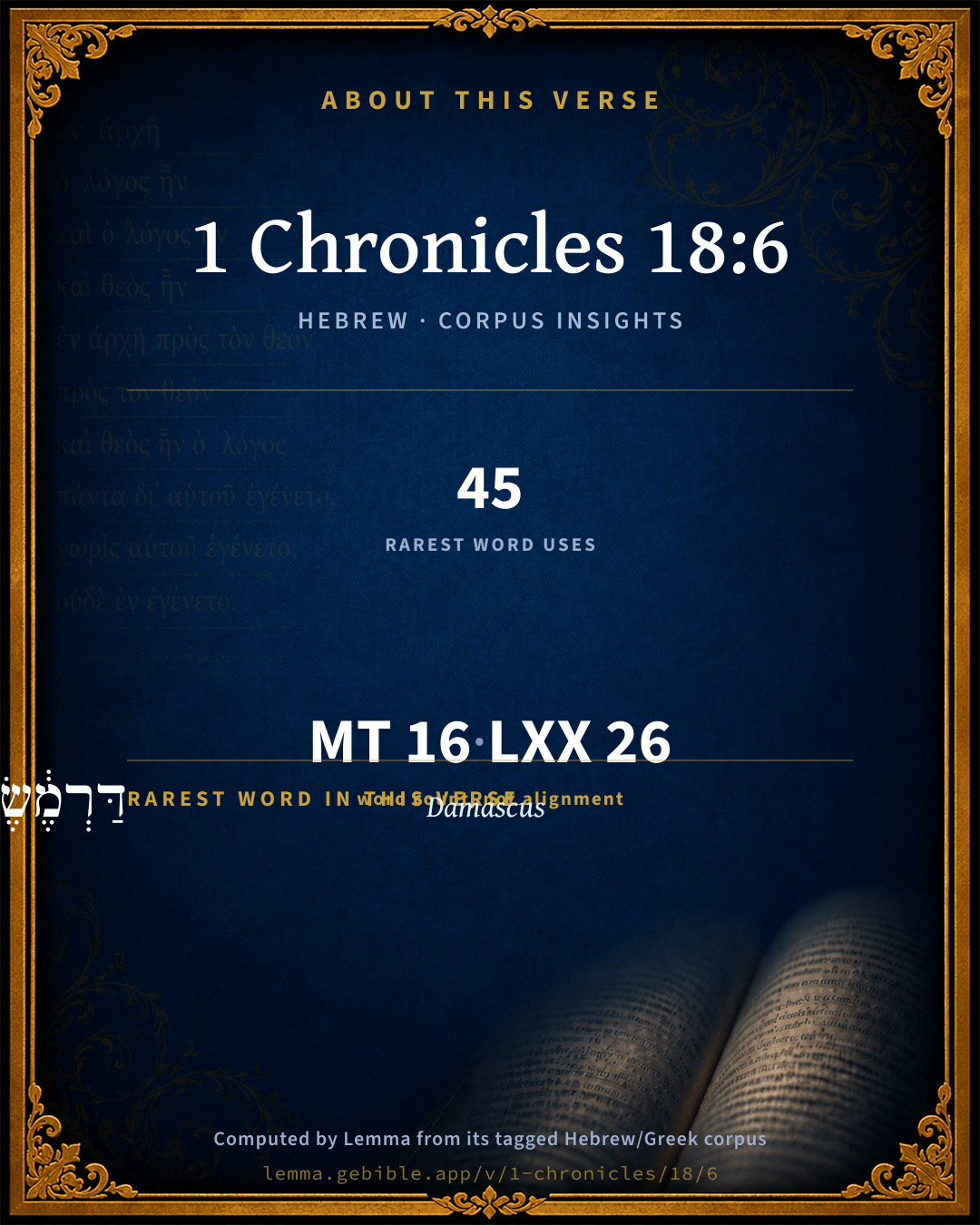
דַּרְמֶ֔שֶׂק Damascus H1834 occurs in 40 verses of the Hebrew Bible. Also found in:

Grammatical profile

  • 5 verbs
  • 10 nouns
  • 1 particle

Verb forms

  • וַיָּ֤שֶׂם Qal · Sequential Imperfect
  • וַיְהִ֤י Qal · Sequential Imperfect
  • נֹשְׂאֵ֣י Qal · Participle Active
  • וַיּ֤וֹשַׁע Hiphil · Sequential Imperfect
  • הָלָֽךְ Qal · Perfect

Repetition

Words recur within this verse — often emphatic in Hebrew:

  • דָּוִיד֙ David H1732 ×3
  • בַּאֲרַ֣ם Aram H758 ×2

Hebrew & Septuagint length

In English translation the verse runs 26 words from the Hebrew and 24 from the Septuagint (LXX English) — closely comparable.

A rough comparison of the two English renderings, which tokenize alike — not a word-level alignment.

Word counts can differ between the Hebrew and the Greek without any difference in meaning — e.g. the Hebrew direct-object marker אֵת has no separate Greek word, and Greek often adds the article ὁ.

In the original languages it is 16 Hebrew tokens and 26 Greek tokens — but the two are counted differently (Hebrew bundles its prefixes and suffixes into one token; the Greek is in lemma form), so that isn’t a like-for-like length.

Cross-references

5

Topical passages linked to 1 Chronicles 18:6 in the Treasury of Scripture Knowledge — connected by theme and wording, ordered by reader-vote popularity; previews shown in the World English Bible.

  • 1 Chronicles 17:8 and I have been with you wherever you have gone, and have cut off all your enemies from before you; and I will make you a name, like the name of the great ones who are in the earth.
  • Psalms 18:43–44 You have delivered me from the strivings of the people. You have made me the head of the nations. A people whom I have not known shall serve me.
  • Psalms 121:8 Yahweh will keep your going out and your coming in, From this time forth, and forevermore.
  • Proverbs 21:31 The horse is prepared for the day of battle; But victory is with Yahweh.
  • 1 Chronicles 18:2 He struck Moab; and the Moabites became servants to David, and brought tribute.

Cross-references courtesy of OpenBible.info (CC BY 4.0).

Hebrew and Greek witnesses Masoretic Hebrew ↔ Greek Septuagint

The same verse in the two great witnesses to the Old Testament, shown verse-for-verse.

These are two independent witnesses, not word-aligned to each other, and the Septuagint is shown in lemma (dictionary) form.

Hebrew 1 Chronicles 18:6 Masoretic · Westminster Leningrad Codex

וַיָּ֤שֶׂם דָּוִיד֙ בַּאֲרַ֣ם דַּרְמֶ֔שֶׂק וַיְהִ֤י אֲרָם֙ לְדָוִ֔יד עֲבָדִ֖ים נֹשְׂאֵ֣י מִנְחָ֑ה וַיּ֤וֹשַׁע יְהוָה֙ לְדָוִ֔יד בְּכֹ֖ל אֲשֶׁ֥ר הָלָֽךְ

Then David put [garrisons] in Syria of Damascus; and the Syrians became servants to David, and brought tribute. Yahweh gave victory to David wherever he went.

World English Bible · Public Domain

Greek LXX 1 Chronicles 18:6 Septuagint · lemma form

καί τίθημι δαυίδ φρουρά ἐν συρία ὁ κατά δαμασκός καί εἰμί ὁ δαυίδ εἰς παῖς φέρω δῶρον καί σώζω κύριος ὁ δαυίδ ἐν πᾶς ὅς πορεύομαι

And David put a garrison in Syria near Damascus; and they became tributary servants to David: and the Lord delivered David wherever he went.

LXX2012 (modern English Septuagint) · Public Domain

On this verse, Ellicott's Commentary for English Readers discusses the Septuagint’s reading. Read the note in Commentary ↓

Hebrew: Westminster Leningrad Codex (CC BY 4.0). Greek: Septuagint (public domain); English from LXX2012 (modern English Septuagint) (Public Domain). How the Septuagint differs from the Hebrew →

Commentary

Notes on 1 Chronicles 18:6 from classic Christian and Jewish commentators (each source and its license shown beneath its notes). The classic Christian expositions comment on the surrounding passage and are grouped to its opening verse, so a note may address several verses; the Jewish commentaries on the Tanakh (Rashi and others) are per-verse, so they appear only where the commentator wrote on this verse.

Lemma curates 59 commentaries, every one of them public domain or Creative Commons licensed, each selected and text-cleaned for this edition rather than reprinted as found. About our sources →

Geneva Bible (1599)

Geneva Bible translators

Or, Darmesek.

That is, in all things that he enterprised.

Geneva Bible (1599) marginal notes — public domain. Text via Bolls.life.

Ellicott's Commentary for English Readers

(6) Put garrisons.—The noun here omitted in the Hebrew, probably by an oversight, occurs in Samuel. In 1Ch_11:16 and 2Ch_17:2 it means “out post,” or “garrison;” in 1Ki_4:19, “prefects,” or “pashas.” The Targum of Samuel gives strategi, “generals;” Syriac and Arabic, “prefects” and “collectors;” LXX. and Vulg., “garrison.” The Arabic here has “collectors and guards;” the Syriac, “commanders.”

Syria-damascus.—Aram of Damascus (1Ch_18:5). (Comp. 1Ch_18:2 for the next clause.)

David’s servants.—To David servants—the order in Samuel.

Thus.—And.

Preserved.—Made victorious.

Preserved David.—Samuel has ‘eth-David—i.e., the simple accusative; Chronicles, le-David, a late construction.

Whithersoever he went.—Same phrase as in 1Ch_17:6; 1Ch_17:8.

Shields.—Shiltê. Probably “armour” or “arms.” (Comp. 2Ki_11:10; 2Ch_23:9, “the spears, and the shields, and the sh’lâtîm; “Eze_27:11; Son_4:4; Jer_51:11, “quivers.”) LXX. here, “golden collars” (Samuel, “bracelets”); Syriac and Arabic, “golden plates which hung on the horses;” Vulg., “quivers (Samuel, “golden arms”).

Hadadezer was not dethroned, but became a vassal king.

A Bible Commentary for English Readers, edited by Charles John Ellicott (1878–1897) — public domain. Text from a community e-Sword module.

The Cambridge Bible for Schools and Colleges

gen. ed. J. J. S. Perowne

6. put garrisons in Syria of Damascus] To secure his rear in any future operations towards Hamath or towards the Euphrates.

brought gifts] See note on 1Ch_18:2.

preserved David] R.V. gave victory to David.

The Cambridge Bible for Schools and Colleges (gen. ed. J. J. S. Perowne; Cambridge University Press, 1878–1918) — public domain. Text from a community e-Sword module.

Haydock's Catholic Bible Commentary

A garrison. Literally, "soldiers." This word has been lost by the neglect of some Hebrew transcriber. (Calmet) --- Protestants supply it. (Haydock)

George Leo Haydock (1774–1849), Haydock's Catholic Family Bible and Commentary, 1859 edition — public domain. Excludes Psalms (Douay-Rheims chapter numbering differs from Protestant) and Deuterocanonical books (Catholic canon only).

The Pulpit Commentary

the word "garrisons" appears in the text in the parallel place, and would be justly supplied in our Hebrew text here.

HOMILIES BY J.R. THOMSON Ver. 6.

Preservation.

The contrast between the God of the Bible and the gods of the heathen, in respect to moral character, is of the most thorough and striking kind. Amongst other noticeable points of contrast, observe this: the imaginary deities of the superstitious idolaters are usually famed and feared for their destructive qualities, whilst the Lord is ever represented as a God of salvation, delighting to preserve his people. The bloodthirsty Shiva, one of the most widely worshipped gods of the Hindus, is the destroyer. Jehovah, it is recorded, "preserved David whithersoever he went.

I THE DANGERS of ordinary human life are many. It is not only kings and warriors who are exposed to peril, though the position of monarchs exposes them to the violence of the assassin, and the occupation of the soldier is in itself a challenge to the dart of death; but in every position of life, at every age and in every clime, we walk encompassed by dangers seen and unseen.

II DIVINE PROTECTION is a truth supported by revelation. Not by reason of favouritism and caprice, not in response to any superstitious observances or entreaties, but in virtue of his own attributes, God is a Protector. He is not satisfied to create, and then to abandon what he has made. His universal providence, general and particular, is the joy and comfort of his people. It is equally shown in their prosperity and their adversity.

III Hence THE PRESERVATION OF GOD"S PEOPLE FROM HARM. He is their Shield, and Buckler, their Defence, and Fortress. He delivers their eyes from tears, their souls from death, their feet from falling. The confidence of the psalmist was signal and most instructive. (see Ps 91) It is a source of security and consolation to know that our times are in God"s hands.

An earthquake may be bid to spare The man that"s strangled with a hair.

And when Christians fall victims to the hate and hostility of sinners, or are slain by the operation of natural laws, they still have the assurance that no real evil can befall them.

Angel-guards from thee surround us; We are safe, for thou art nigh.

Well may the friend of Jesus exclaim, "I will trust and not be afraid.

IV The obligation is plain, GRATEFULLY TO ACKNOWLEDGE THE PRESERVING MERCY OF GOD. The royal psalmist was not backward in recording with adoring gratitude the delivering and upholding mercy of a faithful God. Never should we forget that he that is our God is the God of salvation. T.

HOMILIES BY R. TUCK

Vers. 6, 13.

Divine preservations in work and war.

In the record given of David"s expeditions and wars, one thing stands out prominently and impressively; it is twice repeated here, as if to it attention was to be particularly drawn: "The Lord preserved David whithersoever he went;" or, in the quaint language of Nehemiah, "The good hand of his God was upon him for good." It may be noted

I THAT DAVID WAS IN ALL THINGS GOD"S SERVANT, This relation set him in an especial manner under God"s care. As his creatures, we come under his providences. As his children, we come into the grace of his fatherly tending. And as his servants, we are assured of his safe keeping while engaged in his mission. The fuller and nearer are our relations with God, the more complete may be our security and our rest in the Divine hands. Compare the expression, "Man is immortal till his work is done." Our Lord Jesus knew that no harm could come to him while he was about "his Father"s business.

II THAT DAVID"S WHOLE LIFE WAS IN GOD"S KEEPING. Because he never broke free of the idea of service. He never wanted to isolate any part of his life, and keep it for self. It is this which alone severs a man from Divine keeping. A man"s wilfully taking his life into his own hand involves the withdrawing of special Divine grace, and then the man learns the evil of his own waywardness by the unrelieved troubles into which he falls. This is the permanent lesson for the ages taught by Eve"s wilfulness in the garden of Eden. The man who can say, "We serve the Lord Christ," and apply it to his whole time and powers and spheres, may be sure that he is altogether safe in "the secret place of the Most High, abiding under the shadow of the Almighty." The angels have charge concerning him, to keep him in all his ways. They will be so near that they shall even bear him up lest he "dash his foot against a stone.

III THIS IN NO WAY INTERFERED WITH HIS SHOWING ENERGY AND ENTERPRISE, It might seem that such assurance of Divine preservation would give a sense of security that would lead to indolence and indifference. But it never does do so, because such a temptation is resisted and overcome by the impulse to faithfulness. To look at, the good man"s life should in these respects be the same as the worldly man"s. On the surface there should be the energy, enterprise, perseverance, and skill, which are the conditions of success in worldly undertakings. The difference lies below. The good man lives and labours for God, and in his strength. The worldly man has no other end than his own fancied good. It may be fully proved and illustrated, from Bible examples, and from those of the Christian history, that full consecration to the service of God has ever been the impulse to a nobler living than any other motive can inspire men to reach. God"s servants always strive to be the best possible in every sphere where they are set.

IV IT BROUGHT DAVID STRENGTH FOR DUTY, AND BEST FOR THE HEART, TO BE ASSURED THAT GOD"S SHADOW WAS OVER HIM. Compare such expressions as, "I will both lay me down in peace and sleep: for thou, Lord, only makest me dwell in safety;" "The Lord is my light and my salvation; whom shall I fear?" And compare such experiences of strength as when fighting the lion and bear, or the giant Goliath; and such experiences of preservation as when hunted by King Saul upon the mountains. All new undertakings were entered upon with the quiet heart. God hath kept; he has promised to keep. "He that keepeth Israel neither slumbers nor sleeps.

Here meet the ever-recurring difficulty of practically fitting together man"s energy and God"s inspirations; man"s enterprise and God"s preservations; man"s free-will and God"s absolute will. Show that to the man who fully trusts, the difficulty fades away; and that, in a most real and practical sense, God"s care and preservation and grace are the sanctifying shadow under which noble lives are now lived. R.T.

The Pulpit Commentary (1880–1919), ed. H.D.M. Spence-Jones & Joseph S. Exell — public domain. Text from a community e-Sword module.

Rashi

Rabbi Shlomo Yitzchaki (Rashi)

And David placed in Aram of Damascus The meaning is [that he stationed] governors, and in II Samuel (8:6), it is stated explicitly: “And David placed governors in Aram of Damascus.”

Rashi on the Tanakh — English translations: “The Judaica Press complete Tanach with Rashi, translated by A. J. Rosenberg” (CC BY 4.0); “Pentateuch with Rashi's commentary by M. Rosenbaum and A.M. Silbermann, 1929-1934” (public domain); “The Metsudah Tanach series, Lakewood, N.J” (CC BY 4.0); and “The Book of Joshua, Metsudah Publications, 1997” (CC BY 4.0). Text via Sefaria.

Lesson kit

Teaching starters — assembled from the data on this page, not authored interpretation. Every prompt links to the verse data it draws on. Edit before teaching.

1 Chronicles, in the Historical, opens this verse with 16 words (13 distinct Hebrew lemmas). Its most distinctive word is Dammeseq (“Damascus”). A historical commentator’s framing appears above. Read the whole chapter for the surrounding context.

Discussion questions

  1. The word Dammeseq carries the sense “Damascus.” How does it shape the verse?
  2. Genesis 14:15 shares the word «Damascus» with this verse. How do the two illuminate each other?
  3. “David” occurs 3× in this one verse. What is the effect of the repetition?
  4. These translations render this verse differently; the difference is in the English rendering, not the original. What questions does that raise?
  5. The verb «וַיָּ֤שֶׂם» is Qal Sequential Imperfect. How does its form color the action?
  6. Reading how Geneva Bible (1599) and Ellicott's Commentary for English Readers read this verse, where do the two commentators agree and where do they part?

Things to notice

Reading settings

Reading text

Shown beneath each verse's original-language words.

Old Testament
Old Testament edition

Read the OT as the Masoretic Hebrew (MT) or the Greek Septuagint (LXX).

English shown for the Greek Septuagint (in the Hebrew ↔ Greek comparison).

Comparing translations? Open the Compare panel on any verse page to stack up to four side by side.