
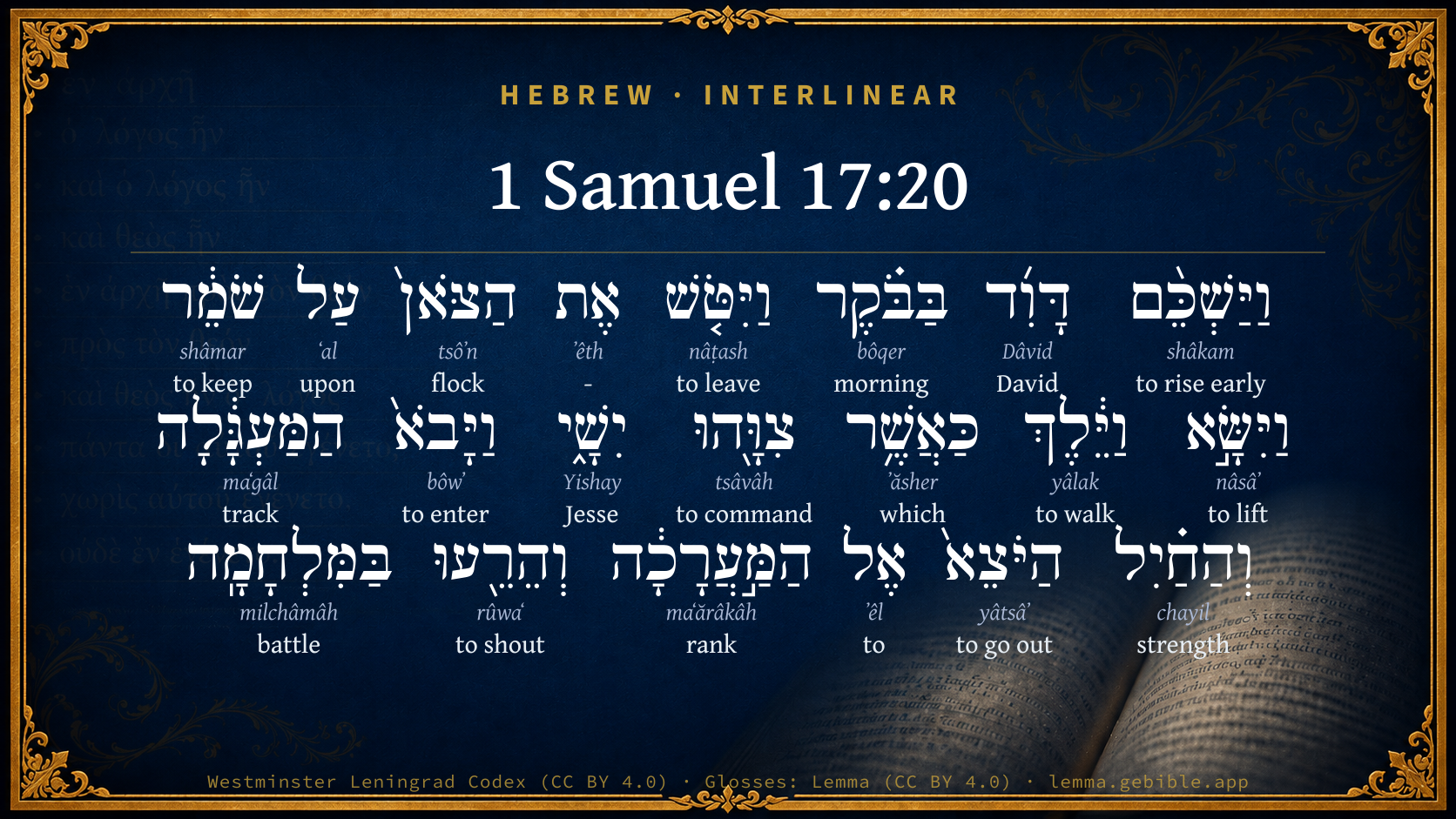
1 Samuel 17:20

Hebrew (Westminster Leningrad Codex) 1 Samuel 17:20 appears in the Hebrew Old Testament. The text above is from the Westminster Leningrad Codex. Each word links to its Strong’s number, a concise gloss, and parsing drawn from the Open Scriptures Hebrew Bible morphology. Click any word for its full Brown-Driver-Briggs (BDB) entry.
Download image
Cite this verse

1 Samuel 17:20 (World English Bible). Public Domain. Lemma interlinear Bible study tool, https://lemma.gebible.app/v/1-samuel/17/20.

Show BibTeX & RIS
BibTeX
RIS
English Translation
David rose up early in the morning, and left the sheep with a keeper, and took, and went, as Jesse had commanded him; and he came to the place of the wagons, as the host which was going forth to the fight shouted for the battle.
World English Bible · Public Domain
Highlights
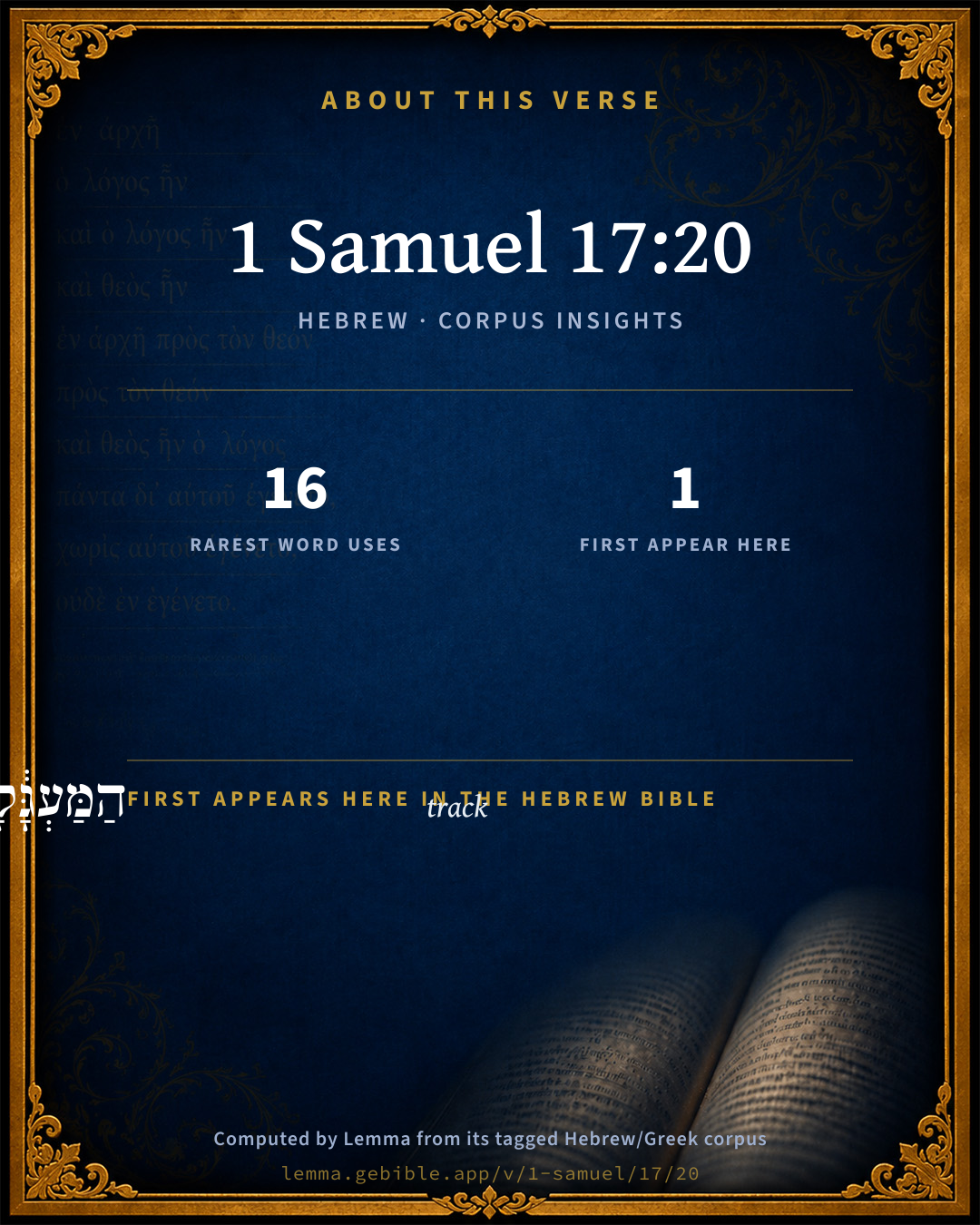
  • 1 first appearance in the Hebrew Bible
Full analysis ↓
Download a study sheet

One document with this verse’s original text, its word-by-word gloss line, the meaning frame, cross-references with their text, attributed commentary, and full source and license credits — printable, and it pastes into notes with its structure intact.

This verse Autodidact and up

Study sheet (.html) Plain text (.txt)

A passage Seminary Student

Up to 50 verses in one chapter. A passage sheet keeps up to 6 commentary sources and 12 cross-references per verse, in the order this page ranks them, and says so on the sheet whenever that leaves anything out. Ask for a single verse and you get the Autodidact verse sheet above.

Everything on this page stays free to read, with no account — the sheet is a download of what is already on screen, not access to it.

Want to remove ads? Support Godless Engineer
Compare translations 3

The same verse in 3 English versions, stacked beneath the original-language interlinear above. Click any original word for its lexicon entry.

Each is an independent rendering of the whole verse — the interlinear is not word-aligned to these translations.

Highlighted words mark where these versions differ — a whole-verse word diff, not a word-by-word alignment.

  • World English Bible Public Domain
    David rose up early in the morning, and left the sheep with a keeper, and took, and went, as Jesse had commanded him; and he came to the place of the wagons, as the host which was going forth to the fight shouted for the battle.
  • King James Version Public Domain
    And David rose up early in the morning, and left the sheep with a keeper, and took, and went, as Jesse had commanded him; and he came to the trench, as the host was going forth to the fight, and shouted for the battle.
  • unfoldingWord Literal Text CC BY-SA 4.0
    So David arose early in the morning and left the flock with a keeper. And he carried and went, just as Jesse had commanded him. And he came the wagon-track, and the army was going out to the array, and they shouted for the battle.

unfoldingWord Literal Text — © unfoldingWord, licensed CC BY-SA 4.0. Word-aligned USFM3 via Door43 (git.door43.org/unfoldingWord/en_ult).

Versions to compare (up to 4)

3 of 4 selected

Show all 18 translations

Every available English version of this verse, each an independent rendering of the whole verse.

  • World English Bible Public Domain
    David rose up early in the morning, and left the sheep with a keeper, and took, and went, as Jesse had commanded him; and he came to the place of the wagons, as the host which was going forth to the fight shouted for the battle.
  • Berean Standard Bible Public Domain
    So David got up early in the morning, left the flock with a keeper, loaded up, and set out as Jesse had instructed him. He reached the camp as the army was marching out to its position and shouting the battle cry.
  • Majority Standard Bible Public Domain
    So David got up early in the morning, left the flock with a keeper, loaded up, and set out as Jesse had instructed him. He reached the camp as the army was marching out to its position and shouting the battle cry.
  • King James Version Public Domain
    And David rose up early in the morning, and left the sheep with a keeper, and took, and went, as Jesse had commanded him; and he came to the trench, as the host was going forth to the fight, and shouted for the battle.
  • American Standard Version (1901) Public Domain
    And David rose up early in the morning, and left the sheep with a keeper, and took, and went, as Jesse had commanded him; and he came to the place of the wagons, as the host which was going forth to the fight shouted for the battle.
  • Revised Version (1885) Public Domain
    And David rose up early in the morning, and left the sheep with a keeper, and took, and went, as Jesse had commanded him; and he came to the place of the wagons, as the host which was going forth to the fight shouted for the battle.
  • Geneva Bible (1599) Public Domain
    So Dauid rose vp earely in the morning, and left the sheepe with a keeper, and tooke and went as Ishai had commanded him, and came within the compasse of the hoste: and the hoste went out in araie, and shouted in the battell.
  • Douay-Rheims (1899) Public Domain
    David therefore arose in the morning, and gave the charge of the flock to the keeper: and went away loaded as Isai had commanded him. And he came to the place of Magala, and to the army, which was going out to fight, and shouted for the battle.
  • Young's Literal Translation Public Domain
    And David riseth early in the morning, and leaveth the flock to a keeper, and lifteth up, and goeth, as Jesse commanded him, and he cometh in to the path, and to the force which is going out unto the rank, and they have shouted for battle;
  • Literal Standard Version CC BY-SA 4.0
    And David rises early in the morning, and leaves the flock to a keeper, and lifts up, and goes, as Jesse commanded him, and he comes to the path, and to the force which is going out to the rank, and they have shouted for battle;
  • Unlocked Literal Bible CC BY-SA 4.0
    David got up early in the morning and left the flock in the care of a shepherd. He took the supplies and left, as Jesse commanded him. He came to the camp as the army was going out to the battlefield shouting the war cry.
  • unfoldingWord Literal Text CC BY-SA 4.0
    So David arose early in the morning and left the flock with a keeper. And he carried and went, just as Jesse had commanded him. And he came the wagon-track, and the army was going out to the array, and they shouted for the battle.
  • Darby Bible Public Domain
    And David rose up early in the morning, and left the sheep with a keeper, and took his charge and went, as Jesse had commanded him. And he came to the wagon-defence; and the host which was going forth to the battle-array shouted for the fight.
  • World Messianic Bible Public Domain
    David rose up early in the morning and left the sheep with a keeper, and took the provisions and went, as Jesse had commanded him. He came to the place of the wagons as the army which was going out to the fight shouted for the battle.
  • Webster's Bible Public Domain
    And David rose early in the morning, and left the sheep with a keeper, and took, and went, as Jesse had commanded him; and he came to the trench, as the host was going forth to the fight, and shouted for the battle.
  • Free Bible Version CC BY-SA 4.0
    David got up early in the morning and left the flock with a shepherd. He took the supplies and set out as Jesse had told him to. He arrived at the camp just as the army was marching out to its battle line, shouting the war cry.
  • Bible in Basic English Public Domain
    And David got up early in the morning, and, giving the sheep into the care of a keeper, took the things and went as Jesse had said; and he came to the lines where the carts were, when the army was going out to the fight giving their war-cry.
  • JPS Tanakh (1917) Public Domain
    And David rose up early in the morning, and left the sheep with a keeper, and took, and went, as Jesse had commanded him; and he came to the barricade, as the host which was going forth to the fight shouted for the battle.

Literal Standard Version (2020), Covenant Press — licensed CC BY-SA 4.0. Text via the HelloAO Bible API (eBible.org). Unlocked Literal Bible (unfoldingWord) — licensed CC BY-SA 4.0. Text via the HelloAO Bible API (eBible.org). unfoldingWord Literal Text — © unfoldingWord, licensed CC BY-SA 4.0. Word-aligned USFM3 via Door43 (git.door43.org/unfoldingWord/en_ult). Free Bible Version, Dr. Jonathan Gallagher — licensed CC BY-SA 4.0. Text via the HelloAO Bible API (eBible.org).

Word by word

More ways to search: Search by grammar → Find every occurrence → Compare this word →

Practice this passage: Drill this verse → Learn its vocabulary →

הַמַּעְגָּ֔לָה
maʻgâl
H4570
“the · track · toward”
Particle, Definite Article + Noun, Common, Masculine, Singular, Absolute + Suffix, Demonstrative
Part of Speech
Particle + Noun
Type
Common
Gender
Masculine
Number
Singular
State
Absolute
Full BDB Definition

Origin: from the same as H5696

TWOT: 1560f

entrenchment, track - circumvallation, entrenchment - track
  1. וַיַּשְׁכֵּ֨ם shâkam H7925 “and · to rise early” Conjunction + Verb, Hiphil, Sequential Imperfect, 3rd Person, Masculine, Singular
  2. דָּוִ֜ד Dâvid H1732 “David” Noun, Proper
  3. בַּבֹּ֗קֶר bôqer H1242 “in/at the · morning” Preposition, Determined + Noun, Common, Masculine, Singular, Absolute
  4. וַיִּטֹּ֤שׁ nâṭash H5203 “and · to leave” Conjunction + Verb, Qal, Sequential Imperfect, 3rd Person, Masculine, Singular
  5. אֶת ʼêth H853 “-” Particle, Direct Object
  6. הַצֹּאן֙ tsôʼn H6629 “the · flock” Particle, Definite Article + Noun, Common, Both, Singular, Absolute
  7. עַל ʻal H5921 “upon” Preposition
  8. שֹׁמֵ֔ר shâmar H8104 “keeping” Verb, Qal, Participle Active, Masculine, Singular, Absolute
  9. וַיִּשָּׂ֣א nâsâʼ H5375 “and · to lift” Conjunction + Verb, Qal, Sequential Imperfect, 3rd Person, Masculine, Singular
  10. וַיֵּ֔לֶךְ yâlak H3212 “and · to walk” Conjunction + Verb, Qal, Sequential Imperfect, 3rd Person, Masculine, Singular
  11. כַּאֲשֶׁ֥ר ʼăsher H834 “like/as · which” Preposition + Particle, Relative
  12. צִוָּ֖הוּ tsâvâh H6680 “to command · him” Verb, Piel, Perfect, 3rd Person, Masculine, Singular + Suffix, Personal, 3rd Person, Masculine, Singular
  13. יִשָׁ֑י Yishay H3448 “Jesse” Noun, Proper
  14. וַיָּבֹא֙ bôwʼ H935 “and · to enter” Conjunction + Verb, Qal, Sequential Imperfect, 3rd Person, Masculine, Singular
  15. וְהַחַ֗יִל chayil H2428 “and · the · strength” Conjunction + Particle, Definite Article + Noun, Common, Masculine, Singular, Absolute
  16. הַיֹּצֵא֙ yâtsâʼ H3318 “the · going out” Particle, Definite Article + Verb, Qal, Participle Active, Masculine, Singular, Absolute
  17. אֶל ʼêl H413 “to” Preposition
  18. הַמַּ֣עֲרָכָ֔ה maʻărâkâh H4634 “the · rank” Particle, Definite Article + Noun, Common, Feminine, Singular, Absolute
  19. וְהֵרֵ֖עוּ rûwaʻ H7321 “and · to shout” Conjunction + Verb, Hiphil, Perfect, 3rd Person, Common, Plural
  20. בַּמִּלְחָמָֽה milchâmâh H4421 “in/at the · battle” Preposition, Determined + Noun, Common, Feminine, Singular, Absolute

About this verse

These counts appear in no published source. They are computed here, from the morphology-tagged text and Lemma’s own curated glosses. What Lemma adds →

21
words
21
distinct lemmas
Historical
section

Notable vocabulary

The rarest word here is הַמַּעְגָּ֔לָה track H4570 — appearing just 16 times in the whole Hebrew Bible.

First appearance in Scripture

This word makes its first canonical appearance in the Hebrew Bible here:

  • הַמַּעְגָּ֔לָה track H4570

Shared distinctive vocabulary

הַמַּעְגָּ֔לָה track H4570 occurs in 16 verses of the Hebrew Bible. Also found in:

Grammatical profile

  • 9 verbs
  • 8 nouns
  • 2 prepositions
  • 2 particles

Verb forms

  • וַיַּשְׁכֵּ֨ם Hiphil · Sequential Imperfect
  • וַיִּטֹּ֤שׁ Qal · Sequential Imperfect
  • שֹׁמֵ֔ר Qal · Participle Active
  • וַיִּשָּׂ֣א Qal · Sequential Imperfect
  • וַיֵּ֔לֶךְ Qal · Sequential Imperfect
  • צִוָּ֖הוּ Piel · Perfect
  • וַיָּבֹא֙ Qal · Sequential Imperfect
  • הַיֹּצֵא֙ Qal · Participle Active
  • וְהֵרֵ֖עוּ Hiphil · Perfect

Hebrew & Septuagint length

In English translation the verse runs 46 words from the Hebrew and 45 from the Septuagint (LXX English) — closely comparable.

A rough comparison of the two English renderings, which tokenize alike — not a word-level alignment.

Word counts can differ between the Hebrew and the Greek without any difference in meaning — e.g. the Hebrew direct-object marker אֵת has no separate Greek word, and Greek often adds the article ὁ.

Cross-references

5

Topical passages linked to 1 Samuel 17:20 in the Treasury of Scripture Knowledge — connected by theme and wording, ordered by reader-vote popularity; previews shown in the World English Bible.

  • 1 Samuel 26:5 David arose, and came to the place where Saul had encamped; and David saw the place where Saul lay, and Abner the son of Ner, the captain of his host: and Saul lay within the place of the wagons, and the people were encamped round about him.
  • Luke 19:43 For the days will come on you, when your enemies will throw up a barricade against you, surround you, hem you in on every side,
  • 1 Samuel 17:28 Eliab his eldest brother heard when he spoke to the men; and Eliab's anger was kindled against David, and he said, Why are you come down? and with whom have you left those few sheep in the wilderness? I know your pride, and the naughtiness of your heart; for you have come down that you might see the battle.
  • 1 Samuel 26:7 So David and Abishai came to the people by night: and, behold, Saul lay sleeping within the place of the wagons, with his spear stuck in the ground at his head; and Abner and the people lay round about him.
  • Ephesians 6:1–2 Children, obey your parents in the Lord, for this is right.

Cross-references courtesy of OpenBible.info (CC BY 4.0).

Hebrew and Greek witnesses Masoretic Hebrew ↔ Greek Septuagint

The same verse in the two great witnesses to the Old Testament, shown verse-for-verse.

These are two independent witnesses, not word-aligned to each other, and the Septuagint is shown in lemma (dictionary) form.

Hebrew 1 Samuel 17:20 Masoretic · Westminster Leningrad Codex

וַיַּשְׁכֵּ֨ם דָּוִ֜ד בַּבֹּ֗קֶר וַיִּטֹּ֤שׁ אֶת הַצֹּאן֙ עַל שֹׁמֵ֔ר וַיִּשָּׂ֣א וַיֵּ֔לֶךְ כַּאֲשֶׁ֥ר צִוָּ֖הוּ יִשָׁ֑י וַיָּבֹא֙ הַמַּעְגָּ֔לָה וְהַחַ֗יִל הַיֹּצֵא֙ אֶל הַמַּ֣עֲרָכָ֔ה וְהֵרֵ֖עוּ בַּמִּלְחָמָֽה

David rose up early in the morning, and left the sheep with a keeper, and took, and went, as Jesse had commanded him; and he came to the place of the wagons, as the host which was going forth to the fight shouted for the battle.

World English Bible · Public Domain

Greek LXX 1 Samuel 17:20 Septuagint · lemma form

καί λαμβάνω ὁ βακτηρία αὐτός ἐν ὁ χείρ αὐτός καί ἐκλέγω ἑαυτοῦ πέντε λίθος λεῖος ἐκ ὁ χειμάρρους καί τίθημι αὐτός ἐν ὁ κάδιον ὁ ποιμενικός ὁ εἰμί αὐτός εἰς συλλογή καί σφενδόνη αὐτός ἐν ὁ χείρ αὐτός καί προςἔρχομαι πρός ὁ ἀνήρ ὁ ἀλλόφυλος

And David rose early in the morning, and left the sheep to a keeper, and took and went as Jessae commanded him, and he came to the trench and to the army as it was going out to fight, and they shouted for the battle.

LXX2012 (modern English Septuagint) · Public Domain

Hebrew: Westminster Leningrad Codex (CC BY 4.0). Greek: Septuagint (public domain); English from LXX2012 (modern English Septuagint) (Public Domain). How the Septuagint differs from the Hebrew →

Targum (Aramaic paraphrase)

1

The Targum is the ancient Jewish Aramaic paraphrase of the Hebrew Scriptures — an interpretive translation, not the Hebrew text itself. Onkelos (literal) and Pseudo-Jonathan (expansive) render the Torah, and Jonathan the Prophets. Coverage is partial: where no permissively-licensed English translation exists for a verse, only the Aramaic is shown. This is verse-level text, not a word-by-word alignment to the Hebrew.

  1. Targum Jonathan Prophets (Joshua–Malachi)
    וְאַקְדֵם דָוִד בְּצַפְרָא וּשְׁבַק יַת עָנָא עַל נָטְרָא וּנְסִיב וַאֲזַל כְּמָה דְפַּקְדֵיהּ יִשַׁי וְאָתָא לְכַרְכּוּמָא וּמַשִׁרְיַת עָבְדֵי קְרָבָא נְפָקוּ לְסִידְרָא וְיַבִּיבוּ בִּקְרָבָא:

    (no public-domain English translation for this verse)

    Targum Jonathan — Aramaic: “Mikraot Gedolot” (public domain). English: “Sefaria Community Translation” (CC0 1.0 (public-domain dedication)); “London "Chaldee Paraphrase," 1871” (public domain). Text via Sefaria.

Commentary

Notes on 1 Samuel 17:20 from classic Christian and Jewish commentators (each source and its license shown beneath its notes). The classic Christian expositions comment on the surrounding passage and are grouped to its opening verse, so a note may address several verses; the Jewish commentaries on the Tanakh (Rashi and others) are per-verse, so they appear only where the commentator wrote on this verse.

Lemma curates 59 commentaries, every one of them public domain or Creative Commons licensed, each selected and text-cleaned for this edition rather than reprinted as found. About our sources →

Trapp's Complete Commentary

John Trapp

1Sa 17:20 And David rose up early in the morning, and left the sheep with a keeper, and took, and went, as Jesse had commanded him; and he came to the trench, as the host was going forth to the fight, and shouted for the battle.

Ver. 20. And left the sheep with a keeper.] A commendable care: neither was there cause that Eliab should so check and chide him for the contrary. {1Sa 17:28}

And shouted for the battle.] This was the old way of beginning the fight: so to show their courage, and to fright the enemy.

John Trapp, A Commentary or Exposition upon All the Books of the Old and New Testament (1647–1656) — public domain. Text from a community e-Sword module.

Joseph Benson's Commentary

1Sa 17:20-22. He came to the trench — Probably the carriages wherewith the host was surrounded. As the host was going forth to the fight — Jesse little thought of sending his son to the camp just at that critical juncture. But the wise God orders the time and all the circumstances of affairs so as to serve the designs of his own glory. David left his carriage, &c. — He left the provision which his father had sent his brethren with some proper person, it being not a time to present it to them when the armies were just going to engage. And ran into the army — Eager to know what was doing there, being deeply concerned for the success of Israel, and desirous of seeing and speaking with his brethren before the commencement of the battle; for possibly it might be the last time he should ever converse with them or see them alive.

Joseph Benson's Commentary on the Old and New Testaments (1811–1818) — public domain. Text from a community e-Sword module.

The Pulpit Commentary

CHAPTER 17:20-58

Vers. 20-22. He came to the trench. More probably the barricade, or outer circle of defence for their camp, made of their wagons (see on ch. 10:22). Strictly the word means a wagon track, but the primary meaning of the verb is to be round. This was the shape of camps in old time, and they were protected against surprise by having the wagons and baggage placed round them. The word occurs again in 1Sa_26:5, 1Sa_26:7. The latter part of the verse is literally, "And he came to the circle of the wagons, and to the host that was going forth to the array; and they shouted for the battle." If the article be omitted before "going forth," for which there is some authority, the rendering of the A.V would be right. David left his carriage. Ie. that which he was carrying. The word is rendered stuff in 1Sa_10:22 1Sa_25:13 1Sa_30:24. Literally the word means utensils, and so whatever he had with him for any purpose. (comp. Act_21:15) Ran into the army. Literally, "to the array," "to the ranks," the place where the troops were drawn up (see ver. 10).

Vers. 20-30.

A religious man"s view of things.

The facts are

1. David arrives at the camp just as preparations are being made for battle.

2. While with his brethren he hears the defiance of Goliath, and observesthe dismay of Israel.

3. Being informed of the inducement offered by Saul for any one to slayGoliath, he makes particular inquiries as to the facts, and suggests the vanity of the defiance.

4. His inquiries arouse the jealousy of Eliab, who imputes to him unhallowed motives.

5. Nevertheless, David persists in his attention to the matter. Thepusillanimity of the entire army seems to have been accepted by Saul as quite reasonable in presence of such a foe. David"s converse with the men revealed a remarkable unanimity of sentiment among them. Estimated by the ordinary maxims of war during times when brute force in individual conflict decided the day, there was, indeed, small chance for a dwarf against a giant. The embarrassment was great, natural, and irremovable. But from the moment of David"s arrival this condition of things appeared to him unreasonable. Coming fresh from the fold, unfamiliar with the ordinary rules of armed warfare, and interpreting facts by principles acquired elsewhere than in the camp and among pusillanimous men, he marvelled at the dismay of Israel, and dared to be singular in his opinion that the giant was not to be dreaded. Events from a religious point of view assume a different aspect. Notice

I AN EMINENTLY RELIGIOUS MAN"S IMPRESSIONS OF FORMIDABLE DIFFICULTIES. David was at this time, in comparison with others, eminently religious. The facts of life impress us according to. sentiments and views already entertained. When, therefore, this devout, God-fearing youth looked on the conflict, he saw it with eyes full of religious light. He felt that the entire army was wrong in feeling and opinion. The principle holds good in other applications. The eminently religious get an impression of the world peculiar to their refined spiritual condition. The most conspicuous instance of this is in the case of the holy Saviour. Coming from the pure, loving sphere of heaven, more sweet and restful than David"s rural pastures, how different would the earth, with its conflicts, cares, and woes, appear to him as compared with their impression on men! Holy men see the world with new eyes when they descend from some mount of transfiguration. No wonder if some highly purified and trustful souls, looking on the fear and inactivity of professed followers of Christ, are disgusted and ashamed at the lack of hope and confidence. If we have the "mind of Christ," fresh, pure, deep in conviction of God"s all-wise and mighty will, toned with pity, and elevated by undying hope, we shall often get impressions of our surroundings which may make us singular, but which, nevertheless, will be just.

II AN EMINENTLY RELIGIOUS MAN WILL NOT HESITATE TO INDICATE AND JUSTIFY HIS IMPRESSIONS. The clear, truthful eyes of the shepherd youth saw the world through a Divine medium, and, with all the sincerity of goodness and force of deep conviction, he was not afraid to let it be known that he differed from others. Who is this Philistine?" He defy the "armies of the living God! The fire burned; he could not but speak. To him it was a most abhorrent thought that any one could dare to assert his strength against God. It is obvious that David reduced. the whole situation to a question of first principles. He remembered who the Philistine was in the sight of God, and what the meaning of Israel"s existence in the great purpose of redemption. The fear of Israel he referred to loss of faith in the people"s mission to the world, and in God as the perfecter of that mission. Illustrations of the same course are elsewhere found. True religious enlightenment must express itself in some form. The holy cannot look on life and be silent. Our Saviour"s words and deeds were largely the expression of the effect of man"s condition upon his nature. It is especially important to remember this reference to first principles in their application to

1. The sorrows and woes of mankind through sin. We cannot solve the mystery of evil, but can fall back on the primary truth that God is good and wise, and therefore his government in the end will be justified.

2. The prevalent habits of the world. We must not fail to trace them to radical alienation from God, and apply the only radical cure, renewal of nature by the Spirit of God.

3. The obstacles in the way of Christ"s triumph. They are real as facts, but we must justify our faith in their removal by indicating their essentially transitory character in contrast with the "everlasting strength" of our God.

III A RELIGIOUS MAN IN GIVING EFFECT TO HIS IMPRESSIONS MAY BE MISREPRESENTED. David"s pure mind was charged with vanity and idle curiosity (ver. 28). The accusation was the more painful in coming from a brother. Jealousy creates a jaundiced medium through which the holiest and most beautiful things appear hideous. A greater than David was also reviled, and his most holy and blessed words and deeds associated with the most wicked of origins. (Mar_3:22; Joh_10:20) Pliny and Tacitus, judicious men of the world, could not appreciate the opinions and motives of the early Christians. Even now strong faith in God, and belief that all obstacles to the progress of Christianity will give way because essentially human, is regarded as fanaticism. Even among some professed believers in Christ those are held to be too sanguine who feel sure that the most formidable of modem giants is as nothing before the mighty power which somehow will sweep it away. Be it so; time will show.

General lessons:

1. Clearness of vision on religious matters, and indirectly on all, is a result of superior devoutness of spirit.

2. "We never need fear being singular when sustained by a clear conscienceand the approval of God.

3. The earnest convictions and simple faith of one man may, in theprovidence of God, work a revolution in popular thought.

4. We give value to our religious convictions when they are indicated withcandour and are sustained by simplicity and purity of life.

5. A love of detraction and petty fault finding, while it does not reallyinjure the devoted who are its object, debases those who indulge in them.

The Pulpit Commentary (1880–1919), ed. H.D.M. Spence-Jones & Joseph S. Exell — public domain. Text from a community e-Sword module.

Jamieson, Fausset & Brown

Robert Jamieson, A. R. Fausset & David Brown

David left the sheep with a keeper--This is the only instance in which the hired shepherd is distinguished from the master or one of his family.

trench--some feeble attempt at a rampart. It appears (see Margin) to have been formed by a line of carts or chariots, which, from the earliest times, was the practice of nomad people.

Jamieson, Fausset & Brown — Commentary Critical and Explanatory on the Whole Bible (1871) — public domain (CC PDM 1.0). Text via the HelloAO Bible API.

Ellicott's Commentary for English Readers

(20) He came to the trench.—Literally, to the wagon rampart; a circle of wagons formed a rude fortification about the camp of Israel. There—that is, within the fortified enclosure—he left (1Sa_17:22) his baggage, the ten cheeses, &c, and hastened to the “front,” where he knew his brethren and the men of Judah would be posted. (See Num_10:14.)

A Bible Commentary for English Readers, edited by Charles John Ellicott (1878–1897) — public domain. Text from a community e-Sword module.

The Cambridge Bible for Schools and Colleges

gen. ed. J. J. S. Perowne

20. the trench] The word may mean either, (a) the circular rampart round the camp; or (b) a barrier formed by the baggage waggons round the camp; or (c) the place where the baggage waggons of the army were kept. It occurs again in 1Sa_26:5; 1Sa_26:7.

shouted for the battle] Raised the ‘slogan’ or war-cry, like Gideon’s “For the Lord and for Gideon” (Jdg_7:18). Cp. Jos_6:5 ff.

The Cambridge Bible for Schools and Colleges (gen. ed. J. J. S. Perowne; Cambridge University Press, 1878–1918) — public domain. Text from a community e-Sword module.

John Gill's Exposition

And David rose up early in the morning,.... Being very ready and eager to obey his father's orders, and visit his brethren:

and left the sheep with a keeper; which showed his care and faithfulness in the discharge of his office; he was not unmindful of his father's sheep, any more than of his commands:

and took; the ephah of parched corn, the ten loaves, and the ten cheeses:

and went, as Jesse had commanded him; went and carried them to the camp, according to his orders:

and he came to the trench; foss or ditch, which was cast up all around the army, partly to prevent the enemy falling on them before, and partly to prevent deserters from them behind; or the word signifying a wagon or carriage, which is here used, this might be a fence around the camp made of wagons fastened to each other; though it may only signify, the camp itself, which lay in a circular form, with proper guards about it to watch the enemy. Now David came up to it just

as the host was going forth to the fight; preparing and getting every thing ready to the battle, and in motion, and upon the march to meet the enemy:

and shouted for the battle; which was usually done when about to make the onset, to animate the soldiers, and strike the greater terror into the enemy; and this noise was sometimes made with the voice in a hideous and howling way, and was called "barritus" (a) by the Romans; with the Trojans it was like the noise of cranes in the air (b); it was also attended with the clashing of shields and spears (c); with the Persians, it was a rough, boisterous, and confused noise (d).

(a) Vid. Valtrimum de re militar. Roman. l. 5. c. 3. p. 314, 315. & A. Gell. Noct. Attic. l. 1. c. 11. (b) Homer. Iliad. 3. ver. 1, 2, 3. (c) Vid. Lydium de re militari, l. 4. c. 3. p. 158, 159. (d) Curt. Hist. l. 3. c. 10. Vid. Alex. ab Alex. Genial. Dier. l. 4. c. 7.

John Gill's Exposition of the Whole Bible (1746–1763) — public domain (CC PDM 1.0). Text via the HelloAO Bible API.

Albert Barnes' Notes on the Bible

The trench - Rather, “the wagons,” which were all put together in the camp so as to form a kind of bulwark or fortification (see 1Sa 26:5, 1Sa 26:7). Here David left his “carriage” 1Sa 17:22, i. e., the things which he had carried, “his things” as we should say, or baggage (translated stuff in 1Sa 10:22; 1Sa 25:13; 1Sa 30:24). There seems to have been an officer (“the keeper,” 1Sa 17:22) in the Hebrew army whose charge it was to guard the baggage.

Albert Barnes' Notes on the Bible (1834–1885) — public domain. Text from a community e-Sword/MySword module.

Haydock's Catholic Bible Commentary

Magala signifies, "the circle, or chariots." The Arabs still place their waggons and baggage round the camp, or in a circle. (Calmet) --- It may also be a proper name. (Menochius)

George Leo Haydock (1774–1849), Haydock's Catholic Family Bible and Commentary, 1859 edition — public domain. Excludes Psalms (Douay-Rheims chapter numbering differs from Protestant) and Deuterocanonical books (Catholic canon only).

Matthew Poole's English Annotations

To the trench, i.e. to the camp or army which was there intrenched.

Shouted for the battle; as the manner was, both to animate themselves, and to terrify their enemies.

Matthew Poole's English Annotations on the Holy Bible (1683–1685) — public domain. Text from a community e-Sword/MySword module.

Whedon's Commentary on the Bible

Daniel D. Whedon

20. The trench — המעגלה, the wagon rampart. The barrier formed around the encampment by the baggage wagons and other vehicles of the army.

The host was going forth to the fight — That is, they were marching out of the camp to put themselves in battle array.

Shouted for the battle — Raised the war cry. Neither of these expressions implies that the armies engaged in actual conflict, as some objectors have absurdly assumed. This appears still more clearly in the following verse.

Daniel D. Whedon (gen. ed.), Commentary on the Old and New Testaments (1874–1909) — public domain. Text from a community e-Sword module.

John Wesley's Explanatory Notes

Went, &c. - Jesse little thought of sending his son to the camp, just at that critical juncture. But the wise God orders the time and all the circumstances of affairs, so as to serve the designs of his own glory.

John Wesley, Explanatory Notes Upon the Whole Bible (1754–1765) — public domain. Text via the GEBible commentary corpus.

Rashi

Rabbi Shlomo Yitzchaki (Rashi)

To the barricade. They would form a circle around the camp, and whoever would go out [of the circle], either in front of, or behind the camp, would be endangered; in front [of the circle] he might be attacked by the men of the enemy armies, and behind [the circle] because he [apparently] seeks to desert.

Rashi on the Tanakh — English translations: “The Judaica Press complete Tanach with Rashi, translated by A. J. Rosenberg” (CC BY 4.0); “Pentateuch with Rashi's commentary by M. Rosenbaum and A.M. Silbermann, 1929-1934” (public domain); “The Metsudah Tanach series, Lakewood, N.J” (CC BY 4.0); and “The Book of Joshua, Metsudah Publications, 1997” (CC BY 4.0). Text via Sefaria.

Lesson kit

Teaching starters — assembled from the data on this page, not authored interpretation. Every prompt links to the verse data it draws on. Edit before teaching.

1 Samuel, in the Historical, opens this verse with 21 words (21 distinct Hebrew lemmas). Its most distinctive word is maʻgâl (“track”). A historical commentator’s framing appears above. Read the whole chapter for the surrounding context.

Discussion questions

  1. How does “track” (maʻgâl) shape what this verse is saying?
  2. The word “track” first appears here in Scripture. What is being introduced at this debut?
  3. 1 Samuel 26:5 shares the word «track» with this verse. How do the two illuminate each other?
  4. The translations on this page render this verse differently — a whole-verse word diff, not a word-by-word alignment. What might account for the different wordings?
  5. The verb «וַיַּשְׁכֵּ֨ם» is Hiphil Sequential Imperfect. How does its form color the action?
  6. Reading how Trapp's Complete Commentary and Joseph Benson's Commentary read this verse, where do the two commentators agree and where do they part?

Things to notice

Reading settings

Reading text

Shown beneath each verse's original-language words.

Old Testament
Old Testament edition

Read the OT as the Masoretic Hebrew (MT) or the Greek Septuagint (LXX).

English shown for the Greek Septuagint (in the Hebrew ↔ Greek comparison).

Comparing translations? Open the Compare panel on any verse page to stack up to four side by side.