
Deuteronomy 24:15

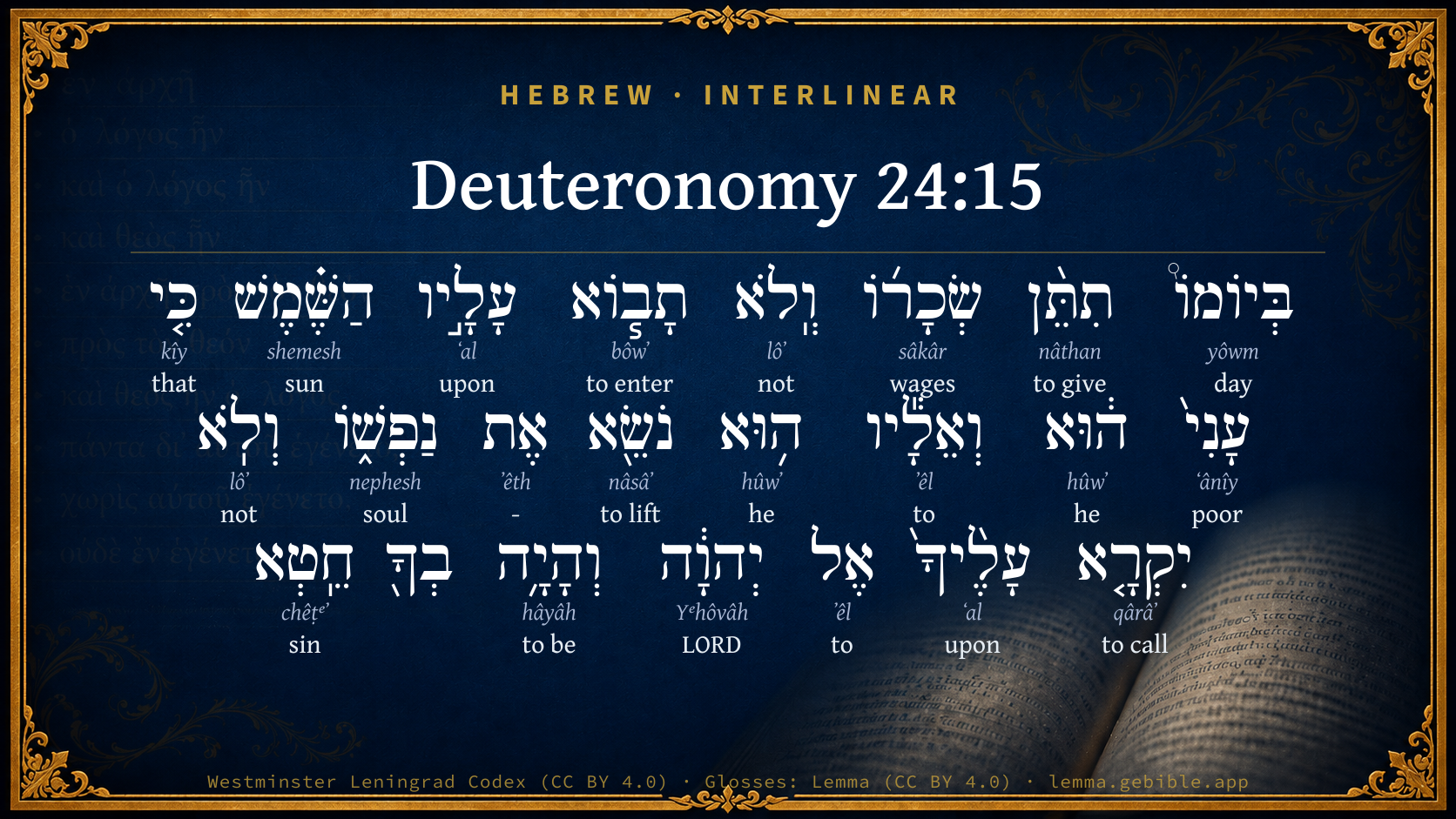
Hebrew (Westminster Leningrad Codex) Deuteronomy 24:15 appears in the Hebrew Old Testament. The text above is from the Westminster Leningrad Codex. Each word links to its Strong’s number, a concise gloss, and parsing drawn from the Open Scriptures Hebrew Bible morphology. Click any word for its full Brown-Driver-Briggs (BDB) entry.
Download image
Cite this verse

Deuteronomy 24:15 (World English Bible). Public Domain. Lemma interlinear Bible study tool, https://lemma.gebible.app/v/deuteronomy/24/15.

Show BibTeX & RIS
BibTeX
RIS
English Translation
in his day you shall give him his hire, neither shall the sun go down on it; for he is poor, and sets his heart on it: lest he cry against you to Yahweh, and it be sin to you.
World English Bible · Public Domain
Download a study sheet

One document with this verse’s original text, its word-by-word gloss line, the meaning frame, cross-references with their text, attributed commentary, and full source and license credits — printable, and it pastes into notes with its structure intact.

This verse Autodidact and up

Study sheet (.html) Plain text (.txt)

A passage Seminary Student

Up to 50 verses in one chapter. A passage sheet keeps up to 6 commentary sources and 12 cross-references per verse, in the order this page ranks them, and says so on the sheet whenever that leaves anything out. Ask for a single verse and you get the Autodidact verse sheet above.

Everything on this page stays free to read, with no account — the sheet is a download of what is already on screen, not access to it.

Want to remove ads? Support Godless Engineer
Compare translations 3

The same verse in 3 English versions, stacked beneath the original-language interlinear above. Click any original word for its lexicon entry.

Each is an independent rendering of the whole verse — the interlinear is not word-aligned to these translations.

Highlighted words mark where these versions differ — a whole-verse word diff, not a word-by-word alignment.

  • World English Bible Public Domain
    in his day you shall give him his hire, neither shall the sun go down on it; for he is poor, and sets his heart on it: lest he cry against you to Yahweh, and it be sin to you.
  • King James Version Public Domain
    At his day thou shalt give him his hire, neither shall the sun go down upon it; for he is poor, and setteth his heart upon it: lest he cry against thee unto the LORD, and it be sin unto thee.
  • unfoldingWord Literal Text CC BY-SA 4.0
    In his day you shall give his wage, and the sun shall not go down on it, for he poor and he lifts up his life to it. Then he will not call against you to Yahweh and have it be for you a sin.

unfoldingWord Literal Text — © unfoldingWord, licensed CC BY-SA 4.0. Word-aligned USFM3 via Door43 (git.door43.org/unfoldingWord/en_ult).

Versions to compare (up to 4)

3 of 4 selected

Show all 18 translations

Every available English version of this verse, each an independent rendering of the whole verse.

  • World English Bible Public Domain
    in his day you shall give him his hire, neither shall the sun go down on it; for he is poor, and sets his heart on it: lest he cry against you to Yahweh, and it be sin to you.
  • Berean Standard Bible Public Domain
    You are to pay his wages each day before sunset, because he is poor and depends on them. Otherwise he may cry out to the LORD against you, and you will be guilty of sin.
  • Majority Standard Bible Public Domain
    You are to pay his wages each day before sunset, because he is poor and depends on them. Otherwise he may cry out to the LORD against you, and you will be guilty of sin.
  • King James Version Public Domain
    At his day thou shalt give him his hire, neither shall the sun go down upon it; for he is poor, and setteth his heart upon it: lest he cry against thee unto the LORD, and it be sin unto thee.
  • American Standard Version (1901) Public Domain
    in his day thou shalt give him his hire, neither shall the sun go down upon it; for he is poor, and setteth his heart upon it: lest he cry against thee unto Jehovah, and it be sin unto thee.
  • Revised Version (1885) Public Domain
    in his day thou shalt give him his hire, neither shall the sun go down upon it; for he is poor, and setteth his heart upon it: lest he cry against thee unto the LORD, and it be sin unto thee.
  • Geneva Bible (1599) Public Domain
    Thou shalt giue him his hire for his day, neither shall the sunne goe downe vpon it: for he is poore, and therewith susteineth his life: lest he crye against thee vnto the Lord, and it be sinne vnto thee.
  • Douay-Rheims (1899) Public Domain
    But thou shalt pay him the price of his labour the same day, before the going down of the sun, because he is poor, and with it maintaineth his life: lest he cry against thee to the Lord, and it be reputed to thee for a sin.
  • Young's Literal Translation Public Domain
    in his day thou dost give his hire, and the sun doth not go in upon it, for he `is' poor, and unto it he is lifting up his soul, and he doth not cry against thee unto Jehovah, and it hath been in thee -- sin.
  • Literal Standard Version CC BY-SA 4.0
    you give his hire in his day, and the sun does not go in on it, for he [is] poor, and he is supporting his life on it, lest he cries against you to YHWH, and it has been sin in you.
  • Unlocked Literal Bible CC BY-SA 4.0
    Each day you must give him his wage; the sun must not go down on this unsettled matter, for he is poor and is counting on it. Do this so that he does not cry out against you to Yahweh, and so that it not be a sin that you have committed.
  • unfoldingWord Literal Text CC BY-SA 4.0
    In his day you shall give his wage, and the sun shall not go down on it, for he poor and he lifts up his life to it. Then he will not call against you to Yahweh and have it be for you a sin.
  • Darby Bible Public Domain
    on his day thou shalt give him his hire, neither shall the sun go down upon it; for he is poor, and his soul yearneth after it; lest he cry against thee to Jehovah, and it be a sin in thee.
  • World Messianic Bible Public Domain
    In his day you shall give him his wages, neither shall the sun go down on it, for he is poor and sets his heart on it, lest he cry against you to the LORD, and it be sin to you.
  • Webster's Bible Public Domain
    At his day thou shalt give him his hire, neither shall the sun go down upon it, for he is poor, and setteth his heart upon it: lest he should cry against thee to the LORD, and it be sin to thee.
  • Free Bible Version CC BY-SA 4.0
    Pay his wages every day before sunset, because he is poor and is relying on them. If you don't he may complain to the Lord about you, and you will be found guilty of sin.
  • Bible in Basic English Public Domain
    Give him his payment day by day, not keeping it back over night; for he is poor and his living is dependent on it; and if his cry against you comes to the ears of the Lord, it will be judged as sin in you.
  • JPS Tanakh (1917) Public Domain
    In the same day thou shalt give him his hire, neither shall the sun go down upon it; for he is poor, and setteth his heart upon it: lest he cry against thee unto the LORD and it be sin in thee.

Literal Standard Version (2020), Covenant Press — licensed CC BY-SA 4.0. Text via the HelloAO Bible API (eBible.org). Unlocked Literal Bible (unfoldingWord) — licensed CC BY-SA 4.0. Text via the HelloAO Bible API (eBible.org). unfoldingWord Literal Text — © unfoldingWord, licensed CC BY-SA 4.0. Word-aligned USFM3 via Door43 (git.door43.org/unfoldingWord/en_ult). Free Bible Version, Dr. Jonathan Gallagher — licensed CC BY-SA 4.0. Text via the HelloAO Bible API (eBible.org).

Word by word

More ways to search: Search by grammar → Find every occurrence → Compare this word →

Practice this passage: Drill this verse → Learn its vocabulary →

שְׂכָר֜וֹ
sâkâr
H7939
“wages · his”
Noun, Common, Masculine, Singular, Construct + Suffix, Personal, 3rd Person, Masculine, Singular
Part of Speech
Noun
Type
Common
Gender
Masculine
Number
Singular
State
Construct
Full BDB Definition

Origin: from H7936

TWOT: 2264 . 1b

hire, wages - wages - reward, pay - fare, fee, passage-money
  1. בְּיוֹמוֹ֩ yôwm H3117 “in/at · day · his” Preposition + Noun, Common, Masculine, Singular, Construct + Suffix, Personal, 3rd Person, Masculine, Singular
  2. תִתֵּ֨ן nâthan H5414 “to give” Verb, Qal, Imperfect, 2nd Person, Masculine, Singular
  3. וְֽלֹא lôʼ H3808 “and · not” Conjunction + Particle, Negative
  4. תָב֧וֹא bôwʼ H935 “to enter” Verb, Qal, Imperfect, 3rd Person, Feminine, Singular
  5. עָלָ֣יו ʻal H5921 “upon · him” Preposition + Suffix, Personal, 3rd Person, Masculine, Singular
  6. הַשֶּׁ֗מֶשׁ shemesh H8121 “the · sun” Particle, Definite Article + Noun, Common, Both, Singular, Absolute
  7. כִּ֤י kîy H3588 “that” Conjunction
  8. עָנִי֙ ʻânîy H6041 “poor” Adjective, Adjective, Masculine, Singular, Absolute
  9. ה֔וּא hûwʼ H1931 “he” Pronoun, Personal, 3rd Person, Masculine, Singular
  10. וְאֵלָ֕יו ʼêl H413 “and · to · him” Conjunction + Preposition + Suffix, Personal, 3rd Person, Masculine, Singular
  11. ה֥וּא hûwʼ H1931 “he” Pronoun, Personal, 3rd Person, Masculine, Singular
  12. נֹשֵׂ֖א nâsâʼ H5375 “lifting” Verb, Qal, Participle Active, Masculine, Singular, Absolute
  13. אֶת ʼêth H853 “-” Particle, Direct Object
  14. נַפְשׁ֑וֹ nephesh H5315 “soul · his” Noun, Common, Both, Singular, Construct + Suffix, Personal, 3rd Person, Masculine, Singular
  15. וְלֹֽא lôʼ H3808 “and · not” Conjunction + Particle, Negative
  16. יִקְרָ֤א qârâʼ H7121 “to call” Verb, Qal, Imperfect, 3rd Person, Masculine, Singular
  17. עָלֶ֨יךָ֙ ʻal H5921 “upon · you” Preposition + Suffix, Personal, 2nd Person, Masculine, Singular
  18. אֶל ʼêl H413 “to” Preposition
  19. יְהוָ֔ה Yᵉhôvâh H3068 “LORD” Noun, Proper
  20. וְהָיָ֥ה hâyâh H1961 “and · to be” Conjunction + Verb, Qal, Sequential Perfect, 3rd Person, Masculine, Singular
  21. חֵֽטְא chêṭᵉʼ H2399 “sin” Noun, Common, Masculine, Singular, Absolute

About this verse

These counts appear in no published source. They are computed here, from the morphology-tagged text and Lemma’s own curated glosses. What Lemma adds →

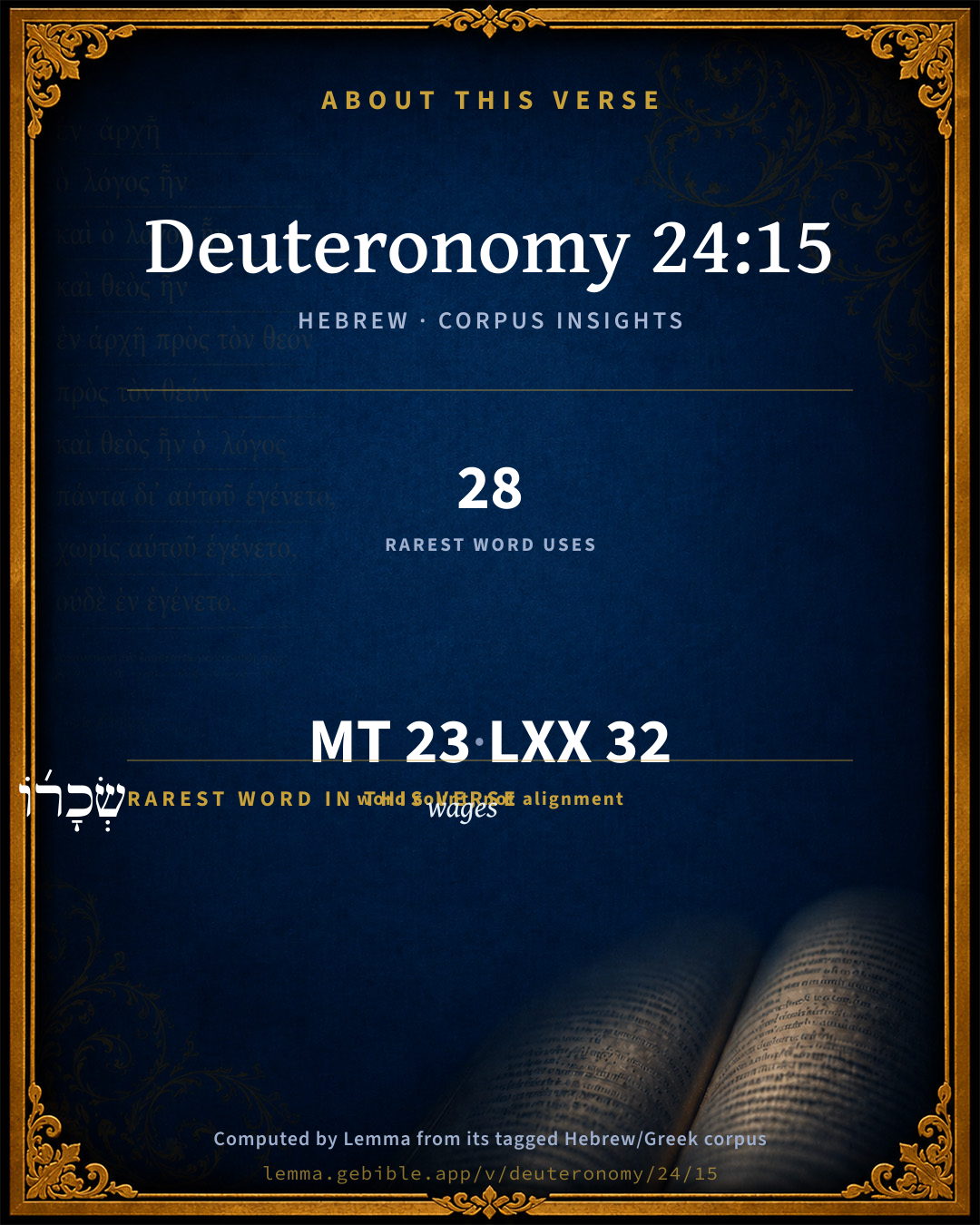
23
words
18
distinct lemmas
Pentateuch
section

Shared distinctive vocabulary

שְׂכָר֜וֹ wages H7939 occurs in 25 verses of the Hebrew Bible. Also found in:

Grammatical profile

  • 5 verbs
  • 6 nouns
  • 1 adjective
  • 2 pronouns
  • 5 prepositions
  • 1 conjunction
  • 3 particles

Verb forms

  • תִתֵּ֨ן Qal · Imperfect
  • תָב֧וֹא Qal · Imperfect
  • נֹשֵׂ֖א Qal · Participle Active
  • יִקְרָ֤א Qal · Imperfect
  • וְהָיָ֥ה Qal · Sequential Perfect

Repetition

Words recur within this verse — often emphatic in Hebrew:

  • עָלָ֣יו upon H5921 ×2
  • וְֽלֹא not H3808 ×2
  • ה֔וּא he H1931 ×2
  • וְאֵלָ֕יו to H413 ×2

Hebrew & Septuagint length

In English translation the verse runs 40 words from the Hebrew and 32 from the Septuagint (LXX English) — closely comparable.

A rough comparison of the two English renderings, which tokenize alike — not a word-level alignment.

Word counts can differ between the Hebrew and the Greek without any difference in meaning — e.g. the Hebrew direct-object marker אֵת has no separate Greek word, and Greek often adds the article ὁ.

In the original languages it is 23 Hebrew tokens and 32 Greek tokens — but the two are counted differently (Hebrew bundles its prefixes and suffixes into one token; the Greek is in lemma form), so that isn’t a like-for-like length.

Cross-references

17

Topical passages linked to Deuteronomy 24:15 in the Treasury of Scripture Knowledge — connected by theme and wording, ordered by reader-vote popularity; previews shown in the World English Bible.

  • Leviticus 19:13 "'You shall not oppress your neighbor, nor rob him. The wages of a hired servant shall not remain with you all night until the morning.
  • Proverbs 3:27–28 Don't withhold good from those to whom it is due, When it is in the power of your hand to do it.
  • James 5:4 Behold, the wages of the laborers who mowed your fields, which you have kept back by fraud, cry out, and the cries of those who reaped have entered into the ears of the Lord of Hosts.
  • Jeremiah 22:13 Woe to him who builds his house by unrighteousness, and his chambers by injustice; who uses his neighbor's service without wages, and doesn't give him his hire;
  • Deuteronomy 15:9 Beware that there not be a base thought in your heart, saying, The seventh year, the year of release, is at hand; and your eye be evil against your poor brother, and you give him nothing; and he cry to Yahweh against you, and it be sin to you.
  • Exodus 22:23–24 If you take advantage of them at all, and they cry at all to me, I will surely hear their cry;
  • Job 35:9 "By reason of the multitude of oppressions they cry out; They cry for help by reason of the arm of the mighty.
  • Job 34:28 So that they caused the cry of the poor to come to him, He heard the cry of the afflicted.
  • Job 31:38 If my land cries out against me, And the furrows of it weep together;
  • Psalms 24:4 He who has clean hands and a pure heart; Who has not lifted up his soul to falsehood, And has not sworn deceitfully.
  • Psalms 25:1 To you, Yahweh, do I lift up my soul.
  • Psalms 86:4 Bring joy to the soul of your servant, For to you, Lord, do I lift up my soul.
  • Proverbs 23:10–11 Don't move the ancient boundary stone. Don't encroach on the fields of the fatherless:
  • Isaiah 5:7 For the vineyard of Yahweh of Hosts is the house of Israel, And the men of Judah his pleasant plant: And he looked for justice, but, behold, oppression; For righteousness, but, behold, a cry of distress.
  • Matthew 20:8 When evening had come, the lord of the vineyard said to his steward, 'Call the laborers and pay them their wages, beginning from the last to the first.'
  • Mark 10:19 You know the commandments: 'Do not murder,' 'Do not commit adultery,' 'Do not steal,' 'Do not give false testimony,' 'Do not defraud,' 'Honor your father and mother.'"
  • Proverbs 22:22–23 Don't exploit the poor, because he is poor; And don't crush the needy in court;

Cross-references courtesy of OpenBible.info (CC BY 4.0).

Hebrew and Greek witnesses Masoretic Hebrew ↔ Greek Septuagint

The same verse in the two great witnesses to the Old Testament, shown verse-for-verse.

These are two independent witnesses, not word-aligned to each other, and the Septuagint is shown in lemma (dictionary) form.

Hebrew Deuteronomy 24:15 Masoretic · Westminster Leningrad Codex

בְּיוֹמוֹ֩ תִתֵּ֨ן שְׂכָר֜וֹ וְֽלֹא תָב֧וֹא עָלָ֣יו הַשֶּׁ֗מֶשׁ כִּ֤י עָנִי֙ ה֔וּא וְאֵלָ֕יו ה֥וּא נֹשֵׂ֖א אֶת נַפְשׁ֑וֹ וְלֹֽא יִקְרָ֤א עָלֶ֨יךָ֙ אֶל יְהוָ֔ה וְהָיָ֥ה בְךָ֖ חֵֽטְא

in his day you shall give him his hire, neither shall the sun go down on it; for he is poor, and sets his heart on it: lest he cry against you to Yahweh, and it be sin to you.

World English Bible · Public Domain

Greek LXX Deuteronomy 24:15 Septuagint · lemma form

αὐθημερόν ἀποδίδωμι ὁ μισθός αὐτός οὐ ἐπιδύω ὁ ἥλιος ἐπί αὐτός ὅτι πένης εἰμί καί ἐν αὐτός ἔχω ὁ ἐλπίς καί οὐ καταβοάω κατά σύ πρός κύριος καί εἰμί ἐν σύ ἁμαρτία

You shall surely restore his pledge at sunset, and he shall sleep in his garment, and he shall bless you; and it shall be mercy to you before the Lord your God.

LXX2012 (modern English Septuagint) · Public Domain

On this verse, Haydock's Catholic Bible Commentary discusses the Septuagint’s reading. Read the note in Commentary ↓

Hebrew: Westminster Leningrad Codex (CC BY 4.0). Greek: Septuagint (public domain); English from LXX2012 (modern English Septuagint) (Public Domain). How the Septuagint differs from the Hebrew →

Targum (Aramaic paraphrase)

2

The Targum is the ancient Jewish Aramaic paraphrase of the Hebrew Scriptures — an interpretive translation, not the Hebrew text itself. Onkelos (literal) and Pseudo-Jonathan (expansive) render the Torah, and Jonathan the Prophets. Coverage is partial: where no permissively-licensed English translation exists for a verse, only the Aramaic is shown. This is verse-level text, not a word-by-word alignment to the Hebrew.

  1. Targum Onkelos Torah (Genesis–Deuteronomy)
    בְּיוֹמֵהּ תִּתֵּן אַגְרֵהּ וְלָא תֵעוּל עֲלוֹהִי שִׁמְשָׁא אֲרֵי עַנְיָא הוּא וְלֵהּ הוּא מְסַר יָת נַפְשֵׁהּ וְלָא יִקְרֵי עֲלָךְ קֳדָם יְיָ וִיהֵי בָךְ חוֹבָא

    (no public-domain English translation for this verse)

    Targum Onkelos — Aramaic: “Onkelos Genesis” (public domain); “Onkelos Exodus” (public domain); “Onkelos Leviticus” (public domain); “Onkelos Numbers” (public domain); “Onkelos Deuteronomy” (public domain). English: “Sefaria Community Translation” (CC0 1.0 (public-domain dedication)); “J.W. Etheridge. The Targums of Onkelos and Jonathan Ben Uzziel on the Pentateuch. London: Longmans, Green, 1862” (public domain). Text via Sefaria.

  2. Targum Pseudo-Jonathan Torah (Genesis–Deuteronomy)
    בְּיוֹמֵיהּ תִּפְרַע לֵיהּ סוֹטְרֵיהּ וְלָא תִטְמוֹעַ עֲלוֹי שִׁמְשָׁא מְטוֹל דְּעַנְיָא הוּא וּמְטוּלְתֵּיהּ הוּא סָבַר לְקַיְימָא יַת נַפְשֵׁיהּ וְלָא יִקְבּוֹל עֲלָךְ קֳדָם יְיָ וִיהֵי בָּךְ חוֹבָא

    In his day thou shalt pay him his hire. Nor let the sun go down upon it; because he is poor, and he hopes (for that hire) to sustain his life: lest he appeal against thee before the Lord, and it be guilt in thee.

    Targum Pseudo-Jonathan — Aramaic: “Targum Jonathan on Genesis” (public domain); “Targum Jonathan on Exodus” (public domain); “Targum Jonathan on Leviticus” (public domain); “Targum Jonathan on Numbers” (public domain); “Targum Jonathan on Deuteronomy” (public domain). English: “The Targum of Jonathan ben Uzziel, trans. J. W. Etheridge, London, 1862” (public domain). Text via Sefaria.

Commentary

Notes on Deuteronomy 24:15 from classic Christian and Jewish commentators (each source and its license shown beneath its notes). The classic Christian expositions comment on the surrounding passage and are grouped to its opening verse, so a note may address several verses; the Jewish commentaries on the Tanakh (Rashi and others) are per-verse, so they appear only where the commentator wrote on this verse.

Lemma curates 59 commentaries, every one of them public domain or Creative Commons licensed, each selected and text-cleaned for this edition rather than reprinted as found. About our sources →

Adam Clarke's Commentary

Verse 15. He is poor, and setteth his heart upon it] How exceedingly natural is this! The poor servant who seldom sees money, yet finds from his master's affluence that it procures all the conveniences and comforts of life, longs for the time when he shall receive his wages; should his pay be delayed after the time is expired, he may naturally be expected to cry unto God against him who withholds it. See most of these subjects treated at large on Ex 22:21-27.

Adam Clarke's Commentary on the Bible (1810–1826) — public domain. Text from a community e-Sword/MySword module.

The Cambridge Bible for Schools and Colleges

gen. ed. J. J. S. Perowne

15. his day] Cp. Job_14:6, Mat_20:2.

setteth his heart] Lit. lifteth up his desire (nephesh). The Heb. term with its several meanings suggests how his life depends on his wage. Being poor he cannot be indifferent to it.

cry against thee, etc] Cp. Deu_24:13, Deu_15:9. And it be sin unto thee, see on Deu_15:9.

The Cambridge Bible for Schools and Colleges (gen. ed. J. J. S. Perowne; Cambridge University Press, 1878–1918) — public domain. Text from a community e-Sword module.

John Gill's Exposition

At his day thou shalt give him his hire,.... At the close of the day, when his work is done, the hire agreed for must be paid him; and, by the same rule, all such that were hired by the week, month, or year, were to have their wages paid them at the day their time was up:

neither shall the sun go down upon it; it was to be paid before sun setting, or at it; see Lev 19:13,

for he is poor, and setteth his heart upon it; being poor, he cannot wait any longer for the payment of it; his personal and family wants are such as require immediate payment; and besides, he has been eagerly expecting it, and earnestly desiring it, that he may satisfy the craving necessities of himself and family; and therefore it would be a great balk and disappointment to him to have his wages detained:

lest he cry against thee to the Lord; having none to apply unto but him, who is the patron of the poor and needy, not being able to help himself, nor having interest in any to interpose on his behalf; and his cry, and the cry of his hire too, enter into the ears of the Lord of hosts, and is regarded by him, Jam 5:4,

and it be sin unto thee: be imputed to him, the guilt charged on him, and punishment inflicted for it.

John Gill's Exposition of the Whole Bible (1746–1763) — public domain (CC PDM 1.0). Text via the HelloAO Bible API.

Haydock's Catholic Bible Commentary

Maintaineth: encourageth him. (Calmet) --- Septuagint, "in it he placeth his hope." (Haydock) --- Day labourers are obliged to support themselves and families with their wages; (Menochius) so that if they agree to have them paid every day, it would be an injustice to detain them. (Haydock)

George Leo Haydock (1774–1849), Haydock's Catholic Family Bible and Commentary, 1859 edition — public domain. Excludes Psalms (Douay-Rheims chapter numbering differs from Protestant) and Deuterocanonical books (Catholic canon only).

Matthew Poole's English Annotations

At his day; at the time appointed, weekly or daily.

Neither shall the sun go down upon it, to wit, after the day upon which it is due, and desired or demanded by him; for justice must not be denied or delayed.

Setteth his heart upon it, Heb. lifteth up his soul to it, which notes his great desire and hope of it, and his dependence upon it: see Psa 24:4; Jer 22:27.

Matthew Poole's English Annotations on the Holy Bible (1683–1685) — public domain. Text from a community e-Sword/MySword module.

John Wesley's Explanatory Notes

At this day - At the time appointed, weekly or daily.

John Wesley, Explanatory Notes Upon the Whole Bible (1754–1765) — public domain. Text via the GEBible commentary corpus.

Rashi

Rabbi Shlomo Yitzchaki (Rashi)

ואליו הוא נשא את נפשו means, for the sake of this hire he exposes his life even unto death: he climbs up a steep staircase or hangs on to a high tree to do his work (Sifrei Devarim 279:3; Bava Metzia 112a).

והיה בך חטא [LEST HE CALL AGAINST THEE UNTO THE LORD,] AND IT BE SIN UNTO THEE — under any circumstances, even if he does not call against thee to the Lord, but greater haste is made to punish thee because of him who cries (Sifrei Devarim 279:4; cf. Rashi on Deuteronomy 15:9).

Rashi on the Tanakh — English translations: “The Judaica Press complete Tanach with Rashi, translated by A. J. Rosenberg” (CC BY 4.0); “Pentateuch with Rashi's commentary by M. Rosenbaum and A.M. Silbermann, 1929-1934” (public domain); “The Metsudah Tanach series, Lakewood, N.J” (CC BY 4.0); and “The Book of Joshua, Metsudah Publications, 1997” (CC BY 4.0). Text via Sefaria.

Ramban (Nachmanides)

Rabbi Moshe ben Nachman (Ramban / Nachmanides)

IN THE SAME DAY THOU SHALT GIVE HIM HIS HIRE, NEITHER SHALT THE SUN GO DOWN UPON IT. The meaning thereof by way of the plain sense of Scripture is that this explains what is stated in the Torah, the wages of a hired servant shall not abide with thee all night until the morning, for it is the manner of verses to speak of the common occurrence, and the custom is to hire a laborer for one day and for him to leave toward evening before sunset. And so Scripture commands [the employer] to pay him during his day as soon as he finishes his work, and that the sun should not set upon him [before he is paid], in order that he should be able to purchase with his wages what he, his wife, and his children, need to eat at night, for he is poor as are most of those who hire themselves out for the day, he has staked his life upon this wage to buy with it food to sustain his life. Thus he teaches us here that the intent of what He said in the Torah, the wages of a hired servant shall not abide with thee all night until the morning is that you pay him during his day, for if you do not pay him when he leaves his work, he will go home and his wage will be left with you until morning and he may die of hunger at night. In a similar way is the verse, for that is his only covering, it is his garment for his skin; wherein shall he sleep? It states the reason for the commandment in most of these prohibitions. And our Rabbis have explained that the verse [the wages of a hired servant shall not abide with thee all night] until the morning applies to a day-worker [who departs from work at sundown; the time for paying him his wages is the entire night, and this law is not violated before daybreak]. Then he reverted to explain here the law of a man who is hired for night-work [whose departure from work is at daybreak and the time for paying his wages is the whole day and the law is not violated until sundown]. Thus for each one, there is a twelve hour deadline for payment. This is the truth as received by tradition and is appropriate with correct interpretation.

Ramban (Nachmanides) on the Tanakh — English translation: “Commentary on the Torah by Ramban (Nachmanides). Translated and annotated by Charles B. Chavel. New York, Shilo Pub. House, 1971-1976” (CC BY 4.0). Text via Sefaria.

Lesson kit

Teaching starters — assembled from the data on this page, not authored interpretation. Every prompt links to the verse data it draws on. Edit before teaching.

Deuteronomy, in the Pentateuch, opens this verse with 23 words (18 distinct Hebrew lemmas). Its most distinctive word is sâkâr (“wages”). A historical commentator’s framing appears above. Read the whole chapter for the surrounding context.

Discussion questions

  1. What does “wages” (sâkâr) contribute to the verse as a whole?
  2. How does Genesis 15:1, which shares the word «wages», read alongside this verse?
  3. What does the repetition of “upon” (2× in this one verse) do in this verse?
  4. These translations render this verse differently. What is at stake in choosing one wording over another?
  5. «תִתֵּ֨ן» is a Qal Imperfect verb. How does that grammatical form shape the action described?
  6. Compare how Adam Clarke's Commentary and The Cambridge Bible for Schools and Colleges read this verse. Where do they agree or differ?

Things to notice

Reading settings

Reading text

Shown beneath each verse's original-language words.

Old Testament
Old Testament edition

Read the OT as the Masoretic Hebrew (MT) or the Greek Septuagint (LXX).

English shown for the Greek Septuagint (in the Hebrew ↔ Greek comparison).

Comparing translations? Open the Compare panel on any verse page to stack up to four side by side.