
Genesis 18:2

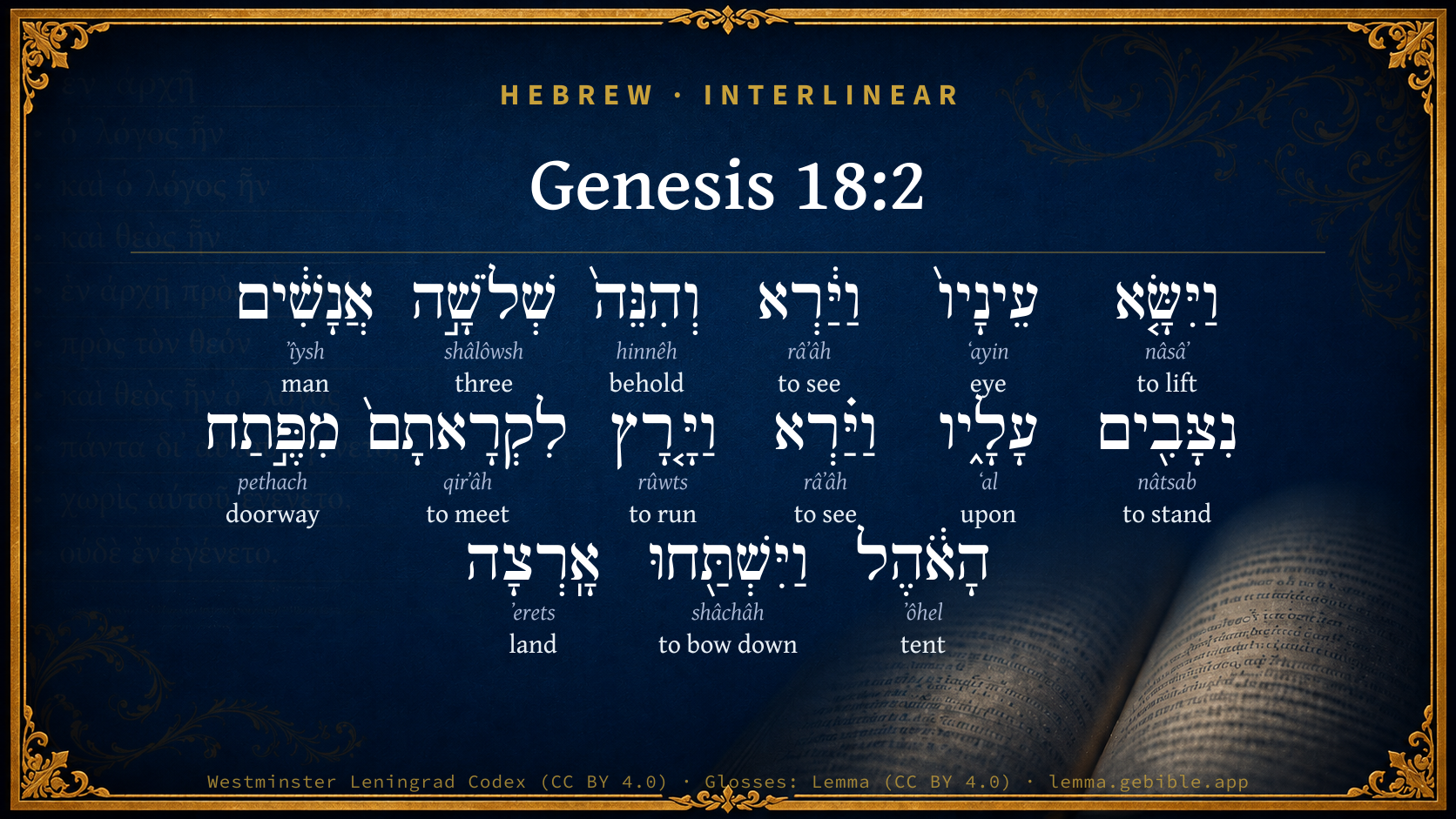
Hebrew (Westminster Leningrad Codex) Genesis 18:2 appears in the Hebrew Old Testament. The text above is from the Westminster Leningrad Codex. Each word links to its Strong’s number, a concise gloss, and parsing drawn from the Open Scriptures Hebrew Bible morphology. Click any word for its full Brown-Driver-Briggs (BDB) entry.
Download image
Cite this verse

Genesis 18:2 (World English Bible). Public Domain. Lemma interlinear Bible study tool, https://lemma.gebible.app/v/genesis/18/2.

Show BibTeX & RIS
BibTeX
RIS
English Translation
He lifted up his eyes and looked, and saw that three men stood opposite him. When he saw them, he ran to meet them from the tent door, and bowed himself to the earth,
World English Bible · Public Domain
Highlights
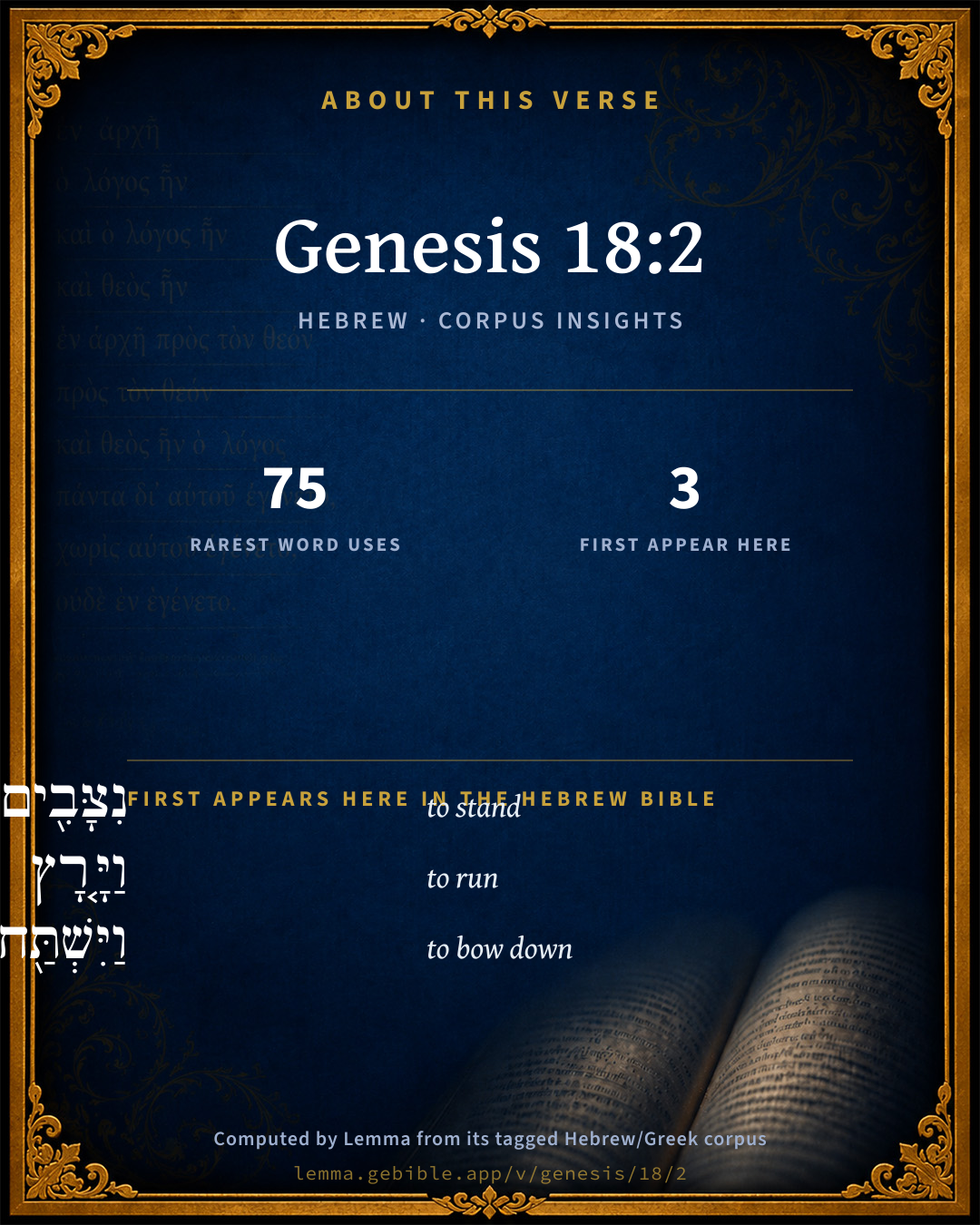
  • 3 first appearances in the Hebrew Bible
Full analysis ↓
Download a study sheet

One document with this verse’s original text, its word-by-word gloss line, the meaning frame, cross-references with their text, attributed commentary, and full source and license credits — printable, and it pastes into notes with its structure intact.

This verse Autodidact and up

Study sheet (.html) Plain text (.txt)

A passage Seminary Student

Up to 50 verses in one chapter. A passage sheet keeps up to 6 commentary sources and 12 cross-references per verse, in the order this page ranks them, and says so on the sheet whenever that leaves anything out. Ask for a single verse and you get the Autodidact verse sheet above.

Everything on this page stays free to read, with no account — the sheet is a download of what is already on screen, not access to it.

Want to remove ads? Support Godless Engineer
Compare translations 3

The same verse in 3 English versions, stacked beneath the original-language interlinear above. Click any original word for its lexicon entry.

Each is an independent rendering of the whole verse — the interlinear is not word-aligned to these translations.

Highlighted words mark where these versions differ — a whole-verse word diff, not a word-by-word alignment.

  • World English Bible Public Domain
    He lifted up his eyes and looked, and saw that three men stood opposite him. When he saw them, he ran to meet them from the tent door, and bowed himself to the earth,
  • King James Version Public Domain
    And he lift up his eyes and looked, and, lo, three men stood by him: and when he saw them, he ran to meet them from the tent door, and bowed himself toward the ground,
  • unfoldingWord Literal Text CC BY-SA 4.0
    And he lifted his eyes and looked, and behold, three men were standing nearby him. And he saw, he ran from the entrance of the tent to meet them and bowed himself to the ground,

unfoldingWord Literal Text — © unfoldingWord, licensed CC BY-SA 4.0. Word-aligned USFM3 via Door43 (git.door43.org/unfoldingWord/en_ult).

Versions to compare (up to 4)

3 of 4 selected

Show all 17 translations

Every available English version of this verse, each an independent rendering of the whole verse.

  • World English Bible Public Domain
    He lifted up his eyes and looked, and saw that three men stood opposite him. When he saw them, he ran to meet them from the tent door, and bowed himself to the earth,
  • Berean Standard Bible Public Domain
    And Abraham looked up and saw three men standing nearby. When he saw them, he ran from the entrance of his tent to meet them and bowed low to the ground.
  • Majority Standard Bible Public Domain
    And Abraham looked up and saw three men standing nearby. When he saw them, he ran from the entrance of his tent to meet them and bowed low to the ground.
  • King James Version Public Domain
    And he lift up his eyes and looked, and, lo, three men stood by him: and when he saw them, he ran to meet them from the tent door, and bowed himself toward the ground,
  • American Standard Version (1901) Public Domain
    and he lifted up his eyes and looked, and, lo, three men stood over against him: and when he saw them, he ran to meet them from the tent door, and bowed himself to the earth,
  • Revised Version (1885) Public Domain
    and he lift up his eyes and looked, and, lo, three men stood over against him: and when he saw them, he ran to meet them from the tent door, and bowed himself to the earth,
  • Geneva Bible (1599) Public Domain
    And he lift vp his eyes, and looked: and lo, three men stoode by him, and when he sawe them, he ranne to meete them from the tent doore, and bowed himselfe to the grounde.
  • Young's Literal Translation Public Domain
    and he lifteth up his eyes and looketh, and lo, three men standing by him, and he seeth, and runneth to meet them from the opening of the tent, and boweth himself towards the earth,
  • Literal Standard Version CC BY-SA 4.0
    and he lifts up his eyes and looks, and behold, three men standing by him, and he sees, and runs to meet them from the opening of the tent, and bows himself toward the earth,
  • Unlocked Literal Bible CC BY-SA 4.0
    He looked up and, behold, he saw three men standing across from him. When he saw them, he ran to meet them from the tent door and bowed low to the ground.
  • unfoldingWord Literal Text CC BY-SA 4.0
    And he lifted his eyes and looked, and behold, three men were standing nearby him. And he saw, he ran from the entrance of the tent to meet them and bowed himself to the ground,
  • Darby Bible Public Domain
    And he lifted up his eyes and saw, and behold, three men standing near him. And when he saw [them], he ran to meet them from the tent-door, and bowed himself to the earth,
  • World Messianic Bible Public Domain
    He lifted up his eyes and looked, and saw that three men stood near him. When he saw them, he ran to meet them from the tent door, and bowed himself to the earth,
  • Webster's Bible Public Domain
    And he lifted up his eyes and looked, and lo, three men stood by him: and when he saw them, he ran to meet them from the tent door, and bowed himself toward the ground,
  • Free Bible Version CC BY-SA 4.0
    He looked up and all of a sudden he saw three men standing there. As soon as he saw them, he ran over to meet them and bowed low to the ground.
  • Bible in Basic English Public Domain
    And lifting up his eyes, he saw three men before him; and seeing them, he went quickly to them from the door of the tent, and went down on his face to the earth;
  • JPS Tanakh (1917) Public Domain
    and he lifted up his eyes and looked, and, lo, three men stood over against him; and when he saw them, he ran to meet them from the tent door, and bowed down to the earth,

Literal Standard Version (2020), Covenant Press — licensed CC BY-SA 4.0. Text via the HelloAO Bible API (eBible.org). Unlocked Literal Bible (unfoldingWord) — licensed CC BY-SA 4.0. Text via the HelloAO Bible API (eBible.org). unfoldingWord Literal Text — © unfoldingWord, licensed CC BY-SA 4.0. Word-aligned USFM3 via Door43 (git.door43.org/unfoldingWord/en_ult). Free Bible Version, Dr. Jonathan Gallagher — licensed CC BY-SA 4.0. Text via the HelloAO Bible API (eBible.org).

Word by word

More ways to search: Search by grammar → Find every occurrence → Compare this word →

Practice this passage: Drill this verse → Learn its vocabulary →

נִצָּבִ֖ים
nâtsab
H5324
“standing”
Verb, Niphal, Participle Active, Masculine, Plural, Absolute
Part of Speech
Verb
Stem
Niphal
Form
Participle Active
Gender
Masculine
Number
Plural
State
Absolute
Full BDB Definition

Origin: a primitive root

TWOT: 1398

to stand, take one's stand, stand upright, be set (over), establish - (Niphal) - to station oneself, take one's stand - to stand, be stationed - to stand, take an upright position - to be stationed, be appointed - deputy, prefect, appointed, deputed (substantive) - to stand firm - (Hiphil) - to station, set - to set up, erect - to cause to stand erect - to fix, establish - (Hophal) to be fixed, be determined, be stationary
  1. וַיִּשָּׂ֤א nâsâʼ H5375 “and · to lift” Conjunction + Verb, Qal, Sequential Imperfect, 3rd Person, Masculine, Singular
  2. עֵינָיו֙ ʻayin H5869 “eyes · his” Noun, Common, Both, Dual, Construct + Suffix, Personal, 3rd Person, Masculine, Singular
  3. וַיַּ֔רְא râʼâh H7200 “and · to see” Conjunction + Verb, Qal, Sequential Imperfect, 3rd Person, Masculine, Singular
  4. וְהִנֵּה֙ hinnêh H2009 “and · behold” Conjunction + Particle, Demonstrative
  5. שְׁלֹשָׁ֣ה shâlôwsh H7969 “three” Adjective, Cardinal number, Masculine, Singular, Absolute
  6. אֲנָשִׁ֔ים ʼîysh H376 “men” Noun, Common, Masculine, Plural, Absolute
  7. עָלָ֑יו ʻal H5921 “upon · him” Preposition + Suffix, Personal, 3rd Person, Masculine, Singular
  8. וַיַּ֗רְא râʼâh H7200 “and · to see” Conjunction + Verb, Qal, Sequential Imperfect, 3rd Person, Masculine, Singular
  9. וַיָּ֤רָץ rûwts H7323 “and · to run” Conjunction + Verb, Qal, Sequential Imperfect, 3rd Person, Masculine, Singular
  10. לִקְרָאתָם֙ qirʼâh H7125 “to meet · them” Preposition + Verb, Qal, Infinitive Construct + Suffix, Personal, 3rd Person, Masculine, Plural
  11. מִפֶּ֣תַח pethach H6607 “from · doorway of” Preposition + Noun, Common, Masculine, Singular, Construct
  12. הָאֹ֔הֶל ʼôhel H168 “the · tent” Particle, Definite Article + Noun, Common, Masculine, Singular, Absolute
  13. וַיִּשְׁתַּ֖חוּ shâchâh H7812 “and · to bow down” Conjunction + Verb, Hithpael, Sequential Imperfect, 3rd Person, Masculine, Singular
  14. אָֽרְצָה ʼerets H776 “land · toward” Noun, Common, Both, Singular, Absolute + Suffix, Demonstrative

About this verse

These counts appear in no published source. They are computed here, from the morphology-tagged text and Lemma’s own curated glosses. What Lemma adds →

15
words
14
distinct lemmas
Pentateuch
section

First appearance in Scripture

These words make their first canonical appearance in the Hebrew Bible here:

  • נִצָּבִ֖ים to stand H5324
  • וַיָּ֤רָץ to run H7323
  • וַיִּשְׁתַּ֖חוּ to bow down H7812

Grammatical profile

  • 7 verbs
  • 5 nouns
  • 1 adjective
  • 1 preposition
  • 1 particle

Verb forms

  • וַיִּשָּׂ֤א Qal · Sequential Imperfect
  • וַיַּ֔רְא Qal · Sequential Imperfect
  • נִצָּבִ֖ים Niphal · Participle Active
  • וַיַּ֗רְא Qal · Sequential Imperfect
  • וַיָּ֤רָץ Qal · Sequential Imperfect
  • לִקְרָאתָם֙ Qal · Infinitive Construct
  • וַיִּשְׁתַּ֖חוּ Hithpael · Sequential Imperfect

Repetition

A word recurs within this verse — often emphatic in Hebrew:

  • וַיַּ֔רְא to see H7200 ×2

Hebrew & Septuagint length

In English translation the verse runs 34 words from the Hebrew and 36 from the Septuagint (LXX English) — closely comparable.

A rough comparison of the two English renderings, which tokenize alike — not a word-level alignment.

Word counts can differ between the Hebrew and the Greek without any difference in meaning — e.g. the Hebrew direct-object marker אֵת has no separate Greek word, and Greek often adds the article ὁ.

Cross-references

17

Topical passages linked to Genesis 18:2 in the Treasury of Scripture Knowledge — connected by theme and wording, ordered by reader-vote popularity; previews shown in the World English Bible.

  • Hebrews 13:2 Don't forget to show hospitality to strangers, for in doing so, some have entertained angels without knowing it.
  • Genesis 18:22 The men turned from there, and went toward Sodom, but Abraham stood yet before Yahweh.
  • Genesis 19:1 The two angels came to Sodom at evening. Lot sat in the gate of Sodom. Lot saw them, and rose up to meet them. He bowed himself with his face to the earth,
  • Judges 13:3 The angel of Yahweh appeared to the woman, and said to her, See now, you are barren, and don't bear; but you shall conceive, and bear a son.
  • Genesis 23:7 Abraham rose up, and bowed himself to the people of the land, even to the children of Heth.
  • Genesis 18:16 The men rose up from there, and looked toward Sodom. Abraham went with them to see them on their way.
  • Genesis 32:24 Jacob was left alone, and wrestled with a man there until the breaking of the day.
  • Genesis 43:26 When Joseph came home, they brought him the present which was in their hand into the house, and bowed down themselves to him to the earth.
  • Genesis 43:28 They said, "Your servant, our father, is well. He is still alive." They bowed the head, and did homage.
  • Genesis 44:14 Judah and his brothers came to Joseph's house, and he was still there. They fell on the ground before him.
  • Joshua 5:13 It happened, when Joshua was by Jericho, that he lifted up his eyes and looked, and, behold, there stood a man over against him with his sword drawn in his hand: and Joshua went to him, and said to him, Are you for us, or for our adversaries?
  • Genesis 33:3–7 He himself passed over in front of them, and bowed himself to the ground seven times, until he came near to his brother.
  • Judges 13:6–11 Then the woman came and told her husband, saying, A man of God came to me, and his face was like the face of the angel of God, very awesome; and I didn't ask him whence he was, neither did he tell me his name:
  • Ruth 2:10 Then she fell on her face, and bowed herself to the ground, and said to him, Why have I found favor in your sight, that you should take knowledge of me, seeing I am a foreigner?
  • 1 Peter 4:9 Be hospitable one to another without grumbling.
  • 2 Kings 2:15 When the sons of the prophets who were at Jericho over against him saw him, they said, The spirit of Elijah does rest on Elisha. They came to meet him, and bowed themselves to the ground before him.
  • Romans 12:13 contributing to the needs of the saints; given to hospitality.

Cross-references courtesy of OpenBible.info (CC BY 4.0).

Hebrew and Greek witnesses Masoretic Hebrew ↔ Greek Septuagint

The same verse in the two great witnesses to the Old Testament, shown verse-for-verse.

These are two independent witnesses, not word-aligned to each other, and the Septuagint is shown in lemma (dictionary) form.

Hebrew Genesis 18:2 Masoretic · Westminster Leningrad Codex

וַיִּשָּׂ֤א עֵינָיו֙ וַיַּ֔רְא וְהִנֵּה֙ שְׁלֹשָׁ֣ה אֲנָשִׁ֔ים נִצָּבִ֖ים עָלָ֑יו וַיַּ֗רְא וַיָּ֤רָץ לִקְרָאתָם֙ מִפֶּ֣תַח הָאֹ֔הֶל וַיִּשְׁתַּ֖חוּ אָֽרְצָה

He lifted up his eyes and looked, and saw that three men stood opposite him. When he saw them, he ran to meet them from the tent door, and bowed himself to the earth,

World English Bible · Public Domain

Greek LXX Genesis 18:2 Septuagint · lemma form

ἀναβλέπω δέ ὁ ὀφθαλμός αὐτός ὁράω καί ἰδού τρεῖς ἀνήρ ἵστημι ἐπάνω αὐτός καί ὁράω προςτρέχω εἰς συνάντησις αὐτός ἀπό ὁ θύρα ὁ σκηνή αὐτός καί προςκυνέω ἐπί ὁ γῆ

And he lifted up his eyes and saw, and behold! three men stood before him; and having seen them he ran to meet them from the door of his tent, and did obeisance to the ground.

LXX2012 (modern English Septuagint) · Public Domain

Hebrew: Westminster Leningrad Codex (CC BY 4.0). Greek: Septuagint (public domain); English from LXX2012 (modern English Septuagint) (Public Domain). How the Septuagint differs from the Hebrew →

Targum (Aramaic paraphrase)

2

The Targum is the ancient Jewish Aramaic paraphrase of the Hebrew Scriptures — an interpretive translation, not the Hebrew text itself. Onkelos (literal) and Pseudo-Jonathan (expansive) render the Torah, and Jonathan the Prophets. Coverage is partial: where no permissively-licensed English translation exists for a verse, only the Aramaic is shown. This is verse-level text, not a word-by-word alignment to the Hebrew.

  1. Targum Onkelos Torah (Genesis–Deuteronomy)
    וּזְקַף עֵינוֹהִי וַחֲזָא וְהָא תְּלָתָא גֻּבְרִין (נ''י גַּבְרִין) קָיְמִין עִלָּווֹהִי וַחֲזָא וּרְהַט לְקַדָּמוּתְהוֹן מִתְּרַע מַשְׁכְּנָא וּסְגִיד עַל אַרְעָא

    (no public-domain English translation for this verse)

    Targum Onkelos — Aramaic: “Onkelos Genesis” (public domain); “Onkelos Exodus” (public domain); “Onkelos Leviticus” (public domain); “Onkelos Numbers” (public domain); “Onkelos Deuteronomy” (public domain). English: “Sefaria Community Translation” (CC0 1.0 (public-domain dedication)); “J.W. Etheridge. The Targums of Onkelos and Jonathan Ben Uzziel on the Pentateuch. London: Longmans, Green, 1862” (public domain). Text via Sefaria.

  2. Targum Pseudo-Jonathan Torah (Genesis–Deuteronomy)
    וּזְקַף עֵינוֹי וְחָמָא וְהָא תְלָתָא מַלְאָכִין בִּדְמוּת גוּבְרִין קַיְימִין קוֹמוֹי דְאִשְׁתַּלְחוּ לִצְרוֹךְ תְּלַת מִילַיָא אֲרוּם לֵית אַוְשַׁר לְמַלְאָכָא דְשֵׁירוּתָא דְמִשְׁתַּלֵיחָא לְיַתִּיר מִן מִילָא חַד חַד אָתָא לִמְבַשְרָא יָתֵיהּ דְהָא שָרָה יָלְדָה בַּר זָכָר וְחַד אָתָא לְמִישֵׁזְבָא יַת לוֹט וְחַד אָתָא לְמֵיהֲפַךְ יַת סְדוֹם וְיַת עֲמוֹרָה וְכַד חָמִינוּן רָהַט לִקְדָמוּתְהוֹן מִתְּרַע מַשְׁכְּנָא וּסְגִיד עַל אַרְעָא

    And he lifted up his eyes and looked, and, behold, three angels in the resemblance of men were standing before him; (angels) who had been sent from the necessity of three things;--because it is not possible for a ministering angel to be sent for more than one purpose at a time;--one, then, had come to make known to him that Sarah should bear a man-child; one had come to deliver Lot; and one to overthrow Sedom and Amorah. And when he saw them, he ran to meet them from the door of the tent, and bowed himself on the earth.

    Targum Pseudo-Jonathan — Aramaic: “Targum Jonathan on Genesis” (public domain); “Targum Jonathan on Exodus” (public domain); “Targum Jonathan on Leviticus” (public domain); “Targum Jonathan on Numbers” (public domain); “Targum Jonathan on Deuteronomy” (public domain). English: “The Targum of Jonathan ben Uzziel, trans. J. W. Etheridge, London, 1862” (public domain). Text via Sefaria.

Commentary

Notes on Genesis 18:2 from classic Christian and Jewish commentators (each source and its license shown beneath its notes). The classic Christian expositions comment on the surrounding passage and are grouped to its opening verse, so a note may address several verses; the Jewish commentaries on the Tanakh (Rashi and others) are per-verse, so they appear only where the commentator wrote on this verse.

Lemma curates 59 commentaries, every one of them public domain or Creative Commons licensed, each selected and text-cleaned for this edition rather than reprinted as found. About our sources →

Trapp's Complete Commentary

John Trapp

Gen 18:2 And he lift up his eyes and looked, and, lo, three men stood by him: and when he saw [them], he ran to meet them from the tent door, and bowed himself toward the ground,

Ver. 2. And he lift up his eyes and looked.] As "pursuing hospitality" (that is the apostle’s expression, Rom 12:13), and waiting an opportunity of doing good. Charity is no churl. "The liberal man deviseth liberal things"; {Isa 32:8} "he considereth the poor and needy". {Psa 41:1} Praeoccupat vocem petituri , as Augustine expounds it, {a} he stays not till he is asked a good turn; he ministereth to the uses, not only "to the necessities {b} of the saints," as the apostle’s word is, {Rom 12:13} and as Bishop Hooper’s and Dr Taylor’s practice was. The one had his board of beggars sent for, and served every day with whole and wholesome meats, ere himself sat down to dinner. And the other went once a fortnight at the least, to the almshouse, and other poor men that had, many children, and were sick, to see what they lacked, and to supply them. {c}

And bowed himself toward the ground.] Piety is no enemy to courtesy; it doth not remove but rectify it, that it be not only complimental and ridiculous. Potest Augur Augurem videre et non ridere? {d} So it may be said of our common cringers.

{a} Aug. in Psalm ciii.

{b} ταις χρειαις Usibus, non necessitatibus. Nequis existimet prius non succurrendum proximo quam ad necessitatem sit redactus.

{c} Act. and Mon., fol. 1369, 1388.

{d} Cicero.

John Trapp, A Commentary or Exposition upon All the Books of the Old and New Testament (1647–1656) — public domain. Text from a community e-Sword module.

Joseph Benson's Commentary

Gen 18:2. And lo, three men — These three men were three spiritual, heavenly beings, now assuming human shapes, that they might be visible to Abraham, and conversable with him. Some think they were all three created angels; others, which is more probable, that one of them was the Son of God. He bowed himself toward the ground — Religion doth not destroy, but improve good manners, and teaches us to “honour all men.”

Joseph Benson's Commentary on the Old and New Testaments (1811–1818) — public domain. Text from a community e-Sword module.

Tyndale Open Study Notes

Tyndale Open Resources

18:2-8 Abraham received his visitors as very important guests, perhaps realizing that they were messengers from God.

Tyndale Open Study Notes — © Tyndale Open Resources, licensed CC BY-SA 4.0. Text via the HelloAO Bible API.

Geneva Bible (1599)

Geneva Bible translators

That is, three Angels in man’s shape.

Geneva Bible (1599) marginal notes — public domain. Text via Bolls.life.

Jamieson, Fausset & Brown

Robert Jamieson, A. R. Fausset & David Brown

lift up his eyes . . . and, lo, three men--Travellers in that quarter start at sunrise and continue till midday when they look out for some resting-place.

he ran to meet them--When the visitor is an ordinary person, the host merely rises; but if of superior rank, the custom is to advance a little towards the stranger, and after a very low bow, turn and lead him to the tent, putting an arm round his waist, or tapping him on the shoulder as they go, to assure him of welcome.

Jamieson, Fausset & Brown — Commentary Critical and Explanatory on the Whole Bible (1871) — public domain (CC PDM 1.0). Text via the HelloAO Bible API.

Adam Clarke's Commentary

Verse 2. Three men stood by him] נצבים עליו nitstsabim alaiv, were standing over against him; for if they had been standing by him, as our translation says, he needed not to have "run from the tent door to meet them." To Abraham these appeared at first as men; but he entertained angels unawares, see Heb 13:2.

Adam Clarke's Commentary on the Bible (1810–1826) — public domain. Text from a community e-Sword/MySword module.

John Calvin's Commentaries

2. And, lo, three men stood by him. Before Moses proceeds to his principal subject, he describes to us, the hospitality of the holy man; and he calls the angels men, because, being clothed with human bodies, they appeared to be nothing else than men. And this was done designedly, in order that he, receiving them as men, might give proof of his charity. For angels do not need those services of ours, which are the true evidences of charity. Moreover, hospitality holds the chief place among these services; because it is no common virtue to assist strangers, from whom there is no hope of reward. For men in general are wont, when they do favors to others, to look for a return; but he who is kind to unknown guests and persons, proves himself to be disinterestedly liberal. Wherefor the humanity of Abraham deserves no slight praise; because he freely invites men who were to him unknown, through whom he had no advantage, and from whom he had no hope of mutual favors. What, therefore, was Abraham’s object? Truly, that he might relieve the necessity of his guests. He sees them wearied with their journey, and has no doubt that they are overcome by heat; he considers that the time of day was becoming dangerous to travelers; and therefore he wishes both to comfort, and to relieve persons thus oppressed. And certainly, the sense of nature itself dictates, that the strangers are to be especially assisted; unless blind self love rather impels us to mercenary services. For none are more deserving of compassion and help than those whom we see deprived of friends, and of domestic comforts. And therefore the right of hospitality has been held most sacred among all people, and no disgrace was ever more detestable than to be called inhospitable. For it is a brutal cruelty, proudly to despise those who, being destitute of ordinary, have recourse to our assistance. It is however asked, whether Abraham was wont, thus to receive indiscriminately all kinds of guests? I answer that, according to his accustomed prudence, he made his distinction between his guests. And truly, the invitation, which Moses here relates, has something uncommon. Undoubtedly, the angels bore, in their countenance and manner, marks of extraordinary dignity; so that Abraham would conclude them to be worthy not only of meat and drink, but also of honor. They who think that he was thus attentive to his office, because he had been taught, by his fathers, that the angels often appeared in the world in human form, reasons too philosophically. Even the authority of to Apostle is contrary to this; for he denies that they were, at first, known to be angels either by Abraham, or by Lot, since they thought they were entertaining men. (Hebrews 13:2) This, then is to be maintained; that when he saw men of reverend aspect, and having marks of singular excellence, advancing on their journey, he saluted them with honor, and invited them to repose. But at that time, there was greater honesty than is at present, to be found amid the prevailing perfidy of mankind; so that the right of hospitality might be exercised with less danger. Therefore, the great number of inns are evidence of our depravity, and prove it to have arisen from our own fault, that the principal duty of humanity has become obsolete among us.

And bowed himself toward the ground. This token of reverence was in common use with oriental nations. The mystery which some of the ancient writers have endeavored to elicit from this act; namely, that Abraham adored one out of the three, whom he saw, and, therefore perceived by faith, that there are three persons in one God, since it is frivolous, and obnoxious to ridicule and calumny, I am more than content to omit. For we have before said, that the angels were so received by the holy man, as by one who intended to discharge a duty towards men. But the fact that God honored his benignity, and granted it to him as a reward, that angels should be presented to him for guests, was that he was not aware of, till they had made themselves known at the conclusion of the meal. It was therefore a merely human and civil honor, which he paid them. As to his having saluted one in particular, it was probably done because he excelled the other two. For we know that angels often appeared with Christ their Head; here, therefore, among the three angels, Moses points out one, as the Chief of the embassy.

John Calvin's Commentaries (1540-1563) — public domain. Text from the Calvin Translation Society English edition (1840s-50s) via the Christian Classics Ethereal Library (ccel.org). Calvin's coverage is partial (roughly two-thirds of the Bible); uncommented books and verses are honest gaps, never fabricated. The 19th-century editor's footnotes and remarks are omitted so the notes are faithfully Calvin's own voice.

Ellicott's Commentary for English Readers

(2) Three men.—Jewish commentators explain the number by saying that, as no angel might execute more than one commission at a time, one of the three came to heal Abraham, the second to bear the message to Sarah, and the third to destroy Sodom. More correctly one was “the angel of Jehovah,” who came as the manifestation of Deity to Abraham, and the other two were his companions, commissioned by him afterwards to execute judgment on the cities of the plain, The number three pointed also to the Trinity of Persons in the Godhead, and is therefore read by our Church as one of the lessons for Trinity Sunday. But we must be careful not to use it as a proof of this doctrine, lest the inference should be drawn of a personal appearance of the Father and of the Holy Ghost, which would savour of heretical impiety.

A Bible Commentary for English Readers, edited by Charles John Ellicott (1878–1897) — public domain. Text from a community e-Sword module.

The Cambridge Bible for Schools and Colleges

gen. ed. J. J. S. Perowne

2. lo, three men] The sudden appearance of the three men before the tent is especially recorded. Their approach had not been observed. As in the case of Gen_32:24, Jos_5:13, Jdg_13:10-11, the angelic visitants are not distinguishable from ordinary men.

bowed himself to the earth] Cf. Gen_19:1, Gen_23:7, Gen_33:3, Gen_42:6; the regular gesture of salutation towards those of higher rank.

The Cambridge Bible for Schools and Colleges (gen. ed. J. J. S. Perowne; Cambridge University Press, 1878–1918) — public domain. Text from a community e-Sword module.

John Gill's Exposition

And he lifted up his eyes and looked,.... To see if he could observe any passengers coming that way:

and, lo, three men stood by him; having perhaps descended at once from heaven upon the spot near where Abraham sat; for these, whoever they were, appeared in an human form, and they were took by Abraham at first sight to be men, and as such he treated them: some have taken these to be the three divine Persons, as some of the ancients; of which opinion was Dr. Lightfoot, who expressly says (h),"three months after this, (i.e. the institution of the circumcision,) the three Persons in the Trinity dine with Abraham, and foretell the birth of Isaac; again, the Son and the Holy Ghost go down to Sodom, but the first Person in the Trinity stayeth with Abraham''and elsewhere (i),"the three Persons in the Trinity, in the shape of three men, appear to Abraham and dine with him, and eat the first flesh mentioned eaten in all the Scripture.''But to this may be objected, that the Father and the Holy Spirit are never said to appear in an human form, see Joh 5:37; or are ever called angels, as these are, Gen 19:1; but they rather seem to be angels, as the Targums of Jonathan and Jerusalem call them, in the likeness of men, who were sent on three messages, as they suggest; one to bring the news of Sarah's bearing Isaac; the other to deliver Lot; and the third to overthrow Sodom and Gomorrah; which is a much better sense than that of Ben Gersom, who takes them to be three prophets, and mentions the names of two of them, Shem and Heber; for two of these are expressly called angels, Gen 19:1; and the apostle seems to refer to this history, Heb 13:2; in the Talmud (k) they are said to be Michael, Gabriel, and Raphael: the truth of the matter seems to be this, that one of them was the son of God in an human form, that chiefly conversed with Abraham, and who rained from heaven brimstone on Sodom; and the other two were angels in the like form that accompanied him in that expedition:

and when he saw them, he ran to meet them from the tent door; for, though they are before said to stand "by him", it must be understood of their being near him, but at some little distance; and as soon as he saw them, he did not stay for their coming up to him, but, to show how ready he was to entertain them, he arises from his seat at the tent door and ran to meet them, and gave them an hearty welcome to what he would provide for them:

and bowed himself toward the ground; not in a way of religious adoration, for, had he took them for angels, be could not have done that, and he knew not as yet that one of them was Jehovah; but in a civil manner, as was the custom of those countries when in the presence of, or when they received? great personages, and such, by their look and habit, Abraham took these to be.

(h) Works, vol. 1. p. 13. (i) Ib. p. 695. (k) T. Bab. Yoma, fol. 37. 2.

John Gill's Exposition of the Whole Bible (1746–1763) — public domain (CC PDM 1.0). Text via the HelloAO Bible API.

Haydock's Catholic Bible Commentary

Men in outward appearance, but angels indeed. (Hebrews xiii. 2; St. Augustine, City of God xvi. chap. 29.) Some have supposed, that one of them was the Son of God, whom Abraham adored, and who bears throughout the chief authority. Tres vidit et unum adoravit. He saw three and adored one, as we read in the Church office. In the former supposition, which is generally adopted, this adoration was only a civil ceremony, if Abraham considered them as mere men; or it might be mixed with a degree of religious, though inferior veneration, if he imagined they were angels; or in fine, he adored God in his representatives. (Haydock)

George Leo Haydock (1774–1849), Haydock's Catholic Family Bible and Commentary, 1859 edition — public domain. Excludes Psalms (Douay-Rheims chapter numbering differs from Protestant) and Deuterocanonical books (Catholic canon only).

Matthew Poole's English Annotations

Three men, as they seemed to be, though indeed they were angels in men’s shape.

Bowed himself toward the ground; a respect usually paid to persons of quality, such as these seemed to be.

Matthew Poole's English Annotations on the Holy Bible (1683–1685) — public domain. Text from a community e-Sword/MySword module.

Whedon's Commentary on the Bible

Daniel D. Whedon

2. Three men — An angelophany, in which the celestial messengers took on the form and habits of ordinary men. It appears from what follows that one of these was the Angel of Jehovah, (see note on Gen_16:7.) who speaks in the Divine name and represents Deity himself. Comp. Gen_18:13; Gen_18:17; Gen_18:20; Gen_18:22; Gen_18:26; Gen_18:33. But such a manifestation of Jehovah in human form appears extraordinary, and has been made the subject of ridicule by unbelievers. What! they say, God eating veal along with Abraham! Abraham washing God’s feet, and feeding him with cakes! That is worse than heathen idolatry. But the same difficulty holds with the theory that the three men were angels. Did Abraham wash the feet of angels and feed them with veal and cakes? That seems clearly to be the purport of the narrative; and before we hasten to pronounce it absurd or heathenish, let us calmly consider why such a theophany and such an angelophany should be thought incredible? It will not be denied that God has the power thus to manifest himself. He could have assumed a human form, and done all that is here recorded. But it is assumed that such action is incompatible with the divine majesty and the spiritual nature of God. But who knows this? Or who is competent to say that it was improper, and unworthy of Jehovah to reveal himself thus in human form to the father of the faithful?

It would, indeed, be unseemly and idolatrous for us to represent God under a human or any other form. This is expressly forbidden. Exodus 20:45. But if God may reveal himself in a pillar of cloud, or a pillar of fire, or a burning bush, why not also in a human form?

The Christian who believes that God was “manifest in the flesh” in the person of Jesus Christ, will not regard this theophany with strange wonder, or incredulity. When we consider the special purpose of this appearance of Jehovah to Abraham, namely, to bring Sarah to a belief in the promise, we may well suppose that the human form would have been the most suitable semblance under which Jehovah could appear. Such a theophany would adumbrate the future seed, the Christ of God, born of a woman, yet declared to be the Son of God, with power; who would eat and drink with men, and wash the feet of his disciples, that he might teach them the same lesson of humble service. He was seen and ministered unto by angels. He, even after his resurrection, ate before his disciples, to convince them that he was no unsubstantial spectre. Luk_24:43. So the God of Abraham makes this revelation a most intense reality to him, and through him to Sarah, that she may become partaker of his faith, and a proper mother of the chosen seed.

Daniel D. Whedon (gen. ed.), Commentary on the Old and New Testaments (1874–1909) — public domain. Text from a community e-Sword module.

The Pulpit Commentary

And he lift up his eyes and looked, and, lo, three men stood by him. Not in addition to (Kalisch), but including (Keil), Jehovah, whose appearance to the patriarch, having in the previous verse been first generally stated, is now minutely described. That these three men were not manifestations of the three persons of the Godhead (Justin Martyr, Ambrose, Cyril), but Jehovah accompanied by two created angels (Keil, et alii, may be inferred from Gen_19:1. When first perceived by the patriarch they were believed to be men, strangers, who were approaching his tent, and indeed were already close to it, or standing by him. And when he saw them (i.e. understood that one of them was Jehovah, Jarchi rightly explaining that the word translated above "looked," i.e. with the bodily vision now implies an act of mental perception) he ran to meet them from the tent door, and bowed himself toward the ground. The expression denotes the complete prostration of the body by first falling on the knees, and then inclining the head forwards till it touches the ground. As this was a mode of salutation practiced by Orientals towards superiors generally, such as kings and princes, (2Sa_9:8) but also towards equals, (Gen_23:7 Gen_33:6, 7 42:6 43:26) as well as towards the Deity (Gen_22:5; 1Sa_1:3) it is impossible to affirm with certainty (Keil, Lunge) that an act of worship was intended by the patriarch, and not simply the presentation of human and civil honor (Calvin). If Heb_13:2 inclines to countenance the latter interpretation, the language in which Abraham immediately addresses one of the three men almost leads to the conclusion that already the patriarch had recognized Jehovah.

The Pulpit Commentary (1880–1919), ed. H.D.M. Spence-Jones & Joseph S. Exell — public domain. Text from a community e-Sword module.

John Wesley's Explanatory Notes

And lo three men - These three men were three spiritual heavenly beings, now assuming human shapes, that they might be visible to Abraham, and conversable with him. Some think they were all three created angels; others, that one of them was the Son of God. He bowed himself towards the ground - Religion doth not destroy but improve good manners, and teaches us to honour all men.

John Wesley, Explanatory Notes Upon the Whole Bible (1754–1765) — public domain. Text via the GEBible commentary corpus.

Rashi

Rabbi Shlomo Yitzchaki (Rashi)

והנה שלשה אנשים AND BEHOLD THREE MEN — one to announce to Sarah the birth of a son, one to overthrow Sodom, and one to cure Abraham, for one angel does not carry out two commissions (Genesis Rabbah 50:2). You may know that this is so because throughout this section it (Scripture) mentions them in the plural — “and they ate” (Genesis 18:8), “and they said unto him” (Genesis 18:9) — whilst in the case of the announcement it states, (Genesis 18:10) “And he said, I will certainly return unto thee”, and with regard to the overthrow of Sodom it says (Genesis 19:22) “For “I” cannot do anything” and (Genesis 19:21) “that “I” will not overthrow [the city]”. Raphael who healed Abraham went thence to rescue Lot; that explains what is stated (Genesis 19:17) “And it came to pass when they had brought them forth, that he said, Escape for thy life”, for you learn from this that only one of these acted as Deliverer

נצבים עליו STOOD BY, or OVER HIM — before him; only this is a more fitting expression to use of angels

וירא AND HE SAW — What does the repetition of this word וירא imply? The first time it has its ordinary meaning (“he looked”), the second that of understanding: he saw that they were standing in one spot, and so understood that they had no desire to cause him any trouble. Although they knew that he would go to meet them they nevertheless remained where they were out of respect to him and to show him that they wished to spare him trouble; he, therefore, took the initiative and ran towards them. In the Treatise Bava Metzia 86b we have the following: It is written, “they were standing by him” and it is also written “He ran towards them” — how can these apparently contradictory statements be reconciled? But the explanation is, that at first they stood by him and when they perceived that he was loosening and re-binding his bandages, they retired from him; he therefore immediately ran towards them.

Rashi on the Tanakh — English translations: “The Judaica Press complete Tanach with Rashi, translated by A. J. Rosenberg” (CC BY 4.0); “Pentateuch with Rashi's commentary by M. Rosenbaum and A.M. Silbermann, 1929-1934” (public domain); “The Metsudah Tanach series, Lakewood, N.J” (CC BY 4.0); and “The Book of Joshua, Metsudah Publications, 1997” (CC BY 4.0). Text via Sefaria.

Ramban (Nachmanides)

Rabbi Moshe ben Nachman (Ramban / Nachmanides)

STOOD OVER HIM. The purport thereof is that they were standing opposite Abraham and looking at him, the expression being similar to: that stood over the reapers; the chief officers that stood over the work. And due to the fact that he [Abraham] was sitting and they were standing and looking at him, the verse says, “over him.” This is also the meaning of the expression, And he saw, and ran to meet them, for as he saw them standing opposite him and not continuing their journey, he ran to meet them in order to bring them to his house.The sense of the expression, From the tent door, is that Abraham was still sitting there after the vision of the Shechinah had departed from him.It is possible that the expression “over him” refers to the tent, i.e., that they were near it on the side which was not opposite the door, and there they stood and did not approach Abraham, just as in the verse, encamping ‘al’ (on) the sea. means “standing alongside him.”

Ramban (Nachmanides) on the Tanakh — English translation: “Commentary on the Torah by Ramban (Nachmanides). Translated and annotated by Charles B. Chavel. New York, Shilo Pub. House, 1971-1976” (CC BY 4.0). Text via Sefaria.

Radak

Rabbi David Kimhi (Radak)

וישא את עיניו, the first thing Avraham saw after he had gone to sleep were three men standing next to him, נצבים עליו, apparently ready to be of service to him. The meaning of the expression נצבים עליו is similar to Samuel I 22,7 ויאמר שאול לעבדיו הנצבים עליו, “Saul said to the people standing next to him (in attendance) etc.” The same expression is also used in this context in Ruth 2,6 הנצב על הקוצרים, “who was standing next to the reapers;” we also find this expression in Kings I 5,30 "משרי הנצבים, and in numerous other places in Scripture. These three men beheld by Avraham were standing at his disposal. They did not move, but indicated that they were expecting instructions from him. When he realised this he ran toward them. This explains why the word וירא, “he saw” appears twice in this verse in close succession.

מפתח האהל, where he had been sitting. He saw himself running towards these men in his vision.

וישתחו ארצה, they appeared to him to be men of great stature. He then addressed them with the words reported in the Torah. Our sages (Bereshit Rabbah 50,2) say that Avraham was so familiar with the sight of angels that their sudden appearance did not cause him to become disoriented, frightened and he perceived them essentially as אנשים, men. On the other hand, Lot, whose spiritual powers were quite minor, perceived the men as being angels, מלאכים, seeing that he had had little experience with such phenomena. (compare 19,1) Manoach’s wife had already told her husband that the face of the man who had told her that she would have a son was like that of an angel of G’d. (Judges 13,6)

Radak on the Tanakh — English translations: “Sefaria Community Translation” (CC0 1.0 (public-domain dedication)); “Eliyahu Munk, HaChut Hameshulash” (CC BY 4.0); “Rabbi Mike Feuer, Jerusalem Anthology” (CC BY 4.0); and “R. David Kimhi on the first book of Psalms, Translated by R.G. Finch, London, 1919” (public domain). Text via Sefaria.

Lesson kit

Teaching starters — assembled from the data on this page, not authored interpretation. Every prompt links to the verse data it draws on. Edit before teaching.

Genesis, in the Pentateuch, opens this verse with 15 words (14 distinct Hebrew lemmas). Its most distinctive word is nâtsab (“to stand”). A historical commentator’s framing appears above. Read the whole chapter for the surrounding context.

Discussion questions

  1. How does “to stand” (nâtsab) shape what this verse is saying?
  2. 3 words make their first appearance in Scripture here. What does this debut establish?
  3. How does Hebrews 13:2, which shares this passage’s theme, read alongside this verse?
  4. What does the repetition of “to see” (2× in this one verse) do in this verse?
  5. These translations render this verse differently. What is at stake in choosing one wording over another?
  6. «וַיִּשָּׂ֤א» is a Qal Sequential Imperfect verb. How does that grammatical form shape the action described?
  7. Compare how Trapp's Complete Commentary and Joseph Benson's Commentary read this verse. Where do they agree or differ?

Things to notice

  • 3 words make their first canonical appearance in Scripture here.
  • These translations choose different wording for 15 words in this verse.
  • “to see” occurs 2× in this single verse.
  • 14 distinct Hebrew lemmas span 15 words in this verse.

Reading settings

Reading text

Shown beneath each verse's original-language words.

Old Testament
Old Testament edition

Read the OT as the Masoretic Hebrew (MT) or the Greek Septuagint (LXX).

English shown for the Greek Septuagint (in the Hebrew ↔ Greek comparison).

Comparing translations? Open the Compare panel on any verse page to stack up to four side by side.