Deuteronomy 12:26

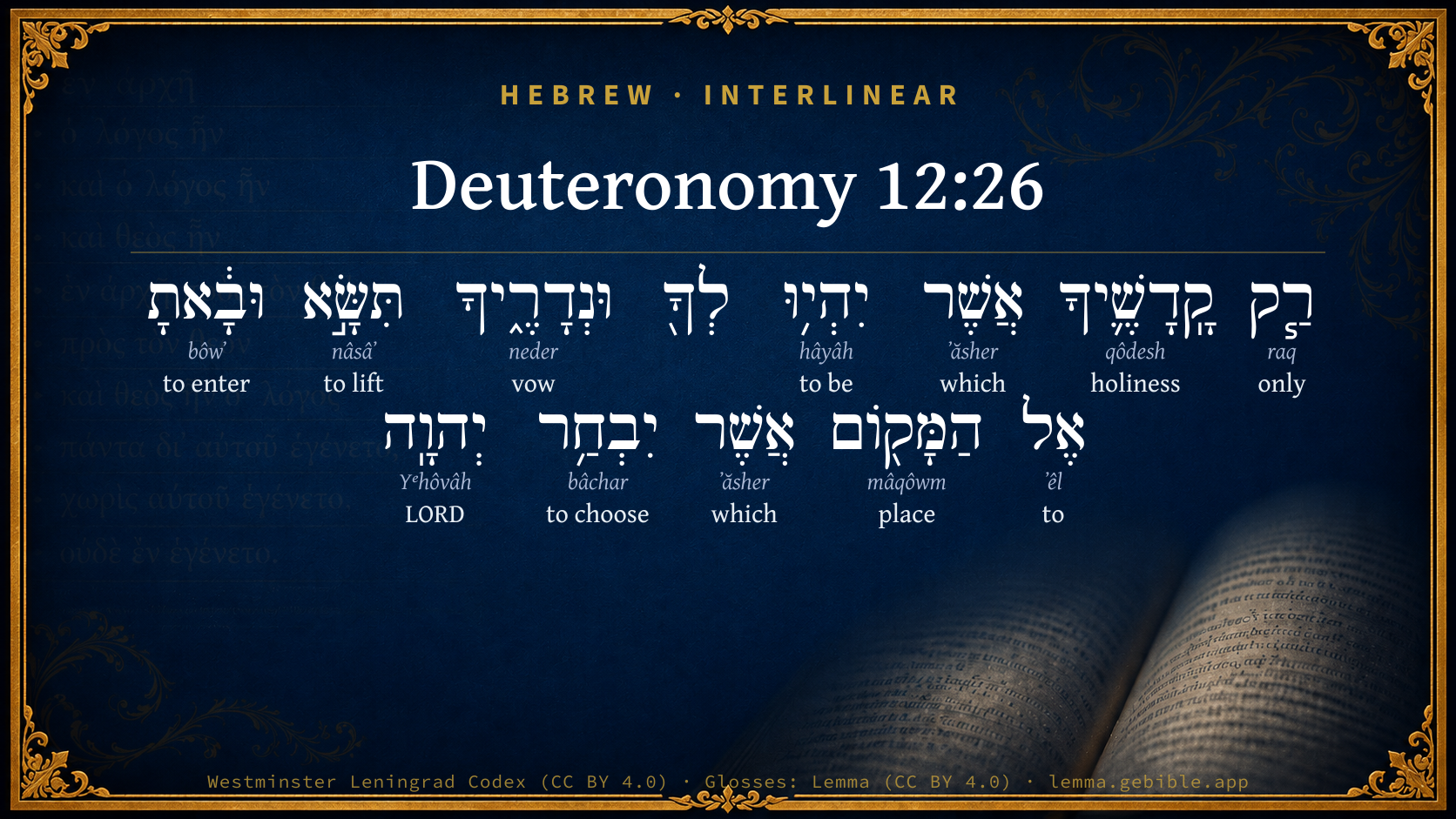
Hebrew (Westminster Leningrad Codex) Deuteronomy 12:26 appears in the Hebrew Old Testament. The text above is from the Westminster Leningrad Codex. Each word links to its Strong’s number, a concise gloss, and parsing drawn from the Open Scriptures Hebrew Bible morphology. Click any word for its full Brown-Driver-Briggs (BDB) entry.
Download image
Cite this verse

Deuteronomy 12:26 (World English Bible). Public Domain. Lemma interlinear Bible study tool, https://lemma.gebible.app/v/deuteronomy/12/26.

Show BibTeX & RIS
BibTeX
RIS
English Translation
Only your holy things which you have, and your vows, you shall take, and go to the place which Yahweh shall choose:
World English Bible · Public Domain
Download a study sheet

One document with this verse’s original text, its word-by-word gloss line, the meaning frame, cross-references with their text, attributed commentary, and full source and license credits — printable, and it pastes into notes with its structure intact.

This verse Autodidact and up

Study sheet (.html) Plain text (.txt)

A passage Seminary Student

Up to 50 verses in one chapter. A passage sheet keeps up to 6 commentary sources and 12 cross-references per verse, in the order this page ranks them, and says so on the sheet whenever that leaves anything out. Ask for a single verse and you get the Autodidact verse sheet above.

Everything on this page stays free to read, with no account — the sheet is a download of what is already on screen, not access to it.

Want to remove ads? Support Godless Engineer
Compare translations 3

The same verse in 3 English versions, stacked beneath the original-language interlinear above. Click any original word for its lexicon entry.

Each is an independent rendering of the whole verse — the interlinear is not word-aligned to these translations.

Highlighted words mark where these versions differ — a whole-verse word diff, not a word-by-word alignment.

  • World English Bible Public Domain
    Only your holy things which you have, and your vows, you shall take, and go to the place which Yahweh shall choose:
  • King James Version Public Domain
    Only thy holy things which thou hast, and thy vows, thou shalt take, and go unto the place which the LORD shall choose:
  • unfoldingWord Literal Text CC BY-SA 4.0
    But your sacred things that you have and your vow offerings, you shall take and go to the place that Yahweh will choose.

unfoldingWord Literal Text — © unfoldingWord, licensed CC BY-SA 4.0. Word-aligned USFM3 via Door43 (git.door43.org/unfoldingWord/en_ult).

Versions to compare (up to 4)

3 of 4 selected

Show all 18 translations

Every available English version of this verse, each an independent rendering of the whole verse.

  • World English Bible Public Domain
    Only your holy things which you have, and your vows, you shall take, and go to the place which Yahweh shall choose:
  • Berean Standard Bible Public Domain
    But you are to take your holy things and your vow offerings and go to the place the LORD will choose.
  • Majority Standard Bible Public Domain
    But you are to take your holy things and your vow offerings and go to the place the LORD will choose.
  • King James Version Public Domain
    Only thy holy things which thou hast, and thy vows, thou shalt take, and go unto the place which the LORD shall choose:
  • American Standard Version (1901) Public Domain
    Only thy holy things which thou hast, and thy vows, thou shalt take, and go unto the place which Jehovah shall choose:
  • Revised Version (1885) Public Domain
    Only thy holy things which thou hast, and thy vows, thou shalt take, and go unto the place which the LORD shall choose:
  • Geneva Bible (1599) Public Domain
    But thine holy things which thou hast, and thy vowes thou shalt take vp, and come vnto the place which the Lord shall chuse.
  • Douay-Rheims (1899) Public Domain
    But the things which thou hast sanctified and vowed to the Lord, thou shalt take, and shalt come to the place which the Lord shall choose:
  • Young's Literal Translation Public Domain
    `Only, thy holy things which thou hast, and thy vows, thou dost take up, and hast gone in unto the place which Jehovah doth choose,
  • Literal Standard Version CC BY-SA 4.0
    Only, your holy things which you have, and your vows, you take up, and have gone to the place which YHWH chooses,
  • Unlocked Literal Bible CC BY-SA 4.0
    But the things that belong to Yahweh that you have and the offerings for your vows—you will take these and go to the place that Yahweh chooses.
  • unfoldingWord Literal Text CC BY-SA 4.0
    But your sacred things that you have and your vow offerings, you shall take and go to the place that Yahweh will choose.
  • Darby Bible Public Domain
    But thy hallowed things which thou hast, and what thou hast vowed, thou shalt take, and come to the place which Jehovah will choose;
  • World Messianic Bible Public Domain
    Only your holy things which you have, and your vows, you shall take and go to the place which the LORD shall choose.
  • Webster's Bible Public Domain
    Only thy holy things which thou hast, and thy vows, thou shalt take, and go to the place which the LORD shall choose:
  • Free Bible Version CC BY-SA 4.0
    Take your holy sacrifices and the offerings to fulfill your vows and go to the place the Lord will choose.
  • Bible in Basic English Public Domain
    But the holy things which you have, and the offerings of your oaths, you are to take to the place which will be marked out by the Lord:
  • JPS Tanakh (1917) Public Domain
    Only thy holy things which thou hast, and thy vows, thou shalt take, and go unto the place which the LORD shall choose;

Literal Standard Version (2020), Covenant Press — licensed CC BY-SA 4.0. Text via the HelloAO Bible API (eBible.org). Unlocked Literal Bible (unfoldingWord) — licensed CC BY-SA 4.0. Text via the HelloAO Bible API (eBible.org). unfoldingWord Literal Text — © unfoldingWord, licensed CC BY-SA 4.0. Word-aligned USFM3 via Door43 (git.door43.org/unfoldingWord/en_ult). Free Bible Version, Dr. Jonathan Gallagher — licensed CC BY-SA 4.0. Text via the HelloAO Bible API (eBible.org).

Word by word

More ways to search: Search by grammar → Find every occurrence → Compare this word →

Practice this passage: Drill this verse → Learn its vocabulary →

וּנְדָרֶ֑יךָ
neder
H5088
“and · vows · your”
Conjunction + Noun, Common, Masculine, Plural, Construct + Suffix, Personal, 2nd Person, Masculine, Singular
Part of Speech
Conjunction + Noun
Type
Common
Gender
Masculine
Number
Plural
State
Construct
Full BDB Definition

Origin: from H5087

TWOT: 1308a

vow, votive offering
  1. רַ֧ק raq H7535 “only” Particle, Accusative
  2. קָֽדָשֶׁ֛יךָ qôdesh H6944 “holy things · your” Noun, Common, Masculine, Plural, Construct + Suffix, Personal, 2nd Person, Masculine, Singular
  3. אֲשֶׁר ʼăsher H834 “which” Particle, Relative
  4. יִהְי֥וּ hâyâh H1961 “to be” Verb, Qal, Imperfect, 3rd Person, Masculine, Plural
  5. תִּשָּׂ֣א nâsâʼ H5375 “to lift” Verb, Qal, Imperfect, 2nd Person, Masculine, Singular
  6. וּבָ֔אתָ bôwʼ H935 “and · to enter” Conjunction + Verb, Qal, Sequential Perfect, 2nd Person, Masculine, Singular
  7. אֶל ʼêl H413 “to” Preposition
  8. הַמָּק֖וֹם mâqôwm H4725 “the · place” Particle, Definite Article + Noun, Common, Masculine, Singular, Absolute
  9. אֲשֶׁר ʼăsher H834 “which” Particle, Relative
  10. יִבְחַ֥ר bâchar H977 “to choose” Verb, Qal, Imperfect, 3rd Person, Masculine, Singular
  11. יְהוָֽה Yᵉhôvâh H3068 “LORD” Noun, Proper

About this verse

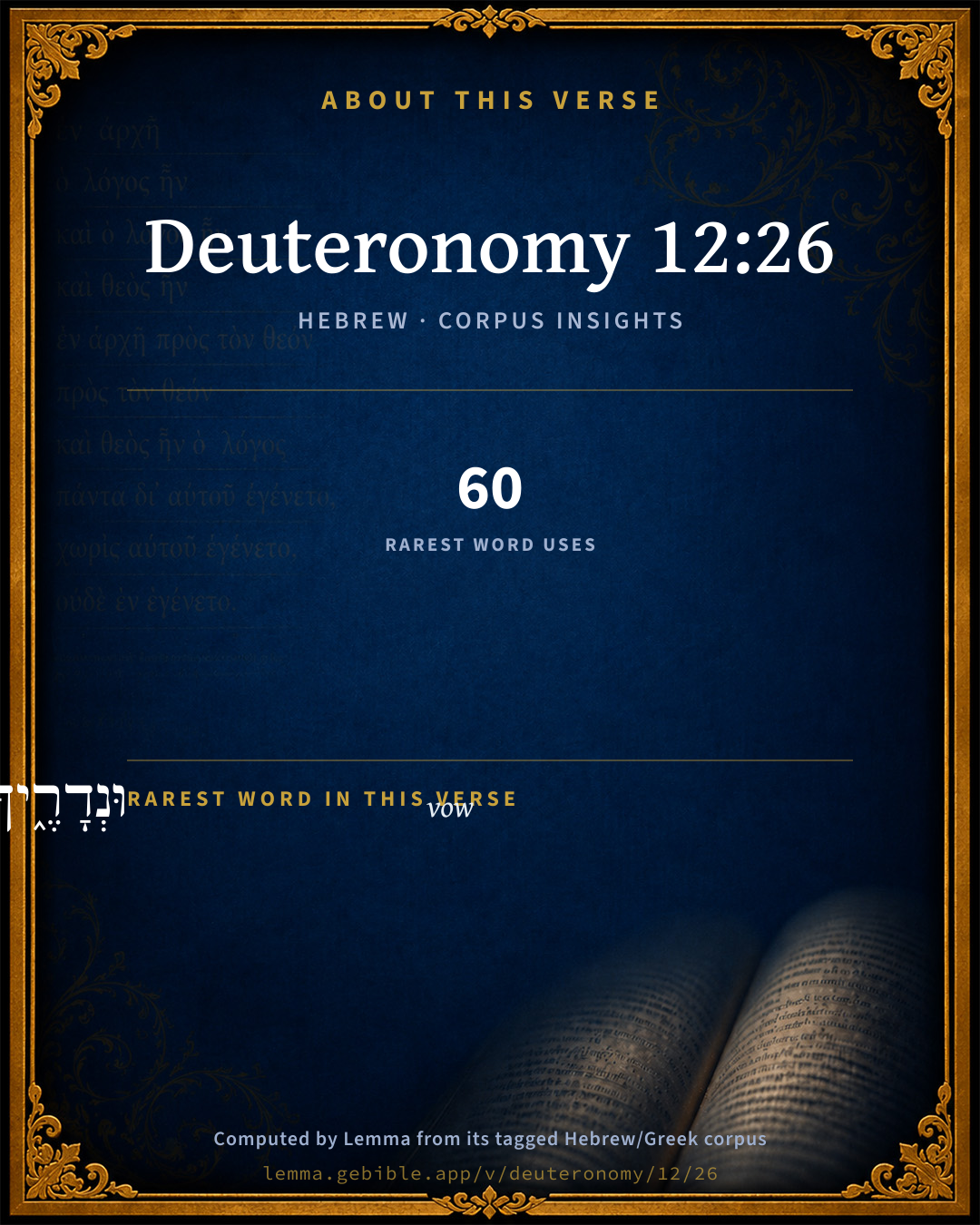
These counts appear in no published source. They are computed here, from the morphology-tagged text and Lemma’s own curated glosses. What Lemma adds →

13
words
11
distinct lemmas
Pentateuch
section

Shared distinctive vocabulary

וּנְדָרֶ֑יךָ vow H5088 occurs in 57 verses of the Hebrew Bible. Also found in:

Grammatical profile

  • 4 verbs
  • 4 nouns
  • 2 prepositions
  • 3 particles

Verb forms

  • יִהְי֥וּ Qal · Imperfect
  • תִּשָּׂ֣א Qal · Imperfect
  • וּבָ֔אתָ Qal · Sequential Perfect
  • יִבְחַ֥ר Qal · Imperfect

Repetition

A word recurs within this verse — often emphatic in Hebrew:

  • אֲשֶׁר which H834 ×2

Hebrew & Septuagint length

In English translation the verse runs 22 words from the Hebrew and 33 from the Septuagint (LXX English) — the Septuagint runs noticeably longer here. See the side-by-side →

A rough comparison of the two English renderings, which tokenize alike — not a word-level alignment.

Word counts can differ between the Hebrew and the Greek without any difference in meaning — e.g. the Hebrew direct-object marker אֵת has no separate Greek word, and Greek often adds the article ὁ.

Cross-references

10

Topical passages linked to Deuteronomy 12:26 in the Treasury of Scripture Knowledge — connected by theme and wording, ordered by reader-vote popularity; previews shown in the World English Bible.

  • Numbers 5:9–10 Every heave offering of all the holy things of the children of Israel, which they present to the priest, shall be his.
  • Numbers 18:19 All the heave-offerings of the holy things, which the children of Israel offer to Yahweh, have I given you, and your sons and your daughters with you, as a portion forever: it is a covenant of salt forever before Yahweh to you and to your seed with you.
  • Genesis 28:20 Jacob vowed a vow, saying, "If God will be with me, and will keep me in this way that I go, and will give me bread to eat, and clothing to put on,
  • Leviticus 22:18–33 "Speak to Aaron, and to his sons, and to all the children of Israel, and say to them, 'Whoever is of the house of Israel, or of the foreigners in Israel, who offers his offering, whether it be any of their vows, or any of their freewill offerings, which they offer to Yahweh for a burnt offering;
  • Deuteronomy 12:6 and there you shall bring your burnt offerings, and your sacrifices, and your tithes, and the heave-offering of your hand, and your vows, and your freewill-offerings, and the firstborn of your herd and of your flock:
  • Deuteronomy 12:11 then it shall happen that to the place which Yahweh your God shall choose, to cause his name to dwell there, there shall you bring all that I command you: your burnt offerings, and your sacrifices, your tithes, and the heave-offering of your hand, and all your choice vows which you vow to Yahweh.
  • Deuteronomy 12:17–18 You may not eat within your gates the tithe of your grain, or of your new wine, or of your oil, or the firstborn of your herd or of your flock, nor any of your vows which you vow, nor your freewill-offerings, nor the heave-offering of your hand;
  • Deuteronomy 12:21 If the place which Yahweh your God shall choose, to put his name there, be too far from you, then you shall kill of your herd and of your flock, which Yahweh has given you, as I have commanded you; and you may eat within your gates, after all the desire of your soul.
  • 1 Samuel 1:21–24 The man Elkanah, and all his house, went up to offer to Yahweh the yearly sacrifice, and his vow.
  • Psalms 66:13–15 I will come into your temple with burnt offerings. I will pay my vows to you,

Cross-references courtesy of OpenBible.info (CC BY 4.0).

Hebrew and Greek witnesses Masoretic Hebrew ↔ Greek Septuagint

The same verse in the two great witnesses to the Old Testament, shown verse-for-verse.

Here the Septuagint runs noticeably longer than the Hebrew — LXX2012 (modern English Septuagint) 33 words vs World English Bible 22. A rough length comparison of the two English translations, not a word-level alignment — read both below.

These are two independent witnesses, not word-aligned to each other, and the Septuagint is shown in lemma (dictionary) form.

Hebrew Deuteronomy 12:26 Masoretic · Westminster Leningrad Codex

רַ֧ק קָֽדָשֶׁ֛יךָ אֲשֶׁר יִהְי֥וּ לְךָ֖ וּנְדָרֶ֑יךָ תִּשָּׂ֣א וּבָ֔אתָ אֶל הַמָּק֖וֹם אֲשֶׁר יִבְחַ֥ר יְהוָֽה

Only your holy things which you have, and your vows, you shall take, and go to the place which Yahweh shall choose:

World English Bible · Public Domain

Greek LXX Deuteronomy 12:26 Septuagint · lemma form

πλήν ὁ ἅγιος σύ ἐάν γίγνομαι σύ καί ὁ εὐχή σύ λαμβάνω ἥκω εἰς ὁ τόπος ὅς ἄν ἐκλέγω κύριος ὁ θεός σύ ἐπικαλέω ὁ ὄνομα αὐτός ἐκεῖ

But you shall take your holy things, if you have any, and your vowed-offerings, and come to the place which the Lord your God shall choose to have his name named upon it.

LXX2012 (modern English Septuagint) · Public Domain

Hebrew: Westminster Leningrad Codex (CC BY 4.0). Greek: Septuagint (public domain); English from LXX2012 (modern English Septuagint) (Public Domain). How the Septuagint differs from the Hebrew →

Targum (Aramaic paraphrase)

2

The Targum is the ancient Jewish Aramaic paraphrase of the Hebrew Scriptures — an interpretive translation, not the Hebrew text itself. Onkelos (literal) and Pseudo-Jonathan (expansive) render the Torah, and Jonathan the Prophets. Coverage is partial: where no permissively-licensed English translation exists for a verse, only the Aramaic is shown. This is verse-level text, not a word-by-word alignment to the Hebrew.

  1. Targum Onkelos Torah (Genesis–Deuteronomy)
    לְחוֹד מַעְשַׂר קוּדְשָׁיךְ דִיהוֹן לָךְ וְנִדְרָךְ תִּטוֹל וְתֵיתֵי לְאַתְרָא דִי יִתִּרְעֵי יְיָ

    (no public-domain English translation for this verse)

    Targum Onkelos — Aramaic: “Onkelos Genesis” (public domain); “Onkelos Exodus” (public domain); “Onkelos Leviticus” (public domain); “Onkelos Numbers” (public domain); “Onkelos Deuteronomy” (public domain). English: “Sefaria Community Translation” (CC0 1.0 (public-domain dedication)); “J.W. Etheridge. The Targums of Onkelos and Jonathan Ben Uzziel on the Pentateuch. London: Longmans, Green, 1862” (public domain). Text via Sefaria.

  2. Targum Pseudo-Jonathan Torah (Genesis–Deuteronomy)
    לְחוֹד בְּעִירֵי מַעֲשַר קוּדְשֵׁיכוֹן דִּיהֲווֹן לְכוֹן וְנִדְרֵיכוֹן תֵּיעָלוּן וְתֵיתוּן לְאַתְרָא דְיִתְרְעֵי יְיָ

    Nevertheless, animals which are your consecrated tenths, and your votive offerings, you shall take and bring to the place which the Lord will choose;

    Targum Pseudo-Jonathan — Aramaic: “Targum Jonathan on Genesis” (public domain); “Targum Jonathan on Exodus” (public domain); “Targum Jonathan on Leviticus” (public domain); “Targum Jonathan on Numbers” (public domain); “Targum Jonathan on Deuteronomy” (public domain). English: “The Targum of Jonathan ben Uzziel, trans. J. W. Etheridge, London, 1862” (public domain). Text via Sefaria.

Commentary

Notes on Deuteronomy 12:26 from classic Christian and Jewish commentators (each source and its license shown beneath its notes). The classic Christian expositions comment on the surrounding passage and are grouped to its opening verse, so a note may address several verses; the Jewish commentaries on the Tanakh (Rashi and others) are per-verse, so they appear only where the commentator wrote on this verse.

Lemma curates 59 commentaries, every one of them public domain or Creative Commons licensed, each selected and text-cleaned for this edition rather than reprinted as found. About our sources →

Jamieson, Fausset & Brown

Robert Jamieson, A. R. Fausset & David Brown

HOLY THINGS TO BE EATEN IN THE HOLY PLACE. (Deu 12:26-32)

Only thy holy things which thou hast--The tithes mentioned (Deu 12:17) are not to be considered ordinary tithes, which belonged to the Levites, and of which private Israelites had a right to eat; but they are other extraordinary tithes or gifts, which the people carried to the sanctuary to be presented as peace offerings, and on which, after being offered and the allotted portion given to the priest, they feasted with their families and friends (Lev 27:30).

Jamieson, Fausset & Brown — Commentary Critical and Explanatory on the Whole Bible (1871) — public domain (CC PDM 1.0). Text via the HelloAO Bible API.

Trapp's Complete Commentary

John Trapp

Deu 12:26 Only thy holy things which thou hast, and thy vows, thou shalt take, and go unto the place which the LORD shall choose:

Ver. 26. Go unto the place.] Far off though it be, yet go thou must thither with thy sacrifices; though at home thou mayest kill and eat for thine own repast and refreshing.

John Trapp, A Commentary or Exposition upon All the Books of the Old and New Testament (1647–1656) — public domain. Text from a community e-Sword module.

Geneva Bible (1599)

Geneva Bible translators

That which thou wilt offer in sacrifice.

Geneva Bible (1599) marginal notes — public domain. Text via Bolls.life.

Ellicott's Commentary for English Readers

(26) Only thy holy things . . . and thy vows.—The holy things probably mean the firstlings, which were necessarily holy, and must be made burnt offerings (Deu_12:6). The second tithe was also considered holy. The first tithe, or ordinary provision for the Levites (see Numbers 18), was not considered holy. The vows might be either burnt offerings or peace offerings.

A Bible Commentary for English Readers, edited by Charles John Ellicott (1878–1897) — public domain. Text from a community e-Sword module.

John Gill's Exposition

Only thy holy things which thou hast,.... Which the Targums of Onkelos and Jonathan interpret of the tithe of their holy things, and Aben Ezra of their burnt offerings and peace offerings; they seem to include all in Deu 12:17.

and thy vows thou shalt take, and go unto the place which the Lord shall choose; so often referred to, but not named; see Deu 12:5.

John Gill's Exposition of the Whole Bible (1746–1763) — public domain (CC PDM 1.0). Text via the HelloAO Bible API.

Matthew Poole's English Annotations

The holy things, mentioned before, Deu 12:6,11,17, which thou hast consecrated to God.

Matthew Poole's English Annotations on the Holy Bible (1683–1685) — public domain. Text from a community e-Sword/MySword module.

The Pulpit Commentary

Vers. 26, 27. The holy things; i.e. the offerings prescribed by the Law; "hallowed things" (Num_18:8; cf. Lev_21:22) Which thou hast; literally, which are to thee ; i.e. which are binding on thee. Thy burnt offerings, the flesh and the blood; i.e. the flesh and the blood of the burnt offerings which were to be laid upon the altar. (Lev_1:5-9) The blood of thy sacrifices (zebachim) shall be poured out upon the altar. This refers to the ritual of the shelamim, or peace offering. (Lev_3:2, Lev_3:8, Lev_3:13) The word zebach (hbz,) is never used in the Pentateuch of an atoning sacrifice (Oehler, "Theology of the Old Testament," 2:2); it is used only of such offerings as furnished a sacrificial meal; hence it is added here, and thou shalt eat the flesh.

The Pulpit Commentary (1880–1919), ed. H.D.M. Spence-Jones & Joseph S. Exell — public domain. Text from a community e-Sword module.

unfoldingWord translationNotes

Door43 World Missions Community

offerings for your vows

"offerings to fulfill vows" or "vow offerings"

the blood of your sacrifices will be poured out

This can be stated in active form. AT: "the priest will pour out the blood of the sacrifice" (See: Active or Passive)

you will eat the flesh

God's law specifies which parts of the animal are for the burnt offering, which parts are for the priest and which parts are for the offerer to eat. The full meaning of this statement can be made explicit. AT: "you will eat some of the meat" (See: Assumed Knowledge and Implicit Information)

translationWords

sacrifice

vow

burnt offering

blood

altar

unfoldingWord translationNotes — © Distant Shores Media and the Door43 World Missions Community, licensed CC BY-SA 4.0. Source: git.door43.org/Door43/en_tn.

Rashi

Rabbi Shlomo Yitzchaki (Rashi)

רק קדשיך ONLY (i.e. however) THY HOLY THINGS [… THOU SHALT BEAR AND GO UNTO THE PLACE WHICH THE LORD SHALL CHOOSE] — This means: although you are permitted to slaughter non-holy animals I do not permit you to slaughter consecrated animals and to eat them in thy gates (i.e. wherever you please) without sacrificing them on the altar, but bring them to the “House of Choice” (the Sanctuary).

Rashi on the Tanakh — English translations: “The Judaica Press complete Tanach with Rashi, translated by A. J. Rosenberg” (CC BY 4.0); “Pentateuch with Rashi's commentary by M. Rosenbaum and A.M. Silbermann, 1929-1934” (public domain); “The Metsudah Tanach series, Lakewood, N.J” (CC BY 4.0); and “The Book of Joshua, Metsudah Publications, 1997” (CC BY 4.0). Text via Sefaria.

Lesson kit

Teaching starters — assembled from the data on this page, not authored interpretation. Every prompt links to the verse data it draws on. Edit before teaching.

Deuteronomy, in the Pentateuch, opens this verse with 13 words (11 distinct Hebrew lemmas). Its most distinctive word is neder (“vow”). The Greek Septuagint runs longer here. A historical commentator’s framing appears above. Read the whole chapter for the surrounding context.

Discussion questions

  1. The word neder carries the sense “vow.” How does it shape the verse?
  2. Genesis 28:20 shares the word «vow» with this verse. How do the two illuminate each other?
  3. “which” occurs 2× in this one verse. What is the effect of the repetition?
  4. Compared with the Hebrew, the Septuagint runs longer here. What questions does that raise?
  5. These translations render this verse differently. What is at stake in choosing one wording over another?
  6. The verb «יִהְי֥וּ» is Qal Imperfect. How does its form color the action?
  7. Reading how Jamieson, Fausset & Brown and Trapp's Complete Commentary read this verse, where do the two commentators agree and where do they part?

Things to notice

Reading settings

Reading text

Shown beneath each verse's original-language words.

Old Testament
Old Testament edition

Read the OT as the Masoretic Hebrew (MT) or the Greek Septuagint (LXX).

English shown for the Greek Septuagint (in the Hebrew ↔ Greek comparison).

Comparing translations? Open the Compare panel on any verse page to stack up to four side by side.