
Psalms 82:2

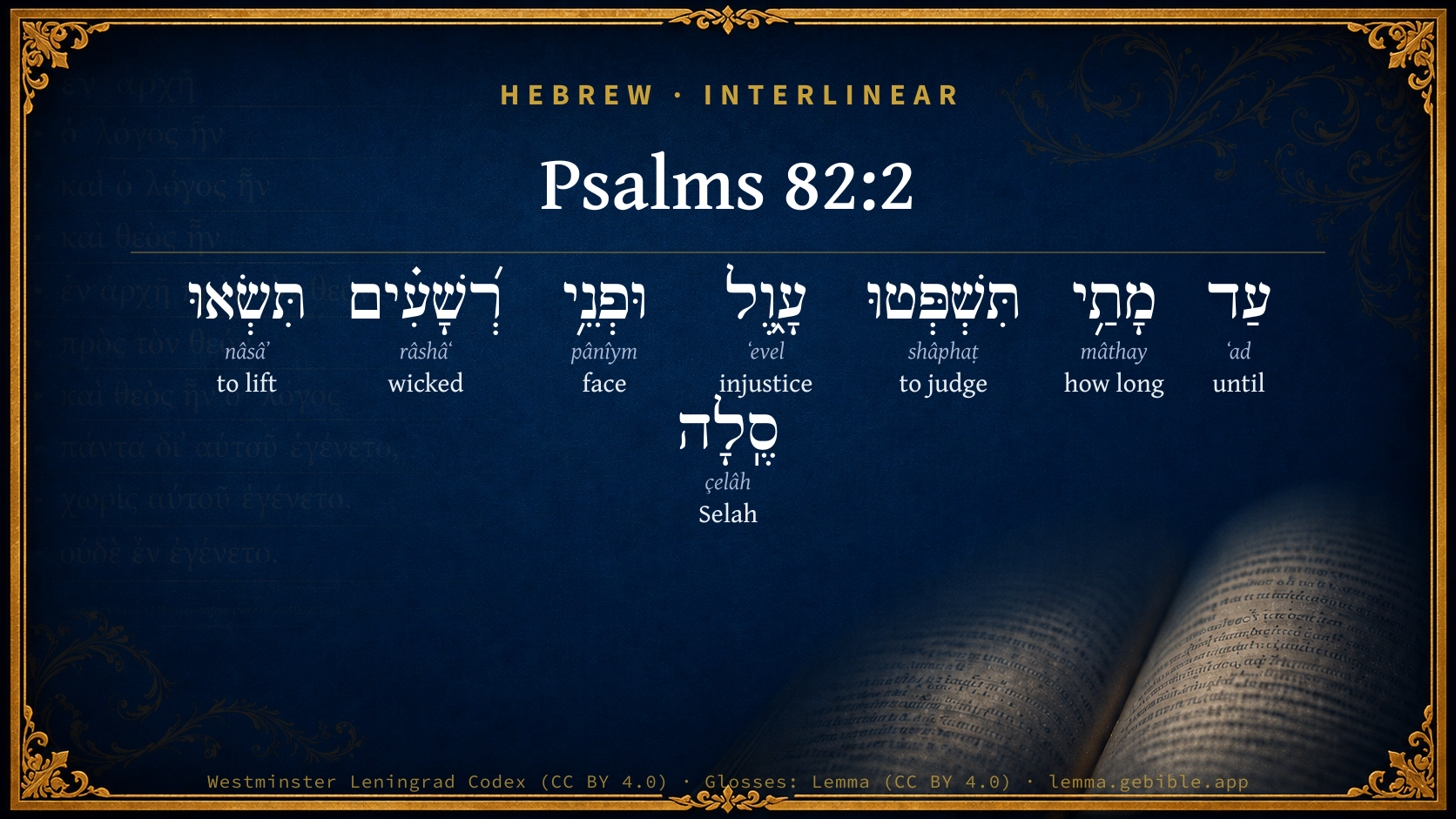
Hebrew (Westminster Leningrad Codex) Psalms 82:2 appears in the Hebrew Old Testament. The text above is from the Westminster Leningrad Codex. Each word links to its Strong’s number, a concise gloss, and parsing drawn from the Open Scriptures Hebrew Bible morphology. Click any word for its full Brown-Driver-Briggs (BDB) entry.
Download image
Cite this verse

Psalms 82:2 (World English Bible). Public Domain. Lemma interlinear Bible study tool, https://lemma.gebible.app/v/psalms/82/2.

Show BibTeX & RIS
BibTeX
RIS
English Translation
"How long will you judge unjustly, And show partiality to the wicked?" Selah.
World English Bible · Public Domain
Download a study sheet

One document with this verse’s original text, its word-by-word gloss line, the meaning frame, cross-references with their text, attributed commentary, and full source and license credits — printable, and it pastes into notes with its structure intact.

This verse Autodidact and up

Study sheet (.html) Plain text (.txt)

A passage Seminary Student

Up to 50 verses in one chapter. A passage sheet keeps up to 6 commentary sources and 12 cross-references per verse, in the order this page ranks them, and says so on the sheet whenever that leaves anything out. Ask for a single verse and you get the Autodidact verse sheet above.

Everything on this page stays free to read, with no account — the sheet is a download of what is already on screen, not access to it.

Want to remove ads? Support Godless Engineer
Compare translations 3

The same verse in 3 English versions, stacked beneath the original-language interlinear above. Click any original word for its lexicon entry.

Each is an independent rendering of the whole verse — the interlinear is not word-aligned to these translations.

Highlighted words mark where these versions differ — a whole-verse word diff, not a word-by-word alignment.

  • World English Bible Public Domain
    "How long will you judge unjustly, And show partiality to the wicked?" Selah.
  • King James Version Public Domain
    How long will ye judge unjustly, and accept the persons of the wicked? Selah.
  • unfoldingWord Literal Text CC BY-SA 4.0
    “Until when will you judge injustice and lift up the faces of the wicked? Selah

unfoldingWord Literal Text — © unfoldingWord, licensed CC BY-SA 4.0. Word-aligned USFM3 via Door43 (git.door43.org/unfoldingWord/en_ult).

Versions to compare (up to 4)

3 of 4 selected

Show all 18 translations

Every available English version of this verse, each an independent rendering of the whole verse.

  • World English Bible Public Domain
    "How long will you judge unjustly, And show partiality to the wicked?" Selah.
  • Berean Standard Bible Public Domain
    “How long will you judge unjustly and show partiality to the wicked? Selah
  • Majority Standard Bible Public Domain
    “How long will you judge unjustly and show partiality to the wicked? Selah
  • King James Version Public Domain
    How long will ye judge unjustly, and accept the persons of the wicked? Selah.
  • American Standard Version (1901) Public Domain
    How long will ye judge unjustly, And respect the persons of the wicked? Selah
  • Revised Version (1885) Public Domain
    How long will ye judge unjustly, and respect the persons of the wicked? Selah
  • Geneva Bible (1599) Public Domain
    How long wil ye iudge vniustly, and accept the persons of the wicked? Selah.
  • Douay-Rheims (1899) Public Domain
    How long will you judge unjustly: and accept the persons of the wicked?
  • Young's Literal Translation Public Domain
    Till when do ye judge perversely? And the face of the wicked lift up? Selah.
  • Literal Standard Version CC BY-SA 4.0
    Until when do you judge perversely? And lift up the face of the wicked? Selah.
  • Unlocked Literal Bible CC BY-SA 4.0
    How long will you judge unjustly and show favoritism to the wicked? Selah
  • unfoldingWord Literal Text CC BY-SA 4.0
    “Until when will you judge injustice and lift up the faces of the wicked? Selah
  • Darby Bible Public Domain
    How long will ye judge unrighteously, and accept the person of the wicked? Selah.
  • World Messianic Bible Public Domain
    “How long will you judge unjustly, and show partiality to the wicked?” Selah.
  • Webster's Bible Public Domain
    How long will ye judge unjustly, and accept the persons of the wicked? Selah.
  • Free Bible Version CC BY-SA 4.0
    How long will you make unfair judgments and show favoritism to the wicked? Selah.
  • Bible in Basic English Public Domain
    How long will you go on judging falsely, having respect for the persons of evil-doers? (Selah.)
  • JPS Tanakh (1917) Public Domain
    'How long will ye judge unjustly, and respect the persons of the wicked? Selah

Literal Standard Version (2020), Covenant Press — licensed CC BY-SA 4.0. Text via the HelloAO Bible API (eBible.org). Unlocked Literal Bible (unfoldingWord) — licensed CC BY-SA 4.0. Text via the HelloAO Bible API (eBible.org). unfoldingWord Literal Text — © unfoldingWord, licensed CC BY-SA 4.0. Word-aligned USFM3 via Door43 (git.door43.org/unfoldingWord/en_ult). Free Bible Version, Dr. Jonathan Gallagher — licensed CC BY-SA 4.0. Text via the HelloAO Bible API (eBible.org).

Word by word

More ways to search: Search by grammar → Find every occurrence → Compare this word →

Practice this passage: Drill this verse → Learn its vocabulary →

About this verse

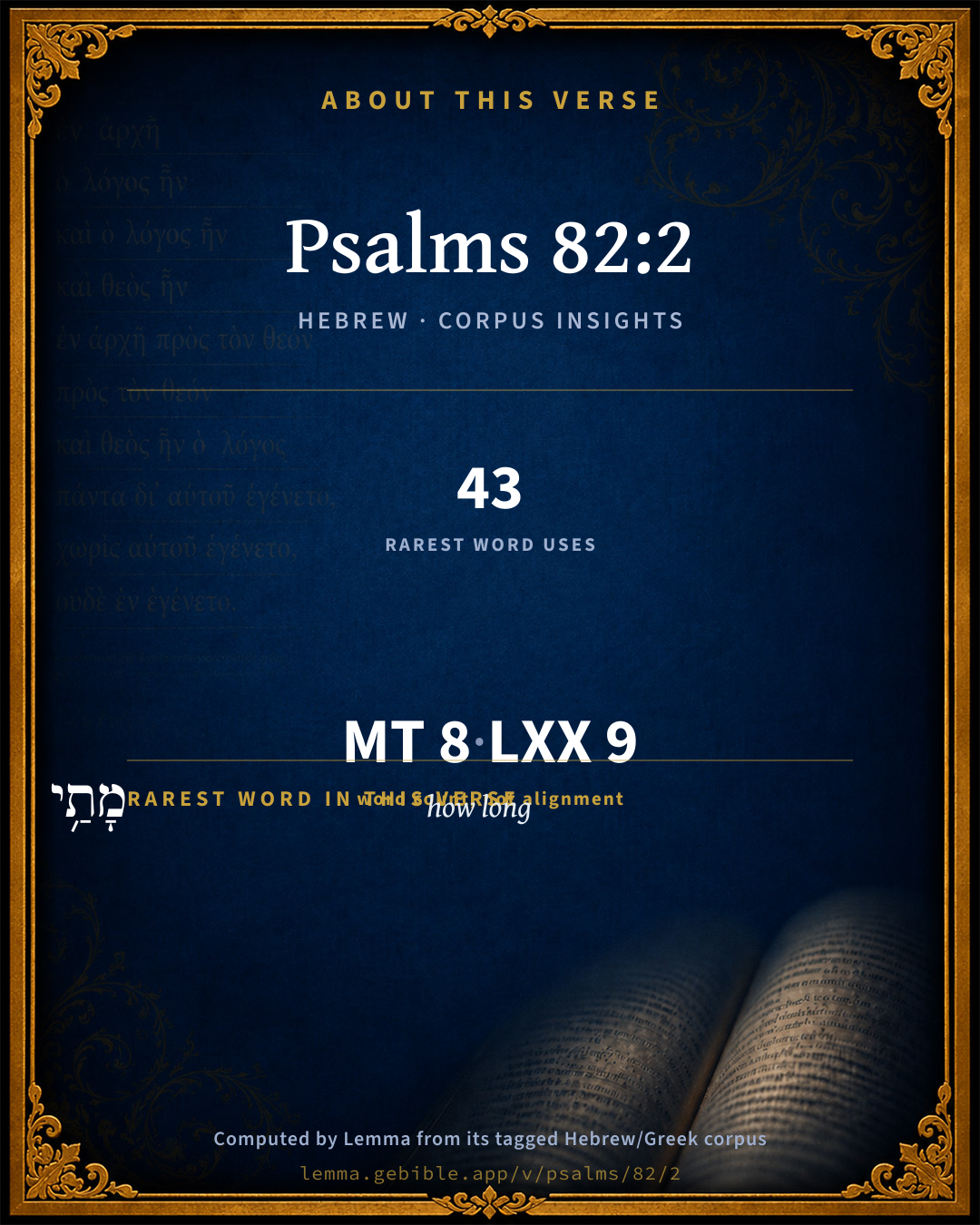
These counts appear in no published source. They are computed here, from the morphology-tagged text and Lemma’s own curated glosses. What Lemma adds →

8
words
8
distinct lemmas
Wisdom
section

Shared distinctive vocabulary

מָתַ֥י how long H4970 occurs in 40 verses of the Hebrew Bible. Also found in:

Grammatical profile

  • 2 verbs
  • 2 nouns
  • 1 adjective
  • 1 preposition
  • 2 particles

Verb forms

  • תִּשְׁפְּטוּ Qal · Imperfect
  • תִּשְׂאוּ Qal · Imperfect

Hebrew & Septuagint length

In English translation the verse runs 13 words from the Hebrew and 13 from the Septuagint (LXX English) — the same length.

A rough comparison of the two English renderings, which tokenize alike — not a word-level alignment.

Word counts can differ between the Hebrew and the Greek without any difference in meaning — e.g. the Hebrew direct-object marker אֵת has no separate Greek word, and Greek often adds the article ὁ.

In the original languages it is 8 Hebrew tokens and 9 Greek tokens — but the two are counted differently (Hebrew bundles its prefixes and suffixes into one token; the Greek is in lemma form), so that isn’t a like-for-like length.

Cross-references

14

Topical passages linked to Psalms 82:2 in the Treasury of Scripture Knowledge — connected by theme and wording, ordered by reader-vote popularity; previews shown in the World English Bible.

  • Deuteronomy 1:17 You shall not show partiality in judgment; you shall hear the small and the great alike; you shall not be afraid of the face of man; for the judgment is God's: and the cause that is too hard for you, you shall bring to me, and I will hear it.
  • Proverbs 18:5 To be partial to the faces of the wicked is not good, Nor to deprive the innocent of justice.
  • Psalms 58:1–2 Do you indeed speak righteousness, silent ones? Do you judge blamelessly, you sons of men?
  • Exodus 10:3 Moses and Aaron went in to Pharaoh, and said to him, "This is what Yahweh, the God of the Hebrews, says: 'How long will you refuse to humble yourself before me? Let my people go, that they may serve me.
  • Galatians 2:6 But from those who were reputed to be important (whatever they were, it makes no difference to me; God doesn't show partiality to man)--they, I say, who were respected imparted nothing to me,
  • Exodus 23:6–7 "You shall not deny justice to your poor people in their lawsuits.
  • Leviticus 19:15 "'You shall do no injustice in judgment: you shall not be partial to the poor, nor show favoritism to the great; but in righteousness shall you judge your neighbor.
  • 1 Kings 18:21 Elijah came near to all the people, and said, "How long will you waver between the two sides? If Yahweh is God, follow him; but if Baal, then follow him." The people answered him not a word.
  • 2 Chronicles 19:7 Now therefore let the fear of Yahweh be on you; take heed and do it: for there is no iniquity with Yahweh our God, nor respect of persons, nor taking of bribes.
  • Job 34:19 Who doesn't respect the persons of princes, Nor regards the rich more than the poor; For they all are the work of his hands.
  • Psalms 62:3 How long will you assault a man, Would all of you throw him down, Like a leaning wall, like a tottering fence?
  • Micah 3:1–3 I said, "Please listen, you heads of Jacob, And rulers of the house of Israel: Isn't it for you to know justice?
  • Micah 3:9–12 Please listen to this, you heads of the house of Jacob, And rulers of the house of Israel, Who abhor justice, And pervert all equity.
  • Matthew 17:17 Jesus answered, "Faithless and perverse generation! How long will I be with you? How long will I bear with you? Bring him here to me."

Cross-references courtesy of OpenBible.info (CC BY 4.0).

Hebrew and Greek witnesses Masoretic Hebrew ↔ Greek Septuagint

The same verse in the two great witnesses to the Old Testament, shown verse-for-verse.

You’re reading Greek Psalm 81 (Hebrew Psalm 82). The Septuagint counts the superscription, so verse numbers can differ from the Hebrew — chapter-level alignment, not verse-by-verse. Numbering follows Rahlfs.

These are two independent witnesses, not word-aligned to each other, and the Septuagint is shown in lemma (dictionary) form.

Hebrew Psalms 82:2 Masoretic · Westminster Leningrad Codex

עַד מָתַ֥י תִּשְׁפְּטוּ עָ֑וֶל וּפְנֵ֥י רְ֝שָׁעִ֗ים תִּשְׂאוּ סֶֽלָה

"How long will you judge unjustly, And show partiality to the wicked?" Selah.

World English Bible · Public Domain

Greek LXX Greek Psalm 81:2 Septuagint · lemma form

ἕως πότε κρίνω ἀδικία καί πρόσωπον ἁμαρτωλός λαμβάνω διάψαλμα

How long will you⌃ judge unrighteously, and accept the persons of sinners? Pause.

LXX2012 (modern English Septuagint) · Public Domain

Hebrew: Westminster Leningrad Codex (CC BY 4.0). Greek: Septuagint (public domain); English from LXX2012 (modern English Septuagint) (Public Domain). How the Septuagint differs from the Hebrew →

Commentary

Notes on Psalms 82:2 from classic Christian and Jewish commentators (each source and its license shown beneath its notes). The classic Christian expositions comment on the surrounding passage and are grouped to its opening verse, so a note may address several verses; the Jewish commentaries on the Tanakh (Rashi and others) are per-verse, so they appear only where the commentator wrote on this verse.

Lemma curates 59 commentaries, every one of them public domain or Creative Commons licensed, each selected and text-cleaned for this edition rather than reprinted as found. About our sources →

Trapp's Complete Commentary

John Trapp

Psa 82:2 How long will ye judge unjustly, and accept the persons of the wicked? Selah.

Ver. 2. How long will ye judge unjustly] viz. Through a cyclopical contempt of God’s severity.

Ne pecces, Deus ipse videt.

Will ye represent and express God to the world as a corrupt, crooked, and unrighteous judge?

And accept the persons of the wicked?] Heb. lift up their faces, and show them more favour than others that are much more honest? Barabbas oft is released, and Christ crucified. Alter habet aequum, sed alter habebit aequum, said that partial emperor, This man hath the right on his side, but the other shall carry the cause, for all that.

John Trapp, A Commentary or Exposition upon All the Books of the Old and New Testament (1647–1656) — public domain. Text from a community e-Sword module.

The Biblical Illustrator

Joseph S. Exell

Psa_82:2

How long will ye judge unjustly, and accept the persons of the wicked?

Magistrates rebuked for unjust judgment

1. The sin reproved in general, and that is unjust judgment,--a sin most peculiar to judges. To be covetous, envious, passionate, and proud, is evil; but to judge unjustly, to justify the wicked, and condemn the just is not only abominable, but an abomination in the abstract (Pro_17:15). This is iniquity and perverseness with a witness.

2. The duration of their sin, implied in how long? It implies that they had for a long time persevered in this practice, and therefore he doth not simply say, ye do unjustly, but how long will ye do unjustly? The interrogation is a vehement negation, ye ought in no wise to continue so long in your injustice as you have done.

3. The generality of the sinners implied in ye; how long will ye, i.e. all of ye, judge unjustly? There might be some few, some gleanings, as the prophet speaks (Mic_7:1-2), of just judges, but the generality was very corrupt.

4. An exegesis, an illustration, or, if you will, an aggravation of what went before. Ye judge unjustly. What is that? Why, ye accept the persons of the wicked, ye admire their persons, ye favour their faces, ye plead their causes; but the cause of the poor and the righteous man cannot be heard. In the original it is, Ye accept the face of the wicked. Now, to accept the face of a man is a Hebrew phrase, and signifies a showing favour and respect to a man (Gen_19:22).

Observations:

1. Even great men, when they go astray, must be sharply reproved. But for this great wisdom and prudence is required.

2. Continuance in evil is a great evil. How long, saith God, will ye judge unjustly? To do an unjust act is ill, but to persevere for many years in acting unrighteousness is the height of evil. As perseverance in goodness is the crown of goodness (Job_2:3), so perseverance in sin is sin in grain; it is of a deep dye; it is hardly, if ever, set out again.

3. It is no wonder to see judges judge unjustly. They did so here, and God complains of such elsewhere (Isa_1:23; Jer_5:1; Mic_3:9).

4. Few great men are good men. They are subject to great temptations, and so to great corruptions.

5. Perverting of judgment is a great sin (Eze_22:6-7; Isa_5:6-7; Jer_5:28-29; Amo_2:6; Amo_5:6-7; Amo_5:11; Mal_3:5).

6. Magistrates must judge impartially. They must not respect persons but causes. They must look more on the face of the cause than the face of the man. This respecting of persons is not good, saith Solomon, that is, it is very bad (Pro_24:23). It is a sin oft forbidden (Deu_1:17; Deu_16:19; Job_13:8; Job_13:10; 2Ch_19:6-7; Pro_18:5; Pro_28:21; Jam_2:9; Jud_1:16), Men must not judge according to any outward appearance or quality of the person that appears before them, but according to the equity of the cause (Joh_7:24). (T. Hall, B. D.)

Corrupt judges

Catiline, being prosecuted for some great offence, corrupted the judges. When they had given their verdict, though he was acquitted only by a majority of two, he said he had put himself to a needless expense in bribing one of those judges, for it would have been sufficient to have had a majority of one. (Plutarchs Cicero.)

The Biblical Illustrator, edited by Joseph S. Exell (c. 1880s–1900s) — public domain. Text from a community e-Sword module.

Joseph Benson's Commentary

Psa 82:2. How long will ye judge unjustly? — The psalmist speaks to them in God’s name, and reproves them for their continued unrighteousness in their public administrations; and accept the persons of the wicked — By overlooking the merits of the cause, and giving sentence according to your respect or affection to the person. It appears from Isa 1:23, that the courts of justice were very corrupt in Hezekiah’s reign, at which time probably this Psalm was written.

Joseph Benson's Commentary on the Old and New Testaments (1811–1818) — public domain. Text from a community e-Sword module.

J. A. Alexander on Psalms

Joseph Addison Alexander

2. (Psa 82:2) How long will ye judge wrong, and the faces of wicked men accept? Selah. The question implies that they had done so long enough, nay, too long, since it was wrong from the beginning. Wrong, in the strongest moral sense, injustice, wickedness. Wrong, in Hebrew as in English, may be construed either as an adverb or a noun, or both, i.e. as a noun adverbially used to qualify the verb. See the similar construction of its counter-part or converse, Psa 58:1. The last clause exemplies one of the most peculiar Hebrew idioms. The combination usually rendered respect persons in the English Bible, and applied to judicial partiality, means literally to take (or take up) faces. Some suppose this to mean the raising of the countenance, or causing to look up from deep dejection. But the highest philological authorities are now agreed, that the primary idea is that of accepting one man's face or person rather than another's, the, precise form of expression, though obscure, being probably derived from the practice of admitting suitors to confer with governors or rulers face to face, a privilege which can sometimes only be obtained by bribes, especially though not exclusively in oriental courts. The Selah commends the implied charge of official malversation to the serious reflection of the accused parties.

Joseph Addison Alexander, The Psalms Translated and Explained (1850) — public domain. Text from a community e-Sword module.

Tyndale Open Study Notes

Tyndale Open Resources

82:2 Since justice marks God’s reign (89:4), he opposes favoring the wicked. So the psalmist is perplexed and cries out to God for justice (82:3-4, 8).

Tyndale Open Study Notes — © Tyndale Open Resources, licensed CC BY-SA 4.0. Text via the HelloAO Bible API.

Geneva Bible (1599)

Geneva Bible translators

For thieves and murderers find favor in judgment, when the cause of the godly cannot be heard.

Geneva Bible (1599) marginal notes — public domain. Text via Bolls.life.

Adam Clarke's Commentary

Verse 2. Accept the persons of the wicked?] "Lift up their faces," encourage them in their oppressions.

Selah.] "Mark this:" ye do it, and sorely shall ye suffer for it.

Adam Clarke's Commentary on the Bible (1810–1826) — public domain. Text from a community e-Sword/MySword module.

John Calvin's Commentaries

2 How long will ye judge unjustly? Many suppose that God is here introduced speaking, and that these are the words which he utters from his throne of judgment. But I would rather consider the prophet himself as the speaker, who, in order to prepare the way for administering a rebuke, had spoken in the manner in which he did in the first verse. Kings may lift up their heads above the clouds, but they, as well as the rest of mankind, are under the government of God; and such being the case, it is in vain for them arrogantly to struggle to obtain exemption from the obligations of reason. Yet this is what they do. Although tyrants are amongst the basest of men, and occupy their exalted station by detestable treason, yet if any servant of God has the fortitude to open his mouth against them, they immediately attempt to shelter themselves by appealing to the sacred name of God, as if great wrong had been done to them. Thus, whilst they persuade themselves that they are privileged with exemption from the law to which the rest of mankind are subject, they endeavor to deprive the common people of divine truth and its ministers. In short, they think that there can be no sovereignty unless where uncontrolled license is enjoyed. But let this principle be once established, “That God rules among them,” and then a way is opened up for the admission of divine truth. Accordingly, the prophet, after having thus laid a foundation for his authority, freely inveighs against princes, and reproves the very gross vice of selling themselves to those who unrighteously oppress the poor, and of being gained by bribes to pervert in their administration every principle of justice. He expressly names the wicked; for good men will never attempt to corrupt judges. Moreover, there is a certain devilish frenzy which infatuates the princes of the world, and leads them voluntarily to pay greater respect to wicked men than to the simple and innocent. Even supposing that the wicked continue inactive, and use no endeavors to obtain for themselves favor either by flattery, fraud, bribery, or other artifices; yet those who bear rule are for the most part inclined of themselves to the bad side. The reason why the prophet upbraids them is, that wicked men find more favor at their hands than the good and conscientious.

John Calvin's Commentaries (1540-1563) — public domain. Text from the Calvin Translation Society English edition (1840s-50s) via the Christian Classics Ethereal Library (ccel.org). Calvin's coverage is partial (roughly two-thirds of the Bible); uncommented books and verses are honest gaps, never fabricated. The 19th-century editor's footnotes and remarks are omitted so the notes are faithfully Calvin's own voice.

Ellicott's Commentary for English Readers

(2) How long?—What a terrible severity in this Divine Quousque tandem!

“The gods

Grow angry with your patience; this their care,

And must be yours, that guilty men escape not;

As crimes do grow, justice should rouse itself.”

BEN JONSON.

Judge unjustly.—Literally, judge iniquity. For the opposite expression see Psa_58:1. Lev_19:15, which lays down the great principle of strictly fair and unbribable justice is evidently in the poet’s mind, as is shown by the use of the next clause.

Accept the persons.—Literally, lift up the faces. An expression arising from the Eastern custom of prostration before a king or judge. The accepted suitor is commanded to “lift up his face,” i.e., to arise. (Comp. Pro_18:5, and Jehoshaphat’s address to the judges, 2Ch_19:7.) This fine sense of the majesty of incorruptible justice attended Israel throughout its history. (See Sir_7:6.)

(2-4) These verses contain the rebuke addressed by the supreme judge to those abusing the judicial office and function.

A Bible Commentary for English Readers, edited by Charles John Ellicott (1878–1897) — public domain. Text from a community e-Sword module.

The Cambridge Bible for Schools and Colleges

gen. ed. J. J. S. Perowne

2. accept the persons] Or, as R.V., respect the persons, shewing partiality to the rich and powerful. Strict impartiality in the administration of justice is frequently enjoined in the Law. Favouring the poor is condemned as well as favouring the rich. See Exo_23:2-3; Exo_23:6-8; Lev_19:15; Lev_19:35; Deu_1:17; Deu_16:18 ff.: cp. Pro_18:5; Pro_24:23. The music strikes up to emphasise the question, and as it were give time for an answer. But the judges have no defence, and God proceeds to remind them of their duty.

2–4. God speaks, arraigning the judges for injustice and partiality, and bidding them perform their duties faithfully.

The Cambridge Bible for Schools and Colleges (gen. ed. J. J. S. Perowne; Cambridge University Press, 1878–1918) — public domain. Text from a community e-Sword module.

John Gill's Exposition

How long will ye judge unjustly,.... These are the words not of the psalmist, but of the divine Person that stands in the congregation of the mighty, and judges among the gods; calling the unjust judges to an account, and reproving them for their unrighteous proceedings and perversion of justice, in which they had long continued, and which was an aggravation of their sin; this is very applicable to the rulers and judges of the Jewish nation in the times of Christ, who had long dealt very unjustly, and continued to do so; they judged wrong judgment, or judgment of iniquity, as Aben Ezra renders it, both in civil and ecclesiastical things; their judgment was depraved concerning the law, which they transgressed and made void by adhering to the traditions of the elders; they passed an unrighteous judgment on John the Baptist, the forerunner of Christ, rejecting his baptism, and calling him a devil; and upon Christ himself, adjudging him to death for crimes he was not guilty of; and upon his followers, whom they cast out of the synagogue; the character of an unjust judge see in Luk 18:2,

and accept the persons of the wicked? gave the cause in favour of them, and against the righteous, because they were rich, or related to them, or had bribes from them, contrary to the law in Deu 16:19, so the judges among the Jews, in Christ's time, judged according to appearance, the outward circumstances of men, and not righteous judgment, as our Lord suggests, Joh 7:24.

Selah. See Gill on Psa 3:2.

John Gill's Exposition of the Whole Bible (1746–1763) — public domain (CC PDM 1.0). Text via the HelloAO Bible API.

Albert Barnes' Notes on the Bible

How long will ye judge unjustly - literally, Judge evil. This is designed, evidently, to denote the prevailing character of the magistrates at the time when the psalm was written. Unhappily such occasions occur very often in the course of human affairs.

And accept the persons of the wicked? - literally, Lift up, or bear, the faces of the wicked. The meaning is, that they showed favor or partiality to wicked people; they did not decide cases according to truth, but were influenced by a regard for particular persons on account of their rank, their position, their wealth, or their relation to themselves. This is a common phrase in the Scriptures to denote favoritism or partiality. Job 34:19; Act 10:34; Rom 2:11; 1Pe 1:17; Lev 19:15; Deu 1:17.

Albert Barnes' Notes on the Bible (1834–1885) — public domain. Text from a community e-Sword/MySword module.

Matthew Poole's English Annotations

The psalmist speaketh to them in God’s name, and reproves them for their continued and resolved unrighteousness in their public administrations.

Accept the persons, by overlooking the merits of the cause, and giving sentence according to your respect or affection to the person.

Matthew Poole's English Annotations on the Holy Bible (1683–1685) — public domain. Text from a community e-Sword/MySword module.

The Treasury of David

Charles H. Spurgeon

Ver. 2. How long will ye judge unjustly and accept the persons of the wicked? It is indirectly stated that the magistrates had been unjust and corrupt. They not only excused the wicked, but even decided in their favour against the righteous. A little of this is too much, a short time too long. Some suitors could get their claims settled at once, and in their own favour, while others were wearing out their lives by waiting for an audience, or were robbed by legal process because their opponents had the judge's ear: how long were such things to be perpetuated? Would they never remember the Great Judge, and renounce their wickedness? This verse is so grandly stern that one is tempted to say, "Surely an Elijah is here."

Selah. This gives the offenders pause for consideration and confession.

Whole Psalm. Asaph, who has written so much in the previous Psalms of the coming of Christ in the flesh, now speaks of his second coming to judgment. Josephus Maria Thomasius. 1649-1713.

Ver. 2. And accept the persons of the wicked. The last clause exemplifies one of the most peculiar Hebrew idioms. The combination usually rendered respect persons in the English Bible, and applied to judicial partiality, means literally to take (or take up) faces. Some suppose this to mean the raising of the countenance, or causing to look up from dejection. But the highest philological authorities are now agreed, that the primary idea is that of accepting one man's face or person rather than another's, the precise form of expression, though obscure, being probably derived from the practice of admitting suitors to confer with governors or rulers, face to face, a privilege which can sometimes only be obtained by bribes, especially, though not exclusively, in oriental courts. Joseph Addison Alexander.

Ver. 2. A common sin. Regard for the persons of men often influences our judgment of their opinions, virtues, vices, and general bearing; this involves injustice to others, as well as deep injury to the flattered.

Psalms 82:3*

Charles H. Spurgeon's The Treasury of David (1869–1885) — public domain. Psalms only. Text from a community e-Sword/MySword module.

Whedon's Commentary on the Bible

Daniel D. Whedon

2. How long will ye judge unjustly—God, who stands in the assembly, speaks to the ministers of justice. The “how long” is the first thundertone to the consciences of these corrupt office bearers, and calls their attention back to the law. Lev_19:15; Deu_1:17.

Accept the persons of the wicked—Lift up the faces of the wicked; give them assurance and favour, having respect to their persons, which was forbidden in the law. Lev_19:15

Daniel D. Whedon (gen. ed.), Commentary on the Old and New Testaments (1874–1909) — public domain. Text from a community e-Sword module.

The Pulpit Commentary

How long will ye judge unjustly? "The cry of the impatient Jehovah" (Cheyne); comp. Exo_10:3 Exo_16:28 Num_14:11, Num_14:27. And accept the persons of the wicked? Accepting men"s persons is favouring them unduly on account of their position or outward circumstances. It was strictly forbidden in the Mosaic Law. (see Deu_1:17 Deu_16:19 Lev_19:15)

Accepting the person.

Jehoshaphat, (2Ch_19:7) in addressing the Judges, reminds them that "with the Lord our God is no respect of persons, nor taking of gifts". (see also 2Sa_14:14 Act_10:34 Rom_2:11 Gal_2:6) This Hebrew term, "accepting the person," or "accepting the face," is the equivalent of our term, "show partiality to." The figure is taken from the Eastern custom of prostration before a king or judge. The accepted suitor is commanded to "lift up his face," that is, to rise up. The extent to which the bribery of judges is carried on in the East may be illustrated by the following passage, referring to Egypt, by Mr. Lane. "The rank of a plaintiff or defendant, or a bribe from either, often influences the decision of the judge. In general the naib (deputy of the judge), and mooftee (chief doctor of the law) take bribes; and the cadi (chief judge) receives from his naib. On some occasions, particularly in long litigations, bribes are given by each party, and the decision is awarded in favour of him who pays highest. This frequently happens in difficult lawsuits; and even in cases respecting which the law is perfectly clear, strict justice is not always administered, bribes and false testimony being employed by one of the parties. The shocking extent to which bribery and suborning false witnesses are carried on in Moslem courts of law, and in the tribunal of the cadi at Cairo, can scarcely be credited." The psalmist pronounces the magistrates of his day to be indifferent to justice, neglectful of their duties, venal and unscrupulous, and he warns them of the ruin they are bringing on society. St. James reminds us that this "undue partiality," this "accepting the person," this showing preference for the rich, is not confined to judges. It may be observed even in the relations of the Christian Church. (see Jam_2:1-4)

I THERE IS NO "ACCEPTING THE PERSON" WITH GOD. This is distinctly declared by St. Peter. (1Pe_1:17) "If ye call on the Father, who without respect of persons judgeth according to every man"s work.

Certain settings of the Christian truth, those known as Calvinistic, which put in prominence the Divine election, have been used or misused to encourage an idea of" favouritism" in God. It is always better to regard the Divine election as simply the all-wise selection of the most fitting person for the work which has to be done. It is only a subtle form of self-conceit which makes us imagine ourselves the special favourites of Heaven. "God accepteth no man"s person." "The Judge of all the earth does right.

II THERE SHOULD BE NO "ACCEPTING THE PERSON" WITH MEN. This, however, must apply to official relations and duties, not to personal feelings and preferences. It is the fruitful source of evils in the family, business, society, and the Church. The least loved and the most unlovely folk in the world are the family pets, the society pets. R.T.

The Pulpit Commentary (1880–1919), ed. H.D.M. Spence-Jones & Joseph S. Exell — public domain. Text from a community e-Sword module.

John Wesley's Explanatory Notes

How long - The psalmist speaks to them in God's name. Accept - By giving sentence according to your respect or affection to the person.

John Wesley, Explanatory Notes Upon the Whole Bible (1754–1765) — public domain. Text via the GEBible commentary corpus.

Lesson kit

Teaching starters — assembled from the data on this page, not authored interpretation. Every prompt links to the verse data it draws on. Edit before teaching.

Psalms, in the Wisdom, opens this verse with 8 words (8 distinct Hebrew lemmas). Its most distinctive word is mâthay (“how long”). A historical commentator’s framing appears above. Read the whole chapter for the surrounding context.

Discussion questions

  1. The word mâthay carries the sense “how long.” How does it shape the verse?
  2. Genesis 30:30 shares the word «how long» with this verse. How do the two illuminate each other?
  3. These translations render this verse differently. What is at stake in choosing one wording over another?
  4. The verb «תִּשְׁפְּטוּ» is Qal Imperfect. How does its form color the action?
  5. Reading how Trapp's Complete Commentary and The Biblical Illustrator read this verse, where do the two commentators agree and where do they part?

Things to notice

Reading settings

Reading text

Shown beneath each verse's original-language words.

Old Testament
Old Testament edition

Read the OT as the Masoretic Hebrew (MT) or the Greek Septuagint (LXX).

English shown for the Greek Septuagint (in the Hebrew ↔ Greek comparison).

Comparing translations? Open the Compare panel on any verse page to stack up to four side by side.