
Esther 5:2

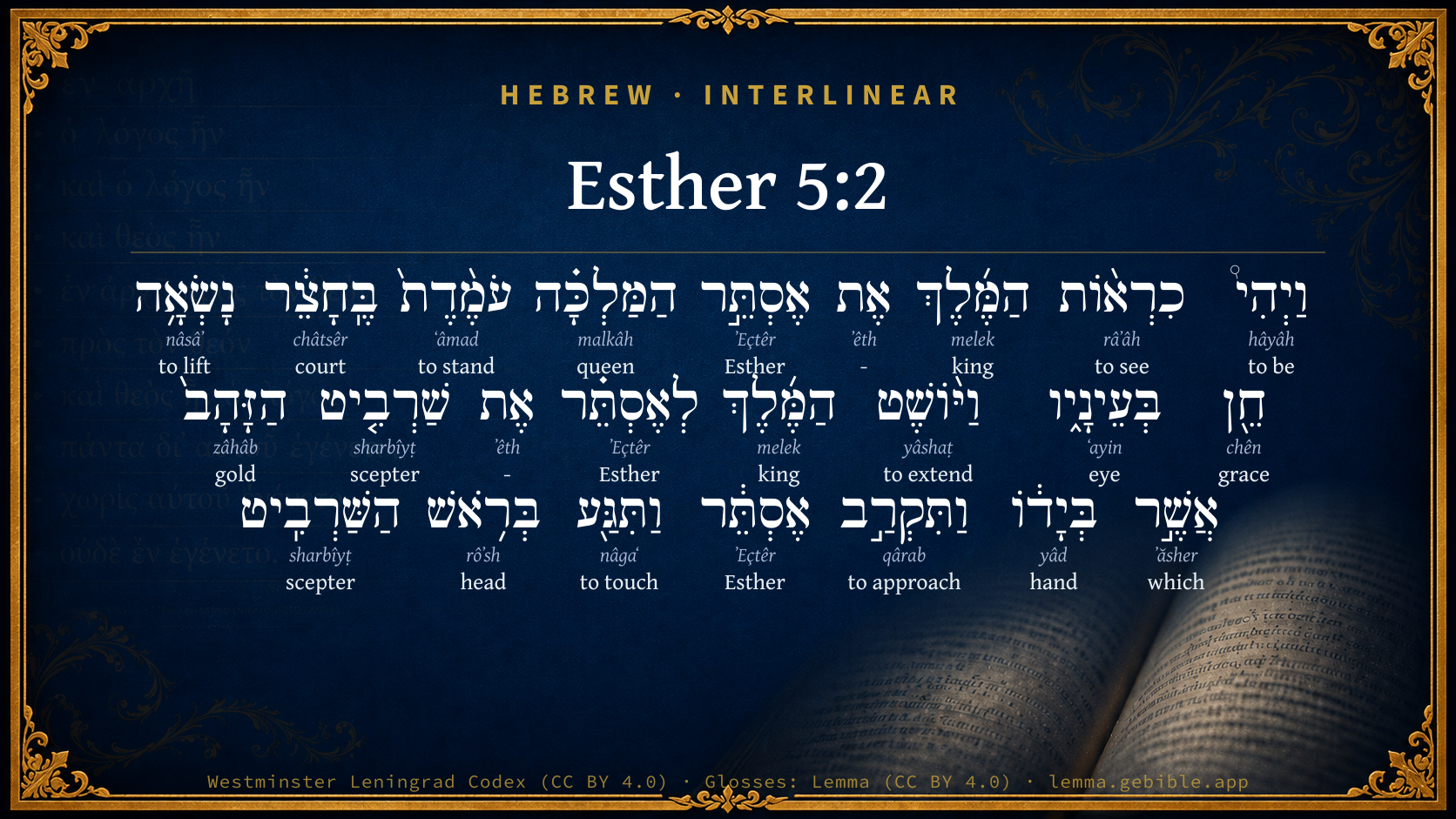
Hebrew (Westminster Leningrad Codex) Esther 5:2 appears in the Hebrew Old Testament. The text above is from the Westminster Leningrad Codex. Each word links to its Strong’s number, a concise gloss, and parsing drawn from the Open Scriptures Hebrew Bible morphology. Click any word for its full Brown-Driver-Briggs (BDB) entry.
Download image
Cite this verse

Esther 5:2 (World English Bible). Public Domain. Lemma interlinear Bible study tool, https://lemma.gebible.app/v/esther/5/2.

Show BibTeX & RIS
BibTeX
RIS
English Translation
It was so, when the king saw Esther the queen standing in the court, that she obtained favor in his sight; and the king held out to Esther the golden scepter that was in his hand. So Esther drew near, and touched the top of the scepter.
World English Bible · Public Domain
Download a study sheet

One document with this verse’s original text, its word-by-word gloss line, the meaning frame, cross-references with their text, attributed commentary, and full source and license credits — printable, and it pastes into notes with its structure intact.

This verse Autodidact and up

Study sheet (.html) Plain text (.txt)

A passage Seminary Student

Up to 50 verses in one chapter. A passage sheet keeps up to 6 commentary sources and 12 cross-references per verse, in the order this page ranks them, and says so on the sheet whenever that leaves anything out. Ask for a single verse and you get the Autodidact verse sheet above.

Everything on this page stays free to read, with no account — the sheet is a download of what is already on screen, not access to it.

Want to remove ads? Support Godless Engineer
Compare translations 3

The same verse in 3 English versions, stacked beneath the original-language interlinear above. Click any original word for its lexicon entry.

Each is an independent rendering of the whole verse — the interlinear is not word-aligned to these translations.

Highlighted words mark where these versions differ — a whole-verse word diff, not a word-by-word alignment.

  • World English Bible Public Domain
    It was so, when the king saw Esther the queen standing in the court, that she obtained favor in his sight; and the king held out to Esther the golden scepter that was in his hand. So Esther drew near, and touched the top of the scepter.
  • King James Version Public Domain
    And it was so, when the king saw Esther the queen standing in the court, that she obtained favour in his sight: and the king held out to Esther the golden sceptre that was in his hand. So Esther drew near, and touched the top of the sceptre.
  • unfoldingWord Literal Text CC BY-SA 4.0
    And it happened that, as soon as the king saw Esther the queen standing in the court, she lifted favor in his eyes. And the king held out to Esther the scepter of gold that was in his hand, so Esther approached and touched the head of the scepter.

unfoldingWord Literal Text — © unfoldingWord, licensed CC BY-SA 4.0. Word-aligned USFM3 via Door43 (git.door43.org/unfoldingWord/en_ult).

Versions to compare (up to 4)

3 of 4 selected

Show all 18 translations

Every available English version of this verse, each an independent rendering of the whole verse.

  • World English Bible Public Domain
    It was so, when the king saw Esther the queen standing in the court, that she obtained favor in his sight; and the king held out to Esther the golden scepter that was in his hand. So Esther drew near, and touched the top of the scepter.
  • Berean Standard Bible Public Domain
    As soon as the king saw Queen Esther standing in the court, she found favor in his sight. The king extended the gold scepter in his hand toward Esther, and she approached and touched the tip of the scepter.
  • Majority Standard Bible Public Domain
    As soon as the king saw Queen Esther standing in the court, she found favor in his sight. The king extended the gold scepter in his hand toward Esther, and she approached and touched the tip of the scepter.
  • King James Version Public Domain
    And it was so, when the king saw Esther the queen standing in the court, that she obtained favour in his sight: and the king held out to Esther the golden sceptre that was in his hand. So Esther drew near, and touched the top of the sceptre.
  • American Standard Version (1901) Public Domain
    And it was so, when the king saw Esther the queen standing in the court, that she obtained favor in his sight; and the king held out to Esther the golden sceptre that was in his hand. So Esther drew near, and touched the top of the sceptre.
  • Revised Version (1885) Public Domain
    And it was so, when the king saw Esther the queen standing in the court, that she obtained favour in his sight: and the king held out to Esther the golden sceptre that was in his hand. So Esther drew near, and touched the top of the sceptre.
  • Geneva Bible (1599) Public Domain
    And when the King saw Ester the Queene standing in the court, shee founde fauour in his sight: and the King held out the golden scepter that was in his hand: so Ester drewe neere, and touched the toppe of the scepter.
  • Douay-Rheims (1899) Public Domain
    And when he saw Esther the queen standing, she pleased his eyes, and he held out toward her the golden sceptre, which he held in his hand: and she drew near, and kissed the top of his sceptre.
  • Young's Literal Translation Public Domain
    and it cometh to pass, at the king's seeing Esther the queen standing in the court, she hath received grace in his eyes, and the king holdeth out to Esther the golden sceptre that `is' in his hand, and Esther draweth near, and toucheth the top of the sceptre.
  • Literal Standard Version CC BY-SA 4.0
    and it comes to pass, at the king’s seeing Esther the queen standing in the court, she has received grace in his eyes, and the king holds out to Esther the golden scepter that [is] in his hand, and Esther draws near, and touches the top of the scepter.
  • Unlocked Literal Bible CC BY-SA 4.0
    When the king saw Esther the queen standing in the courtyard, she received approval in his eyes. He held out to her the golden scepter in his hand. So Esther approached and touched the tip of the scepter.
  • unfoldingWord Literal Text CC BY-SA 4.0
    And it happened that, as soon as the king saw Esther the queen standing in the court, she lifted favor in his eyes. And the king held out to Esther the scepter of gold that was in his hand, so Esther approached and touched the head of the scepter.
  • Darby Bible Public Domain
    And it was so, when the king saw the queen Esther standing in the court, that she obtained grace in his sight; and the king held out to Esther the golden sceptre that was in his hand; and Esther drew near, and touched the top of the sceptre.
  • World Messianic Bible Public Domain
    When the king saw Esther the queen standing in the court, she obtained favor in his sight; and the king held out to Esther the golden scepter that was in his hand. So Esther came near and touched the top of the scepter.
  • Webster's Bible Public Domain
    And it was so, when the king saw Esther the queen standing in the court, that she obtained favor in his sight: and the king held out to Esther the golden scepter that was in his hand. So Esther drew near, and touched the top of the scepter.
  • Free Bible Version CC BY-SA 4.0
    When the king saw Queen Esther standing in the inner court she won his approval so he acted favorably by holding out his scepter to her. So Esther went over and touched the end of the scepter.
  • Bible in Basic English Public Domain
    And when the king saw Esther the queen waiting in the inner room, looking kindly on her he put out the rod of gold in his hand to her. So Esther came near and put her fingers on the top of the rod.
  • JPS Tanakh (1917) Public Domain
    And it was so, when the king saw Esther the queen standing in the court, that she obtained favour in his sight; and the king held out to Esther the golden sceptre that was in his hand. So Esther drew near, and touched the top of the sceptre.

Literal Standard Version (2020), Covenant Press — licensed CC BY-SA 4.0. Text via the HelloAO Bible API (eBible.org). Unlocked Literal Bible (unfoldingWord) — licensed CC BY-SA 4.0. Text via the HelloAO Bible API (eBible.org). unfoldingWord Literal Text — © unfoldingWord, licensed CC BY-SA 4.0. Word-aligned USFM3 via Door43 (git.door43.org/unfoldingWord/en_ult). Free Bible Version, Dr. Jonathan Gallagher — licensed CC BY-SA 4.0. Text via the HelloAO Bible API (eBible.org).

Word by word

More ways to search: Search by grammar → Find every occurrence → Compare this word →

Practice this passage: Drill this verse → Learn its vocabulary →

וַיּ֨וֹשֶׁט
yâshaṭ
H3447
“and · to extend”
Conjunction + Verb, Hiphil, Sequential Imperfect, 3rd Person, Masculine, Singular
Part of Speech
Conjunction + Verb
Stem
Hiphil
Form
Sequential Imperfect
Person
3rd Person
Gender
Masculine
Number
Singular
Full BDB Definition

Origin: a primitive root

TWOT: 925

(Hiphil) to hold out, extend
  1. וַיְהִי֩ hâyâh H1961 “and · to be” Conjunction + Verb, Qal, Sequential Imperfect, 3rd Person, Masculine, Singular
  2. כִרְא֨וֹת râʼâh H7200 “like/as · to see” Preposition + Verb, Qal, Infinitive Construct
  3. הַמֶּ֜לֶךְ melek H4428 “the · king” Particle, Definite Article + Noun, Common, Masculine, Singular, Absolute
  4. אֶת ʼêth H853 “-” Particle, Direct Object
  5. אֶסְתֵּ֣ר ʼEçtêr H635 “Esther” Noun, Proper
  6. הַמַּלְכָּ֗ה malkâh H4436 “the · queen” Particle, Definite Article + Noun, Common, Feminine, Singular, Absolute
  7. עֹמֶ֨דֶת֙ ʻâmad H5975 “standing” Verb, Qal, Participle Active, Feminine, Singular, Absolute
  8. בֶּֽחָצֵ֔ר châtsêr H2691 “in/at the · court” Preposition, Determined + Noun, Common, Both, Singular, Absolute
  9. נָשְׂאָ֥ה nâsâʼ H5375 “to lift” Verb, Qal, Perfect, 3rd Person, Feminine, Singular
  10. חֵ֖ן chên H2580 “grace” Noun, Common, Masculine, Singular, Absolute
  11. בְּעֵינָ֑יו ʻayin H5869 “in/at · eyes · his” Preposition + Noun, Common, Both, Dual, Construct + Suffix, Personal, 3rd Person, Masculine, Singular
  12. הַמֶּ֜לֶךְ melek H4428 “the · king” Particle, Definite Article + Noun, Common, Masculine, Singular, Absolute
  13. לְאֶסְתֵּ֗ר ʼEçtêr H635 “to/for · Esther” Preposition + Noun, Proper
  14. אֶת ʼêth H853 “-” Particle, Direct Object
  15. שַׁרְבִ֤יט sharbîyṭ H8275 “scepter of” Noun, Common, Masculine, Singular, Construct
  16. הַזָּהָב֙ zâhâb H2091 “the · gold” Particle, Definite Article + Noun, Common, Masculine, Singular, Absolute
  17. אֲשֶׁ֣ר ʼăsher H834 “which” Particle, Relative
  18. בְּיָד֔וֹ yâd H3027 “in/at · hand · his” Preposition + Noun, Common, Both, Singular, Construct + Suffix, Personal, 3rd Person, Masculine, Singular
  19. וַתִּקְרַ֣ב qârab H7126 “and · to approach” Conjunction + Verb, Qal, Sequential Imperfect, 3rd Person, Feminine, Singular
  20. אֶסְתֵּ֔ר ʼEçtêr H635 “Esther” Noun, Proper
  21. וַתִּגַּ֖ע nâgaʻ H5060 “and · to touch” Conjunction + Verb, Qal, Sequential Imperfect, 3rd Person, Feminine, Singular
  22. בְּרֹ֥אשׁ rôʼsh H7218 “in/at · head of” Preposition + Noun, Common, Masculine, Singular, Construct
  23. הַשַּׁרְבִֽיט sharbîyṭ H8275 “the · scepter” Particle, Definite Article + Noun, Common, Masculine, Singular, Absolute

About this verse

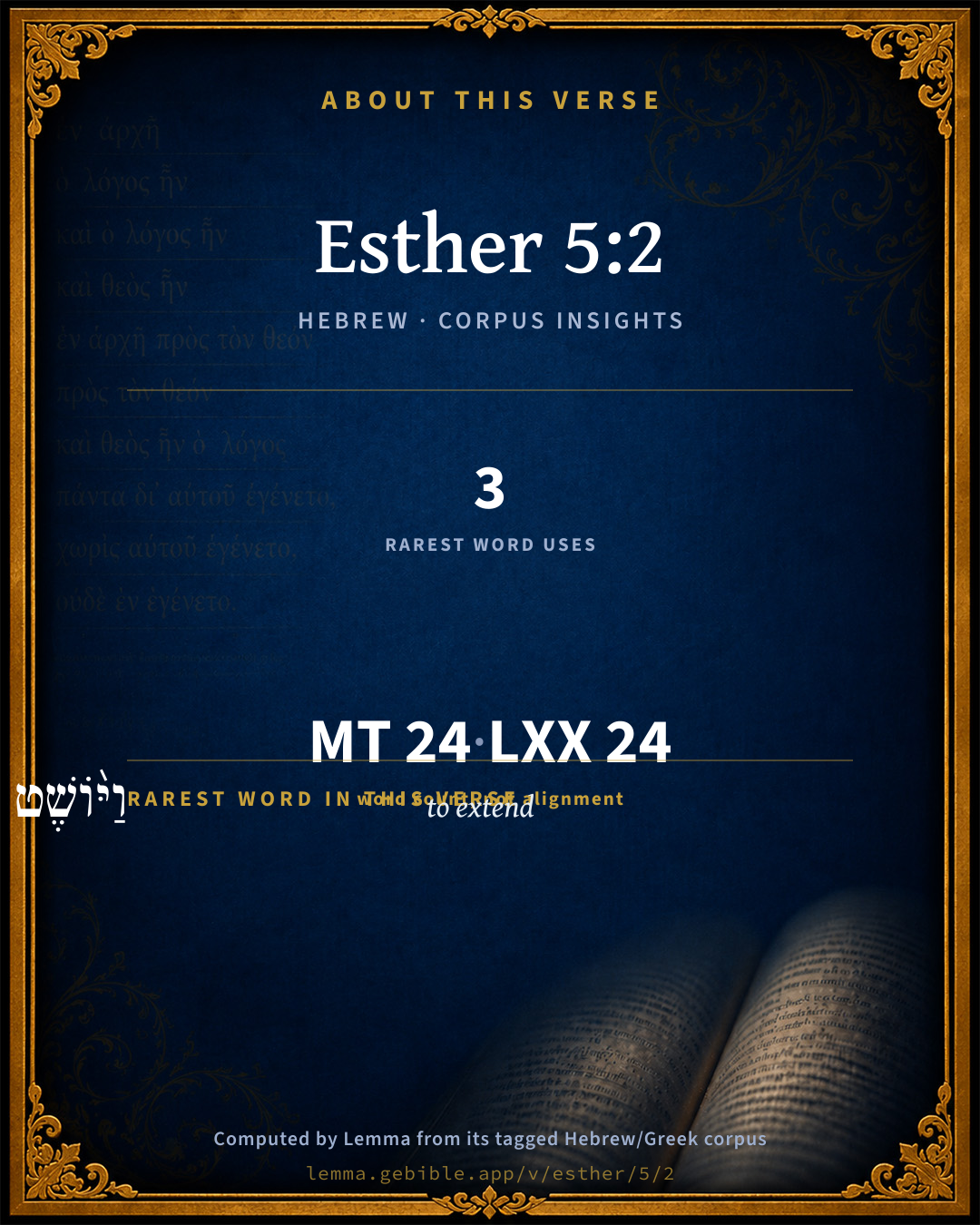
These counts appear in no published source. They are computed here, from the morphology-tagged text and Lemma’s own curated glosses. What Lemma adds →

24
words
19
distinct lemmas
Historical
section

Notable vocabulary

The rarest word here is וַיּ֨וֹשֶׁט to extend H3447 — appearing just 3 times in the whole Hebrew Bible.

Shared distinctive vocabulary

וַיּ֨וֹשֶׁט to extend H3447 occurs in 3 verses of the Hebrew Bible. Also found in:

Grammatical profile

  • 7 verbs
  • 14 nouns
  • 3 particles

Verb forms

  • וַיְהִי֩ Qal · Sequential Imperfect
  • כִרְא֨וֹת Qal · Infinitive Construct
  • עֹמֶ֨דֶת֙ Qal · Participle Active
  • נָשְׂאָ֥ה Qal · Perfect
  • וַיּ֨וֹשֶׁט Hiphil · Sequential Imperfect
  • וַתִּקְרַ֣ב Qal · Sequential Imperfect
  • וַתִּגַּ֖ע Qal · Sequential Imperfect

Repetition

Words recur within this verse — often emphatic in Hebrew:

  • אֶסְתֵּ֣ר Esther H635 ×3
  • הַמֶּ֜לֶךְ king H4428 ×2
  • שַׁרְבִ֤יט scepter H8275 ×2

Hebrew & Septuagint length

In English translation the verse runs 47 words from the Hebrew and 81 from the Septuagint (LXX English) — the Septuagint runs noticeably longer here. See the side-by-side →

A rough comparison of the two English renderings, which tokenize alike — not a word-level alignment.

Word counts can differ between the Hebrew and the Greek without any difference in meaning — e.g. the Hebrew direct-object marker אֵת has no separate Greek word, and Greek often adds the article ὁ.

In the original languages it is 24 Hebrew tokens and 24 Greek tokens — but the two are counted differently (Hebrew bundles its prefixes and suffixes into one token; the Greek is in lemma form), so that isn’t a like-for-like length.

Cross-references

9

Topical passages linked to Esther 5:2 in the Treasury of Scripture Knowledge — connected by theme and wording, ordered by reader-vote popularity; previews shown in the World English Bible.

  • Esther 8:4 Then the king held out to Esther the golden scepter. So Esther arose, and stood before the king.
  • Esther 4:11 All the king's servants, and the people of the king's provinces, do know, that whoever, whether man or woman, shall come to the king into the inner court, who is not called, there is one law for him, that he be put to death, except those to whom the king shall hold out the golden scepter, that he may live: but I have not been called to come in to the king these thirty days.
  • Proverbs 21:1 The king's heart is in Yahweh's hand like the watercourses. He turns it wherever he desires.
  • Genesis 32:28 He said, "Your name will no longer be called 'Jacob,' but, 'Israel,' for you have fought with God and with men, and have prevailed."
  • Nehemiah 1:11 Lord, I beg you, let now your ear be attentive to the prayer of your servant, and to the prayer of your servants, who delight to fear your name; and please prosper your servant this day, and grant him mercy in the sight of this man. Now I was cup bearer to the king.
  • Esther 2:9 The maiden pleased him, and she obtained kindness of him; and he speedily gave her things for her purification, with her portions, and the seven maidens who were meet to be given her out of the king's house: and he removed her and her maidens to the best place of the house of the women.
  • Psalms 116:1 I love Yahweh, because he listens to my voice, And my cries for mercy.
  • Acts 7:10 and delivered him out of all his afflictions, and gave him favor and wisdom before Pharaoh, king of Egypt. He made him governor over Egypt and all his house.
  • Acts 10:4 He, fastening his eyes on him, and being frightened, said, "What is it, Lord?" He said to him, "Your prayers and your gifts to the needy have gone up for a memorial before God.

Cross-references courtesy of OpenBible.info (CC BY 4.0).

Hebrew and Greek witnesses Masoretic Hebrew ↔ Greek Septuagint

The same verse in the two great witnesses to the Old Testament, shown verse-for-verse.

Here the Septuagint runs noticeably longer than the Hebrew — LXX2012 (modern English Septuagint) 81 words vs World English Bible 47. A rough length comparison of the two English translations, not a word-level alignment — read both below.

These are two independent witnesses, not word-aligned to each other, and the Septuagint is shown in lemma (dictionary) form.

Hebrew Esther 5:2 Masoretic · Westminster Leningrad Codex

וַיְהִי֩ כִרְא֨וֹת הַמֶּ֜לֶךְ אֶת אֶסְתֵּ֣ר הַמַּלְכָּ֗ה עֹמֶ֨דֶת֙ בֶּֽחָצֵ֔ר נָשְׂאָ֥ה חֵ֖ן בְּעֵינָ֑יו וַיּ֨וֹשֶׁט הַמֶּ֜לֶךְ לְאֶסְתֵּ֗ר אֶת שַׁרְבִ֤יט הַזָּהָב֙ אֲשֶׁ֣ר בְּיָד֔וֹ וַתִּקְרַ֣ב אֶסְתֵּ֔ר וַתִּגַּ֖ע בְּרֹ֥אשׁ הַשַּׁרְבִֽיט

It was so, when the king saw Esther the queen standing in the court, that she obtained favor in his sight; and the king held out to Esther the golden scepter that was in his hand. So Esther drew near, and touched the top of the scepter.

World English Bible · Public Domain

Greek LXX Esther 5:2 Septuagint · lemma form

εἶπον δέ εσθηρ ἡμέρα ἐγώ ἐπίσημος σήμερον εἰμί εἰ οὖν δοκέω ὁ βασιλεύς ἔρχομαι καί αὐτός καί αμαν εἰς ὁ δοχή ὅς ποιέω σήμερον

And having raised the golden sceptre he laid it upon her neck, and embraced her, and said, Speak to me. And she said to him, I saw you, my lord, as an angel of God, and my heart was troubled for fear of your glory; for you, my lord, are to be wondered at, and your face is full of grace. And while she was speaking, she fainted and fell. Then the king was troubled, and all his servants comforted her.

LXX2012 (modern English Septuagint) · Public Domain

On this verse, Adam Clarke's Commentary discusses the Septuagint’s reading. Read the note in Commentary ↓

Hebrew: Westminster Leningrad Codex (CC BY 4.0). Greek: Septuagint (public domain); English from LXX2012 (modern English Septuagint) (Public Domain). How the Septuagint differs from the Hebrew →

Commentary

Notes on Esther 5:2 from classic Christian and Jewish commentators (each source and its license shown beneath its notes). The classic Christian expositions comment on the surrounding passage and are grouped to its opening verse, so a note may address several verses; the Jewish commentaries on the Tanakh (Rashi and others) are per-verse, so they appear only where the commentator wrote on this verse.

Lemma curates 59 commentaries, every one of them public domain or Creative Commons licensed, each selected and text-cleaned for this edition rather than reprinted as found. About our sources →

Trapp's Complete Commentary

John Trapp

Est 5:2 And it was so, when the king saw Esther the queen standing in the court, [that] she obtained favour in his sight: and the king held out to Esther the golden sceptre that [was] in his hand. So Esther drew near, and touched the top of the sceptre.

Ver. 2. And it was so] God, the great heart disposer, so ordered it.

That when the king saw Esther the queen, &c.] Beautified by God in a special manner, as was Moses, αστειος τω θεω, Act 7:20, Stephen, Act 6:15, &c. And some faces we know do appear most orientally fair when they are most instamped with sorrow.

That she obtained favour in his sight] Josephus saith, that at first the king frowned upon her, so that she fell into a swoon before him. Rex autem, voluntate arbitror Dei, mentem mutavit, i.e. but the king, as God would have it, changed his mind, and cheered her up. How true this is I know not; but this I know, that the wrath of a king is as the roaring of a lion, which is so terrible, that it astonieth all that hear it, and that omne trahit secum Caesaris ira malum. All drag the evil wrath with Caesar himself. Sir Christopher Hatton, being checked and threatened by Queen Elizabeth, died soon after; neither could the queen, having once cast him down with her word only, raise him up again, though she visited him, and comforted him. Esther here was soon raised and relieved.

Deiecit ut relevet, premit ut solaria praestet;

Enecat, ut possit vivificare Deus.

And the king held out to Esther the golden sceptre] He did not kick her out of his presence, as some Cambyses would have done, neither did he command her to the block, as Henry VIII did his Anne Bullen upon a mere pretence of disloyalty; neither yet did he cashier her, as he had done Vashti for a less offence: but, by holding out his sceptre, shows his gracious respects unto her. This was the Lord’s own work, as was likewise that of old, that Laban should leave Jacob with a kiss, Gen 31:55 Esau meet him with a kiss, Gen 33:4, where the word kissed hath a prick over each letter in the original, to show the wonder of God’s work in changing Esau’s heart from his former hatred. {Hebrew Text Note} Let a man’s ways please the Lord, and men shall quickly befriend him. This is compendiosissima hominum gratiam consequendi via, saith Lavater here, the readiest way to win favour with all others. When David was once a man after God’s heart, whatsoever he did pleased the people.

So Esther drew near, and touched the top of his sceptre] With her hand, saith the Chaldee; with her mouth, saith the Vulgate translation. This she did, either in token of submission, or for the avoiding of danger; for, as Josephus saith, He that touched the king’s sceptre was out of the reach of evil, O απτομενος, ακινδυνος. Wives should submit themselves to their own husbands, as it is fit in the Lord. Submission includeth reverence (in heart, speeches, gestures) and obedience to all their husband’s lawful commands and restraints. This is no more than is meet, saith the apostle, Col 3:19.

John Trapp, A Commentary or Exposition upon All the Books of the Old and New Testament (1647–1656) — public domain. Text from a community e-Sword module.

Tyndale Open Study Notes

Tyndale Open Resources

5:2 he welcomed her and held out the gold scepter to her: She was not killed for entering the king’s presence without an invitation (4:11, 16).

Tyndale Open Study Notes — © Tyndale Open Resources, licensed CC BY-SA 4.0. Text via the HelloAO Bible API.

Geneva Bible (1599)

Geneva Bible translators

Which was a sign that her coming was agreeable unto him, as Esther 4:11.

Geneva Bible (1599) marginal notes — public domain. Text via Bolls.life.

Jamieson, Fausset & Brown

Robert Jamieson, A. R. Fausset & David Brown

the king held out to Esther the golden sceptre that was in his hand--This golden scepter receives an interesting illustration from the sculptured monuments of Persia and Assyria. In the bas-reliefs of Persepolis, copied by Sir Robert Ker Porter, we see King Darius enthroned in the midst of his court, and walking abroad in equal state; in either case he carries in his right hand a slender rod or wand, about equal in length to his own height, ornamented with a small knob at the summit. In the Assyrian alabasters, those found at Nimroud as well as those from Khorsabad, "the great king" is furnished with the same appendage of royalty, a slender rod, but destitute of any knob or ornament. On the Khorsabad reliefs the rod is painted red, doubtless to represent gold; proving that "the golden sceptre" was a simple wand of that precious metal, commonly held in the right hand, with one end resting on the ground, and that whether the king was sitting or walking. "The gold sceptre" has received little alteration or modification since ancient times [GOSS]. It was extended to Esther as a token not only that her intrusion was pardoned, but that her visit was welcome, and a favorable reception given to the suit she had come to prefer.

touched the top of the sceptre--This was the usual way of acknowledging the royal condescension, and at the same time expressing reverence and submission to the august majesty of the king.

Jamieson, Fausset & Brown — Commentary Critical and Explanatory on the Whole Bible (1871) — public domain (CC PDM 1.0). Text via the HelloAO Bible API.

Adam Clarke's Commentary

Verse 2. She obtained favour in his sight] The Septuagint represents "the king as being at first greatly enraged when he saw Esther, because she had dared to appear before him unveiled, and she, perceiving this, was so terrified that she fainted away; on which the king, touched with tenderness, sprung from his throne, took her up in his arms, laid the golden sceptre on her neck, and spoke to her in the most endearing manner." This is more circumstantial than the Hebrew, but is not contrary to it.

The golden sceptre that was in his hand.] That the kings of Persia did wear a golden sceptre, we have the following proof in Xenophon: Ὁτι ου τοδε το χρυσουν σκηπτρον το την βασιλειαν διασωξον εστιν, αλλ' πιστοι φιλοι σκηπτρον βασιλευσιν αληθεστατον και ασφαλεστατον. See Cyrop., lib. viii., p. 139, edit. Steph. 1581. It is not, said Cyrus to his son Cambyses, the GOLDEN SCEPTRE that saves the kingdom; faithful friends are the truest and safest sceptre of the empire.

Adam Clarke's Commentary on the Bible (1810–1826) — public domain. Text from a community e-Sword/MySword module.

The Cambridge Bible for Schools and Colleges

gen. ed. J. J. S. Perowne

2. held out to Esther the golden sceptre] See Est_4:11.

touched] So among the Greeks the suppliant laid hold of the person or the garments of the person to whom the appeal was directed. The Vulgate makes Esther kiss the sceptre (‘osculata est summitatem virgae eius’). For the Greek apocryphal Additions, presenting a detailed account of Esther’s preparations for the interview and of the interview itself, see chaps. 14, 15.

The Cambridge Bible for Schools and Colleges (gen. ed. J. J. S. Perowne; Cambridge University Press, 1878–1918) — public domain. Text from a community e-Sword module.

John Gill's Exposition

And it was so, when the king saw Esther the queen standing in the court, that she obtained favour in his sight,.... Which no doubt was of God, who has the hearts of kings in his hand, and turns them as he pleases; the king had not called her for thirty days past, or more, which showed coolness of affection to her, and now she transgressed a law by coming uncalled for, which might have provoked his wrath; and for a lesser matter than this was Vashti divorced; but yet his mind was inclined to her, and she appeared very amiable and pleasing to him:

and the king held out to Esther the golden sceptre that was in his hand; as a token of his well pleasedness in her, and acceptance of her; and that no harm should come to her for transgressing the law:

so Esther drew near, and touched the top of the sceptre; as acknowledging his kindness, and her thankfulness for it, as well as subjection and obedience to him.

John Gill's Exposition of the Whole Bible (1746–1763) — public domain (CC PDM 1.0). Text via the HelloAO Bible API.

Haydock's Catholic Bible Commentary

Golden. "It is not this golden sceptre which saves the kingdom," said Cyrus, "but faithful friends are the most true and secure sceptre for kings." (Cyrop. viii.) (Calmet) --- Kissed. Hebrew, "touched." (Haydock)

George Leo Haydock (1774–1849), Haydock's Catholic Family Bible and Commentary, 1859 edition — public domain. Excludes Psalms (Douay-Rheims chapter numbering differs from Protestant) and Deuterocanonical books (Catholic canon only).

Matthew Poole's English Annotations

The king held out the golden sceptre, in testimony that he pardoned her presumption, and accepted her person, and was ready to grant her petition.

Esther touched the top of his sceptre, in token of her thankful acceptance of the king’s great favour, and of her reverence and submission to his majesty, whereof that might possibly be a usual token, and it may be, at the king’s call and invitation to her to come near to him.

Matthew Poole's English Annotations on the Holy Bible (1683–1685) — public domain. Text from a community e-Sword/MySword module.

The Pulpit Commentary

Esther touched the top of the sceptre. This was, no doubt, the customary act by which the king"s grace was, as it were, accepted and appropriated. It is analogous to that touch of the person or of the garments which secured the suppliant mercy among the Greeks.

HOMILIES BY P.C. BARKER

Ver. 2.

The hour that revealed duty.

This verse speaks of an hour when darkness turned to light, gloomy foreboding to well-grounded hope; and when the anguish of trembling suspense was lifted off many a heart, as an unhealthy vapour lifts itself and vanishes before the growing sun. Though it was most true that many a heart was this hour relieved of its strain of anxiety, and was immensely gladdened, yet, as the immediate task had devolved upon Esther, so no doubt the immediate relief was hers. In her first and chiefly the battle was fought and the victory won. In what she thought, did, and obtained we may find concentrated the important suggestions of the hour in question. Notice three things:

I THE UNPROMISING APPEARANCES WHICH THIS HOUR PRESENTED. They were not mere dim, vague impressions which it made, nor were they fancies. These appearances were true for the human point of view, however they might be overruled by Divine power and goodness. For men they were hard facts, with which it was necessary to deal. Thus it was certain that

1. The hour was one which found incalculable human interests at stake.The blotting out of existence, the swift swallowing up of human lives innumerable, with all their precious freightage of love and joy, of purpose and hope, was no light fancy, no vague fear now. Yet that was the appalling uncertainty beneath the burden of which the solemn hour bended. It was not dull cloudiness of sky alone, and that made worse by unnecessary apprehension and weak fearfulness. It was one defined dark mass of cloud.

2. To all human appearance the question of the hour depended on thecaprice of one man. It did not resemble some case of great interest, which was going to have the best attention of a select number of the best of people, and thereupon a deliberate decision be taken. In that hour the momentary whim of a capricious despot would decide the question of life or death, for the innocent Esther first, and after her for a whole race, of which she was then the head and representative. But all the while this is, truly speaking, only a forcible case of a constant phenomenon, a genuine fact of human life. We can see, when shown in the dimensions of the instance before us here, the same thing which, because it is on a lesser scale, eludes both belief and even notice in our ordinary life.

3. The responsibility of doing the best possible, or all that was possible, forthat hour rested on one gentle, loving woman. What a disproportion! The case is that of the lives of perhaps a million people. The judge is a sensual, capricious Eastern despot. The advocate and intercessor is Esther. And it may be immediate death to her so much as to stand where she does. The occasion witnesses her not defiant, not overcome. It exhibits her a pattern of human self-forgetfulness that secret of so much of a soul"s highest influence on earth, and of its "power to prevail" with heaven. She has collected most calmly a soul"s whole force; strength sufficient to the day is hers; and in her may most truly be seen an example of "strength made perfect in weakness.

II THE CAREFUL PREPARATIONS MADE FOR THIS HOUR.

1. The crisis had not been recklessly nor negligently met. Deep thought hadbeen spent upon it. Anxious consultation had been held upon it. Loving and mature advice had been offered and accepted regarding it.

2. To meet and counteract the things of sight, and "that do appear," resort had been had to faith. The interposition of the Unseen had been sought in "lastings oft" and long. Esther had sent word to Mordecai, (Est_4:16) "I also and my maidens will fast likewise

3. In this supplication of Heaven the aid of intercession had not beenforgotten. Esther had not overlooked the importance of a general union of her people in religious exercise. She called into vitality and determined activity the whole combined and sympathetic force of multitudes, who at her instance did for three days put away from themselves every other thought, care, hope, that they might be found "watching" as regards the crisis of this hour. What an interesting suggestion arises from the words, (Est_4:17) "So Mordecai went his way, and did according to all that Esther had commanded him." The tender ward has become the strong, firm, religious teacher of her guardian.

III THE GRAND RESULTS OF THIS HOUR.

1. The event of the hour disappointed all fear, rewarded amply all anxiouspreparation, fulfilled more than the most that hope had dared contemplate.

2. The event of the hour proved different from all that could be reckonedupon at the hands of mere human goodness. And an impressive lesson of religion was taught: "The king"s heart is in the hand of the Lord". (Pro_21:1) This was what secured the rest. "The king held out to Esther the golden sceptre that was in his hand. So Esther drew near, and touched the top of the sceptre.

3. The event of the hour was grander because of its contrasts.

(1) Esther"s darkest hour changes to light; Haman"s day, ablaze with light and confidence and boasting, is overspread, and goes out in darkness and storm.

(2) The change for Esther and her people themselves is great indeed between the beginning and the end of that hour. Toil brought rest so quickly. Fierce struggle brought peace so sweet. Anguish brought bliss so full. These are the contrasts, as safe, as blessed, as they were sudden. B.

The Pulpit Commentary (1880–1919), ed. H.D.M. Spence-Jones & Joseph S. Exell — public domain. Text from a community e-Sword module.

John Wesley's Explanatory Notes

Held out - In testimony that he pardoned her presumption, and was ready to grant her petition. Touched - In token of her thankful acceptance of the king's favour, and of her reverence and submission.

John Wesley, Explanatory Notes Upon the Whole Bible (1754–1765) — public domain. Text via the GEBible commentary corpus.

Lesson kit

Teaching starters — assembled from the data on this page, not authored interpretation. Every prompt links to the verse data it draws on. Edit before teaching.

Esther, in the Historical, opens this verse with 24 words (19 distinct Hebrew lemmas). Its most distinctive word is yâshaṭ (“to extend”). The Greek Septuagint runs longer here. A historical commentator’s framing appears above. Read the whole chapter for the surrounding context.

Discussion questions

  1. How does “to extend” (yâshaṭ) shape what this verse is saying?
  2. Esther 4:11 shares the word «to extend» with this verse. How do the two illuminate each other?
  3. “Esther” occurs 3× in this one verse. What is the effect of the repetition?
  4. Compared with the Hebrew, the Septuagint runs longer here. What questions does that raise?
  5. The translations on this page render this verse differently — a whole-verse word diff, not a word-by-word alignment. What might account for the different wordings?
  6. The verb «וַיְהִי֩» is Qal Sequential Imperfect. How does its form color the action?
  7. Reading how Trapp's Complete Commentary and Tyndale Open Study Notes read this verse, where do the two commentators agree and where do they part?

Things to notice

Reading settings

Reading text

Shown beneath each verse's original-language words.

Old Testament
Old Testament edition

Read the OT as the Masoretic Hebrew (MT) or the Greek Septuagint (LXX).

English shown for the Greek Septuagint (in the Hebrew ↔ Greek comparison).

Comparing translations? Open the Compare panel on any verse page to stack up to four side by side.