
2 Chronicles 25:19

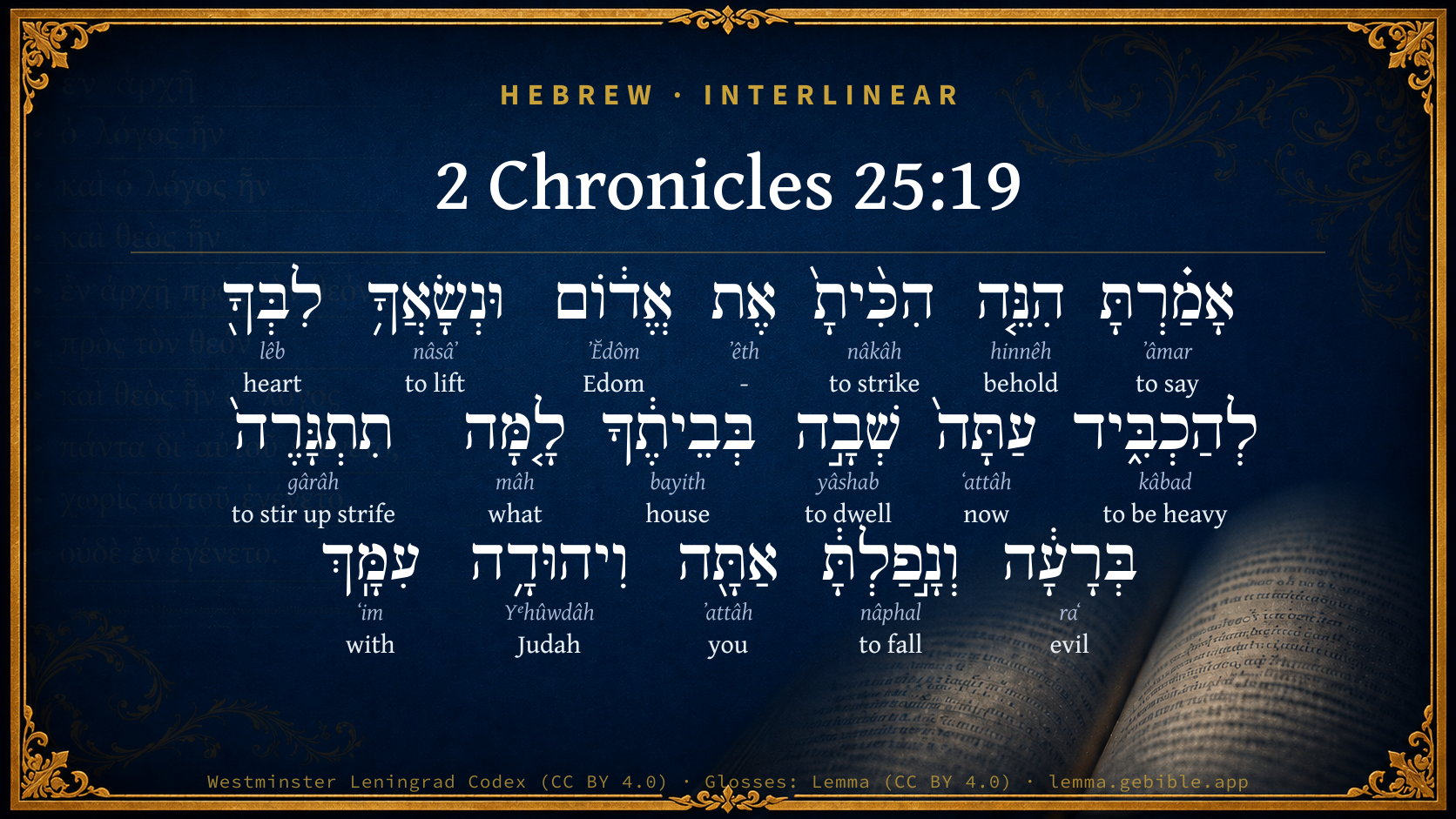
Hebrew (Westminster Leningrad Codex) 2 Chronicles 25:19 appears in the Hebrew Old Testament. The text above is from the Westminster Leningrad Codex. Each word links to its Strong’s number, a concise gloss, and parsing drawn from the Open Scriptures Hebrew Bible morphology. Click any word for its full Brown-Driver-Briggs (BDB) entry.
Download image
Cite this verse

2 Chronicles 25:19 (World English Bible). Public Domain. Lemma interlinear Bible study tool, https://lemma.gebible.app/v/2-chronicles/25/19.

Show BibTeX & RIS
BibTeX
RIS
English Translation
You say, Behold, you have struck Edom; and your heart lifts you up to boast: abide now at home; why should you meddle to [your] hurt, that you should fall, even you, and Judah with you?
World English Bible · Public Domain
Download a study sheet

One document with this verse’s original text, its word-by-word gloss line, the meaning frame, cross-references with their text, attributed commentary, and full source and license credits — printable, and it pastes into notes with its structure intact.

This verse Autodidact and up

Study sheet (.html) Plain text (.txt)

A passage Seminary Student

Up to 50 verses in one chapter. A passage sheet keeps up to 6 commentary sources and 12 cross-references per verse, in the order this page ranks them, and says so on the sheet whenever that leaves anything out. Ask for a single verse and you get the Autodidact verse sheet above.

Everything on this page stays free to read, with no account — the sheet is a download of what is already on screen, not access to it.

Want to remove ads? Support Godless Engineer
Compare translations 3

The same verse in 3 English versions, stacked beneath the original-language interlinear above. Click any original word for its lexicon entry.

Each is an independent rendering of the whole verse — the interlinear is not word-aligned to these translations.

Highlighted words mark where these versions differ — a whole-verse word diff, not a word-by-word alignment.

  • World English Bible Public Domain
    You say, Behold, you have struck Edom; and your heart lifts you up to boast: abide now at home; why should you meddle to [your] hurt, that you should fall, even you, and Judah with you?
  • King James Version Public Domain
    Thou sayest, Lo, thou hast smitten the Edomites; and thine heart lifteth thee up to boast: abide now at home; why shouldest thou meddle to thine hurt, that thou shouldest fall, even thou, and Judah with thee?
  • unfoldingWord Literal Text CC BY-SA 4.0
    You have said, Behold, you have struck down Edom, and your heart has lifted you to boast. Now, sit in your house. Why excite yourself in evil and fall, you and Judah with you?”

unfoldingWord Literal Text — © unfoldingWord, licensed CC BY-SA 4.0. Word-aligned USFM3 via Door43 (git.door43.org/unfoldingWord/en_ult).

Versions to compare (up to 4)

3 of 4 selected

Show all 18 translations

Every available English version of this verse, each an independent rendering of the whole verse.

  • World English Bible Public Domain
    You say, Behold, you have struck Edom; and your heart lifts you up to boast: abide now at home; why should you meddle to [your] hurt, that you should fall, even you, and Judah with you?
  • Berean Standard Bible Public Domain
    You have said, ‘Look, I have defeated Edom,’ and your heart has become proud and boastful. Now stay at home. Why should you stir up trouble so that you fall—you and Judah with you?”
  • Majority Standard Bible Public Domain
    You have said, ‘Look, I have defeated Edom,’ and your heart has become proud and boastful. Now stay at home. Why should you stir up trouble so that you fall—you and Judah with you?”
  • King James Version Public Domain
    Thou sayest, Lo, thou hast smitten the Edomites; and thine heart lifteth thee up to boast: abide now at home; why shouldest thou meddle to thine hurt, that thou shouldest fall, even thou, and Judah with thee?
  • American Standard Version (1901) Public Domain
    Thou sayest, Lo, thou hast smitten Edom; and thy heart lifteth thee up to boast: abide now at home; why shouldest thou meddle to `thy' hurt, that thou shouldest fall, even thou, and Judah with thee?
  • Revised Version (1885) Public Domain
    Thou sayest, Lo, thou hast smitten Edom; and thine heart lifteth thee up to boast: abide now at home; why shouldest thou meddle to thy hurt, that thou shouldest fall, even thou, and Judah with thee?
  • Geneva Bible (1599) Public Domain
    Thou thinkest: lo, thou hast smitten Edom, and thine heart lifteth thee vp to bragge: abide now at home: why doest thou prouoke to thine hurt, that thou shouldest fall, and Iudah with thee?
  • Douay-Rheims (1899) Public Domain
    Thou hast said: I have overthrown Edom, and therefore thy heart is lifted up with pride: stay at home, why dost thou provoke evil against thee, that both thou shouldst fall and Juda with thee.
  • Young's Literal Translation Public Domain
    Thou hast said, Lo, I have smitten Edom; and thy heart hath lifted thee up to boast; now, abide in thy house, why dost thou stir thyself up in evil, that thou hast fallen, thou, and Judah with thee?'
  • Literal Standard Version CC BY-SA 4.0
    You have said, Behold, I have struck Edom; and your heart has lifted you up to boast; now, abide in your house, why do you stir yourself up in evil, that you have fallen, you and Judah with you?”
  • Unlocked Literal Bible CC BY-SA 4.0
    You have said, 'See, I have struck down Edom,' and your heart has lifted you up. Take pride in your victory, but stay at home, for why should you cause yourself trouble and fall, both you and Judah with you?”
  • unfoldingWord Literal Text CC BY-SA 4.0
    You have said, Behold, you have struck down Edom, and your heart has lifted you to boast. Now, sit in your house. Why excite yourself in evil and fall, you and Judah with you?”
  • Darby Bible Public Domain
    Thou thinkest, Lo, thou hast smitten Edom; and thy heart has lifted thee up to boast: abide now at home; why shouldest thou contend with misfortune, that thou shouldest fall, thou and Judah with thee?
  • World Messianic Bible Public Domain
    You say to yourself that you have struck Edom; and your heart lifts you up to boast. Now stay at home. Why should you meddle with trouble, that you should fall, even you and Judah with you?’”
  • Webster's Bible Public Domain
    Thou sayest, Lo, thou hast smitten the Edomites; and thy heart lifteth thee up to boast: abide now at home; why shouldst thou meddle to thy hurt, that thou shouldst fall, even thou, and Judah with thee?
  • Free Bible Version CC BY-SA 4.0
    You're telling yourself how great you are for defeating Edom, boasting about it. But just stay at home. Why should you stir up trouble that will bring you down, and Judah with you?”
  • Bible in Basic English Public Domain
    You say, See, I have overcome Edom; and your heart is lifted up with pride: now keep in your country; why do you make causes of trouble, putting yourself, and Judah with you, in danger of downfall?
  • JPS Tanakh (1917) Public Domain
    Thou sayest — lo, thou hast smitten Edom; will thy heart therefore lift thee up to glory therein? abide now at home; why shouldest thou meddle with evil, that thou shouldest fall, even thou, and Judah with thee?'

Literal Standard Version (2020), Covenant Press — licensed CC BY-SA 4.0. Text via the HelloAO Bible API (eBible.org). Unlocked Literal Bible (unfoldingWord) — licensed CC BY-SA 4.0. Text via the HelloAO Bible API (eBible.org). unfoldingWord Literal Text — © unfoldingWord, licensed CC BY-SA 4.0. Word-aligned USFM3 via Door43 (git.door43.org/unfoldingWord/en_ult). Free Bible Version, Dr. Jonathan Gallagher — licensed CC BY-SA 4.0. Text via the HelloAO Bible API (eBible.org).

Word by word

More ways to search: Search by grammar → Find every occurrence → Compare this word →

Practice this passage: Drill this verse → Learn its vocabulary →

תִתְגָּרֶה֙
gârâh
H1624
“to stir up strife”
Verb, Hithpael, Imperfect, 2nd Person, Masculine, Singular
Part of Speech
Verb
Stem
Hithpael
Form
Imperfect
Person
2nd Person
Gender
Masculine
Number
Singular
Full BDB Definition

Origin: a primitive root

TWOT: 378

to cause strife, stir up, contend, meddle, strive, be stirred up - (Piel) to stir up strife, excite strife - (Hithpael) - to excite oneself against, engage in strife - to excite oneself (against foe), wage war
  1. אָמַ֗רְתָּ ʼâmar H559 “to say” Verb, Qal, Perfect, 2nd Person, Masculine, Singular
  2. הִנֵּ֤ה hinnêh H2009 “behold” Particle, Demonstrative
  3. הִכִּ֨יתָ֙ nâkâh H5221 “to strike” Verb, Hiphil, Perfect, 2nd Person, Masculine, Singular
  4. אֶת ʼêth H853 “-” Particle, Direct Object
  5. אֱד֔וֹם ʼĔdôm H123 “Edom” Noun, Proper
  6. וּנְשָׂאֲךָ֥ nâsâʼ H5375 “and · to lift · you” Conjunction + Verb, Qal, Perfect, 3rd Person, Masculine, Singular + Suffix, Personal, 2nd Person, Masculine, Singular
  7. לִבְּךָ֖ lêb H3820 “heart · your” Noun, Common, Masculine, Singular, Construct + Suffix, Personal, 2nd Person, Masculine, Singular
  8. לְהַכְבִּ֑יד kâbad H3513 “to be heavy” Preposition + Verb, Hiphil, Infinitive Construct
  9. עַתָּה֙ ʻattâh H6258 “now” Adverb
  10. שְׁבָ֣ה yâshab H3427 “dwell” Verb, Qal, Imperative, 2nd Person, Masculine, Singular + Suffix, h
  11. בְּבֵיתֶ֔ךָ bayith H1004 “in/at · house · your” Preposition + Noun, Common, Masculine, Singular, Construct + Suffix, Personal, 2nd Person, Masculine, Singular
  12. לָ֤מָּה mâh H4100 “to/for · what” Preposition + Particle, Interrogative
  13. בְּרָעָ֔ה raʻ H7451 “in/at · evil” Preposition + Noun, Common, Feminine, Singular, Absolute
  14. וְנָ֣פַלְתָּ֔ nâphal H5307 “and · to fall” Conjunction + Verb, Qal, Sequential Perfect, 2nd Person, Masculine, Singular
  15. אַתָּ֖ה ʼattâh H859 “you” Pronoun, Personal, 2nd Person, Masculine, Singular
  16. וִיהוּדָ֥ה Yᵉhûwdâh H3063 “and · Judah” Conjunction + Noun, Proper
  17. עִמָּֽךְ ʻim H5973 “with · you” Preposition + Suffix, Personal, 2nd Person, Feminine, Singular

About this verse

These counts appear in no published source. They are computed here, from the morphology-tagged text and Lemma’s own curated glosses. What Lemma adds →

18
words
18
distinct lemmas
Historical
section

Notable vocabulary

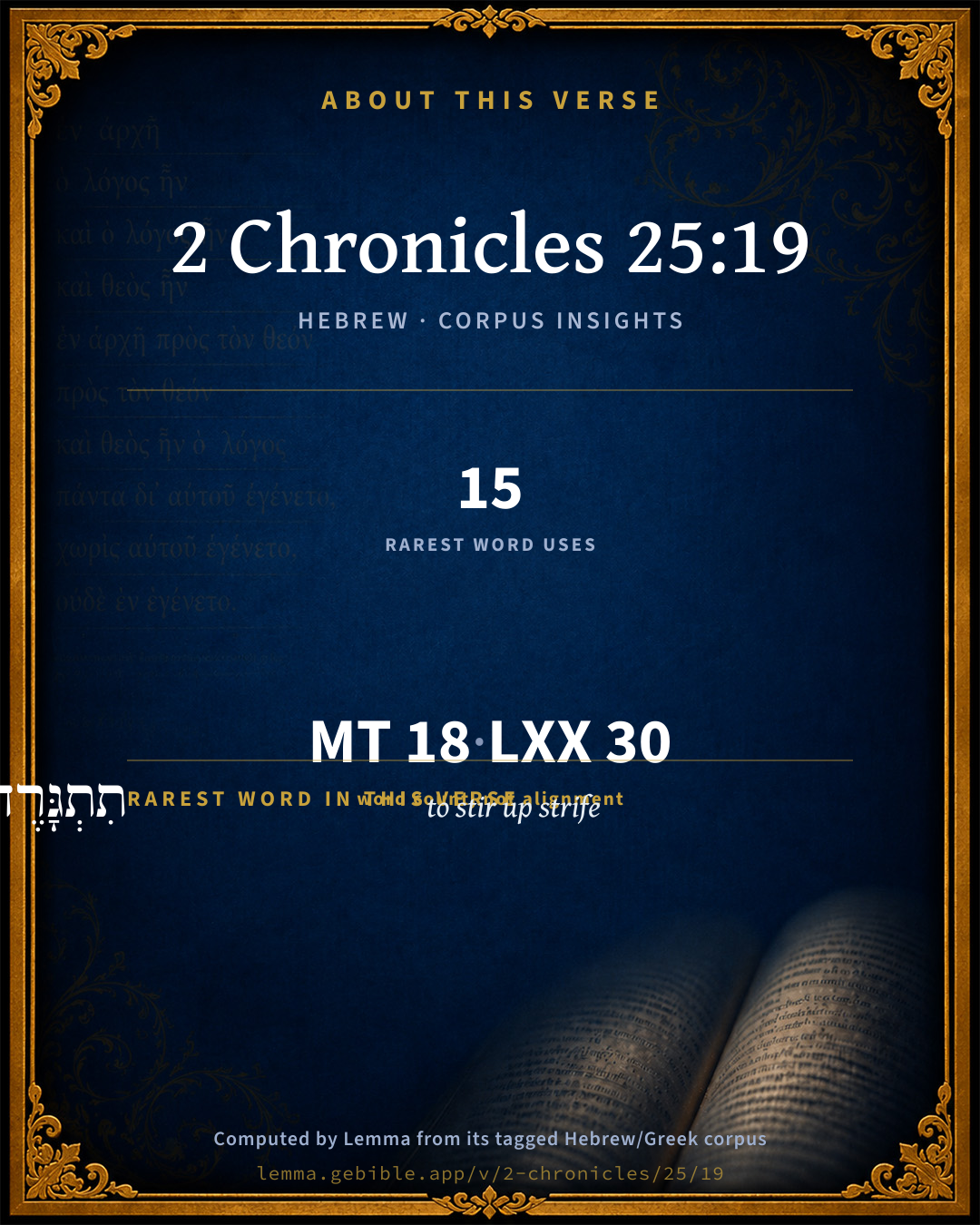
The rarest word here is תִתְגָּרֶה֙ to stir up strife H1624 — appearing just 15 times in the whole Hebrew Bible.

Shared distinctive vocabulary

תִתְגָּרֶה֙ to stir up strife H1624 occurs in 13 verses of the Hebrew Bible. Also found in:

Grammatical profile

  • 7 verbs
  • 5 nouns
  • 1 pronoun
  • 1 preposition
  • 1 adverb
  • 3 particles

Verb forms

  • אָמַ֗רְתָּ Qal · Perfect
  • הִכִּ֨יתָ֙ Hiphil · Perfect
  • וּנְשָׂאֲךָ֥ Qal · Perfect
  • לְהַכְבִּ֑יד Hiphil · Infinitive Construct
  • שְׁבָ֣ה Qal · Imperative
  • תִתְגָּרֶה֙ Hithpael · Imperfect
  • וְנָ֣פַלְתָּ֔ Qal · Sequential Perfect

Hebrew & Septuagint length

In English translation the verse runs 36 words from the Hebrew and 34 from the Septuagint (LXX English) — closely comparable.

A rough comparison of the two English renderings, which tokenize alike — not a word-level alignment.

Word counts can differ between the Hebrew and the Greek without any difference in meaning — e.g. the Hebrew direct-object marker אֵת has no separate Greek word, and Greek often adds the article ὁ.

In the original languages it is 18 Hebrew tokens and 30 Greek tokens — but the two are counted differently (Hebrew bundles its prefixes and suffixes into one token; the Greek is in lemma form), so that isn’t a like-for-like length.

Cross-references

17

Topical passages linked to 2 Chronicles 25:19 in the Treasury of Scripture Knowledge — connected by theme and wording, ordered by reader-vote popularity; previews shown in the World English Bible.

  • 2 Chronicles 26:16 But when he was strong, his heart was lifted up, so that he did corruptly, and he trespassed against Yahweh his God; for he went into the temple of Yahweh to burn incense on the altar of incense.
  • 2 Chronicles 32:25 But Hezekiah didn't render again according to the benefit done to him; for his heart was lifted up: therefore there was wrath on him, and on Judah and Jerusalem.
  • Deuteronomy 8:14 then your heart be lifted up, and you forget Yahweh your God, who brought you forth out of the land of Egypt, out of the house of bondage;
  • 2 Chronicles 35:21 But he sent ambassadors to him, saying, What have I to do with you, you king of Judah? [I come] not against you this day, but against the house with which I have war; and God has commanded me to make haste: forbear you from [meddling with] God, who is with me, that he not destroy you.
  • Proverbs 13:10 Pride only breeds quarrels, But with ones who take advice is wisdom.
  • Proverbs 16:18 Pride goes before destruction, And a haughty spirit before a fall.
  • Proverbs 18:6 A fool's lips come into strife, And his mouth invites beatings.
  • Proverbs 20:3 It is an honor for a man to keep aloof from strife; But every fool will be quarreling.
  • Proverbs 26:17 Like one who grabs a dog's ears Is one who passes by and meddles in a quarrel not his own.
  • Proverbs 28:25 One who is greedy stirs up strife; But one who trusts in Yahweh will prosper.
  • Jeremiah 9:23 Thus says Yahweh, Don't let the wise man glory in his wisdom, neither let the mighty man glory in his might, don't let the rich man glory in his riches;
  • Daniel 5:20–23 But when his heart was lifted up, and his spirit was hardened so that he dealt proudly, he was deposed from his kingly throne, and they took his glory from him:
  • Habakkuk 2:4 Behold, his soul is puffed up. It is not upright in him, but the righteous will live by his faith.
  • Luke 14:31 Or what king, as he goes to encounter another king in war, will not sit down first and consider whether he is able with ten thousand to meet him who comes against him with twenty thousand?
  • 1 Corinthians 1:29 that no flesh should boast before God.
  • James 4:6 But he gives more grace. Therefore it says, "God resists the proud, but gives grace to the humble."
  • 1 Peter 5:5 Likewise, you younger ones, be subject to the elder. Yes, all of you gird yourselves with humility, to subject yourselves to one another; for "God resists the proud, but gives grace to the humble."

Cross-references courtesy of OpenBible.info (CC BY 4.0).

Hebrew and Greek witnesses Masoretic Hebrew ↔ Greek Septuagint

The same verse in the two great witnesses to the Old Testament, shown verse-for-verse.

These are two independent witnesses, not word-aligned to each other, and the Septuagint is shown in lemma (dictionary) form.

Hebrew 2 Chronicles 25:19 Masoretic · Westminster Leningrad Codex

אָמַ֗רְתָּ הִנֵּ֤ה הִכִּ֨יתָ֙ אֶת אֱד֔וֹם וּנְשָׂאֲךָ֥ לִבְּךָ֖ לְהַכְבִּ֑יד עַתָּה֙ שְׁבָ֣ה בְּבֵיתֶ֔ךָ לָ֤מָּה תִתְגָּרֶה֙ בְּרָעָ֔ה וְנָ֣פַלְתָּ֔ אַתָּ֖ה וִיהוּדָ֥ה עִמָּֽךְ

You say, Behold, you have struck Edom; and your heart lifts you up to boast: abide now at home; why should you meddle to [your] hurt, that you should fall, even you, and Judah with you?

World English Bible · Public Domain

Greek LXX 2 Chronicles 25:19 Septuagint · lemma form

εἶπον ἰδού πατάσσω ὁ ιδουμαία καί ἐπιαἴρω σύ ὁ καρδία ὁ βαρύς νῦν καταἧμαι ἐν οἶκος σύ καί ἵνα τίς συνβάλλω ἐν κακία καί πίπτω σύ καί ἰούδας μετά σύ

You have said, Behold, I have struck Idumea, and your stout heart exalts you: now stay at home; for why do you implicate yourself in mischief, that you should fall, and Juda with you.

LXX2012 (modern English Septuagint) · Public Domain

Hebrew: Westminster Leningrad Codex (CC BY 4.0). Greek: Septuagint (public domain); English from LXX2012 (modern English Septuagint) (Public Domain). How the Septuagint differs from the Hebrew →

Commentary

Notes on 2 Chronicles 25:19 from classic Christian and Jewish commentators (each source and its license shown beneath its notes). The classic Christian expositions comment on the surrounding passage and are grouped to its opening verse, so a note may address several verses; the Jewish commentaries on the Tanakh (Rashi and others) are per-verse, so they appear only where the commentator wrote on this verse.

Lemma curates 59 commentaries, every one of them public domain or Creative Commons licensed, each selected and text-cleaned for this edition rather than reprinted as found. About our sources →

Ellicott's Commentary for English Readers

(19) Thou sayest.—Slightly altered from 2Ki_14:10. Thou sayest, or thou thinkest, is added here. The word in Hebrew meaning Lo (hinnçh) is perhaps a corruption of the word meaning smiting (hakkçh) :“Thou hast indeed smitten.”

To boast.—To get glory (hakbîd). Only so used here. Kings, “thine heart lifteth thee up. Be honoured (i.e., enjoy thine honours), and abide at home” (hikkâ-bçd). The difference is one of points only, and may be due to a copyist.

A Bible Commentary for English Readers, edited by Charles John Ellicott (1878–1897) — public domain. Text from a community e-Sword module.

The Cambridge Bible for Schools and Colleges

gen. ed. J. J. S. Perowne

19. Thou sayest] i.e. to thyself.

meddle to thine hurt] R.V. mg., provoke calamity, i.e. by making claims which he could not enforce.

The Cambridge Bible for Schools and Colleges (gen. ed. J. J. S. Perowne; Cambridge University Press, 1878–1918) — public domain. Text from a community e-Sword module.

The Pulpit Commentary

If the contents of this verse do not fail to impress with a persuasion of the keen mental gift of Joash, they do not fall far short of warranting some persuasion of a certain moral sense and goodness about him also. He knows human nature well, and Amaziah"s particular variety therein perfectly well. And many would have snapped at the opportunity of humbling such a man. But not so Joash; he enjoys, indeed, the opportunity of satisfying his own sarcasm and patronizingness, but would still spare Amaziah"s people and save him from himself. This does not resemble, at any rote, the commonest, poorest, hungriest style of soul. To boast. Our text gives us here hiph. infinitive construct, where the parallel has niph. imperative. This lends the more effective shaft to the invective of Joash, though without material difference to the sense.

The Pulpit Commentary (1880–1919), ed. H.D.M. Spence-Jones & Joseph S. Exell — public domain. Text from a community e-Sword module.

Rashi

Rabbi Shlomo Yitzchaki (Rashi)

and your heart has made you haughty to pursue glory, and you wish to be glorified also on my account. In II Kings (14:10), the reading is: “Retain your honor by staying home.”

Rashi on the Tanakh — English translations: “The Judaica Press complete Tanach with Rashi, translated by A. J. Rosenberg” (CC BY 4.0); “Pentateuch with Rashi's commentary by M. Rosenbaum and A.M. Silbermann, 1929-1934” (public domain); “The Metsudah Tanach series, Lakewood, N.J” (CC BY 4.0); and “The Book of Joshua, Metsudah Publications, 1997” (CC BY 4.0). Text via Sefaria.

Lesson kit

Teaching starters — assembled from the data on this page, not authored interpretation. Every prompt links to the verse data it draws on. Edit before teaching.

2 Chronicles, in the Historical, opens this verse with 18 words (18 distinct Hebrew lemmas). Its most distinctive word is gârâh (“to stir up strife”). A historical commentator’s framing appears above. Read the whole chapter for the surrounding context.

Discussion questions

  1. The word gârâh carries the sense “to stir up strife.” How does it shape the verse?
  2. How does Deuteronomy 2:5, which shares the word «to stir up strife», read alongside this verse?
  3. The translations on this page render this verse differently — a whole-verse word diff, not a word-by-word alignment. What might account for the different wordings?
  4. «אָמַ֗רְתָּ» is a Qal Perfect verb. How does that grammatical form shape the action described?
  5. Compare how Ellicott's Commentary for English Readers and The Cambridge Bible for Schools and Colleges read this verse. Where do they agree or differ?

Things to notice

Reading settings

Reading text

Shown beneath each verse's original-language words.

Old Testament
Old Testament edition

Read the OT as the Masoretic Hebrew (MT) or the Greek Septuagint (LXX).

English shown for the Greek Septuagint (in the Hebrew ↔ Greek comparison).

Comparing translations? Open the Compare panel on any verse page to stack up to four side by side.