
2 Kings 14:10

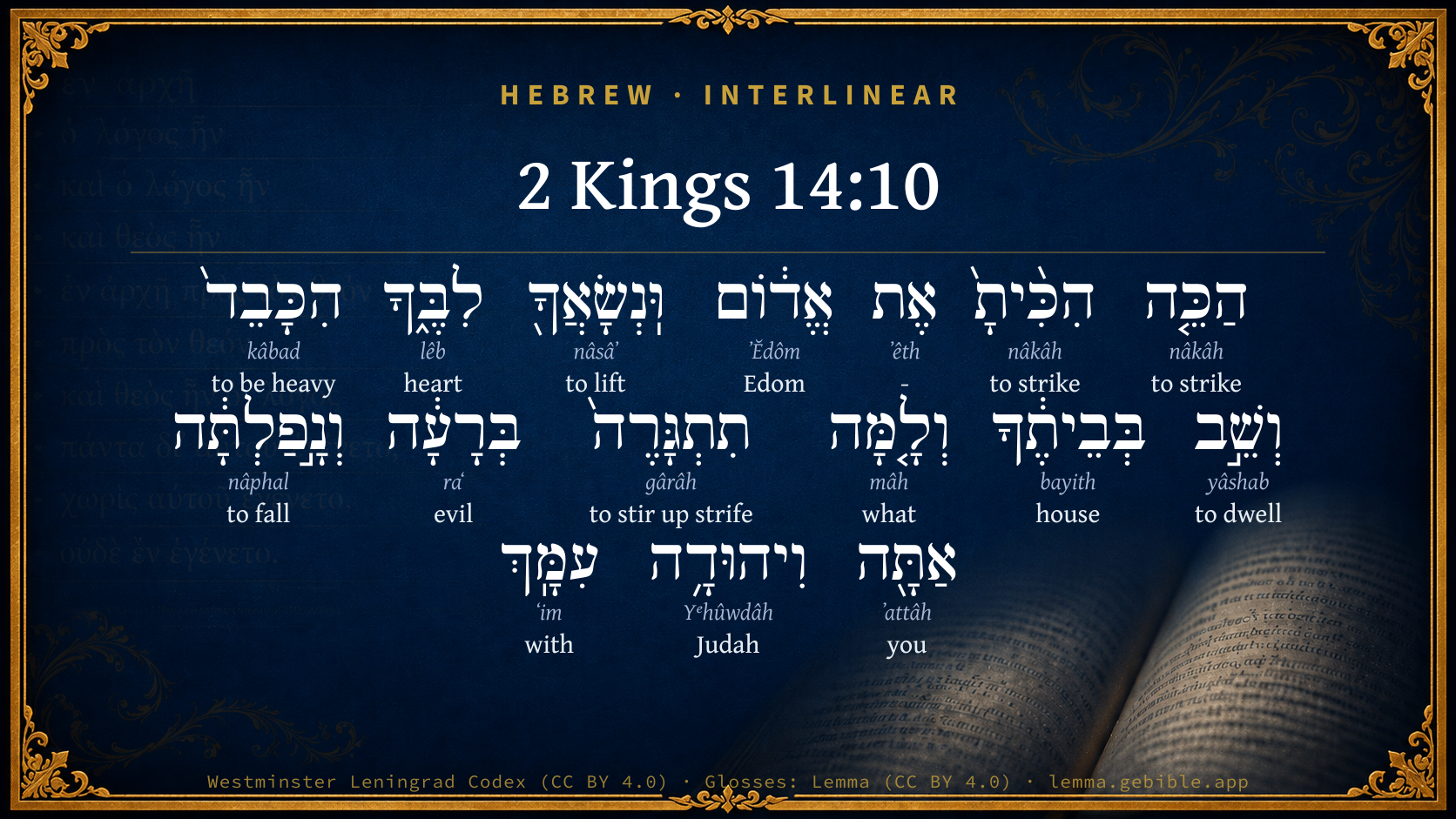
Hebrew (Westminster Leningrad Codex) 2 Kings 14:10 appears in the Hebrew Old Testament. The text above is from the Westminster Leningrad Codex. Each word links to its Strong’s number, a concise gloss, and parsing drawn from the Open Scriptures Hebrew Bible morphology. Click any word for its full Brown-Driver-Briggs (BDB) entry.
Download image
Cite this verse

2 Kings 14:10 (World English Bible). Public Domain. Lemma interlinear Bible study tool, https://lemma.gebible.app/v/2-kings/14/10.

Show BibTeX & RIS
BibTeX
RIS
English Translation
You have indeed struck Edom, and your heart has lifted you up: glory of it, and abide at home; for why should you meddle to [your] hurt, that you should fall, even you, and Judah with you?
World English Bible · Public Domain
Download a study sheet

One document with this verse’s original text, its word-by-word gloss line, the meaning frame, cross-references with their text, attributed commentary, and full source and license credits — printable, and it pastes into notes with its structure intact.

This verse Autodidact and up

Study sheet (.html) Plain text (.txt)

A passage Seminary Student

Up to 50 verses in one chapter. A passage sheet keeps up to 6 commentary sources and 12 cross-references per verse, in the order this page ranks them, and says so on the sheet whenever that leaves anything out. Ask for a single verse and you get the Autodidact verse sheet above.

Everything on this page stays free to read, with no account — the sheet is a download of what is already on screen, not access to it.

Want to remove ads? Support Godless Engineer
Compare translations 3

The same verse in 3 English versions, stacked beneath the original-language interlinear above. Click any original word for its lexicon entry.

Each is an independent rendering of the whole verse — the interlinear is not word-aligned to these translations.

Highlighted words mark where these versions differ — a whole-verse word diff, not a word-by-word alignment.

  • World English Bible Public Domain
    You have indeed struck Edom, and your heart has lifted you up: glory of it, and abide at home; for why should you meddle to [your] hurt, that you should fall, even you, and Judah with you?
  • King James Version Public Domain
    Thou hast indeed smitten Edom, and thine heart hath lifted thee up: glory of this, and tarry at home: for why shouldest thou meddle to thy hurt, that thou shouldest fall, even thou, and Judah with thee?
  • unfoldingWord Literal Text CC BY-SA 4.0
    Striking, you have struck Edom, and your heart has lifted you up. Be honored, but stay in your house. For why should you contend with calamity, so that you will fall, you and Judah with you?”

unfoldingWord Literal Text — © unfoldingWord, licensed CC BY-SA 4.0. Word-aligned USFM3 via Door43 (git.door43.org/unfoldingWord/en_ult).

Versions to compare (up to 4)

3 of 4 selected

Show all 18 translations

Every available English version of this verse, each an independent rendering of the whole verse.

  • World English Bible Public Domain
    You have indeed struck Edom, and your heart has lifted you up: glory of it, and abide at home; for why should you meddle to [your] hurt, that you should fall, even you, and Judah with you?
  • Berean Standard Bible Public Domain
    You have indeed defeated Edom, and your heart has become proud. Glory in that and stay at home. Why should you stir up trouble so that you fall—you and Judah with you?”
  • Majority Standard Bible Public Domain
    You have indeed defeated Edom, and your heart has become proud. Glory in that and stay at home. Why should you stir up trouble so that you fall—you and Judah with you?”
  • King James Version Public Domain
    Thou hast indeed smitten Edom, and thine heart hath lifted thee up: glory of this, and tarry at home: for why shouldest thou meddle to thy hurt, that thou shouldest fall, even thou, and Judah with thee?
  • American Standard Version (1901) Public Domain
    Thou hast indeed smitten Edom, and thy heart hath lifted thee up: glory thereof, and abide at home; for why shouldest thou meddle to `thy' hurt, that thou shouldest fall, even thou, and Judah with thee?
  • Revised Version (1885) Public Domain
    Thou hast indeed smitten Edom, and thine heart hath lifted thee up: glory thereof, and abide at home; for why shouldest thou meddle to thy hurt, that thou shouldest fall, even thou, and Judah with thee?
  • Geneva Bible (1599) Public Domain
    Because thou hast smitten Edom, thine heart hath made thee proud: bragge of glory, and tary at home. why doest thou prouoke to thine hurt, that thou shouldest fall, and Iudah with thee?
  • Douay-Rheims (1899) Public Domain
    Thou hast beaten and prevailed over Edom, and thy heart hath lifted thee up: be content with the glory, and sit at home: why provokest thou evil, that thou shouldst fall, and Juda with thee?
  • Young's Literal Translation Public Domain
    Thou hast certainly smitten Edom, and thy heart hath lifted thee up; be honoured, and abide in thy house; and why dost thou stir thyself up in evil, that thou hast fallen, thou, and Judah with thee?'
  • Literal Standard Version CC BY-SA 4.0
    You have certainly struck Edom, and your heart has lifted you up; be honored, and abide in your house; and why do you stir yourself up in evil, that you have fallen, you and Judah with you?”
  • Unlocked Literal Bible CC BY-SA 4.0
    You have indeed attacked Edom, and your heart has lifted you up. Take pride in your victory, but stay at home, for why should you cause yourself trouble and fall, both you and Judah with you?”
  • unfoldingWord Literal Text CC BY-SA 4.0
    Striking, you have struck Edom, and your heart has lifted you up. Be honored, but stay in your house. For why should you contend with calamity, so that you will fall, you and Judah with you?”
  • Darby Bible Public Domain
    Thou hast indeed smitten Edom, and thy heart has lifted thee up: boast thyself, and abide at home; for why shouldest thou contend with misfortune, that thou shouldest fall, thou, and Judah with thee?
  • World Messianic Bible Public Domain
    You have indeed struck Edom, and your heart has lifted you up. Enjoy the glory of it, and stay at home; for why should you meddle to your harm, that you fall, even you, and Judah with you?”
  • Webster's Bible Public Domain
    Thou hast indeed smitten Edom, and thy heart hath lifted thee up: glory of this, and tarry at home: for why shouldst thou meddle to thy hurt, that thou shouldst fall, even thou, and Judah with thee?
  • Free Bible Version CC BY-SA 4.0
    You may indeed have defeated Edom. Now you've become arrogant. Stay home and enjoy your victory! Why provoke trouble that will bring you down, and Judah with you?”
  • Bible in Basic English Public Domain
    It is true that you have overcome Edom and your heart is uplifted; let that glory be enough for you, and keep in your country; why do you make causes of trouble, putting yourself, and Judah with you, in danger of downfall?
  • JPS Tanakh (1917) Public Domain
    Thou hast indeed smitten Edom, and will thy heart lift thee up? glory therein, and remain at home; for why shouldest thou meddle with evil, that thou shouldest fall, even thou, and Judah with thee?

Literal Standard Version (2020), Covenant Press — licensed CC BY-SA 4.0. Text via the HelloAO Bible API (eBible.org). Unlocked Literal Bible (unfoldingWord) — licensed CC BY-SA 4.0. Text via the HelloAO Bible API (eBible.org). unfoldingWord Literal Text — © unfoldingWord, licensed CC BY-SA 4.0. Word-aligned USFM3 via Door43 (git.door43.org/unfoldingWord/en_ult). Free Bible Version, Dr. Jonathan Gallagher — licensed CC BY-SA 4.0. Text via the HelloAO Bible API (eBible.org).

Word by word

More ways to search: Search by grammar → Find every occurrence → Compare this word →

Practice this passage: Drill this verse → Learn its vocabulary →

תִתְגָּרֶה֙
gârâh
H1624
“to stir up strife”
Verb, Hithpael, Imperfect, 2nd Person, Masculine, Singular
Part of Speech
Verb
Stem
Hithpael
Form
Imperfect
Person
2nd Person
Gender
Masculine
Number
Singular
Full BDB Definition

Origin: a primitive root

TWOT: 378

to cause strife, stir up, contend, meddle, strive, be stirred up - (Piel) to stir up strife, excite strife - (Hithpael) - to excite oneself against, engage in strife - to excite oneself (against foe), wage war
  1. הַכֵּ֤ה nâkâh H5221 “to strike” Verb, Hiphil, Infinitive Absolute
  2. הִכִּ֨יתָ֙ nâkâh H5221 “to strike” Verb, Hiphil, Perfect, 2nd Person, Masculine, Singular
  3. אֶת ʼêth H853 “-” Particle, Direct Object
  4. אֱד֔וֹם ʼĔdôm H123 “Edom” Noun, Proper
  5. וּֽנְשָׂאֲךָ֖ nâsâʼ H5375 “and · to lift · you” Conjunction + Verb, Qal, Sequential Perfect, 3rd Person, Masculine, Singular + Suffix, Personal, 2nd Person, Masculine, Singular
  6. לִבֶּ֑ךָ lêb H3820 “heart · your” Noun, Common, Masculine, Singular, Construct + Suffix, Personal, 2nd Person, Masculine, Singular
  7. הִכָּבֵד֙ kâbad H3513 “be heavy” Verb, Niphal, Imperative, 2nd Person, Masculine, Singular
  8. וְשֵׁ֣ב yâshab H3427 “and · dwell” Conjunction + Verb, Qal, Imperative, 2nd Person, Masculine, Singular
  9. בְּבֵיתֶ֔ךָ bayith H1004 “in/at · house · your” Preposition + Noun, Common, Masculine, Singular, Construct + Suffix, Personal, 2nd Person, Masculine, Singular
  10. וְלָ֤מָּה mâh H4100 “and · to/for · what” Conjunction + Preposition + Particle, Interrogative
  11. בְּרָעָ֔ה raʻ H7451 “in/at · evil” Preposition + Noun, Common, Feminine, Singular, Absolute
  12. וְנָ֣פַלְתָּ֔ה nâphal H5307 “and · to fall” Conjunction + Verb, Qal, Sequential Perfect, 2nd Person, Masculine, Singular
  13. אַתָּ֖ה ʼattâh H859 “you” Pronoun, Personal, 2nd Person, Masculine, Singular
  14. וִיהוּדָ֥ה Yᵉhûwdâh H3063 “and · Judah” Conjunction + Noun, Proper
  15. עִמָּֽךְ ʻim H5973 “with · you” Preposition + Suffix, Personal, 2nd Person, Feminine, Singular

About this verse

These counts appear in no published source. They are computed here, from the morphology-tagged text and Lemma’s own curated glosses. What Lemma adds →

16
words
15
distinct lemmas
Historical
section

Notable vocabulary

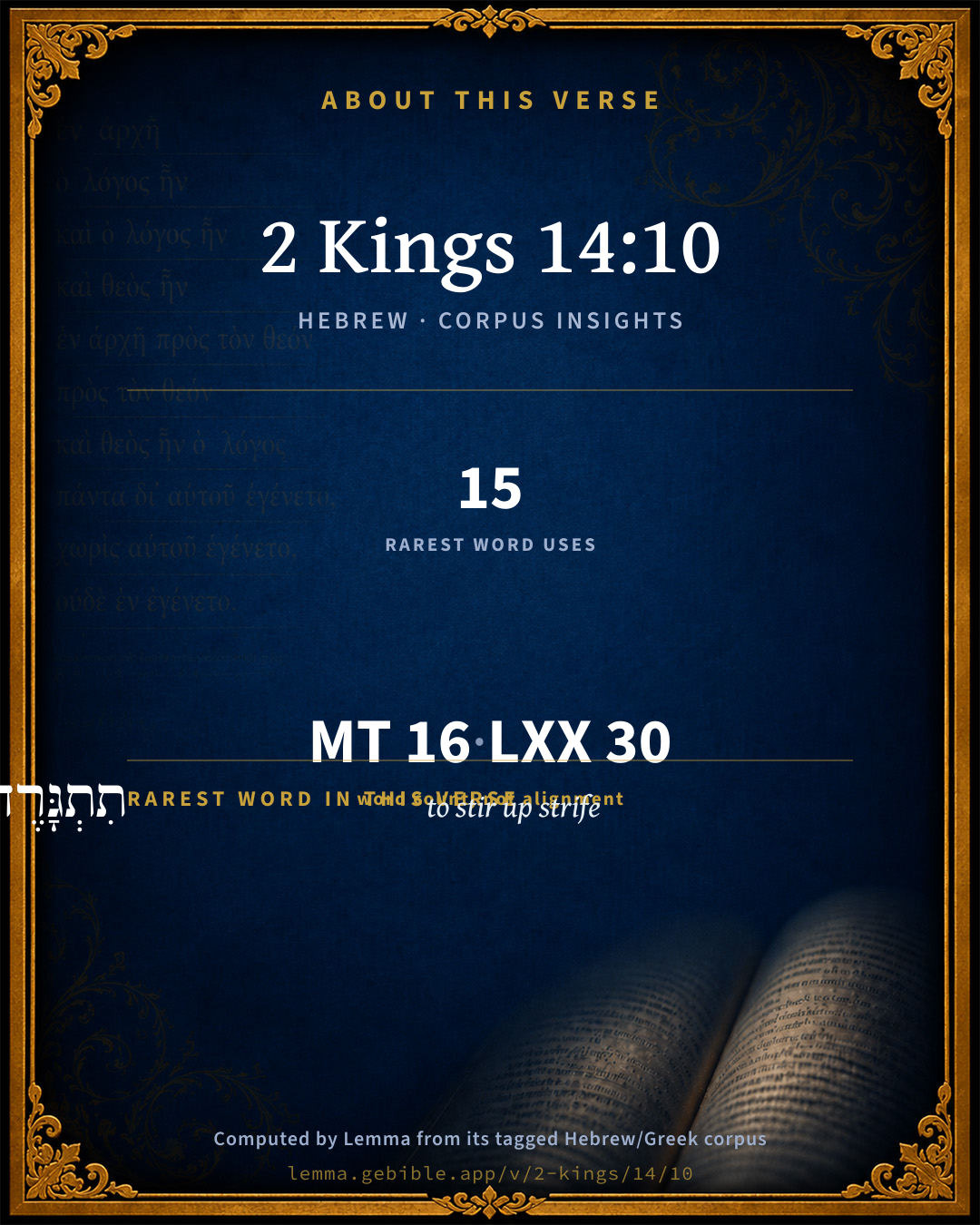
The rarest word here is תִתְגָּרֶה֙ to stir up strife H1624 — appearing just 15 times in the whole Hebrew Bible.

Shared distinctive vocabulary

תִתְגָּרֶה֙ to stir up strife H1624 occurs in 13 verses of the Hebrew Bible. Also found in:

Grammatical profile

  • 7 verbs
  • 5 nouns
  • 1 pronoun
  • 1 preposition
  • 2 particles

Verb forms

  • הַכֵּ֤ה Hiphil · Infinitive Absolute
  • הִכִּ֨יתָ֙ Hiphil · Perfect
  • וּֽנְשָׂאֲךָ֖ Qal · Sequential Perfect
  • הִכָּבֵד֙ Niphal · Imperative
  • וְשֵׁ֣ב Qal · Imperative
  • תִתְגָּרֶה֙ Hithpael · Imperfect
  • וְנָ֣פַלְתָּ֔ה Qal · Sequential Perfect

Repetition

A word recurs within this verse — often emphatic in Hebrew:

  • הַכֵּ֤ה to strike H5221 ×2

Hebrew & Septuagint length

In English translation the verse runs 37 words from the Hebrew and 36 from the Septuagint (LXX English) — closely comparable.

A rough comparison of the two English renderings, which tokenize alike — not a word-level alignment.

Word counts can differ between the Hebrew and the Greek without any difference in meaning — e.g. the Hebrew direct-object marker אֵת has no separate Greek word, and Greek often adds the article ὁ.

In the original languages it is 16 Hebrew tokens and 30 Greek tokens — but the two are counted differently (Hebrew bundles its prefixes and suffixes into one token; the Greek is in lemma form), so that isn’t a like-for-like length.

Cross-references

22

Topical passages linked to 2 Kings 14:10 in the Treasury of Scripture Knowledge — connected by theme and wording, ordered by reader-vote popularity; previews shown in the World English Bible.

  • Deuteronomy 8:14 then your heart be lifted up, and you forget Yahweh your God, who brought you forth out of the land of Egypt, out of the house of bondage;
  • 2 Chronicles 26:16 But when he was strong, his heart was lifted up, so that he did corruptly, and he trespassed against Yahweh his God; for he went into the temple of Yahweh to burn incense on the altar of incense.
  • 2 Chronicles 32:25 But Hezekiah didn't render again according to the benefit done to him; for his heart was lifted up: therefore there was wrath on him, and on Judah and Jerusalem.
  • Proverbs 3:30 Don't strive with a man without cause, If he has done you no harm.
  • Proverbs 15:18 A wrathful man stirs up contention, But one who is slow to anger appeases strife.
  • Proverbs 16:18 Pride goes before destruction, And a haughty spirit before a fall.
  • Proverbs 20:3 It is an honor for a man to keep aloof from strife; But every fool will be quarreling.
  • Exodus 8:9 Moses said to Pharaoh, "I give you the honor of setting the time that I should pray for you, and for your servants, and for your people, that the frogs be destroyed from you and your houses, and remain in the river only."
  • 2 Kings 14:7 He killed of Edom in the Valley of Salt ten thousand, and took Sela by war, and called the name of it Joktheel, to this day.
  • 2 Chronicles 35:21 But he sent ambassadors to him, saying, What have I to do with you, you king of Judah? [I come] not against you this day, but against the house with which I have war; and God has commanded me to make haste: forbear you from [meddling with] God, who is with me, that he not destroy you.
  • Proverbs 17:14 The beginning of strife is like breaching a dam, Therefore stop contention before quarreling breaks out.
  • Proverbs 25:8 Don't be hasty in bringing charges to court. What will you do in the end when your neighbor shames you?
  • Proverbs 26:17 Like one who grabs a dog's ears Is one who passes by and meddles in a quarrel not his own.
  • Jeremiah 9:23–24 Thus says Yahweh, Don't let the wise man glory in his wisdom, neither let the mighty man glory in his might, don't let the rich man glory in his riches;
  • Ezekiel 38:2 Son of man, set your face toward Gog, of the land of Magog, the prince of Rosh, Meshech, and Tubal, and prophesy against him,
  • Ezekiel 38:5 Persia, Cush, and Put with them, all of them with shield and helmet;
  • Ezekiel 38:17 Thus says the Lord Yahweh: Are you he of whom I spoke in old time by my servants the prophets of Israel, who prophesied in those days for [many] years that I would bring you against them?
  • Daniel 5:20–23 But when his heart was lifted up, and his spirit was hardened so that he dealt proudly, he was deposed from his kingly throne, and they took his glory from him:
  • Habakkuk 2:4 Behold, his soul is puffed up. It is not upright in him, but the righteous will live by his faith.
  • Luke 14:31–32 Or what king, as he goes to encounter another king in war, will not sit down first and consider whether he is able with ten thousand to meet him who comes against him with twenty thousand?
  • James 1:9 But let the brother in humble circumstances glory in his high position;
  • James 4:6 But he gives more grace. Therefore it says, "God resists the proud, but gives grace to the humble."

Cross-references courtesy of OpenBible.info (CC BY 4.0).

Hebrew and Greek witnesses Masoretic Hebrew ↔ Greek Septuagint

The same verse in the two great witnesses to the Old Testament, shown verse-for-verse.

These are two independent witnesses, not word-aligned to each other, and the Septuagint is shown in lemma (dictionary) form.

Hebrew 2 Kings 14:10 Masoretic · Westminster Leningrad Codex

הַכֵּ֤ה הִכִּ֨יתָ֙ אֶת אֱד֔וֹם וּֽנְשָׂאֲךָ֖ לִבֶּ֑ךָ הִכָּבֵד֙ וְשֵׁ֣ב בְּבֵיתֶ֔ךָ וְלָ֤מָּה תִתְגָּרֶה֙ בְּרָעָ֔ה וְנָ֣פַלְתָּ֔ה אַתָּ֖ה וִיהוּדָ֥ה עִמָּֽךְ

You have indeed struck Edom, and your heart has lifted you up: glory of it, and abide at home; for why should you meddle to [your] hurt, that you should fall, even you, and Judah with you?

World English Bible · Public Domain

Greek LXX 2 Kings 14:10 Septuagint · lemma form

τύπτω πατάσσω ὁ ιδουμαία καί ἐπιαἴρω σύ ὁ καρδία σύ ἐνδοξάζομαι καταἧμαι ἐν ὁ οἶκος σύ καί ἵνα τίς ἐρίζω ἐν κακία σύ καί πίπτω σύ καί ἰούδας μετά σύ

You have struck and wounded Edom, and your heart has lifted you up: stay at home and glorify yourself; for therefore are you quarrelsome to your hurt? So both you will fall and Juda with you.

LXX2012 (modern English Septuagint) · Public Domain

On this verse, Ellicott's Commentary for English Readers discusses the Septuagint’s reading. Read the note in Commentary ↓

Hebrew: Westminster Leningrad Codex (CC BY 4.0). Greek: Septuagint (public domain); English from LXX2012 (modern English Septuagint) (Public Domain). How the Septuagint differs from the Hebrew →

Targum (Aramaic paraphrase)

1

The Targum is the ancient Jewish Aramaic paraphrase of the Hebrew Scriptures — an interpretive translation, not the Hebrew text itself. Onkelos (literal) and Pseudo-Jonathan (expansive) render the Torah, and Jonathan the Prophets. Coverage is partial: where no permissively-licensed English translation exists for a verse, only the Aramaic is shown. This is verse-level text, not a word-by-word alignment to the Hebrew.

  1. Targum Jonathan Prophets (Joshua–Malachi)
    מִימְחָא מְחֵיתָא יַת אֱנַשׁ אֱדוֹם וְרָאֵים עֲלָךְ לִבָּךְ אִתְיְקַר וְתִיב בְּבֵיתָךְ וּלְמָא אַתְּ מִתְגָרֵי בְּבִישְׁתָא וְתִתְקְטֵיל אַתְּ וּדְבֵית יְהוּדָה עִמָךְ:

    (no public-domain English translation for this verse)

    Targum Jonathan — Aramaic: “Mikraot Gedolot” (public domain). English: “Sefaria Community Translation” (CC0 1.0 (public-domain dedication)); “London "Chaldee Paraphrase," 1871” (public domain). Text via Sefaria.

Commentary

Notes on 2 Kings 14:10 from classic Christian and Jewish commentators (each source and its license shown beneath its notes). The classic Christian expositions comment on the surrounding passage and are grouped to its opening verse, so a note may address several verses; the Jewish commentaries on the Tanakh (Rashi and others) are per-verse, so they appear only where the commentator wrote on this verse.

Lemma curates 59 commentaries, every one of them public domain or Creative Commons licensed, each selected and text-cleaned for this edition rather than reprinted as found. About our sources →

Trapp's Complete Commentary

John Trapp

2Ki 14:10 Thou hast indeed smitten Edom, and thine heart hath lifted thee up: glory [of this], and tarry at home: for why shouldest thou meddle to [thy] hurt, that thou shouldest fall, [even] thou, and Judah with thee?

Ver. 10. And thine heart hath lifted thee up.] Here vice correcteth sin, as we say. Calcat Amaziae fastum, at maiori cum fastu: for by this scornful answer it appeareth that Jehoash was every whit as proud and bold as Amaziah.

John Trapp, A Commentary or Exposition upon All the Books of the Old and New Testament (1647–1656) — public domain. Text from a community e-Sword module.

Joseph Benson's Commentary

2Ki 14:10. Thou hast indeed smitten Edom — A weak, unarmed, undisciplined body of men; and therefore thou thinkest thou canst carry all before thee, and subdue the regular forces of Israel with as much ease. Thy heart hath lifted thee up — Here lies the root of all sin; it is in the heart; thence it proceeds, and that must bear the blame. It is not providence, the event, the occasion, whatever it is, that makes men proud, or secure, or discontented, or the like; but it is their own heart that doth it. Thou art proud of the blow thou hast given to Edom, as if that had made thee formidable to all mankind. Glory of this, and tarry at home — Content thyself with that glory and success, and let not thy ambition betray thee to thy ruin. For why shouldest thou meddle to thy hurt? — As fools often do. Many would have wealth and honour enough, if they did but know when they have enough. That thou shouldest fall, and Judah with thee — He warns him of the consequence; that it would be fatal, not to himself only, but to his kingdom, which he ought to protect.

Joseph Benson's Commentary on the Old and New Testaments (1811–1818) — public domain. Text from a community e-Sword module.

Geneva Bible (1599)

Geneva Bible translators

Brag of the victory, so that thou tarry at home, and envy me not.

Geneva Bible (1599) marginal notes — public domain. Text via Bolls.life.

Adam Clarke's Commentary

Verse 10. Glory of this, and tarry at home] There is a vast deal of insolent dignity in this remonstrance of Jehoash: but it has nothing conciliatory; no proposal of making amends for the injury his army had done to the unoffending inhabitants of Judah. The ravages committed by the army of Jehoash were totally unprovoked, and they were base and cowardly; they fell upon women, old men, and children, and butchered them in cold blood, for all the effective men were gone off with their king against the Edomites. The quarrel of Amaziah was certainly just, yet he was put to the rout; he did meddle to his hurt; he fell, and Judah fell with him, as Jehoash had said: but why was this? Why it came of God; for he had brought the gods of Seir, and set them up to be his gods, and bowed down himself before them, and burnt incense to them; therefore God delivered them into the hands of their enemies, because they sought after the gods of Edom, 2Ch 25:14; 2Ch 25:20. This was the reason why the Israelites triumphed.

Adam Clarke's Commentary on the Bible (1810–1826) — public domain. Text from a community e-Sword/MySword module.

Ellicott's Commentary for English Readers

(10) Thou hast indeed smitten—i.e., thou hast thoroughly worsted; gained a brilliant victory over Edom. (The “indeed” qualifies “smitten.”)

Hath lifted.—Rather, lifteth.

Glory of this, and tarry at home.—Literally, be honoured, and abide in thine own house, i.e., be content with the glory thou hast achieved. Rest on thy laurels, and do not risk them by further enterprises which may not turn out so favourably. So the Vulg. Thenius explains: “Show thy might at home,” referring to the LXX. (Comp. 2Sa_6:20).

For why shouldest thou meddle to thine hurt?—Rather, and why shouldst thou challenge or provoke (literally, attack, Deu_2:5) disaster?

A Bible Commentary for English Readers, edited by Charles John Ellicott (1878–1897) — public domain. Text from a community e-Sword module.

The Cambridge Bible for Schools and Colleges

gen. ed. J. J. S. Perowne

10. and thine heart hath lifted thee up] The more usual expression is that ‘the heart is lifted up’. Cf. Deu_8:14; Deu_17:20; 2Ch_26:16; Eze_28:2. But when the heart is lifted up, the whole spirit of the man soars toward lofty aims.

glory of this] R.V. glory thereof. i.e. Of the Edomite conquest.

tarry [R.V. abide] at home] The change is to harmonize with the rendering in 2 Chronicles.

why shouldest thou meddle to thy hurt] The ‘meddling’ implied by the verb is generally the meddling of contention. Cf. Deu_2:9 where the A.V. has ‘contend not with them’, and in verses 5 and 19 of the same chapter, where the same word occurs, the R.V. has adopted ‘contend’ instead of ‘meddle’. The order is there given in respect of those nations whom the Israelites are charged to let alone. Hence in this verse R.V. has on the margin ‘provoke not calamity’. Calamity is thus viewed as an enemy, with whom Amaziah was unwisely venturing to go to war.

The Cambridge Bible for Schools and Colleges (gen. ed. J. J. S. Perowne; Cambridge University Press, 1878–1918) — public domain. Text from a community e-Sword module.

John Gill's Exposition

And Judah was put to the worse before Israel,.... Could not face them; but, as Josephus (d) says, a sudden fear and consternation seized them, and before they joined battle with the Israelites, turned their backs:

and they fled every man to their tents; to their cities, as the Targum, and left their king alone.

(d) Antiqu. l. 9. c. 9. sect. 3.

John Gill's Exposition of the Whole Bible (1746–1763) — public domain (CC PDM 1.0). Text via the HelloAO Bible API.

Albert Barnes' Notes on the Bible

Glory of this ... - literally, “Be honored;” i. e. “Enjoy thy honor ... be content with it.” “Why wilt thou meddle with misfortune?”

Albert Barnes' Notes on the Bible (1834–1885) — public domain. Text from a community e-Sword/MySword module.

Haydock's Catholic Bible Commentary

Home, to boast of thy victory, (Haydock) but do not offer to molest others. (Calmet) --- God permitted that Amasias should pay no attention to this advice, nor to the prophet who reproached him for adoring the idols which he had brought from Edom, 2 Paralipomenon xxv. 14.

George Leo Haydock (1774–1849), Haydock's Catholic Family Bible and Commentary, 1859 edition — public domain. Excludes Psalms (Douay-Rheims chapter numbering differs from Protestant) and Deuterocanonical books (Catholic canon only).

Matthew Poole's English Annotations

Glory of this; content thyself with that glory and success, and let not thine ambition betray thee to ruin.

Matthew Poole's English Annotations on the Holy Bible (1683–1685) — public domain. Text from a community e-Sword/MySword module.

Whedon's Commentary on the Bible

Daniel D. Whedon

10. Thine heart hath lifted thee up — The king of Israel, with keen insight, discerned the real ground of Amaziah’s pride and insolence. His recent victory had lifted him up — filled him with pride, and he thought himself unconquerable.

Why shouldest thou meddle to thy hurt — Gesenius renders: Wherefore shouldest thou contend with calamity. רעה, here rendered hurt, is represented as the foe with whom he meddles, or contends. Why, he asks, shouldest thou engage in strife with misfortune?

Daniel D. Whedon (gen. ed.), Commentary on the Old and New Testaments (1874–1909) — public domain. Text from a community e-Sword module.

The Pulpit Commentary

Thou hast indeed smitten Edom (see ver. 7, and the comment), and thine heart hath lifted thee upi.e. , made thee proud, exalted thee above measureglory of this, and tarry at homei.e. , rest content with the glory which thou hast gained in thy Edomite war; make thy boast thereof, but do not affront fresh dangersfor why shouldest thou meddle to thy hurt literally, why wilt thou meddle with misfortune?that thou shouldest fall, even thou, and Judah with thee? Joash was as confident of success, if it came to war, as Amaziah. His three victories over Syria (2Ki_13:25) were, he thought, at least as good evidence of military strength as Amaziah"s one victory over Edom.

The Pulpit Commentary (1880–1919), ed. H.D.M. Spence-Jones & Joseph S. Exell — public domain. Text from a community e-Sword module.

John Wesley's Explanatory Notes

Glory - Content thyself with that glory, and let not thine ambition betray thee to ruin.

John Wesley, Explanatory Notes Upon the Whole Bible (1754–1765) — public domain. Text via the GEBible commentary corpus.

Lesson kit

Teaching starters — assembled from the data on this page, not authored interpretation. Every prompt links to the verse data it draws on. Edit before teaching.

2 Kings, in the Historical, opens this verse with 16 words (15 distinct Hebrew lemmas). Its most distinctive word is gârâh (“to stir up strife”). A historical commentator’s framing appears above. Read the whole chapter for the surrounding context.

Discussion questions

  1. The word gârâh carries the sense “to stir up strife.” How does it shape the verse?
  2. Deuteronomy 2:5 shares the word «to stir up strife» with this verse. How do the two illuminate each other?
  3. “to strike” occurs 2× in this one verse. What is the effect of the repetition?
  4. The translations on this page render this verse differently — a whole-verse word diff, not a word-by-word alignment. What might account for the different wordings?
  5. The verb «הַכֵּ֤ה» is Hiphil Infinitive Absolute. How does its form color the action?
  6. Reading how Trapp's Complete Commentary and Joseph Benson's Commentary read this verse, where do the two commentators agree and where do they part?

Things to notice

Reading settings

Reading text

Shown beneath each verse's original-language words.

Old Testament
Old Testament edition

Read the OT as the Masoretic Hebrew (MT) or the Greek Septuagint (LXX).

English shown for the Greek Septuagint (in the Hebrew ↔ Greek comparison).

Comparing translations? Open the Compare panel on any verse page to stack up to four side by side.