
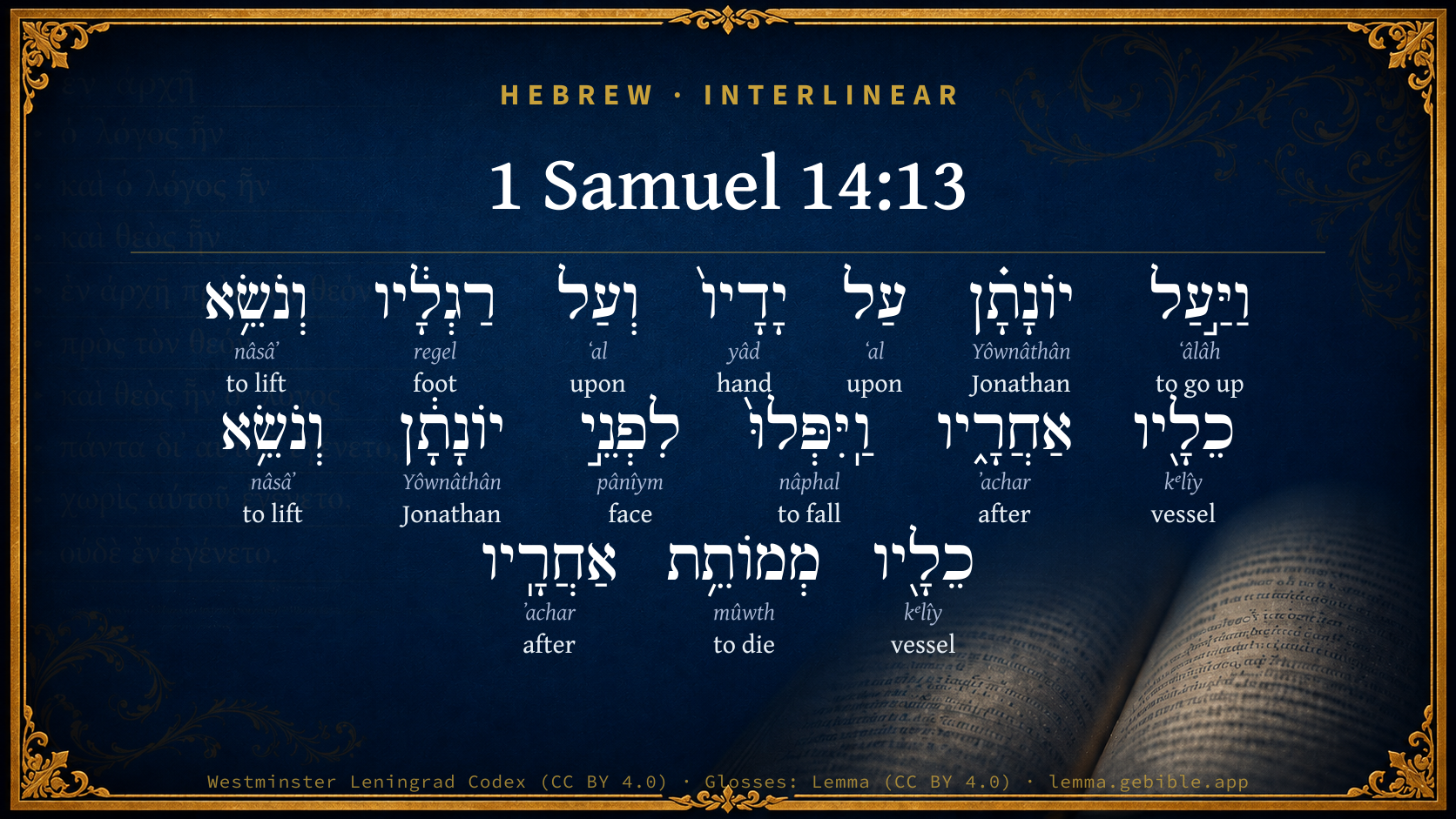
1 Samuel 14:13

Hebrew (Westminster Leningrad Codex) 1 Samuel 14:13 appears in the Hebrew Old Testament. The text above is from the Westminster Leningrad Codex. Each word links to its Strong’s number, a concise gloss, and parsing drawn from the Open Scriptures Hebrew Bible morphology. Click any word for its full Brown-Driver-Briggs (BDB) entry.
Download image
Cite this verse

1 Samuel 14:13 (World English Bible). Public Domain. Lemma interlinear Bible study tool, https://lemma.gebible.app/v/1-samuel/14/13.

Show BibTeX & RIS
BibTeX
RIS
English Translation
Jonathan climbed up on his hands and on his feet, and his armor bearer after him: and they fell before Jonathan; and his armor bearer killed them after him.
World English Bible · Public Domain
Download a study sheet

One document with this verse’s original text, its word-by-word gloss line, the meaning frame, cross-references with their text, attributed commentary, and full source and license credits — printable, and it pastes into notes with its structure intact.

This verse Autodidact and up

Study sheet (.html) Plain text (.txt)

A passage Seminary Student

Up to 50 verses in one chapter. A passage sheet keeps up to 6 commentary sources and 12 cross-references per verse, in the order this page ranks them, and says so on the sheet whenever that leaves anything out. Ask for a single verse and you get the Autodidact verse sheet above.

Everything on this page stays free to read, with no account — the sheet is a download of what is already on screen, not access to it.

Want to remove ads? Support Godless Engineer
Compare translations 3

The same verse in 3 English versions, stacked beneath the original-language interlinear above. Click any original word for its lexicon entry.

Each is an independent rendering of the whole verse — the interlinear is not word-aligned to these translations.

Highlighted words mark where these versions differ — a whole-verse word diff, not a word-by-word alignment.

  • World English Bible Public Domain
    Jonathan climbed up on his hands and on his feet, and his armor bearer after him: and they fell before Jonathan; and his armor bearer killed them after him.
  • King James Version Public Domain
    And Jonathan climbed up upon his hands and upon his feet, and his armourbearer after him: and they fell before Jonathan; and his armourbearer slew after him.
  • unfoldingWord Literal Text CC BY-SA 4.0
    And Jonathan went up on his hands and on his feet, and the carrier of his equipment behind him. And they fell to the face of Jonathan, and the carrier of his equipment was killing behind him.

unfoldingWord Literal Text — © unfoldingWord, licensed CC BY-SA 4.0. Word-aligned USFM3 via Door43 (git.door43.org/unfoldingWord/en_ult).

Versions to compare (up to 4)

3 of 4 selected

Show all 18 translations

Every available English version of this verse, each an independent rendering of the whole verse.

  • World English Bible Public Domain
    Jonathan climbed up on his hands and on his feet, and his armor bearer after him: and they fell before Jonathan; and his armor bearer killed them after him.
  • Berean Standard Bible Public Domain
    So Jonathan climbed up on his hands and feet, with his armor-bearer behind him. And the Philistines fell before Jonathan, and his armor-bearer followed and finished them off.
  • Majority Standard Bible Public Domain
    So Jonathan climbed up on his hands and feet, with his armor-bearer behind him. And the Philistines fell before Jonathan, and his armor-bearer followed and finished them off.
  • King James Version Public Domain
    And Jonathan climbed up upon his hands and upon his feet, and his armourbearer after him: and they fell before Jonathan; and his armourbearer slew after him.
  • American Standard Version (1901) Public Domain
    And Jonathan climbed up upon his hands and upon his feet, and his armorbearer after him: and they fell before Jonathan; and his armorbearer slew them after him.
  • Revised Version (1885) Public Domain
    And Jonathan climbed up upon his hands and upon his feet, and his armourbearer after him: and they fell before Jonathan; and his armourbearer slew them after him.
  • Geneva Bible (1599) Public Domain
    So Ionathan went vp vpon his hands and vpon his feete, and his armour bearer after him: and some fell before Ionathan, and his armour bearer slewe others after him.
  • Douay-Rheims (1899) Public Domain
    And Jonathan went up creeping on his hands and feet, and his armourbearer after him. And some fell before Jonathan, others his armourbearer slew as he followed him.
  • Young's Literal Translation Public Domain
    And Jonathan goeth up on his hands, and on his feet, and the bearer of his weapons after him; and they fall before Jonathan, and the bearer of his weapons is putting to death after him.
  • Literal Standard Version CC BY-SA 4.0
    And Jonathan goes up on his hands, and on his feet, and the bearer of his weapons after him; and they fall before Jonathan, and the bearer of his weapons is putting [them] to death after him.
  • Unlocked Literal Bible CC BY-SA 4.0
    Jonathan climbed up on his hands and feet, and his armor bearer followed behind him. The Philistines were put to death before Jonathan, and his armor bearer put some to death behind him.
  • unfoldingWord Literal Text CC BY-SA 4.0
    And Jonathan went up on his hands and on his feet, and the carrier of his equipment behind him. And they fell to the face of Jonathan, and the carrier of his equipment was killing behind him.
  • Darby Bible Public Domain
    And Jonathan climbed up upon his hands and upon his feet, and his armour-bearer after him; and they fell before Jonathan; and his armour-bearer slew after him.
  • World Messianic Bible Public Domain
    Jonathan climbed up on his hands and on his feet, and his armor bearer after him, and they fell before Jonathan; and his armor bearer killed them after him.
  • Webster's Bible Public Domain
    And Jonathan climbed up upon his hands and upon his feet, and his armor-bearer after him: and they fell before Jonathan; and his armor-bearer slew after him.
  • Free Bible Version CC BY-SA 4.0
    So Jonathan climbed up on his hands and feet, with his armor-bearer right behind him. Jonathan attacked and killed them, and his armor-bearer followed doing the same.
  • Bible in Basic English Public Domain
    And Jonathan went up, gripping with his hands and his feet, his servant going up after him; and the Philistines gave way before Jonathan when he made an attack on them, and his servant put them to death after him.
  • JPS Tanakh (1917) Public Domain
    And Jonathan climbed up upon his hands and upon his feet, and his armour-bearer after him; and they fell before Jonathan; and his armour-bearer slew them after him.

Literal Standard Version (2020), Covenant Press — licensed CC BY-SA 4.0. Text via the HelloAO Bible API (eBible.org). Unlocked Literal Bible (unfoldingWord) — licensed CC BY-SA 4.0. Text via the HelloAO Bible API (eBible.org). unfoldingWord Literal Text — © unfoldingWord, licensed CC BY-SA 4.0. Word-aligned USFM3 via Door43 (git.door43.org/unfoldingWord/en_ult). Free Bible Version, Dr. Jonathan Gallagher — licensed CC BY-SA 4.0. Text via the HelloAO Bible API (eBible.org).

Word by word

More ways to search: Search by grammar → Find every occurrence → Compare this word →

Practice this passage: Drill this verse → Learn its vocabulary →

יוֹנָתָ֗ן
Yôwnâthân
H3129
“Jonathan”
Noun, Proper
Part of Speech
Noun
Type
Proper
Full BDB Definition

Origin: a form of H3083

TWOT: None

Jonathan or Jehonathan = "Jehovah has given" - a son of king Saul and a friend of David - a son of the high priest Abiathar and the last descendant of Eli of whom we hear - one of David's mighty warriors - a Levite and father of Zechariah, a priest who blew the trumpet at the dedication of the wall - a son of Kareah and a brother of Johanan; a Judaite captain after the fall of Jerusalem - another Judaite - father of Ebed in the time of Ezra - son of Asahel in the time of Ezra - a priest of the family of Melicu in the time of Nehemiah - son of Joiada and his successor to the high priesthood in the time of Nehemiah
  1. וַיַּ֣עַל ʻâlâh H5927 “and · to go up” Conjunction + Verb, Qal, Sequential Imperfect, 3rd Person, Masculine, Singular
  2. עַל ʻal H5921 “upon” Preposition
  3. יָדָיו֙ yâd H3027 “hands · his” Noun, Common, Both, Dual, Construct + Suffix, Personal, 3rd Person, Masculine, Singular
  4. וְעַל ʻal H5921 “and · upon” Conjunction + Preposition
  5. רַגְלָ֔יו regel H7272 “feet · his” Noun, Common, Feminine, Dual, Construct + Suffix, Personal, 3rd Person, Masculine, Singular
  6. וְנֹשֵׂ֥א nâsâʼ H5375 “and · lifting” Conjunction + Verb, Qal, Participle Active, Masculine, Singular, Construct
  7. כֵלָ֖יו kᵉlîy H3627 “vessels · his” Noun, Common, Masculine, Plural, Construct + Suffix, Personal, 3rd Person, Masculine, Singular
  8. אַחֲרָ֑יו ʼachar H310 “after · him” Preposition + Suffix, Personal, 3rd Person, Masculine, Singular
  9. וַֽיִּפְּלוּ֙ nâphal H5307 “and · to fall” Conjunction + Verb, Qal, Sequential Imperfect, 3rd Person, Masculine, Plural
  10. לִפְנֵ֣י pânîym H6440 “to/for · face(s) of” Preposition + Noun, Common, Both, Plural, Construct
  11. יוֹנָתָ֔ן Yôwnâthân H3129 “Jonathan” Noun, Proper
  12. וְנֹשֵׂ֥א nâsâʼ H5375 “and · lifting” Conjunction + Verb, Qal, Participle Active, Masculine, Singular, Construct
  13. כֵלָ֖יו kᵉlîy H3627 “vessels · his” Noun, Common, Masculine, Plural, Construct + Suffix, Personal, 3rd Person, Masculine, Singular
  14. מְמוֹתֵ֥ת mûwth H4191 “dying” Verb, Polel, Participle Active, Masculine, Singular, Absolute
  15. אַחֲרָֽיו ʼachar H310 “after · him” Preposition + Suffix, Personal, 3rd Person, Masculine, Singular

About this verse

These counts appear in no published source. They are computed here, from the morphology-tagged text and Lemma’s own curated glosses. What Lemma adds →

16
words
11
distinct lemmas
Historical
section

Shared distinctive vocabulary

יוֹנָתָ֗ן Jonathan H3129 occurs in 36 verses of the Hebrew Bible. Also found in:

Grammatical profile

  • 5 verbs
  • 7 nouns
  • 4 prepositions

Verb forms

  • וַיַּ֣עַל Qal · Sequential Imperfect
  • וְנֹשֵׂ֥א Qal · Participle Active
  • וַֽיִּפְּלוּ֙ Qal · Sequential Imperfect
  • וְנֹשֵׂ֥א Qal · Participle Active
  • מְמוֹתֵ֥ת Polel · Participle Active

Repetition

Words recur within this verse — often emphatic in Hebrew:

  • יוֹנָתָ֗ן Jonathan H3129 ×2
  • עַל upon H5921 ×2
  • וְנֹשֵׂ֥א to lift H5375 ×2
  • כֵלָ֖יו vessel H3627 ×2
  • אַחֲרָ֑יו after H310 ×2

Hebrew & Septuagint length

In English translation the verse runs 29 words from the Hebrew and 34 from the Septuagint (LXX English) — closely comparable.

A rough comparison of the two English renderings, which tokenize alike — not a word-level alignment.

Word counts can differ between the Hebrew and the Greek without any difference in meaning — e.g. the Hebrew direct-object marker אֵת has no separate Greek word, and Greek often adds the article ὁ.

Cross-references

7

Topical passages linked to 1 Samuel 14:13 in the Treasury of Scripture Knowledge — connected by theme and wording, ordered by reader-vote popularity; previews shown in the World English Bible.

  • Leviticus 26:7–8 You shall chase your enemies, and they shall fall before you by the sword.
  • Deuteronomy 28:7 Yahweh will cause your enemies who rise up against you to be struck before you: they shall come out against you one way, and shall flee before you seven ways.
  • Deuteronomy 32:30 How should one chase a thousand, Two put ten thousand to flight, Except their Rock had sold them, Yahweh had delivered them up?
  • Joshua 23:10 One man of you shall chase a thousand; for Yahweh your God, he it is who fights for you, as he spoke to you.
  • Psalms 18:29 For by you, I advance through a troop. By my God, I leap over a wall.
  • Romans 8:31 What then shall we say about these things? If God is for us, who can be against us?
  • Hebrews 11:34 quenched the power of fire, escaped the edge of the sword, from weakness were made strong, grew mighty in war, and turned to flight armies of aliens.

Cross-references courtesy of OpenBible.info (CC BY 4.0).

Hebrew and Greek witnesses Masoretic Hebrew ↔ Greek Septuagint

The same verse in the two great witnesses to the Old Testament, shown verse-for-verse.

These are two independent witnesses, not word-aligned to each other, and the Septuagint is shown in lemma (dictionary) form.

Hebrew 1 Samuel 14:13 Masoretic · Westminster Leningrad Codex

וַיַּ֣עַל יוֹנָתָ֗ן עַל יָדָיו֙ וְעַל רַגְלָ֔יו וְנֹשֵׂ֥א כֵלָ֖יו אַחֲרָ֑יו וַֽיִּפְּלוּ֙ לִפְנֵ֣י יוֹנָתָ֔ן וְנֹשֵׂ֥א כֵלָ֖יו מְמוֹתֵ֥ת אַחֲרָֽיו

Jonathan climbed up on his hands and on his feet, and his armor bearer after him: and they fell before Jonathan; and his armor bearer killed them after him.

World English Bible · Public Domain

Greek LXX 1 Samuel 14:13 Septuagint · lemma form

καί ἀναβαίνω ιωναθαν ἐπί ὁ χείρ αὐτός καί ἐπί ὁ πούς αὐτός καί ὁ αἴρω ὁ σκεῦος αὐτός μετά αὐτός καί ἐπιβλέπω κατά πρόσωπον ιωναθαν καί πατάσσω αὐτός καί ὁ αἴρω ὁ σκεῦος αὐτός ἐπιδίδωμι ὀπίσω αὐτός

And Jonathan went up on his hands and feet, and his armor-bearer with him; and they looked on the face of Jonathan, and he struck them, and his armor-bearer did strike them after him.

LXX2012 (modern English Septuagint) · Public Domain

Hebrew: Westminster Leningrad Codex (CC BY 4.0). Greek: Septuagint (public domain); English from LXX2012 (modern English Septuagint) (Public Domain). How the Septuagint differs from the Hebrew →

Targum (Aramaic paraphrase)

1

The Targum is the ancient Jewish Aramaic paraphrase of the Hebrew Scriptures — an interpretive translation, not the Hebrew text itself. Onkelos (literal) and Pseudo-Jonathan (expansive) render the Torah, and Jonathan the Prophets. Coverage is partial: where no permissively-licensed English translation exists for a verse, only the Aramaic is shown. This is verse-level text, not a word-by-word alignment to the Hebrew.

  1. Targum Jonathan Prophets (Joshua–Malachi)
    וּסְלִיק יוֹנָתָן עַל יְדוֹהִי וְעַל רַגְלוֹהִי וּנָטַל זְיָנֵיהּ בַּתְרוֹהִי וּנְפָלוּ מְטַעֲנִין קֳדָם יוֹנָתָן וְנָטַל זְיָנֵיהּ מֵמִית בַּתְרוֹהִי:

    (no public-domain English translation for this verse)

    Targum Jonathan — Aramaic: “Mikraot Gedolot” (public domain). English: “Sefaria Community Translation” (CC0 1.0 (public-domain dedication)); “London "Chaldee Paraphrase," 1871” (public domain). Text via Sefaria.

Commentary

Notes on 1 Samuel 14:13 from classic Christian and Jewish commentators (each source and its license shown beneath its notes). The classic Christian expositions comment on the surrounding passage and are grouped to its opening verse, so a note may address several verses; the Jewish commentaries on the Tanakh (Rashi and others) are per-verse, so they appear only where the commentator wrote on this verse.

Lemma curates 59 commentaries, every one of them public domain or Creative Commons licensed, each selected and text-cleaned for this edition rather than reprinted as found. About our sources →

Trapp's Complete Commentary

John Trapp

1Sa 14:13 And Jonathan climbed up upon his hands and upon his feet, and his armourbearer after him: and they fell before Jonathan; and his armourbearer slew after him.

Ver. 13. And Jonathan climbed up upon his hands and upon his feet.] See 1Sa 14:4. Faith in God’s power and promises will eat its way over all Alps of opposition. Magna facinora, magnis periculis emuntur, saith the historian. {a} Great acts are bought with great hazards.

And they fell before Jonathan.] Who cut his way through a wood of men: as did afterwards the thrice noble Scanderbeg.

And his armour bearer slew after him.] With the weapons of the slain Philistines he slew more of them.

{a} Dionys. Halicar.

John Trapp, A Commentary or Exposition upon All the Books of the Old and New Testament (1647–1656) — public domain. Text from a community e-Sword module.

The Biblical Illustrator

Joseph S. Exell

1Sa_14:13

And they fell before Jonathan, and his armour bearer slew after him.

The qualities that win

Sir Charles Napier, when in India, encountered an army of thirty-five thousand Belloches with two thousand men, of whom only four hundred were Europeans. He charged them in the centre up a high bank, and for three hours the battle was undecided. At last they turned and fled. It is this sort of pluck, tenacity and determined perseverance which wins soldiers battles, and, indeed, every battle. It is the one neck nearer that wins the race and shows the blood; the one pull more of the oar that proves the beefiness of the fellow, as Oxford men say; it is the one march more that wins the campaign, the five minutes more persistent courage that wins the fight. Though your force be less than anothers, you equal and outmaster your opponent if you continue it longer and concentrate it more. (S. Smiles)

The Biblical Illustrator, edited by Joseph S. Exell (c. 1880s–1900s) — public domain. Text from a community e-Sword module.

Joseph Benson's Commentary

1Sa 14:13. They fell before Jonathan — It is probable that the garrison, after they had spoken to Jonathan and his armour-bearer, concerned themselves no further about them, so that they climbed up unperceived, and fell upon the Philistines unawares, and perhaps when they were unarmed. And being endowed with extraordinary strength and courage, and having, with incredible boldness, killed the first they met with, it is not strange if the Philistines were both astonished and intimidated; God also struck them with a panic; and withal, infatuated their minds, and possibly put an evil spirit among them, which in this universal confusion made them conceive that there was treachery among themselves, and therefore caused them to sheath their swords in one another’s bowels.

Joseph Benson's Commentary on the Old and New Testaments (1811–1818) — public domain. Text from a community e-Sword module.

Geneva Bible (1599)

Geneva Bible translators

That is, he crept up, or went up with all haste.

Geneva Bible (1599) marginal notes — public domain. Text via Bolls.life.

Adam Clarke's Commentary

Verse 13. Jonathan climbed up] It seems he had a part of the rock still to get over. When he got over he began to slay the guards, which were about twenty in number, these were of a sort of outpost or advanced guard to the garrison.

Slew after him] Jonathan knocked them down, and the armour-bearer despatched them. This seems to be the meaning.

Adam Clarke's Commentary on the Bible (1810–1826) — public domain. Text from a community e-Sword/MySword module.

Ellicott's Commentary for English Readers

(13) And they fell before Jonathan . . .—The sign he prayed for was given him. There were probably but few sentinels at their posts; the inaccessibility of the craggy fortress had lulled the garrison into security. The few watching him at first mocked, and then, as Jonathan advanced with strange rapidity, they seem to have been, as it were, paralysed—the feat was hardly human—as the man, all armed, sprang over the rocky parapet. “His chief weapon was his bow,” writes Dean Stanley; “his whole tribe was a tribe of archers, and he was the chief archer of them all.” Arrived at the summit, in rapid succession he shot his deadly bolts, his gallant armour-bearer following his chief’s example. and twenty men, so says the record, fell before they had recovered their surprise. In a moment a panic seized the garrison, and a hurried flight ensued, for they felt they had to deal with no mortal strength.

A Bible Commentary for English Readers, edited by Charles John Ellicott (1878–1897) — public domain. Text from a community e-Sword module.

The Cambridge Bible for Schools and Colleges

gen. ed. J. J. S. Perowne

13. Jonathan climbed up upon his hands and upon his feet] “Immediately to the east of the village of Michmash exists a natural fortress, still called ‘the fort’ by the peasantry. It is a ridge rising in three rounded knolls above a perpendicular crag, ending in a narrow tongue to the east with cliffs below.” Conder’s Tent Work, II. 112. This may have been the post occupied by the advanced guard of the Philistines.

The Cambridge Bible for Schools and Colleges (gen. ed. J. J. S. Perowne; Cambridge University Press, 1878–1918) — public domain. Text from a community e-Sword module.

John Gill's Exposition

And Jonathan climbed up upon his hands and upon his feet,.... He did not attempt to go up the way or pass the Philistines kept, but turned aside and climbed up a precipice thought inaccessible, and came upon them unseen, and at unawares; for had he attempted to come up in any part where he was seen, they could easily have beat him down, and prevented his ascent; but though the place he climbed was so very steep and cragged, yet going on all four, as we say, he surmounted the difficulty; for he took this method of going on his hands and feet, not so much that he might not be seen; but because otherwise he could not have got up, not being able to stand on his feet; some think it was the precipice called Bozez he climbed, which, according to the Targum, had its name from its being lubricous and slippery:

and his armourbearer after him; who clambered up in the same manner, in imitation of his master, and as taught and directed by him:

and they fell before Jonathan, and his armourbearer slew after him; Jonathan, coming upon them at an unawares, knocked them down; or falling upon them, and laying about him with great dispatch, wounded them, and laid them prostrate to the ground; and his armourbearer following them, put them to death, dispatched them at once; and so between them both made quick riddance of them.

John Gill's Exposition of the Whole Bible (1746–1763) — public domain (CC PDM 1.0). Text via the HelloAO Bible API.

Matthew Poole's English Annotations

The Philistines could easily have hindered their ascent, but thought scorn to do it, not questioning but they could cut them off in a moment when they were come up to them according to their invitation.

Jonathan and his armourbearer being endowed with extraordinary strength and courage, and having with incredible boldness killed the first they met with, and so proceeding with success, it is not strange if the Philistines were both astonished and intimidated; God also struck them with a panic terror; and withal, infatuated their minds, and possibly put an evil spirit among them, which in this universal confusion made them conceive that there was treachery amongst themselves, and therefore caused them to sheath their swords in one another’s bowels, as appears from 1Sa 14:16,20.

Matthew Poole's English Annotations on the Holy Bible (1683–1685) — public domain. Text from a community e-Sword/MySword module.

The Pulpit Commentary

Upon his hands and upon his feet. Of course a single stone rolled down upon them while thus clambering up the precipitous side of the cliff would have sent them to the bottom; but the Philistines, apparently considering the ascent impossible, seem entirely to have neglected them. The youthful appearance of the two no doubt contributed to throw them off their guard. And they fell before Jonathan. The brevity of the Hebrew very well expresses the rapidity of Jonathan"s action. Used to mountaineering, he was ready, as soon as he had reached the summit, to commence the attack, and the Philistines, little expecting so vigorous an onslaught from so feeble a force, were surprised, and made but a slight resistance. The armour bearer also behaved with a bravery like his master"s.

Vers. 13-23.

God"s faithfulness to his own.

The facts are

1. Jonathan and his servant ascend the precipice and slay, on a narrow stripof land, about twenty men.

2. A panic arising, from a combination of causes, the commotion attractsthe attention of Saul"s sentinels.

3. It being ascertained that Jonathan was engaged against the Philistines,inquiry is sought of God, by Saul, through the priest Ahiah.

4. The tumult among the Philistines increasing, Saul abruptly stops theinquiry and leads on his followers to battle.

5. The deserters and the fugitives fall on the rear of the retreatingPhilistines. The historian sums up the narrative of events in this section by the suggestive words, "So the Lord saved Israel that day." It was "the Lord," working through the instrumentality of a noble hearted man and the events concurrent with his action not withholding the reward of fidelity, notwithstanding the questionable conduct of the king. "It is the Lord," must be the verdict of history, not only of their deliverance, but of many others in all time.

I GOD"S FAITHFULNESS IS SEEN IN PERFECTING THE WORK WHICH HE INSPIRES. There can be no doubt but that Jonathan received this "good and perfect gift" of inspiration, to seek the salvation of his country, from God. We have seen that it could not have been a mere human, earth born impulse. There may be a point at which the human free aspiration becomes touched with a Divine power; but, as a whole, the impulse is of God. The narrative tells us how certainly God wrought for the perfecting of that which he saw in the heart. Not a step of his way did Jonathan find to be a practical denial of the truth of his inward prompting. Thus the life of the true man of God is crowded with evidences of the Divine faithfulness. He who begins a "good work" within us will carry it through. He is "not unrighteous to forget our work of faith and labour of love." He will "perfect that which concerneth us." "Loving his own," he loves "to the end." Abraham, under an inspiration from God, went forth, and all through his pilgrimage he found Jehovah to be a covenant keeping God. In our painful and protracted endeavours, in obedience to an aspiration born from above to rise to the heights of holiness and to bless others, we shall find him faithful who hath promised never to leave nor forsake us.

II IN MAINTAINING HIS FAITHFULNESS TO HIS PEOPLE GOD CAUSES VARIED INFLUENCES TO CONVERGE ON THE DESIRED RESULT OF EFFORT. The Divine faithfulness is not arbitrarily and absolutely manifested. It is seen in realising the desired end by a succession of events naturally connected. Jonathan"s exertions were put forth as though all rested on the courage of his own heart and the strength of his own arm. The narrative shows us how an unseen hand upheld the brave soldier, and caused diverse things to converge on the one issue: e.g. the young soldier"s skill, tact, and courage; the folly of the defenders in allowing him a footing on the narrow pathway of the upper part of the precipice; the fear aroused through ignorance of the full facts of the assault; the panic spread from post to post strengthened, possibly, by a slight shock of earthquake; the onward movement of Saul"s troop; and the opportunity created for the rallying of fugitives and deserters (vers. 21, 22).

Such a historical episode is of great value to us, as indicating in distinct, traceable incidents the reality of that Divine wisdom and power which ever presides over all the efforts of Christians to rid themselves and the world of Sill. It illustrates as on a picture the great formula of faith things work together for good to them that love God." As "the stars in their courses fought against Sisera," and as even holy angels are "ministering spirits sent forth to minister to those who shall be heirs of salvation," so may it be said, in the case of every one who strives to purify himself from all sin, or seeks by some bold or ordinary endeavour to win the world over to Christ, "all things are yours, are being governed by the Lord of all so as to subserve the one holy end to the attainment of which your hearts are inspired.

III IN MANIFESTING HIS FAITHFULNESS TO HIS PEOPLE GOD PERMITS THE IMPERFECT TO SHARE IN THE BLESSINGS PROCURED BY THE MORE PERFECT. Primarily, it was God"s compassion for Israel and his covenant with Abraham that must account for this new deliverance. Secondarily, it was a reward to Jonathan"s fidelity and self-consecration. Saul had shut himself out of the honour and privilege of obtaining deliverance for the nation. Even now his old folly and rashness reappear, in religiously beginning to seek counsel, thus honouring God, and then in irreverently discontinuing to seek that counsel, through his impetuous haste to join in the pursuit, thus preferring the impulse of his heart to the declared will of God. Nevertheless, even Saul derives great advantage from the prowess of the good and devout Jonathan. God, in his mercy, does not sacrifice the final interests of his people to the folly of a leader. Thus, also, Joseph"s brethren shared in the prosperity won by their holy and wise brother. The inferior Christians of today participate in some of the outward blessings accruing to the faithful as the result of their fidelity.

General lessons.

1. It would be a profitable study to note in detail, over the field of sacredand Church history, and in the sphere of private Christian enterprise, to what a large extent the world is indebted for spiritual, material, and educational good to the honour God has put on the labours of the most faithful of his servants.

2. We may be perfectly sure in the pursuit of any holy enterprise, to whichpersonally we may feel inadequate, that God, with whom is "no restraint," will develop helping circumstances.

3. The helping circumstances desiderated will arise, not at first, but only as we faithfully press along the line of duty.

4. The cumulating record of God"s faithfulness to his people through thelong ages should make us calm, strong, and immovable in the most perilous of enterprises undertaken for Christ.

The Pulpit Commentary (1880–1919), ed. H.D.M. Spence-Jones & Joseph S. Exell — public domain. Text from a community e-Sword module.

John Wesley's Explanatory Notes

They fell - For being endowed with extraordinary strength and courage, and having with incredible boldness killed the first they met with, it is not strange if the Philistines were both astonished and intimidated; God also struck them with a panic; and withal, infatuated their minds, and possibly, put an evil spirit among them, which in this universal confusion made them conceive that there was treachery among themselves, and therefore caused them to sheathe their swords in one anothers bowels.

John Wesley, Explanatory Notes Upon the Whole Bible (1754–1765) — public domain. Text via the GEBible commentary corpus.

unfoldingWord translationNotes

Door43 World Missions Community

Jonathan climbed up on his hands and feet

He did this because it was very steep. This could be made explicit. AT: "So Jonathan climbed up, using his hands and his feet because it was very steep" (See: Assumed Knowledge and Implicit Information)

The Philistines were put to death before Jonathan

This can be stated in active form. AT: "Jonathan killed the Philistines" (See: Active or Passive)

his armor bearer put some to death behind him

"Jonathan's armor bearer followed him and also killed Philistine soldiers"

translationWords

die

unfoldingWord translationNotes — © Distant Shores Media and the Door43 World Missions Community, licensed CC BY-SA 4.0. Source: git.door43.org/Door43/en_tn.

Rashi

Rabbi Shlomo Yitzchaki (Rashi)

On his hands and feet. I.e., with all his might and running.

Rashi on the Tanakh — English translations: “The Judaica Press complete Tanach with Rashi, translated by A. J. Rosenberg” (CC BY 4.0); “Pentateuch with Rashi's commentary by M. Rosenbaum and A.M. Silbermann, 1929-1934” (public domain); “The Metsudah Tanach series, Lakewood, N.J” (CC BY 4.0); and “The Book of Joshua, Metsudah Publications, 1997” (CC BY 4.0). Text via Sefaria.

Lesson kit

Teaching starters — assembled from the data on this page, not authored interpretation. Every prompt links to the verse data it draws on. Edit before teaching.

1 Samuel, in the Historical, opens this verse with 16 words (11 distinct Hebrew lemmas). Its most distinctive word is Yôwnâthân (“Jonathan”). A historical commentator’s framing appears above. Read the whole chapter for the surrounding context.

Discussion questions

  1. The word Yôwnâthân carries the sense “Jonathan.” How does it shape the verse?
  2. How does Judges 18:30, which shares the word «Jonathan», read alongside this verse?
  3. What does the repetition of “Jonathan” (2× in this one verse) do in this verse?
  4. These translations render this verse differently; the difference is in the English rendering, not the original. What questions does that raise?
  5. «וַיַּ֣עַל» is a Qal Sequential Imperfect verb. How does that grammatical form shape the action described?
  6. Compare how Trapp's Complete Commentary and The Biblical Illustrator read this verse. Where do they agree or differ?

Things to notice

Reading settings

Reading text

Shown beneath each verse's original-language words.

Old Testament
Old Testament edition

Read the OT as the Masoretic Hebrew (MT) or the Greek Septuagint (LXX).

English shown for the Greek Septuagint (in the Hebrew ↔ Greek comparison).

Comparing translations? Open the Compare panel on any verse page to stack up to four side by side.