
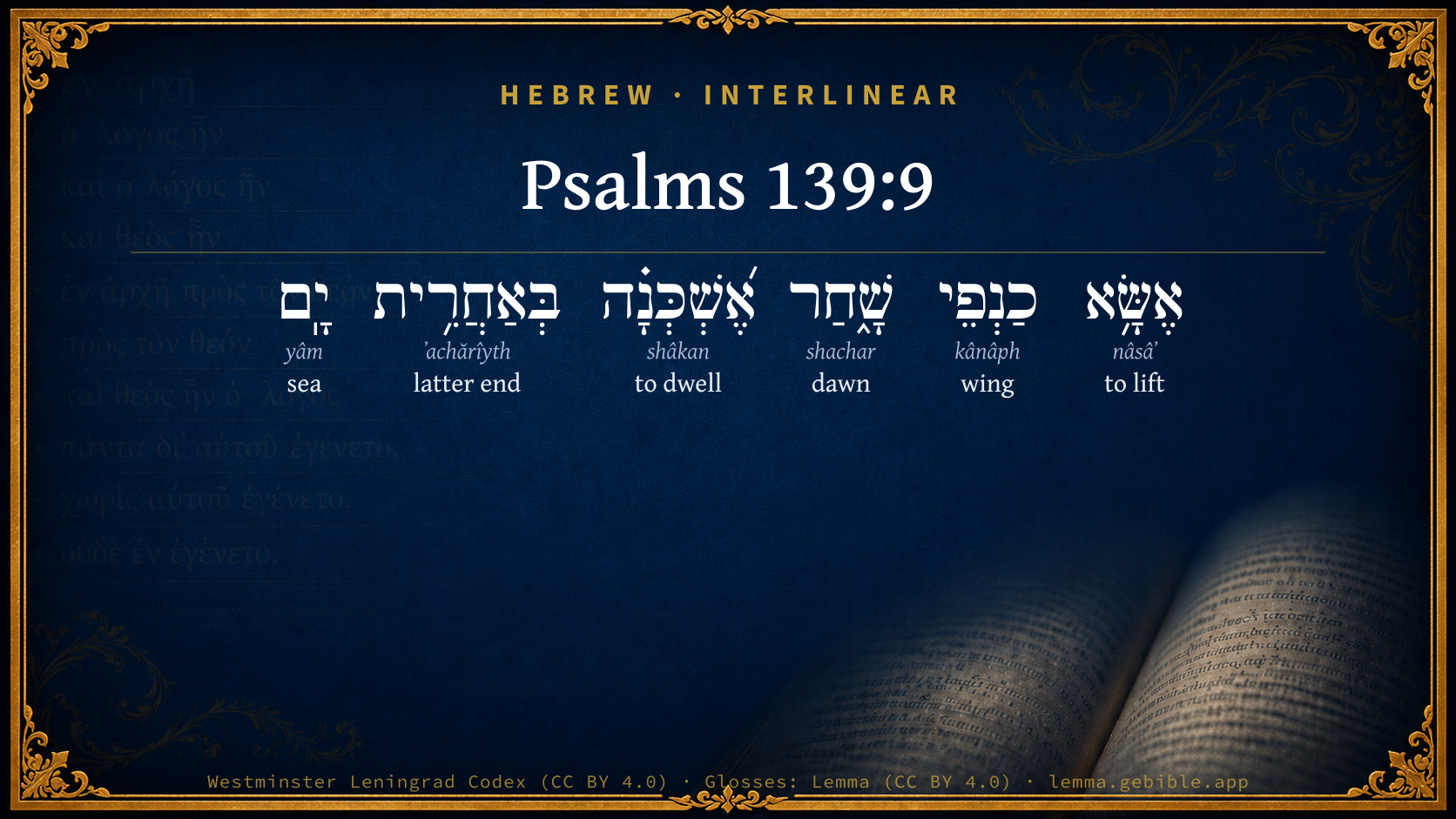
Psalms 139:9

Hebrew (Westminster Leningrad Codex) Psalms 139:9 appears in the Hebrew Old Testament. The text above is from the Westminster Leningrad Codex. Each word links to its Strong’s number, a concise gloss, and parsing drawn from the Open Scriptures Hebrew Bible morphology. Click any word for its full Brown-Driver-Briggs (BDB) entry.
Download image
Cite this verse

Psalms 139:9 (World English Bible). Public Domain. Lemma interlinear Bible study tool, https://lemma.gebible.app/v/psalms/139/9.

Show BibTeX & RIS
BibTeX
RIS
English Translation
If I take the wings of the dawn, And settle in the uttermost parts of the sea;
World English Bible · Public Domain
Download a study sheet

One document with this verse’s original text, its word-by-word gloss line, the meaning frame, cross-references with their text, attributed commentary, and full source and license credits — printable, and it pastes into notes with its structure intact.

This verse Autodidact and up

Study sheet (.html) Plain text (.txt)

A passage Seminary Student

Up to 50 verses in one chapter. A passage sheet keeps up to 6 commentary sources and 12 cross-references per verse, in the order this page ranks them, and says so on the sheet whenever that leaves anything out. Ask for a single verse and you get the Autodidact verse sheet above.

Everything on this page stays free to read, with no account — the sheet is a download of what is already on screen, not access to it.

Want to remove ads? Support Godless Engineer
Compare translations 3

The same verse in 3 English versions, stacked beneath the original-language interlinear above. Click any original word for its lexicon entry.

Each is an independent rendering of the whole verse — the interlinear is not word-aligned to these translations.

Highlighted words mark where these versions differ — a whole-verse word diff, not a word-by-word alignment.

  • World English Bible Public Domain
    If I take the wings of the dawn, And settle in the uttermost parts of the sea;
  • King James Version Public Domain
    If I take the wings of the morning, and dwell in the uttermost parts of the sea;
  • unfoldingWord Literal Text CC BY-SA 4.0
    I lift up the wings of the dawn, dwell in the farthest part of the sea,

unfoldingWord Literal Text — © unfoldingWord, licensed CC BY-SA 4.0. Word-aligned USFM3 via Door43 (git.door43.org/unfoldingWord/en_ult).

Versions to compare (up to 4)

3 of 4 selected

Show all 17 translations

Every available English version of this verse, each an independent rendering of the whole verse.

  • World English Bible Public Domain
    If I take the wings of the dawn, And settle in the uttermost parts of the sea;
  • Berean Standard Bible Public Domain
    If I rise on the wings of the dawn, if I settle by the farthest sea,
  • Majority Standard Bible Public Domain
    If I rise on the wings of the dawn, if I settle by the farthest sea,
  • King James Version Public Domain
    If I take the wings of the morning, and dwell in the uttermost parts of the sea;
  • American Standard Version (1901) Public Domain
    If I take the wings of the morning, And dwell in the uttermost parts of the sea;
  • Revised Version (1885) Public Domain
    If I take the wings of the morning, and dwell in the uttermost parts of the sea;
  • Geneva Bible (1599) Public Domain
    Let mee take the winges of the morning, and dwell in the vttermost parts of the sea:
  • Young's Literal Translation Public Domain
    I take the wings of morning, I dwell in the uttermost part of the sea,
  • Literal Standard Version CC BY-SA 4.0
    I take the wings of morning, || I dwell in the uttermost part of the sea,
  • Unlocked Literal Bible CC BY-SA 4.0
    If I fly away on the wings of the morning and go to live in the uttermost parts across the sea,
  • unfoldingWord Literal Text CC BY-SA 4.0
    I lift up the wings of the dawn, dwell in the farthest part of the sea,
  • Darby Bible Public Domain
    [If] I take the wings of the dawn [and] dwell in the uttermost parts of the sea,
  • World Messianic Bible Public Domain
    If I take the wings of the dawn, and settle in the uttermost parts of the sea,
  • Webster's Bible Public Domain
    If I take the wings of the morning, and dwell in the uttermost parts of the sea;
  • Free Bible Version CC BY-SA 4.0
    If I were to fly away on wings of the dawn to the east; if I were to live on the far western shore of the sea,
  • Bible in Basic English Public Domain
    If I take the wings of the morning, and go to the farthest parts of the sea;
  • JPS Tanakh (1917) Public Domain
    If I take the wings of the morning, and dwell in the uttermost parts of the sea;

Literal Standard Version (2020), Covenant Press — licensed CC BY-SA 4.0. Text via the HelloAO Bible API (eBible.org). Unlocked Literal Bible (unfoldingWord) — licensed CC BY-SA 4.0. Text via the HelloAO Bible API (eBible.org). unfoldingWord Literal Text — © unfoldingWord, licensed CC BY-SA 4.0. Word-aligned USFM3 via Door43 (git.door43.org/unfoldingWord/en_ult). Free Bible Version, Dr. Jonathan Gallagher — licensed CC BY-SA 4.0. Text via the HelloAO Bible API (eBible.org).

Word by word

More ways to search: Search by grammar → Find every occurrence → Compare this word →

Practice this passage: Drill this verse → Learn its vocabulary →

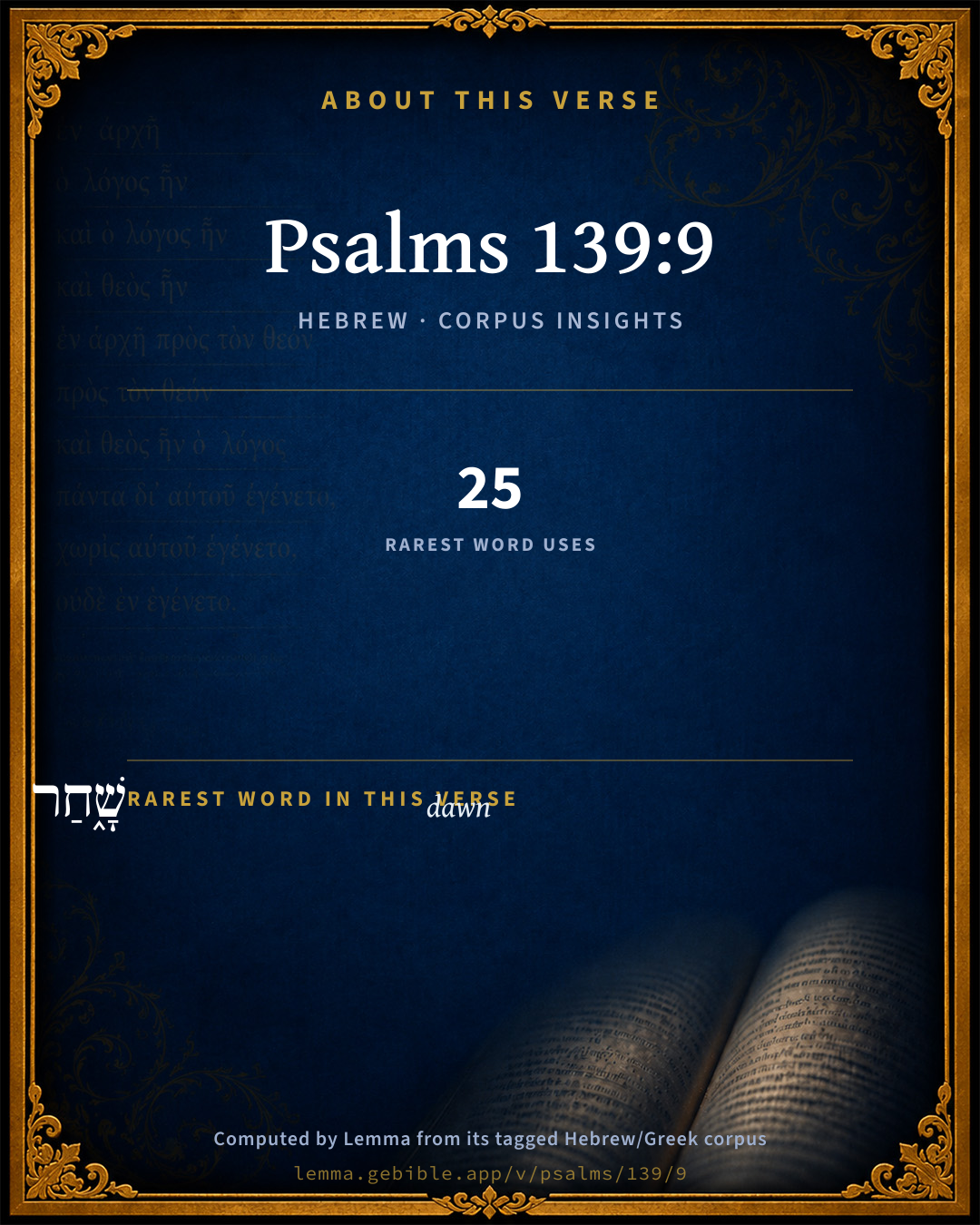
About this verse

These counts appear in no published source. They are computed here, from the morphology-tagged text and Lemma’s own curated glosses. What Lemma adds →

6
words
6
distinct lemmas
Wisdom
section

Notable vocabulary

The rarest word here is שָׁ֑חַר dawn H7837 — appearing just 25 times in the whole Hebrew Bible.

Shared distinctive vocabulary

שָׁ֑חַר dawn H7837 occurs in 24 verses of the Hebrew Bible. Also found in:

Grammatical profile

  • 2 verbs
  • 4 nouns

Verb forms

  • אֶשָּׂ֥א Qal · Imperfect
  • אֶ֝שְׁכְּנָ֗ה Qal · Cohortative

Hebrew & Septuagint length

In English translation the verse runs 17 words from the Hebrew and 22 from the Septuagint (LXX English) — closely comparable.

A rough comparison of the two English renderings, which tokenize alike — not a word-level alignment.

Word counts can differ between the Hebrew and the Greek without any difference in meaning — e.g. the Hebrew direct-object marker אֵת has no separate Greek word, and Greek often adds the article ὁ.

Cross-references

3

Topical passages linked to Psalms 139:9 in the Treasury of Scripture Knowledge — connected by theme and wording, ordered by reader-vote popularity; previews shown in the World English Bible.

  • Psalms 19:6 His going forth is from the end of the heavens, His circuit to its ends; There is nothing hidden from its heat.
  • Psalms 74:16–17 The day is yours, the night is also yours. You have prepared the light and the sun.
  • Malachi 4:2 But to you who fear my name shall the sun of righteousness arise with healing in its wings. You will go out, and leap like calves of the stall.

Cross-references courtesy of OpenBible.info (CC BY 4.0).

Hebrew and Greek witnesses Masoretic Hebrew ↔ Greek Septuagint

The same verse in the two great witnesses to the Old Testament, shown verse-for-verse.

You’re reading Greek Psalm 138 (Hebrew Psalm 139). The Septuagint counts the superscription, so verse numbers can differ from the Hebrew — chapter-level alignment, not verse-by-verse. Numbering follows Rahlfs.

These are two independent witnesses, not word-aligned to each other, and the Septuagint is shown in lemma (dictionary) form.

Hebrew Psalms 139:9 Masoretic · Westminster Leningrad Codex

אֶשָּׂ֥א כַנְפֵי שָׁ֑חַר אֶ֝שְׁכְּנָ֗ה בְּאַחֲרִ֥ית יָֽם

If I take the wings of the dawn, And settle in the uttermost parts of the sea;

World English Bible · Public Domain

Greek LXX Greek Psalm 138:9 Septuagint · lemma form

ἐάν ἀναλαμβάνω ὁ πτέρυξ ἐγώ κατά ὄρθρος καί κατασκηνόω εἰς ὁ ἔσχατος ὁ θάλασσα

If I should spread my wings to fly straight forward, and sojourn at the extremity of the sea, it would be vain,

LXX2012 (modern English Septuagint) · Public Domain

Hebrew: Westminster Leningrad Codex (CC BY 4.0). Greek: Septuagint (public domain); English from LXX2012 (modern English Septuagint) (Public Domain). How the Septuagint differs from the Hebrew →

Commentary

Notes on Psalms 139:9 from classic Christian and Jewish commentators (each source and its license shown beneath its notes). The classic Christian expositions comment on the surrounding passage and are grouped to its opening verse, so a note may address several verses; the Jewish commentaries on the Tanakh (Rashi and others) are per-verse, so they appear only where the commentator wrote on this verse.

Lemma curates 59 commentaries, every one of them public domain or Creative Commons licensed, each selected and text-cleaned for this edition rather than reprinted as found. About our sources →

Trapp's Complete Commentary

John Trapp

Psa 139:9 [If] I take the wings of the morning, [and] dwell in the uttermost parts of the sea;

Ver. 9. If I take the wings of the morning] The morning light is diffused in an instant all the whole welkin over. If I could fly never so swiftly from one end of the heaven to the other, saith David, I should be never the nearer. This is a poetic expression.

And dwell in the uttermost parts of the sea] Or of the west, whither the sun, setting, is said to hasten and hide himself. The Syriac and Arabic have it, If I take the wings of the eagle and dwell, &c. And of the eagle they write, that when she would change her feathers she falleth down into the sea.

John Trapp, A Commentary or Exposition upon All the Books of the Old and New Testament (1647–1656) — public domain. Text from a community e-Sword module.

The Biblical Illustrator

Joseph S. Exell

Psa_139:9-10

If I take the wings of the morning, and dwell in the uttermost parts of the sea.

Christianity the universal religion

The traveller who passes from one quarter of the globe to another feels that the encircling sky which girdles in the ocean is but a type of the unseen power that surrounds us all. It is the expression of the same truth as that which drew from the first navigator who, from the shores of England, reached the shores of America, Heaven is as near to us on the sea as on the land. The philanthropist whose wide charity embraces within its grasp the savage and the civilized man--the white man and the negro--feels that the hand of God is with him in his enterprises, because in the face of all his fellow-men he recognizes, however faintly and feebly expressed, the image of the likeness of God. The philosopher who endeavours to trace out the unity of mankind, and the unity of all created things, consciously or unconsciously, expresses the same truth--namely, that the Divine eye saw our substance yet being imperfect, and that in His book were all our members written, which day by day were fashioned and evolved, while as yet there were none of them--while all was as yet rudimental and undeveloped, alike in the individual and in the race. The heart-stricken, lonely, suffering, or doubting soul, who sees only a step before him, who can but pray, Lead, kindly light, amid the encircling gloom--he, too, can echo the old psalmist: The darkness is no darkness to Thee; the darkness and light to Thee are both alike. Though He slay me, yet will I trust in Him. But in the especial form of the words of the text there is a peculiar force, which it is my purpose to bring before you . . . The psalmist wishes to indicate that God could be found in those regions of the earth into which it was least likely that any Divine influence should penetrate, and he expresses it by saying, If I were to take the wings of the morning; if I were to mount on the outspreading radiance which, in the eastern heavens, precedes the rise of dawn, if I were to follow the sun on his onward course and pass with him over land and ocean, till I reach the uttermost parts of the sea, far away in the distant and unknown west, even there, also, strange as it may seem, the hand of God will lead me, the right hand of God will hold me; even there, also, beyond the shadows of the setting of the sun; even there, beyond the furthest horizon, the furthest west of the furthest sea, will be found the Presence which leaps over the most impassable barriers. That which seemed to him so portentous as to be almost incredible, has become one of the familiar, we might almost say one of the fundamental, truths of our religious and social existence. Not only in the East, so we may venture to give his words their fullest and widest meaning--not only in the East, consecrated by patriarchal tradition and usage, but in the unknown and distant islands and seas of the West, the power of God shall be felt as a sustaining help and guiding hand.

I. The contrast between the East and the West is one of the most vivid which strikes the mind of man. Of the great geographical impressions left on the most casual observer, none is deeper than that which is produced when a child of the Western civilization sets foot on the shores of the Eastern world. And so in history, two distinct streams of human interest have followed always the race of Shem and the race of Japhet; and the turning-points, the critical moments of their history, have been when the two streams have crossed each other and met--as on a few great occasions--in conflict or in union. It is the very image which is presented to us in the splendid vision of the evangelical prophet in Isa_60:8-9. Who are these that fly as a cloud, and as the doves to their windows? They are the isles; that is, the isles, and coasts, and promontories, and creeks, and bays of the Mediterranean and Atlantic shores. The isles shall wait for Him, and the ships of Tarshish first. Tarshish--that is, the West--with all its vessels of war and its vessels of merchandise. The ships of Tarshish first, and of Venetia, and Carthage, and Spain--these first brought the shores of Cornwall, the name of Britain, within the range of the old civilized world. All these, with their energy and activity, were to build up the walls and pour their wealth through the gates of the Heavenly Jerusalem. And so, in fact, it has been. Christianity, born in the East, has become the religion of the West even more than the religion of the East. Only by travelling from its early home has it grown to its full stature. The more it has adapted itself to the wants of the new-born nation which it embraces, the more it has resembled the first teaching and character of its Founder and of its followers. Judaism, as a supreme religion, expired when its local sanctuary was destroyed. Mohammedanism, after its first burst of conquest, withdrew itself almost entirely within the limits of the East. But Christianity has found not only its shelter and refuge, but its throne and home, in countries which, humanly speaking, it could hardly have been expected to reach at all. The Christian religion rose on the wings of the morning; but it has remained in the uttermost parts of the sea, because the hand of God was with it, and the right hand of God was upholding it.

II. Consider what were the peculiar points of Christianity which have enabled it to combine these two worlds of thought, each so different from the other. In its full development, in its earliest and most authentic representation, we see gathered the completion of those gifts and graces which East and West possesses separately, and which each of us is bound, in his measure, to appropriate and imitate. And, first, observe, on the one hand, in the Gospel history, the awe, the reverence, the profound resignation to the Divine will, the calm, untroubled repose which are the very qualities which the Eastern religions possessed, at a time when, to the West, they were almost wholly unknown, and which, even now, are more remarkably exhibited in Eastern nations than amongst ourselves. Christ has taught us how to be reverential, and serious, and composed. He has taught as no less how to be active, and stirring, and manly, and courageous. The activity of the West has been incorporated into Christianity, because it belongs to the original character and genius of its Founder, no less than its awe and its reverence. Again, in every Eastern religion, even in that which Moses proclaimed from Mount Sinai, there was darkness, a mystery, a veil, as the apostle expressed it--a veil on the prophets face, a veil on the peoples heart-a blind submission to absolute authority. There was darkness around the throne of God; there was darkness within the Temple wall; there was in the Holy of Holies a darkness never broken. To a great extent this darkness and exclusiveness must prevail always, till the time comes when we shall see no longer through a glass darkly. This we have in Christianity, in common with all the East; but yet, so far as the veil can be withdrawn, it has been withdrawn by Jesus Christ and by His true disciples. He is the Light of the world. In Him we behold the open face, the glory of the Father. Again; there was in all Eastern religions, whether we look Godward or manward, a sternness and separation from the common feelings and interests of mankind. We see it, as regards man, in the hardness and harshness of the Eastern laws. We see it, as regards God, in the profound prostration of the soul of man, displayed first in the peculiarities of Jewish worship, and to this day in the prayers of devout Mussulmans. And this, also, enters in its measure into the life of Christ and the life of Christendom. The invisible, eternal, irreproachable Deity, the sublime elevation of the Founder of our religion above all the turmoils of earthly passion and of local prejudice--that is the link of Christianity with the East. And, on the other hand, there was another side of the truth which, until Christ appeared, had been hardly revealed at all to the children of the older covenant. In Christ we see how the Divine Word could become flesh, and yet the Father of all remain invisible and inconceivable. In Christ we see not merely, as in the Levitical system of Christianity, man sacrificing his choicest gifts to God; but God, if one may so say, sacrificing His own dear Son for the good of man.

III. What do we learn from this? Surely, the mere statement of the fact is an almost constraining proof that the religion which thus unites both divisions of the human race, was, indeed, of an origin above them both; that the light which thus shines on both sides, so to speak, of the image of humanity is, indeed, the light that lighteth every man. There is no monopoly, no sameness, no one-sidedness, no narrowness here. The variety, the complexity, the diversity, the breadth of the character of Christ and of His religion is, indeed, an expression of the universal omnipresence of God. It is for us to bear in mind that this many-sidedness of Christianity is a constant encouragement to hold fast those particles of it we already possess, and to reach forward to whatever elements of it are still beyond us. Say not that Christianity has been exhausted; say not that the hopes of Christianity have failed, nor yet that they have been entirely fulfilled. In our Fathers house are many mansions. In one or other of its many mansions each wandering soul may at last find its place, here or hereafter. (Dean Stanley.)

The Biblical Illustrator, edited by Joseph S. Exell (c. 1880s–1900s) — public domain. Text from a community e-Sword module.

J. A. Alexander on Psalms

Joseph Addison Alexander

9. (Psa 139:9) I will raise the wings of day-break. 1 will dwell in the end of the sea. By supplying if, although the sense is not materially changed, the form of expression becomes much less striking. The conditional construction is forbidden also, or at least rendered highly improbable, by the form of the second verb, expressing strong desire and resolution. The truth is, that we have here a bold transition. After speaking of guilty flight from God him-self, the Psalmist now speaks of anxious flight from other enemies, and as if visibly surrounded by them, here resolves to escape from them. This, which is Hengstenberg's interpretation, is strongly favoured by the unconditional construction, although he himself retains the other. The same writer objects to the translation raise the wings, that before one can raise wings he must have them. But for that very reason the possession of themmay be presupposed, or considered as implied in the act expressed. The same combination is employed by Ezekiel (Eze 10:16; Eze 10:19), in a way that admits of only one translation. The Hebrew word is not the common one for morning, but one denoting day-break or the dawn. See above, on Psa 57:8. The point of comparison appears. to be the incalculable velocity of light. The extremity (or end) of the sea, is added to heaven and hell, in order to convey the idea of the most remote points.

Joseph Addison Alexander, The Psalms Translated and Explained (1850) — public domain. Text from a community e-Sword module.

Tyndale Open Study Notes

Tyndale Open Resources

139:9 ride the wings of the morning: This poetic expression describes traveling eastward, as far as the sunrise, if that were possible. • the farthest oceans: This expression takes the traveler in the opposite direction, far to the west.

Tyndale Open Study Notes — © Tyndale Open Resources, licensed CC BY-SA 4.0. Text via the HelloAO Bible API.

Ellicott's Commentary for English Readers

(9) If . . .—Literally,

I lift wings of dawn

I dwell in the end of the sea.

The wings of the morning.—This exquisite image suggesting not only the pinions of cloud that seem often to lift the dawn into the sky, but also the swift sailing of the light across the world, may be compared to the “wings of the sun” in Mal_4:2, and the “wings of the wind” in Psa_18:10.

The uttermost parts of the sea—i.e., to a Hebrew the extreme west. The poet imagines himself darting from east to farthest west, with the rapidity of light.

A Bible Commentary for English Readers, edited by Charles John Ellicott (1878–1897) — public domain. Text from a community e-Sword module.

The Cambridge Bible for Schools and Colleges

gen. ed. J. J. S. Perowne

9. If I should lift up the wings of the dawn &c.] If I were to fly with the swiftness of light from the east to the furthest west. The dawn swiftly spreading over the sky, is naturally represented as winged. Cp. ‘wings of the wind,’ Psa_18:10, ‘wings of the sun,’ Mal_4:2.

The sea, from the position of the Mediterranean to the west of Palestine, denotes the West.

The Cambridge Bible for Schools and Colleges (gen. ed. J. J. S. Perowne; Cambridge University Press, 1878–1918) — public domain. Text from a community e-Sword module.

John Gill's Exposition

Even there shall thy hand lead me,.... For he could not get there with all the assistance of the wings of the morning, could they be had, without the leadings of divine Providence; and when there, being a good man, should experience the leadings of divine grace; let the people of God be where they will, he heads them as a parent his child, teaching him to go; and as a shepherd his flock, into green pastures, and to fountains of living water; he leads to himself, and to his Son by his Spirit; into communion and fellowship with them, and to a participation of all blessings grace; guides them with his counsel, and directs all their ways and going;

and thy right hand shall hold me; the Lord lays hold on his people, and apprehends them for himself, and claims his interest in them; he holds them in his ways, that they slip and fall not; he upholds them with the right hand of his righteousness, and they are safe; and he holds them from going into or on in wrong ways to their hurt.

John Gill's Exposition of the Whole Bible (1746–1763) — public domain (CC PDM 1.0). Text via the HelloAO Bible API.

Albert Barnes' Notes on the Bible

If I take the wings of the morning - literally, “I will take the wings of the morning.” That is, I will take this as a supposable case; I will imagine what would occur, should I be able to take to myself the wings of the morning, and endeavor to escape “by flight” from the presence of God, or go where he could not pursue me, or where he would not be. The “wings of the morning” evidently mean that by which the light of the morning “seems to fly” - the most rapid object known to us. It is not to be supposed that the psalmist had an idea of the exact velocity of light, but to him that was the most rapid object known; and his language is not the “less” striking because the laws of its flight have become accurately known. The word rendered “morning” refers to the dawn - the daybreak - the Aurora - the “first” beams of the morning light. The beams of light are in fact no swifter then than at any other time of the day, but they seem to be swifter, as they so quickly penetrate the darkness.

And dwell in the uttermost parts of the sea - The end of the sea; that is, the “west,” as the sea referred to undoubtedly is the Mediterranean, which was west of Palestine, and which became another name for the west. The idea is, that if he could fly with the rapidity of light, and could be in an instant over the sea, even beyond its remotest border, still God would be there before him. He could not escape from the divine presence.

Albert Barnes' Notes on the Bible (1834–1885) — public domain. Text from a community e-Sword/MySword module.

Matthew Poole's English Annotations

If I should flee as swiftly from try presence as the morning light doth, which in an instant scattereth itself from east to west; for the sea being the western border of Canaan, is oft put for the west in Scripture. And wings are poetically ascribed to the morning or morning light here, as they are elsewhere to the sun, as Mal 4:2, and to the winds, as Psa 18:10; 104:3, and to other things of eminent swiftness.

Matthew Poole's English Annotations on the Holy Bible (1683–1685) — public domain. Text from a community e-Sword/MySword module.

The Treasury of David

Charles H. Spurgeon

Ver. 9. If I take the wings of the morning, and dwell in the uttermost parts of the sea. If I could fly with all swiftness, and find a habitation where the mariner has not yet ploughed the deep, yet I could not reach the boundaries of the divine presence. Light flies with inconceivable rapidity, and it flashes far afield beyond all human ken; it illuminates the great and wide sea, and sets its waves gleaming afar; but its speed would utterly fail if employed in flying from the Lord. Were we to speed on the wings of the morning breeze, and break into oceans unknown to chart and map, yet there we should find the Lord already present. He who saves to the uttermost would be with us in the uttermost parts of the sea.

Ver. 9. The wings of the morning, is an elegant metaphor; and by them we may conjecture is meant the sunbeams, called "wings" because of their swift and speedy motion, making their passage so sudden and instantaneous, as that they do prevent the observation of the eye; called "the wings of the morning" because the dawn of the morning comes flying in upon these wings of the sun, and brings light along with it; and, by beating and fanning of these wings, scatters the darkness before it. "Now", saith the Psalmist, "if I could pluck these wings of the morning", the sunbeams, if I could imp (graft) my own shoulders with them; if I should fly as far and as swift as light, even in an instant, to the uttermost parts of the sea; yea, if in my flight I could spy out some solitary rock, so formidable and dismal as if we might almost call in question whether ever a Providence had been there; if I could pitch there on the top of it, where never anything had made its abode, but coldness, thunders, and tempests; yet there shall thy hand lead me, and thy right hand shall hold me." Ezekiel Hopkins.

Ver. 9. The wings of the morning. This figure to a Western is not a little obscure. For my part, I cannot doubt that we are to understand certain beautiful light clouds as thus poetically described. I have observed invariably, that in the late spring time, in summer, and yet more especially in the autumn, white clouds are to be seen in Palestine. They only occur at the earliest hours of morning, just previous to and at the time of sunrise. It is the total absence of clouds at all other parts of the day, except during the short period of the winter rains, that lends such striking solemnity and force to those descriptions of the Second Advent where our Lord is represented as coming in the clouds. This feature of his majesty loses all its meaning in lands like ours, in which clouds are of such common occurrence that they are rarely absent from the sky. The morning clouds of summer and autumn are always of a brilliant silvery white, save at such times as they are dyed with the delicate opal tints of dawn. They hang low upon the mountains of Judah, and produce effects of undescribable beauty, as they float far down in the valleys, or rise to wrap themselves around the summit of the hills. In almost every instance, by about seven o'clock the heat has dissipated these fleecy clouds, and to the vivid Eastern imagination morn has faded her outstretched wings. James Neil.

Ver. 9. If I take the wings of the morning. The point of comparison appears to be the incalculable velocity of light. Joseph Addison Alexander.

Ver. 9-10. When we think that we fly from God, in running out of one place into another, we do but run from one hand to the other; for there is no place where God is not, and whithersoever a rebellious sinner doth run, the hand of God will meet with him to cross him, and hinder his hoped for good success, although he securely prophesieth never so much good unto himself in his journey. What! had Jonah offended the winds or the waters, that they bear him such enmity? The winds and the waters and all God's creatures are wont to take God's part against Jonah, or any rebellious sinner. For though God in the beginning gave power to man over all creatures to rule them, yet when man sins, God giveth power and strength to his creatures to rule and bridle man. Therefore even he that now was lord over the waters, now the waters are lord over him. Henry Smith.

Ver. 9-10.

Should fate command me to the farthest verge

Of the green earth, to distant barbarous climes,

Rivers unknown to song; where first the sun

Gilds Indian mountains, or his setting beam

Flames on the Atlantic isles; 'tis nought to me:

Since GOD is ever present, ever felt,

In the void waste as in the city full;

And where he vital breathes, there must be joy,

When e'en at last the solemn hour shall come,

And wing my mystic flight to future worlds,

I cheerful will obey; there with new powers,

Will rising wonders sing: I cannot go

Where universal love smiles not around,

Sustaining all yon orbs, and all their sons:

From seeming evil still deducing good,

And better thence again, and better still,

In infinite progression.

James Thomson, 1700-1748.

Ver. 9-10.

1. The greatest security and encouragement to a sinner supposed.

a) The placethe remotest part of the sea; by which you are to understand the most obscure nook in the creation.

b) His swift and speedy flight after the commission of sin, to this supposed refuge and sanctuary: "If I take the wings of the morning."

2. This supposed security and encouragement is utterly destroyed (Ps 139:10).

See Flavel's "Seaman's Preservative in Foreign Countries."

Psalms 139:10*

Charles H. Spurgeon's The Treasury of David (1869–1885) — public domain. Psalms only. Text from a community e-Sword/MySword module.

Whedon's Commentary on the Bible

Daniel D. Whedon

9. Wings of the morning—Wings of the dawn are swift wings, like the early light, which spreads swiftly.

Uttermost parts of the sea—The ancients supposed the sea everywhere surrounded the land, and hence the description is of the utmost limit of the globe. It also stands for extreme west, as opposed to “morning,” or earliest dawn, in the preceding line. In this view the supposition is equal to the extreme points of the universe.

Daniel D. Whedon (gen. ed.), Commentary on the Old and New Testaments (1874–1909) — public domain. Text from a community e-Sword module.

The Pulpit Commentary

Vers. 9, 10. If I take the wings of the morning. If I were to speed across the earth on the wings of the dawn, and, having done so, were then to dwell in the uttermost parts of the sea the extreme west, where the sun sotseven there shall thy hand lead me. In that distant region I should still find thy guiding hand. And thy right hand shall hold me. Thy strong right hand would uphold me.

The Pulpit Commentary (1880–1919), ed. H.D.M. Spence-Jones & Joseph S. Exell — public domain. Text from a community e-Sword module.

John Wesley's Explanatory Notes

The wings - If I should flee from east to west: for the sea being the western border of Canaan, is often put for the west in scripture. And wings are poetically ascribed to the morning here, as they are elsewhere to the sun, and to the winds.

John Wesley, Explanatory Notes Upon the Whole Bible (1754–1765) — public domain. Text via the GEBible commentary corpus.

unfoldingWord translationNotes

Door43 World Missions Community

If I fly away on the wings of the morning and go to live in the uttermost parts across the sea

The author uses exaggeration to explain that wherever he is, God is there too. (See: Hyperbole and Generalization and Hypothetical Situations)

If I fly away on the wings of the morning

In the ancient near east, the sun was often imagined as if it had wings which enabled it to fly across the sky. AT: "If the sun could carry me with itself across the sky" (See: Metaphor)

in the uttermost parts across the sea

"very far away to the west"

will hold on to me

"will help me"

translationWords

life

hand

right hand

unfoldingWord translationNotes — © Distant Shores Media and the Door43 World Missions Community, licensed CC BY-SA 4.0. Source: git.door43.org/Door43/en_tn.

Rashi

Rabbi Shlomo Yitzchaki (Rashi)

[If] I take up the wings of dawn If I take up for myself the wings of dawn, which shine at once from one end of the world to the other, so will I fly swiftly until I dwell at the end of the sea.

Rashi on the Tanakh — English translations: “The Judaica Press complete Tanach with Rashi, translated by A. J. Rosenberg” (CC BY 4.0); “Pentateuch with Rashi's commentary by M. Rosenbaum and A.M. Silbermann, 1929-1934” (public domain); “The Metsudah Tanach series, Lakewood, N.J” (CC BY 4.0); and “The Book of Joshua, Metsudah Publications, 1997” (CC BY 4.0). Text via Sefaria.

Lesson kit

Teaching starters — assembled from the data on this page, not authored interpretation. Every prompt links to the verse data it draws on. Edit before teaching.

Psalms, in the Wisdom, opens this verse with 6 words (6 distinct Hebrew lemmas). Its most distinctive word is shachar (“dawn”). A historical commentator’s framing appears above. Read the whole chapter for the surrounding context.

Discussion questions

  1. How does “dawn” (shachar) shape what this verse is saying?
  2. Genesis 19:15 shares the word «dawn» with this verse. How do the two illuminate each other?
  3. The translations on this page render this verse differently — a whole-verse word diff, not a word-by-word alignment. What might account for the different wordings?
  4. The verb «אֶשָּׂ֥א» is Qal Imperfect. How does its form color the action?
  5. Reading how Trapp's Complete Commentary and The Biblical Illustrator read this verse, where do the two commentators agree and where do they part?

Things to notice

Reading settings

Reading text

Shown beneath each verse's original-language words.

Old Testament
Old Testament edition

Read the OT as the Masoretic Hebrew (MT) or the Greek Septuagint (LXX).

English shown for the Greek Septuagint (in the Hebrew ↔ Greek comparison).

Comparing translations? Open the Compare panel on any verse page to stack up to four side by side.