
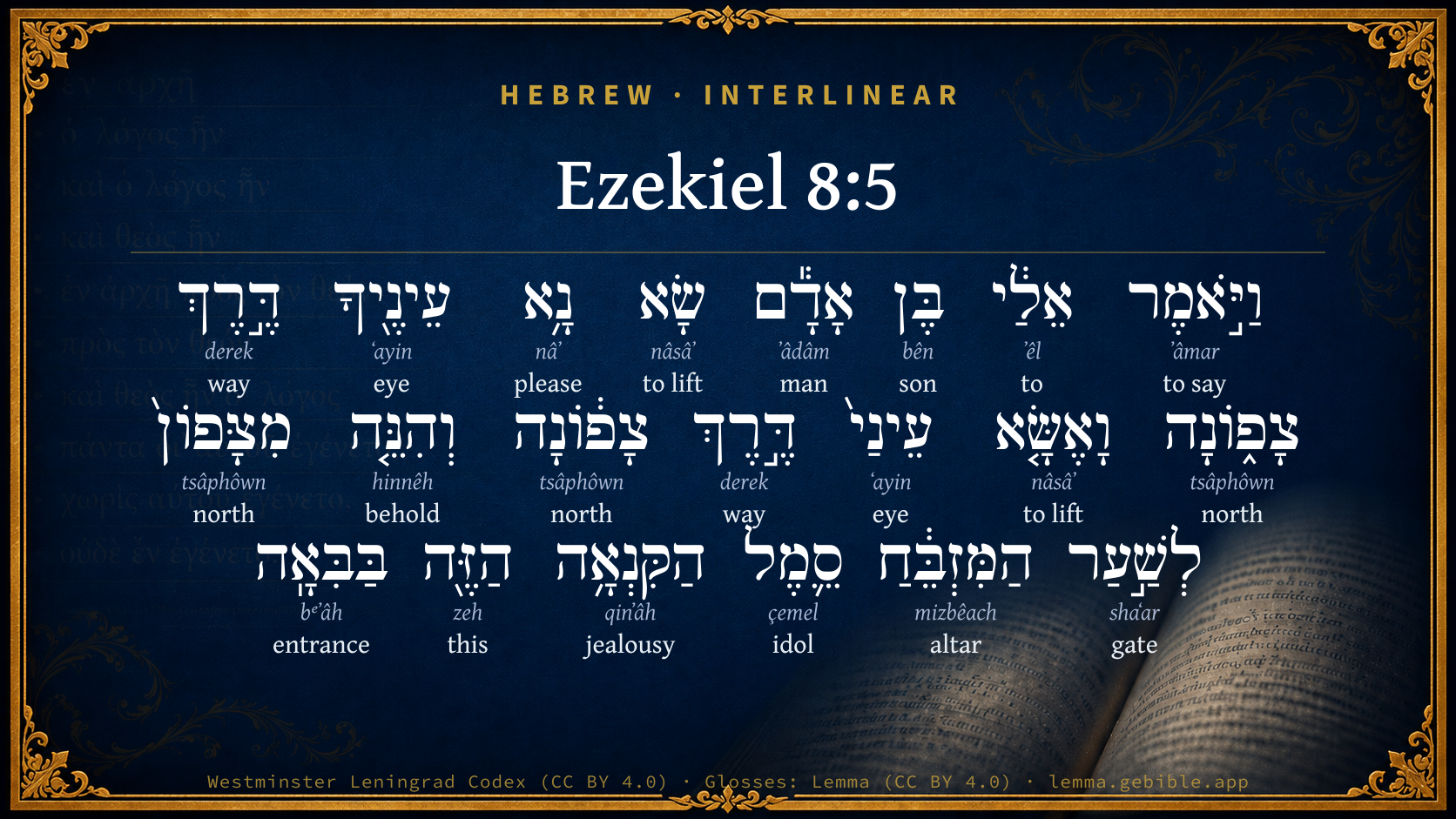
Ezekiel 8:5

Hebrew (Westminster Leningrad Codex) Ezekiel 8:5 appears in the Hebrew Old Testament. The text above is from the Westminster Leningrad Codex. Each word links to its Strong’s number, a concise gloss, and parsing drawn from the Open Scriptures Hebrew Bible morphology. Click any word for its full Brown-Driver-Briggs (BDB) entry.
Download image
Cite this verse

Ezekiel 8:5 (World English Bible). Public Domain. Lemma interlinear Bible study tool, https://lemma.gebible.app/v/ezekiel/8/5.

Show BibTeX & RIS
BibTeX
RIS
English Translation
Then said he to me, Son of man, lift up your eyes now the way toward the north. So I lifted up my eyes the way toward the north, and see, northward of the gate of the altar this image of jealousy in the entry.
World English Bible · Public Domain
Highlights
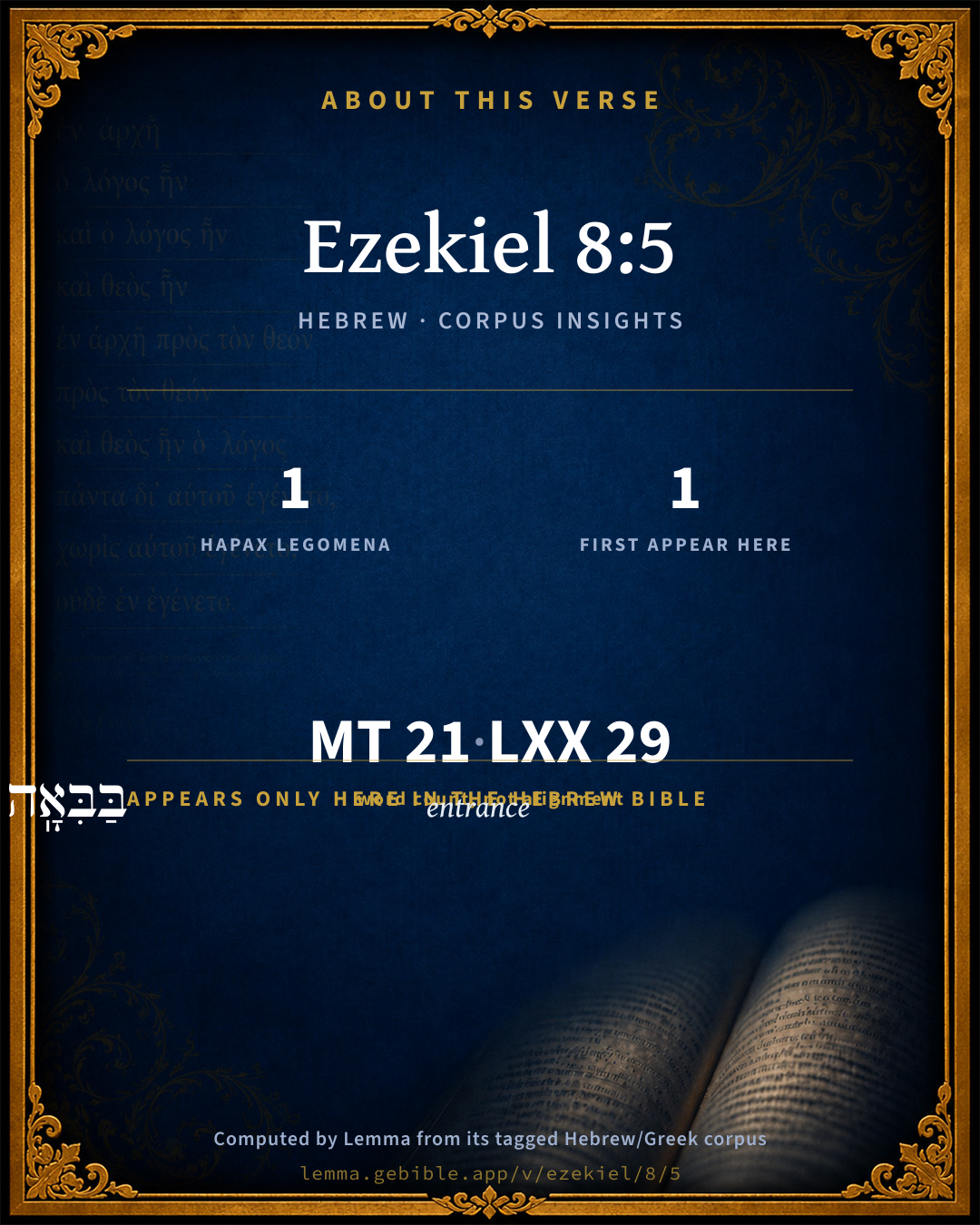
  • 1 hapax legomenon — only here in the Hebrew Bible
  • 1 first appearance in the Hebrew Bible
Full analysis ↓
Download a study sheet

One document with this verse’s original text, its word-by-word gloss line, the meaning frame, cross-references with their text, attributed commentary, and full source and license credits — printable, and it pastes into notes with its structure intact.

This verse Autodidact and up

Study sheet (.html) Plain text (.txt)

A passage Seminary Student

Up to 50 verses in one chapter. A passage sheet keeps up to 6 commentary sources and 12 cross-references per verse, in the order this page ranks them, and says so on the sheet whenever that leaves anything out. Ask for a single verse and you get the Autodidact verse sheet above.

Everything on this page stays free to read, with no account — the sheet is a download of what is already on screen, not access to it.

Want to remove ads? Support Godless Engineer
Compare translations 3

The same verse in 3 English versions, stacked beneath the original-language interlinear above. Click any original word for its lexicon entry.

Each is an independent rendering of the whole verse — the interlinear is not word-aligned to these translations.

Highlighted words mark where these versions differ — a whole-verse word diff, not a word-by-word alignment.

  • World English Bible Public Domain
    Then said he to me, Son of man, lift up your eyes now the way toward the north. So I lifted up my eyes the way toward the north, and see, northward of the gate of the altar this image of jealousy in the entry.
  • King James Version Public Domain
    Then said he unto me, Son of man, lift up thine eyes now the way toward the north. So I lifted up mine eyes the way toward the north, and behold northward at the gate of the altar this image of jealousy in the entry.
  • unfoldingWord Literal Text CC BY-SA 4.0
    Then he said to me, “Son of man, lift up your eyes to the north.” So I lifted up my eyes to the north, and to the north of the gate leading to the altar, there in the entrance, was the idol of jealousy.

unfoldingWord Literal Text — © unfoldingWord, licensed CC BY-SA 4.0. Word-aligned USFM3 via Door43 (git.door43.org/unfoldingWord/en_ult).

Versions to compare (up to 4)

3 of 4 selected

Show all 18 translations

Every available English version of this verse, each an independent rendering of the whole verse.

  • World English Bible Public Domain
    Then said he to me, Son of man, lift up your eyes now the way toward the north. So I lifted up my eyes the way toward the north, and see, northward of the gate of the altar this image of jealousy in the entry.
  • Berean Standard Bible Public Domain
    “Son of man,” He said to me, “now lift up your eyes to the north.” So I lifted up my eyes to the north, and in the entrance north of the Altar Gate I saw this idol of jealousy.
  • Majority Standard Bible Public Domain
    “Son of man,” He said to me, “now lift up your eyes to the north.” So I lifted up my eyes to the north, and in the entrance north of the Altar Gate I saw this idol of jealousy.
  • King James Version Public Domain
    Then said he unto me, Son of man, lift up thine eyes now the way toward the north. So I lifted up mine eyes the way toward the north, and behold northward at the gate of the altar this image of jealousy in the entry.
  • American Standard Version (1901) Public Domain
    Then said he unto me, Son of man, lift up thine eyes now the way toward the north. So I lifted up mine eyes the way toward the north, and behold, northward of the gate of the altar this image of jealousy in the entry.
  • Revised Version (1885) Public Domain
    Then said he unto me, Son of man, lift up thine eyes now the way toward the north. So I lifted up mine eyes the way toward the north, and behold northward of the gate of the altar this image of jealousy in the entry.
  • Geneva Bible (1599) Public Domain
    Then saide he vnto mee, Sonne of man, lift vp thine eyes nowe towarde the North. So I lift vp mine eyes towarde the North, and beholde, Northward, at the gate of the altar, this idole of indignation was in the entrie.
  • Douay-Rheims (1899) Public Domain
    And he said to me: Son of man, lift up thy eyes towards the way of the north. And I lifted up my eyes towards the way of the north: and behold on the north side of the gate of the altar the idol of jealousy in the very entry.
  • Young's Literal Translation Public Domain
    And He saith unto me, `Son of man, lift up, I pray thee, thine eyes the way of the north.' And I lift up mine eyes the way of the north, and lo, on the north of the gate of the altar this figure of jealousy, at the entrance.
  • Literal Standard Version CC BY-SA 4.0
    And He says to me, “Son of man, now lift up your eyes [toward] the way of the north.” And I lift up my eyes [toward] the way of the north, and behold, on the north of the gate of the altar [is] this figure of jealousy, at the entrance.
  • Unlocked Literal Bible CC BY-SA 4.0
    Then he said to me, “Son of man, lift up your eyes to the north.” So I lifted up my eyes to the north, and to the north of the gate leading to the altar, there in the entrance, was the idol of jealousy.
  • unfoldingWord Literal Text CC BY-SA 4.0
    Then he said to me, “Son of man, lift up your eyes to the north.” So I lifted up my eyes to the north, and to the north of the gate leading to the altar, there in the entrance, was the idol of jealousy.
  • Darby Bible Public Domain
    And he said unto me, Son of man, lift up now thine eyes toward the north. And I lifted up mine eyes toward the north, and behold, northward of the gate of the altar, this image of jealousy in the entry.
  • World Messianic Bible Public Domain
    Then he said to me, “Son of man, lift up your eyes now the way toward the north.” So I lifted up my eyes the way toward the north, and saw, northward of the gate of the altar this image of jealousy in the entry.
  • Webster's Bible Public Domain
    Then said he to me, Son of man, lift up thy eyes now the way towards the north. So I lifted up my eyes the way towards the north, and behold northward at the gate of the altar this image of jealousy in the entry.
  • Free Bible Version CC BY-SA 4.0
    “Son of man,” he told me, “now look to the north.” So I looked to the north, and in the entrance to the north of the Altar Gate I saw this idol that angered God.
  • Bible in Basic English Public Domain
    Then he said to me, Son of man, now let your eyes be lifted up in the direction of the north; and on looking in the direction of the north, to the north of the doorway of the altar, I saw this image of envy by the way in.
  • JPS Tanakh (1917) Public Domain
    Then said He unto me: 'Son of man, lift up thine eyes now the way toward the north.' So I lifted up mine eyes the way toward the north, and behold northward of the gate of the altar this image of jealousy in the entry.

Literal Standard Version (2020), Covenant Press — licensed CC BY-SA 4.0. Text via the HelloAO Bible API (eBible.org). Unlocked Literal Bible (unfoldingWord) — licensed CC BY-SA 4.0. Text via the HelloAO Bible API (eBible.org). unfoldingWord Literal Text — © unfoldingWord, licensed CC BY-SA 4.0. Word-aligned USFM3 via Door43 (git.door43.org/unfoldingWord/en_ult). Free Bible Version, Dr. Jonathan Gallagher — licensed CC BY-SA 4.0. Text via the HelloAO Bible API (eBible.org).

Word by word

More ways to search: Search by grammar → Find every occurrence → Compare this word →

Practice this passage: Drill this verse → Learn its vocabulary →

בַּבִּאָֽה
bᵉʼâh
H872
“in/at the · entrance”
Preposition, Determined + Noun, Common, Feminine, Singular, Absolute
Part of Speech
Preposition + Noun
Type
Common
Gender
Feminine
Number
Singular
State
Absolute
Full BDB Definition

Origin: from H935

TWOT: 212a

entrance, a coming in, entering, entry (of the temple) - entrance - entering (act of entrance)
  1. וַיֹּ֣אמֶר ʼâmar H559 “and · to say” Conjunction + Verb, Qal, Sequential Imperfect, 3rd Person, Masculine, Singular
  2. אֵלַ֔י ʼêl H413 “to · me” Preposition + Suffix, Personal, 1st Person, Common, Singular
  3. בֶּן bên H1121 “son of” Noun, Common, Masculine, Singular, Construct
  4. אָדָ֕ם ʼâdâm H120 “man” Noun, Common, Masculine, Singular, Absolute
  5. שָׂא nâsâʼ H5375 “lift” Verb, Qal, Imperative, 2nd Person, Masculine, Singular
  6. נָ֥א nâʼ H4994 “please” Particle, Exhortation
  7. עֵינֶ֖יךָ ʻayin H5869 “eyes · your” Noun, Common, Both, Dual, Construct + Suffix, Personal, 2nd Person, Masculine, Singular
  8. דֶּ֣רֶךְ derek H1870 “way of” Noun, Common, Both, Singular, Construct
  9. צָפ֑וֹנָה tsâphôwn H6828 “north · toward” Noun, Common, Feminine, Singular, Absolute + Suffix, Demonstrative
  10. וָאֶשָּׂ֤א nâsâʼ H5375 “and · to lift” Conjunction + Verb, Qal, Sequential Imperfect, 1st Person, Common, Singular
  11. עֵינַי֙ ʻayin H5869 “eyes · my” Noun, Common, Both, Dual, Construct + Suffix, Personal, 1st Person, Common, Singular
  12. דֶּ֣רֶךְ derek H1870 “way of” Noun, Common, Both, Singular, Construct
  13. צָפ֔וֹנָה tsâphôwn H6828 “north · toward” Noun, Common, Feminine, Singular, Absolute + Suffix, Demonstrative
  14. וְהִנֵּ֤ה hinnêh H2009 “and · behold” Conjunction + Particle, Demonstrative
  15. מִצָּפוֹן֙ tsâphôwn H6828 “from · north” Preposition + Noun, Common, Feminine, Singular, Absolute
  16. לְשַׁ֣עַר shaʻar H8179 “to/for · gate of” Preposition + Noun, Common, Masculine, Singular, Construct
  17. הַמִּזְבֵּ֔חַ mizbêach H4196 “the · altar” Particle, Definite Article + Noun, Common, Masculine, Singular, Absolute
  18. סֵ֛מֶל çemel H5566 “idol of” Noun, Common, Masculine, Singular, Construct
  19. הַקִּנְאָ֥ה qinʼâh H7068 “the · jealousy” Particle, Definite Article + Noun, Common, Feminine, Singular, Absolute
  20. הַזֶּ֖ה zeh H2088 “the · this” Particle, Definite Article + Pronoun, Demonstrative, Masculine, Singular

About this verse

These counts appear in no published source. They are computed here, from the morphology-tagged text and Lemma’s own curated glosses. What Lemma adds →

21
words
16
distinct lemmas
Prophets
section

Notable vocabulary

1 hapax legomenon — a word that appears only here in the entire Hebrew Bible:

  • בַּבִּאָֽה entrance H872

First appearance in Scripture

This word makes its first canonical appearance in the Hebrew Bible here:

  • בַּבִּאָֽה entrance H872

Shared distinctive vocabulary

סֵ֛מֶל idol H5566 occurs in 5 verses of the Hebrew Bible. Also found in:

Grammatical profile

  • 3 verbs
  • 14 nouns
  • 1 pronoun
  • 1 preposition
  • 2 particles

Verb forms

  • וַיֹּ֣אמֶר Qal · Sequential Imperfect
  • שָׂא Qal · Imperative
  • וָאֶשָּׂ֤א Qal · Sequential Imperfect

Repetition

Words recur within this verse — often emphatic in Hebrew:

  • צָפ֑וֹנָה north H6828 ×3
  • שָׂא to lift H5375 ×2
  • עֵינֶ֖יךָ eye H5869 ×2
  • דֶּ֣רֶךְ way H1870 ×2

Hebrew & Septuagint length

In English translation the verse runs 45 words from the Hebrew and 35 from the Septuagint (LXX English) — closely comparable.

A rough comparison of the two English renderings, which tokenize alike — not a word-level alignment.

Word counts can differ between the Hebrew and the Greek without any difference in meaning — e.g. the Hebrew direct-object marker אֵת has no separate Greek word, and Greek often adds the article ὁ.

In the original languages it is 21 Hebrew tokens and 29 Greek tokens — but the two are counted differently (Hebrew bundles its prefixes and suffixes into one token; the Greek is in lemma form), so that isn’t a like-for-like length.

Cross-references

6

Topical passages linked to Ezekiel 8:5 in the Treasury of Scripture Knowledge — connected by theme and wording, ordered by reader-vote popularity; previews shown in the World English Bible.

  • Ezekiel 8:3 He put forth the form of a hand, and took me by a lock of my head; and the Spirit lifted me up between earth and the sky, and brought me in the visions of God to Jerusalem, to the door of the gate of the inner [court] that looks toward the north; where was the seat of the image of jealousy, which provokes to jealousy.
  • Jeremiah 3:2 Lift up your eyes to the bare heights, and see; where have you not been lain with? By the ways have you sat for them, as an Arabian in the wilderness; and you have polluted the land with your prostitution and with your wickedness.
  • Psalms 48:2 Beautiful in elevation, the joy of the whole earth, Is Mount Zion, on the north sides, The city of the great King.
  • Psalms 78:58 For they provoked him to anger with their high places, And moved him to jealousy with their engraved images.
  • Jeremiah 32:34 But they set their abominations in the house which is called by my name, to defile it.
  • Zechariah 5:5–11 Then the angel who talked with me came forward, and said to me, "Lift up now your eyes, and see what is this that is appearing."

Cross-references courtesy of OpenBible.info (CC BY 4.0).

Hebrew and Greek witnesses Masoretic Hebrew ↔ Greek Septuagint

The same verse in the two great witnesses to the Old Testament, shown verse-for-verse.

These are two independent witnesses, not word-aligned to each other, and the Septuagint is shown in lemma (dictionary) form.

Hebrew Ezekiel 8:5 Masoretic · Westminster Leningrad Codex

וַיֹּ֣אמֶר אֵלַ֔י בֶּן אָדָ֕ם שָׂא נָ֥א עֵינֶ֖יךָ דֶּ֣רֶךְ צָפ֑וֹנָה וָאֶשָּׂ֤א עֵינַי֙ דֶּ֣רֶךְ צָפ֔וֹנָה וְהִנֵּ֤ה מִצָּפוֹן֙ לְשַׁ֣עַר הַמִּזְבֵּ֔חַ סֵ֛מֶל הַקִּנְאָ֥ה הַזֶּ֖ה בַּבִּאָֽה

Then said he to me, Son of man, lift up your eyes now the way toward the north. So I lifted up my eyes the way toward the north, and see, northward of the gate of the altar this image of jealousy in the entry.

World English Bible · Public Domain

Greek LXX Ezekiel 8:5 Septuagint · lemma form

καί εἶπον πρός ἐγώ υἱός ἄνθρωπος ἀναβλέπω ὁ ὀφθαλμός σύ πρός βορέας καί ἀναβλέπω ὁ ὀφθαλμός ἐγώ πρός βορέας καί ἰδού ἀπό βορέας ἐπί ὁ πύλη ὁ πρός ἀνατολή

And he said to me, Son of man, lift up your eyes toward the north. So I lifted up my eyes toward the north, and, behold, I looked from the north toward the eastern gate.

LXX2012 (modern English Septuagint) · Public Domain

On this verse, The Cambridge Bible for Schools and Colleges discusses the Septuagint’s reading. Read the note in Commentary ↓

Hebrew: Westminster Leningrad Codex (CC BY 4.0). Greek: Septuagint (public domain); English from LXX2012 (modern English Septuagint) (Public Domain). How the Septuagint differs from the Hebrew →

Targum (Aramaic paraphrase)

1

The Targum is the ancient Jewish Aramaic paraphrase of the Hebrew Scriptures — an interpretive translation, not the Hebrew text itself. Onkelos (literal) and Pseudo-Jonathan (expansive) render the Torah, and Jonathan the Prophets. Coverage is partial: where no permissively-licensed English translation exists for a verse, only the Aramaic is shown. This is verse-level text, not a word-by-word alignment to the Hebrew.

  1. Targum Jonathan Prophets (Joshua–Malachi)
    וַאֲמַר לִי בַּר אָדָם זְקוֹף כְּעַן עֵינָךְ לְאוֹרַח צִפּוּנָא וּזְקָפֵית עֵינַי לְאוֹרַח צִפּוּנָא וְהָא מִצִפּוּנָא לִתְרַע מַדְבְּחָא צְלַם קִנְאָתָא הָדֵין בְּמַעֲלָנָא:

    (no public-domain English translation for this verse)

    Targum Jonathan — Aramaic: “Mikraot Gedolot” (public domain). English: “Sefaria Community Translation” (CC0 1.0 (public-domain dedication)); “London "Chaldee Paraphrase," 1871” (public domain). Text via Sefaria.

Commentary

Notes on Ezekiel 8:5 from classic Christian and Jewish commentators (each source and its license shown beneath its notes). The classic Christian expositions comment on the surrounding passage and are grouped to its opening verse, so a note may address several verses; the Jewish commentaries on the Tanakh (Rashi and others) are per-verse, so they appear only where the commentator wrote on this verse.

Lemma curates 59 commentaries, every one of them public domain or Creative Commons licensed, each selected and text-cleaned for this edition rather than reprinted as found. About our sources →

Trapp's Complete Commentary

John Trapp

Eze 8:5 Then said he unto me, Son of man, lift up thine eyes now the way toward the north. So I lifted up mine eyes the way toward the north, and behold northward at the gate of the altar this image of jealousy in the entry.

Ver. 5. The way toward the north.] Where was the greatest concourse of idolaters.

At the gate of the altar.] Why so called, see 2Ki 16:14.

This image of jealousy in the entry.] Idolatry committed in God’s own temple was most abominable, as when an adulteress hath her gallants under her husband’s nose, Messalina-like.

John Trapp, A Commentary or Exposition upon All the Books of the Old and New Testament (1647–1656) — public domain. Text from a community e-Sword module.

Whedon's Commentary on the Bible

Daniel D. Whedon

EZEKIEL SEES IN VISION THE WICKEDNESS OF THE CITY, AND HEARS THE SENTENCE OF JEHOVAH UPON IT, Eze_8:5-18.

5. Lift up thine eyes… toward the north — “The northern entrance was the most frequented, partly because the royal palace and buildings lay to the south and east, and the west was inclosed by the buildings of the temple itself.” — Davidson. It was the north gate which Ezekiel had entered (Eze_8:3) and he is now commanded to pause and look back to the gate through which he had just come and once more consider the heinousness of the abomination of placing within the sacred precincts that which Jehovah had expressly forbidden (Exo_20:2).

The gate of the altar — This probably was a technical name for the northern gate. The altar was within the next court, but from this gate the view would perhaps be unimpeded. The law provided that the sacrifices should be slain on the north side of the altar (Lev_1:5; Lev_1:11), and probably it was through this gate that the victims were brought into the temple. (See Temple Plan, p. 209.)

In the entry — It was in the most prominent place and in full view. There was an “entry” connected with each court (Jer_38:14).

Daniel D. Whedon (gen. ed.), Commentary on the Old and New Testaments (1874–1909) — public domain. Text from a community e-Sword module.

Keil & Delitzsch

C. F. Keil & F. Delitzsch

First Abomination-Picture

Eze 8:5. And He said to me, Son of man, lift up thine eyes now towards the north. And I lifted up my eyes towards the north, and, behold, to the north of the gate of the altar was this image of jealousy at the entrance. Eze 8:6. And He said to me, Son of man, seest thou what they do? great abominations, which the house of Israel doeth here, that I may go far away from my sanctuary; and thou shalt yet again see greater abominations still. - As Ezekiel had taken his stand in the inner court at the entrance of the north gate, and when looking thence towards the north saw the image of jealousy to the north of the altar gate, the image must have stood on the outer side of the entrance, so that the prophet saw it as he looked through the open doorway. The altar gate is the same as the northern gate of the inner court mentioned in Ezekiel 3. But it is impossible to state with certainty how it came to be called the altar gate. Possibly from the circumstance that the sacrificial animals were taken through this gate to the altar, to be slaughtered on the northern side of the altar, according to Lev 1:4; Lev 5:11, etc. מהם, contracted from מה־הם, like מזּה from מה זה in Exo 4:2. The words "what they are doing here" do not force us to assume that at that very time they were worshipping the idol. They simply describe what was generally practised there. The setting up of the image involved the worship of it. The subject to לרחקה is not the house of Israel, but Jehovah. They perform great abominations, so that Jehovah is compelled to go to a distance from His sanctuary, i.e., to forsake it (cf. Eze 11:23), because they make it an idol-temple.

Keil & Delitzsch — Biblical Commentary on the Old Testament (1861–1891) — public domain (CC PDM 1.0). Text via the HelloAO Bible API. (Old Testament only.)

Geneva Bible (1599)

Geneva Bible translators

That is, in the court where the people had made an altar to Baal.

Geneva Bible (1599) marginal notes — public domain. Text via Bolls.life.

Jamieson, Fausset & Brown

Robert Jamieson, A. R. Fausset & David Brown

gate of . . . altar--the principal avenue to the altar of burnt offering; as to the northern position, see Kg2 16:14. Ahaz had removed the brazen altar from the front of the Lord's house to the north of the altar which he had himself erected. The locality of the idol before God's own altar enhances the heinousness of the sin.

Jamieson, Fausset & Brown — Commentary Critical and Explanatory on the Whole Bible (1871) — public domain (CC PDM 1.0). Text via the HelloAO Bible API.

John Calvin's Commentaries

Here one profanation of the temple, is shown to the Prophet, namely, the idol erected at the entrance of the area near the altar. It may happen that the worship of God is but slightly vitiated, so that the corruption is scarcely apparent. But while the Prophet repeats that the idol was that of jealousy, lie points out the gross and shameful disgrace of that spectacle, so that they could not gloss over their impiety by any pretense, after they had so openly and confessedly revolted from the law of God. But when he is ordered to raise his eyes to the way of the north, this also avails for the confirmation of his teaching. For if the Prophet had turned his eyes that way of his own accord, his looking that way would have been of less moment, but when God directs his eyes by express command, the reproach which afterwards follows has more weight. This, therefore, is the reason why the Prophet did not cast his eyes of his own accord towards the idol, as he might have done, but was admonished by God to do so. Meanwhile it appears with what docility he obeyed God’s commands. He puts these two things together, that he was ordered to raise his eyes, and that he immediately did so We see here that he was so obedient to God’s command, that he did not delay but instantly obeyed it. He says, the idol was near the gate of the altar, which circumstance exaggerates the crime. If the idol had been erected in any remote corner it would have been an intolerable sacrilege, though the modesty of the Jews had been greater: but when they erected the idol before the altar they flew as it were in the very face of God. If an immodest woman runs after an adulterer, her husband is justly enraged; but if she brings him before her husband, and wantons with him before his eyes, and prostitutes herself to all crimes, then certainly such wanton lust cannot be endured. But such was the audacity of the people, that when the idol was erected before the gate of the altar it seemed like wishing to dethrone the Almighty, and to contaminate his altar by the sight of the idol. It follows —

John Calvin's Commentaries (1540-1563) — public domain. Text from the Calvin Translation Society English edition (1840s-50s) via the Christian Classics Ethereal Library (ccel.org). Calvin's coverage is partial (roughly two-thirds of the Bible); uncommented books and verses are honest gaps, never fabricated. The 19th-century editor's footnotes and remarks are omitted so the notes are faithfully Calvin's own voice.

Ellicott's Commentary for English Readers

(5) The way toward the north.—This shows that Ezekiel in his vision was within the court of the priests, as otherwise he could not have looked toward the north to see the idol in the north gate. He had already seen this; but now his attention is directed to it particularly. It was not enough that he should see it; it was to be especially pointed out as a part of the reason for the Divine judgments. The expression, “Gate of the altar,” may find an additional explanation in the fact mentioned in 2Ki_16:14, that Ahaz removed the altar towards the north, and thus would have placed it very near this gate.

A Bible Commentary for English Readers, edited by Charles John Ellicott (1878–1897) — public domain. Text from a community e-Sword module.

The Cambridge Bible for Schools and Colleges

gen. ed. J. J. S. Perowne

5. gate of the altar] Is probably the northern inner gate. The northern entrance was the most frequented, partly because the royal palace and buildings lay to the south and east, and the west was closed by the buildings of the temple itself. In Lev_1:4 the sacrificial victims are commanded to be slaughtered on the north side of the altar.

in the entry] The image was situated on the north of the altar gate, and the words in or at the entry are to be taken somewhat generally. The words are wanting in LXX.

The Cambridge Bible for Schools and Colleges (gen. ed. J. J. S. Perowne; Cambridge University Press, 1878–1918) — public domain. Text from a community e-Sword module.

John Gill's Exposition

Then said he unto me, son of man,.... That is, the glorious Person described above in this vision, the glorious God of Israel, seen by the prophet in the temple, he spoke unto him, calling him son of man; a name by which he often goes in this prophecy:

lift up thine eyes now toward the north; of the mountain of the house without the court, as Jarchi interprets it:

so I lifted up mine eyes the way toward the north: being obedient to the heavenly vision:

and behold northward at the gate of the altar; at the northern gate of the inner court, where was the altar of burnt offering, brought by Ahaz; to the north of the altar he built in imitation of that at Damascus, Kg2 16:10; and here stood

this image of jealousy in the entry; or the image of this jealousy; the image before mentioned, which provoked the Lord to jealousy; this stood at the entry of the northern gate, which led into the inner court, and to the altar.

John Gill's Exposition of the Whole Bible (1746–1763) — public domain (CC PDM 1.0). Text via the HelloAO Bible API.

Matthew Poole's English Annotations

Then; when he had in vision brought me hither.

Lift up thine eyes; observe diligently and exactly every thing which thou mayst see northward first.

The gate of the altar; so called, because Ahaz had removed it from the middle of the court, where by God’s command it was placed by Solomon; but now Ahaz setting it near this north gate, it gave name to the gate or possibly because of an altar erected there to some idol by Manasseh.

Image of jealousy: see Eze 8:3, &c.

In the entry; in the very midst of the court, in the very passage to the temple, to affront the worship of God.

Matthew Poole's English Annotations on the Holy Bible (1683–1685) — public domain. Text from a community e-Sword/MySword module.

John Wesley's Explanatory Notes

Northward - Ahaz had removed it from the middle of the court and set it near this north gate, to which it gave name. Entry - In the very passage to the temple, to affront the worship of God.

John Wesley, Explanatory Notes Upon the Whole Bible (1754–1765) — public domain. Text via the GEBible commentary corpus.

Scofield Reference Notes

C. I. Scofield

Son of man

The combined purport of the four visions of profanation in Ezekiel 8, is idolatry set up in the entire temple, even in the holy of holies Eze 8:10; Eze 8:11 women given over to phallic cults Eze 8:14 and nature-worship Exo 8:16.

The Scofield Reference Bible (1917 edition), notes by C. I. Scofield — public domain. Text from a community e-Sword module.

Kretzmann's Popular Commentary

Paul E. Kretzmann

Various Abominations

v. 5. Then said He unto me, Son of man, lift up thine eyes now the way toward the north, to the left of the direction in which the Temple faced. So I lifted up mine eyes the way toward the north and behold northward, at the Gate of the Altar, probably just outside the entrance, this image of jealousy in the entry, the idol which filled the Lord with such deep resentment and anger.

v. 6. He said furthermore unto me, Son of man, seest thou what they do? namely, the members of the house of Israel in erecting and worshiping a picture devoted to idolatry. Even the great abominations that the house of Israel, the members of the covenant nation, committeth here, that I should go far off from My Sanctuary? being obliged to forsake His own seat of worship on account of the fact that it was now entirely devoted to idolatrous practices. The north gate of the Temple was called the Gate of the Altar probably because the sacrificial animals were brought in there, to be slaughtered near this entrance. But turn thee yet again, and thou shalt see greater abominations.

v. 7. And He brought me to the door of the court, very likely the northern entrance to the outer court; and when I looked, behold a hole in the wall, in that portion of the wall which divided the courts.

v. 8. Then said He unto me, Son of man, dig now in the wall, enlarging the hole which he saw before him; and when I had digged in the wall, behold a door. Some commentators think that the text speaks of an opening which had been made contrary to the Law to admit such people to the inner court as had no right to enter, and that this opening had been blocked up during Josiah’s reformation.

v. 9. And He said unto me, Go in and behold the wicked abominations that they do here, the idolatrous customs which they practiced.

v. 10. So I went in and saw; and behold every form of creeping things, of reptiles, worms, and similar animals, Lev 11:29-32. and abominable beasts, such as were regarded as Leviticallv unclean, and all the idols of the house of Israel, portrayed upon the wall round about, after the manner of decorative painting indulged in by heathen, especially by Egyptians.

v. 11. And there stood before them seventy men of the ancients of the house of Israel, a number which is found also elsewhere for representative bodies among time people of the covenant, and in the midst of them stood Jaazaniah, the son of Shaphan, with every man his censer in his hand; and a thick cloud of incense went up, as all these men were deeply engrossed with their idolatrous worship. The picture was a representation of what was done throughout the nation, in the form of secret idolatry, in various abominable cults which had gained a foothold in the country.

v. 12. Then said He unto me, Son of man, hast thou seen what the ancients of the house of Israel do in the dark, in the secrecy of these hidden cells, every man in the chambers of his imagery? where idolatrous pictures were painted on the walls and other evidences of idolatrous abominations were freely exposed. For they say, The Lord seeth us not, not being aware of their transgression; the Lord hath forsaken the earth, having withdrawn His merciful presence from His people. Thus they denied both the omniscience and the omnipresence of God.

v. 13. He said also unto me, Turn thee yet again, and thou shalt see greater abominations that they do.

v. 14. Then He brought me to the door of the gate of the Lord’s house which was toward the north, where the outer court of the Temple opened toward the outside, and, behold, there sat women weeping for Tammuz, an idol identified with the Adonis of the Greeks, whose festival, celebrated in June, was celebrated with immoral excesses. This public weeping for a heathen idol of this kind characterizes the state of affairs among the women of Israel at that time.

v. 15. Then said He unto me, Hast thou seen this, O son of man? being duly impressed with the heinousness of the abominations practiced by people who would be regarded the nation of the Lord. Turn thee yet again, and thou shalt see greater abominations than these, some which challenged the Lord’s punishment in a still greater degree.

v. 16. And He brought me into the inner court of the Lord’s house, to the Court of the Priests, immediately before the sanctuary of the Temple, and, behold, at the door of the Temple of the Lord, between the porch and the altar, the most sacred part of the inner court, forbidden to all but the priests, were about five and twenty men, with their backs toward the Temple of the Lord, as though ignoring or despising the Sanctuary altogether, and their faces toward the east, away from the Holy Place and from the altar of burnt offerings; and they worship the sun toward the east, in the idolatrous worship practiced by many heathen, as they gave divine honor to the lights of the heavens.

v. 17. Then He said unto me, Hast thou seen this, O son of man? this open denial of the one true God. Is it a light thing to the house of Judah that they commit the abominations which they commit here? For they have filled the land with violence, in thus heaping guilt upon guilt by utterly disregarding the rights of their neighbors, and have returned to provoke Me to anger; and, lo, they put the branch to their nose, apparently in a gesture or act expressing their utter contempt for the true worship of Jehovah, and that in the very Temple dedicated to Him.

v. 18. Therefore will I also deal in fury; Mine eye shall not spare, in showing them any measure of mercy, neither will I have pity; and though they cry in Mine ears with a loud voice, in an attempt to influence the Lord to show them a favor, yet will I not hear them. Open and vicious sinners will finally place themselves in a position where they are outside the pale of God’s mercy, when even repentance conies too late.

Paul E. Kretzmann, Popular Commentary of the Bible (1921–1924) — public domain. Text from a community e-Sword module.

unfoldingWord translationNotes

Door43 World Missions Community

General Information:

The "figure like a man" (Ezekiel 8:2) speaks to Ezekiel.

Son of man

"Son of a human being" or "Son of humanity." God calls Ezekiel this to emphasize that Ezekiel is only a human being. God is eternal and powerful, but humans are not. See how you translated this in Ezekiel 2:1. AT: "Mortal person" or "Human" (See: Assumed Knowledge and Implicit Information)

lift up your eyes ... lifted up my eyes

This idiom means that he should look towards something. AT: "look up ... looked up" or "turn your head and look ... turned my head and looked" (See: Idiom)

gate leading to the altar

"gate through which people would walk so they could go to the altar"

do you see what they are doing?

God uses this question to bring Ezekiel's attention to what the people were doing. AT: "I want you to understand why I hate what the people here are doing." (See: Rhetorical Question)

the house of Israel

The word "house" is a metonym for the family that lives in the house, in this case the Israelites, the descendants of Jacob over many years. See how you translated this in Ezekiel 3:1. AT: "the Israelites" or "the Israelite people group" (See: Metonymy)

translationWords

Son of Man

gate

altar

false god

jealous

abomination

house

sanctuary

unfoldingWord translationNotes — © Distant Shores Media and the Door43 World Missions Community, licensed CC BY-SA 4.0. Source: git.door43.org/Door43/en_tn.

Rashi

Rabbi Shlomo Yitzchaki (Rashi)

“Now lift your eyes northward” Toward the Temple Mount, outside the court. For he [already] was standing outside the northern entrance of the court, and north of the gate is [farther] outside the court.

from the north of the gate of the altar On the Temple Mount, from the north of that northern gate of the court, and I say that that gate was exactly in line with the gate of the altar.

at the entrance Heb. בַּבִאָה. When a person comes to enter the court, he finds it there; a l’entree in French, at the entrance.

Rashi on the Tanakh — English translations: “The Judaica Press complete Tanach with Rashi, translated by A. J. Rosenberg” (CC BY 4.0); “Pentateuch with Rashi's commentary by M. Rosenbaum and A.M. Silbermann, 1929-1934” (public domain); “The Metsudah Tanach series, Lakewood, N.J” (CC BY 4.0); and “The Book of Joshua, Metsudah Publications, 1997” (CC BY 4.0). Text via Sefaria.

Lesson kit

Teaching starters — assembled from the data on this page, not authored interpretation. Every prompt links to the verse data it draws on. Edit before teaching.

Ezekiel, in the Prophets, opens this verse with 21 words (16 distinct Hebrew lemmas). Its most distinctive word is bᵉʼâh (“entrance”). A historical commentator’s framing appears above. Read the whole chapter for the surrounding context.

Discussion questions

  1. The word bᵉʼâh carries the sense “entrance.” How does it shape the verse?
  2. This verse holds 1 word here found nowhere else in the Hebrew Bible. What might the rare word draw attention to?
  3. The word “entrance” first appears here in Scripture. What is being introduced at this debut?
  4. Deuteronomy 4:16 shares the word «idol» with this verse. How do the two illuminate each other?
  5. “north” occurs 3× in this one verse. What is the effect of the repetition?
  6. The translations on this page render this verse differently — a whole-verse word diff, not a word-by-word alignment. What might account for the different wordings?
  7. The verb «וַיֹּ֣אמֶר» is Qal Sequential Imperfect. How does its form color the action?
  8. Reading how Trapp's Complete Commentary and Whedon's Commentary on the Bible read this verse, where do the two commentators agree and where do they part?

Things to notice

  • 1 word in this verse appears nowhere else in the Hebrew Bible.
  • 1 word makes its first canonical appearance in Scripture here.
  • This verse counts 21 Hebrew ↔ 29 Greek words.
  • These translations choose different wording for 13 words in this verse.
  • “north” occurs 3× in this single verse.

Reading settings

Reading text

Shown beneath each verse's original-language words.

Old Testament
Old Testament edition

Read the OT as the Masoretic Hebrew (MT) or the Greek Septuagint (LXX).

English shown for the Greek Septuagint (in the Hebrew ↔ Greek comparison).

Comparing translations? Open the Compare panel on any verse page to stack up to four side by side.