
Job 27:21

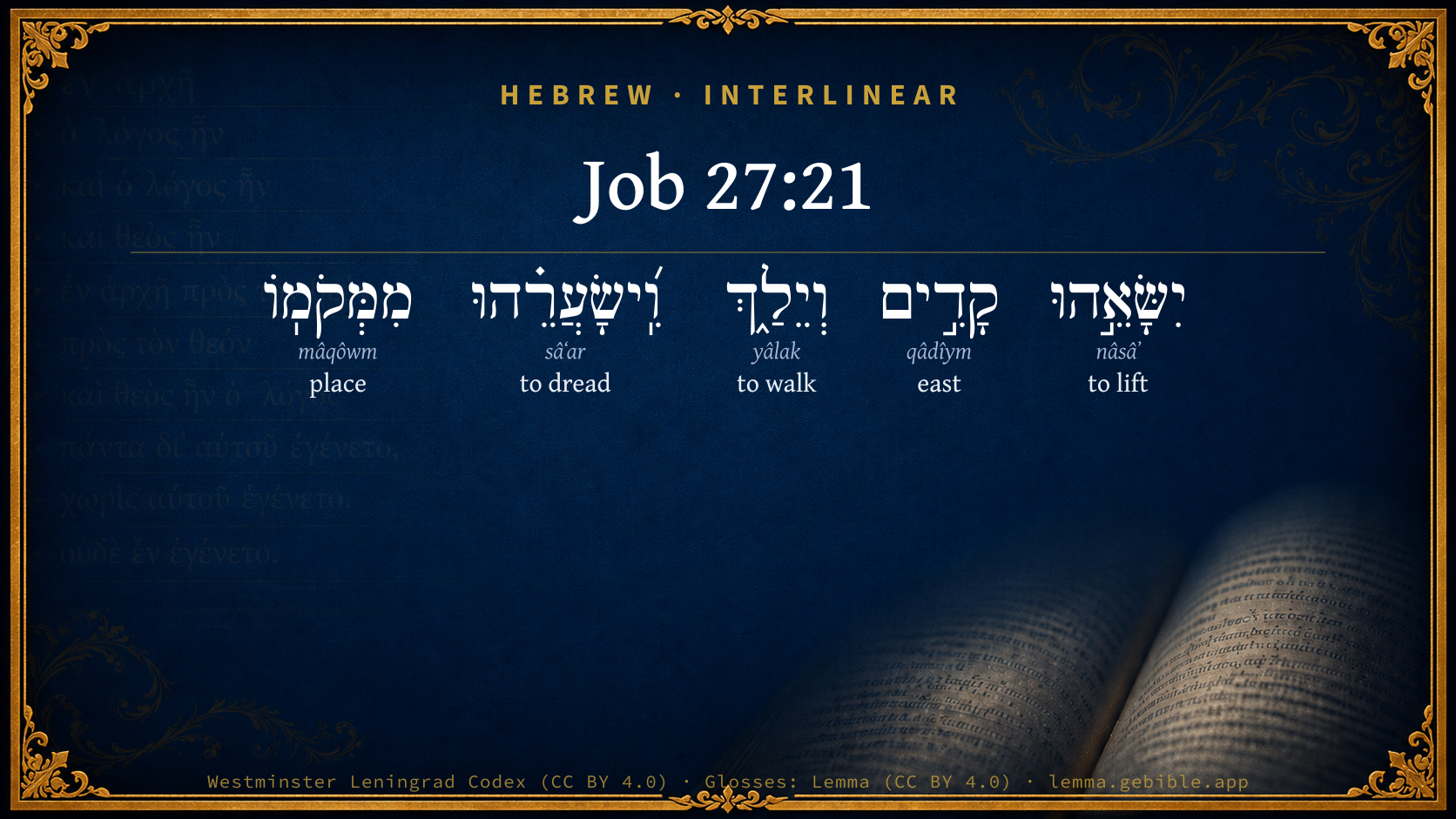
Hebrew (Westminster Leningrad Codex) Job 27:21 appears in the Hebrew Old Testament. The text above is from the Westminster Leningrad Codex. Each word links to its Strong’s number, a concise gloss, and parsing drawn from the Open Scriptures Hebrew Bible morphology. Click any word for its full Brown-Driver-Briggs (BDB) entry.
Download image
Cite this verse

Job 27:21 (World English Bible). Public Domain. Lemma interlinear Bible study tool, https://lemma.gebible.app/v/job/27/21.

Show BibTeX & RIS
BibTeX
RIS
English Translation
The east wind carries him away, and he departs; It sweeps him out of his place.
World English Bible · Public Domain
Download a study sheet

One document with this verse’s original text, its word-by-word gloss line, the meaning frame, cross-references with their text, attributed commentary, and full source and license credits — printable, and it pastes into notes with its structure intact.

This verse Autodidact and up

Study sheet (.html) Plain text (.txt)

A passage Seminary Student

Up to 50 verses in one chapter. A passage sheet keeps up to 6 commentary sources and 12 cross-references per verse, in the order this page ranks them, and says so on the sheet whenever that leaves anything out. Ask for a single verse and you get the Autodidact verse sheet above.

Everything on this page stays free to read, with no account — the sheet is a download of what is already on screen, not access to it.

Want to remove ads? Support Godless Engineer
Compare translations 3

The same verse in 3 English versions, stacked beneath the original-language interlinear above. Click any original word for its lexicon entry.

Each is an independent rendering of the whole verse — the interlinear is not word-aligned to these translations.

Highlighted words mark where these versions differ — a whole-verse word diff, not a word-by-word alignment.

  • World English Bible Public Domain
    The east wind carries him away, and he departs; It sweeps him out of his place.
  • King James Version Public Domain
    The east wind carrieth him away, and he departeth: and as a storm hurleth him out of his place.
  • unfoldingWord Literal Text CC BY-SA 4.0
    The east wind takes him away, and he leaves; indeed, it blasts him from his place.

unfoldingWord Literal Text — © unfoldingWord, licensed CC BY-SA 4.0. Word-aligned USFM3 via Door43 (git.door43.org/unfoldingWord/en_ult).

Versions to compare (up to 4)

3 of 4 selected

Show all 18 translations

Every available English version of this verse, each an independent rendering of the whole verse.

  • World English Bible Public Domain
    The east wind carries him away, and he departs; It sweeps him out of his place.
  • Berean Standard Bible Public Domain
    The east wind carries him away, and he is gone; it sweeps him out of his place.
  • Majority Standard Bible Public Domain
    The east wind carries him away, and he is gone; it sweeps him out of his place.
  • King James Version Public Domain
    The east wind carrieth him away, and he departeth: and as a storm hurleth him out of his place.
  • American Standard Version (1901) Public Domain
    The east wind carrieth him away, and he departeth; And it sweepeth him out of his place.
  • Revised Version (1885) Public Domain
    The east wind carrieth him away, and he departeth; and it sweepeth him out of his place.
  • Geneva Bible (1599) Public Domain
    The East winde shall take him away, and he shall depart: and it shall hurle him out of his place.
  • Douay-Rheims (1899) Public Domain
    A burning wind shall take him up, and carry him away, and as a whirlwind shall snatch him from his place.
  • Young's Literal Translation Public Domain
    Take him up doth an east wind, and he goeth, And it frighteneth him from his place,
  • Literal Standard Version CC BY-SA 4.0
    An east wind takes him up, and he goes, || And it frightens him from his place,
  • Unlocked Literal Bible CC BY-SA 4.0
    The east wind carries him away, and he leaves; it sweeps him out of his place.
  • unfoldingWord Literal Text CC BY-SA 4.0
    The east wind takes him away, and he leaves; indeed, it blasts him from his place.
  • Darby Bible Public Domain
    The east wind carrieth him away and he is gone; and as a storm it hurleth him out of his place.
  • World Messianic Bible Public Domain
    The east wind carries him away, and he departs. It sweeps him out of his place.
  • Webster's Bible Public Domain
    The east wind carrieth him away, and he departeth: and as a storm hurleth him out of his place.
  • Free Bible Version CC BY-SA 4.0
    The east wind picks them up and they're gone, carried away from where they were.
  • Bible in Basic English Public Domain
    The east wind takes him up and he is gone; he is forced violently out of his place.
  • JPS Tanakh (1917) Public Domain
    The east wind carrieth him away, and he departeth; and it sweepeth him out of his place.

Literal Standard Version (2020), Covenant Press — licensed CC BY-SA 4.0. Text via the HelloAO Bible API (eBible.org). Unlocked Literal Bible (unfoldingWord) — licensed CC BY-SA 4.0. Text via the HelloAO Bible API (eBible.org). unfoldingWord Literal Text — © unfoldingWord, licensed CC BY-SA 4.0. Word-aligned USFM3 via Door43 (git.door43.org/unfoldingWord/en_ult). Free Bible Version, Dr. Jonathan Gallagher — licensed CC BY-SA 4.0. Text via the HelloAO Bible API (eBible.org).

Word by word

More ways to search: Search by grammar → Find every occurrence → Compare this word →

Practice this passage: Drill this verse → Learn its vocabulary →

וִֽ֝ישָׂעֲרֵ֗הוּ
sâʻar
H8175
“and · to dread · him”
Conjunction + Verb, Piel, Imperfect, 3rd Person, Masculine, Singular + Suffix, Personal, 3rd Person, Masculine, Singular
Part of Speech
Conjunction + Verb
Stem
Piel
Form
Imperfect
Person
3rd Person
Gender
Masculine
Number
Singular
Full BDB Definition

Origin: a primitive root

TWOT: 2274d , 2275 , 2276

to storm, shiver, dread, bristle (with horror), be very afraid - (Qal) - to bristle (with horror) - to dread - to storm away, sweep away, whirl away - (Qal) - to sweep away - to storm away (of God's action against the wicked) (figuratively) - (Niphal) to be stormy, be tempestuous (exceedingly) - (Piel) to whirl away, be stormed away - (Hithpael) to storm against, come as a storm
  1. יִשָּׂאֵ֣הוּ nâsâʼ H5375 “to lift · him” Verb, Qal, Imperfect, 3rd Person, Masculine, Singular + Suffix, Personal, 3rd Person, Masculine, Singular
  2. קָדִ֣ים qâdîym H6921 “east” Noun, Common, Masculine, Singular, Absolute
  3. וְיֵלַ֑ךְ yâlak H3212 “and · to walk” Conjunction + Verb, Qal, Imperfect, 3rd Person, Masculine, Singular
  4. מִמְּקֹמֽוֹ mâqôwm H4725 “from · place · his” Preposition + Noun, Common, Masculine, Singular, Construct + Suffix, Personal, 3rd Person, Masculine, Singular

About this verse

These counts appear in no published source. They are computed here, from the morphology-tagged text and Lemma’s own curated glosses. What Lemma adds →

5
words
5
distinct lemmas
Wisdom
section

Notable vocabulary

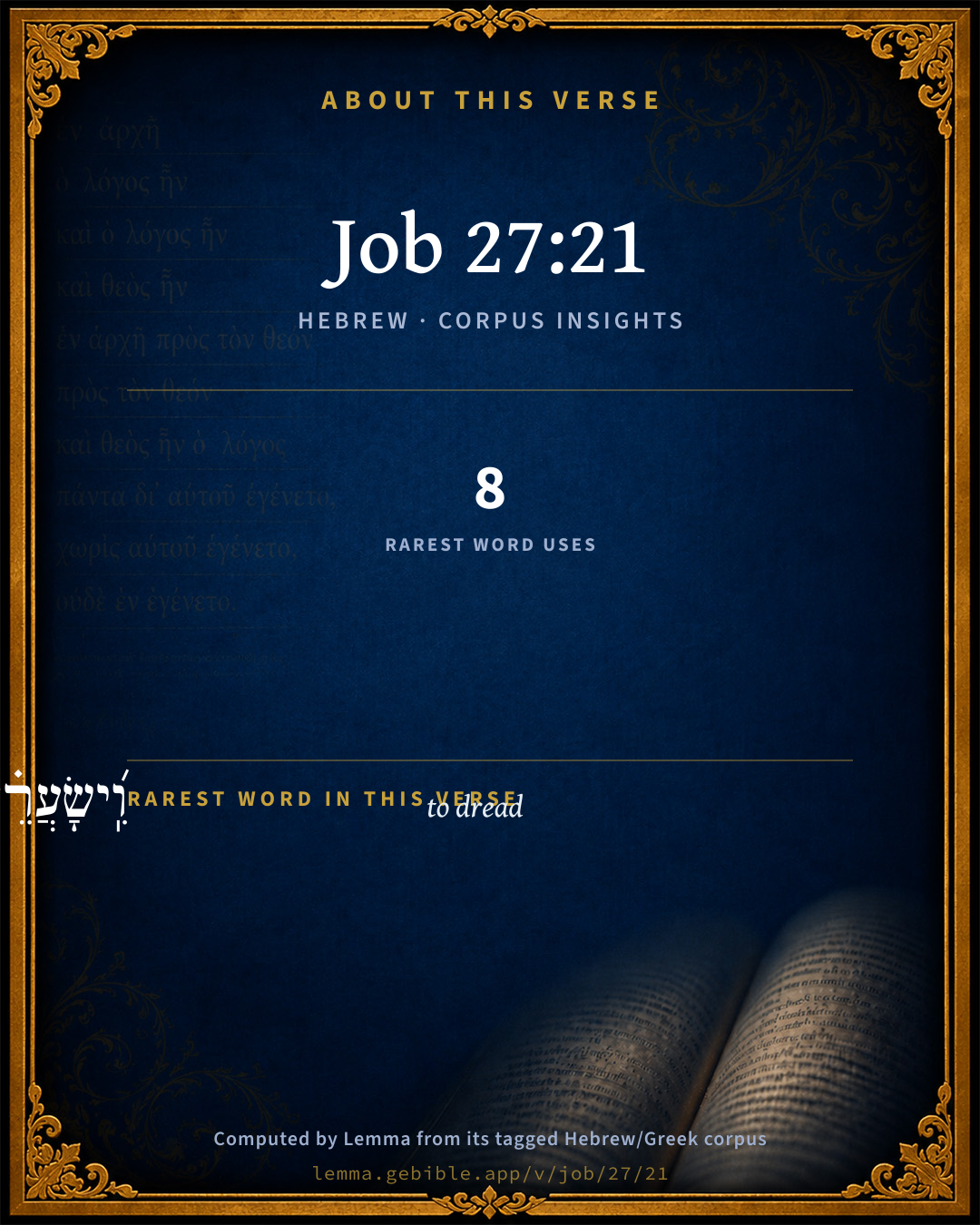
The rarest word here is וִֽ֝ישָׂעֲרֵ֗הוּ to dread H8175 — appearing just 8 times in the whole Hebrew Bible.

Shared distinctive vocabulary

וִֽ֝ישָׂעֲרֵ֗הוּ to dread H8175 occurs in 8 verses of the Hebrew Bible. Also found in:

Grammatical profile

  • 3 verbs
  • 2 nouns

Verb forms

  • יִשָּׂאֵ֣הוּ Qal · Imperfect
  • וְיֵלַ֑ךְ Qal · Imperfect
  • וִֽ֝ישָׂעֲרֵ֗הוּ Piel · Imperfect

Hebrew & Septuagint length

In English translation the verse runs 16 words from the Hebrew and 21 from the Septuagint (LXX English) — closely comparable.

A rough comparison of the two English renderings, which tokenize alike — not a word-level alignment.

Word counts can differ between the Hebrew and the Greek without any difference in meaning — e.g. the Hebrew direct-object marker אֵת has no separate Greek word, and Greek often adds the article ὁ.

Cross-references

10

Topical passages linked to Job 27:21 in the Treasury of Scripture Knowledge — connected by theme and wording, ordered by reader-vote popularity; previews shown in the World English Bible.

  • Psalms 11:6 On the wicked he will rain blazing coals; Fire, sulfur, and scorching wind shall be the portion of their cup.
  • Psalms 83:15 So pursue them with your tempest, And terrify them with your storm.
  • Job 7:10 He shall return no more to his house, Neither shall his place know him any more.
  • Job 21:18 That they are as stubble before the wind, As chaff that the storm carries away?
  • Psalms 58:9 Before your pots can feel the heat of the thorns, He will sweep away the green and the burning alike.
  • Exodus 9:23–25 Moses stretched forth his rod toward the heavens, and Yahweh sent thunder, hail, and lightning flashed down to the earth. Yahweh rained hail on the land of Egypt.
  • Jeremiah 18:17 I will scatter them as with an east wind before the enemy; I will show them the back, and not the face, in the day of their calamity.
  • Hosea 13:15 Though he is fruitful among his brothers, an east wind will come, The breath of Yahweh coming up from the wilderness; And his spring will become dry, And his fountain will be dried up. He will plunder the storehouse of treasure.
  • Nahum 1:3–8 Yahweh is slow to anger, and great in power, and will by no means leave the guilty unpunished. Yahweh has his way in the whirlwind and in the storm, and the clouds are the dust of his feet.
  • Matthew 7:27 The rain came down, the floods came, and the winds blew, and beat on that house; and it fell--and great was its fall."

Cross-references courtesy of OpenBible.info (CC BY 4.0).

Hebrew and Greek witnesses Masoretic Hebrew ↔ Greek Septuagint

The same verse in the two great witnesses to the Old Testament, shown verse-for-verse.

These are two independent witnesses, not word-aligned to each other, and the Septuagint is shown in lemma (dictionary) form.

Hebrew Job 27:21 Masoretic · Westminster Leningrad Codex

יִשָּׂאֵ֣הוּ קָדִ֣ים וְיֵלַ֑ךְ וִֽ֝ישָׂעֲרֵ֗הוּ מִמְּקֹמֽוֹ

The east wind carries him away, and he departs; It sweeps him out of his place.

World English Bible · Public Domain

Greek LXX Job 27:21 Septuagint · lemma form

ἀναλαμβάνω αὐτός καίω καί ἀποἔρχομαι καί λικμάω αὐτός ἐκ ὁ τόπος αὐτός

And a burning wind shall catch him, and he shall depart, and it shall utterly drive him out of his place.

LXX2012 (modern English Septuagint) · Public Domain

On this verse, Albert Barnes' Notes on the Bible discusses the Septuagint’s reading. Read the note in Commentary ↓

Hebrew: Westminster Leningrad Codex (CC BY 4.0). Greek: Septuagint (public domain); English from LXX2012 (modern English Septuagint) (Public Domain). How the Septuagint differs from the Hebrew →

Commentary

Notes on Job 27:21 from classic Christian and Jewish commentators (each source and its license shown beneath its notes). The classic Christian expositions comment on the surrounding passage and are grouped to its opening verse, so a note may address several verses; the Jewish commentaries on the Tanakh (Rashi and others) are per-verse, so they appear only where the commentator wrote on this verse.

Lemma curates 59 commentaries, every one of them public domain or Creative Commons licensed, each selected and text-cleaned for this edition rather than reprinted as found. About our sources →

Trapp's Complete Commentary

John Trapp

Job 27:21 The east wind carrieth him away, and he departeth: and as a storm hurleth him out of his place.

Ver. 21. The east wind carrieth him away] Deus subito et severo suo iudicio (Lavat.). God, by his sudden and severe judgment, hurrieth him hence to the place of torment, without the least hope of ever either mending or ending.

And he departeth] But with as ill a will as ever did Lot out of Sodom; Adam out of Paradise; the Jebusites out of Jerusalem; the unjust steward out of his office; the devil out of the demoniac.

And as a storm hurleth him] Turbinat eum, tosseth him like a ball into a far country, as if he were wherried away by a fierce whirlwind, or served as pastime for tempests.

John Trapp, A Commentary or Exposition upon All the Books of the Old and New Testament (1647–1656) — public domain. Text from a community e-Sword module.

Joseph Benson's Commentary

Job 27:21-22. The east wind — Some terrible judgment, fitly compared to the east wind, which, in those parts, was most vehement, furious, pestilential, and destructive; carrieth him away — Out of his place, as it follows; out of his stately mansion, where he expected to dwell for ever; whence he shall be carried, either by an enemy or by death. For God shall cast upon him — His darts or plagues, one after another and not spare — That is, shall show no pity or mercy to him when he crieth to him for it. As there is no Hebrew for God, we may attribute this power to the storm occasioned by the east wind. For, if the tempest, Job 27:20, steals him away, according to the same kind of phraseology, the storm may be said to cast itself upon him, and not spare. He would fain flee out of his hand — That is, God’s hand, or from the power and violence of the storm. He earnestly desires and endeavours, by all possible ways, to escape the judgments of God, but in vain. Those that will not be persuaded to flee to the arms of divine grace, which are now stretched out to receive them, will not be able to flee from the arms of divine wrath, which will shortly be stretched out to destroy them.

Joseph Benson's Commentary on the Old and New Testaments (1811–1818) — public domain. Text from a community e-Sword module.

Jamieson, Fausset & Brown

Robert Jamieson, A. R. Fausset & David Brown

(Job 21:18; Job 15:2; Psa 58:9).

Jamieson, Fausset & Brown — Commentary Critical and Explanatory on the Whole Bible (1871) — public domain (CC PDM 1.0). Text via the HelloAO Bible API.

Adam Clarke's Commentary

Verse 21. The east wind carrieth him away] Such as is called by Mr. Good, a levanter, the euroclydon, the eastern storm of Ac 27:14.

Adam Clarke's Commentary on the Bible (1810–1826) — public domain. Text from a community e-Sword/MySword module.

The Cambridge Bible for Schools and Colleges

gen. ed. J. J. S. Perowne

21. The east wind is gusty and tempestuous, ch. Job_38:24, Psa_48:7. See Wetzstein’s note in Del.

and as a storm hurleth] Or, and in storm hurleth. With this which Job says of the sinner compare what he says of himself, ch. Job_9:17, Job_30:22, “Thou liftest me up to the wind; thou causest me to ride upon it, and dissolvest me in the tempest”; and see his former query regarding the wicked, ch. Job_21:18.

The Cambridge Bible for Schools and Colleges (gen. ed. J. J. S. Perowne; Cambridge University Press, 1878–1918) — public domain. Text from a community e-Sword module.

John Gill's Exposition

For God shall cast upon him, and not spare,.... Cast his sins upon him, which will lie as an intolerable weight upon his conscience; and his wrath upon him, which being poured out like fire, he will not be able to bear it; and deserved punishment on him, which, like a talent of lead, will bear him down to the lowest hell; and this will be done without showing any mercy at all; for, though the wicked have much of sparing mercy in this world, they have none in the next; there is sparing mercy now, but none in hell; God, that spared not the angels that sinned, nor the old world, nor Sodom and Gomorrah, will not spare them, Pe2 2:4; he that made them will have no mercy on them; and he that formed them will show them no favour:

he would fain flee out of his hands; in whose hands he is, not as all men are, being the works of his hands, and supported by him; much less as his people are, secure there; but in his hands as an awful and terrible Judge, condemning him for his sins, and sentencing him to everlasting punishment; and a fearful thing it is to fall into the hands of the living and almighty God: there is no getting out of them, though "fleeing, he flees", as the phrase is, with all his might and main, with all the swiftness he can; it is all to no purpose; he is where he was, and must continue in the torment and misery he is in to all eternity; his worm of conscience will never die, nor the fire of divine wrath be ever quenched; though he will desire death ten thousand times over, he shall not find it, it shall flee from him, Rev 9:6.

John Gill's Exposition of the Whole Bible (1746–1763) — public domain (CC PDM 1.0). Text via the HelloAO Bible API.

Albert Barnes' Notes on the Bible

The east wind carrieth him away - He is swept off as by the violence of a tempest. Severe storms are represented in this book as coming from the East; compare the notes at Job 15:2. The ancients believed that people might be carried away by a tempest or whirlwind; compare Isa 41:16; see also Homer, Odyssey xx. 63ff:

“Snatch me, ye whirlwinds far from human race,

Test through the void illimitable space;

Or if dismounted from the rapid cloud,

Me with his whelming wave let Ocean shroud!”

Pope

Compare the notes at Job 30:22. The parallelism here would seem to imply that the wind referred to was violent, but it is possible that the allusion may be to the burning winds of the desert, so well known in the East, and so frequently described by travelers. The Vulgate here renders the Hebrew word קדים qâdı̂ym, ventus urens, “burning wind;” the Septuagint in like manner, καύσων kausōn; the Syriac simply wind. This east wind, or burning wind, is what the Arabians call Samum. It is a hot wind which passes over the desert, and which was formerly supposed to be destructive of life. More recent travelers however, tell us that it is not fatal to life, though exceedingly oppressive.

And as a storm - See Psa 58:9.

Hurleth him out of his place - Takes him entirely away, or removes him from the earth.

Albert Barnes' Notes on the Bible (1834–1885) — public domain. Text from a community e-Sword/MySword module.

Matthew Poole's English Annotations

The east wind, i.e. some violent and terrible judgment, fitly compared to the east wind, which in those parts was most vehement and furious, and withal pestilent and pernicious; of which see Exo 10:13; 14:21; Psa 48:7; 78:26; Hos 13:15; Jon 4:8.

Carrieth him away, out of his place, as it follows, out of his stately palace, wherein he expected to dwell for ever; whence he shall be carried either by an enemy, that shall take him and carry him into captivity, or by death.

Matthew Poole's English Annotations on the Holy Bible (1683–1685) — public domain. Text from a community e-Sword/MySword module.

Whedon's Commentary on the Bible

Daniel D. Whedon

21. The east wind — A storm brought on by an east wind is generally very destructive on account of its strong gusts, and it will even uproot the largest trees. (Wetzstein.) This wind, according to “The Hamasa,” is usually most violent at night. See Job_15:2.

Daniel D. Whedon (gen. ed.), Commentary on the Old and New Testaments (1874–1909) — public domain. Text from a community e-Sword module.

The Pulpit Commentary

The east wind carrieth him away, and he departeth. The khamsin wind, coming with all its violence and burning heat, drives him before it, and is irresistible (see "Ancient Monarchies," vol. 2. p. 482). And as a storm hurleth him out of his place. This is little more than a repetition of the previous hemistich. The man is swept from the earth by a storm of calamity.

The east wind.

Kingsley wrote an ode to the east wind. But few men have a good word for it. We in England, however, have quite our share of the presence of this unwelcome visitor. Has the east wind any religious significance to us.

I THERE ARE DESTRUCTIVE FORCES IN NATURE. The east wind is destructive. It brings blight to plants and illness to men. We might have expected that a perfect world would have only fresh, healthy west winds. Yet we must recognize the fact that, like the east wind, lightning, tempest, earthquakes, drought, and deluge are naturally hurtful influences. We need not resort to a Manichaean explanation, and suppose that a malignant being is at the root of these things. For scientific research teaches us that the destroying agencies of nature minister to its progress. The biting east wind that cuts off the more tender plants leaves the hardier ones to flourish with greater freedom, and so tends to promote their growth and propagation. The buffeting of the world helps to develop robustness of character.

II INFLUENCE PARTAKES OF THE CHARACTER OF ITS ORIGIN. The east wind is gendered on the dreary steppes of Russia. Arid plains suck out of it all its exhilarating properties. Cold regions lend it cruel barbs of ice. Even in beautiful, smiling England, the east wind comes as a blast from Siberia, and the desolation of the land of exile accompanies it. Spiritual influence is like its origin. Cruel natures can only spread an atmosphere of cruelty and distress about them. No man can influence others excepting through what he possesses. We cannot permanently disguise our characters. As we are in our hearts and homes, so shall we be ultimately in our work and in the outcome of our lives.

III CHILDHOOD DETERMINES MANHOOD. Leagues away beyond whole empires the east wind is born in the far-off Russian solitude. Yet when it flies over our fields and rushes in at our doors it is true to the character it received in the land of its birth. Not only is its influence true to its origin, but the wind itself continues of the same harsh character, although it is now surrounded by very genial circumstances. The tone and set of life are determined in youth. Some asperity may be softened and mellowed by the discipline of later years; but in the main most men are of the character of their youth. Hence the great importance of a right life at the start.

IV EAST WINDS ARE CONFINED TO EARTH. There are none in heaven. The storms and terrors of life that beset God"s children are peculiar to this brief time of discipline. The fruits of the heavenly Eden are not touched by frost or blighting blast. Those people who have no portion in the better land may well dread the destructive agencies of nature, which tear away all that they have to live for. But true Christians should learn to face the east wind of cutting calamity, knowing that they have but to cross the moor, and a cheerful home will welcome them on the other side. W.F.A.

The Pulpit Commentary (1880–1919), ed. H.D.M. Spence-Jones & Joseph S. Exell — public domain. Text from a community e-Sword module.

John Wesley's Explanatory Notes

East-wind - Some terrible judgment, fitly compared to the east-wind, which in those parts was most vehement, and pernicious. Carrieth him - Out of his palace wherein he expected to dwell forever; whence he shall be carried either by an enemy, or by death.

John Wesley, Explanatory Notes Upon the Whole Bible (1754–1765) — public domain. Text via the GEBible commentary corpus.

Lesson kit

Teaching starters — assembled from the data on this page, not authored interpretation. Every prompt links to the verse data it draws on. Edit before teaching.

Job, in the Wisdom, opens this verse with 5 words (5 distinct Hebrew lemmas). Its most distinctive word is sâʻar (“to dread”). A historical commentator’s framing appears above. Read the whole chapter for the surrounding context.

Discussion questions

  1. What does “to dread” (sâʻar) contribute to the verse as a whole?
  2. How does Deuteronomy 32:17, which shares the word «to dread», read alongside this verse?
  3. The translations on this page render this verse differently — a whole-verse word diff, not a word-by-word alignment. What might account for the different wordings?
  4. «יִשָּׂאֵ֣הוּ» is a Qal Imperfect verb. How does that grammatical form shape the action described?
  5. Compare how Trapp's Complete Commentary and Joseph Benson's Commentary read this verse. Where do they agree or differ?

Things to notice

Reading settings

Reading text

Shown beneath each verse's original-language words.

Old Testament
Old Testament edition

Read the OT as the Masoretic Hebrew (MT) or the Greek Septuagint (LXX).

English shown for the Greek Septuagint (in the Hebrew ↔ Greek comparison).

Comparing translations? Open the Compare panel on any verse page to stack up to four side by side.