
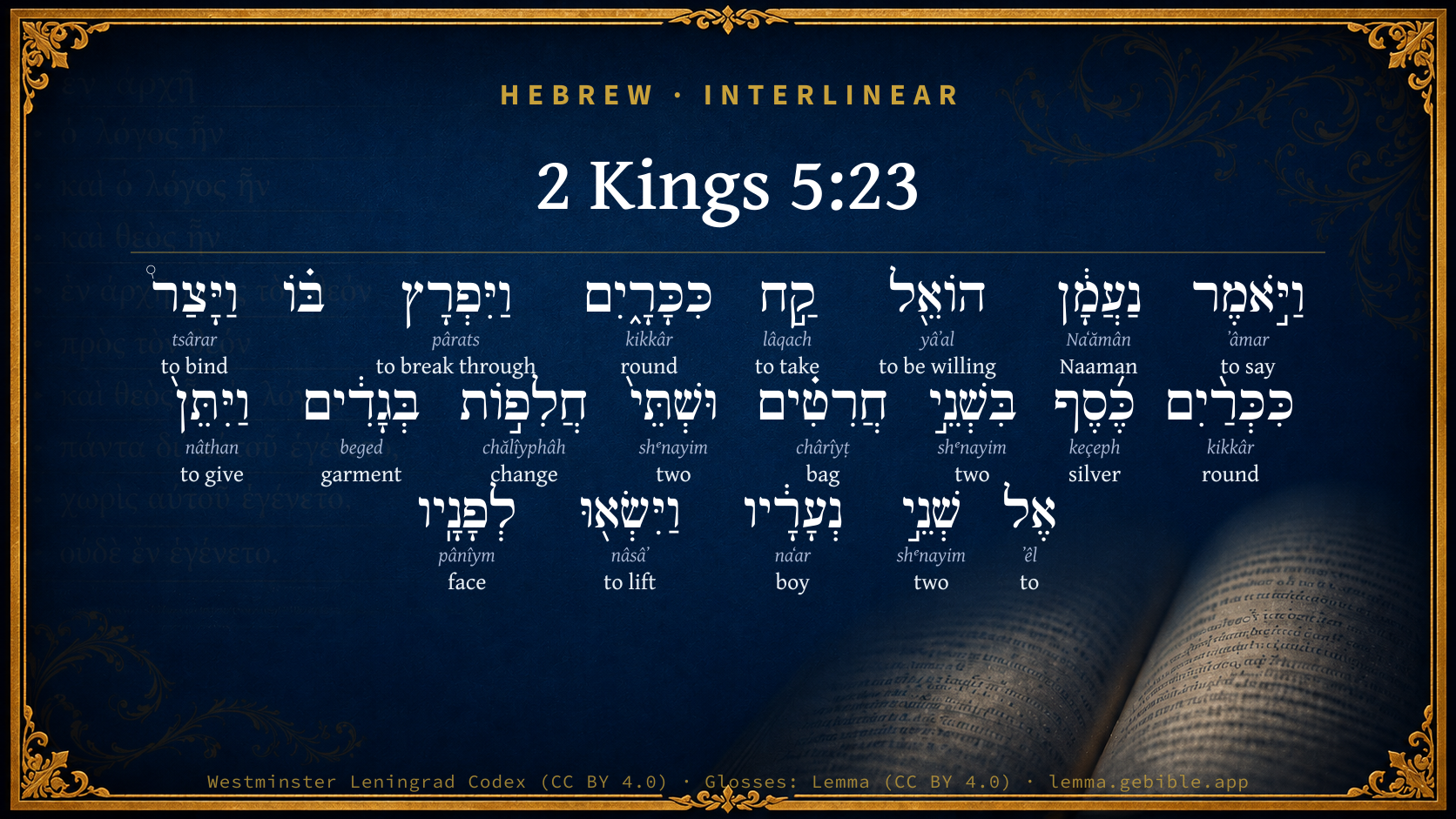
2 Kings 5:23

Hebrew (Westminster Leningrad Codex) 2 Kings 5:23 appears in the Hebrew Old Testament. The text above is from the Westminster Leningrad Codex. Each word links to its Strong’s number, a concise gloss, and parsing drawn from the Open Scriptures Hebrew Bible morphology. Click any word for its full Brown-Driver-Briggs (BDB) entry.
Download image
Cite this verse

2 Kings 5:23 (World English Bible). Public Domain. Lemma interlinear Bible study tool, https://lemma.gebible.app/v/2-kings/5/23.

Show BibTeX & RIS
BibTeX
RIS
English Translation
Naaman said, Be pleased to take two talents. He urged him, and bound two talents of silver in two bags, with two changes of clothing, and laid them on two of his servants; and they bore them before him.
World English Bible · Public Domain
Highlights
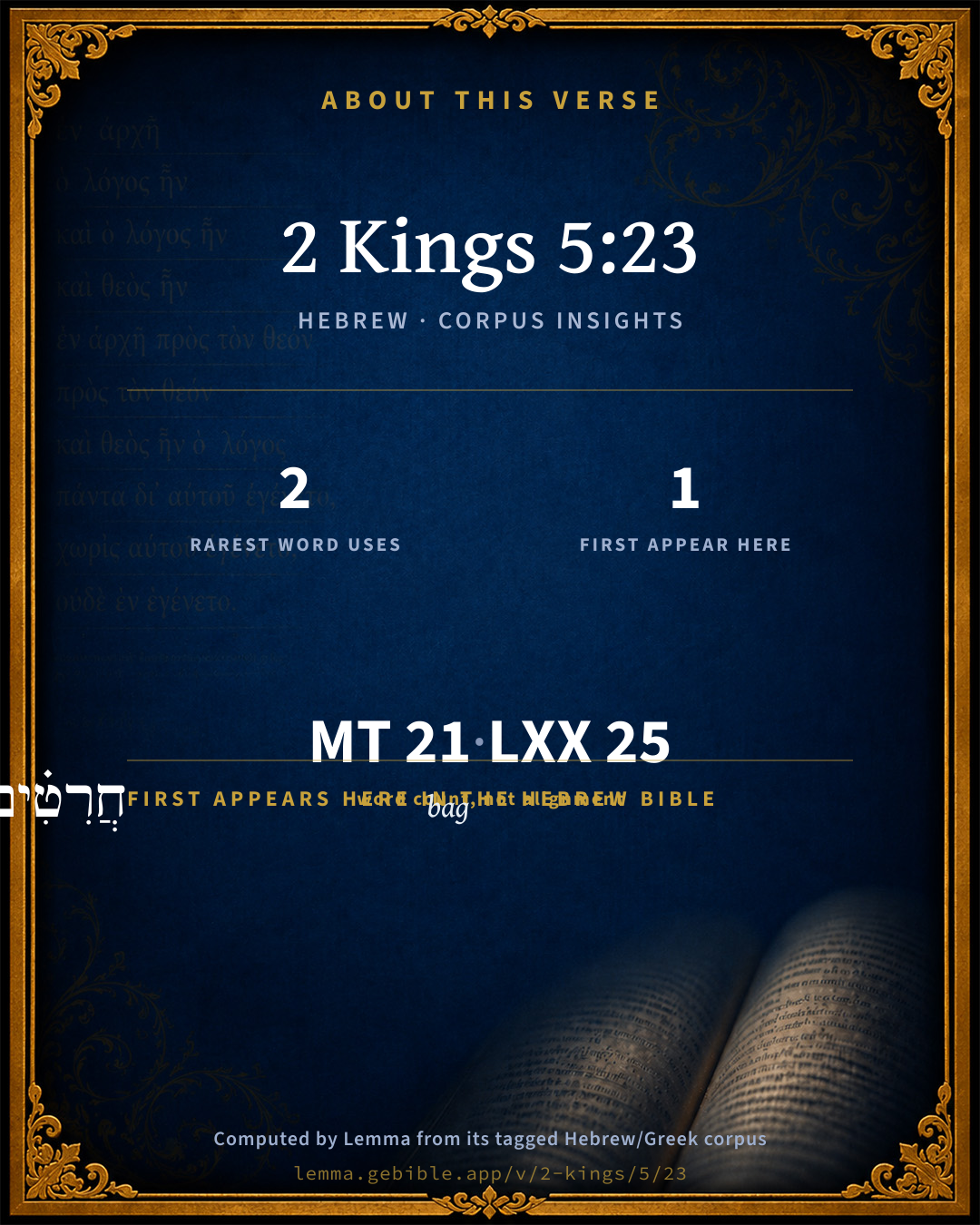
  • 1 first appearance in the Hebrew Bible
Full analysis ↓
Download a study sheet

One document with this verse’s original text, its word-by-word gloss line, the meaning frame, cross-references with their text, attributed commentary, and full source and license credits — printable, and it pastes into notes with its structure intact.

This verse Autodidact and up

Study sheet (.html) Plain text (.txt)

A passage Seminary Student

Up to 50 verses in one chapter. A passage sheet keeps up to 6 commentary sources and 12 cross-references per verse, in the order this page ranks them, and says so on the sheet whenever that leaves anything out. Ask for a single verse and you get the Autodidact verse sheet above.

Everything on this page stays free to read, with no account — the sheet is a download of what is already on screen, not access to it.

Want to remove ads? Support Godless Engineer
Compare translations 3

The same verse in 3 English versions, stacked beneath the original-language interlinear above. Click any original word for its lexicon entry.

Each is an independent rendering of the whole verse — the interlinear is not word-aligned to these translations.

Highlighted words mark where these versions differ — a whole-verse word diff, not a word-by-word alignment.

  • World English Bible Public Domain
    Naaman said, Be pleased to take two talents. He urged him, and bound two talents of silver in two bags, with two changes of clothing, and laid them on two of his servants; and they bore them before him.
  • King James Version Public Domain
    And Naaman said, Be content, take two talents. And he urged him, and bound two talents of silver in two bags, with two changes of garments, and laid them upon two of his servants; and they bare them before him.
  • unfoldingWord Literal Text CC BY-SA 4.0
    And Naaman said, “Be willing, take two kikkars.” And he urged him, and he bound two silver kikkars in two bags and two changes of clothes. And he gave to two of his servants, and they carried to his face.

unfoldingWord Literal Text — © unfoldingWord, licensed CC BY-SA 4.0. Word-aligned USFM3 via Door43 (git.door43.org/unfoldingWord/en_ult).

Versions to compare (up to 4)

3 of 4 selected

Show all 18 translations

Every available English version of this verse, each an independent rendering of the whole verse.

  • World English Bible Public Domain
    Naaman said, Be pleased to take two talents. He urged him, and bound two talents of silver in two bags, with two changes of clothing, and laid them on two of his servants; and they bore them before him.
  • Berean Standard Bible Public Domain
    But Naaman insisted, “Please, take two talents.” And he urged Gehazi to accept them. Then he tied up two talents of silver in two bags along with two sets of clothing and gave them to two of his servants, who carried them ahead of Gehazi.
  • Majority Standard Bible Public Domain
    But Naaman insisted, “Please, take two talents.” And he urged Gehazi to accept them. Then he tied up two talents of silver in two bags along with two sets of clothing and gave them to two of his servants, who carried them ahead of Gehazi.
  • King James Version Public Domain
    And Naaman said, Be content, take two talents. And he urged him, and bound two talents of silver in two bags, with two changes of garments, and laid them upon two of his servants; and they bare them before him.
  • American Standard Version (1901) Public Domain
    And Naaman said, Be pleased to take two talents. And he urged him, and bound two talents of silver in two bags, with two changes of raiment, and laid them upon two of his servants; and they bare them before him.
  • Revised Version (1885) Public Domain
    And Naaman said, Be content, take two talents. And he urged him, and bound two talents of silver in two bags, with two changes of raiment, and laid them upon two of his servants; and they bare them before him.
  • Geneva Bible (1599) Public Domain
    And Naaman saide, Yea, take two talents: and he compelled him, and bound two talents of siluer in two bagges, with two change of garments, and gaue them vnto two of his seruants, that they might beare them before him.
  • Douay-Rheims (1899) Public Domain
    And Naaman said: It is better that thou take two talents. And he forced him, and bound two talents of silver in two bags, and two changes of garments, and laid them upon two of his servants, and they carried them before him.
  • Young's Literal Translation Public Domain
    And Naaman saith, `Be pleased, take two talents;' and he urgeth on him, and bindeth two talents of silver in two purses, and two changes of garments, and giveth unto two of his young men, and they bear before him;
  • Literal Standard Version CC BY-SA 4.0
    And Naaman says, “Be pleased, take two talents”; and he urges him, and binds two talents of silver in two purses, and two changes of garments, and gives [them] to two of his young men, and they carry [them] before him;
  • Unlocked Literal Bible CC BY-SA 4.0
    Naaman replied, “I am very happy to give you two talents.” Naaman urged Gehazi and tied two talents of silver in two bags, with two changes of clothes, and laid them on two of his servants, who carried the bags of silver before Gehazi.
  • unfoldingWord Literal Text CC BY-SA 4.0
    And Naaman said, “Be willing, take two kikkars.” And he urged him, and he bound two silver kikkars in two bags and two changes of clothes. And he gave to two of his servants, and they carried to his face.
  • Darby Bible Public Domain
    And Naaman said, Consent to take two talents. And he urged him, and bound two talents of silver in two bags, with two changes of raiment, and laid them upon two of his young men; and they bore them before him.
  • World Messianic Bible Public Domain
    Naaman said, “Be pleased to take two talents.” He urged him, and bound two talents of silver in two bags, with two changes of clothing, and laid them on two of his servants; and they carried them before him.
  • Webster's Bible Public Domain
    And Naaman said, Be content, take two talents. And he urged him, and bound two talents of silver in two bags, with two changes of garments, and laid them upon two of his servants; and they bore them before him.
  • Free Bible Version CC BY-SA 4.0
    But Naaman replied, “Please, take two talents.” He insisted that Gehazi accept them. Then he tied up two talents of silver in two bags as well as two sets of clothing. He gave them to two of his servants, who carried them for Gehazi.
  • Bible in Basic English Public Domain
    And Naaman said, Be good enough to take two talents. And forcing him to take them, he put two talents of silver in two bags, with two changes of clothing, and gave them to his two servants to take before him.
  • JPS Tanakh (1917) Public Domain
    And Naaman said: 'Be content, take two talents.' And he urged him, and bound two talents of silver in two bags, with two changes of raiment, and laid them upon two of his servants; and they bore them before him.

Literal Standard Version (2020), Covenant Press — licensed CC BY-SA 4.0. Text via the HelloAO Bible API (eBible.org). Unlocked Literal Bible (unfoldingWord) — licensed CC BY-SA 4.0. Text via the HelloAO Bible API (eBible.org). unfoldingWord Literal Text — © unfoldingWord, licensed CC BY-SA 4.0. Word-aligned USFM3 via Door43 (git.door43.org/unfoldingWord/en_ult). Free Bible Version, Dr. Jonathan Gallagher — licensed CC BY-SA 4.0. Text via the HelloAO Bible API (eBible.org).

Word by word

More ways to search: Search by grammar → Find every occurrence → Compare this word →

Practice this passage: Drill this verse → Learn its vocabulary →

חֲרִטִ֗ים
chârîyṭ
H2754
“bags”
Noun, Common, Masculine, Plural, Absolute
Part of Speech
Noun
Type
Common
Gender
Masculine
Number
Plural
State
Absolute
Full BDB Definition

Origin: from the same as H2747

TWOT: 739a

bag, purse
  1. וַיֹּ֣אמֶר ʼâmar H559 “and · to say” Conjunction + Verb, Qal, Sequential Imperfect, 3rd Person, Masculine, Singular
  2. נַעֲמָ֔ן Naʻămân H5283 “Naaman” Noun, Proper
  3. הוֹאֵ֖ל yâʼal H2974 “be willing” Verb, Hiphil, Imperative, 2nd Person, Masculine, Singular
  4. קַ֣ח lâqach H3947 “take” Verb, Qal, Imperative, 2nd Person, Masculine, Singular
  5. כִּכָּרָ֑יִם kikkâr H3603 “talents” Noun, Common, Both, Dual, Absolute
  6. וַיִּפְרָץ pârats H6555 “and · to break through” Conjunction + Verb, Qal, Sequential Imperfect, 3rd Person, Masculine, Singular
  7. וַיָּצַר֩ tsârar H6887 “and · to bind” Conjunction + Verb, Qal, Sequential Imperfect, 3rd Person, Masculine, Singular
  8. כִּכְּרַ֨יִם kikkâr H3603 “talents” Noun, Common, Both, Dual, Absolute
  9. כֶּ֜סֶף keçeph H3701 “silver” Noun, Common, Masculine, Singular, Absolute
  10. בִּשְׁנֵ֣י shᵉnayim H8147 “in/at · two” Preposition + Adjective, Cardinal number, Masculine, Dual, Construct
  11. וּשְׁתֵּי֙ shᵉnayim H8147 “and · two” Conjunction + Adjective, Cardinal number, Feminine, Dual, Construct
  12. חֲלִפ֣וֹת chălîyphâh H2487 “changes of” Noun, Common, Feminine, Plural, Construct
  13. בְּגָדִ֔ים beged H899 “garments” Noun, Common, Masculine, Plural, Absolute
  14. וַיִּתֵּן֙ nâthan H5414 “and · to give” Conjunction + Verb, Qal, Sequential Imperfect, 3rd Person, Masculine, Singular
  15. אֶל ʼêl H413 “to” Preposition
  16. שְׁנֵ֣י shᵉnayim H8147 “two” Adjective, Cardinal number, Masculine, Dual, Construct
  17. נְעָרָ֔יו naʻar H5288 “boys · his” Noun, Common, Masculine, Plural, Construct + Suffix, Personal, 3rd Person, Masculine, Singular
  18. וַיִּשְׂא֖וּ nâsâʼ H5375 “and · to lift” Conjunction + Verb, Qal, Sequential Imperfect, 3rd Person, Masculine, Plural
  19. לְפָנָֽיו pânîym H6440 “to/for · face(s) · his” Preposition + Noun, Common, Both, Plural, Construct + Suffix, Personal, 3rd Person, Masculine, Singular

About this verse

These counts appear in no published source. They are computed here, from the morphology-tagged text and Lemma’s own curated glosses. What Lemma adds →

21
words
17
distinct lemmas
Historical
section

Notable vocabulary

The rarest word here is חֲרִטִ֗ים bag H2754 — appearing just 2 times in the whole Hebrew Bible.

First appearance in Scripture

This word makes its first canonical appearance in the Hebrew Bible here:

  • חֲרִטִ֗ים bag H2754

Shared distinctive vocabulary

חֲרִטִ֗ים bag H2754 occurs in 2 verses of the Hebrew Bible. Also found in:

Grammatical profile

  • 7 verbs
  • 9 nouns
  • 3 adjectives
  • 2 prepositions

Verb forms

  • וַיֹּ֣אמֶר Qal · Sequential Imperfect
  • הוֹאֵ֖ל Hiphil · Imperative
  • קַ֣ח Qal · Imperative
  • וַיִּפְרָץ Qal · Sequential Imperfect
  • וַיָּצַר֩ Qal · Sequential Imperfect
  • וַיִּתֵּן֙ Qal · Sequential Imperfect
  • וַיִּשְׂא֖וּ Qal · Sequential Imperfect

Repetition

Words recur within this verse — often emphatic in Hebrew:

  • בִּשְׁנֵ֣י two H8147 ×3
  • כִּכָּרָ֑יִם round H3603 ×2

Hebrew & Septuagint length

In English translation the verse runs 39 words from the Hebrew and 37 from the Septuagint (LXX English) — closely comparable.

A rough comparison of the two English renderings, which tokenize alike — not a word-level alignment.

Word counts can differ between the Hebrew and the Greek without any difference in meaning — e.g. the Hebrew direct-object marker אֵת has no separate Greek word, and Greek often adds the article ὁ.

In the original languages it is 21 Hebrew tokens and 25 Greek tokens — but the two are counted differently (Hebrew bundles its prefixes and suffixes into one token; the Greek is in lemma form), so that isn’t a like-for-like length.

Cross-references

7

Topical passages linked to 2 Kings 5:23 in the Treasury of Scripture Knowledge — connected by theme and wording, ordered by reader-vote popularity; previews shown in the World English Bible.

  • 1 Kings 20:7 Then the king of Israel called all the elders of the land, and said, Please notice how this man seeks mischief: for he sent to me for my wives, and for my children, and for my silver, and for my gold; and I didn't deny him.
  • 2 Kings 2:17 When they urged him until he was ashamed, he said, Send. They sent therefore fifty men; and they sought three days, but didn't find him.
  • 2 Kings 5:16 But he said, As Yahweh lives, before whom I stand, I will receive none. He urged him to take it; but he refused.
  • 2 Kings 6:3 One said, Be pleased, I pray you, to go with your servants. He answered, I will go.
  • 2 Kings 12:10 It was so, when they saw that there was much money in the chest, that the king's scribe and the high priest came up, and they put up in bags and counted the money that was found in the house of Yahweh.
  • Isaiah 30:6 The burden of the animals of the South. Through the land of trouble and anguish, from whence come the lioness and the lion, the viper and fiery flying serpent, they carry their riches on the shoulders of young donkeys, and their treasures on the humps of camels, to a people that shall not profit [them].
  • Luke 11:54 lying in wait for him, and seeking to catch him in something he might say, that they might accuse him.

Cross-references courtesy of OpenBible.info (CC BY 4.0).

Hebrew and Greek witnesses Masoretic Hebrew ↔ Greek Septuagint

The same verse in the two great witnesses to the Old Testament, shown verse-for-verse.

These are two independent witnesses, not word-aligned to each other, and the Septuagint is shown in lemma (dictionary) form.

Hebrew 2 Kings 5:23 Masoretic · Westminster Leningrad Codex

וַיֹּ֣אמֶר נַעֲמָ֔ן הוֹאֵ֖ל קַ֣ח כִּכָּרָ֑יִם וַיִּפְרָץ בּ֗וֹ וַיָּצַר֩ כִּכְּרַ֨יִם כֶּ֜סֶף בִּשְׁנֵ֣י חֲרִטִ֗ים וּשְׁתֵּי֙ חֲלִפ֣וֹת בְּגָדִ֔ים וַיִּתֵּן֙ אֶל שְׁנֵ֣י נְעָרָ֔יו וַיִּשְׂא֖וּ לְפָנָֽיו

Naaman said, Be pleased to take two talents. He urged him, and bound two talents of silver in two bags, with two changes of clothing, and laid them on two of his servants; and they bore them before him.

World English Bible · Public Domain

Greek LXX 2 Kings 5:23 Septuagint · lemma form

καί εἶπον ναιμαν λαμβάνω διτάλαντον ἀργύριον καί λαμβάνω ἐν δύο θύλακος καί δύο ἀλλάσσω στολή καί δίδωμι ἐπί δύο παιδάριον αὐτός καί αἴρω ἔμπροσθεν αὐτός

And Naiman said, Take two talents of silver. And he took two talents of silver in two bags, and two changes of raiment, and put them upon two of his servants, and they bore them before him.

LXX2012 (modern English Septuagint) · Public Domain

On this verse, Ellicott's Commentary for English Readers discusses the Septuagint’s reading. Read the note in Commentary ↓

Hebrew: Westminster Leningrad Codex (CC BY 4.0). Greek: Septuagint (public domain); English from LXX2012 (modern English Septuagint) (Public Domain). How the Septuagint differs from the Hebrew →

Targum (Aramaic paraphrase)

1

The Targum is the ancient Jewish Aramaic paraphrase of the Hebrew Scriptures — an interpretive translation, not the Hebrew text itself. Onkelos (literal) and Pseudo-Jonathan (expansive) render the Torah, and Jonathan the Prophets. Coverage is partial: where no permissively-licensed English translation exists for a verse, only the Aramaic is shown. This is verse-level text, not a word-by-word alignment to the Hebrew.

  1. Targum Jonathan Prophets (Joshua–Malachi)
    וַאֲמַר נַעֲמָן שְׁרֵי סַב תַּרְתֵּין כִּכְרִין וְאַתְקֵיף בֵּיהּ וְצַר תַּרְתֵּין כִּכְּרִין דִכְסַף בִּתְרֵין פִּלְדְסִין וּתְרֵין אִצְטַלְוָן דִלְבוּשִׁין וִיהַב לִתְרֵין עוּלֵימוֹהִי וּנְסִיבוּ קֳדָמוֹהִי:

    (no public-domain English translation for this verse)

    Targum Jonathan — Aramaic: “Mikraot Gedolot” (public domain). English: “Sefaria Community Translation” (CC0 1.0 (public-domain dedication)); “London "Chaldee Paraphrase," 1871” (public domain). Text via Sefaria.

Commentary

Notes on 2 Kings 5:23 from classic Christian and Jewish commentators (each source and its license shown beneath its notes). The classic Christian expositions comment on the surrounding passage and are grouped to its opening verse, so a note may address several verses; the Jewish commentaries on the Tanakh (Rashi and others) are per-verse, so they appear only where the commentator wrote on this verse.

Lemma curates 59 commentaries, every one of them public domain or Creative Commons licensed, each selected and text-cleaned for this edition rather than reprinted as found. About our sources →

Trapp's Complete Commentary

John Trapp

2Ki 5:23 And Naaman said, Be content, take two talents. And he urged him, and bound two talents of silver in two bags, with two changes of garments, and laid [them] upon two of his servants; and they bare [them] before him.

Ver. 23. Be content, take two talents.] Which amount to seven hundred and fifty pounds sterling. God saith as much in effect to his suitors, pressing and heaping mercies upon them. {Joh 16:24}

John Trapp, A Commentary or Exposition upon All the Books of the Old and New Testament (1647–1656) — public domain. Text from a community e-Sword module.

Jamieson, Fausset & Brown

Robert Jamieson, A. R. Fausset & David Brown

in two bags--People in the East, when travelling, have their money, in certain sums, put up in bags.

Jamieson, Fausset & Brown — Commentary Critical and Explanatory on the Whole Bible (1871) — public domain (CC PDM 1.0). Text via the HelloAO Bible API.

Adam Clarke's Commentary

Verse 23. He - bound two talents of silver] It required two servants to carry these two talents, for, according to the computation above, each talent was about 120lbs. weight.

Adam Clarke's Commentary on the Bible (1810–1826) — public domain. Text from a community e-Sword/MySword module.

Ellicott's Commentary for English Readers

(23) Be content.—Be willing, consent to take. The Vatican LXX. omits; the Alexandrian renders αὐτοῦ, owing to a transposition of the Hebrew letters (hãlô’ for hô’êl).

Bound.—Deu_14:25.

Bags.—Only here and in Isa_3:22, where it means “purses.”

Laid them upon two.—Gave them to two of his (i.e., Naaman’s) young men. The courtesy of the act is obvious.

Before him.—Gehazi.

A Bible Commentary for English Readers, edited by Charles John Ellicott (1878–1897) — public domain. Text from a community e-Sword module.

The Cambridge Bible for Schools and Colleges

gen. ed. J. J. S. Perowne

23. bound two talents of silver in two bags] The money was put into the bag, and the opening tied up. The word translated ‘bags’ (LXX., θύλακοι) occurs in the list of female finery in Isa_3:22 and is rendered by R.V. ‘satchels’. Probably the bag was of an ornamental character, as the root word signifies ‘to engrave’. Perhaps there was some embroidery, or network in its formation.

laid them upon two of his servants] For the money must have been of considerable weight, and Naaman having had no opportunity of doing honour to Elisha, would be the more anxious to pay all attention to Gehazi.

The Cambridge Bible for Schools and Colleges (gen. ed. J. J. S. Perowne; Cambridge University Press, 1878–1918) — public domain. Text from a community e-Sword module.

John Gill's Exposition

And Naaman said, be content,.... Or be pleased; do not object to it:

take two talents: a talent for each young man, which amounted to between three hundred and four hundred pounds apiece:

and he urged; pressed him hard, insisted upon his taking them, who might pretend a great deal of modesty, and a strict regard to his master's orders:

and bound two talents of silver in two bags, with two changes of garments; for each young man:

and laid them upon two of his servants, the servants of Naaman, not choosing to burden Elisha's servant with them; for such a quantity of money and clothes was pretty heavy:

and they bare them before him; both for his ease, and for his honour.

John Gill's Exposition of the Whole Bible (1746–1763) — public domain (CC PDM 1.0). Text via the HelloAO Bible API.

Albert Barnes' Notes on the Bible

Be content - i. e. “consent.”

Albert Barnes' Notes on the Bible (1834–1885) — public domain. Text from a community e-Sword/MySword module.

Haydock's Catholic Bible Commentary

Him. The weight must have been considerable, (6000 sicles, ver. 26., and Exodus xxxviii. 25.; Haydock) otherwise Giezi would have preferred carrying them himself, that his master might not know. (Calmet) --- He had pretended a reluctance to take more than one talent, not to swerve from his master’s injunctions. (Menochius)

George Leo Haydock (1774–1849), Haydock's Catholic Family Bible and Commentary, 1859 edition — public domain. Excludes Psalms (Douay-Rheims chapter numbering differs from Protestant) and Deuterocanonical books (Catholic canon only).

Matthew Poole's English Annotations

He urged him, who at first refused it upon a pretence of modesty and obedience to his master’s command.

Matthew Poole's English Annotations on the Holy Bible (1683–1685) — public domain. Text from a community e-Sword/MySword module.

Whedon's Commentary on the Bible

Daniel D. Whedon

23. Naaman said… take two talents — Worth about three thousand three hundred and twenty dollars.

Upon two of his servants — Naaman’s servants. Comp. 2Ki_5:24. The gift was a weight which one could not well carry.

Daniel D. Whedon (gen. ed.), Commentary on the Old and New Testaments (1874–1909) — public domain. Text from a community e-Sword module.

The Pulpit Commentary

And Naaman said, Be content, take two talents; rather, consent, take two talents. Do not oppose thyself to my wishes consent to receive double what thou hast asked. Naaman is anxious to show his gratitude by giving as much as he can induce the ether side to accept. He suggests two talents, probably because the strangers who are said to have arrived are two. And he urged him. Gehazi must have made some show of declining the offer. And bound two talents of silver in two bagsi.e. put up two talents separately in two bags, closing the month Of the bag in each case by "binding" it round with a stringwith two changes of garments as asked for (ver. 22)and laid them upon two of his servants. If the Hebrew silver talent was worth as Keil supposes, or even as Thenius reckons, it would be pretty well as much as an ordinary slave could carry, being somewhat over a hundredweight. And they bare them before him; i.e. they the servants bare the two sacks of money before him Gehazi.

The Pulpit Commentary (1880–1919), ed. H.D.M. Spence-Jones & Joseph S. Exell — public domain. Text from a community e-Sword module.

John Wesley's Explanatory Notes

Urged him - Who at first refused it upon a pretense of modesty.

John Wesley, Explanatory Notes Upon the Whole Bible (1754–1765) — public domain. Text via the GEBible commentary corpus.

Keil & Delitzsch

C. F. Keil & F. Delitzsch

But Naaman forced him to accept two talents (קח הואל, be pleased to take; and כּכּרים, with the dual ending, ne pereat indicium numeri - Winer) in two purses, and two changes of raiment, and out of politeness had these presents carried by two of his servants before Gehazi.

Keil & Delitzsch — Biblical Commentary on the Old Testament (1861–1891) — public domain (CC PDM 1.0). Text via the HelloAO Bible API. (Old Testament only.)

unfoldingWord translationNotes

Door43 World Missions Community

two talents

This can be written in modern measurements. This talents are of silver. AT: "two talents of silver" or "66 kilograms of silver" (See: Biblical Weight and Ellipsis)

laid them on two

"gave them to"

Naaman urged Gehazi

Naaman urged him to take gifts. AT: "Naaman urged Gehazi to take the gifts" (See: Assumed Knowledge and Implicit Information)

Your servant

Gehazi refers to himself here as Elisha's servant.

translationWords

servant

Elisha

unfoldingWord translationNotes — © Distant Shores Media and the Door43 World Missions Community, licensed CC BY-SA 4.0. Source: git.door43.org/Door43/en_tn.

Rashi

Rabbi Shlomo Yitzchaki (Rashi)

“Please.” Swear that he sent you.

In two bags. Types of garments and kerchiefs, as in, “and the kerchiefs and the pouches [=חֲרִיטִים].” Menachem classified it thus. But [Targum] Yonoson rendered this as “פַּלְדָּסִין [=sheets],” and the one [חֲרִיטִים] in the Book of Yeshayahu, [he rendered] as “מְחַכַּיָּא [=a plate covering the genitals].” The exegetes say that “בִּשְׁנֵי חֲרִיטֵי,” means “in two long pockets,” brides, in O.F.

His two servants. Na’amon’s.

And they carried them before him. Before Geichazi.

Rashi on the Tanakh — English translations: “The Judaica Press complete Tanach with Rashi, translated by A. J. Rosenberg” (CC BY 4.0); “Pentateuch with Rashi's commentary by M. Rosenbaum and A.M. Silbermann, 1929-1934” (public domain); “The Metsudah Tanach series, Lakewood, N.J” (CC BY 4.0); and “The Book of Joshua, Metsudah Publications, 1997” (CC BY 4.0). Text via Sefaria.

Lesson kit

Teaching starters — assembled from the data on this page, not authored interpretation. Every prompt links to the verse data it draws on. Edit before teaching.

2 Kings, in the Historical, opens this verse with 21 words (17 distinct Hebrew lemmas). Its most distinctive word is chârîyṭ (“bag”). A historical commentator’s framing appears above. Read the whole chapter for the surrounding context.

Discussion questions

  1. What does “bag” (chârîyṭ) contribute to the verse as a whole?
  2. The word “bag” first appears here in Scripture. What is being introduced at this debut?
  3. Isaiah 3:22 shares the word «bag» with this verse. How do the two illuminate each other?
  4. “two” occurs 3× in this one verse. What is the effect of the repetition?
  5. These translations render this verse differently; the difference is in the English rendering, not the original. What questions does that raise?
  6. The verb «וַיֹּ֣אמֶר» is Qal Sequential Imperfect. How does its form color the action?
  7. Reading how Trapp's Complete Commentary and Jamieson, Fausset & Brown read this verse, where do the two commentators agree and where do they part?

Things to notice

Reading settings

Reading text

Shown beneath each verse's original-language words.

Old Testament
Old Testament edition

Read the OT as the Masoretic Hebrew (MT) or the Greek Septuagint (LXX).

English shown for the Greek Septuagint (in the Hebrew ↔ Greek comparison).

Comparing translations? Open the Compare panel on any verse page to stack up to four side by side.