
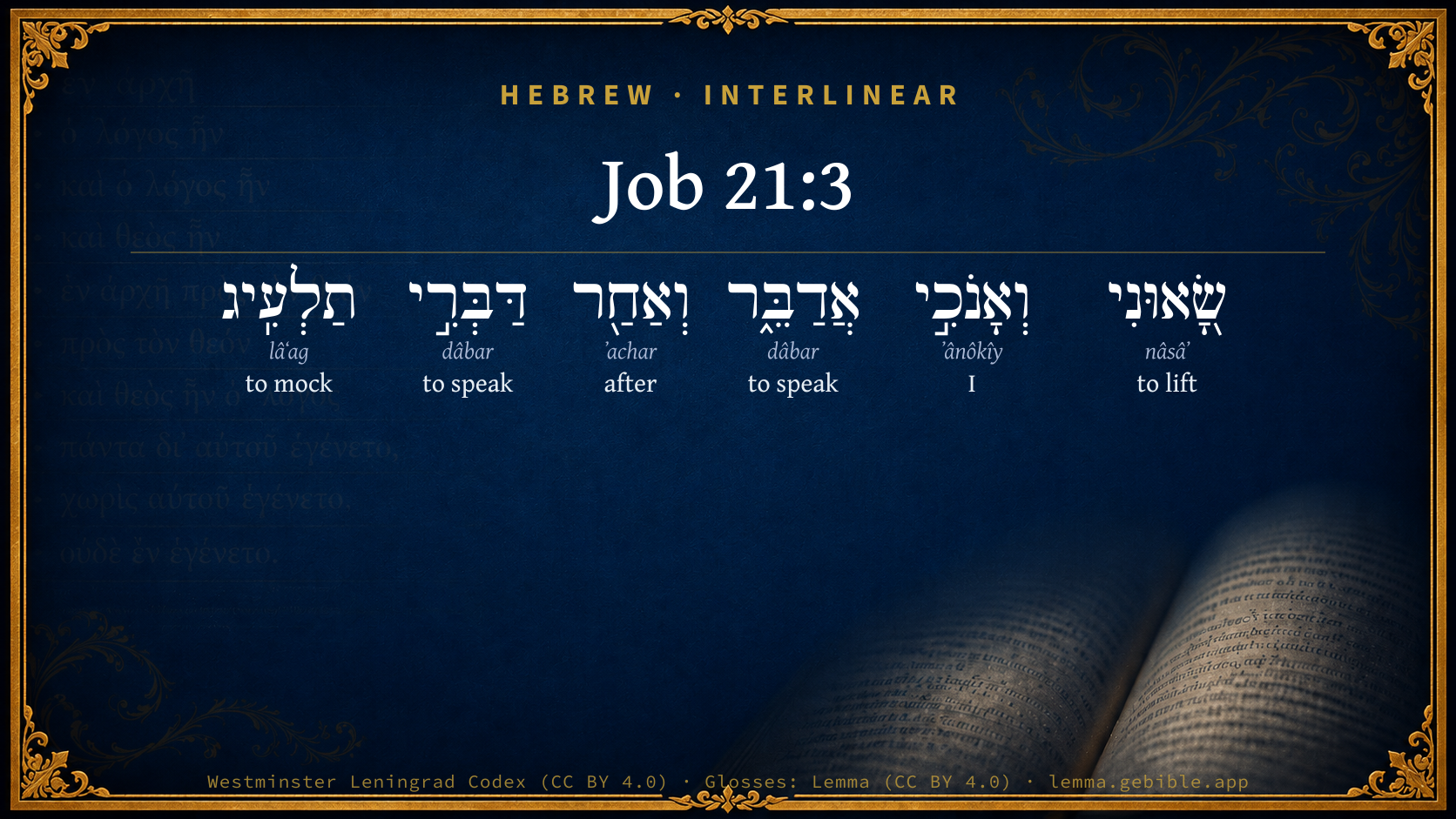
Job 21:3

Hebrew (Westminster Leningrad Codex) Job 21:3 appears in the Hebrew Old Testament. The text above is from the Westminster Leningrad Codex. Each word links to its Strong’s number, a concise gloss, and parsing drawn from the Open Scriptures Hebrew Bible morphology. Click any word for its full Brown-Driver-Briggs (BDB) entry.
Download image
Cite this verse

Job 21:3 (World English Bible). Public Domain. Lemma interlinear Bible study tool, https://lemma.gebible.app/v/job/21/3.

Show BibTeX & RIS
BibTeX
RIS
English Translation
Allow me, and I also will speak; After I have spoken, mock on.
World English Bible · Public Domain
Download a study sheet

One document with this verse’s original text, its word-by-word gloss line, the meaning frame, cross-references with their text, attributed commentary, and full source and license credits — printable, and it pastes into notes with its structure intact.

This verse Autodidact and up

Study sheet (.html) Plain text (.txt)

A passage Seminary Student

Up to 50 verses in one chapter. A passage sheet keeps up to 6 commentary sources and 12 cross-references per verse, in the order this page ranks them, and says so on the sheet whenever that leaves anything out. Ask for a single verse and you get the Autodidact verse sheet above.

Everything on this page stays free to read, with no account — the sheet is a download of what is already on screen, not access to it.

Want to remove ads? Support Godless Engineer
Compare translations 3

The same verse in 3 English versions, stacked beneath the original-language interlinear above. Click any original word for its lexicon entry.

Each is an independent rendering of the whole verse — the interlinear is not word-aligned to these translations.

Highlighted words mark where these versions differ — a whole-verse word diff, not a word-by-word alignment.

  • World English Bible Public Domain
    Allow me, and I also will speak; After I have spoken, mock on.
  • King James Version Public Domain
    Suffer me that I may speak; and after that I have spoken, mock on.
  • unfoldingWord Literal Text CC BY-SA 4.0
    Tolerate me and I will speak, and after I have spoken, you may mock.

unfoldingWord Literal Text — © unfoldingWord, licensed CC BY-SA 4.0. Word-aligned USFM3 via Door43 (git.door43.org/unfoldingWord/en_ult).

Versions to compare (up to 4)

3 of 4 selected

Show all 18 translations

Every available English version of this verse, each an independent rendering of the whole verse.

  • World English Bible Public Domain
    Allow me, and I also will speak; After I have spoken, mock on.
  • Berean Standard Bible Public Domain
    Bear with me while I speak; then, after I have spoken, you may go on mocking.
  • Majority Standard Bible Public Domain
    Bear with me while I speak; then, after I have spoken, you may go on mocking.
  • King James Version Public Domain
    Suffer me that I may speak; and after that I have spoken, mock on.
  • American Standard Version (1901) Public Domain
    Suffer me, and I also will speak; And after that I have spoken, mock on.
  • Revised Version (1885) Public Domain
    Suffer me, and I also will speak; and after that I have spoken, mock on.
  • Geneva Bible (1599) Public Domain
    Suffer mee, that I may speake, and when I haue spoken, mocke on.
  • Douay-Rheims (1899) Public Domain
    Suffer me, and I will speak, and after, if you please, laugh at my words.
  • Young's Literal Translation Public Domain
    Bear with me, and I speak, And after my speaking -- ye may deride.
  • Literal Standard Version CC BY-SA 4.0
    Bear with me, and I speak, || And after my speaking—you may deride.
  • Unlocked Literal Bible CC BY-SA 4.0
    Put up with me, and I also will speak; after I have spoken, mock on.
  • unfoldingWord Literal Text CC BY-SA 4.0
    Tolerate me and I will speak, and after I have spoken, you may mock.
  • Darby Bible Public Domain
    Suffer me and I will speak; and after I have spoken, mock on!
  • World Messianic Bible Public Domain
    Allow me, and I also will speak. After I have spoken, mock on.
  • Webster's Bible Public Domain
    Suffer me that I may speak; and after I have spoken, mock on.
  • Free Bible Version CC BY-SA 4.0
    Bear with me; let me speak. After I've spoken you can resume mocking me.
  • Bible in Basic English Public Domain
    Let me say what is in my mind, and after that, go on making sport of me.
  • JPS Tanakh (1917) Public Domain
    Suffer me, that I may speak; and after that I have spoken, mock on.

Literal Standard Version (2020), Covenant Press — licensed CC BY-SA 4.0. Text via the HelloAO Bible API (eBible.org). Unlocked Literal Bible (unfoldingWord) — licensed CC BY-SA 4.0. Text via the HelloAO Bible API (eBible.org). unfoldingWord Literal Text — © unfoldingWord, licensed CC BY-SA 4.0. Word-aligned USFM3 via Door43 (git.door43.org/unfoldingWord/en_ult). Free Bible Version, Dr. Jonathan Gallagher — licensed CC BY-SA 4.0. Text via the HelloAO Bible API (eBible.org).

Word by word

More ways to search: Search by grammar → Find every occurrence → Compare this word →

Practice this passage: Drill this verse → Learn its vocabulary →

About this verse

These counts appear in no published source. They are computed here, from the morphology-tagged text and Lemma’s own curated glosses. What Lemma adds →

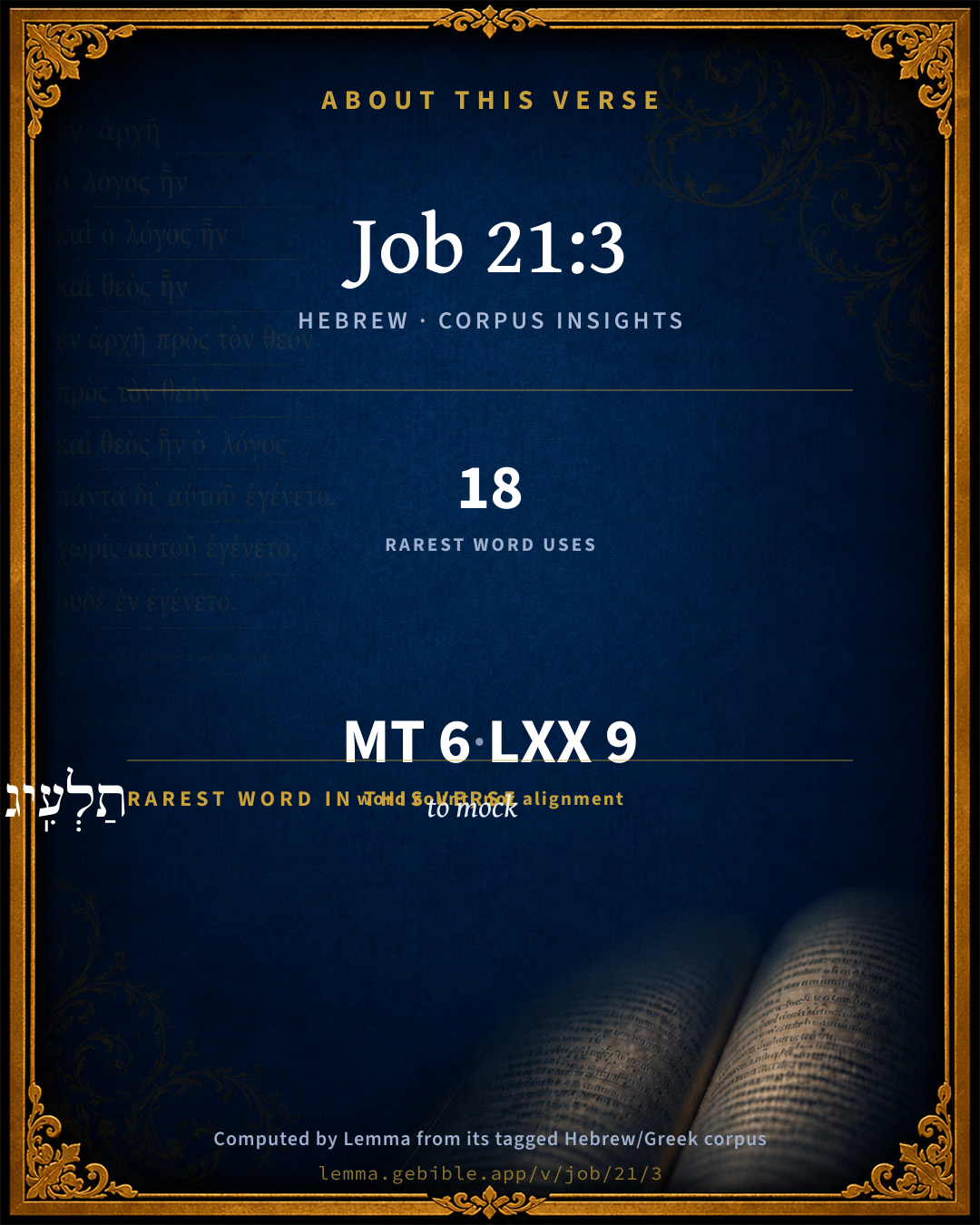
6
words
5
distinct lemmas
Wisdom
section

Notable vocabulary

The rarest word here is תַלְעִֽיג to mock H3932 — appearing just 18 times in the whole Hebrew Bible.

Shared distinctive vocabulary

תַלְעִֽיג to mock H3932 occurs in 18 verses of the Hebrew Bible. Also found in:

Grammatical profile

  • 4 verbs
  • 1 pronoun
  • 1 adverb

Verb forms

  • שָׂ֭אוּנִי Qal · Imperative
  • אֲדַבֵּ֑ר Piel · Imperfect
  • דַּבְּרִ֣י Piel · Infinitive Construct
  • תַלְעִֽיג Hiphil · Imperfect

Repetition

A word recurs within this verse — often emphatic in Hebrew:

  • אֲדַבֵּ֑ר to speak H1696 ×2

Hebrew & Septuagint length

In English translation the verse runs 13 words from the Hebrew and 14 from the Septuagint (LXX English) — closely comparable.

A rough comparison of the two English renderings, which tokenize alike — not a word-level alignment.

Word counts can differ between the Hebrew and the Greek without any difference in meaning — e.g. the Hebrew direct-object marker אֵת has no separate Greek word, and Greek often adds the article ὁ.

In the original languages it is 6 Hebrew tokens and 9 Greek tokens — but the two are counted differently (Hebrew bundles its prefixes and suffixes into one token; the Greek is in lemma form), so that isn’t a like-for-like length.

Cross-references

7

Topical passages linked to Job 21:3 in the Treasury of Scripture Knowledge — connected by theme and wording, ordered by reader-vote popularity; previews shown in the World English Bible.

  • Job 16:10 They have gaped on me with their mouth; They have struck me on the cheek reproachfully. They gather themselves together against me.
  • Job 17:2 Surely there are mockers with me, My eye dwells on their provocation.
  • Job 16:20 My friends scoff at me. My eyes pour out tears to God,
  • Job 12:4–5 I am like one who is a joke to his neighbor, I, who called on God, and he answered. The just, the blameless man is a joke.
  • Job 13:9 Is it good that he should search you out? Or as one deceives a man, will you deceive him?
  • Job 13:13 "Be silent, leave me alone, that I may speak. Let come on me what will.
  • Job 33:31–33 Mark well, Job, and listen to me: Hold your peace, and I will speak.

Cross-references courtesy of OpenBible.info (CC BY 4.0).

Hebrew and Greek witnesses Masoretic Hebrew ↔ Greek Septuagint

The same verse in the two great witnesses to the Old Testament, shown verse-for-verse.

These are two independent witnesses, not word-aligned to each other, and the Septuagint is shown in lemma (dictionary) form.

Hebrew Job 21:3 Masoretic · Westminster Leningrad Codex

שָׂ֭אוּנִי וְאָנֹכִ֣י אֲדַבֵּ֑ר וְאַחַ֖ר דַּבְּרִ֣י תַלְעִֽיג

Allow me, and I also will speak; After I have spoken, mock on.

World English Bible · Public Domain

Greek LXX Job 21:3 Septuagint · lemma form

αἴρω ἐγώ ἐγώ δέ λαλέω εἶτα οὐ καταγελάω ἐγώ

Raise me, and I will speak; then you⌃ shall not laugh me to scorn.

LXX2012 (modern English Septuagint) · Public Domain

Hebrew: Westminster Leningrad Codex (CC BY 4.0). Greek: Septuagint (public domain); English from LXX2012 (modern English Septuagint) (Public Domain). How the Septuagint differs from the Hebrew →

Commentary

Notes on Job 21:3 from classic Christian and Jewish commentators (each source and its license shown beneath its notes). The classic Christian expositions comment on the surrounding passage and are grouped to its opening verse, so a note may address several verses; the Jewish commentaries on the Tanakh (Rashi and others) are per-verse, so they appear only where the commentator wrote on this verse.

Lemma curates 59 commentaries, every one of them public domain or Creative Commons licensed, each selected and text-cleaned for this edition rather than reprinted as found. About our sources →

Trapp's Complete Commentary

John Trapp

Job 21:3 Suffer me that I may speak; and after that I have spoken, mock on.

Ver. 3. Suffer me that I may speak] Say that it be suffering to you to hear me (for now I see you have, as they write of some creatures, fel in aure), yet put yourselves to the pain of hearing me, and bear me, though I am burdensome to you, though my speeches cross the grain of your spirits. See 2Co 11:1. I will promise you to speak nothing worthy of a scoff, such as was that of Theophrastus, Let him shun the talkative man who would not be put into a fit of a fever (Theoph. Charact. cap. de garrul.). Or that of Aristotle, before whom when one, having made a long and idle discourse, concluded it thus, I doubt I have been too tedious unto you, sir philosopher, with my many words: In good sooth, said Aristotle, you have not been tedious to me, for I gave no heed to anything you said (Plut. de Garrulit.).

And after I have spoken, mock on] Heb. Mock thou on, thou Zophar (to whom he turned his speech, and very likely his eye also), if thou canst find in thy heart to mock at so much reason as I shall allege in mine own defence; I gainstand thee not. He lacked no wit who said, If a wise man speak evil of thee or to thee, endure him; if a fool, slight him. Sile, et funestam dedisti plagam, trouble not thyself at his taunts, and thou punishest him sufficiently (Chrysost.).

John Trapp, A Commentary or Exposition upon All the Books of the Old and New Testament (1647–1656) — public domain. Text from a community e-Sword module.

Jamieson, Fausset & Brown

Robert Jamieson, A. R. Fausset & David Brown

literally, "Begin your mockings" (Job 17:2).

Jamieson, Fausset & Brown — Commentary Critical and Explanatory on the Whole Bible (1871) — public domain (CC PDM 1.0). Text via the HelloAO Bible API.

The Cambridge Bible for Schools and Colleges

gen. ed. J. J. S. Perowne

3. mock on] This last word is sing. and seems addressed to Zophar the last speaker, whose pictures of the fate of the wicked deeply wounded Job. Having heard his account of the prosperity of the wicked, they shall have leave then to proceed with their bitter taunts and insinuations if they have a mind.

The Cambridge Bible for Schools and Colleges (gen. ed. J. J. S. Perowne; Cambridge University Press, 1878–1918) — public domain. Text from a community e-Sword module.

John Gill's Exposition

As for me, is my complaint to man?.... Job had been complaining, and still was, and continued to do so after this, but not to them, his friends, nor any other man; his complaint was made to God, and of him he thought he was hardly dealt with by him, he could not tell for what; he had desired to know the reason why he contended with him in such a manner, but could get no satisfaction; when his friends came first to visit him, they said nothing to him, nor he to them; and when he did speak, it was not to them, but to God, of whom he complains; and expostulates with him why he had ever been born, or had not died as soon as born, and not have lived to have seen such unhappy days, and endured so much affliction and trouble:

and if it were so; that he had made his complaint to man, since it would have been in vain, and to no purpose, he should have got no relief, nor obtained any satisfaction:

why should not my spirit be troubled? or "shortened" (l); or, as the Targum, be straitened; for as comfort and joy enlarge the heart, trouble contracts and straitens it; or is "my prayer" or (m) "petition to men?" it was not, though he was reduced so low, and was in such a distressed condition; he had asked nothing of men, not of these his friends, neither to give him of their substance, nor to help him out of the hands of his enemies, Job 6:21; he had poured out his complaint before God, and had directed his prayer to the God of his life; he had desired to speak to none but the Almighty, and to reason only with him; he had petitioned him to take cognizance of his case, and to admit of a hearing of it before him, and to have it determined by him; he had complained of wrongs and injuries done him, and begged to be redressed and righted, but got no answer; God did not think fit to answer him, but hid himself from him, and continued so to do: "and if", if this be the case, as it really was, "why should not my spirit be troubled?" is there not reason for it? Some think Job's meaning is, is "my disputation", as the Vulgate Latin version, or is my discourse concerning human things, things within the compass of human knowledge and reasoning? or, to be attained to by the force of that, without divine revelation? no, it is concerning divine things; concerning the mysteries of Providence, with respect to good and bad men; concerning the living Redeemer, his incarnation, resurrection, &c. and faith in him; concerning the general resurrection, the final judgment, and a future state of happiness: or does my complaint, petition, or discourse, savour of that which is human, and is intermixed with human frailty? if it be so, it should be borne with, it should be considered I am but a man, and liable to err; and especially great allowances should be made in my present circumstances, being trader such sore afflictions; and it may be reasonably thought, that though the spirit may be willing to behave in a better manner, the flesh is weak, and much must be imputed unto that; and it will not seem so extravagant to indulge a troubled spirit so severely exercised; persons under afflictions generally think they do well to be troubled, and that there is reason enough for it, and ought to be borne with, and not to be reproached and rallied on that account.

(l) "abbreviabitur", Montanus, Vatablus, "abbreviaretur", Drusius, Cocceius, Michaelis. (m) "precatio mea", Drusius.

John Gill's Exposition of the Whole Bible (1746–1763) — public domain (CC PDM 1.0). Text via the HelloAO Bible API.

Albert Barnes' Notes on the Bible

Suffer me that I may speak - Allow me to speak without interruption, or bear with me while I freely express my sentiments - it is all that I now ask.

And after that I have spoken, mock on - Resume your reproaches, if you will, when I am done. I ask only the privilege of expressing my thoughts on a very important point, and when that is done, I will allow you to resume your remarks as you have done before, and you may utter your sentiments without interruption. Or it may be, that Job utters this in a kind of triumph, and that he feels that what he was about to say was so important that it would end the “argument;” and that all they could say after that would be mere mockery and reviling. The word rendered “mock on” (לעג lâ‛ag) means, originally, “to stammer, to speak unintelligibly” - then, “to speak in a barbarous or foreign language” - then, “to deride or to mock, to ridicule or insult.” The idea is, that they might mock his woes, and torture his feelings as they had done, if they would only allow him to express his sentiments.

Albert Barnes' Notes on the Bible (1834–1885) — public domain. Text from a community e-Sword/MySword module.

Matthew Poole's English Annotations

Suffer me that I may speak without such interruption as you have given me, Job 20:2; and if I do not defend my cause with solid and convincing arguments, go on in your scoffs if you please.

Matthew Poole's English Annotations on the Holy Bible (1683–1685) — public domain. Text from a community e-Sword/MySword module.

Whedon's Commentary on the Bible

Daniel D. Whedon

3. Mock on — Literally, thou mayest mock. He means Zophar, whose remarks were thus far the most cruel and lacerating of all. In his would-be coup-de-grace Zophar exhausted himself, and speaks no more. Job’s individualizing of Zophar here, as of Eliphaz in Job_16:3, and of Bildad in Job_26:2-4, spurs the sufferer up to the highest strains of oratory.

Daniel D. Whedon (gen. ed.), Commentary on the Old and New Testaments (1874–1909) — public domain. Text from a community e-Sword module.

The Pulpit Commentary

Suffer me that I may speak; or, suffer me, and I also will speak. There is an emphasis on the "I" (ykna). Job implies that his opponents are not allowing him his fair share of the argument, which is an accusation that can scarcely be justified. Since the dialogue opened, Job"s speeches have occupied eleven chapters, those of his "comforters" seven only. But a controversialist who has much to say is apt to think that sufficient time is not allowed him. And after that I have spoken, mock on. Job does not hope to convince, or silence, or shame the other interlocutors. When he has said his say, all that he expects is mockery and derision.

HOMILIES BY W.F. ADENEY Ver. 3. The right of reply.

I THE RIGHT OF REPLY IS JUSTLY CLAIMED. Job has heard enough from his friends. He is impatient to answer them. Surely they should allow him to do so.

1. This right is conceded law. The worst criminal may be defended by counsel, may call witnesses in his favour, may make his own statement. In civil eases both sides are heard before judgment is pronounced.

2. This right should be allowed in social life. It is not just to condemn any one unheard. There may come to us a damaging tale concerning a person; it is our duty to suspend our judgment till he has given his explanation.

3. This right ought to be permitted in theology. It was a theological as well as a personal discussion that Job was carrying on with his friends. But in theology people are most impatient of hearing anything contrary to their own views. Yet it is not just to condemn those who differ from us until we have heard what they have to say on their side of a question.

II THE RIGHT OF REPLY IS HELPFUL IN THE INTERESTS OF TRUTH. We are all tempted to take partial, one-sided views of things. It is only by bringing light from all quarters that we can see the rounded totality of truth. Therefore discussion helps truth. At first, indeed, it may not seem to do so, and, indeed, there seems to be a certain irony in it, for the most eager combatants are usually furthest from a just con-caption of what they are contending for. But after the discussion is over, those who look on are better able to understand the whole subject. Thus the discussion of Job and his friends throws light on the mystery of Providence. The creeds of Christendom were forged in the fires of controversy. Theology is a result of discussion. The right of reply has given breadth, depth, and definiteness to it. Truth is not helped by the persecution of error.

III THE RIGHT OF REPLY IS A CONSOLATION TO THE MISJUDGED. Job only asks for this. When he has spoken his friends may mock on. There is some humour in his tone, or perhaps a bitter scorn. Truth is strong. Only let it shine out in its native strength, and calumny must wither before it. Any unjust accusations will then only break themselves like waves that are dashed to pieces on the crags. We can afford to be indifferent to falsehood and error if we can speak out and let the truth be fairly seen.

IV THE RIGHT OF REPLY WILL BE GIVEN ULTIMATELY TO ALL, It will be of little use to those who are in the wrong. To be able to stand up in the searching light of eternity and reply for a bad case is no desirable privilege. Rather than attempt to reply, the self-convicted sinner will call on the mountains and hills to cover him. But those who are honestly endeavouring to make the truth manifest in face of great opposition and gross misapprehension may learn to possess their souls in patience if they will come to understand that the oppression and injustice are but temporary. Though silenced for a season, ultimately truth will speak out with a trumpet-voice.

In conclusion, let us remember that God has a right of redly to all man"s foolish sophistry, to all his shuffling excuses. All error and pretence will be pulverized annihilated when God speaks his great answer to cavilers, unbelievers, and opponents of every kind. W.F.A.

The Pulpit Commentary (1880–1919), ed. H.D.M. Spence-Jones & Joseph S. Exell — public domain. Text from a community e-Sword module.

John Wesley's Explanatory Notes

Speak - without interruption. Mock - If I do not defend my cause with solid arguments, go on in your scoffs.

John Wesley, Explanatory Notes Upon the Whole Bible (1754–1765) — public domain. Text via the GEBible commentary corpus.

Rashi

Rabbi Shlomo Yitzchaki (Rashi)

Bear with me Heb. שאוני, endure me.

Rashi on the Tanakh — English translations: “The Judaica Press complete Tanach with Rashi, translated by A. J. Rosenberg” (CC BY 4.0); “Pentateuch with Rashi's commentary by M. Rosenbaum and A.M. Silbermann, 1929-1934” (public domain); “The Metsudah Tanach series, Lakewood, N.J” (CC BY 4.0); and “The Book of Joshua, Metsudah Publications, 1997” (CC BY 4.0). Text via Sefaria.

Lesson kit

Teaching starters — assembled from the data on this page, not authored interpretation. Every prompt links to the verse data it draws on. Edit before teaching.

Job, in the Wisdom, opens this verse with 6 words (5 distinct Hebrew lemmas). Its most distinctive word is lâʻag (“to mock”). A historical commentator’s framing appears above. Read the whole chapter for the surrounding context.

Discussion questions

  1. The word lâʻag carries the sense “to mock.” How does it shape the verse?
  2. How does 2 Kings 19:21, which shares the word «to mock», read alongside this verse?
  3. What does the repetition of “to speak” (2× in this one verse) do in this verse?
  4. The translations on this page render this verse differently — a whole-verse word diff, not a word-by-word alignment. What might account for the different wordings?
  5. «שָׂ֭אוּנִי» is a Qal Imperative verb. How does that grammatical form shape the action described?
  6. Compare how Trapp's Complete Commentary and Jamieson, Fausset & Brown read this verse. Where do they agree or differ?

Things to notice

Reading settings

Reading text

Shown beneath each verse's original-language words.

Old Testament
Old Testament edition

Read the OT as the Masoretic Hebrew (MT) or the Greek Septuagint (LXX).

English shown for the Greek Septuagint (in the Hebrew ↔ Greek comparison).

Comparing translations? Open the Compare panel on any verse page to stack up to four side by side.