
Exodus 28:38

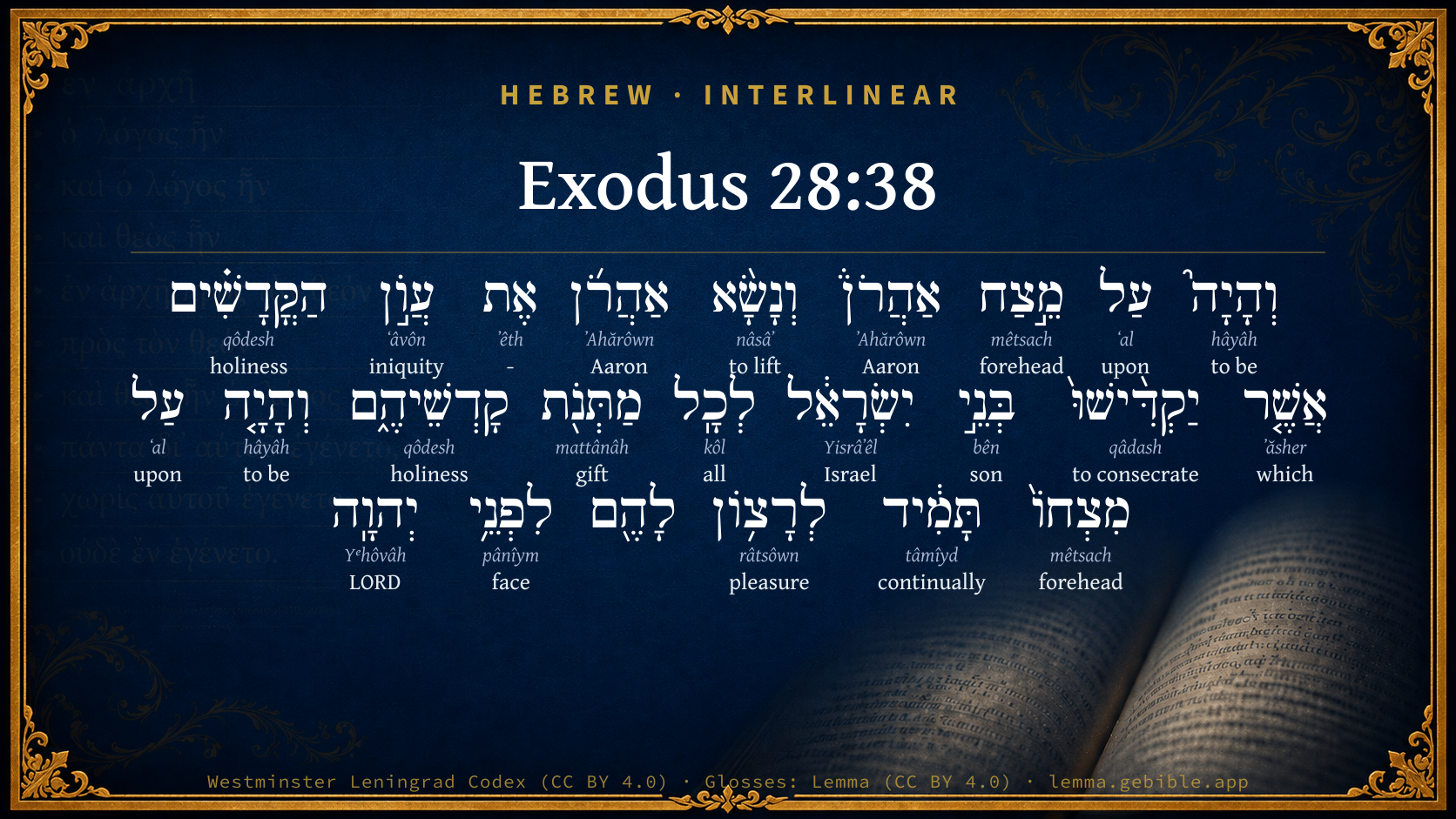
Hebrew (Westminster Leningrad Codex) Exodus 28:38 appears in the Hebrew Old Testament. The text above is from the Westminster Leningrad Codex. Each word links to its Strong’s number, a concise gloss, and parsing drawn from the Open Scriptures Hebrew Bible morphology. Click any word for its full Brown-Driver-Briggs (BDB) entry.
Download image
Cite this verse

Exodus 28:38 (World English Bible). Public Domain. Lemma interlinear Bible study tool, https://lemma.gebible.app/v/exodus/28/38.

Show BibTeX & RIS
BibTeX
RIS
English Translation
It shall be on Aaron's forehead, and Aaron shall bear the iniquity of the holy things, which the children of Israel shall make holy in all their holy gifts; and it shall be always on his forehead, that they may be accepted before Yahweh.
World English Bible · Public Domain
Highlights Full analysis ↓
Download a study sheet

One document with this verse’s original text, its word-by-word gloss line, the meaning frame, cross-references with their text, attributed commentary, and full source and license credits — printable, and it pastes into notes with its structure intact.

This verse Autodidact and up

Study sheet (.html) Plain text (.txt)

A passage Seminary Student

Up to 50 verses in one chapter. A passage sheet keeps up to 6 commentary sources and 12 cross-references per verse, in the order this page ranks them, and says so on the sheet whenever that leaves anything out. Ask for a single verse and you get the Autodidact verse sheet above.

Everything on this page stays free to read, with no account — the sheet is a download of what is already on screen, not access to it.

Want to remove ads? Support Godless Engineer
Compare translations 3

The same verse in 3 English versions, stacked beneath the original-language interlinear above. Click any original word for its lexicon entry.

Each is an independent rendering of the whole verse — the interlinear is not word-aligned to these translations.

Highlighted words mark where these versions differ — a whole-verse word diff, not a word-by-word alignment.

  • World English Bible Public Domain
    It shall be on Aaron's forehead, and Aaron shall bear the iniquity of the holy things, which the children of Israel shall make holy in all their holy gifts; and it shall be always on his forehead, that they may be accepted before Yahweh.
  • King James Version Public Domain
    And it shall be upon Aaron's forehead, that Aaron may bear the iniquity of the holy things, which the children of Israel shall hallow in all their holy gifts; and it shall be always upon his forehead, that they may be accepted before the LORD.
  • unfoldingWord Literal Text CC BY-SA 4.0
    And it shall be on the forehead of Aaron, and Aaron shall bear the iniquity of the holy things which the sons of Israel shall cause to be holy, for all of the gifts of their holy things, and it shall be on his forehead continually for their acceptance before the face of Yahweh.

unfoldingWord Literal Text — © unfoldingWord, licensed CC BY-SA 4.0. Word-aligned USFM3 via Door43 (git.door43.org/unfoldingWord/en_ult).

Versions to compare (up to 4)

3 of 4 selected

Show all 18 translations

Every available English version of this verse, each an independent rendering of the whole verse.

  • World English Bible Public Domain
    It shall be on Aaron's forehead, and Aaron shall bear the iniquity of the holy things, which the children of Israel shall make holy in all their holy gifts; and it shall be always on his forehead, that they may be accepted before Yahweh.
  • Berean Standard Bible Public Domain
    And it will be worn on Aaron’s forehead, so that he may bear the iniquity of the holy things that the sons of Israel consecrate with regard to all their holy gifts. It shall always be on his forehead, so that they may be acceptable before the LORD.
  • Majority Standard Bible Public Domain
    And it will be worn on Aaron’s forehead, so that he may bear the iniquity of the holy things that the sons of Israel consecrate with regard to all their holy gifts. It shall always be on his forehead, so that they may be acceptable before the LORD.
  • King James Version Public Domain
    And it shall be upon Aaron's forehead, that Aaron may bear the iniquity of the holy things, which the children of Israel shall hallow in all their holy gifts; and it shall be always upon his forehead, that they may be accepted before the LORD.
  • American Standard Version (1901) Public Domain
    And it shall be upon Aaron's forehead, and Aaron shall bear the iniquity of the holy things, which the children of Israel shall hallow in all their holy gifts; and it shall be always upon his forehead, that they may be accepted before Jehovah.
  • Revised Version (1885) Public Domain
    And it shall be upon Aaron’s forehead, and Aaron shall bear the iniquity of the holy things, which the children of Israel shall hallow in all their holy gifts; and it shall be always upon his forehead, that they may be accepted before the LORD.
  • Geneva Bible (1599) Public Domain
    So it shalbe vpon Aarons forehead, that Aaron may beare the iniquitie of the offrings, which the children of Israel shall offer in all their holy offrings: and it shall be alwayes vpon his forehead, to make them acceptable before the Lord.
  • Douay-Rheims (1899) Public Domain
    Hanging over the forehead of the high priest. And Aaron shall bear the iniquities of those things, which the children of Israel have offered and sanctified, in all their gifts and offerings. And the plate shall be always on his forehead, that the Lord may be well pleased with them.
  • Young's Literal Translation Public Domain
    and it hath been on the forehead of Aaron, and Aaron hath borne the iniquity of the holy things which the sons of Israel do hallow, even all their holy gifts; and it hath been on his forehead continually for a pleasing thing for them before Jehovah.
  • Literal Standard Version CC BY-SA 4.0
    and it has been on the forehead of Aaron, and Aaron has borne the iniquity of the holy things which the sons of Israel hallow, even all their holy gifts; and it has been on his forehead continually for a pleasing thing for them before YHWH.
  • Unlocked Literal Bible CC BY-SA 4.0
    It must be on Aaron's forehead; he must always bear any guilt that might attach to the offering of the holy gifts that the Israelites set apart to Yahweh. The turban must be always on his forehead so that Yahweh may accept their gifts.
  • unfoldingWord Literal Text CC BY-SA 4.0
    And it shall be on the forehead of Aaron, and Aaron shall bear the iniquity of the holy things which the sons of Israel shall cause to be holy, for all of the gifts of their holy things, and it shall be on his forehead continually for their acceptance before the face of Yahweh.
  • Darby Bible Public Domain
    And it shall be upon Aaron's forehead, and Aaron shall bear the iniquity of the holy things, which the children of Israel shall hallow in all gifts of their holy things; and it shall be continually on his forehead, that they may be accepted before Jehovah.
  • World Messianic Bible Public Domain
    It shall be on Aaron’s forehead, and Aaron shall bear the iniquity of the holy things, which the children of Israel shall make holy in all their holy gifts; and it shall be always on his forehead, that they may be accepted before the LORD.
  • Webster's Bible Public Domain
    And it shall be upon Aaron's forehead, that Aaron may bear the iniquity of the holy things, which the children of Israel shall hallow in all their holy gifts; and it shall be always upon his forehead, that they may be accepted before the LORD.
  • Free Bible Version CC BY-SA 4.0
    Aaron will wear it on his forehead, so that he may take responsibility for the guilt of the offerings the Israelites make, and this applies to all their holy gifts. It must always remain on his forehead in order that the people are accepted in the Lord's presence.
  • Bible in Basic English Public Domain
    And it will be over Aaron's brow, so that Aaron will be responsible for any error in all the holy offerings made by the children of Israel; it will be on his brow at all times, so that their offerings may be pleasing to the Lord.
  • JPS Tanakh (1917) Public Domain
    And it shall be upon Aaron's forehead, and Aaron shall bear the iniquity committed in the holy things, which the children of Israel shall hallow, even in all their holy gifts; and it shall be always upon his forehead, that they may be accepted before the LORD.

Literal Standard Version (2020), Covenant Press — licensed CC BY-SA 4.0. Text via the HelloAO Bible API (eBible.org). Unlocked Literal Bible (unfoldingWord) — licensed CC BY-SA 4.0. Text via the HelloAO Bible API (eBible.org). unfoldingWord Literal Text — © unfoldingWord, licensed CC BY-SA 4.0. Word-aligned USFM3 via Door43 (git.door43.org/unfoldingWord/en_ult). Free Bible Version, Dr. Jonathan Gallagher — licensed CC BY-SA 4.0. Text via the HelloAO Bible API (eBible.org).

Word by word

More ways to search: Search by grammar → Find every occurrence → Compare this word →

Practice this passage: Drill this verse → Learn its vocabulary →

מֵ֣צַח
mêtsach
H4696
“forehead of”
Noun, Common, Masculine, Singular, Construct
Part of Speech
Noun
Type
Common
Gender
Masculine
Number
Singular
State
Construct
Full BDB Definition

Origin: from an unused root meaning to be clear, i.e. conspicuous

TWOT: 1233a

brow, forehead
  1. וְהָיָה֮ hâyâh H1961 “and · to be” Conjunction + Verb, Qal, Sequential Perfect, 3rd Person, Masculine, Singular
  2. עַל ʻal H5921 “upon” Preposition
  3. אַהֲרֹן֒ ʼAhărôwn H175 “Aaron” Noun, Proper
  4. וְנָשָׂ֨א nâsâʼ H5375 “and · to lift” Conjunction + Verb, Qal, Sequential Perfect, 3rd Person, Masculine, Singular
  5. אַהֲרֹ֜ן ʼAhărôwn H175 “Aaron” Noun, Proper
  6. אֶת ʼêth H853 “-” Particle, Direct Object
  7. עֲוֺ֣ן ʻâvôn H5771 “iniquity of” Noun, Common, Both, Singular, Construct
  8. הַקֳּדָשִׁ֗ים qôdesh H6944 “the · holy things” Particle, Definite Article + Noun, Common, Masculine, Plural, Absolute
  9. אֲשֶׁ֤ר ʼăsher H834 “which” Particle, Relative
  10. יַקְדִּ֨ישׁוּ֙ qâdash H6942 “to consecrate” Verb, Hiphil, Imperfect, 3rd Person, Masculine, Plural
  11. בְּנֵ֣י bên H1121 “sons of” Noun, Common, Masculine, Plural, Construct
  12. יִשְׂרָאֵ֔ל Yisrâʼêl H3478 “Israel” Noun, Proper
  13. לְכָֽל kôl H3605 “to/for · all of” Preposition + Noun, Common, Masculine, Singular, Construct
  14. מַתְּנֹ֖ת mattânâh H4979 “gifts of” Noun, Common, Feminine, Plural, Construct
  15. קָדְשֵׁיהֶ֑ם qôdesh H6944 “holy things · their” Noun, Common, Masculine, Plural, Construct + Suffix, Personal, 3rd Person, Masculine, Plural
  16. וְהָיָ֤ה hâyâh H1961 “and · to be” Conjunction + Verb, Qal, Sequential Perfect, 3rd Person, Masculine, Singular
  17. עַל ʻal H5921 “upon” Preposition
  18. מִצְחוֹ֙ mêtsach H4696 “forehead · his” Noun, Common, Masculine, Singular, Construct + Suffix, Personal, 3rd Person, Masculine, Singular
  19. תָּמִ֔יד tâmîyd H8548 “continually” Noun, Common, Masculine, Singular, Absolute
  20. לְרָצ֥וֹן râtsôwn H7522 “to/for · pleasure” Preposition + Noun, Common, Masculine, Singular, Absolute
  21. לִפְנֵ֥י pânîym H6440 “to/for · face(s) of” Preposition + Noun, Common, Both, Plural, Construct
  22. יְהוָֽה Yᵉhôvâh H3068 “LORD” Noun, Proper

About this verse

These counts appear in no published source. They are computed here, from the morphology-tagged text and Lemma’s own curated glosses. What Lemma adds →

24
words
18
distinct lemmas
Pentateuch
section

Notable vocabulary

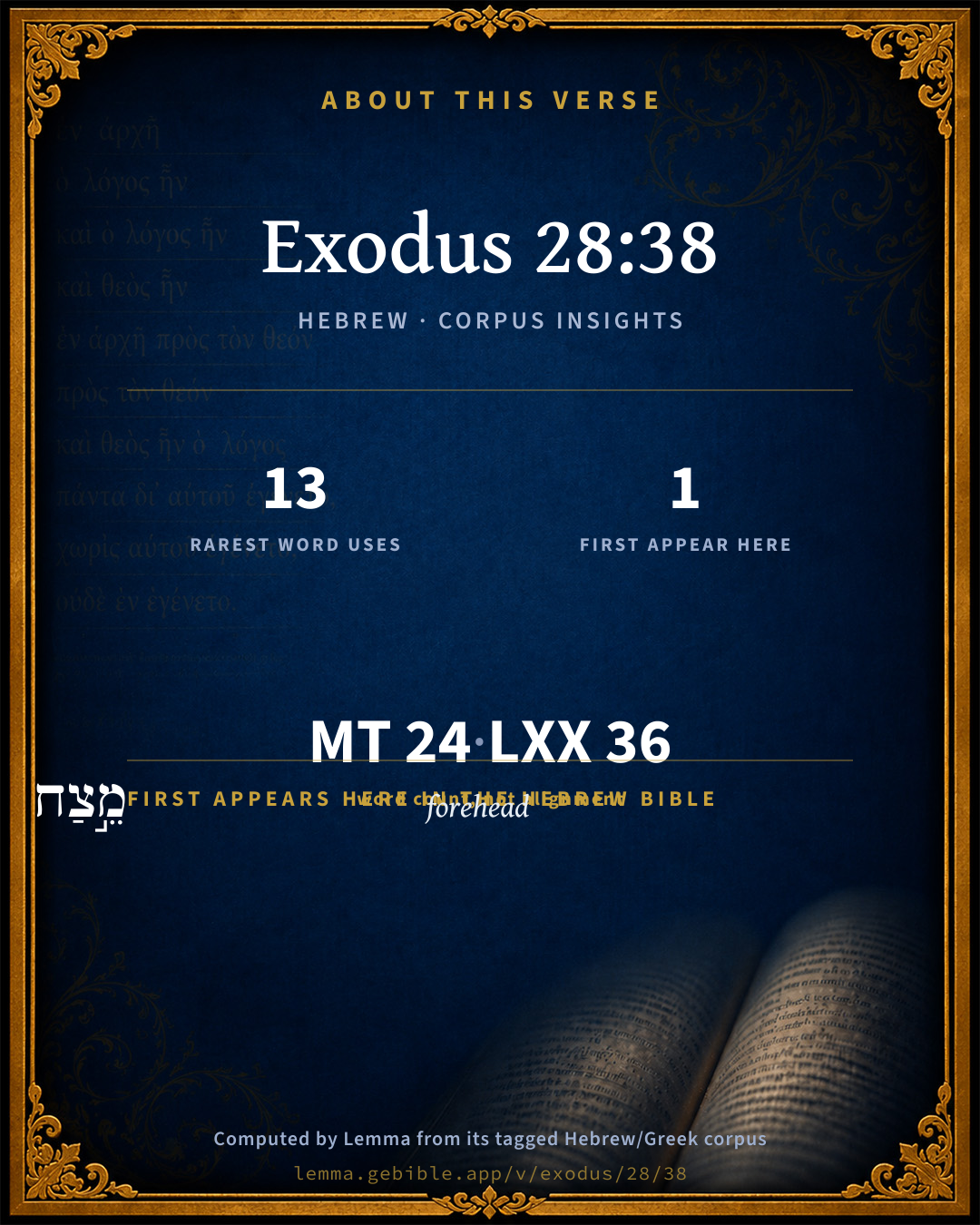
The rarest word here is מֵ֣צַח forehead H4696 — appearing just 13 times in the whole Hebrew Bible.

First appearance in Scripture

This word makes its first canonical appearance in the Hebrew Bible here:

  • מֵ֣צַח forehead H4696

Shared distinctive vocabulary

מֵ֣צַח forehead H4696 occurs in 10 verses of the Hebrew Bible. Also found in:

Grammatical profile

  • 4 verbs
  • 15 nouns
  • 3 prepositions
  • 2 particles

Verb forms

  • וְהָיָה֮ Qal · Sequential Perfect
  • וְנָשָׂ֨א Qal · Sequential Perfect
  • יַקְדִּ֨ישׁוּ֙ Hiphil · Imperfect
  • וְהָיָ֤ה Qal · Sequential Perfect

Repetition

Words recur within this verse — often emphatic in Hebrew:

  • וְהָיָה֮ to be H1961 ×2
  • עַל upon H5921 ×2
  • מֵ֣צַח forehead H4696 ×2
  • אַהֲרֹן֒ Aaron H175 ×2
  • הַקֳּדָשִׁ֗ים holiness H6944 ×2

Hebrew & Septuagint length

In English translation the verse runs 44 words from the Hebrew and 24 from the Septuagint (LXX English) — the Septuagint runs noticeably shorter here. See the side-by-side →

A rough comparison of the two English renderings, which tokenize alike — not a word-level alignment.

Word counts can differ between the Hebrew and the Greek without any difference in meaning — e.g. the Hebrew direct-object marker אֵת has no separate Greek word, and Greek often adds the article ὁ.

In the original languages it is 24 Hebrew tokens and 36 Greek tokens — but the two are counted differently (Hebrew bundles its prefixes and suffixes into one token; the Greek is in lemma form), so that isn’t a like-for-like length.

Cross-references

20

Topical passages linked to Exodus 28:38 in the Treasury of Scripture Knowledge — connected by theme and wording, ordered by reader-vote popularity; previews shown in the World English Bible.

  • 1 Peter 2:24 who his own self bore our sins in his body on the tree, that we, having died to sins, might live to righteousness; by whose stripes you were healed.
  • Numbers 18:1 Yahweh said to Aaron, You and your sons and your fathers' house with you shall bear the iniquity of the sanctuary; and you and your sons with you shall bear the iniquity of your priesthood.
  • Leviticus 10:17 "Why haven't you eaten the sin offering in the place of the sanctuary, seeing it is most holy, and he has given it you to bear the iniquity of the congregation, to make atonement for them before Yahweh?
  • John 1:29 The next day, he saw Jesus coming to him, and said, "Behold, the Lamb of God, who takes away the sin of the world!
  • Hebrews 9:28 so Christ also, having been once offered to bear the sins of many, will appear a second time, without sin, to those who are eagerly waiting for him for salvation.
  • Leviticus 1:4 He shall lay his hand on the head of the burnt offering, and it shall be accepted for him to make atonement for him.
  • Leviticus 22:9 "'They shall therefore keep my charge, lest they bear sin for it, and die therein, if they profane it. I am Yahweh who sanctifies them.
  • Leviticus 22:27 "When a bull, or a sheep, or a goat, is born, then it shall remain seven days with its mother; and from the eighth day and thenceforth it shall be accepted for the offering of an offering made by fire to Yahweh.
  • Isaiah 56:7 even them will I bring to my holy mountain, and make them joyful in my house of prayer: their burnt offerings and their sacrifices shall be accepted on my altar; for my house shall be called a house of prayer for all peoples.
  • Ezekiel 4:4–6 Moreover lie you on your left side, and lay the iniquity of the house of Israel on it; [according to] the number of the days that you shall lie on it, you shall bear their iniquity.
  • Exodus 28:43 They shall be on Aaron, and on his sons, when they go in to the tent of meeting, or when they come near to the altar to minister in the holy place; that they don't bear iniquity, and die: it shall be a statute forever to him and to his descendants after him.
  • Leviticus 23:11 and he shall wave the sheaf before Yahweh, to be accepted for you. On the next day after the Sabbath the priest shall wave it.
  • Isaiah 53:11–12 He shall see of the travail of his soul, [and] shall be satisfied: by the knowledge of himself shall my righteous servant justify many; and he shall bear their iniquities.
  • 2 Corinthians 5:21 For him who knew no sin he made to be sin on our behalf; so that in him we might become the righteousness of God.
  • 1 Peter 2:5 You also, as living stones, are built up as a spiritual house, to be a holy priesthood, to offer up spiritual sacrifices, acceptable to God through Jesus Christ.
  • Leviticus 22:16 and so cause them to bear the iniquity that brings guilt, when they eat their holy things: for I am Yahweh who sanctifies them.'"
  • Isaiah 53:6 All we like sheep have gone astray; everyone has turned to his own way; and Yahweh has laid on him the iniquity of us all.
  • Isaiah 60:7 All the flocks of Kedar shall be gathered together to you, the rams of Nebaioth shall minister to you; they shall come up with acceptance on my altar; and I will glorify the house of my glory.
  • Ephesians 1:6 to the praise of the glory of his grace, by which he freely bestowed favor on us in the Beloved,
  • 1 Peter 3:18 Because Christ also suffered for sins once, the righteous for the unrighteous, that he might bring you to God; being put to death in the flesh, but made alive in the spirit;

Cross-references courtesy of OpenBible.info (CC BY 4.0).

Hebrew and Greek witnesses Masoretic Hebrew ↔ Greek Septuagint

The same verse in the two great witnesses to the Old Testament, shown verse-for-verse.

Here the Septuagint runs noticeably shorter than the Hebrew — LXX2012 (modern English Septuagint) 24 words vs World English Bible 44. A rough length comparison of the two English translations, not a word-level alignment — read both below.

These are two independent witnesses, not word-aligned to each other, and the Septuagint is shown in lemma (dictionary) form.

Hebrew Exodus 28:38 Masoretic · Westminster Leningrad Codex

וְהָיָה֮ עַל מֵ֣צַח אַהֲרֹן֒ וְנָשָׂ֨א אַהֲרֹ֜ן אֶת עֲוֺ֣ן הַקֳּדָשִׁ֗ים אֲשֶׁ֤ר יַקְדִּ֨ישׁוּ֙ בְּנֵ֣י יִשְׂרָאֵ֔ל לְכָֽל מַתְּנֹ֖ת קָדְשֵׁיהֶ֑ם וְהָיָ֤ה עַל מִצְחוֹ֙ תָּמִ֔יד לְרָצ֥וֹן לָהֶ֖ם לִפְנֵ֥י יְהוָֽה

It shall be on Aaron's forehead, and Aaron shall bear the iniquity of the holy things, which the children of Israel shall make holy in all their holy gifts; and it shall be always on his forehead, that they may be accepted before Yahweh.

World English Bible · Public Domain

Greek LXX Exodus 28:38 Septuagint · lemma form

καί εἰμί ἐπί ὁ μέτωπον ααρων καί ἐκαἴρω ααρων ὁ ἁμάρτημα ὁ ἅγιος ὅσος ἄν ἁγιάζω ὁ υἱός ἰσραήλ πᾶς δόμα ὁ ἅγιος αὐτός καί εἰμί ἐπί ὁ μέτωπον ααρων διά πᾶς δεκτός αὐτός ἔναντι κύριος

And you shall make for them linen drawers to cover the nakedness of their flesh; they shall reach from the loins to the thighs.

LXX2012 (modern English Septuagint) · Public Domain

Hebrew: Westminster Leningrad Codex (CC BY 4.0). Greek: Septuagint (public domain); English from LXX2012 (modern English Septuagint) (Public Domain). How the Septuagint differs from the Hebrew →

Targum (Aramaic paraphrase)

2

The Targum is the ancient Jewish Aramaic paraphrase of the Hebrew Scriptures — an interpretive translation, not the Hebrew text itself. Onkelos (literal) and Pseudo-Jonathan (expansive) render the Torah, and Jonathan the Prophets. Coverage is partial: where no permissively-licensed English translation exists for a verse, only the Aramaic is shown. This is verse-level text, not a word-by-word alignment to the Hebrew.

  1. Targum Onkelos Torah (Genesis–Deuteronomy)
    וִיהֵי עַל בֵּית עֵינוֹהִי דְאַהֲרֹן וְיִטּוֹל אַהֲרֹן יָת עֲוָיַת קוּדְשַׁיָא דִי יְקַדְשׁוּן בְּנֵי יִשְׂרָאֵל לְכָל מַתְּנַּת קוּדְשֵׁיהוֹן וִיהֵי עַל בֵּית עֵינוֹהִי תְּדִירָא לְרַעֲוָא לְהוֹן קֳדָם יְיָ:

    (no public-domain English translation for this verse)

    Targum Onkelos — Aramaic: “Onkelos Genesis” (public domain); “Onkelos Exodus” (public domain); “Onkelos Leviticus” (public domain); “Onkelos Numbers” (public domain); “Onkelos Deuteronomy” (public domain). English: “Sefaria Community Translation” (CC0 1.0 (public-domain dedication)); “J.W. Etheridge. The Targums of Onkelos and Jonathan Ben Uzziel on the Pentateuch. London: Longmans, Green, 1862” (public domain). Text via Sefaria.

  2. Targum Pseudo-Jonathan Torah (Genesis–Deuteronomy)
    וִיהֵי עַל פְּדַחְתָּא דְבֵית אַפּוֹי דְאַהֲרן מִן צִידְעָא לְצִידְעָא יִתְמְטֵי וְיִטוֹל אַהֲרן יַת עֲוָויַית קוּדְשַׁיָא דִיקַדְשׁוּן בְּנֵי יִשְרָאֵל לְכָל מַתְּנַת קוּדְשֵׁיהוֹן דִּמְשַׁקְרִין בְּהוֹן וִיהֵי עַל פְּדַחְתֵּיהּ תְּדִירָא לְרַעֲוָא לְהוֹן קֳדָם יְיָ

    And it shall be in the front of Aharon's forehead, from time to time as it comes; and Aharon shall bear the iniquity of the consecrated things which the sons of Israel may consecrate; even of all their sacred gifts in which they have been insincere. And it shall be upon the front continually, for their reconciliation before the Lord.

    Targum Pseudo-Jonathan — Aramaic: “Targum Jonathan on Genesis” (public domain); “Targum Jonathan on Exodus” (public domain); “Targum Jonathan on Leviticus” (public domain); “Targum Jonathan on Numbers” (public domain); “Targum Jonathan on Deuteronomy” (public domain). English: “The Targum of Jonathan ben Uzziel, trans. J. W. Etheridge, London, 1862” (public domain). Text via Sefaria.

Commentary

Notes on Exodus 28:38 from classic Christian and Jewish commentators (each source and its license shown beneath its notes). The classic Christian expositions comment on the surrounding passage and are grouped to its opening verse, so a note may address several verses; the Jewish commentaries on the Tanakh (Rashi and others) are per-verse, so they appear only where the commentator wrote on this verse.

Lemma curates 59 commentaries, every one of them public domain or Creative Commons licensed, each selected and text-cleaned for this edition rather than reprinted as found. About our sources →

Trapp's Complete Commentary

John Trapp

Exo 28:38 And it shall be upon Aaron’s forehead, that Aaron may bear the iniquity of the holy things, which the children of Israel shall hallow in all their holy gifts; and it shall be always upon his forehead, that they may be accepted before the LORD.

Ver. 38. That Aaron may bear the iniquity of the holy things.] Get the people’s pardon. This Christ did indeed for all his. {1Jn 2:1-2}

John Trapp, A Commentary or Exposition upon All the Books of the Old and New Testament (1647–1656) — public domain. Text from a community e-Sword module.

Joseph Benson's Commentary

Exo 28:38. Aaron must have this upon his forehead, that he may bear the iniquity of the holy things, and that they may be accepted before the Lord — Herein he was a type of Christ, the great Mediator between God and man. Through him, what is amiss in our services, is pardoned: even this would be our ruin, if God should enter into judgment with us: but Christ, our High-Priest, bears this iniquity; bears it for us, so as to bear it from us. Through him, likewise, what is good is accepted; our persons, our performances, are pleasing to God upon the account of Christ’s intercession, and not otherwise. His being holiness to the Lord, recommends all those to the divine favour that believe in him. Having such a High-Priest, we come boldly to the throne of grace.

Joseph Benson's Commentary on the Old and New Testaments (1811–1818) — public domain. Text from a community e-Sword module.

Geneva Bible (1599)

Geneva Bible translators

Their offerings could not be so perfect, but some fault would be therein: which sin the high Priest bare, and pacified God.

Geneva Bible (1599) marginal notes — public domain. Text via Bolls.life.

Adam Clarke's Commentary

Verse 38. May bear the iniquity of the holy things] ונשא אהרן את עון הקדשים venasa Aharon eth avon hakkodashim. And Aaron shall bear (in a vicarious and typical manner) the sin of the holy or separated things - offerings or sacrifices. Aaron was, as the high priest of the Jews, the type or representative of our blessed Redeemer; and as he offered the sacrifices prescribed by the law to make an atonement for sin, and was thereby represented as bearing their sins because he was bound to make an atonement for them; so Christ is represented as bearing their sins, i.e., the punishment due to the sins of the world, in his becoming a sacrifice for the human race. See Isa 53:4, Isa 53:12, where the same verb, נשא nasa, is used; and see 1Pe 2:24. By the inscription on the plate on his forehead Aaron was acknowledged as the holy minister of the holy God. To the people's services and their offerings much imperfection was attached, and therefore Aaron was represented, not only as making an atonement in general for the sins of the people by the sacrifices they brought, but also as making an atonement for the imperfection of the atonement itself, and the manner in which it was brought.

It shall be always upon his forehead] The plate inscribed with Holiness to the Lord should be always on his forehead, to teach that the law required holiness; that this was its aim, design, and end: and the same is required by the Gospel; for under this dispensation it is expressly said, Without holiness no man shall see the Lord; Heb 12:14.

Adam Clarke's Commentary on the Bible (1810–1826) — public domain. Text from a community e-Sword/MySword module.

Ellicott's Commentary for English Readers

(38) That Aaron may bear the iniquity of the holy things.—The “holy things” are the offerings brought by the people. These would always have some “iniquity” attaching to them, some imperfection, owing to the imperfection of human nature and the mixed character of human motives. The high priest’s official holiness enabled him to present to God offerings thus imperfect without offending Him. It was accepted as purging the offerings from their impurity.

It shall be always upon his forehead—that is to say, during his ministrations.

A Bible Commentary for English Readers, edited by Charles John Ellicott (1878–1897) — public domain. Text from a community e-Sword module.

The Cambridge Bible for Schools and Colleges

gen. ed. J. J. S. Perowne

38. bear the iniquity, &c.] i.e. take upon himself the guilt of any ritual error or mistake made accidentally in offering the holy things; cf. Lev_22:16. Elsewhere the expression becomes equivalent to be responsible for (Num_18:1; Num_18:23). Cf. LOT. p. 50, No. 20c.

that they may be accepted] more lit. for their acceptance: so Lev_22:20; and similarly (in the Heb.) Lev_1:3; Lev_19:5; Lev_Exo_22:19; Lev_22:21; Lev_22:29; Lev_23:11. The gold plate, with its inscription, on the high priest’s forehead, marks him out as the people’s specially holy representative before God: and enables him, as such, to secure His acceptance of their offerings, in spite of any venial oversight or omission made in offering them.

The Cambridge Bible for Schools and Colleges (gen. ed. J. J. S. Perowne; Cambridge University Press, 1878–1918) — public domain. Text from a community e-Sword module.

John Gill's Exposition

And thou shall embroider the coat of fine linen,.... Which was a distinct garment from the ephod, and from the robe of the ephod, and was the innermost of all; it was made of fine linen, curiously wrought in the weaving of it: according to some, it was full of a sort of eyelet holes; but as the word is that, from whence comes that for ouches, Exo 28:6. Jarchi thinks it was full of holes, like those ouches or sockets, in which the stones were set; and so this coat was decked and adorned with gems and precious stones stuck in those holes or ouches: but rather it was figured with such little cornered holes as are in the stomach of animals that chew the cud, called the "reticulum"; being in the form of network, as Maimonides (i) observes, and which is approved by Braunius (k): this was an emblem of the righteousness of Christ, comparable to fine linen richly embroidered, decked and adorned with jewels, and curiously wrought, see Rev 19:8,

and thou shalt make the mitre of fine linen: which was a wrap of linen sixteen cubits long, as Maimonides (l) says, both for the high priest, and for common priests, which only differed in the manner of wrapping them; that for the high priest was wrapped fold upon fold, as a roller for a plaster, and so the mitre was flat upon the head, and was like a turban, and did not rise up into a point; but those of the common priests were so wrapped, as that they arose up like a night cap, or a high crowned hat. The mitre, hat, or cap, though a token of honour, yet also of servitude; and may denote, that the people of the Jews were in a state of servitude, and point at the obscurity and darkness of that dispensation; they not clearly discerning divine mysteries, and wanting boldness and freedom to look up to God; or it may denote that the priests under the law were servants, and that Christ, our great High Priest, should appear in the form of one; and may also point at the intenseness of the mind in them and him on business, being deaf to everything else. The Targum of Jonathan says, the coat of fine linen was to atone for the shedding of innocent blood, and the mitre to atone for those who have elated thoughts, are puffed up with pride and vain conceit:

and thou shall make the girdle of needlework; to gird about the embroidered coat, which Josephus (m) says was four fingers broad; but, according to Maimonides (n), it was about three fingers broad, and thirty two cubits long, which they wound about and about; and though we translate it "needlework", it should rather be the "work of the embroiderer", as Ainsworth renders it: and this was not wrought by the needle, but in weaving; for, as Maimonides (o) observes,"they did not make any of the priests' garments with needlework, but the work of the weaver, according to Exo 39:27.''This girdle may denote the strength, readiness, faithfulness, and integrity of Christ in the performance of his priestly office; see Isa 11:5.

(i) Cele Hamikdash, c. 8. sect. 16. (k) De Vestitu Sacerdot. Heb. l. 1. c. 17. p. 379, 380. (l) Ut supra, (Cele Hamikdash) c. 8. sect. 19. (m) Antiqu. l. 3. c. 7. sect. 2. (n) Ut supra. (Cele Hamikdash, c. 8. sect. 19.) (o) lbid.

John Gill's Exposition of the Whole Bible (1746–1763) — public domain (CC PDM 1.0). Text via the HelloAO Bible API.

Haydock's Catholic Bible Commentary

Iniquities. This means, perhaps, that he shall wear these grand vestments and crown only on the solemn day of expiation, when he makes atonement for all the sins of the people, as a figure of Jesus Christ. Josephus tells us, that on other occasions, he wore a less costly attire. (Jewish Wars v. 6. or 15.) (Calmet) --- By bearing on his forehead kodesh la Yehovah, "Holiness to the Lord," he confessed that all mankind were sinners, and stood in need of pardon. (Haydock)

George Leo Haydock (1774–1849), Haydock's Catholic Family Bible and Commentary, 1859 edition — public domain. Excludes Psalms (Douay-Rheims chapter numbering differs from Protestant) and Deuterocanonical books (Catholic canon only).

Matthew Poole's English Annotations

That Aaron may bear the iniquity of the holy things; either,

1. That he, being consecrated to God for this end, that he should take care as far as he could that both persons and things presented to God should be holy or agreeable to the mind of God, might bear the punishment for any miscarriage committed therein which he could have prevented. Or rather,

2. That he, being a holy person, and appointed by God to make a typical reconciliation for the sins of the people, and to intercede for them, might take away, or obtain from God the pardon of their iniquity, wherewith even their holy things are defiled, if God should severely mark what is amiss in them; which sense the last words of the verse favour. And the high priest was herein eminently a type of Christ, who properly and truly bare and took away the iniquity of his people’s holy things by his sacrifice and intercession.

Which the children of Israel shall hallow in all their holy gifts, i.e. shall separate or consecrate unto God in all their offerings or gifts. If there be any thing amiss either in the thing offered, or in the manner of offering, God upon the priest’s intercession will pardon it.

It shall be always upon his forehead, i.e. at all times of his solemn appearance before God.

Matthew Poole's English Annotations on the Holy Bible (1683–1685) — public domain. Text from a community e-Sword/MySword module.

The Pulpit Commentary

It shall be upon his forehead, that Aaron may bear the iniquity of the sacred things. Imperfection attaches to everything that man does; and even the sacrifices that the people offered to God required to be atoned for and purified. It was granted to the high priest in his official capacity to make the necessary atonement, and so render the people"s gifts acceptable. For this purpose he was invested with an official holiness, proclaimed by the inscription upon the plate, which exhibited him as the type and representative of that perfectly Holy One, through whom alone can any real atonement be made to the Father. It shall be always upon his foreheadi.e. , whenever he ministers.

The Pulpit Commentary (1880–1919), ed. H.D.M. Spence-Jones & Joseph S. Exell — public domain. Text from a community e-Sword module.

John Wesley's Explanatory Notes

Aaron must have this upon his forehead, that he may bear the iniquity of the holy things, and that they may be accepted before the Lord - Herein he was a type of Christ, the great Mediator between God and man. Thro' him what is amiss in our services is pardoned: even this would be our ruin, if God should enter into judgment with us: but Christ our high priest bears this iniquity; bears it for us, so as to bear it from us. Thro' him likewise what is good is accepted; our persons, our performances are pleasing to God upon the account of Christ's intercession, and not otherwise. His being holiness to the Lord, recommends all those to the divine favour that believe in him. Having such a high priest, we come boldly to the throne of grace.

John Wesley, Explanatory Notes Upon the Whole Bible (1754–1765) — public domain. Text via the GEBible commentary corpus.

Scofield Reference Notes

C. I. Scofield

bear

i.e. be responsible for every neglect or offence respecting "the holy things," etc.

The Scofield Reference Bible (1917 edition), notes by C. I. Scofield — public domain. Text from a community e-Sword module.

Rashi

Rabbi Shlomo Yitzchaki (Rashi)

ונשא אהרן AND AARON SHALL BEAR [THE INIQUITY OF THE HOLY THINGS] — The word נשא is an expression of forgiveness, but nevertheless it does not move from (lose) its ordinary meaning of “bearing”: Aaron bears the load of iniquity so that it follows that the iniquity is lifted off the holy things.

את עון הקדשים [HE SHALL BEAR] THE INIQUITY OF THE HOLY THINGS — atoning for the blood and fat of sacrifices which had been offered when they were unclean, as we have learned (Pesachim 17b; Yoma 7a): What iniquity is it that it (the Plate) bears (atones for)? If you say that it is the iniquity caused by פגול — but it is already said in reference to this, (Leviticus 19:7) “it cannot be atoned for”! If you say it is the iniquity caused by נותר — but it is said in reference to this, (Leviticus 7:18) “It shall not under any circumstances be accounted [unto him] as a sacrifice”! Nor can one say that it (the Plate) atoned for the iniquity of the priest who offered a sacrifice when he was unclean because it is stated here, “[shall bear] the iniquity of the holy things” and it does not state “the iniquity of those who offer the sacrifices” — thus it (the Plate) atones only in so far as to make the sacrifice a fitting one if there had been anything irregular about it.

והיה על מצחו תמיד — It is not possible to say that this means that it should be on his forehead continually because, as a matter of fact, it was on it only at the time of the sacrificial service. But the word תמיד is to be connected with the words that follow: “continually to make atonement for them”, even if it be not then upon his forehead, i. e. when the High Priest was not officiating, and therefore was not wearing the Plate, at that time when the unclean animal was being sacrificed by an ordinary priest. But according to the opinion (if we adopt the opinion) of him (Rabbi Judah) who says that only whilst it was on his forehead did it atone and effect pardon, and that if it was not on his forehead it did not effect pardon, the following inference must be derived from the phrase על מצחו תמיד: it informs us that he must constantly touch it whilst it is on his forehead, so that he should not divert his attention from it (Yoma 7b).

Rashi on the Tanakh — English translations: “The Judaica Press complete Tanach with Rashi, translated by A. J. Rosenberg” (CC BY 4.0); “Pentateuch with Rashi's commentary by M. Rosenbaum and A.M. Silbermann, 1929-1934” (public domain); “The Metsudah Tanach series, Lakewood, N.J” (CC BY 4.0); and “The Book of Joshua, Metsudah Publications, 1997” (CC BY 4.0). Text via Sefaria.

Lesson kit

Teaching starters — assembled from the data on this page, not authored interpretation. Every prompt links to the verse data it draws on. Edit before teaching.

Exodus, in the Pentateuch, opens this verse with 24 words (18 distinct Hebrew lemmas). Its most distinctive word is mêtsach (“forehead”). The Greek Septuagint runs shorter here. A historical commentator’s framing appears above. Read the whole chapter for the surrounding context.

Discussion questions

  1. The word mêtsach carries the sense “forehead.” How does it shape the verse?
  2. This is the first place “forehead” appears in Scripture (first appears here). What does its debut here establish?
  3. How does 1 Samuel 17:49, which shares the word «forehead», read alongside this verse?
  4. What does the repetition of “to be” (2× in this one verse) do in this verse?
  5. The Septuagint runs shorter here than the Hebrew. What might account for the difference?
  6. The translations on this page render this verse differently — a whole-verse word diff, not a word-by-word alignment. What might account for the different wordings?
  7. «וְהָיָה֮» is a Qal Sequential Perfect verb. How does that grammatical form shape the action described?
  8. Compare how Trapp's Complete Commentary and Joseph Benson's Commentary read this verse. Where do they agree or differ?

Things to notice

Reading settings

Reading text

Shown beneath each verse's original-language words.

Old Testament
Old Testament edition

Read the OT as the Masoretic Hebrew (MT) or the Greek Septuagint (LXX).

English shown for the Greek Septuagint (in the Hebrew ↔ Greek comparison).

Comparing translations? Open the Compare panel on any verse page to stack up to four side by side.