
2 Chronicles 11:21

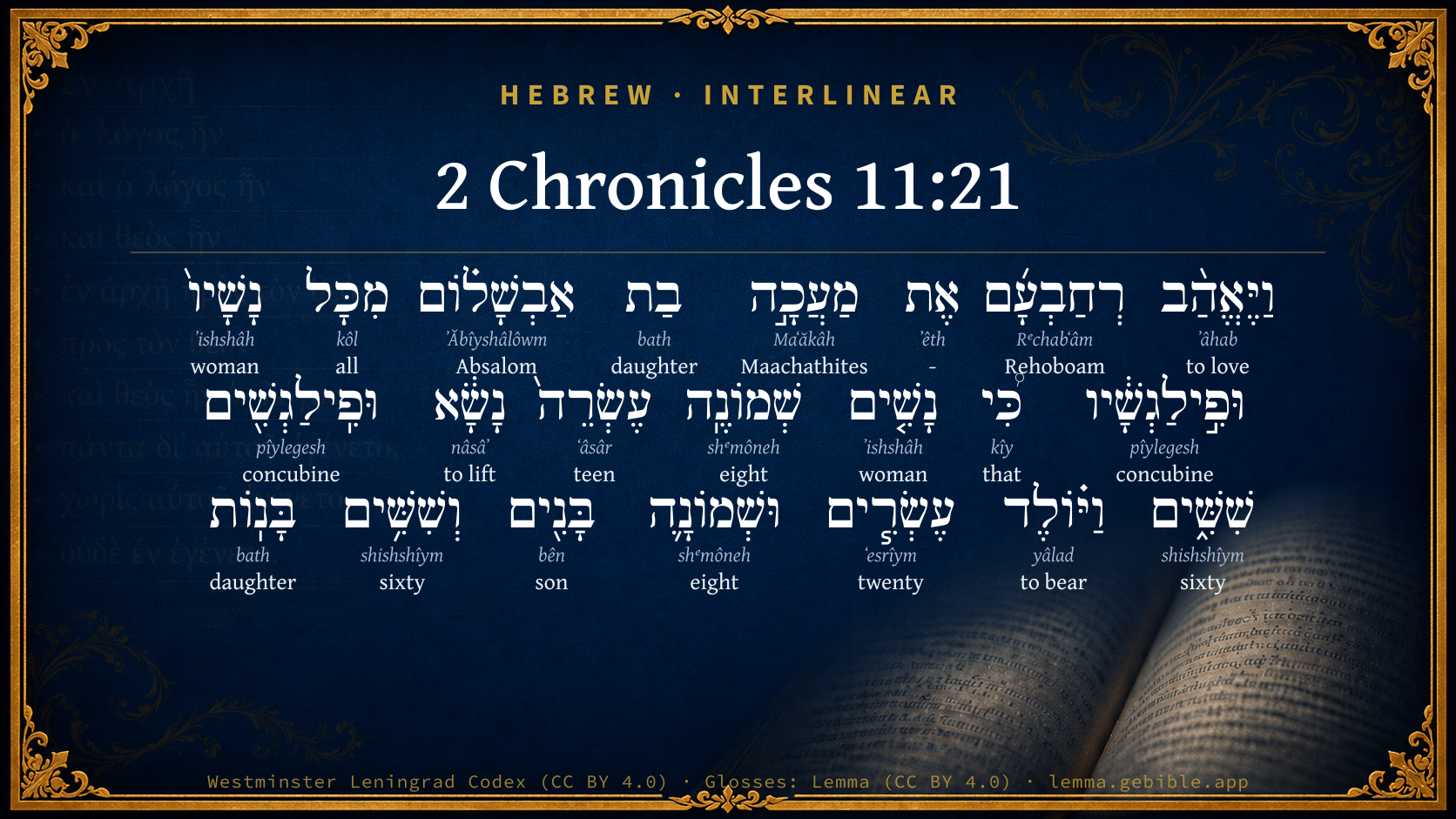
Hebrew (Westminster Leningrad Codex) 2 Chronicles 11:21 appears in the Hebrew Old Testament. The text above is from the Westminster Leningrad Codex. Each word links to its Strong’s number, a concise gloss, and parsing drawn from the Open Scriptures Hebrew Bible morphology. Click any word for its full Brown-Driver-Briggs (BDB) entry.
Download image
Cite this verse

2 Chronicles 11:21 (World English Bible). Public Domain. Lemma interlinear Bible study tool, https://lemma.gebible.app/v/2-chronicles/11/21.

Show BibTeX & RIS
BibTeX
RIS
English Translation
Rehoboam loved Maacah the daughter of Absalom above all his wives and his concubines: (for he took eighteen wives, and sixty concubines, and became the father of twenty-eight sons and sixty daughters.)
World English Bible · Public Domain
Download a study sheet

One document with this verse’s original text, its word-by-word gloss line, the meaning frame, cross-references with their text, attributed commentary, and full source and license credits — printable, and it pastes into notes with its structure intact.

This verse Autodidact and up

Study sheet (.html) Plain text (.txt)

A passage Seminary Student

Up to 50 verses in one chapter. A passage sheet keeps up to 6 commentary sources and 12 cross-references per verse, in the order this page ranks them, and says so on the sheet whenever that leaves anything out. Ask for a single verse and you get the Autodidact verse sheet above.

Everything on this page stays free to read, with no account — the sheet is a download of what is already on screen, not access to it.

Want to remove ads? Support Godless Engineer
Compare translations 3

The same verse in 3 English versions, stacked beneath the original-language interlinear above. Click any original word for its lexicon entry.

Each is an independent rendering of the whole verse — the interlinear is not word-aligned to these translations.

Highlighted words mark where these versions differ — a whole-verse word diff, not a word-by-word alignment.

  • World English Bible Public Domain
    Rehoboam loved Maacah the daughter of Absalom above all his wives and his concubines: (for he took eighteen wives, and sixty concubines, and became the father of twenty-eight sons and sixty daughters.)
  • King James Version Public Domain
    And Rehoboam loved Maachah the daughter of Absalom above all his wives and his concubines: (for he took eighteen wives, and threescore concubines; and begat twenty and eight sons, and threescore daughters.)
  • unfoldingWord Literal Text CC BY-SA 4.0
    And Rehoboam loved Maacah, the daughter of Absalom, more than all his wives and his concubines, for he lifted 18 wives and 60 concubines, and he fathered 28 sons and 60 daughters.

unfoldingWord Literal Text — © unfoldingWord, licensed CC BY-SA 4.0. Word-aligned USFM3 via Door43 (git.door43.org/unfoldingWord/en_ult).

Versions to compare (up to 4)

3 of 4 selected

Show all 18 translations

Every available English version of this verse, each an independent rendering of the whole verse.

  • World English Bible Public Domain
    Rehoboam loved Maacah the daughter of Absalom above all his wives and his concubines: (for he took eighteen wives, and sixty concubines, and became the father of twenty-eight sons and sixty daughters.)
  • Berean Standard Bible Public Domain
    Rehoboam loved Maacah daughter of Absalom more than all his wives and concubines. In all, he had eighteen wives and sixty concubines, and he was the father of twenty-eight sons and sixty daughters.
  • Majority Standard Bible Public Domain
    Rehoboam loved Maacah daughter of Absalom more than all his wives and concubines. In all, he had eighteen wives and sixty concubines, and he was the father of twenty-eight sons and sixty daughters.
  • King James Version Public Domain
    And Rehoboam loved Maachah the daughter of Absalom above all his wives and his concubines: (for he took eighteen wives, and threescore concubines; and begat twenty and eight sons, and threescore daughters.)
  • American Standard Version (1901) Public Domain
    And Rehoboam loved Maacah the daughter of Absalom above all his wives and his concubines: (for he took eighteen wives, and threescore concubines, and begat twenty and eight sons and threescore daughters.)
  • Revised Version (1885) Public Domain
    And Rehoboam loved Maacah the daughter of Absalom above all his wives and his concubines: (for he took eighteen wives, and threescore concubines, and begat twenty and eight sons and threescore daughters.)
  • Geneva Bible (1599) Public Domain
    And Rehoboam loued Maakah ye daughter of Absalom aboue all his wiues and his concubines: for he tooke eighteene wiues, and three score concubines, and begate eyght and twentie sonnes, and three score daughters.
  • Douay-Rheims (1899) Public Domain
    And Roboam loved Maacha the daughter of Absalom above all his wives, and concubines: for he had married eighteen wives, and threescore concubines: and he beget eight and twenty sons, and threescore daughters.
  • Young's Literal Translation Public Domain
    And Rehoboam loveth Maachah daughter of Absalom above all his wives and his concubines -- for eighteen wives he hath taken, and sixty concubines -- and he begetteth twenty and eight sons, and sixty daughters.
  • Literal Standard Version CC BY-SA 4.0
    And Rehoboam loves Maachah daughter of Absalom above all his wives and his concubines—for he has taken eighteen wives and sixty concubines—and he begets twenty-eight sons and sixty daughters.
  • Unlocked Literal Bible CC BY-SA 4.0
    Rehoboam loved Maacah, Absalom's daughter, more than all his other wives and his concubines (he took eighteen wives and sixty concubines, and became the father of twenty-eight sons and sixty daughters).
  • unfoldingWord Literal Text CC BY-SA 4.0
    And Rehoboam loved Maacah, the daughter of Absalom, more than all his wives and his concubines, for he lifted 18 wives and 60 concubines, and he fathered 28 sons and 60 daughters.
  • Darby Bible Public Domain
    And Rehoboam loved Maachah the daughter of Absalom above all his wives and his concubines; for he had taken eighteen wives and sixty concubines, and he begot twenty-eight sons and sixty daughters.
  • World Messianic Bible Public Domain
    Rehoboam loved Maacah the granddaughter of Absalom above all his wives and his concubines; for he took eighteen wives and sixty concubines, and became the father of twenty-eight sons and sixty daughters.
  • Webster's Bible Public Domain
    And Rehoboam loved Maachah the daughter of Absalom above all his wives and his concubines: (for he took eighteen wives, and sixty concubines; and begat twenty and eight sons, and sixty daughters.)
  • Free Bible Version CC BY-SA 4.0
    Rehoboam loved Maacah Absalom's daughter more than all his other wives and concubines. He had a total of eighteen wives and sixty concubines, twenty-eight sons and sixty daughters.
  • Bible in Basic English Public Domain
    Maacah, the daughter of Absalom, was dearer to Rehoboam than all his wives and his servant-wives: (for he had eighteen wives and sixty servant-wives, and was the father of twenty-eight sons and sixty daughters.)
  • JPS Tanakh (1917) Public Domain
    And Rehoboam loved Maacah the daughter of Absalom above all his wives and his concubines — for he took eighteen wives, and threescore concubines, and begot twenty and eight sons and threescore daughters.

Literal Standard Version (2020), Covenant Press — licensed CC BY-SA 4.0. Text via the HelloAO Bible API (eBible.org). Unlocked Literal Bible (unfoldingWord) — licensed CC BY-SA 4.0. Text via the HelloAO Bible API (eBible.org). unfoldingWord Literal Text — © unfoldingWord, licensed CC BY-SA 4.0. Word-aligned USFM3 via Door43 (git.door43.org/unfoldingWord/en_ult). Free Bible Version, Dr. Jonathan Gallagher — licensed CC BY-SA 4.0. Text via the HelloAO Bible API (eBible.org).

Word by word

More ways to search: Search by grammar → Find every occurrence → Compare this word →

Practice this passage: Drill this verse → Learn its vocabulary →

מַעֲכָ֣ה
Maʻăkâh
H4601
“Maachathites”
Noun, Proper
Part of Speech
Noun
Type
Proper
Full BDB Definition

Origin: from H4600

TWOT: None

Maachathites = "pressure (literally she has pressed)" - father of Achish, king of Gath at the beginning of Solomon's reign (noun proper masculine) - father of Hanan, one of David's mighty warriors (noun proper masculine) - a Simeonite, father of Shephatiah, prince of his tribe in the reign of David (noun proper masculine) - son of Nahor by concubine Reumah (noun proper masculine) - daughter of king Talmai of Geshur, wife of David, and mother of Absalom (noun proper feminine) - daughter of Absalom, wife of king Rehoboam of Judah, and mother of king Abijam of Judah (noun proper feminine) - concubine of Caleb the son of Hezron (noun proper feminine) - wife of Machir of the tribe of Manasseh (noun proper feminine) - wife of Jehiel, father of Gibeon (noun proper feminine) - a mercenary people hired to fight David (noun proper)
  1. וַיֶּאֱהַ֨ב ʼâhab H157 “and · to love” Conjunction + Verb, Qal, Sequential Imperfect, 3rd Person, Masculine, Singular
  2. רְחַבְעָ֜ם Rᵉchabʻâm H7346 “Rehoboam” Noun, Proper
  3. אֶת ʼêth H853 “-” Particle, Direct Object
  4. בַת bath H1323 “daughter of” Noun, Common, Feminine, Singular, Construct
  5. אַבְשָׁל֗וֹם ʼĂbîyshâlôwm H53 “Absalom” Noun, Proper
  6. מִכָּל kôl H3605 “from · all of” Preposition + Noun, Common, Masculine, Singular, Construct
  7. נָשָׁיו֙ ʼishshâh H802 “women · his” Noun, Common, Feminine, Plural, Construct + Suffix, Personal, 3rd Person, Masculine, Singular
  8. וּפִ֣ילַגְשָׁ֔יו pîylegesh H6370 “and · concubines · his” Conjunction + Noun, Common, Feminine, Plural, Construct + Suffix, Personal, 3rd Person, Masculine, Singular
  9. כִּ֠י kîy H3588 “that” Conjunction
  10. נָשִׁ֤ים ʼishshâh H802 “women” Noun, Common, Feminine, Plural, Absolute
  11. שְׁמוֹנֶֽה shᵉmôneh H8083 “eight” Adjective, Cardinal number, Feminine, Singular, Absolute
  12. עֶשְׂרֵה֙ ʻâsâr H6240 “teen” Adjective, Cardinal number, Feminine, Singular, Absolute
  13. נָשָׂ֔א nâsâʼ H5375 “to lift” Verb, Qal, Perfect, 3rd Person, Masculine, Singular
  14. וּפִֽילַגְשִׁ֖ים pîylegesh H6370 “and · concubines” Conjunction + Noun, Common, Feminine, Plural, Absolute
  15. שִׁשִּׁ֑ים shishshîym H8346 “sixty” Adjective, Cardinal number, Both, Plural, Absolute
  16. וַיּ֗וֹלֶד yâlad H3205 “and · to bear” Conjunction + Verb, Hiphil, Sequential Imperfect, 3rd Person, Masculine, Singular
  17. עֶשְׂרִ֧ים ʻesrîym H6242 “twenty” Adjective, Cardinal number, Both, Plural, Absolute
  18. וּשְׁמוֹנָ֛ה shᵉmôneh H8083 “and · eight” Conjunction + Adjective, Cardinal number, Masculine, Singular, Absolute
  19. בָּנִ֖ים bên H1121 “sons” Noun, Common, Masculine, Plural, Absolute
  20. וְשִׁשִּׁ֥ים shishshîym H8346 “and · sixty” Conjunction + Adjective, Cardinal number, Both, Plural, Absolute
  21. בָּנֽוֹת bath H1323 “daughters” Noun, Common, Feminine, Plural, Absolute

About this verse

These counts appear in no published source. They are computed here, from the morphology-tagged text and Lemma’s own curated glosses. What Lemma adds →

22
words
17
distinct lemmas
Historical
section

Notable vocabulary

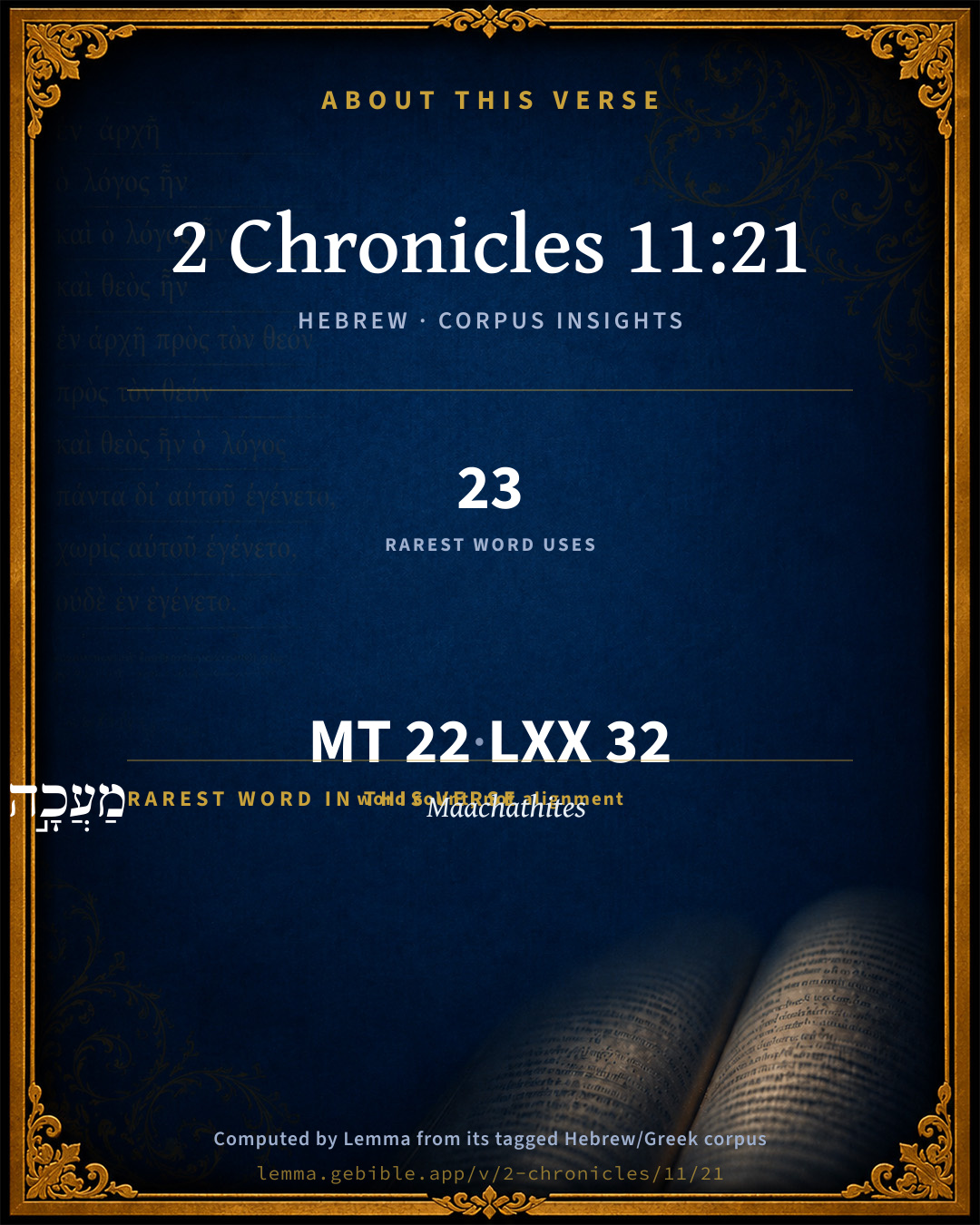
The rarest word here is מַעֲכָ֣ה Maachathites H4601 — appearing just 23 times in the whole Hebrew Bible.

Shared distinctive vocabulary

מַעֲכָ֣ה Maachathites H4601 occurs in 23 verses of the Hebrew Bible. Also found in:

Grammatical profile

  • 3 verbs
  • 11 nouns
  • 6 adjectives
  • 1 conjunction
  • 1 particle

Verb forms

  • וַיֶּאֱהַ֨ב Qal · Sequential Imperfect
  • נָשָׂ֔א Qal · Perfect
  • וַיּ֗וֹלֶד Hiphil · Sequential Imperfect

Repetition

Words recur within this verse — often emphatic in Hebrew:

  • בַת daughter H1323 ×2
  • נָשָׁיו֙ woman H802 ×2
  • וּפִ֣ילַגְשָׁ֔יו concubine H6370 ×2
  • שְׁמוֹנֶֽה eight H8083 ×2
  • שִׁשִּׁ֑ים sixty H8346 ×2

Hebrew & Septuagint length

In English translation the verse runs 32 words from the Hebrew and 33 from the Septuagint (LXX English) — closely comparable.

A rough comparison of the two English renderings, which tokenize alike — not a word-level alignment.

Word counts can differ between the Hebrew and the Greek without any difference in meaning — e.g. the Hebrew direct-object marker אֵת has no separate Greek word, and Greek often adds the article ὁ.

In the original languages it is 22 Hebrew tokens and 32 Greek tokens — but the two are counted differently (Hebrew bundles its prefixes and suffixes into one token; the Greek is in lemma form), so that isn’t a like-for-like length.

Cross-references

8

Topical passages linked to 2 Chronicles 11:21 in the Treasury of Scripture Knowledge — connected by theme and wording, ordered by reader-vote popularity; previews shown in the World English Bible.

  • Deuteronomy 17:17 Neither shall he multiply wives to himself, that his heart not turn away: neither shall he greatly multiply to himself silver and gold.
  • Judges 8:30 Gideon had seventy sons conceived from his body; for he had many wives.
  • 1 Kings 11:3 He had seven hundred wives, princesses, and three hundred concubines; and his wives turned away his heart.
  • 2 Samuel 3:2–5 To David were sons born in Hebron: and his firstborn was Amnon, of Ahinoam the Jezreelitess;
  • 2 Samuel 5:13 David took him more concubines and wives out of Jerusalem, after he was come from Hebron; and there were yet sons and daughters born to David.
  • 2 Chronicles 11:23 He dealt wisely, and dispersed of all his sons throughout all the lands of Judah and Benjamin, to every fortified city: and he gave them food in abundance. He sought [for them] many wives.
  • Song of Solomon 6:8–9 There are sixty queens, eighty concubines, And virgins without number.
  • 1 Chronicles 3:1–9 Now these were the sons of David, who were born to him in Hebron: the firstborn, Amnon, of Ahinoam the Jezreelitess; the second, Daniel, of Abigail the Carmelitess;

Cross-references courtesy of OpenBible.info (CC BY 4.0).

Hebrew and Greek witnesses Masoretic Hebrew ↔ Greek Septuagint

The same verse in the two great witnesses to the Old Testament, shown verse-for-verse.

These are two independent witnesses, not word-aligned to each other, and the Septuagint is shown in lemma (dictionary) form.

Hebrew 2 Chronicles 11:21 Masoretic · Westminster Leningrad Codex

וַיֶּאֱהַ֨ב רְחַבְעָ֜ם אֶת מַעֲכָ֣ה בַת אַבְשָׁל֗וֹם מִכָּל נָשָׁיו֙ וּפִ֣ילַגְשָׁ֔יו כִּ֠י נָשִׁ֤ים שְׁמוֹנֶֽה עֶשְׂרֵה֙ נָשָׂ֔א וּפִֽילַגְשִׁ֖ים שִׁשִּׁ֑ים וַיּ֗וֹלֶד עֶשְׂרִ֧ים וּשְׁמוֹנָ֛ה בָּנִ֖ים וְשִׁשִּׁ֥ים בָּנֽוֹת

Rehoboam loved Maacah the daughter of Absalom above all his wives and his concubines: (for he took eighteen wives, and sixty concubines, and became the father of twenty-eight sons and sixty daughters.)

World English Bible · Public Domain

Greek LXX 2 Chronicles 11:21 Septuagint · lemma form

καί ἀγαπάω ροβοαμ ὁ μααχαν θυγάτηρ αβεσσαλωμ ὑπέρ πᾶς ὁ γυνή αὐτός καί ὁ παλλακή αὐτός ὅτι γυνή δέκα ὀκτώ ἔχω καί παλλακή τριάκοντα καί γεννάω υἱός εἴκοσι ὀκτώ καί θυγάτηρ ἑξήκοντα

And Roboam loved Maacha the daughter of Abessalom more than all his wives and all his concubines: for he had eighteen wives and sixty concubines; and he begot twenty-eight sons, and sixty daughters.

LXX2012 (modern English Septuagint) · Public Domain

Hebrew: Westminster Leningrad Codex (CC BY 4.0). Greek: Septuagint (public domain); English from LXX2012 (modern English Septuagint) (Public Domain). How the Septuagint differs from the Hebrew →

Commentary

Notes on 2 Chronicles 11:21 from classic Christian and Jewish commentators (each source and its license shown beneath its notes). The classic Christian expositions comment on the surrounding passage and are grouped to its opening verse, so a note may address several verses; the Jewish commentaries on the Tanakh (Rashi and others) are per-verse, so they appear only where the commentator wrote on this verse.

Lemma curates 59 commentaries, every one of them public domain or Creative Commons licensed, each selected and text-cleaned for this edition rather than reprinted as found. About our sources →

Trapp's Complete Commentary

John Trapp

2Ch 11:21 And Rehoboam loved Maachah the daughter of Absalom above all his wives and his concubines: (for he took eighteen wives, and threescore concubines; and begat twenty and eight sons, and threescore daughters.)

Ver. 21. He took Maachah, the daughter of Absalom,] i.e., His niece by his sister, or his daughter Tamar, whose husband haply was called Uriel. See 1Ki 15:2.

John Trapp, A Commentary or Exposition upon All the Books of the Old and New Testament (1647–1656) — public domain. Text from a community e-Sword module.

Jamieson, Fausset & Brown

Robert Jamieson, A. R. Fausset & David Brown

he took eighteen wives, and threescore concubines--This royal harem, though far smaller than his father's, was equally in violation of the law, which forbade a king to "multiply wives unto himself" [Deu 17:17].

Jamieson, Fausset & Brown — Commentary Critical and Explanatory on the Whole Bible (1871) — public domain (CC PDM 1.0). Text via the HelloAO Bible API.

Adam Clarke's Commentary

Verse 21. Eighteen wives and threescore concubines] Bad enough, but not so abandoned as his father. Of these marriages and concubinage the issue was twenty-eight sons and sixty daughters; eighty-eight children in the whole, to the education of the whole of whom he could pay but little attention. Numerous families are often neglected; and children by different women, must be yet in a worse state.

Adam Clarke's Commentary on the Bible (1810–1826) — public domain. Text from a community e-Sword/MySword module.

Ellicott's Commentary for English Readers

(21) Loved Maachah.—She probably inherited her mother’s and grandfather’s beauty.

For he took—Nâsâ’, as in 2Ch_13:21; a later usage instead of lâqah.

And threescore concubines.—Josephus (l.c.) says, “thirty,” and the difference in Hebrew is only of one letter. The recurrence of the same number immediately (“threescore daughters”) is also suspicious.

A Bible Commentary for English Readers, edited by Charles John Ellicott (1878–1897) — public domain. Text from a community e-Sword module.

John Gill's Exposition

And he dealt wisely,.... Acted a prudent part, in order to execute his scheme, and particularly by disposing of his other sons in different parts of his kingdom, as follows: or "he made him his son Abijah to understand" (e); he taught and instructed him in the art of government, took a particular care of his education, that he might be fitted for it; and he might instruct him how to behave towards his brethren, for the present and hereafter, as well as towards all the people in general: or "he (Abijah) understood" (f); had more understanding and wisdom than all the children of Rehoboam; though it seems best to interpret it of Rehoboam himself, since it follows:

and disposed of all his children throughout all the countries of Judah and Benjamin, unto every fenced city; to be governors thereof, in whose hands he could better trust them than in any other; or else, by thus separating them, they would not be able to enter into combination against Abijah; but then he must at the same time appoint some persons to watch and observe them; or otherwise, having such, strong places in their possession, they might rebel against him; the Targum is,"he built and repaired the cities, and appointed of all his children throughout all the countries of the house of Judah, to all the fortified cities;''that is, to have the command of them:

and he gave them victual in abundance; that they might have no reason to complain, and might be able to hold out a siege against an enemy, should they be attacked:

and he desired many wives; either for himself, or rather for his son, since he himself had many; or "Abijah desired, or asked (g) many wives" of their parents, or of those who had the dispose of them, in imitation of his father.

(e) "erudire faciebat", Pagninus, Grotius; "docuit", Vatablus. (f) "lntellexit", Piscator. (g) "petivit", Pagninus, Montanus, Vatablus; "postulavit", Piscator.

Next: 2 Chronicles Chapter 12

John Gill's Exposition of the Whole Bible (1746–1763) — public domain (CC PDM 1.0). Text via the HelloAO Bible API.

Whedon's Commentary on the Bible

Daniel D. Whedon

21. Eighteen wives, and threescore concubines — See note on 1Ki_11:3. Rehoboam imitated, but did not go to the extent of, his father’s polygamy. In the number of sons and daughters, however, he far excelled his father.

Daniel D. Whedon (gen. ed.), Commentary on the Old and New Testaments (1874–1909) — public domain. Text from a community e-Sword module.

The Pulpit Commentary

Rehoboam was clearly wrong by Deu_17:17. (note Solomon"s Son_6:8)

The Pulpit Commentary (1880–1919), ed. H.D.M. Spence-Jones & Joseph S. Exell — public domain. Text from a community e-Sword module.

Lesson kit

Teaching starters — assembled from the data on this page, not authored interpretation. Every prompt links to the verse data it draws on. Edit before teaching.

2 Chronicles, in the Historical, opens this verse with 22 words (17 distinct Hebrew lemmas). Its most distinctive word is Maʻăkâh (“Maachathites”). A historical commentator’s framing appears above. Read the whole chapter for the surrounding context.

Discussion questions

  1. The word Maʻăkâh carries the sense “Maachathites.” How does it shape the verse?
  2. How does Genesis 22:24, which shares the word «Maachathites», read alongside this verse?
  3. What does the repetition of “daughter” (2× in this one verse) do in this verse?
  4. The translations on this page render this verse differently — a whole-verse word diff, not a word-by-word alignment. What might account for the different wordings?
  5. «וַיֶּאֱהַ֨ב» is a Qal Sequential Imperfect verb. How does that grammatical form shape the action described?
  6. Compare how Trapp's Complete Commentary and Jamieson, Fausset & Brown read this verse. Where do they agree or differ?

Things to notice

Reading settings

Reading text

Shown beneath each verse's original-language words.

Old Testament
Old Testament edition

Read the OT as the Masoretic Hebrew (MT) or the Greek Septuagint (LXX).

English shown for the Greek Septuagint (in the Hebrew ↔ Greek comparison).

Comparing translations? Open the Compare panel on any verse page to stack up to four side by side.