
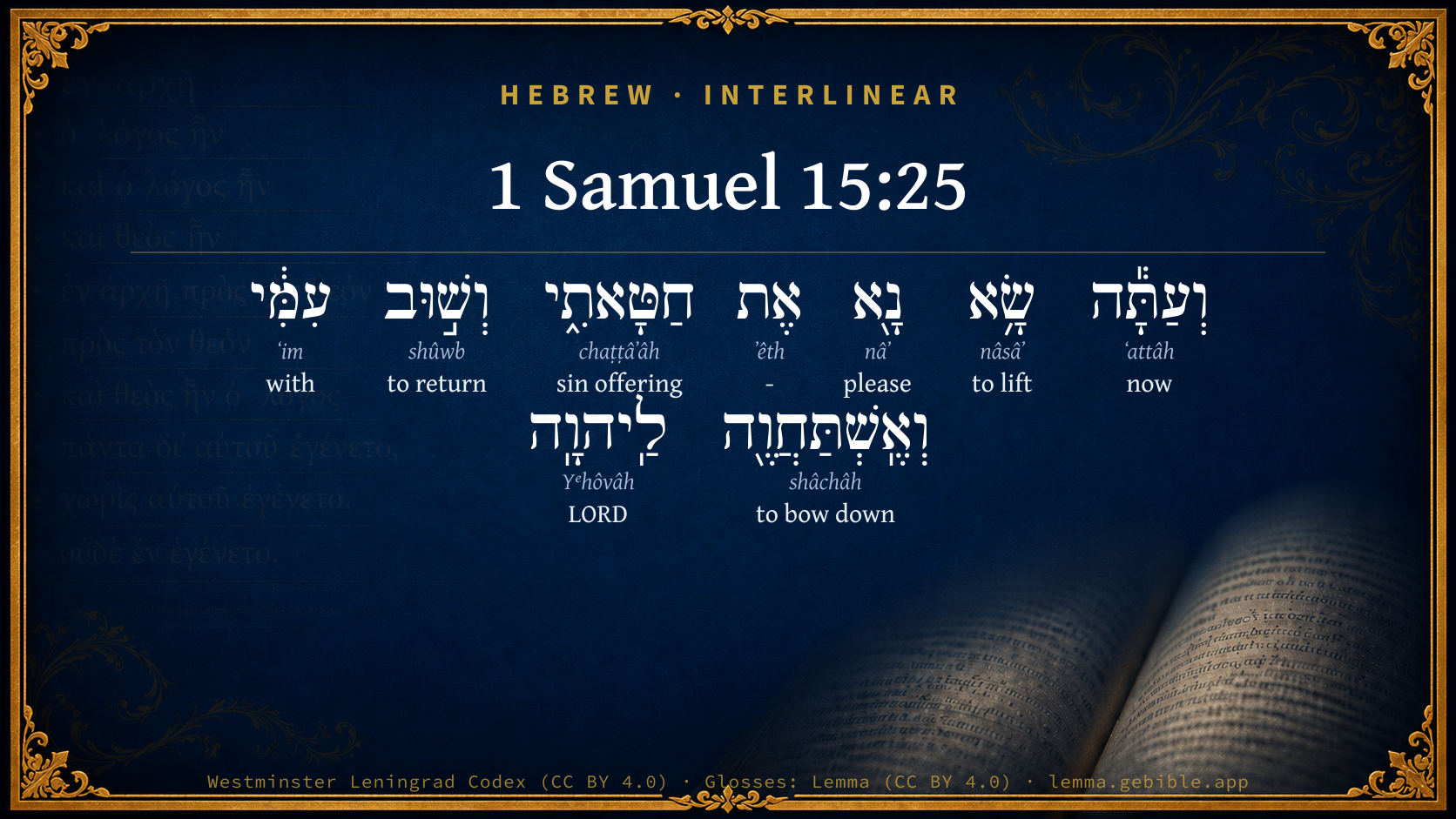
1 Samuel 15:25

Hebrew (Westminster Leningrad Codex) 1 Samuel 15:25 appears in the Hebrew Old Testament. The text above is from the Westminster Leningrad Codex. Each word links to its Strong’s number, a concise gloss, and parsing drawn from the Open Scriptures Hebrew Bible morphology. Click any word for its full Brown-Driver-Briggs (BDB) entry.
Download image
Cite this verse

1 Samuel 15:25 (World English Bible). Public Domain. Lemma interlinear Bible study tool, https://lemma.gebible.app/v/1-samuel/15/25.

Show BibTeX & RIS
BibTeX
RIS
English Translation
Now therefore, please pardon my sin, and turn again with me, that I may worship Yahweh.
World English Bible · Public Domain
Download a study sheet

One document with this verse’s original text, its word-by-word gloss line, the meaning frame, cross-references with their text, attributed commentary, and full source and license credits — printable, and it pastes into notes with its structure intact.

This verse Autodidact and up

Study sheet (.html) Plain text (.txt)

A passage Seminary Student

Up to 50 verses in one chapter. A passage sheet keeps up to 6 commentary sources and 12 cross-references per verse, in the order this page ranks them, and says so on the sheet whenever that leaves anything out. Ask for a single verse and you get the Autodidact verse sheet above.

Everything on this page stays free to read, with no account — the sheet is a download of what is already on screen, not access to it.

Want to remove ads? Support Godless Engineer
Compare translations 3

The same verse in 3 English versions, stacked beneath the original-language interlinear above. Click any original word for its lexicon entry.

Each is an independent rendering of the whole verse — the interlinear is not word-aligned to these translations.

Highlighted words mark where these versions differ — a whole-verse word diff, not a word-by-word alignment.

  • World English Bible Public Domain
    Now therefore, please pardon my sin, and turn again with me, that I may worship Yahweh.
  • King James Version Public Domain
    Now therefore, I pray thee, pardon my sin, and turn again with me, that I may worship the LORD.
  • unfoldingWord Literal Text CC BY-SA 4.0
    But now, please take away my sin and return with me so I may worship Yahweh.”

unfoldingWord Literal Text — © unfoldingWord, licensed CC BY-SA 4.0. Word-aligned USFM3 via Door43 (git.door43.org/unfoldingWord/en_ult).

Versions to compare (up to 4)

3 of 4 selected

Show all 18 translations

Every available English version of this verse, each an independent rendering of the whole verse.

  • World English Bible Public Domain
    Now therefore, please pardon my sin, and turn again with me, that I may worship Yahweh.
  • Berean Standard Bible Public Domain
    Now therefore, please forgive my sin and return with me so I can worship the LORD.”
  • Majority Standard Bible Public Domain
    Now therefore, please forgive my sin and return with me so I can worship the LORD.”
  • King James Version Public Domain
    Now therefore, I pray thee, pardon my sin, and turn again with me, that I may worship the LORD.
  • American Standard Version (1901) Public Domain
    Now therefore, I pray thee, pardon my sin, and turn again with me, that I may worship Jehovah.
  • Revised Version (1885) Public Domain
    Now therefore, I pray thee, pardon my sin, and turn again with me, that I may worship the LORD.
  • Geneva Bible (1599) Public Domain
    Nowe therefore I pray thee, take away my sinne, and turne againe with mee, that I may worship the Lord.
  • Douay-Rheims (1899) Public Domain
    But now bear, I beseech thee, my sin, and return with me, that I may adore the Lord.
  • Young's Literal Translation Public Domain
    and now, bear, I pray thee, with my sin, and turn back with me, and I bow myself to Jehovah.'
  • Literal Standard Version CC BY-SA 4.0
    and now, please bear with my sin, and return with me, and I bow myself to YHWH.”
  • Unlocked Literal Bible CC BY-SA 4.0
    Now, please pardon my sin, and return with me so that I may worship Yahweh.”
  • unfoldingWord Literal Text CC BY-SA 4.0
    But now, please take away my sin and return with me so I may worship Yahweh.”
  • Darby Bible Public Domain
    And now, I pray thee, forgive my sin, and turn again with me, that I may worship Jehovah.
  • World Messianic Bible Public Domain
    Now therefore, please pardon my sin, and turn again with me, that I may worship the LORD.”
  • Webster's Bible Public Domain
    Now therefore, I pray thee, pardon my sin, and turn again with me, that I may worship the LORD.
  • Free Bible Version CC BY-SA 4.0
    So please forgive my sin and come back with me, so I can worship the Lord.”
  • Bible in Basic English Public Domain
    So now, let my sin have forgiveness, and go back with me to give worship to the Lord.
  • JPS Tanakh (1917) Public Domain
    Now therefore, I pray thee, pardon my sin, and return with me, that I may worship the LORD.'

Literal Standard Version (2020), Covenant Press — licensed CC BY-SA 4.0. Text via the HelloAO Bible API (eBible.org). Unlocked Literal Bible (unfoldingWord) — licensed CC BY-SA 4.0. Text via the HelloAO Bible API (eBible.org). unfoldingWord Literal Text — © unfoldingWord, licensed CC BY-SA 4.0. Word-aligned USFM3 via Door43 (git.door43.org/unfoldingWord/en_ult). Free Bible Version, Dr. Jonathan Gallagher — licensed CC BY-SA 4.0. Text via the HelloAO Bible API (eBible.org).

Word by word

More ways to search: Search by grammar → Find every occurrence → Compare this word →

Practice this passage: Drill this verse → Learn its vocabulary →

וְאֶֽשְׁתַּחֲוֶ֖ה
shâchâh
H7812
“and · to bow down”
Conjunction + Verb, Hishtaphel, Imperfect, 1st Person, Common, Singular
Part of Speech
Conjunction + Verb
Stem
Hishtaphel
Form
Imperfect
Person
1st Person
Gender
Common
Number
Singular
Full BDB Definition

Origin: a primitive root

TWOT: 2360

to bow down - (Qal) to bow down - (Hiphil) to depress (figuratively) - (Hithpael) - to bow down, prostrate oneself - before superior in homage - before God in worship - before false gods - before angel
  1. וְעַתָּ֕ה ʻattâh H6258 “and · now” Conjunction + Adverb
  2. שָׂ֥א nâsâʼ H5375 “lift” Verb, Qal, Imperative, 2nd Person, Masculine, Singular
  3. נָ֖א nâʼ H4994 “please” Particle, Exhortation
  4. אֶת ʼêth H853 “-” Particle, Direct Object
  5. חַטָּאתִ֑י chaṭṭâʼâh H2403 “sin offering · my” Noun, Common, Feminine, Singular, Construct + Suffix, Personal, 1st Person, Common, Singular
  6. וְשׁ֣וּב shûwb H7725 “and · return” Conjunction + Verb, Qal, Imperative, 2nd Person, Masculine, Singular
  7. עִמִּ֔י ʻim H5973 “with · me” Preposition + Suffix, Personal, 1st Person, Common, Singular
  8. לַֽיהוָֽה Yᵉhôvâh H3068 “to/for · LORD” Preposition + Noun, Proper

About this verse

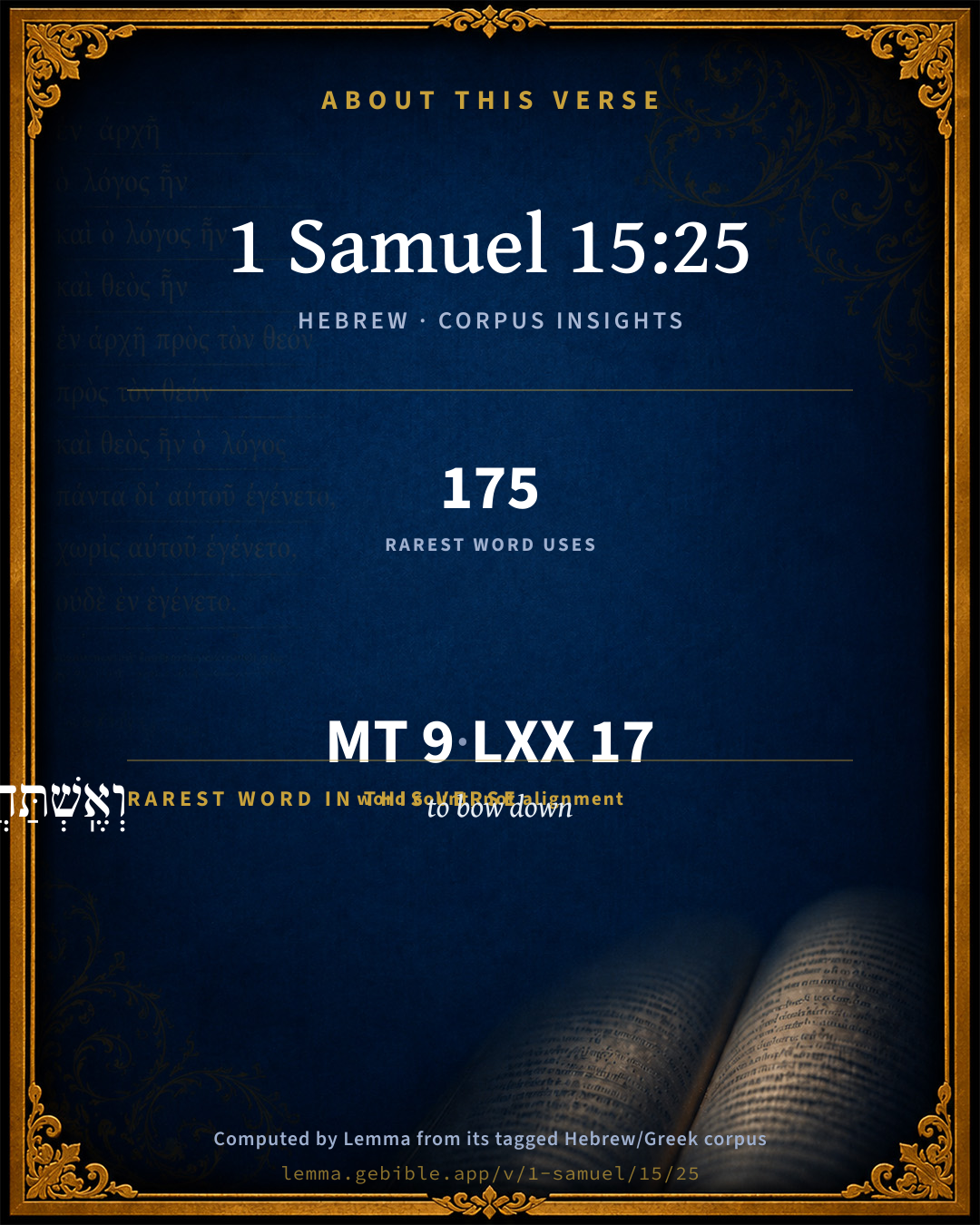
These counts appear in no published source. They are computed here, from the morphology-tagged text and Lemma’s own curated glosses. What Lemma adds →

9
words
9
distinct lemmas
Historical
section

Grammatical profile

  • 3 verbs
  • 2 nouns
  • 1 preposition
  • 1 adverb
  • 2 particles

Verb forms

  • שָׂ֥א Qal · Imperative
  • וְשׁ֣וּב Qal · Imperative
  • וְאֶֽשְׁתַּחֲוֶ֖ה Hishtaphel · Imperfect

Hebrew & Septuagint length

In English translation the verse runs 16 words from the Hebrew and 21 from the Septuagint (LXX English) — closely comparable.

A rough comparison of the two English renderings, which tokenize alike — not a word-level alignment.

Word counts can differ between the Hebrew and the Greek without any difference in meaning — e.g. the Hebrew direct-object marker אֵת has no separate Greek word, and Greek often adds the article ὁ.

In the original languages it is 9 Hebrew tokens and 17 Greek tokens — but the two are counted differently (Hebrew bundles its prefixes and suffixes into one token; the Greek is in lemma form), so that isn’t a like-for-like length.

Cross-references

1

Topical passages linked to 1 Samuel 15:25 in the Treasury of Scripture Knowledge — connected by theme and wording, ordered by reader-vote popularity; previews shown in the World English Bible.

  • Exodus 10:17 Now therefore please forgive my sin again, and pray to Yahweh your God, that he may also take away from me this death."

Cross-references courtesy of OpenBible.info (CC BY 4.0).

Hebrew and Greek witnesses Masoretic Hebrew ↔ Greek Septuagint

The same verse in the two great witnesses to the Old Testament, shown verse-for-verse.

These are two independent witnesses, not word-aligned to each other, and the Septuagint is shown in lemma (dictionary) form.

Hebrew 1 Samuel 15:25 Masoretic · Westminster Leningrad Codex

וְעַתָּ֕ה שָׂ֥א נָ֖א אֶת חַטָּאתִ֑י וְשׁ֣וּב עִמִּ֔י וְאֶֽשְׁתַּחֲוֶ֖ה לַֽיהוָֽה

Now therefore, please pardon my sin, and turn again with me, that I may worship Yahweh.

World English Bible · Public Domain

Greek LXX 1 Samuel 15:25 Septuagint · lemma form

καί νῦν αἴρω δή ὁ ἁμάρτημα ἐγώ καί ἀναστρέφω μετά ἐγώ καί προςκυνέω κύριος ὁ θεός σύ

And now remove, I pray you, my sin, and turn back with me, and I will worship the Lord your God.

LXX2012 (modern English Septuagint) · Public Domain

Hebrew: Westminster Leningrad Codex (CC BY 4.0). Greek: Septuagint (public domain); English from LXX2012 (modern English Septuagint) (Public Domain). How the Septuagint differs from the Hebrew →

Targum (Aramaic paraphrase)

1

The Targum is the ancient Jewish Aramaic paraphrase of the Hebrew Scriptures — an interpretive translation, not the Hebrew text itself. Onkelos (literal) and Pseudo-Jonathan (expansive) render the Torah, and Jonathan the Prophets. Coverage is partial: where no permissively-licensed English translation exists for a verse, only the Aramaic is shown. This is verse-level text, not a word-by-word alignment to the Hebrew.

  1. Targum Jonathan Prophets (Joshua–Malachi)
    וּכְעַן שְׁבוֹק כְּעַן לְחוֹבִי וְתוּב עִמִי וְאֶסְגוֹד קֳדָם יְיָ:

    (no public-domain English translation for this verse)

    Targum Jonathan — Aramaic: “Mikraot Gedolot” (public domain). English: “Sefaria Community Translation” (CC0 1.0 (public-domain dedication)); “London "Chaldee Paraphrase," 1871” (public domain). Text via Sefaria.

Commentary

Notes on 1 Samuel 15:25 from classic Christian and Jewish commentators (each source and its license shown beneath its notes). The classic Christian expositions comment on the surrounding passage and are grouped to its opening verse, so a note may address several verses; the Jewish commentaries on the Tanakh (Rashi and others) are per-verse, so they appear only where the commentator wrote on this verse.

Lemma curates 59 commentaries, every one of them public domain or Creative Commons licensed, each selected and text-cleaned for this edition rather than reprinted as found. About our sources →

Trapp's Complete Commentary

John Trapp

1Sa 15:25 Now therefore, I pray thee, pardon my sin, and turn again with me, that I may worship the LORD.

Ver. 25. Now therefore, I pray thee, pardon my sin,] i.e., Pray God to pardon it: though some here also tax him for this, that he relied more upon another’s virtue than upon his own penitency; likeas afterwards, also, he would cloak his guiltiness with the holiness of another’s presence.

That I may worship the Lord.] He would fashionably serve that God, whom yet he careth not to reconcile by sound repentance.

John Trapp, A Commentary or Exposition upon All the Books of the Old and New Testament (1647–1656) — public domain. Text from a community e-Sword module.

Geneva Bible (1599)

Geneva Bible translators

This was not true repentance, but dissimulation, fearing the loss of his kingdom.

Geneva Bible (1599) marginal notes — public domain. Text via Bolls.life.

Adam Clarke's Commentary

Verse 25. Pardon my sin] Literally, bear my sin; take it away; forgive what I have done against thee, and be my intercessor with God, that he may forgive my offense against him; turn again with me, that I may worship the Lord.

Adam Clarke's Commentary on the Bible (1810–1826) — public domain. Text from a community e-Sword/MySword module.

Ellicott's Commentary for English Readers

(25) Now therefore, I pray thee, pardon my sin.—But, after all, the sorrow of Saul was rather for the immediate earthly consequence which he feared might follow the Divine rejection. He foresaw his power in Israel would sensibly decrease, so he intreats the great prophet not to desert him.

A Bible Commentary for English Readers, edited by Charles John Ellicott (1878–1897) — public domain. Text from a community e-Sword module.

John Gill's Exposition

Now therefore, I pray thee, pardon my sin,.... It can hardly be thought that Saul was so ignorant as to imagine that Samuel could pardon his sin, as committed against God, which none but God can do, but that he would forgive it, so far as he had offended him; or rather his meaning is, that as he was a prophet of the Lord, and had great interest in him, that he would make use of it on his behalf, and pray to God that his sin might be forgiven him, and the sentence reversed concerning his rejection from the kingdom; which perhaps is the chief thing he means by the pardon of his sin, which sometimes means no more than averting a threatened judgment, or freedom from punishment:

and turn again with me; to Gilgal, for he was come out from thence to meet Samuel, having heard that he was coming:

that I may worship the Lord: by offering sacrifice, either in thankfulness for the victory obtained, or to atone for his sin, and seek pardon for it, or both; this he thought would be a motive and inducement to Samuel to go along with him.

John Gill's Exposition of the Whole Bible (1746–1763) — public domain (CC PDM 1.0). Text via the HelloAO Bible API.

Haydock's Catholic Bible Commentary

Bear, or take away. Pardon my fault. Do not expose me in public. --- The Lord, by offering sacrifices, ver. 31. (Calmet)

George Leo Haydock (1774–1849), Haydock's Catholic Family Bible and Commentary, 1859 edition — public domain. Excludes Psalms (Douay-Rheims chapter numbering differs from Protestant) and Deuterocanonical books (Catholic canon only).

Matthew Poole's English Annotations

Pardon my sin; use thy great interest with God to obtain the pardon of my sin. Or, do thou pardon my sin against thee; for he had sinned not only against God, but against Samuel also, as God’s prophet; and therefore needed a pardon both from God and man.

And turn again with me, to Gilgal, whence Saul was gone forth to meet Samuel; and Samuel is here said to turn again to Gilgal, not properly, for he had not now been there; but by way of concomitancy, because he accompanied Saul, who was come thence, and returned thither: see the like expression Rth 1:10,22; 2:6.

That I may worship the Lord; that I may offer further sacrifices to God; partly to praise him for the past victory; and partly to implore his mercy, and the taking off of my sin and punishment. This was a politic device of Saul’s, that Samuel might at least seem to countenance his design, in reserving the cattle for sacrifice; which Samuel seeing, refused to do it. Heb. and I will worship the Lord, i.e. I will seek his pardon and favour.

Matthew Poole's English Annotations on the Holy Bible (1683–1685) — public domain. Text from a community e-Sword/MySword module.

The Pulpit Commentary

Ver. Mat_11:2, Mat_11:3; Act_18:9 Act_23:11)

3. Never long hidden from those who are sincerely desirous of doing it, andseek for the knowledge of it with a view to that end (vers. 2, 3; 1Ki_19:15)

II BESET BY DANGER. "How can I go? If Saul hear of it, he will kill me." The question was not simply an inquiry for direction, but also an expression of fear; and it may possibly have arisen from indications of Saul"s wilfulness such as afterwards appeared (ch. 19:22).

1. Danger is sometimes formidable, even to the bravest of men.

2. It is exaggerated by despondency, doubt, and fear.

Thy soul is by vile fear assailed, which oft So overcasts a man, that he recoils From noblest resolution, like a beast At some false semblance in the twilight gloom (Dante).

3. No danger in the way of duty is equal to that which will be certainly found in departing from it. "In the way of righteousness there is life, and in the pathway thereof there is no death.

III PURSUED WITH FIDELITY. "And Samuel did that which the Lord spake" (ver. 4). His hesitation was only for a moment, and with further light his faith revived and was displayed in fearless devotion. Fidelity to duty

1. Demands the renunciation of self and many cherished plans andpurposes.

2. Appears in trustful, practical, and unreserved obedience. Samuel went independence upon the promise, "I will show thee what thou shalt do," etc.

3. Sometimes necessitates a prudent reserve. There was no deception inwithholding a reason for the action directed, beyond that which lay on the surface of the action itself. To reveal it would be to defeat the end designed. And fidelity is sometimes best shown by silence.

IV TERMINATING IN SAFETY AND HOPE.

1. Threatened danger is averted.

2. Promised guidance is obtained.

3. A brighter day dawns, and

God"s purposes will ripen fast, Unfolding every hour.

Samuel returns to Ramah in peace, and with renewed zeal devotes his remaining days to the work of training a body of younger prophets (ch. 19:20), whose influence, together with a change of dynasty, will save the nation and promote the establishment of the kingdom of God. "Let us ask ourselves whether the Jewish nation would have played any part as a "main propelling agency of modern cultivation," if its monarchy had been allowed to take the form which Saul would have given it, if he had made religion a creature of the kingly power, and war an instrument of rapine, and not of justice, and we shall see that Samuel"s view of the matter was the true one, and in accordance with the proper vocation of a prophet" (Strachey, "Jewish Hist. and Politics"). D.

The Pulpit Commentary (1880–1919), ed. H.D.M. Spence-Jones & Joseph S. Exell — public domain. Text from a community e-Sword module.

John Wesley's Explanatory Notes

Pardon my sin - Neither can it be proved that there was any hypocrisy in this. Rather charity requires us to believe, that he sincerely desired pardon, both from God and man, as he now knew, he had sinned against both.

John Wesley, Explanatory Notes Upon the Whole Bible (1754–1765) — public domain. Text via the GEBible commentary corpus.

Lesson kit

Teaching starters — assembled from the data on this page, not authored interpretation. Every prompt links to the verse data it draws on. Edit before teaching.

1 Samuel, in the Historical, opens this verse with 9 words (9 distinct Hebrew lemmas). Its most distinctive word is shâchâh (“to bow down”). A historical commentator’s framing appears above. Read the whole chapter for the surrounding context.

Discussion questions

  1. What does “to bow down” (shâchâh) contribute to the verse as a whole?
  2. How does Exodus 10:17, which shares this passage’s theme, read alongside this verse?
  3. These translations render this verse differently; the difference is in the English rendering, not the original. What questions does that raise?
  4. «שָׂ֥א» is a Qal Imperative verb. How does that grammatical form shape the action described?
  5. Compare how Trapp's Complete Commentary and Geneva Bible (1599) read this verse. Where do they agree or differ?

Things to notice

Reading settings

Reading text

Shown beneath each verse's original-language words.

Old Testament
Old Testament edition

Read the OT as the Masoretic Hebrew (MT) or the Greek Septuagint (LXX).

English shown for the Greek Septuagint (in the Hebrew ↔ Greek comparison).

Comparing translations? Open the Compare panel on any verse page to stack up to four side by side.