
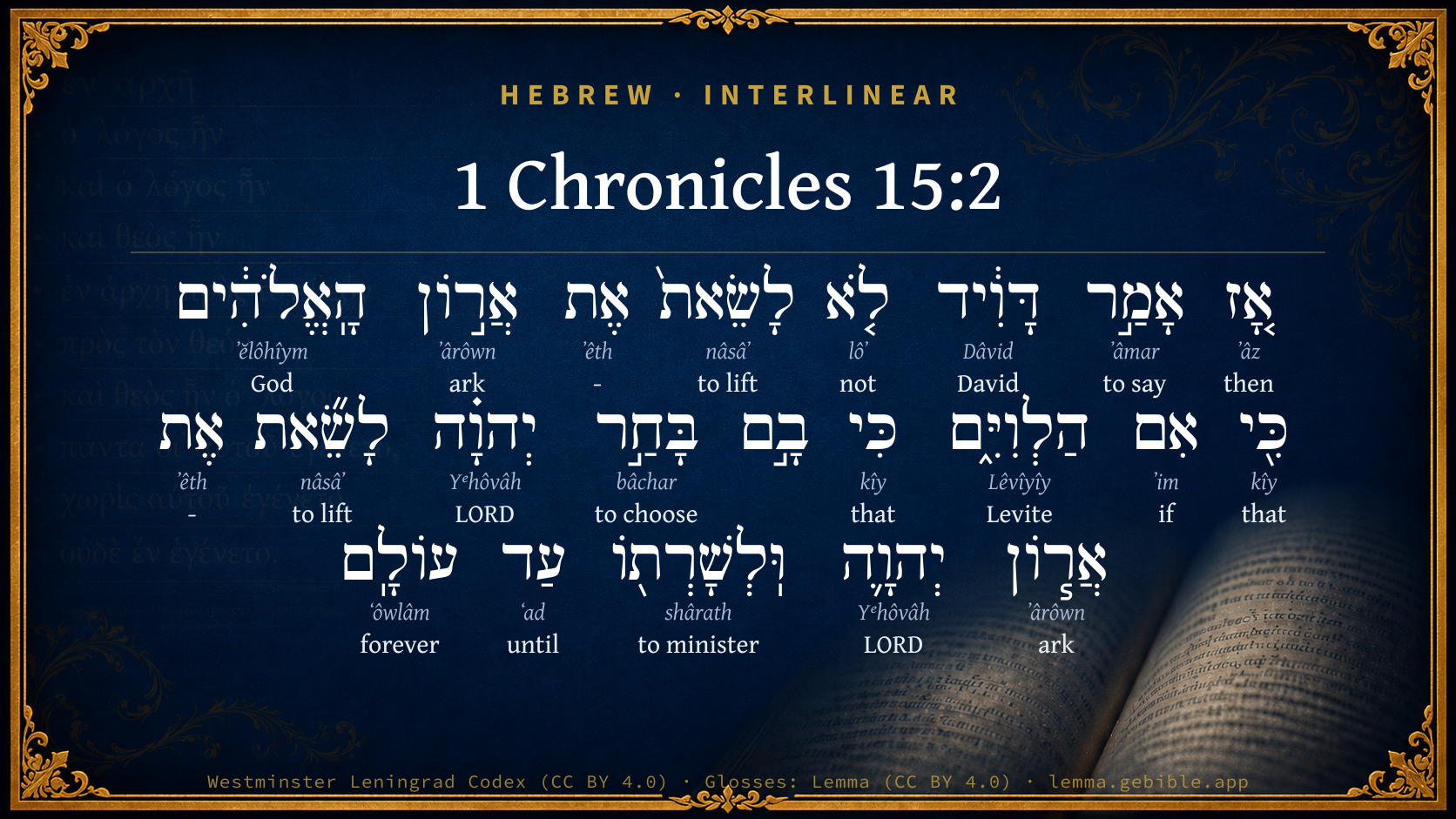
1 Chronicles 15:2

Hebrew (Westminster Leningrad Codex) 1 Chronicles 15:2 appears in the Hebrew Old Testament. The text above is from the Westminster Leningrad Codex. Each word links to its Strong’s number, a concise gloss, and parsing drawn from the Open Scriptures Hebrew Bible morphology. Click any word for its full Brown-Driver-Briggs (BDB) entry.
Download image
Cite this verse

1 Chronicles 15:2 (World English Bible). Public Domain. Lemma interlinear Bible study tool, https://lemma.gebible.app/v/1-chronicles/15/2.

Show BibTeX & RIS
BibTeX
RIS
English Translation
Then David said, None ought to carry the ark of God but the Levites: for them has Yahweh chosen to carry the ark of God, and to minister to him forever.
World English Bible · Public Domain
Download a study sheet

One document with this verse’s original text, its word-by-word gloss line, the meaning frame, cross-references with their text, attributed commentary, and full source and license credits — printable, and it pastes into notes with its structure intact.

This verse Autodidact and up

Study sheet (.html) Plain text (.txt)

A passage Seminary Student

Up to 50 verses in one chapter. A passage sheet keeps up to 6 commentary sources and 12 cross-references per verse, in the order this page ranks them, and says so on the sheet whenever that leaves anything out. Ask for a single verse and you get the Autodidact verse sheet above.

Everything on this page stays free to read, with no account — the sheet is a download of what is already on screen, not access to it.

Want to remove ads? Support Godless Engineer
Compare translations 3

The same verse in 3 English versions, stacked beneath the original-language interlinear above. Click any original word for its lexicon entry.

Each is an independent rendering of the whole verse — the interlinear is not word-aligned to these translations.

Highlighted words mark where these versions differ — a whole-verse word diff, not a word-by-word alignment.

  • World English Bible Public Domain
    Then David said, None ought to carry the ark of God but the Levites: for them has Yahweh chosen to carry the ark of God, and to minister to him forever.
  • King James Version Public Domain
    Then David said, None ought to carry the ark of God but the Levites: for them hath the LORD chosen to carry the ark of God, and to minister unto him for ever.
  • unfoldingWord Literal Text CC BY-SA 4.0
    Then David said, “ not to carry the Box of God except the Levites. For Yahweh chose them to carry the Box of Yahweh and to serve him forever.”

unfoldingWord Literal Text — © unfoldingWord, licensed CC BY-SA 4.0. Word-aligned USFM3 via Door43 (git.door43.org/unfoldingWord/en_ult).

Versions to compare (up to 4)

3 of 4 selected

Show all 18 translations

Every available English version of this verse, each an independent rendering of the whole verse.

  • World English Bible Public Domain
    Then David said, None ought to carry the ark of God but the Levites: for them has Yahweh chosen to carry the ark of God, and to minister to him forever.
  • Berean Standard Bible Public Domain
    Then David said, “No one but the Levites may carry the ark of God, because the LORD has chosen them to carry the ark of the LORD and to minister before Him forever.”
  • Majority Standard Bible Public Domain
    Then David said, “No one but the Levites may carry the ark of God, because the LORD has chosen them to carry the ark of the LORD and to minister before Him forever.”
  • King James Version Public Domain
    Then David said, None ought to carry the ark of God but the Levites: for them hath the LORD chosen to carry the ark of God, and to minister unto him for ever.
  • American Standard Version (1901) Public Domain
    Then David said, None ought to carry the ark of God but the Levites: for them hath Jehovah chosen to carry the ark of God, and to minister unto him for ever.
  • Revised Version (1885) Public Domain
    Then David said, None ought to carry the ark of God but the Levites: for them hath the LORD chosen to carry the ark of God, and to minister unto him for ever.
  • Geneva Bible (1599) Public Domain
    Then Dauid saide, None ought to carie the Arke of God, but the Leuites: for the Lord hath chosen them to beare the Arke of the Lord, and to minister vnto him for euer.
  • Douay-Rheims (1899) Public Domain
    Then David said: No one ought to carry the ark of God, but the Levites, whom the Lord hath chosen to carry it, and to minister unto himself for ever.
  • Young's Literal Translation Public Domain
    Then said David, `None `are' to carry the ark of God, except the Levites, for on them hath Jehovah fixed to carry the ark of God, and to serve Him -- unto the age.'
  • Literal Standard Version CC BY-SA 4.0
    Then David said, “None [are] to carry the Ark of God, except the Levites, for YHWH has fixed on them to carry the Ark of God and to serve Him for all time.”
  • Unlocked Literal Bible CC BY-SA 4.0
    Then David said, “Only the Levites may carry the ark of God, for they had been chosen by Yahweh to carry the ark of Yahweh, and to serve him forever.”
  • unfoldingWord Literal Text CC BY-SA 4.0
    Then David said, “ not to carry the Box of God except the Levites. For Yahweh chose them to carry the Box of Yahweh and to serve him forever.”
  • Darby Bible Public Domain
    Then David said, None ought to carry the ark of God but the Levites, for them has Jehovah chosen to carry the ark of God, and to serve him for ever.
  • World Messianic Bible Public Domain
    Then David said, “No one ought to carry God’s ark but the Levites. For the LORD has chosen them to carry God’s ark, and to minister to him forever.”
  • Webster's Bible Public Domain
    Then David said, None ought to carry the ark of God but the Levites: for them hath the LORD chosen to carry the ark of God, and to minister to him for ever.
  • Free Bible Version CC BY-SA 4.0
    Then he gave orders: “Nobody is to carry the Ark of God except the Levites, for the Lord himself chose them to carry the Ark of the Lord and to serve him forever.”
  • Bible in Basic English Public Domain
    Then David said, The ark of God may not be moved by any but the Levites, for they have been marked out by God to take the ark of God, and to do his work for ever.
  • JPS Tanakh (1917) Public Domain
    Then David said: 'None ought to carry the ark of God but the Levites; for them hath the LORD chosen to carry the ark of the LORD, and to minister unto Him for ever.'

Literal Standard Version (2020), Covenant Press — licensed CC BY-SA 4.0. Text via the HelloAO Bible API (eBible.org). Unlocked Literal Bible (unfoldingWord) — licensed CC BY-SA 4.0. Text via the HelloAO Bible API (eBible.org). unfoldingWord Literal Text — © unfoldingWord, licensed CC BY-SA 4.0. Word-aligned USFM3 via Door43 (git.door43.org/unfoldingWord/en_ult). Free Bible Version, Dr. Jonathan Gallagher — licensed CC BY-SA 4.0. Text via the HelloAO Bible API (eBible.org).

Word by word

More ways to search: Search by grammar → Find every occurrence → Compare this word →

Practice this passage: Drill this verse → Learn its vocabulary →

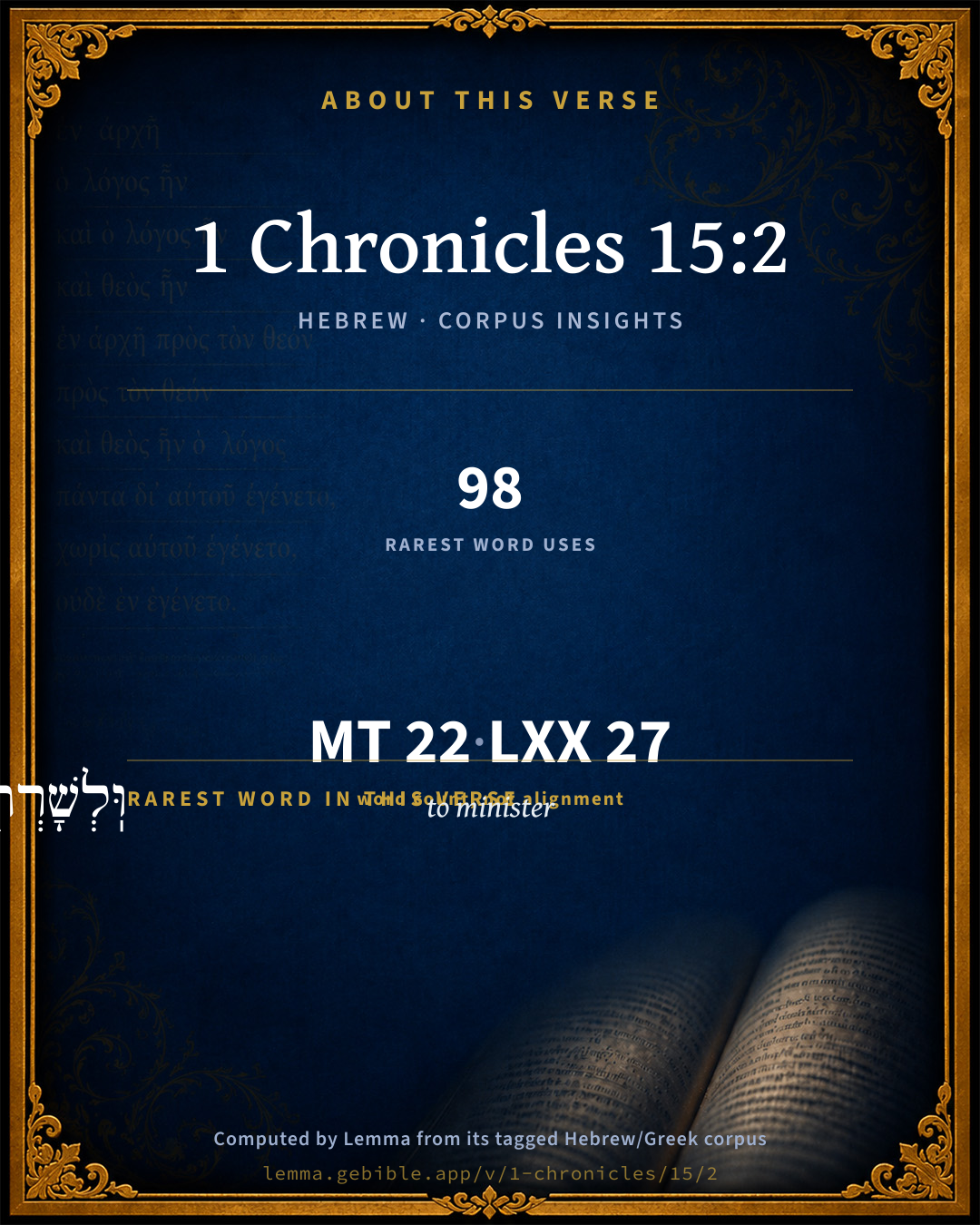
וּֽלְשָׁרְת֖וֹ
shârath
H8334
“and · to minister · him”
Conjunction + Preposition + Verb, Piel, Infinitive Construct + Suffix, Personal, 3rd Person, Masculine, Singular
Part of Speech
Conjunction + Preposition + Verb
Stem
Piel
Form
Infinitive Construct
Full BDB Definition

Origin: a primitive root

TWOT: 2472

(Piel) to minister, serve, minister to
  1. אָ֚ז ʼâz H227 “then” Adverb
  2. אָמַ֣ר ʼâmar H559 “to say” Verb, Qal, Perfect, 3rd Person, Masculine, Singular
  3. דָּוִ֔יד Dâvid H1732 “David” Noun, Proper
  4. לֹ֤א lôʼ H3808 “not” Particle, Negative
  5. לָשֵׂאת֙ nâsâʼ H5375 “to lift” Preposition + Verb, Qal, Infinitive Construct
  6. אֶת ʼêth H853 “-” Particle, Direct Object
  7. אֲר֣וֹן ʼârôwn H727 “ark of” Noun, Common, Both, Singular, Construct
  8. הָֽאֱלֹהִ֔ים ʼĕlôhîym H430 “the · God(s)” Particle, Definite Article + Noun, Common, Masculine, Plural, Absolute
  9. כִּ֖י kîy H3588 “that” Conjunction
  10. אִם ʼim H518 “if” Conjunction
  11. הַלְוִיִּ֑ם Lêvîyîy H3881 “the · Levites” Particle, Definite Article + Noun, Gentilic, Masculine, Plural, Absolute
  12. כִּי kîy H3588 “that” Conjunction
  13. בָּחַ֣ר bâchar H977 “to choose” Verb, Qal, Perfect, 3rd Person, Masculine, Singular
  14. יְהוָ֗ה Yᵉhôvâh H3068 “LORD” Noun, Proper
  15. לָשֵׂ֞את nâsâʼ H5375 “to lift” Preposition + Verb, Qal, Infinitive Construct
  16. אֶת ʼêth H853 “-” Particle, Direct Object
  17. אֲר֧וֹן ʼârôwn H727 “ark of” Noun, Common, Both, Singular, Construct
  18. יְהוָ֛ה Yᵉhôvâh H3068 “LORD” Noun, Proper
  19. עַד ʻad H5704 “until” Preposition
  20. עוֹלָֽם ʻôwlâm H5769 “forever” Noun, Common, Masculine, Singular, Absolute

About this verse

These counts appear in no published source. They are computed here, from the morphology-tagged text and Lemma’s own curated glosses. What Lemma adds →

22
words
16
distinct lemmas
Historical
section

Grammatical profile

  • 5 verbs
  • 8 nouns
  • 2 prepositions
  • 3 conjunctions
  • 1 adverb
  • 3 particles

Verb forms

  • אָמַ֣ר Qal · Perfect
  • לָשֵׂאת֙ Qal · Infinitive Construct
  • בָּחַ֣ר Qal · Perfect
  • לָשֵׂ֞את Qal · Infinitive Construct
  • וּֽלְשָׁרְת֖וֹ Piel · Infinitive Construct

Repetition

Words recur within this verse — often emphatic in Hebrew:

  • לָשֵׂאת֙ to lift H5375 ×2
  • אֲר֣וֹן ark H727 ×2
  • יְהוָ֗ה LORD H3068 ×2
  • כִּ֖י that H3588 ×2

Hebrew & Septuagint length

In English translation the verse runs 31 words from the Hebrew and 38 from the Septuagint (LXX English) — closely comparable.

A rough comparison of the two English renderings, which tokenize alike — not a word-level alignment.

Word counts can differ between the Hebrew and the Greek without any difference in meaning — e.g. the Hebrew direct-object marker אֵת has no separate Greek word, and Greek often adds the article ὁ.

In the original languages it is 22 Hebrew tokens and 27 Greek tokens — but the two are counted differently (Hebrew bundles its prefixes and suffixes into one token; the Greek is in lemma form), so that isn’t a like-for-like length.

Cross-references

13

Topical passages linked to 1 Chronicles 15:2 in the Treasury of Scripture Knowledge — connected by theme and wording, ordered by reader-vote popularity; previews shown in the World English Bible.

  • Deuteronomy 10:8 At that time Yahweh set apart the tribe of Levi, to bear the ark of the covenant of Yahweh, to stand before Yahweh to minister to him, and to bless in his name, to this day.
  • Numbers 18:1–8 Yahweh said to Aaron, You and your sons and your fathers' house with you shall bear the iniquity of the sanctuary; and you and your sons with you shall bear the iniquity of your priesthood.
  • Deuteronomy 31:9 Moses wrote this law, and delivered it to the priests the sons of Levi, who bore the ark of the covenant of Yahweh, and to all the elders of Israel.
  • Numbers 4:2–15 "Take a census of the sons of Kohath from among the sons of Levi, by their families, by their fathers' houses,
  • Numbers 4:19–20 but thus do to them, that they may live, and not die, when they approach to the most holy things: Aaron and his sons shall go in, and appoint them everyone to his service and to his burden;
  • Numbers 8:13–14 You shall set the Levites before Aaron, and before his sons, and offer them as a wave offering to Yahweh.
  • Numbers 8:24–26 "This is that which belongs to the Levites: from twenty-five years old and upward they shall go in to wait on the service in the work of the Tent of Meeting;
  • Joshua 3:3 and they commanded the people, saying, When you see the ark of the covenant of Yahweh your God, and the priests the Levites bearing it, then you shall remove from your place, and go after it.
  • Jeremiah 33:17–22 For thus says Yahweh: David shall never want a man to sit on the throne of the house of Israel;
  • Joshua 6:6 Joshua the son of Nun called the priests, and said to them, Take up the ark of the covenant, and let seven priests bear seven trumpets of rams' horns before the ark of Yahweh.
  • Numbers 7:9 But to the sons of Kohath he gave none, because the service of the sanctuary belonged to them; they carried it on their shoulders.
  • 2 Chronicles 35:3 He said to the Levites who taught all Israel, who were holy to Yahweh, Put the holy ark in the house which Solomon the son of David king of Israel did build; there shall no more be a burden on your shoulders: now serve Yahweh your God, and his people Israel.
  • Isaiah 66:21 Of them also will I take for priests [and] for Levites, says Yahweh.

Cross-references courtesy of OpenBible.info (CC BY 4.0).

Hebrew and Greek witnesses Masoretic Hebrew ↔ Greek Septuagint

The same verse in the two great witnesses to the Old Testament, shown verse-for-verse.

These are two independent witnesses, not word-aligned to each other, and the Septuagint is shown in lemma (dictionary) form.

Hebrew 1 Chronicles 15:2 Masoretic · Westminster Leningrad Codex

אָ֚ז אָמַ֣ר דָּוִ֔יד לֹ֤א לָשֵׂאת֙ אֶת אֲר֣וֹן הָֽאֱלֹהִ֔ים כִּ֖י אִם הַלְוִיִּ֑ם כִּי בָ֣ם בָּחַ֣ר יְהוָ֗ה לָשֵׂ֞את אֶת אֲר֧וֹן יְהוָ֛ה וּֽלְשָׁרְת֖וֹ עַד עוֹלָֽם

Then David said, None ought to carry the ark of God but the Levites: for them has Yahweh chosen to carry the ark of God, and to minister to him forever.

World English Bible · Public Domain

Greek LXX 1 Chronicles 15:2 Septuagint · lemma form

τότε εἶπον δαυίδ οὐ εἰμί αἴρω ὁ κιβωτός ὁ θεός ἀλλά ἤ ὁ λευίτης ὅτι αὐτός ἐκλέγω κύριος αἴρω ὁ κιβωτός κύριος καί λειτουργέω αὐτός ἕως αἰών

Then said David, It is not lawful for any to bear the ark of God, but the Levites; for the Lord has chosen them to bear the ark of the Lord, and to minister to him for ever.

LXX2012 (modern English Septuagint) · Public Domain

Hebrew: Westminster Leningrad Codex (CC BY 4.0). Greek: Septuagint (public domain); English from LXX2012 (modern English Septuagint) (Public Domain). How the Septuagint differs from the Hebrew →

Commentary

Notes on 1 Chronicles 15:2 from classic Christian and Jewish commentators (each source and its license shown beneath its notes). The classic Christian expositions comment on the surrounding passage and are grouped to its opening verse, so a note may address several verses; the Jewish commentaries on the Tanakh (Rashi and others) are per-verse, so they appear only where the commentator wrote on this verse.

Lemma curates 59 commentaries, every one of them public domain or Creative Commons licensed, each selected and text-cleaned for this edition rather than reprinted as found. About our sources →

Trapp's Complete Commentary

John Trapp

1Ch 15:2 Then David said, None ought to carry the ark of God but the Levites: for them hath the LORD chosen to carry the ark of God, and to minister unto him for ever.

Ver. 2. None ought to carry the ark of God but the Levites.] This should have been better considered before. The law was clear. {Num 4:5-15} Wit is best, they say, when bought.

For ever.] Let our lay preachers look to it. Ill accidents attend them, as did Uzzah and Uzziah.

John Trapp, A Commentary or Exposition upon All the Books of the Old and New Testament (1647–1656) — public domain. Text from a community e-Sword module.

Joseph Benson's Commentary

1Ch 15:2. David said, None ought to carry the ark of God but the Levites — The former miscarriage, when they brought up the ark from Kirjath- jearim, had taught him to treat it with greater reverence, according to the prescription of the law, which ordered the Levites to carry it on their shoulders, Num 4:15.

Joseph Benson's Commentary on the Old and New Testaments (1811–1818) — public domain. Text from a community e-Sword module.

Jamieson, Fausset & Brown

Robert Jamieson, A. R. Fausset & David Brown

Then David said, None ought to carry the ark of God but the Levites--After the lapse of three months (Ch1 13:14) the purpose of transporting the ark to Jerusalem was resumed. Time and reflection had led to a discovery of the cause of the painful catastrophe that marred the first attempt. In preparing for the solemn procession that was now to usher the sacred symbol into its resting-place, David took special care that the carriage should be regulated in strict conformity to the law (Num 4:5, Num 4:15; Num 7:9; Num 10:17).

Jamieson, Fausset & Brown — Commentary Critical and Explanatory on the Whole Bible (1871) — public domain (CC PDM 1.0). Text via the HelloAO Bible API.

Adam Clarke's Commentary

Verse 2. None ought to carry the ark - but the Levites] It was their business; and he should have thought of this sooner, and then the unfortunate breach on Uzza would have been prevented; see 1Ch 15:13.

Adam Clarke's Commentary on the Bible (1810–1826) — public domain. Text from a community e-Sword/MySword module.

Ellicott's Commentary for English Readers

(2) Then.—This word is here a real note of time. It seems to denote the end of the three months’ interval mentioned in 1Ch_13:14.

None ought to carry the ark of God but the Levites.—See Num_4:5-15, where the Kohathite Levites are appointed to carry the Ark and other sacred objects; and the more definite Deu_10:8 : “At that time the Lord separated the tribe of Levi, to bear the ark of the covenant of the Lord, to stand before the Lord to minister unto him, and to bless in his name, unto this day.” David’s enunciation of the law is a tacit acknowledgment that on the former occasion (1Ch_13:7-10) it had not been observed. That the Ark was now duly carried by bearers is expressly stated in the older account (2Sa_6:13), though their being Levites is not noticed.

A Bible Commentary for English Readers, edited by Charles John Ellicott (1878–1897) — public domain. Text from a community e-Sword module.

The Cambridge Bible for Schools and Colleges

gen. ed. J. J. S. Perowne

2. None … but the Levites] Num_1:50; Num_7:9. Nothing is said in the parallel place (2Sa_6:13) of the Levites, but bearers (and not a cart) are spoken of with regard to this second attempt. Cp. 2Ch_5:4, note.

The Cambridge Bible for Schools and Colleges (gen. ed. J. J. S. Perowne; Cambridge University Press, 1878–1918) — public domain. Text from a community e-Sword module.

John Gill's Exposition

Then David said,.... Either within himself, or to his ministers and courtiers about him:

none ought to carry the ark of God but the Levites; he saw his former mistake in employing those that were not Levites in bringing up the ark from Kirjathjearim, and bringing it in a cart, and not on the shoulders of the Levites, and so miscarried in his attempt, Sa2 6:1 and, perhaps, had since more diligently consulted the law of God about this matter:

for them hath the Lord chosen to carry the ark of God, and to minister unto him for ever; as long as the Levitical dispensation lasted, as appears from Num 1:50.

John Gill's Exposition of the Whole Bible (1746–1763) — public domain (CC PDM 1.0). Text via the HelloAO Bible API.

Albert Barnes' Notes on the Bible

None ought to carry the ark of God but the Levites - Compare marginal references. We can easily understand that David, after the “breach upon Uzza” 1Ch 13:11, had carefully considered all the legal requirements with respect to moving the ark, and was anxious that they should be strictly observed (compare 1Ch 15:13).

Albert Barnes' Notes on the Bible (1834–1885) — public domain. Text from a community e-Sword/MySword module.

Haydock's Catholic Bible Commentary

Levites, of the family of Caath, ver. 13., and Numbers iv. 5. He was rendered more cautious by the death of Oza. (Calmet) --- For ever, as long as this law subsists. (Haydock)

George Leo Haydock (1774–1849), Haydock's Catholic Family Bible and Commentary, 1859 edition — public domain. Excludes Psalms (Douay-Rheims chapter numbering differs from Protestant) and Deuterocanonical books (Catholic canon only).

Matthew Poole's English Annotations

But the Levites, and that upon their shoulders; of which see Num 4:15; 7:9; and not in a cart, as it was before, to our great grief and loss.

For ever, i.e. so long as the ark is to be removed, and as that worship continues.

Matthew Poole's English Annotations on the Holy Bible (1683–1685) — public domain. Text from a community e-Sword/MySword module.

Whedon's Commentary on the Bible

Daniel D. Whedon

2. None ought to carry the ark of God but the Levites — See Num_1:50. The neglect or forgetfulness of this fact was the cause of the misfortune attending the previous attempt to bring the ark to Jerusalem, and severely had God punished the error. Compare 1Ch_15:13 and chapter 13.

Daniel D. Whedon (gen. ed.), Commentary on the Old and New Testaments (1874–1909) — public domain. Text from a community e-Sword module.

The Pulpit Commentary

This verse together with vers. 12-15 show that the severe lesson of the destruction of Uzzah had been laid to heart, and had made David supremely anxious to take better counsel of the Law. Uzzah, though possibly the son of a Levite, more probably of a Hivite, (Jos_9:7, Jos_9:17) was not a priest, nor is there any sufficient evidence that he was a Levite; and most distinct was the order of the Law, (Num_1:51-53 Num_3:29-32 Num_4:15 Num_4:20) that "when the tabernacle setteth forward, the Levites shall take it down; and when the tabernacle is to be pitched, the Levites shall set it up; and the stranger that cometh nigh shall be put to death." So the sons of Kohath are to come to bear the sanctuary with all its sacred vessels, "but they shall not touch any holy thing, lest they die." Many things were allowed to be carried on waggons under the charge of the Gershonites and Merarites, but the strict contents of the sanctuary were to be borne in a specified manner by the Kohathites.

Vers. 2-15.

Three valuable virtues: rectification, admonition, obedience.

We have

I A ROYAL RECTIFICATION. We have the useful fiction in England that "the king can do no wrong." It has been too often assumed by the potentates of the earth that they could not be mistaken, and need not return on their way. David was not so foolish and so faulty. He had the sense to see that he had erred in the way in which he had carried out a good desire, and he was prepared openly and honourably to retrace his steps. So he said to his courtiers, "No one ought to carry the ark of God," etc. (ver. 2), with obvious reference to the transaction recorded in ch. 13. And he "gathered all Israel together to Jerusalem," and "assembling the children of Aaron and the Levites" (ver. 4), he spoke plainly of the departure from the Law of which he and others had been guilty (vers. 12, 13). We certainly need not be ashamed "to come after the king "in the way of retractation. Where a monarch leads the way we may be content to follow. There is no more certain indication of foolish and fatal obstinacy than the refusal to admit an error. They who cling to their own mistakes and pertinaciously justify them are sure to come to some great grief in time. But they who have the humility and penetration to see that they are wrong, and also the courage to avow and correct it, are sure to find themselves on the upward road. They may take a wrong turn or two, but they move in the right direction, and, like David and the ark, will reach Jerusalem in time.

II A GRACIOUS ADMONITION. (Vers. 11-13.) There may have been some doubt as to where the blame really lay, whether on the king or on the priests, or (as was probable enough) on both. David, while he did not exonerate himself, evidently felt that the priests and Levites were included in the condemnation: indeed, he addresses them and admonishes them as delinquents: "Because ye did it not at the first," etc. (ver. 13). His words and their attitude together may suggest to us that admonition should be graciously given and as graciously received. We should, on such occasions as this, speak as those

(1) who convey their message with reluctance and only on constraint;

(2) who desire to spare feeling as much as faithfulness will allow;

(3) who know that they have themselves reason to desire all possible elemency to be shown;

(4) who must not shun to declare the whole counsel of God.

And on such occasions we should, when ourselves admonished, receive the admonition as those

(1) who are likely enough to have erred;

(2) who are prepared to be reproved by those who are in any position of authority;

(3) who are ready to correct our mistake at the earliest opportunity.

III A PROMPT OBEDIENCE. (Vers. 14, 15.) There seems to have been no hesitancy. on the part of the priests and Levites; they appear to have applied themselves at once, with due zest, to the work which they had neglected before. They sanctified themselves for it (ver. 14), and then they executed it (ver. 15), doing all things "as Moses commanded, according to the word of the Lord." Like them, and like the prodigal of the parable, (Lu 15) who said, "I will arise," and he arose, we should feel and do, conclude and act, with no interval between of which the enemy can make use. When we have taken due time for understanding, and have seen the way we should take, then we should, like the men of whom we read here,

(1) at once make needful preparations for action, and,

(2) these made, carry our conclusions into effect. It is an evil spirit of uncertainty and delay which often makes penitence to be unavailing; it is prompt, unhesitating obedience to the Word of the Lord which takes us to the post of duty and then to the seat of honour and of joy. C.

HOMILIES BY R. TUCK Vers. 2, 12, 13.

Learning the lessons of God"s judgments.

We are not left in any doubt as to the national lesson intended to be taught by the Divine judgement on Uzza. David came to see that "none ought to carry the ark of God but the Levites". (comp Num_1:50 Num_4:15 Num_7:9 Num_10:17) The judgment showed that God had not been "sought after the due order;" and of this error and neglect there is now the honest confession, with due care in the new effort, to meet fully the Divine conditions and requirements. "The "due order" was that the ark should be borne on the shoulders of the Kohathite Levites not that it should be placed upon a cart, drawn by oxen, and rudely shaken." Out of his first mistaken attempt David learned the valuable, practical lesson that

Evil is wrought for want of thought, As well as for want of heart.

The incident suggests a general treatment of the teachings of God"s judgments. Isaiah expresses the attitude, of which David here gives us the example, when he says, (Isa 26) "In the way of thy judgments, O Lord, have we waited for thee.

I JUDGMENT TAUGHT DAVID RESPECT FOR GOD"S LAW AND ORDER. It does not appear that the full ceremonial of Mosaism had been preserved during Saul"s reign, and certainly there had been some neglect of the Scriptures; but it is especially to be observed that, in making a new tabernacle on Mount Zion, and fitting it up according to his own ideas, David was in great peril of wilfulness, and of neglecting to consult and to follow the Divine regulations. Such a judgment as that on Uzza was needed to thoroughly arouse him to the importance of a precise and minute obedience. So we too often say, "What does it matter, if the thing is done?" And we have, often bitterly, to learn that God cares for the doing, and wants even the right things done in the right way. Obedience in the very forms and order of Divine service tests the deep feeling of God"s worshippers. Apostles recognized the importance even of forms when they enjoined, "Let all things be done decently and in order.

II JUDGMENT TAUGHT THE NEED FOR THOUGHTFULNESS AND CARE. Haste is as unfitting as self-will in matters of God"s worship. Consideration; due attention to precedents; personal preparation of spirit; serious demeanour; all properly attend on Divine service. God wants the signs and indications of real heart-feeling and deep sincerity.

III JUDGMENT TAUGHT THE DUTY OF FINDING FIT INSTRUMENTS FOR GOD"S WORK. Holy duties should not be done by unsuitable hands. No common persons might touch the sacred ark. The proper persons were the Levites, and a particular family of them. Illustrate the need for a wiser selection of instruments in connection with the work of the modern Church. Compare the apostolic injunctions, "Lay hands suddenly on no man;" "Let such first be proved.

IV JUDGMENT TAUGHT THE REVERENT TREATMENT OF THE SYMBOLS OF DIVINE PRESENCE. Without adopting strained ideas of sacramental virtue, we too may learn this lesson. Sanctuaries, sacraments, Bibles, etc., because of their sacred associations and suggestions, properly demand reverent treatment. Only shallow and self-satisfied natures tail in reverence. A worthy sense of the infinite glory of the Unseen, Eternal, and Divine, gains fitting expression in the reverent touch of all earth-symbols that bring the Eternal near. There may be danger of stopping with the symbol, even as heathen stopped with the idol; but the fact that danger lies in excess does not relieve us from the claims of the symbolic, as set within wise limitations. There is danger of overdoing forms. But there is also danger of an undue indifference to forms; and this kind of danger is seriously imperilling to some important features of the religious life. This may be practically illustrated in relation to long-received forms of doctrine, and long-hallowed rites and symbols. They who would sincerely honour God must not be unmindful of the reverence that is due to his ark. R.T.

The Pulpit Commentary (1880–1919), ed. H.D.M. Spence-Jones & Joseph S. Exell — public domain. Text from a community e-Sword module.

Keil & Delitzsch

C. F. Keil & F. Delitzsch

Then David said,.... Either within himself, or to his ministers and courtiers about him:

none ought to carry the ark of God but the Levites; he saw his former mistake in employing those that were not Levites in bringing up the ark from Kirjathjearim, and bringing it in a cart, and not on the shoulders of the Levites, and so miscarried in his attempt, Sa2 6:1 and, perhaps, had since more diligently consulted the law of God about this matter:

for them hath the Lord chosen to carry the ark of God, and to minister unto him for ever; as long as the Levitical dispensation lasted, as appears from Num 1:50.

Keil & Delitzsch — Biblical Commentary on the Old Testament (1861–1891) — public domain (CC PDM 1.0). Text via the HelloAO Bible API. (Old Testament only.)

Rashi

Rabbi Shlomo Yitzchaki (Rashi)

except the Levites, for the Lord chose them i.e., God chose the Levites [to carry the Ark], and not a cart, for because we placed it in a cart, Uzza was punished, and that is what is stated further: “For from the beginning, [when] you were not [the bearers], the Lord our God made a breach in us, for we had not sought Him properly,” for we placed it in a cart.

Rashi on the Tanakh — English translations: “The Judaica Press complete Tanach with Rashi, translated by A. J. Rosenberg” (CC BY 4.0); “Pentateuch with Rashi's commentary by M. Rosenbaum and A.M. Silbermann, 1929-1934” (public domain); “The Metsudah Tanach series, Lakewood, N.J” (CC BY 4.0); and “The Book of Joshua, Metsudah Publications, 1997” (CC BY 4.0). Text via Sefaria.

Lesson kit

Teaching starters — assembled from the data on this page, not authored interpretation. Every prompt links to the verse data it draws on. Edit before teaching.

1 Chronicles, in the Historical, opens this verse with 22 words (16 distinct Hebrew lemmas). Its most distinctive word is shârath (“to minister”). A historical commentator’s framing appears above. Read the whole chapter for the surrounding context.

Discussion questions

  1. The word shârath carries the sense “to minister.” How does it shape the verse?
  2. How does Deuteronomy 10:8, which shares this passage’s theme, read alongside this verse?
  3. What does the repetition of “to lift” (2× in this one verse) do in this verse?
  4. The translations on this page render this verse differently — a whole-verse word diff, not a word-by-word alignment. What might account for the different wordings?
  5. «אָמַ֣ר» is a Qal Perfect verb. How does that grammatical form shape the action described?
  6. Compare how Trapp's Complete Commentary and Joseph Benson's Commentary read this verse. Where do they agree or differ?

Things to notice

Reading settings

Reading text

Shown beneath each verse's original-language words.

Old Testament
Old Testament edition

Read the OT as the Masoretic Hebrew (MT) or the Greek Septuagint (LXX).

English shown for the Greek Septuagint (in the Hebrew ↔ Greek comparison).

Comparing translations? Open the Compare panel on any verse page to stack up to four side by side.